

Revelation 3
14“To the angel of the church in Laodicea write:
The Amen, the faithful and true Witness, the Beginning of the creation of God, says this:
(Revelation 3:14, NASB)
The Daily DAVEotional
I’ve written a number of blog posts on Revelation 3:14-22, including this post on why Jesus would rebuke the “lukewarm” Christian but not the “cold” Christian, and this post, which explains why it’s legitimate to use Revelation 3:20 in gospel conversations with non-believers.
So why yet ANOTHER post on this passage, and why highlight only one verse?
Some background
Last week, I happened to post on X a tweet referencing my blog post from Proverbs 8 where I explain that Proverbs 8 is NOT a passage that demonstrates that Jesus is a created being, as Jehovah’s Witnesses will claim. In fact, Proverbs 8 is not about Jesus at all.
Jehovah’s Witnesses point to Proverbs 8 to say Jesus was created.
But the chapter personifies Wisdom as a woman calling out.
It’s not about Jesus.https://t.co/0bCsX1Lag5#BibleStudy #Devotional
— Dave Lowe (@DaveLowedown) July 31, 2026
My tweet got some replies, including a Jehovah’s Witness from Nigeria who decided to take the opportunity to set me straight on my theology.
We had quite the online back and forth exchange, with many verses being offered up as evidence for our respective views.
If you weren’t aware, Jehovah’s Witnesses do not believe that Jesus is God. They teach that he is the first created being of Jehovah and as such, he is not to be worshipped.
They are the modern day torch-bearers of the ancient heretical doctrine known as Arianism. I first wrote about the Jehovah’s Witnesses and their views on Jesus in my post “A Modern Day Version of an Ancient Heresy.”
In my online exchange with this Nigerian Jehovah’s Witness, he presented to me all the usual verses in an attempt to demonstrate that Jesus is not God, including Colossians 1:15, which I addressed in my blog post, “What Does it Mean that Jesus is the Firstborn”, and John 10:30, which I addressed in my blog post “Evidence that Jesus is God” .
One verse that this online JW evangelist offered as evidence that Jesus is not God but is a created being, was Revelation 3:14, the verse that is highlighted in this devotional.
Jehovah’s Witnesses routinely cite Revelation 3:14 as conclusive proof that Jesus is created. After all, the verse literally says that Jesus is the BEGINNING of creation.
What this means, according to the Jehovah’s Witness, is that Jesus is the first created thing of Jehovah’s creation. He is the “beginning” of creation.
However, as is often the case when dialoguing with Jehovah’s Witnesses, the verse does not mean what they THINK it means.
How can that be?
Well, the Greek word in Revelation 3:14 that is translated as “beginning” is the Greek word “arche” (pronounced by sounding out the letters “R” and “K”). It is where we get our English word “architect.”
This word has a number of possible meanings, one of which is “beginning”.
If you look up this word in a Greek lexicon, it says that the word means origin, source, beginning. It also can mean rule.
Biblical translators are in agreement that the meaning of this word is not that Jesus is the first to be created but that Jesus is the source of creation, the author of creation, the BEGINNER of creation or the ORIGIN of creation. Because Jesus is the author of creation, he is the RULER of creation.
Click here to see a A Comprehensive List of Blog Posts Based on Bible Passage Reference
So why does it say that Jesus is the BEGINNING of creation? Why not use one of these other words?
Actually, the NASB, which uses the word “BEGINNING” has a footnote provided by the translators in which they offer up the words “source” and “origin” as alternatives. In other words, the footnote demonstrates that the authors understood that the word “beginning” was meant to be understood in the sense that Jesus is the origin or source of creation.
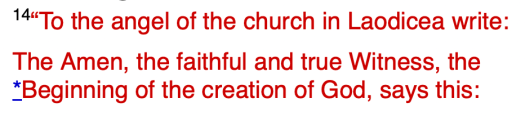
When you click on the “asterisk”, the note is revealed:
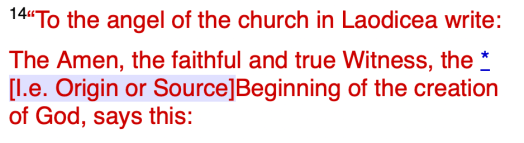
Additionally, most translations do NOT use the word “beginning” in their translation.
The NLT translates Revelation 3:14 as:
“Write this letter to the angel of the church in Laodicea. This is the message from the one who is the Amen—the faithful and true witness, the ruler* [Or the source.] of God’s creation:
Note the translator’s “asterisk” that indicates that the word could mean “ruler” or “source”.
The NIV translates it this way:
14“To the angel of the church in Laodicea write:
These are the words of the Amen, the faithful and true witness, the ruler of God’s creation.
The Holman Christian Standard Bible translates it as:
14“Write to the angel of the church in Laodicea:
“The Amen, the faithful and true Witness, the Originator [Or Ruler, or Source, or Beginning] of God’s creation says:
The brackets are inserted by the translators to indicate different words that would be equally acceptable as translations of the Greek word “arche”.
The NET Bible offers this translation:
“To the angel of the church in Laodicea write the following:
“This is the solemn pronouncement of the Amen, the faithful and true witness, the originator54 of God’s creation:
Notice the number “54” just after the word “originator.” The NET Bible has extensive translation notes, which explain the decision process the translators used to arrive at their translation choices.
The summary of this note number 54 is that “beginning”, “ruler” or “originator” are all three linguistically possible. The editors explain that this term (Greek = arche) is well established in both the Septuagint (LXX) and intertestamental Jewish literature as meaning “ruler, authority.”
The truth is that most translations do not use the word “beginning” for this verse and the translations that do use the word don’t use it to convey the meaning Jehovah’s Witnesses attribute to the verse.
In actuality, the word beginning is a fine word to use if you understand that Jesus literally is the first cause of creation. It is in that sense that he is the beginning. He is the source, the originator, the architect of creation. As such, he is ruler over creation.
One should also keep in mind that the author of Revelation is the apostle John, the same John who wrote the gospel of John and three shorter epistles near the end of the New Testament.
This same John identified Jesus as God in the opening verses of his gospel account, saying:
In the beginning was the Word, and the Word was with God, and the Word was God. 2He was in the beginning with God. (John 1:1, NASB)
To be fair, Jehovah’s Witnesses dispute the traditional Christian teaching of this verse, but I explain why their view is incorrect in my post “A Modern Day Version of an Ancient Heresy”.
This same John also wrote in his first epistle that
This is the message we have heard from Him and announce to you, that God is Light, and in Him there is no darkness at all. (1 John 1:5, NASB)
But in John 1, the author says this about Jesus:
In Him was life, and the life was the Light of men. 5The Light shines in the darkness, and the darkness did not comprehend it. (John 1:4-5)
John also said of Jesus that
All things came into being through Him, and apart from Him nothing came into being that has come into being. (John 1:3, NASB)
This does not sound like John believed that Jesus was created. Instead, John taught that Jesus created ALL things. If Jesus was the first created thing of Jehovah then John 1:3 would be a false statement as Jesus would be “something” that came into being.
A primary rule of Bible study is that Scripture interprets Scripture. In other words, if there is a verse that is confusing, we interpret it in light of other passages that are clear.
In Revelation 3:14, how are we to understand the word “beginning”? That is the debate between Jehovah’s Witnesses and traditional Christianity.
It’s clear that the translators all understood the word “beginning” in the sense that Jesus is the “beginner” or “first cause” of creation. This understanding is supported by all of the other words that could be used as a translation for the Greek word “arche”, including source, origin and ruler.
The Jehovah’s Witnesses explanation for the word “beginner” violates all of the other possible meanings while the traditional Christian understanding of the word “beginning” is in alignment with the other possible word choices.
In addition, the Jehovah’s Witness explanation of this verse contradicts other passages that clearly promote the same traditional Christian view.
In the final analysis, Revelation 3:14 doesn’t teach that Jesus is the first created being of Jehovah. On the contrary, it provides yet another substantial proof that Jesus is divine!
Did you enjoy this post? I’d love to hear your thoughts! Feel free to like, leave a comment below, and share it with your friends or on social media if you found it helpful or interesting. Your support keeps the conversation going!
Reflection
Given the fact that arche can mean “source”, “ruler” and “origin”, what logical explanation could explain how “beginning” means anything other than “first cause”? In other words, how do you explain the fact that the Jehovah’s Witness explanation of the Greek word “arche” does not match any of the other accepted definitions for the word?
Do you find the argument posed in this post against the Jehovah’s Witness’ interpretation of Revelation 3:14 convincing? Why or why not?
Some people argue that debating the nature of Jesus is fruitless and unnecessary. The argument is that as long as we believe that Jesus saves us, that’s all that matters. Everything else is just theological nit-picking. Do you agree with this sentiment? Why do you think it’s important to have a firm understanding of the nature of Jesus?
What has been your experience with Jehovah’s Witnesses? What verses or arguments have they made that you were not able to adequately respond to or refute?
Photo by Greg Rakozy on Unsplash


3 Replies to “Does Revelation 3:14 Prove Jesus is a Created Being?”