Bible References to the Term “Firstborn”


This is a complete list of all Bible verses that contain the word “firstborn”. This list is provided for convenience to those who want to do a word study to determine the meaning and the usage of the word “firstborn”, particularly so you can accurately interpret the meaning of “firstborn” as it relates to Jesus in Colossians 1:15 and Colossians 1:18.

The Jehovah’s Witnesses insist that the meaning of the word “firstborn” in those verses is the normal standard meaning of one born first. Or to put it another way, they claim the word means something like “first in line” or “first in chronology.”

To determine whether their interpretation is correct or even a valid option, it is helpful to see how the word is used throughout Scripture. Specifically, we want to see if the word is ever used with the meaning they attribute in Colossians. If the word is used in other parts of Scripture in the way they define it in Colossians then it lends more credibility to their interpretation.


All references are in the New American Standard Bible, unless otherwise noted

Old Testament

Genesis

  1. Genesis 10:15 – Canaan became the father of Sidon, his firstborn

  2. Genesis 19:31 – Then the firstborn said to the younger, “Our father is old, and there is not a man on earth to come in to us after the manner of the earth.

Lot’s daughter, the firstborn, hatched a plan with her younger sister to get their father to impregnate them in order to ensure that they would have offspring


  1. Genesis 19:33 – So they made their father drink wine that night, and the firstborn went in and lay with her father;

  2. Genesis 19:34 – On the following day, the firstborn said to the younger, “Behold, I lay last night with my father;

  3. Genesis 19:37 – The firstborn bore a son, and called his name Moab

Lot’s oldest bore a son who became the father of the Moabites. The younger daughter bore a son who became the father of the Ammonites.


  1. Genesis 22:20-21 – “Behold, Milcah also has borne children to your brother Nahor: 21Uz his firstborn and Buz his brother

Uz was Abraham’s nephew, the firstborn of Abraham’s brother Nahor


  1. Genesis 25:13 – and these are the names of the sons of Ishmael, by their names, in the order of their birth: Nebaioth, the firstborn of Ishmael, and Kedar and Adbeel and Mibsam

  2. Genesis 27:19 – Jacob said to his father, “I am Esau your firstborn; I have done as you told me. Get up, please, sit and eat of my game, that you may bless me.”

Jacob was deceiving Isaac, pretending to be Esau, the firstborn son


  1. Genesis 27:32 – Isaac his father said to him, “Who are you?” And he said, “I am your son, your firstborn, Esau.”

  2. Genesis 29:26 – But Laban said, “It is not the practice in our place to marry off the younger before the firstborn.

Leah was the firstborn. She was older than Rachel so the custom was that she should be married off first


  1. Genesis 35:23 – the sons of Leah: Reuben, Jacob’s firstborn, then Simeon and Levi and Judah and Issachar and Zebulun;

  2. Genesis 36:15 – The sons of Eliphaz, the firstborn of Esau, are chief Teman, chief Omar, chief Zepho, chief Kenaz

  3. Genesis 38:6 – Now Judah took a wife for Er his firstborn, and her name was Tamar.

  4. Genesis 38:7 – But Er, Judah’s firstborn, was evil in the sight of the LORD, so the LORD took his life.

  5. Genesis 41:51 – Joseph named the firstborn Manasseh,

  6. Genesis 43:33 – Now they were seated before him, the firstborn according to his birthright and the youngest according to his youth, and the men looked at one another in astonishment.

Joseph had seated his brothers according to their birth order. Joseph’s brothers were amazed, as they still were unaware that it was Joseph


  1. Genesis 46:8 – Now these are the names of the sons of Israel, Jacob and his sons, who went to Egypt: Reuben, Jacob’s firstborn.

  2. Genesis 48:14 – But Israel stretched out his right hand and laid it on the head of Ephraim, who was the younger, and his left hand on Manasseh’s head, crossing his hands, although Manasseh was the firstborn.

Jacob intentionally gave Ephraim the blessing of the firstborn even though he was NOT the firstborn


  1. Genesis 48:18 – Joseph said to his father, “Not so, my father, for this one is the firstborn. Place your right hand on his head.”

Joseph tried to correct his father to give the favored blessing to Manasseh, who held that status as the firstborn. In the next verse, Genesis 48:19, Jacob tells Joseph that he realizes Manasseh is the firstborn, yet he knows what he’s doing, so Ephraim received the blessing of the firstborn.


  1. Genesis 49:3-4 – “Reuben, you are my firstborn; My might and the beginning of my strength, Preeminent in dignity and preeminent in power. 4“Uncontrolled as water, you shall not have preeminence, Because you went up to your father’s bed; Then you defiled it —he went up to my couch.

A critical passage in which the definition of “firstborn” is provided by Jacob as he tells Reuben that even though he’s the firstborn, he would not experience the preeminence that is due the firstborn


Exodus

  1. Exodus 4:22 – “Then you shall say to Pharaoh, ‘Thus says the LORD, “Israel is My son, My firstborn. 23“So I said to you, ‘Let My son go that he may serve Me’; but you have refused to let him go. Behold, I will kill your son, your firstborn.”’”

A critical passage in which the term “firstborn” appears twice. The first time, it refers to the nation of Israel. Obviously, the meaning of this first occurrence is NOT that Israel was born first, for Israel was not born in the same sense that people are. They were chosen. It must be stated that Israel was NOT created first. They were NOT the first nation to appear. They were “firstborn” in the sense that they were “preeminent” – they had a special status and unique favor by God as the nation through which God’s blessings would extend to the world.

NOTE that the second occurrence of “firstborn” in this verse is the typical usage – it refers to the literal firstborn son of Pharaoh.


  1. Exodus 4:23 – “So I said to you, ‘Let My son go that he may serve Me’; but you have refused to let him go. Behold, I will kill your son, your firstborn.”’”

  2. Exodus 6:14 – These are the heads of their fathers’ households. The sons of Reuben, Israel’s firstborn: Hanoch and Pallu, Hezron and Carmi; these are the families of Reuben.

  3. Exodus 11:5 – and all the firstborn in the land of Egypt shall die, from the firstborn of the Pharaoh who sits on his throne, even to the firstborn of the slave girl who is behind the millstones; all the firstborn of the cattle as well.

Four occurrences of the term “firstborn”. Notice the first occurrence generally refers to all the firstborn, whether people or animals. The following occurrences serve to clarify or provide more specifics. The second occurrence refers to Pharaoh’s firstborn. The third and fourth occurrences are interesting because this is the first time we see the word “firstborn” used with a prepositional phrase “of….” That does not include the name of the father. We’ve seen “Reuben, firstborn of Jacob” but this is “firstborn of the slave girl” and “firstborn of the cattle”. So we deduce that this refers to the literal first person born of slave girls or cattle. Note though that these are living beings who bear offspring in natural ways. They BIRTH their offspring. Hence, their first offspring can naturally be referred to as “firstborn”. This is noted because the word “firstborn” is not used in this way in Colossians 1.


  1. Exodus 12:12 – ‘For I will go through the land of Egypt on that night, and will strike down all the firstborn in the land of Egypt, both man and beast; and against all the gods of Egypt I will execute judgments—I am the LORD.

  2. Exodus 12:29 – Now it came about at midnight that the LORD struck all the firstborn in the land of Egypt, from the firstborn of Pharaoh who sat on his throne to the firstborn of the captive who was in the dungeon, and all the firstborn of cattle.

  3. Exodus 13:2 – “Sanctify to Me every firstborn, the first offspring of every womb among the sons of Israel, both of man and beast; it belongs to Me.”

After the Passover, God issues a decree that the firstborn of people and cattle should be consecrated to the Lord


  1. Exodus 13:12 (ESV) – you shall set apart to the LORD all that first opens the womb. All the firstborn of your animals that are males shall be the LORD’s.

  2. Exodus 13:13 (ESV) – Every firstborn of a donkey you shall redeem with a lamb, or if you will not redeem it you shall break its neck. Every firstborn of man among your sons you shall redeem.

Another example of the word “firstborn” being used with the phrase “of”. In this case “of man” makes it clear that it’s speaking of the first offspring of all men


  1. Exodus 13:15 – ‘It came about, when Pharaoh was stubborn about letting us go, that the LORD killed every firstborn in the land of Egypt, both the firstborn of man and the firstborn of beast. Therefore, I sacrifice to the LORD the males, the first offspring of every womb, but every firstborn of my sons I redeem.’

  2. Exodus 22:29 – “You shall not delay the offering from your harvest and your vintage. The firstborn of your sons you shall give to Me.

  3. Exodus 34:19 (ESV) – All that open the womb are mine, all your male livestock, the firstborn of cow and sheep.

  4. Exodus 34:20 (ESV) – The firstborn of a donkey you shall redeem with a lamb, or if you will not redeem it you shall break its neck. All the firstborn of your sons you shall redeem. And none shall appear before me empty-handed.

Leviticus

  1. Leviticus 27:26 – However, a firstborn among animals, which as a firstborn belongs to the LORD, no man may consecrate it; whether ox or sheep, it is the LORD’s.

Numbers

  1. Numbers 1:20 – Now the sons of Reuben, Israel’s firstborn, their genealogical registration by their families, by their fathers’ households, according to the number of names, head by head, every male from twenty years old and upward, whoever was able to go out to war,

  2. Numbers 3:2 – These then are the names of the sons of Aaron: Nadab the firstborn, and Abihu, Eleazar and Ithamar.

  3. Numbers 3:12 – “Now, behold, I have taken the Levites from among the sons of Israel instead of every firstborn, the first issue of the womb among the sons of Israel. So the Levites shall be Mine.

  4. Numbers 3:13 – “For all the firstborn are Mine; on the day that I struck down all the firstborn in the land of Egypt, I sanctified to Myself all the firstborn in Israel, from man to beast. They shall be Mine; I am the LORD.”

  5. Numbers 3:40 – Then the LORD said to Moses, “Number every firstborn male of the sons of Israel from a month old and upward, and make a list of their names.

  6. Numbers 3:41 – “You shall take the Levites for Me, I am the LORD, instead of all the firstborn among the sons of Israel, and the cattle of the Levites instead of all the firstborn among the cattle of the sons of Israel.”

  7. Numbers 3:42 – So Moses numbered all the firstborn among the sons of Israel, just as the LORD had commanded him

  8. Numbers 3:43 – and all the firstborn males by the number of names from a month old and upward, for their numbered men were 22,273.

  9. Numbers 3:45 – “Take the Levites instead of all the firstborn among the sons of Israel and the cattle of the Levites. And the Levites shall be Mine; I am the LORD.

  10. Numbers 3:46 – “For the ransom of the 273 of the firstborn of the sons of Israel who are in excess beyond the Levites,

  11. Numbers 8:16 – for they are wholly given to Me from among the sons of Israel. I have taken them for Myself instead of every first issue of the womb, the firstborn of all the sons of Israel.

  12. Numbers 8:17 – “For every firstborn among the sons of Israel is Mine, among the men and among the animals; on the day that I struck down all the firstborn in the land of Egypt I sanctified them for Myself.

  13. Numbers 8:18 – “But I have taken the Levites instead of every firstborn among the sons of Israel.

  14. Numbers 18:15 – “Every first issue of the womb of all flesh, whether man or animal, which they offer to the LORD, shall be yours; nevertheless the firstborn of man you shall surely redeem, and the firstborn of unclean animals you shall redeem.

NOTE the use of firstborn of man, and of animals. These are living creatures that bear offspring through live birth. Hence, firstborn here refers to their FIRST offspring.


  1. Numbers 18:17 – “But the firstborn of an ox or the firstborn of a sheep or the firstborn of a goat, you shall not redeem; they are holy. You shall sprinkle their blood on the altar and shall offer up their fat in smoke as an offering by fire, for a soothing aroma to the LORD.

  2. Numbers 26:5 – Reuben, Israel’s firstborn, the sons of Reuben: of Hanoch, the family of the Hanochites; of Pallu, the family of the Palluites;

Here, Israel refers to Jacob. Reuben was Israel’s (Jacob’s) first born son.


  1. Numbers 33:4 – while the Egyptians were burying all their firstborn whom the LORD had struck down among them. The LORD had also executed judgments on their gods.

Deuteronomy

  1. Deuteronomy 12:6 – “There you shall bring your burnt offerings, your sacrifices, your tithes, the contribution of your hand, your votive offerings, your freewill offerings, and the firstborn of your herd and of your flock.

Herds and flocks are living creatures whose offspring enter via live birth. Hence, the firstborn of herds and flocks refers to the first offspring.


  1. Deuteronomy 12:17 – “You are not allowed to eat within your gates the tithe of your grain or new wine or oil, or the firstborn of your herd or flock, or any of your votive offerings which you vow, or your freewill offerings, or the contribution of your hand.

  2. Deuteronomy 14:23 – “You shall eat in the presence of the LORD your God, at the place where He chooses to establish His name, the tithe of your grain, your new wine, your oil, and the firstborn of your herd and your flock, so that you may learn to fear the LORD your God always.

  3. Deuteronomy 15:19 – “You shall consecrate to the LORD your God all the firstborn males that are born of your herd and of your flock; you shall not work with the firstborn of your herd, nor shear the firstborn of your flock.

  4. Deuteronomy 21:15 – “If a man has two wives, the one loved and the other unloved, and both the loved and the unloved have borne him sons, if the firstborn son belongs to the unloved,

  5. Deuteronomy 21:16 – then it shall be in the day he wills what he has to his sons, he cannot make the son of the loved the firstborn before the son of the unloved, who is the firstborn.

  6. Deuteronomy 21:17 – “But he shall acknowledge the firstborn, the son of the unloved, by giving him a double portion of all that he has, for he is the beginning of his strength; to him belongs the right of the firstborn.

  7. Deuteronomy 25:6 – “It shall be that the firstborn whom she bears shall assume the name of his dead brother, so that his name will not be blotted out from Israel.

  8. Deuteronomy 33:17

“As the firstborn of his ox, majesty is his,

And his horns are the horns of the wild ox;

With them he will push the peoples,

All at once, to the ends of the earth.

And those are the ten thousands of Ephraim,

And those are the thousands of Manasseh.”

This is a prophecy related to Joseph (see Deuteronomy 33:13. Joseph represented Israel’s firstborn ox. Literally, Joseph was Jacob’s strength. His double blessing was represented by Ephraim and Manasseh


Joshua

  1. Joshua 6:26 – Then Joshua made them take an oath at that time, saying, “Cursed before the LORD is the man who rises up and builds this city Jericho; with the loss of his firstborn he shall lay its foundation, and with the loss of his youngest son he shall set up its gates.”

This was a curse…the person who rebuilt Jericho would lose their firstborn. This curse was fulfilled in 1 Kings 16:34


  1. Joshua 17:1 – Now this was the lot for the tribe of Manasseh, for he was the firstborn of Joseph. To Machir the firstborn of Manasseh, the father of Gilead, were allotted Gilead and Bashan, because he was a man of war.

Manasseh was LITERALLY the first one born to Joseph. So yes, he was firstborn in the sense that he was born first. But he was NOT firstborn in the sense of preeminence and favor. That was reserved for Ephraim (see Jeremiah 31:9).


Judges

  1. Judges 8:20 – So he said to Jether his firstborn, “Rise, kill them.” But the youth did not draw his sword, for he was afraid, because he was still a youth.

1 Samuel

  1. 1 Samuel 8:2 – Now the name of his firstborn was Joel, and the name of his second, Abijah; they were judging in Beersheba.

  2. 1 Samuel 14:49 – Now the sons of Saul were Jonathan and Ishvi and Malchi-shua; and the names of his two daughters were these: the name of the firstborn Merab and the name of the younger Michal.

  3. 1 Samuel 17:13 – The three older sons of Jesse had gone after Saul to the battle. And the names of his three sons who went to the battle were Eliab the firstborn, and the second to him Abinadab, and the third Shammah.

The next verse, 1 Samuel 17:14 says that David was the YOUNGEST. Yet Psalm 89:27 says David was the “firstborn”


2 Samuel

  1. 2 Samuel 3:2 – Sons were born to David at Hebron: his firstborn was Amnon, by Ahinoam the Jezreelitess;

1 Kings

  1. 1 Kings 16:34 – In his days Hiel the Bethelite built Jericho; he laid its foundations with the loss of Abiram his firstborn, and set up its gates with the loss of his youngest son Segub, according to the word of the LORD, which He spoke by Joshua the son of Nun.

1 Chronicles

  1. 1 Chronicles 1:13 – Canaan became the father of Sidon, his firstborn, Heth, 14and the Jebusites, the Amorites, the Girgashites, 15the Hivites, the Arkites, the Sinites, 16the Arvadites, the Zemarites and the Hamathites.

Canaan’s firstborn was Sidon, father of the Sidonians. Canaan also fathered, Heth and the various other nations listed. All came from Canaan.


  1. 1 Chronicles 1:29 – These are their genealogies: the firstborn of Ishmael was Nebaioth, then Kedar, Adbeel, Mibsam,

Note that Ishmael was literally the first one born to Isaac but he was NOT the firstborn. Isaac was the firstborn.


  1. 1 Chronicles 2:3 – The sons of Judah were Er, Onan and Shelah; these three were born to him by Bath-shua the Canaanitess. And Er, Judah’s firstborn, was wicked in the sight of the LORD, so He put him to death.

  2. 1 Chronicles 2:13 – and Jesse became the father of Eliab his firstborn, then Abinadab the second, Shimea the third,

The next verse continues and demonstrates that David was the SEVENTH born to Jesse


  1. 1 Chronicles 2:25 – Now the sons of Jerahmeel the firstborn of Hezron were Ram the firstborn, then Bunah, Oren, Ozem and


  2. 1 Chronicles 2:27 – The sons of Ram, the firstborn of Jerahmeel, were Maaz, Jamin and Eker.

  3. 1 Chronicles 2:42 – Now the sons of Caleb, the brother of Jerahmeel, were Mesha his firstborn, who was the father of Ziph; and his son was Mareshah, the father of Hebron.

  4. 1 Chronicles 2:50 – The sons of Hur, the firstborn of Ephrathah, were Shobal the father of Kiriath-jearim,

  5. 1 Chronicles 3:1 – Now these were the sons of David who were born to him in Hebron: the firstborn was Amnon, by Ahinoam the Jezreelitess; the second was Daniel, by Abigail the Carmelitess;

  6. 1 Chronicles 3:15 – The sons of Josiah were Johanan the firstborn, and the second was Jehoiakim, the third Zedekiah, the fourth Shallum.

  7. 1 Chronicles 4:4 – Penuel was the father of Gedor, and Ezer the father of Hushah. These were the sons of Hur, the firstborn of Ephrathah, the father of Bethlehem.

  8. 1 Chronicles 5:1 – Now the sons of Reuben the firstborn of Israel (for he was the firstborn, but because he defiled his father’s bed, his birthright was given to the sons of Joseph the son of Israel; so that he is not enrolled in the genealogy according to the birthright.

  9. 1 Chronicles 5:3 – the sons of Reuben the firstborn of Israel were Hanoch and Pallu, Hezron and Carmi.

  10. 1 Chronicles 6:28 – The sons of Samuel were Joel the firstborn, and Abijah the second.

  11. 1 Chronicles 8:1 – And Benjamin became the father of Bela his firstborn, Ashbel the second, Aharah the third,

  12. 1 Chronicles 8:30 – and his firstborn son was Abdon, then Zur, Kish, Baal, Nadab,

  13. 1 Chronicles 8:39 – he sons of Eshek his brother were Ulam his firstborn, Jeush the second and Eliphelet the third.

  14. 1 Chronicles 9:5 – From the Shilonites were Asaiah the firstborn and his sons.

  15. 1 Chronicles 9:31 – Mattithiah, one of the Levites, who was the firstborn of Shallum the Korahite, had the responsibility over the things which were baked in pans.

  16. 1 Chronicles 9:35-37 – In Gibeon Jeiel the father of Gibeon lived, and his wife’s name was Maacah, 36and his firstborn son was Abdon, then Zur, Kish, Baal, Ner, Nadab, 37Gedor, Ahio, Zechariah and Mikloth.

  17. 1 Chronicles 26:10 – Meshelemiah had sons: Zechariah the firstborn, Jediael the second, Zebadiah the third, Jathniel the fourth,

 2 Chronicles

  1. 2 Chronicles 21:3 – Their father [Jehoshaphat] gave them many gifts of silver, gold and precious things, with fortified cities in Judah, but he gave the kingdom to Jehoram because he was the firstborn.

Nehemiah

  1. Nehemiah 10:36 – and bring to the house of our God the firstborn of our sons and of our cattle, and the firstborn of our herds and our flocks as it is written in the law, for the priests who are ministering in the house of our God.

Job

  1. Job 18:13

“His skin is devoured by disease,

The firstborn of death devours his limbs.


An interesting use of the word “firstborn”. This is part of a larger discourse by Bildad pontificating on the fate of the wicked. Bildad postulates that the wicked ultimate get trapped and they get theirs. He is thus inferring that the reason Job has experienced such calamity is because his wickedness (sin) has finally caught up.

But note the use of the term “firstborn”. It is very similar to Colossians 1:18 in which Paul refers to Jesus as the firstborn from the dead.

Are we to believe that the use of “firstborn” in this case means “first in line”? Clearly, this verse in Job firstborn of death refers to the author of death. Literally, “death devours his limbs”.

Death does not birth anything and does not have a literal first offspring. But death CAN rule. Death can overwhelm. That is the sense that is being conveyed here.


Psalms

  1. Psalms 78:51

And smote all the firstborn in Egypt,

The first issue of their virility in the tents of Ham.


  1. Psalms 89:27

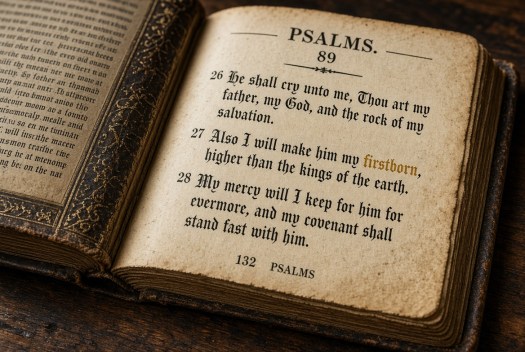
“I also shall make him My firstborn,

The highest of the kings of the earth.

This Psalm is speaking about David, who was NOT the firstborn son of Jesse. David was the SEVENTH son, literally the last son of Jesse.

But God elevated him to the position of preeminence. Hence, David was the firstborn.


  1. Psalms 105:36

He also struck down all the firstborn in their land,

The first fruits of all their vigor.


  1. Psalms 135:8

He smote the firstborn of Egypt,

Both of man and beast.


  1. Psalms 136:10

To Him who smote the Egyptians in their firstborn,

For His lovingkindness is everlasting,


Isaiah

  1. Isaiah 14:30 (ESV)

And the firstborn of the poor will graze,

And the needy lie down in safety;

but I will kill your root with famine,

and your remnant it will slay.

Another interesting use of “firstborn” where it is used in a phrase that does not include a person or animal. Therefore, the “firstborn” CANNOT refer to first offspring.

So what does it mean to be “firstborn of the poor”

The Jehovah’s Witnesses want to twist and stretch the meaning of firstborn in Colossians to mean  something like “first in line” or “first one to experience”. They have to create this meaning in order to make its usage with respect to Jesus fit their theological understanding of his nature, namely that he is NOT God, but is a created being.

So if that is the meaning of the word “firstborn” in that case, then that same meaning and usage should fit here, in a similar usage. Does it work?

Hardly.

What exactly would this mean if its saying the first to be poor? Or how could the Philistines (those to whom this prophecy is directed be the first ones to experience being poor?

The meaning of the word cannot mean what Jehovah’s Witnesses contend. If it did, you would end up with a garbled, incoherent mess.

But if firstborn is taken to mean preeminence or rank, then this verse is saying that those who are supremely poor will be fed. Or another way of thinking about it is “those who are the MOST poor”. This is why the NIV doesn’t even translate the word “firstborn.” It simply says “the poorest of the poor.” The NASB, which is one of the most literal translations doesn’t even use the word “firstborn” for this verse. This verse will not show up in a search of the NASB1995 (though it will in 2020 version). The NASB1995 translates this “those who are most helpless will eat.”


Jeremiah

  1. Jeremiah 31:9

“With weeping they will come,

And by supplication I will lead them;

I will make them walk by streams of waters,

On a straight path in which they will not stumble;

For I am a father to Israel,

And Ephraim is My firstborn.”

An important verse in this discussion. We’ve already seen that Manasseh was Joseph’s first offspring. (See Genesis 48:14 and Genesis 48:18)

Yet even though Manasseh was the firstborn in terms of being the first offspring, Ephraim was the “firstborn” in terms of preeminence.

It’s clear that preeminence is MORE important than birth order. True, the first offspring normally held the preeminent position, but not always.

Hence, when spoken of Christ, who had NO spiritual brothers to share the inheritance, is it more likely that the term “firstborn” is being used to let us know that he was the first in a line of children, or is it more likely that it is being used to let us know that he is preeminent?

I think the answer is obvious. Since he has NO sibling rivals to compete for the birthright, there is no need to inform us that he is the “first offspring”.


Ezekiel

  1. Ezekiel 20:26 – and I pronounced them unclean because of their gifts, in that they caused all their firstborn to pass through the fire so that I might make them desolate, in order that they might know that I am the LORD.’”

The Israelites had offered their firstborn children as sacrifices to pagan idols


Micah

  1. Micah 6:7 –

Does the LORD take delight in thousands of rams,

In ten thousand rivers of oil?

Shall I present my firstborn for my rebellious acts,

The fruit of my body for the sin of my soul?


This verse is akin to the modern day saying, “what do I have to do? Give you my firstborn?”


Zechariah

  1. Zechariah 12:10 – “I will pour out on the house of David and on the inhabitants of Jerusalem, the Spirit of grace and of supplication, so that they will look on Me whom they have pierced; and they will mourn for Him, as one mourns for an only son, and they will weep bitterly over Him like the bitter weeping over a firstborn.

New Testament


Luke

  1. Luke 2:7 – And she gave birth to her firstborn son; and she wrapped Him in cloths, and laid Him in a manger, because there was no room for them in the inn.

Yes, Jesus WAS the firstborn son of Mary. He was literally the first of her offspring

  1. Luke 2:23 – (as it is written in the Law of the Lord, “EVERY firstborn MALE THAT OPENS THE WOMB SHALL BE CALLED HOLY TO THE LORD”),

Romans

  1. Romans 8:29 – For those whom He foreknew, He also predestined to become conformed to the image of His Son, so that He would be the firstborn among many brethren;

What is this verse saying?

It’s saying that those who become children of God are predestined to be conformed to the image of Jesus. That is, we are going to be LIKE him. We will be sinless and holy and righteous in reality. We won’t just be declared righteous, we will BE righteous because in the end, our sin nature will finally be eradicated.

This is the sense that we will fully be Christ’s brethren. But he is the firstborn among all these brethren. Which simply means, he is preeminent. He is supreme.

So this verse, as applied to Jesus does not state that he is the first of Jehovah’s creation. It’s stating that he will have a preeminent position among all the brethren.

This makes sense if we understand that Jesus is a son by nature but we are sons (and daughters) by adoption.


Colossians

  1. Colossians 1:15 – He is the image of the invisible God, the firstborn of all creation.

This is one of the passages in dispute with Jehovah’s Witnesses. They contend that this verse means that Jesus is the first one created by Jehovah. So firstborn here means something like “first in line” or “first one to experience…”

But as we’ve seen, there is no other verse where this is the meaning of “firstborn”, even in verses of similar construction. It cannot mean that Jesus is literally the first offspring of creation for creation cannot have offspring.

Jehovah’s Witnesses claim that the use of firstborn here should carry the normal meaning that is seen in the majority of verses in Scripture. But we’ve seen that the normal usage applies to the first child of normal parents who bore that child through natural child birthing. But this cannot describe Jesus because even if you believe that he was created, he certainly was not birthed in the same way that people are. Jesus did not have a spiritual mother who “bore” him.

Additionally, Jesus has no spiritual siblings. Therefore, there is no need to distinguish him from rival siblings in terms of the firstborn status.

First born does NOT mean first-created. There is a different word that specifically communicates that, and Paul did not use that word to describe Jesus.

Therefore, the logical understanding of the term “firstborn” in this verse is preeminence or rule. The idea is that Jesus reigns over creation. Why? Because he is creator, as the verses that follow teach.


  1. Colossians 1:18 – He is also head of the body, the church; and He is the beginning, the firstborn from the dead, so that He Himself will come to have first place in everything.

The second verse in this passage that uses the term “firstborn”. How do the Jehovah’s Witnesses explain this occurrence?

They pull out their made up meaning of “first in line”. Remember there has been no other occurrence of the term “firstborn” in the more than 100 instances where the idea is anything similar to “first in line.”

Their understanding of this verse is that Jesus was “first in line” to come “from the dead”.

This is faulty for a number of reasons. First of all, Jesus was not the first to die and he was NOT the first to be resurrected.

The response from Jehovah’s Witnesses is that Jesus was the first to be raised to immortality. But this doesn’t make sense within the Jehovah’s Witnesses’ framework, for they do not even believe that Jesus was raised with a physical body. They believe that Jesus was raised from the dead (so was Lazarus) and Jesus now has returned to his pre-incarnate state of being the archangel, Michael. So Jesus is still alive. But so is Moses and Elijah. They appeared with Jesus at the transfiguration.

The Jehovah’s Witnesses’ view here that Jesus was the first to overcome death doesn’t make sense, especially given the statement that follows from Paul, “so that He Himself will come to have first place in everything.”

The meaning of preeminence for the word “firstborn” makes complete sense in this verse, as well as the prior verse and it fits perfectly with the context, including the statement that follows.

Jesus is preeminent over creation, he RULES over creation because he’s the creator. Jesus is preeminent over death, he RULES over death because he CONQUERED death. As a result, He himself will have first place in everything.” Jesus will have supremacy.

See the post “What Does it Mean that Jesus is the Firstborn?”


Hebrews

  1. Hebrews 1:6

And when He again brings the firstborn into the world, He says,

“AND LET ALL THE ANGELS OF GOD WORSHIP HIM.”


This verse is interesting because firstborn clearly refers to Jesus, but does it mean that he was the first offspring?

That is a doubtful interpretation for reasons that have already been enumerated. Jesus was not born. The more logical understanding of this term as applied to Jesus is “preeminent one”.

This makes sense given the context. This passage starting in verse 5 and ending with verse 13 is designed to demonstrate that Jesus is superior (better than) the angels.

So when the firstborn, the preeminent one comes into the world, God says “let all the angels worship Him.”

Now two things should be said about this. First of all, only God should be worshipped. So what does it say about Jesus that God instructs the angels to worship Him?

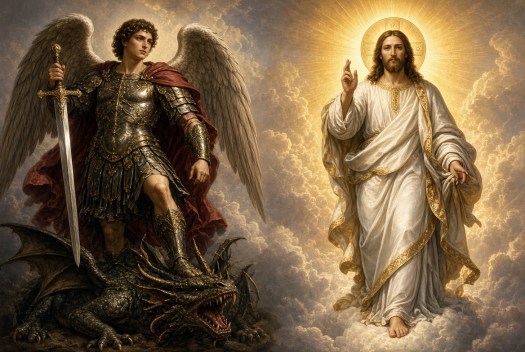
Secondly, the Jehovah’s Witnesses believe that Jesus is actually the archangel Michael. They believe that he is the highest of angels and God the Father (Jehovah to the Jehovah’s Witnesses) tasked Michael with the task of coming into the world to redeem humanity. Michael took on a human nature and changed his name, for some reason. When his task was complete, he returned to heaven and assumed his prior identity.

So you have an angel coming to earth, taking on a human nature and God the Father is instructing all the other angels to WORSHIP him. This does not sound like an angel or even someone who is god-like, as Jehovah’s Witnesses will say. This sounds like someone who possesses the divine nature. Indeed, this is what Hebrews says in Hebrews 1:3 and 4. Jesus is the EXACT representation of God’s nature AND he is BETTER than the angels. How can he be better than the angels if he himself is an angel?


  1. Hebrews 11:28 – By faith he kept the Passover and the sprinkling of the blood, so that he who destroyed the firstborn would not touch them.

This verse is talking about Moses. Moses was faithful to follow the Passover instructions so that the angel of death would not touch the firstborn children of Israel.


  1. Hebrews 12:23 – to the general assembly and church of the firstborn who are enrolled in heaven, and to God, the Judge of all, and to the spirits of the righteous made perfect,

There is some debate about what the term “church of the firstborn” refers to but we know it does NOT refer to Jesus. It’s referring to a group of people in heaven. It’s also clear that the idea of “first offspring” is not in view here. It cannot mean that because it’s talking about people who are in heaven with the Lord so it doesn’t make sense that it’s referring to people who are born first.


Revelation

  1. Revelation 1:5 – and from Jesus Christ, the faithful witness, the firstborn of the dead, and the ruler of the kings of the earth. To Him who loves us and released us from our sins by His blood—

This is the last occurrence of the term “firstborn” and it is the one occurrence that most resembles the usage of Colossians, especially Colossians 1:18.

So what does this mean?

Jehovah’s Witnesses will argue for the interpretation that they hold for Colossians 1:18, namely that this means that Jesus is the first to overcome death, that Jesus is “first in line”.

But given the context, that John follows this phrase by saying that Jesus is the RULER of the kings of the earth, it makes more sense that John is using the term to communicate that Jesus is the one who is preeminent over death. Jesus rules over death, just as he rules over the kings of earth.

A reminder that Jesus was not born. So what would be the purpose of using the term “firstborn” if it does not apply to Jesus as it applied to Reuben, Manasseh and the hundred other references that referred to the first offspring of some person?

Clearly, John is pointing to Jesus’ special status. To conclude otherwise is to stretch or twist the context of these passages and phrases to unnatural and incoherent meanings.


Image created by Grok

How Does Isaiah 44 Demonstrate that Jesus is God?

If you’re wondering why there is an image of a pretzel with a side of mustard for a blog post related to Isaiah 44, read to the end of the post to find out

Isaiah 44

24The LORD, your Redeemer and Creator, says: “I am the LORD, who made all things. I alone stretched out the heavens. By myself I made the earth and everything in it. (Isaiah 44:24, NLT)


The Daily DAVEotional

The lion’s share of verses in Isaiah 44 deal with the foolishness of idols, which I wrote about in my blog post “A Discourse on the Foolishness of Idols”.

However, at the end of Isaiah 44, the prophecy shifts as God gives His people hope regarding the future restoration of the holy city of Jerusalem, which has been decimated due to the fact that many of its inhabitants have been exiled to Babylon. It’s this later passage that I want to focus on in this post, specifically, the first verse in that section.

You’re probably asking, “how exactly does Isaiah 44 demonstrate that Jesus is God, especially since Jesus isn’t mentioned at all in the passage?”

That’s a good question. To answer that question, we must first look at a New Testament passage from Colossians 1.

Speaking of Jesus, Paul, in Colossians 1:16-17, says:

16For by him all things were created: things in heaven and on earth, visible and invisible, whether thrones or powers or rulers or authorities; all things were created by him and for him. 17He is before all things, and in him all things hold together. (NIV)

The clear teaching of these verses is unmistakeable. Jesus is the creator of ALL things. As such, He CANNOT himself be a created thing. In addition, He is BEFORE all things, which means He existed before all things. That means He is eternal. Lastly, He holds all things together, which means He is all-powerful.

By every possible measure, these two verses unequivocally teach that Jesus is God, for He possesses attributes that only God possesses (eternality, omnipotence) and He performs acts that only God could perform, namely creating ALL things.

What’s interesting though is how this same passage is interpreted by the Jehovah’s Witnesses. The Jehovah’s Witnesses do not use any of the standard Christian Bible translations that you’re probably familiar with. Instead, they have their own translation, The New World Translation (NWT), which renders Colossians 1:16-17 this way:

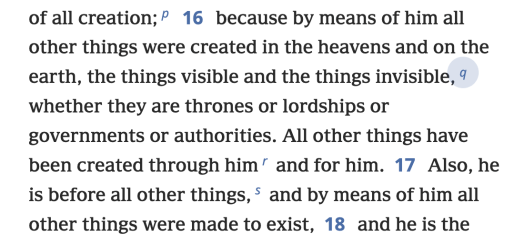
16  because by means of him all other things were created in the heavens and on the earth, the things visible and the things invisible, whether they are thrones or lordships or governments or authorities. All other things have been created through him and for him.  17  Also, he is before all other things, and by means of him all other things were made to exist,  (NWT)

Do you notice the differences between these two translations?

The Jehovah’s Witnesses’ New World Translation inserts the word “other” into the text four times despite the fact that the word “other” is nowhere in the original Greek text. So why is this word inserted four times into the text when it’s not in the original Greek text?


Click here to see a A Comprehensive List of Blog Posts Based on Bible Passage Reference


It’s obvious that the Jehovah’s Witnesses add the word “other” multiple times in order to dilute the clear meaning of the original Greek text, which is that Jesus is the creator of ALL things.

Not only do the Jehovah’s Witnesses unjustifiably add the word “other” to the text, but they do so deceptively.

It’s customary in Bible translations to put any added word in brackets if isn’t in the original Greek text. When the reader sees a word in brackets, it’s a cue that the word is not original to the text but has been added by the translators for some reason, usually for readability.

The online version of the Jehovah’s Witnesses New World Translation. Note that Colossians 1:16-17 does not have brackets around the four occurrences of the word “other” despite the fact that the word “other” appears nowhere in the original Greek text.

It is highly unusual that a translator would add a word to the translation that isn’t in the original Greek and NOT put it in brackets, especially when the addition of the word completely changes the meaning of the text. One can only conclude that the Jehovah’s Witnesses omit the brackets in order to deceive the average person, who will naturally assume that the Jehovah’s Witnesses version of the text accurately reflects what the original Greek text says.

The obvious teaching from Colossians 1:16-17 is uncomfortable to Jehovah’s Witnesses who are so committed to their doctrine that Jesus is a created being that they MUST add the word “other” in order to make the passage fit their doctrinal bias.

Now I’m certain that after I post this online, I’ll encounter many Jehovah’s Witnesses who will attempt to educate me on why it’s ok and even necessary for their translators to add the word “other” to this passage.

Their argument is that the Greek word “panta” can be translated “all other” in some contexts in order to make the reading more “smooth”.  They will undoubtedly point to Luke 13:2 as an example where “panta” is translated as “all other Galileans” instead of just “all Galileans”.

While it’s true that panta can be translated as “all other” in some contexts, it’s not true that it can be translated “all other” whenever the word occurs. The general rule is that the addition of the word “other” is acceptable if it makes the verse more readable BUT DOES NOT CHANGE THE MEANING OF THE VERSE.

The Jehovah’s Witnesses violate this rule by adding the word “other” four times to Colossians 1:16-17 because that is the only way to make those two verses align with their teaching that Jesus is a created being.

So what does any of this have to do with Isaiah 44:24, which is supposed to be the subject of this devotional blog post?

I’m glad you asked.

Let’s assume for one moment that grammatically, the Jehovah’s Witnesses addition of the word “other” four times is linguistically allowed. It’s not, since the word appears nowhere in the original Greek text, but let’s just play along for the sake of argument.

The Jehovah’s Witnesses theological position is that Jehovah created Jesus and THEN Jesus created everything else (all other things).

But Isaiah 44:24 directly refutes this position, as Jehovah says:

I am the LORD, who made all things. I alone stretched out the heavens. By myself I made the earth and everything in it.

Did you catch that?

Jehovah says that he acted ALONE and created ALL THINGS by HIMSELF. He made the earth and EVERYTHING in it.

This directly refutes the Jehovah’s Witnesses doctrinal teaching that Jesus was first created and then created all “other” things.

The Jehovah’s Witnesses teaching is therefore logically false. In order to accept their teaching, one must ignore certain scriptures altogether while directly altering other verses in an effort to bring them into alignment with their prescribed viewpoint.

Nowhere in Scripture does it say that Jesus is created and then Jesus created all “other” things. This view is communicated only in the Jehovah’s Witnesses own translation (the NWT) which conveniently changes key verses in order to force them to agree with their heretical christological view.

Colossians 1:16-17 clearly teaches that all things were created by Jesus, which means he himself cannot be created. Adding the word “other” becomes problematic for Jehovah’s Witnesses as it means they must either deny the clear teaching of Isaiah 44:24 or try to explain it using some other kind of pretzel logic.

The problem for Jehovah’s Witnesses is that they have created so many doctrinal pretzels with their edited translation that their isn’t enough theological mustard available in the world to help us choke down what they’re serving.


Did you enjoy this post? I’d love to hear your thoughts! Feel free to like, leave a comment below, and share it with your friends or on social media if you found it helpful or interesting. Your support keeps the conversation going!


Reflection

If Jesus created all “other” things, how is it possible that Jehovah alone created all things by himself?

How do you explain the fact that all major Bible translations omit the word “other” from Colossians 1:16-17 but the Jehovah’s Witnesses add the word four times?

If Jesus is indeed the creator of all things, and is indeed before all things, what does that imply about his nature?

If Jesus is a created being, as the Jehovah’s Witnesses claim, how does Jesus secure salvation for humankind? In other words, how is it possible that a being who is not eternal and who is not infinitely holy can secure forgiveness and redemption for mankind?


Photo Created with Grok

Does Revelation 3:14 Prove Jesus is a Created Being?

Revelation 3

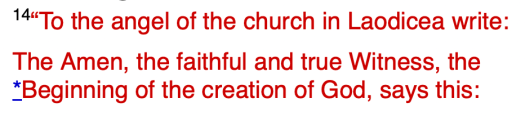
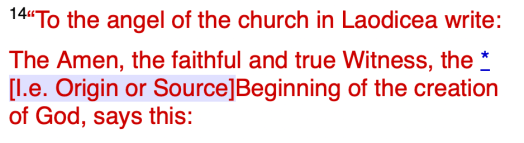
14“To the angel of the church in Laodicea write:

The Amen, the faithful and true Witness, the Beginning of the creation of God, says this:

(Revelation 3:14, NASB)


The Daily DAVEotional

I’ve written a number of blog posts on Revelation 3:14-22, including this post on why Jesus would rebuke the “lukewarm” Christian but not the “cold” Christian, and this post, which explains why it’s legitimate to use Revelation 3:20 in gospel conversations with non-believers.

So why yet ANOTHER post on this passage, and why highlight only one verse?

Some background

Last week, I happened to post on X a tweet referencing my blog post from Proverbs 8 where I explain that Proverbs 8 is NOT a passage that demonstrates that Jesus is a created being, as Jehovah’s Witnesses will claim. In fact, Proverbs 8 is not about Jesus at all.

My tweet got some replies, including a Jehovah’s Witness from Nigeria who decided to take the opportunity to set me straight on my theology.

We had quite the online back and forth exchange, with many verses being offered up as evidence for our respective views.

If you weren’t aware, Jehovah’s Witnesses do not believe that Jesus is God. They teach that he is the first created being of Jehovah and as such, he is not to be worshipped.

They are the modern day torch-bearers of the ancient heretical doctrine known as Arianism. I first wrote about the Jehovah’s Witnesses and their views on Jesus in my post “A Modern Day Version of an Ancient Heresy.”

In my online exchange with this Nigerian Jehovah’s Witness, he presented to me all the usual verses in an attempt to demonstrate that Jesus is not God, including Colossians 1:15, which I addressed in my blog post, “What Does it Mean that Jesus is the Firstborn”, and John 10:30, which I addressed in my blog post “Evidence that Jesus is God” .

One verse that this online JW evangelist offered as evidence that Jesus is not God but is a created being, was Revelation 3:14, the verse that is highlighted in this devotional.

Jehovah’s Witnesses routinely cite Revelation 3:14 as conclusive proof that Jesus is created. After all, the verse literally says that Jesus is the BEGINNING of creation.

What this means, according to the Jehovah’s Witness, is that Jesus is the first created thing of Jehovah’s creation. He is the “beginning” of creation.

However, as is often the case when dialoguing with Jehovah’s Witnesses, the verse does not mean what they THINK it means.

How can that be?

Well, the Greek word in Revelation 3:14 that is translated as “beginning” is the Greek word “arche” (pronounced by sounding out the letters “R” and “K”). It is where we get our English word “architect.”

This word has a number of possible meanings, one of which is “beginning”.

If you look up this word in a Greek lexicon, it says that the word means origin, source, beginning. It also can mean rule.

Biblical translators are in agreement that the meaning of this word is not that Jesus is the first to be created but that Jesus is the source of creation, the author of creation, the BEGINNER of creation or the ORIGIN of creation. Because Jesus is the author of creation, he is the RULER of creation.


Click here to see a A Comprehensive List of Blog Posts Based on Bible Passage Reference


So why does it say that Jesus is the BEGINNING of creation? Why not use one of these other words?

Actually, the NASB, which uses the word “BEGINNING” has a footnote provided by the translators in which they offer up the words “source” and “origin” as alternatives. In other words, the footnote demonstrates that the authors understood that the word “beginning” was meant to be understood in the sense that Jesus is the origin or source of creation.

When you click on the “asterisk”, the note is revealed:

Additionally, most translations do NOT use the word “beginning” in their translation.

The NLT translates Revelation 3:14 as:

“Write this letter to the angel of the church in Laodicea. This is the message from the one who is the Amen—the faithful and true witness, the ruler* [Or the source.] of God’s creation:

Note the translator’s “asterisk” that indicates that the word could mean “ruler” or “source”.

The NIV translates it this way:

14“To the angel of the church in Laodicea write:

These are the words of the Amen, the faithful and true witness, the ruler of God’s creation.

The Holman Christian Standard Bible translates it as:

14“Write to the angel of the church in Laodicea:

“The Amen, the faithful and true Witness, the Originator [Or Ruler, or Source, or Beginning] of God’s creation says:

The brackets are inserted by the translators to indicate different words that would be equally acceptable as translations of the Greek word “arche”.

The NET Bible offers this translation:

“To the angel of the church in Laodicea write the following:

“This is the solemn pronouncement of the Amen, the faithful and true witness, the originator54 of God’s creation:

Notice the number “54” just after the word “originator.” The NET Bible has extensive translation notes, which explain the decision process the translators used to arrive at their translation choices.

The summary of this note number 54 is that “beginning”, “ruler” or “originator” are all three linguistically possible. The editors explain that this term (Greek = arche) is well established in both the Septuagint (LXX) and intertestamental Jewish literature as meaning “ruler, authority.”

The truth is that  most translations do not use the word “beginning” for this verse and the translations that do use the word don’t use it to convey the meaning Jehovah’s Witnesses attribute to the verse.

In actuality, the word beginning is a fine word to use if you understand that Jesus literally is the first cause of creation. It is in that sense that he is the beginning. He is the source, the originator, the architect of creation. As such, he is ruler over creation.

One should also keep in mind that the author of Revelation is the apostle John, the same John who wrote the gospel of John and three shorter epistles near the end of the New Testament.

This same John identified Jesus as God in the opening verses of his gospel account, saying:

In the beginning was the Word, and the Word was with God, and the Word was God. 2He was in the beginning with God. (John 1:1, NASB)

To be fair, Jehovah’s Witnesses dispute the traditional Christian teaching of this verse, but I explain why their view is incorrect in my post “A Modern Day Version of an Ancient Heresy”.

This same John also wrote in his first epistle that

This is the message we have heard from Him and announce to you, that God is Light, and in Him there is no darkness at all. (1 John 1:5, NASB)

But in John 1, the author says this about Jesus:

In Him was life, and the life was the Light of men. 5The Light shines in the darkness, and the darkness did not comprehend it. (John 1:4-5)

John also said of Jesus that

All things came into being through Him, and apart from Him nothing came into being that has come into being. (John 1:3, NASB)

This does not sound like John believed that Jesus was created. Instead, John taught that Jesus created ALL things. If Jesus was the first created thing of Jehovah then John 1:3 would be a false statement as Jesus would be “something” that came into being.

A primary rule of Bible study is that Scripture interprets Scripture. In other words, if there is a verse that is confusing, we interpret it in light of other passages that are clear.

In Revelation 3:14, how are we to understand the word “beginning”? That is the debate between Jehovah’s Witnesses and traditional Christianity.

It’s clear that the translators all understood the word “beginning” in the sense that Jesus is the “beginner” or “first cause” of creation. This understanding is supported by all of the other words that could be used as a translation for the Greek word “arche”, including source, origin and ruler.

The Jehovah’s Witnesses explanation for the word “beginner” violates all of the other possible meanings while the traditional Christian understanding of the word “beginning” is in alignment with the other possible word choices.

In addition, the Jehovah’s Witness explanation of this verse contradicts other passages that clearly promote the same traditional Christian view.

In the final analysis, Revelation 3:14 doesn’t teach that Jesus is the first created being of Jehovah. On the contrary, it provides yet another substantial proof that Jesus is divine!


Did you enjoy this post? I’d love to hear your thoughts! Feel free to like, leave a comment below, and share it with your friends or on social media if you found it helpful or interesting. Your support keeps the conversation going!


Reflection

Given the fact that arche can mean “source”, “ruler” and “origin”, what logical explanation could explain how “beginning” means anything other than “first cause”? In other words, how do you explain the fact that the Jehovah’s Witness explanation of the Greek word “arche” does not match any of the other accepted definitions for the word?

Do you find the argument posed in this post against the Jehovah’s Witness’ interpretation of Revelation 3:14 convincing? Why or why not?

Some people argue that debating the nature of Jesus is fruitless and unnecessary. The argument is that as long as we believe that Jesus saves us, that’s all that matters. Everything else is just theological nit-picking. Do you agree with this sentiment? Why do you think it’s important to have a firm understanding of the nature of Jesus?

What has been your experience with Jehovah’s Witnesses? What verses or arguments have they made that you were not able to adequately respond to or refute?


Photo by Greg Rakozy on Unsplash

Should People Take the Mormon “Challenge”?

Galatians 1

6I am shocked that you are turning away so soon from God, who in his love and mercy called you to share the eternal life he gives through Christ. You are already following a different way 7that pretends to be the Good News but is not the Good News at all. You are being fooled by those who twist and change the truth concerning Christ.

8Let God’s curse fall on anyone, including myself, who preaches any other message than the one we told you about. Even if an angel comes from heaven and preaches any other message, let him be forever cursed. 9I will say it again: If anyone preaches any other gospel than the one you welcomed, let God’s curse fall upon that person.

10Obviously, I’m not trying to be a people pleaser! No, I am trying to please God. If I were still trying to please people, I would not be Christ’s servant. (Galatians 1:6-10, NLT)


The Daily DAVEotional

If you haven’t noticed, Mormonism has been a huge topic on social media the last few days. The main topic of discussion and debate has been centered around the question of whether or not Mormons are Christians.

For context, the Department of Defense recently posted a memo regarding new abbreviated codes to identify the many different religious backgrounds that might be represented among the troops.

According to Secretary of War Pete Hegseth, the previous list of religious options was out of control, with over 200 different options. The goal was to simplify the number of codes and options, making it easier for chaplains to do their job of ministering to the troops.

The problem was that the new list had a number of different Christian denominations listed, such as “Christian-Baptist” and “Christian-Presbyterian” but the Mormon Church was not listed as Christian. Instead, it was listed simply as “Latter Day Saint.”

This set off a firestorm among many Mormon influencers and regular Mormon Joes who were offended that the U.S. government apparently didn’t consider Mormons to be Christian.

Chief among those speaking out online were Utah Senator Mike Lee (@basedMikeLee on X), who took every opportunity to post his thoughts and objections to this “egregious error” inflicted on Latter Day Saints.

This incident sparked a lot of online conversations about whether or not Mormons are Christians.

Mormons, of course, believe they ARE Christians, while evangelicals have argued that Mormons are NOT Christians because, despite the fact that Jesus Christ is in their name, they do not hold to the traditional Christian doctrinal views on Jesus, God, the Church, salvation, or the Scriptures.

The online discussion afforded many Mormons, including Senator Lee, the opportunity to inform and proselytize others regarding the Mormon faith.

In one of his posts, Senator Lee offered up what I’m calling the “Mormon challenge”:

This is the Mormon “trump” card so to speak. “Just read the Book of Mormon in it’s entirety”, they say, “and ask God humbly and with sincerity if it’s true.” This challenge is often offered as a gauntlet that is laid down for those who portend to be truth-seekers.

“What do you have to lose”, Mormons ask. The sentiment is, “Don’t be a chicken!”

Millions of Mormons attest that Mormonism is indeed true based on this challenge.

Should Christians accept this challenge?

The answer is a resounding NO.

There are two reasons why Christians should not take this challenge and neither of them have to do with being scared of the outcome.

The first reason you should not take this challenge is because it’s not falsifiable. The challenge is actually like the old “heads I win, tails you lose” proposition, which means that the challenge is designed to “prove” Mormonism is true regardless of the results of your humble and sincere prayer.

Think about it: if you pray and you say that you felt nothing or you didn’t get any firm and obvious confirmation from your prayer, the Mormon can just say that you were obviously not sincere enough, or humble enough or something similar.

Yet if you say that you DID feel something, that emotional response, regardless of how small or incomprehensible, is offered as proof that Mormonism is true.

In other words, the challenge simply appeals to an emotional response as evidence of veracity.

This leads to the second reason one should NOT take this challenge, which is that it’s unbiblical.

Nowhere in Scripture are people encouraged to evaluate truth claims by appealing to an emotional response.

Instead, we are exhorted to test a message against the clear revelation that has already been given by God.

Acts 17 is a good example of this. I have written about this passage in another blog post, “Fact-Checking and Misinformation in the New Testament” in which the Bereans were commended for testing Paul’s message against the Scriptures.

A second clear example of testing a message is in the Galatians passage listed above, in which Paul tells his audience that any “gospel” message that is not in alignment or in agreement with the gospel message he had already preached to them was to be rejected. Paul tells the Galatians that the person giving this false message is to be cursed.

We know exactly what the message was that Paul originally preached to the Galatians because he writes his letter to the Galatians to reinforce the original message and to correct their subsequent misunderstanding brought about by false teachers. The gospel message Paul preached was a message of justification by faith in Christ alone, apart from any works.

Since we already know that the Mormon message is different than Paul’s message on many different levels doctrinally, there is no need to “pray on it.” In fact, reading the Book of Mormon and praying on it could be considered disobedience to Paul’s admonition to outright reject so-called gospel messages that are different from what he taught the Galatians.

The debate about whether Mormons are Christian or not, while interesting, is in many ways irrelevant. The truth is that anyone can identify themselves as a Christian. Yet, it’s not as important what you call yourself as what you believe.

Mormons say they are Christians because they follow Jesus Christ. But so do Jehovah’s Witnesses, Catholics, Evangelical Christians, Liberal Christians and even Progressive Christians. Even Muslims will tell you that they respect and revere Jesus as a prophet.

All these groups, along with Latter Day Saints, have wildly different theological views on God, Jesus, salvation and the nature of the church, and yet, they all consider themselves “Christian”.

Are they Christian? The only way we can really know is to evaluate their beliefs in relation to what the Bible teaches.

With that in mind, I propose an alternate challenge to those who consider themselves Mormons…a challenge that is actually biblical. The challenge is to read the Bible cover to cover. Then compare the teachings of Mormonism with the teachings of the Bible, and specifically, compare the Mormon message with the gospel message taught by Jesus and the apostles in the New Testament.

Then tell me – does Mormonism line up with the already revealed and accepted teachings of Jesus and the apostles?

So Mike Lee (and other Mormons)….will you accept the challenge?


Did you enjoy this post? I’d love to hear your thoughts! Feel free to like, leave a comment below, and share it with your friends or on social media if you found it helpful or interesting. Your support keeps the conversation going!


Reflection

What is your definition of a Christian? According to the Bible and the gospel, how does one become a Christian?

What was the essence of the salvation message taught by Jesus and His disciples? What is the essence of the Mormon message regarding how a person is saved?

What is the traditional Christian teaching on the nature of Jesus? How do Mormons view the nature of Jesus? Are these two views the same? How do they differ?

Do you think it matters what a person believes about Jesus in order to be saved? Or is it simply enough to say you believe in Jesus? 


photo by Dave Lowe