What Does it Mean that Jesus is the Firstborn? (Part 2)

Colossians 1

15He is the image of the invisible God, the firstborn over all creation. 16For by him all things were created: things in heaven and on earth, visible and invisible, whether thrones or powers or rulers or authorities; all things were created by him and for him. 17He is before all things, and in him all things hold together. 18And he is the head of the body, the church; he is the beginning and the firstborn from among the dead, so that in everything he might have the supremacy. 19For God was pleased to have all his fullness dwell in him, 20and through him to reconcile to himself all things, whether things on earth or things in heaven, by making peace through his blood, shed on the cross. (Colossians 1:15-20, NIV)


The Daily DAVEotional

About a year ago, I posted my thoughts on this very passage, explaining the meaning of the term “firstborn” and why it doesn’t teach that Jesus is a created being, as the Jehovah’s Witnesses argue.

I don’t want to rehash all of my points from that post so if you haven’t read it, I encourage you to read the original post, “What Does it Mean that Jesus is the Firstborn?” to get up to speed on the debate between the traditional Christian understanding of Jesus and the Arian view that Jehovah’s Witnesses hold.

My purpose in this post is to provide a response to some of the arguments levied by Jehovah’s Witnesses who argue against my interpretation of this passage.

In my initial post, I made the claim that the primary meaning of “firstborn” in Colossians 1:15 and 18 is “preeminence”. I reasoned that this makes the most sense since Paul uses “firstborn” in conjunction with two different terms, “creation” and “death”, neither of which have anything to do with a parent. Therefore, it seems most natural that Paul is using the term to demonstrate Jesus’ supremacy (pre-eminence) over creation and death.

In recent weeks, I’ve encountered a number of committed Jehovah’s Witnesses online who disagree with my interpretation and have offered up their own explanations for this passage.

The standard Jehovah’s Witness talking point as it relates to the meaning of “firstborn” in Colossians 1 is that the term means something like “first in line.”

The argument is that the term “firstborn” most often refers to the first offspring of a particular person. Therefore, the word should be interpreted in a similar manner when it’s used in a verse that is not referencing offspring.

If you agree with the Jehovah’s Witness logic, then the interpretation of Colossians 1 yields the following:

Jesus is the firstborn of creation, which means that he was the first one to be created by Jehovah.

Jesus is the firstborn from among the dead, which means he’s the first one to overcome death.

To some, particularly Jehovah’s Witnesses and others who hold to an Arian view of Christ, the debate is over. In their mind, the logic is irrefutable.

But is it?

Sound Bible study methods dictate that we investigate their claims. Is their understanding of the word the standard interpretation?

Let’s see.


Click here to see a A Comprehensive List of Blog Posts Based on Bible Passage Reference


I did a Bible search and found that the word “firstborn” shows up in 111 Bible verses, all but 9 of which are found in the Old Testament. In some verses, the word “firstborn” appears multiple times. Hence, the term is used more than 120 times throughout the Bible.

I’ve catalogued every verse where the term shows up, so you can see for yourself. You can access this list of verses in my blog post “Bible References to the Term “Firstborn”“.

The Jehovah’s Witnesses are right in this respect – a majority of the references to the term “firstborn” do actually refer to the first one born to a particular person. However, it is rather obvious from the context of all of those passages that this is the meaning.

Take Genesis 10:15 for example, which is the very first occurrence of the term. The verse says,

Canaan became the father of Sidon, his firstborn.

In a majority of the occurrences of the term “firstborn”, it’s used in this same manner where the term is by itself, but referencing a parent. Occasionally, the term is referenced to another living creature as in Exodus 11:5 which states that God was going to kill the firstborn of Pharaoh as well as the firstborn of all cattle.

It’s clear in these situations that the term does mean “first offspring” primarily because the verse gives the name of the parent and the son or daughter.

But how is the word understood when it is not used in conjunction with a living being (man or animal)? Is it understood in the same way?

Typically not.

One of the first occurrences where firstborn is used in a non-traditional way is Exodus 4:22, which says,

“Then you shall say to Pharaoh, ‘Thus says the LORD, “Israel is My son, My firstborn23“So I said to you, ‘Let My son go that he may serve Me’; but you have refused to let him go. Behold, I will kill your son, your firstborn.”’”

Notice that the term shows up twice. In the second instance it’s used in the same way we typically see the word being used, in reference to the first offspring of a person. In this case, it’s referring to the first offspring of Pharaoh.

But in the first instance of the term “firstborn”, it is not used in the typical fashion.

According to Jehovah’s Witness’ argumentation, the word should have the same meaning even when it’s used in a non-traditional way.

It turns out that the first instance of “firstborn” in this passage CANNOT mean what the Jehovah’s Witnesses attribute to the term. God specifically states that Israel, the nation, is his firstborn. If we understand “firstborn” to be “first in line”, in what sense is Israel the “first in line”?

Israel was not the first nation to be created. And God doesn’t “birth” nations anyway, so the word cannot mean “first offspring”.

It’s clear by the context that the first occurrence of “firstborn” in this verse is to be understood as Israel having a favored status. God selected Israel for a distinct and unique purpose – to be a nation through which all the other nations would be blessed and come to know the one true God.

In this case, the meaning of “preeminent” is clearly the correct understanding.

Genesis 48 provides an insightful story that helps us understand the significance of the firstborn.

In this passage, Joseph brings his sons Manasseh and Ephraim to Jacob in order to receive a blessing before Jacob passes.

Jacob is old and his vision is failing. As he reaches out to bless Joseph’s sons, he crosses his arms so that his right hand is on Ephraim instead of Manasseh who is the first offspring of Joseph and therefore the firstborn.

Genesis 48:14 says,

But Israel stretched out his right hand and laid it on the head of Ephraim, who was the younger, and his left hand on Manasseh’s head, crossing his hands, although Manasseh was the firstborn.

In Genesis 48:18, Joseph tries to correct his father, saying,

“Not so, my father, for this one is the firstborn. Place your right hand on his head.”

Jacob tells Joseph that he is aware of the situation and he knows what he is doing. He tells Joseph that Ephraim, though he is the younger, will have a higher position over his brother. He will be the firstborn, the favored son.

Just a few verses later, in the next chapter, Jacob is giving his final words to each of his sons. Here is what he says to Reuben, his first son, in Genesis 49:3-4,

“Reuben, you are my firstborn; My might and the beginning of my strength, Preeminent in dignity and preeminent in power. 4“Uncontrolled as water, you shall not have preeminence, Because you went up to your father’s bed; Then you defiled it —he went up to my couch.

Jacob not only defines the term “firstborn” for us but expounds on its significance. The firstborn IS the might of the father AND the beginning of the father’s strength. The firstborn is PREEMINENT.

Jacob tells Reuben that he is the firstborn in terms of offspring. But he would NOT be firstborn in terms of preeminence.

These passages, which show up early in the biblical narrative, demonstrate clearly that the idea of “preeminence” was nearly synonymous with the term “firstborn”.

Though Manasseh was Joseph’s first offspring, it turns out that he was not considered the “firstborn” in terms of stature and rank. In Jeremiah 31:9, God  confirms that “Ephraim is my firstborn.”

In 1 Chronicles 2:13, we read that,

Jesse became the father of Eliab his firstborn, then Abinadab the second, Shimea the third,

In verse 14, we learn that David was the seventh and last son born to Jesse. Yet, in Psalm 89:27, God says about David,

“I also shall make him My firstborn,
The highest of the kings of the earth.

David was not the first offspring of Jesse, but God made David His firstborn.

What does that mean?

It cannot mean that David was “first in line” because David was neither the first offspring of Jesse nor was he the first king of Israel.

What it means is that David was made by God to assume the highest rank among rulers. David was made firstborn – he was made to be preeminent.

The context dictates the meaning and sense of the word and so far, when the word is used in a way that doesn’t mean “first offspring”, it carries the meaning of “preeminence.”

There’s an interesting passage in Job that uses the term firstborn. It’s found in Job 18:13, which says:

“His skin is devoured by disease,
The firstborn of death devours his limbs.

This occurrence is informative because it uses the term “firstborn” with the prepositional phrase “of….” that doesn’t have a person or animal following. Whenever we see a person or animal (cattle, herd) follow, as in “firstborn of Jacob” or “firstborn of cattle”, the term always refers to the first offspring.

But in this case, the “firstborn of” phrase is not followed by a person or animal.

Does the standard Jehovah’s Witness meaning of “first in line” follow?

Not really.

Death is inanimate. It’s not a living organism that gives birth as humans and mammals do.

So what is this verse saying?

This verse is part of a larger discourse by Bildad in which he’s communicating his ideology that the wicked eventually get the punishment they deserve. He’s using this argumentation to try to prove that the reason Job has experienced so much trauma and suffering is because Job’s sin has finally caught up to him.

In describing the punishment the wicked will endure, Bildad claims that the skin of the wicked gets devoured by disease AND the “firstborn of death” devours his limbs. It’s obvious that Bildad is making reference to Job’s physical ailments as a proof of Job’s supposed secret sin.

But what is meant by “firstborn of death”?

Note that this term is very similar to how Paul uses “firstborn” in Colossians 1:18.

If “firstborn” means “first in line” in these kinds of cases, what exactly does that mean?

The context will not allow that interpretation because if you assume that meaning, you end up with a garbled mess of a sentence that is completely incoherent.

It’s clear in this context that death is afflicting its victim. There is no sense in which the term “firstborn of death” includes the meaning “first in line”. Death does not birth anything and does not produce a literal offspring.

But death CAN rule. Death CAN overwhelm. That is the sense that is being conveyed here. There is no meaningful or coherent sense in which “first in line” as a meaning applies to the term “firstborn” here.

There’s another uncommon use of the term “firstborn” in Isaiah that does not follow the typical examples that are littered throughout the Old Testament.

Isaiah 14:30 in the ESV says,

And the firstborn of the poor will graze,
And the needy lie down in safety;
but I will kill your root with famine,
and your remnant it will slay.

Here is another example of the word “firstborn” being used in connection with something that is a non-person and a non-animal, negating the traditional meaning of “first offspring.”

What exactly, then is the “firstborn of the poor” and does the definition of “first in line” fit here given the context?

This verse is part of a prophecy that the Lord is giving to Philistia. God warns that Philistia will experience complete devastation and that only “the firstborn of the poor will graze.”

What exactly does that mean?

One thing it doesn’t mean is “first in line”. If we apply the meaning of “highest rank” or “supreme” then it means that those who are the MOST poor will graze (be fed). In other words, it’s going to be bad, and only the most poor, or the poorest of the poor will survive.

It appears that in pretty much every case where the term “firstborn” is used in a way that doesn’t include the parent with the first offspring, the term means “preeminent.”

As mentioned at the outset, there are only 9 verses in the New Testament that use the term “firstborn”.

There are two verses in Luke 2 that use the term, and in both cases, the term “firstborn” is used to refer to Jesus as Mary’s first offspring.

In Hebrews 11:28, the term “firstborn” is referencing the Egyptian plague when the angel of death passed over the Israelites and all of the firstborn of the Israelites were shielded from the plague.

That leaves 6 more verses that use the term “firstborn” including the two in Colossians. None of these other verses use the term in the normal sense where it obviously refers to the first offspring of a certain person.

I’ll examine each of the non-Colossians verses before coming back to Colossians and then summarizing what this tells us.

Romans 8:29 says,

For those whom He foreknew, He also predestined to become conformed to the image of His Son, so that He would be the firstborn among many brethren;

What is this verse saying?

It’s saying that those who become children of God are predestined to be conformed to the image of Jesus. That is, believers ultimately are going to be LIKE him. We won’t just be declared righteous, we will BE righteous because in the end, our sin nature will finally be eradicated.

This is the sense that we will fully be Christ’s brethren. Though we will be LIKE him, we will not be equal to him. Jesus will be the firstborn among all these brethren, which simply means, he will be preeminent. He will be supreme.

So this verse, as applied to Jesus, does not state that he is the first of Jehovah’s creation. It’s stating that he will have a preeminent position among all of the brethren.

This interpretation makes complete sense if we understand that Jesus is a son by nature but we are sons (and daughters) by adoption.

Hebrews 1:6 says,

And when He again brings the firstborn into the world, He says,
“AND LET ALL THE ANGELS OF GOD WORSHIP HIM.”

The term “firstborn” in this verse clearly refers to Jesus, but does it mean that he was the first offspring?

That is a doubtful interpretation for reasons that have already been enumerated. Jesus was not born. Therefore, the more logical understanding of this term as applied to Jesus is “preeminent one”.

This makes sense given the context of Hebrews 1. This passage, starting in verse 5 and ending with verse 13, is demonstrating that Jesus is superior to, or better than the angels.

So when the firstborn, the preeminent one, comes into the world, God says “let all the angels worship Him.” It logically follows that the angels are commanded to worship Jesus because he is preeminent over them.

Now two things should be said about this. First of all, it’s clear from Scripture that only God is to be worshipped. So what does it say about Jesus that God instructs the angels to worship Him?

Secondly, the Jehovah’s Witnesses believe that Jesus is actually the archangel Michael. They believe that Michael is the highest of angels and that God the Father (Jehovah to the Jehovah’s Witnesses) gave Michael the task of coming into the world to redeem humanity. Michael took on a human nature and changed his name for some reason. When his mission was complete, Jesus returned to heaven and assumed his prior identity as Michael the archangel.

So according to the Jehovah’s Witnesses, a powerful angel came to earth, took on a human body and God the Father instructed all the other angels to WORSHIP him.

This doesn’t sound like an angel or even someone who is god-like, as Jehovah’s Witnesses will say. This sounds like someone who possesses the divine nature. In fact, this is exactly what Hebrews 1:3 -4 teaches, that Jesus is the EXACT representation of God’s nature AND he is BETTER than the angels. How can he be better than the angels if he himself IS an angel?

Hebrews 12:23 says,

to the general assembly and church of the firstborn who are enrolled in heaven, and to God, the Judge of all, and to the spirits of the righteous made perfect,

There is some debate about what the term “church of the firstborn” refers to but we know it does NOT refer to Jesus. It clearly refers to a group of people in heaven. It’s also clear that the idea of “first offspring” is not in view here.

I think the most likely understanding of “firstborn” in this verse is either “favored status” or “inheritance.” Remember that the firstborn son had a favored status and received a double portion of the inheritance. So both of these ideas are already inherent in the term.

In this sense, the phrase “church of the firstborn” likely refers to those who have received the inheritance. In other words, it’s referring to those who, because they have placed their faith in Jesus and belong to him, receive exclusive spiritual blessings that are not available to those who are not in the church.

This view makes more sense than anything resembling “first in line”.

Revelation 1:5 says,

and from Jesus Christ, the faithful witness, the firstborn of the dead, and the ruler of the kings of the earth. To Him who loves us and released us from our sins by His blood—

This is the last occurrence of the term “firstborn” in the Bible and it’s the one occurrence that most resembles the usage of Colossians, especially Colossians 1:18.

So what does this mean?

Jehovah’s Witnesses will likely argue for the interpretation that they hold for Colossians 1:18, namely that this means that Jesus is the first to overcome death, that Jesus is “first in line”.

But given the context, noting that John follows this phrase by saying that Jesus is the RULER of the kings of the earth, it makes more sense that John is using the term to communicate that Jesus is the one who is preeminent over death. In other words, Jesus rules over death, just as he rules over the kings of earth.

It bears repeating that Jesus was not born. So what would be the purpose of using the term “firstborn” if it does not apply to Jesus as it applied to Reuben, Manasseh and the dozens of other references that referred to the first offspring of some person?

In other words, the term firstborn, in a majority of cases, was used to identify the first offspring of a person in order to distinguish that person from other siblings who were not first. But since Jesus has no spiritual “siblings”, there is no need to use the term “firstborn” to distinguish him from rival siblings.

Clearly, John is pointing to Jesus’ special status. To conclude otherwise is to stretch or twist the context of these passages and phrases to unnatural and incoherent meanings.

Now let’s circle back to the Colossians verses that use the term “firstborn”.

What we’ve seen in every use of the term “firstborn” is that it most often refers to “first offspring”. But it never means “first offspring” when the term “firstborn” is used in conjunction with  a non-person or non-mammal. In those cases, some form of preeminence, rule or supremacy is meant.

One thing that is clear is that there are no verses where the term firstborn means “first in line”. Yes, it means “first offspring” when speaking of a person or animal that bears offspring in the natural way. However, when “firstborn” is coupled with a non-person, the idea of “first in line” is never in view.

Yet that is exactly what the Jehovah’s Witnesses contend that it means in these two verses in Colossians. They argue that Colossians 1:15 means that Jesus was first in line to be created and Colossians 1:18 means that Jesus was first in line to be raised from the dead.

Their argument is that this understanding is demanded because it is the normal meaning when you see the term.

But, as we’ve seen, it’s only normal when the term is used to refer to “first offspring”. There is no instance where it carries that meaning apart from the term “firstborn” being connected with a living person or an animal such as “cattle” or “herd”.

When the term “firstborn” is used apart from a living person or animal, it always has the meaning of preeminence, supremacy or highest rank.

This rendering makes the most sense in Colossians, especially when you look at the context and realize that Paul is seeking to demonstrate that “in everything Christ might have supremacy.” 

If Paul’s argument is designed to show that Christ will have supremacy in everything (verse 18), then it makes sense that he is going to support that argument by showing that Jesus has supremacy over creation and over death.

So why do Jehovah’s Witnesses still insist that “firstborn”, when attributed to Jesus, means “first in line” when it’s never used that way in any other example?

The answer is that they have manufactured this definition as a way to maintain their theological view that Jesus is a created being.

Jehovah’s Witnesses demonstrate the most egregious form of the Bible study error known as eisegesis, which means to “read into the text.”

In simple terms, the Jehovah’s Witnesses do not approach the text in order to inform their theology. Instead, they add phrases to the text and change the normal meaning of words in order to conform the text to their theology.

It’s clear that, as it relates to Jesus, Paul is using the term “firstborn” in the sense of “preeminence”. This is how the word is used in cases that clearly don’t refer to “first offspring.”

Additionally, the context supports the idea of “preeminence” as the meaning of firstborn.

Paul states that Jesus is the “firstborn of creation” which means Jesus is preeminent over creation.

In the verses that follow, Paul states that Jesus is the creator of all things. So Jesus is preeminent over creation because he is the creator.

The Jehovah’s Witnesses have to manufacture a meaning of firstborn to mean something like “first in line” in order to convince you that Paul is trying to tell you that Jesus is the first created being of Jehovah.

Yet if Paul was trying to communicate that Jesus was “first-created”, he would have used the Greek word “protoktisis” which literally means “first-created.”

That Paul didn’t use that word speaks volumes.

The Jehovah’s Witnesses then have to add the word “other” to the text four times in order to change the meaning of the text to show that Jesus is not really the creator as the original Greek text indicates.

The Jehovah’s Witnesses are like the person who tells a small lie to promote a false narrative but are then forced to create bigger lies in order to maintain the fabricated story.

They first had to offer up a definition for “firstborn” that is literally not used in any of the more than 100 occurrences of the term.

Then, to keep their narrative alive that Jesus is a created being, they have to add the word “other” to the passage four times. Their explanations and justifications for their interpretive choices get increasingly more complicated and logically convoluted in their effort to maintain their theological view.

The most direct, plain and understandable meaning of this passage is that Jesus is preeminent over creation because he is the creator. Additionally, Jesus is preeminent over death because he conquered death. All of this demonstrates that Jesus will come to have first place (i.e. preeminence) in everything!

No extra words and no uncommon and unnatural definitions are required to arrive at this understanding.

So we are back to my original premise in my first blog post, which is that the word “firstborn” does not mean what the Jehovah’s Witnesses think it means.

Jehovah’s Witnesses would do well to heed the advice of Inigo Montoya, who famously said,


Did you enjoy this post? I’d love to hear your thoughts! Feel free to like, leave a comment below, and share it with your friends or on social media if you found it helpful or interesting. Your support keeps the conversation going!


Reflection

Do you agree with the Jehovah’s Witnesses’ interpretation of Colossians 1;15 and Colossians 1:18 that the term “firstborn” should be understood as “first in line”? If so, how do you interpret the other passages that use “firstborn” in a context that doesn’t refer to “first offspring”?

Have you ever told a small lie that escalated into much bigger fabrications? What is the motivation for lying in the first place? What are the reasons a person might continue to promote a falsehood?

What are some examples you can think of where a person is so committed to their narrative that they resort to convoluted logic and distorted definitions in an attempt to justify their narrative?

If the term “firstborn” means “first in line” in Colossians, as Jehovah’s Witnesses assert, what exactly is the meaning of the phrase “firstborn from among the dead”? How does the idea of “first in line” apply to Jesus’ death?


Photo is a screenshot from the movie “The Princess Bride”

Does Revelation 3:14 Prove Jesus is a Created Being?

Revelation 3

14“To the angel of the church in Laodicea write:

The Amen, the faithful and true Witness, the Beginning of the creation of God, says this:

(Revelation 3:14, NASB)


The Daily DAVEotional

I’ve written a number of blog posts on Revelation 3:14-22, including this post on why Jesus would rebuke the “lukewarm” Christian but not the “cold” Christian, and this post, which explains why it’s legitimate to use Revelation 3:20 in gospel conversations with non-believers.

So why yet ANOTHER post on this passage, and why highlight only one verse?

Some background

Last week, I happened to post on X a tweet referencing my blog post from Proverbs 8 where I explain that Proverbs 8 is NOT a passage that demonstrates that Jesus is a created being, as Jehovah’s Witnesses will claim. In fact, Proverbs 8 is not about Jesus at all.

My tweet got some replies, including a Jehovah’s Witness from Nigeria who decided to take the opportunity to set me straight on my theology.

We had quite the online back and forth exchange, with many verses being offered up as evidence for our respective views.

If you weren’t aware, Jehovah’s Witnesses do not believe that Jesus is God. They teach that he is the first created being of Jehovah and as such, he is not to be worshipped.

They are the modern day torch-bearers of the ancient heretical doctrine known as Arianism. I first wrote about the Jehovah’s Witnesses and their views on Jesus in my post “A Modern Day Version of an Ancient Heresy.”

In my online exchange with this Nigerian Jehovah’s Witness, he presented to me all the usual verses in an attempt to demonstrate that Jesus is not God, including Colossians 1:15, which I addressed in my blog post, “What Does it Mean that Jesus is the Firstborn”, and John 10:30, which I addressed in my blog post “Evidence that Jesus is God” .

One verse that this online JW evangelist offered as evidence that Jesus is not God but is a created being, was Revelation 3:14, the verse that is highlighted in this devotional.

Jehovah’s Witnesses routinely cite Revelation 3:14 as conclusive proof that Jesus is created. After all, the verse literally says that Jesus is the BEGINNING of creation.

What this means, according to the Jehovah’s Witness, is that Jesus is the first created thing of Jehovah’s creation. He is the “beginning” of creation.

However, as is often the case when dialoguing with Jehovah’s Witnesses, the verse does not mean what they THINK it means.

How can that be?

Well, the Greek word in Revelation 3:14 that is translated as “beginning” is the Greek word “arche” (pronounced by sounding out the letters “R” and “K”). It is where we get our English word “architect.”

This word has a number of possible meanings, one of which is “beginning”.

If you look up this word in a Greek lexicon, it says that the word means origin, source, beginning. It also can mean rule.

Biblical translators are in agreement that the meaning of this word is not that Jesus is the first to be created but that Jesus is the source of creation, the author of creation, the BEGINNER of creation or the ORIGIN of creation. Because Jesus is the author of creation, he is the RULER of creation.


Click here to see a A Comprehensive List of Blog Posts Based on Bible Passage Reference


So why does it say that Jesus is the BEGINNING of creation? Why not use one of these other words?

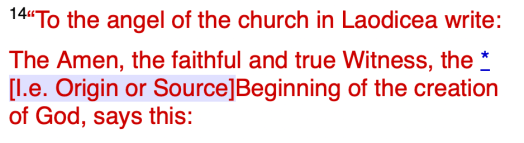
Actually, the NASB, which uses the word “BEGINNING” has a footnote provided by the translators in which they offer up the words “source” and “origin” as alternatives. In other words, the footnote demonstrates that the authors understood that the word “beginning” was meant to be understood in the sense that Jesus is the origin or source of creation.

When you click on the “asterisk”, the note is revealed:

Additionally, most translations do NOT use the word “beginning” in their translation.

The NLT translates Revelation 3:14 as:

“Write this letter to the angel of the church in Laodicea. This is the message from the one who is the Amen—the faithful and true witness, the ruler* [Or the source.] of God’s creation:

Note the translator’s “asterisk” that indicates that the word could mean “ruler” or “source”.

The NIV translates it this way:

14“To the angel of the church in Laodicea write:

These are the words of the Amen, the faithful and true witness, the ruler of God’s creation.

The Holman Christian Standard Bible translates it as:

14“Write to the angel of the church in Laodicea:

“The Amen, the faithful and true Witness, the Originator [Or Ruler, or Source, or Beginning] of God’s creation says:

The brackets are inserted by the translators to indicate different words that would be equally acceptable as translations of the Greek word “arche”.

The NET Bible offers this translation:

“To the angel of the church in Laodicea write the following:

“This is the solemn pronouncement of the Amen, the faithful and true witness, the originator54 of God’s creation:

Notice the number “54” just after the word “originator.” The NET Bible has extensive translation notes, which explain the decision process the translators used to arrive at their translation choices.

The summary of this note number 54 is that “beginning”, “ruler” or “originator” are all three linguistically possible. The editors explain that this term (Greek = arche) is well established in both the Septuagint (LXX) and intertestamental Jewish literature as meaning “ruler, authority.”

The truth is that  most translations do not use the word “beginning” for this verse and the translations that do use the word don’t use it to convey the meaning Jehovah’s Witnesses attribute to the verse.

In actuality, the word beginning is a fine word to use if you understand that Jesus literally is the first cause of creation. It is in that sense that he is the beginning. He is the source, the originator, the architect of creation. As such, he is ruler over creation.

One should also keep in mind that the author of Revelation is the apostle John, the same John who wrote the gospel of John and three shorter epistles near the end of the New Testament.

This same John identified Jesus as God in the opening verses of his gospel account, saying:

In the beginning was the Word, and the Word was with God, and the Word was God. 2He was in the beginning with God. (John 1:1, NASB)

To be fair, Jehovah’s Witnesses dispute the traditional Christian teaching of this verse, but I explain why their view is incorrect in my post “A Modern Day Version of an Ancient Heresy”.

This same John also wrote in his first epistle that

This is the message we have heard from Him and announce to you, that God is Light, and in Him there is no darkness at all. (1 John 1:5, NASB)

But in John 1, the author says this about Jesus:

In Him was life, and the life was the Light of men. 5The Light shines in the darkness, and the darkness did not comprehend it. (John 1:4-5)

John also said of Jesus that

All things came into being through Him, and apart from Him nothing came into being that has come into being. (John 1:3, NASB)

This does not sound like John believed that Jesus was created. Instead, John taught that Jesus created ALL things. If Jesus was the first created thing of Jehovah then John 1:3 would be a false statement as Jesus would be “something” that came into being.

A primary rule of Bible study is that Scripture interprets Scripture. In other words, if there is a verse that is confusing, we interpret it in light of other passages that are clear.

In Revelation 3:14, how are we to understand the word “beginning”? That is the debate between Jehovah’s Witnesses and traditional Christianity.

It’s clear that the translators all understood the word “beginning” in the sense that Jesus is the “beginner” or “first cause” of creation. This understanding is supported by all of the other words that could be used as a translation for the Greek word “arche”, including source, origin and ruler.

The Jehovah’s Witnesses explanation for the word “beginner” violates all of the other possible meanings while the traditional Christian understanding of the word “beginning” is in alignment with the other possible word choices.

In addition, the Jehovah’s Witness explanation of this verse contradicts other passages that clearly promote the same traditional Christian view.

In the final analysis, Revelation 3:14 doesn’t teach that Jesus is the first created being of Jehovah. On the contrary, it provides yet another substantial proof that Jesus is divine!


Did you enjoy this post? I’d love to hear your thoughts! Feel free to like, leave a comment below, and share it with your friends or on social media if you found it helpful or interesting. Your support keeps the conversation going!


Reflection

Given the fact that arche can mean “source”, “ruler” and “origin”, what logical explanation could explain how “beginning” means anything other than “first cause”? In other words, how do you explain the fact that the Jehovah’s Witness explanation of the Greek word “arche” does not match any of the other accepted definitions for the word?

Do you find the argument posed in this post against the Jehovah’s Witness’ interpretation of Revelation 3:14 convincing? Why or why not?

Some people argue that debating the nature of Jesus is fruitless and unnecessary. The argument is that as long as we believe that Jesus saves us, that’s all that matters. Everything else is just theological nit-picking. Do you agree with this sentiment? Why do you think it’s important to have a firm understanding of the nature of Jesus?

What has been your experience with Jehovah’s Witnesses? What verses or arguments have they made that you were not able to adequately respond to or refute?


Photo by Greg Rakozy on Unsplash

Can Christians Pray Directly to Jesus or Only God the Father?

Acts 7

51“You stubborn people! You are heathen at heart and deaf to the truth. Must you forever resist the Holy Spirit? But your ancestors did, and so do you! 52Name one prophet your ancestors didn’t persecute! They even killed the ones who predicted the coming of the Righteous One—the Messiah whom you betrayed and murdered. 53You deliberately disobeyed God’s law, though you received it from the hands of angels. ”

54The Jewish leaders were infuriated by Stephen’s accusation, and they shook their fists in rage. 55But Stephen, full of the Holy Spirit, gazed steadily upward into heaven and saw the glory of God, and he saw Jesus standing in the place of honor at God’s right hand. 56And he told them, “Look, I see the heavens opened and the Son of Man standing in the place of honor at God’s right hand!”

57Then they put their hands over their ears, and drowning out his voice with their shouts, they rushed at him. 58They dragged him out of the city and began to stone him. The official witnesses took off their coats and laid them at the feet of a young man named Saul.

59And as they stoned him, Stephen prayed, “Lord Jesus, receive my spirit.” 60And he fell to his knees, shouting, “Lord, don’t charge them with this sin!” And with that, he died. (Acts 7:51-60, NLT)


The Daily DAVEotional

Last week on X (formerly Twitter), I saw an exchange that made me think. A pastor with a very large following was calling out a well-known politician who claims to be a Christian for the way he prayed.

Attached to the post was a screenshot of the text of the Lord’s Prayer in Matthew 6, along with the following admonition:

Someone should tell (name of politician) that Christians don’t pray to Jesus. We pray to God the Father in the name of Jesus.

My first thought was disappointment at the realization that we now appear to have an online Prayer Police force that is monitoring our actions over the internet.

My second thought was, “Wait, I pray to Jesus all the time. Have I been doing it wrong all these years? Have I been participating in a doctrinally dubious practice?”

It’s a valid question. How exactly are we to pray? Is there a right and wrong format? What are God’s expectations of us as we seek to engage with Him in the practice of prayer?

I’ve been a Christian for a looooong time and I’ve honestly never thought that a person could NOT pray directly to Jesus. After all, when I first heard the gospel as a young boy, I was told that Jesus was standing at the door of my heart and he was knocking (Revelation 3:20). If I was listening to his voice and if I opened the door, he would come into my life! In short, if I responded to Jesus, IN PRAYER, and invited him in, I would become a Christian and receive the gift of eternal life.

I’ve heard many prayers over the years where Jesus was addressed directly and I’ve never, even once, seen or heard someone be corrected for directing their prayers to Jesus, if this is indeed a wrong practice.

I suppose that’s why this post on X, from a pastor with a large following, and a PhD no less, seemed to be coming out of left field.

Disregarding the tone and posture of the tweet, which came off as more sanctimonious rebuke than loving correction, I found myself asking the question, “is he correct?”

The disciples had asked Jesus to teach them to pray. Jesus responded by telling them:

9“Pray, then, in this way:

‘Our Father who is in heaven,

Hallowed be Your name.

10‘Your kingdom come.

Your will be done,

On earth as it is in heaven.

11‘Give us this day our daily bread.

12‘And forgive us our debts, as we also have forgiven our debtors.

13‘And do not lead us into temptation, but deliver us from evil. [For Yours is the kingdom and the power and the glory forever. Amen.]’ (Matthew 6:9-13, NASB)

I decided to survey the prayers in the New Testament that I was aware of, mostly from the book of Acts.

What I found is that most of the prayers ARE directed to God the Father and NOT Jesus, EXCEPT this one example that we find from Stephen in our passage today.

We first meet Stephen in Acts 6 when he is selected, along with six other men, for the special task of meeting a critical need in the early church. These seven men were the first deacons of the church. The text says that Stephen was a man full of faith and the Holy Spirit. He was not a man of marginal commitment or questionable devotion. He walked with God.

By the end of chapter 6, Stephen is no longer serving as an administrator in the church’s food distribution program, but instead, he is having a major impact as an evangelistic preacher. Stephen’s influence had increased significantly and he was now a major leader in the early church movement.

One day, Stephen gets into a debate with some Jews and the text says that:

None of them was able to stand against the wisdom and Spirit by which Stephen spoke. (Acts 6:10, NLT)

They couldn’t defeat his arguments so they found some people to lie about him and he was arrested by the religious rulers and brought before the high council. The Council leaders ask Stephen to respond to the charges that had been brought against him. His response is recorded in Acts 7, which is a lengthy discourse on the history of the Jewish people, including their long-standing pattern of rebelling against God and resisting God’s appointed messengers (His prophets).

For brevity, I haven’t included the full text of that response (Acts 7 in its entirety), but it’s worth the read. For our purposes, I’ve included the relevant part at the end of Acts 7 where Stephen shifts his response from explaining the history of the nation of Israel to his indictment on its leaders for their pride and rebellion.

You can see that the Council leaders and its members don’t take too kindly to Stephen’s accusation and the result is that they dragged Stephen out of the city and stoned him.

What is interesting about this text is that Stephen, as he is being stoned, looks up toward heaven and he prays!

What does he pray?

“Lord Jesus, receive my spirit.” (Acts 7:59)

Stephen, a man who the text says was filled with the Spirit, prayed to Jesus, not the Father.

To me, this provided indisputable proof that it must be ok to direct our prayers to Jesus and not God the Father only.

So I responded to the pastor’s post on X by saying that praying to Jesus must be ok because we have an example in the New Testament with Stephen praying directly to Jesus.

The pastor replied to my response, doubling down by saying:

That was descriptive, not prescriptive.

What does that mean?

He’s actually correct. What that means is that the book of Acts is historical narrative, not didactic teaching. That means that Luke (the author of Acts) was simply recording things that happened. Just because he recorded an event does not mean that what is recorded is supposed to be the normal pattern for all believers.

But Jesus’ words in Matthew 6 are direct teaching. He is instructing us in what to do and how to do it.

So what this pastor was saying in his reply is that just because Stephen is recorded as praying to Jesus doesn’t mean we are supposed to, especially since Jesus’ prayer instruction shows the prayer addressing “our Father”.

So yes, it’s true. Jesus’ teaching is prescriptive, explaining to his disciples how we should pray. And the example of Stephen is descriptive. It’s part of a larger narrative that just describes an event. It’s not part of a passage that is teaching us how to pray.

Does that mean that the pastor’s assertion that we are only to pray to God the Father is correct? Is that the end of the discussion?

Not exactly.

While Jesus teaches the Lord’s prayer in Matthew 6 (and Luke 11), his teaching is not an exhaustive discourse on the subject of prayer. In other words, even though Jesus gives some teaching on prayer in these passages, what he says is not ALL there is to know and learn about prayer.

To make a determination of whether it’s ok to pray to Jesus directly, consider the following:

    • Jesus tells his disciples to pray “in this way”, and then he shares the Lord’s prayer. Does this mean that ALL prayers must repeat these words exactly? If so, why do we never see this exact prayer repeated in the New Testament?
    • Jesus gives his disciples a model, or example of how to pray, which includes addressing “our Father”. Does this mean that a person can never pray to Jesus? What about the Holy Spirit? Can you call on the Holy Spirit?
    • If we are not allowed to pray to Jesus, how are we supposed to respond to Him if he is at the door of our heart knocking? How exactly do we invite Him in?
    • If Jesus promises to come in and dine with us and have fellowship with us, how exactly do we have fellowship with someone we are not supposed to talk (pray) to directly?
    • It’s clear that Jesus is our High priest. The role of a priest is a mediator. Jesus is the mediator between us and holy God. It’s because of Jesus and his atoning sacrifice on the cross that we are able to boldly approach the throne of grace and enter the presence of God the Father. Are we really supposed to believe that Jesus is the mediator between man and God but we are not allowed to talk to him directly?

The whole premise seems a bit absurd. Based on all of the relevant data, it seems clear that while Jesus does instruct his followers to pray to God the Father, there is never a prohibition for believers to address Jesus directly.

It seems clear that because Jesus is our mediator and he is the one knocking at the door of our heart, wanting to come into our lives, that we CAN address him directly.

Furthermore, we have a documented case where a godly, Spirit-filled leader of the early church  (Stephen) addresses Jesus directly. There is no indication, anywhere in scripture, that this is somehow wrong.

One last item is worth mentioning. In the final words of the New Testament, John, in the book of Revelation, pens these words:

Amen! Come, Lord Jesus! (Revelation 22:20, NLT)

If the apostle John finds that it’s ok to pray to Jesus, inviting him to “come”, then I’d say that it’s ok for any of us to address our prayers to Jesus as well.


Did you enjoy this post? I’d love to hear your thoughts! Feel free to like, leave a comment below, and share it with your friends or on social media if you found it helpful or interesting. Your support keeps the conversation going!


Reflection

What would your response have been to this pastor who posted on X? How would you have either affirmed his position or argued against it?

What has been your pattern in prayer? Do you think it’s ok to pray directly to Jesus or should Christians pray ONLY to God the Father? What is the reasoning for your answer?

How have you used the Lord’s Prayer in your walk with Christ? Do you believe that Jesus taught that the Lord’s prayer was THE way to pray – that it is the ONLY pattern for praying? 

What do you think it means that Jesus is our high priest? What is the role of a priest? How do we interact with a priest or mediator?


Photo by Brian Lundquist on Unsplash

Can You Make the Bible an Idol?

Psalm 119

16I delight in your decrees; I will not neglect your word.

20My soul is consumed with longing for your laws at all times.

24Your statutes are my delight; they are my counselors.

40How I long for your precepts! Preserve my life in your righteousness.

43Do not snatch the word of truth from my mouth, for I have put my hope in your laws.

47for I delight in your commands because I love them.

48I lift up my hands to your commands, which I love, and I meditate on your decrees.

70Their hearts are callous and unfeeling, but I delight in your law.

72The law from your mouth is more precious to me than thousands of pieces of silver and gold.

77Let your compassion come to me that I may live, for your law is my delight.

92If your law had not been my delight, I would have perished in my affliction.

97Oh, how I love your law! I meditate on it all day long.

103How sweet are your words to my taste, sweeter than honey to my mouth!

111Your statutes are my heritage forever; they are the joy of my heart.

113I hate double-minded men, but I love your law.

119All the wicked of the earth you discard like dross; therefore I love your statutes.

120My flesh trembles in fear of you; I stand in awe of your laws.

127Because I love your commands more than gold, more than pure gold,

129Your statutes are wonderful; therefore I obey them.

140Your promises have been thoroughly tested, and your servant loves them.

143Trouble and distress have come upon me, but your commands are my delight.

159See how I love your precepts; preserve my life, O LORD, according to your love.

163I hate and abhor falsehood but I love your law.

165Great peace have they who love your law, and nothing can make them stumble.

167I obey your statutes, for I love them greatly.

174I long for your salvation, O LORD, and your law is my delight.

(Psalm 119 – selected verses, NLT)

NOTE: Psalm 119 is the longest chapter in the entire Bible. I’ve included selected verses that reflect the content of this blog post


The Daily DAVEotional

A while back, I read a social media post from a person with a sizable following in which he exhorted people, “Don’t make the Bible an idol.”

My first thought was, “what does that even mean?”

Is it possible to make the Bible an idol? What would that even look like?

I immediately thought about this Psalm (119), which is the longest chapter in the entire Bible and is an extended discourse on the wonders and virtues of God’s word. I’ve written about this Psalm before in my post “The Endless Virtues of God’s Word.”

It’s well worth your time to read the entire Psalm but due to the sheer length of the text, I’ve only included selected verses that highlight the devotion, awe and love that the psalmist has for God’s word.

If ever someone might be accused of worshiping God’s Word and making it an idol, it would be the author of Psalm 119. Notice some of the language he uses to express his feelings about God’s laws, statutes and precepts.

Words like delight, love, long, hope, consumed, sweet, joy, precious and awe are all used to describe how the psalmist feels about God’s laws.

There is clearly a reverence and respect and a deep LOVE for God’s word. But does that equate to idol worship?

To answer that question, we need to understand what idol worship is.

I wrote in a previous blog post, “A Discourse on the Foolishness of Idols” that an idol can be thought of as a substitutionary object of trust. Instead of trusting in God as your deliverer, your provider, your protector, your source of life, your savior, etc, you transfer that trust to something or someone else.

But you can also think of an idol as anything that takes priority or precedence in your heart over God.

So how about this Psalmist? Is he guilty of idol worship? Is it possible to elevate the Bible to a position over God in our lives?

I suppose that if I were to worship the physical book of the Bible as if it were a deity itself, I could be accused of idol worship. But I don’t think that is what’s happening with the psalmist.

The word of the Lord – his law, precepts, ordinances and statutes – are all merely an extension of God Himself. They are not God, but they are a revelation of the character of the true God.

When the psalmist says he loves God’s law, and he delights in His word, he’s making a statement about God’s character. He’s acknowledging that God’s word is a source of revelation about God’s nature and in it, God has provided wisdom and instruction for righteous living.

God’s word tells us who He is and how we’re to live. The psalmist simply acknowledges these facts. Moreover, he’s speaking directly to God when he makes these statements. Therefore, the praise and adoration is directed toward God and not some inanimate scroll.

Think of it this way – let’s say you read a book that you really loved. Then one day you meet the author at a book signing. While you’re at the table, you go on and on about how much you loved the book. You share that the character development, plot lines and context were all relatable and engrossing. Do you think the author will be offended because you praised his/her work and not the author directly? No, the book is an extension of them and it is obvious to all that your praise is directed toward the author.

That is exactly what is happening in this psalm. The psalmist is simply recognizing that God’s laws and statutes are righteous and life-giving.

So why would this online social media influencer bark out that we should not make the Bible an idol? Why is this even a concern?

My desire to answer this question led me down an online rabbit hole. This particular influencer, and others who also warn that we should not make the Bible an idol, belongs to a strain of religious faith that is known as Progressive Christianity.

Progressive Christianity uses the word “Christianity” but it is hardly Christian. While they utilize the same language and reference the same characters as traditional Christianity, they redefine the meaning of words, concepts and even characters in order to suit their own theological preferences.

Progressive Christians occupy a broad spectrum of beliefs but there are some things that tend to be common among most who identify as being a part of this camp.

Perhaps the hallmark value of Progressive Christianity is their view that God is always evolving. Hence, there is an emphasis on searching and questioning, while those claiming to know truth may be labeled as unenlightened or immature.

Progressive Christianity tends to be very ecumenical, embracing all faith religions and ideologies as equally valid and helpful. Loving others means you shouldn’t offend others by telling them that their beliefs might be wrong. Hence, Jesus has been recast from His role as exclusive Savior of the world to that of a moral teacher whose example we’re to follow.

Standing in contrast to Progressive Christianity is orthodox Christianity, which teaches that God can be known because He has revealed Himself to us through His word and through the person of Jesus.

In addition, orthodox Christianity teaches that God is NOT evolving. He has laid out for us in His word what His standards are for living and because God doesn’t change, the standards and statutes set forth in His word apply to us today.

Perhaps you are starting to see the problem. If God doesn’t change, then that means His moral code and His rules for righteous living are not optional and must be obeyed today.

The Progressive Christian attempts to get around this by doubling down on the assertion that God IS evolving while adding the caveat that the Bible is not written by God.

Their claim is that the Bible we have is simply a record of writings by fallible men; they are NOT God’s spoken words. While the Bible may be helpful and inspiring, it is only a tool that you may choose to use; it is NOT authoritative for our lives. If the Bible lacks authority, then it logically follows that I don’t have to abide by all of its restrictive and antiquated rules and regulations.

This is where the rubber meets the road. For the evangelical (orthodox) believer, the Bible is authoritative, for it reveals God’s very nature to us and it contains His laws, statutes, precepts and ordinances for righteous living. This is what the psalmist was extolling in Psalm 119.

The Progressive Christian denies that God is the author of Scripture and so for anyone who believes in the authority of Scripture, they are told by the Progressive Christian, “Don’t make the Bible an idol.”

So you see that this whole argument is based on a completely different foundational view of God’s nature and how he reveals Himself to mankind. The Progressive Christian denies that the Bible is an authoritative tome that accurately reflects God’s nature and provides rules and guidance for living. To them, there are many other ways God may communicate to us apart from the Bible, including other faith traditions.

This denigration of the authority of Scripture allows the Progressive Christian to decide for himself which of the statutes in the Bible are valid for today and which ones aren’t. Conveniently, this allows the Progressive Christian to formulate a view of God that matches their preferences and proclivities exactly, which, strangely, is exactly the definition of forming an idol.

Amazingly, we’ve come full circle. The Progressive Christian tells us not to make the Bible an idol because doing so limits God and restricts our view of Him to how He is portrayed in Scripture.

Meanwhile, the Progressive Christian untethers themselves from the shackles of Biblical revelation of God as an immutable template for representing who God is, opting instead for the freedom to develop an image of God that is highly influenced by their own experiences and preferences.

Ironically, that sounds like idol worship to me.


To learn more about Progressive Christianity and what they believe, watch this 12 minute video from apologist Alisa Childers


Did you enjoy this post? I’d love to hear your thoughts! Feel free to like, leave a comment below, and share it with your friends or on social media if you found it helpful or interesting. Your support keeps the conversation going!


Reflection

What is your view of the Bible? Do you see it as God’s word or a collection of writings written by fallible men?

What is the source of your information about God? How can you know if your view of God is accurate to who God really is rather than just an image you developed about Him that suits your preferences?

Do you think that the commands of the Bible are valid for people today or are they optional? What are the reasons for your position?

What has been your experience with Progressive Christianity? Do you think Progressive Christianity is compatible with traditional, orthodox Christianity? Why or why not?

Why do you think people opt for a Progressive version of Christianity instead of traditional, orthodox Christianity? What do you think are some of the main reasons and driving forces?


Photo by Pixabay on Pexels.com

Can Revelation 3:20 be Used in Evangelism to Non-Christians?

Revelation 3

14“To the angel of the church in Laodicea write:

The Amen, the faithful and true Witness, the Beginning of the creation of God, says this:

15‘I know your deeds, that you are neither cold nor hot; I wish that you were cold or hot. 16‘So because you are lukewarm, and neither hot nor cold, I will spit you out of My mouth. 17‘Because you say, “I am rich, and have become wealthy, and have need of nothing,” and you do not know that you are wretched and miserable and poor and blind and naked, 18I advise you to buy from Me gold refined by fire so that you may become rich, and white garments so that you may clothe yourself, and that the shame of your nakedness will not be revealed; and eye salve to anoint your eyes so that you may see. 19‘Those whom I love, I reprove and discipline; therefore be zealous and repent. 20‘Behold, I stand at the door and knock; if anyone hears My voice and opens the door, I will come in to him and will dine with him, and he with Me. 21‘He who overcomes, I will grant to him to sit down with Me on My throne, as I also overcame and sat down with My Father on His throne. 22‘He who has an ear, let him hear what the Spirit says to the churches.’”  (Revelation 3:14-22, NASB)


The Daily DAVEotional

I recently wrote about how this message to the church at Laodicea might be the most well-known of the seven messages in Revelation 2 and 3 because it’s the origin of the phrase “lukewarm Christian”. You can read my post here.

But there’s another reason why this passage may be the most well-known of the seven church messages. In Revelation 3:20, Jesus is famously quoted as saying,

Behold, I stand at the door and knock; if anyone hears My voice and opens the door, I will come in to him and will dine with him, and he with Me. (NASB)

This particular verse has been used by many Christians around the world, in tracts and evangelistic presentations, to invite those who don’t know Christ to respond to Jesus’s offer of salvation.

“Jesus wants to begin a relationship with you”, the Christian might say to the non-Christian. “He’s standing outside the door of your life and He’s knocking. He wants to come in. But you have to open the door.”

I myself have used this verse with thousands of people as I’ve shared the gospel with them, inviting them to respond to God’s offer of love and forgiveness. I’ve echoed these exact words more times than I can count.

But there’s a potential problem with using this verse in an evangelistic setting.

A few years ago I was taking an online theology course. The professor wanted to create a virtual dialogue, so part of the grade required students to respond to discussion questions he posted online. In order to gain full credit, students were required to respond thoughtfully to each discussion question AND we were also required to respond at least one time to another student’s post. These responses created a sort of “class discussion” but in an online thread.

I vividly remember engaging in a robust exchange with another student who argued that because the message to the church at Laodicea was a message to believers, Revelation 3:20 could not be used as an invitation to non-Christians. In other words, it was argued that Jesus’s invitation in Revelation 3:20 was an invitation for Christians who were worldly to get right with God; it was not an invitation for non-believers to enter into a relationship with God.

It created a very lively class discussion, especially since many of us in the class had been trained to share our faith with others using tracts and presentations that used Revelation 3:20 in precisely the way our classmate was arguing against.

Is what this other person shared true? Are all the evangelistic tracts that utilize Revelation 3:20 as an invitation for non-believers to invite Jesus to come into their life theologically incorrect?

There is no doubt that when Jesus was talking to the church at Laodicea, He was addressing real churches that existed at that time. Therefore we must assume that they were believers.

HOWEVER, just because Jesus was addressing Christians does not mean that we can only quote Revelation 3:20 when we are talking to other Christians.

The truth is that Jesus died for EVERYONE. We all know this. John 3:16, perhaps the most popular verse in the whole Bible, clearly states “For God so loved THE WORLD…” (emphasis mine)

In addition, in 2 Peter 3:9, Peter says, “The Lord is not slow in keeping his promise, as some understand slowness. He is patient with you, not wanting anyone to perish, but EVERYONE to come to repentance.” (NIV, emphasis mine)

Many more verses demonstrate God’s desire for ALL people to come to know Him, including Mark 10:45, Luke 19:10, John 10:10 and 1 Timothy 4:10.

Consequently, since Scripture teaches that God’s desire is for ALL people to be in an intimate fellowship with Him (not just Christians), it is appropriate to use Revelation 3:20 with non-believers, even though it was initially written to a group of believers.

As Dr. Thomas Constable says in his Bible notes on Revelation 3:20;

“This verse expresses a truth taught elsewhere in Scripture, namely, that Jesus Christ desires intimate fellowship with all people (cf. Song 5:2-6; Mk 10:45; Lk 19:10; Jn 10:10; 1Ti 4:10). Consequently, I believe it is appropriate to use it in evangelism. It expresses God’s universal desire very graphically, by way of application, not interpretation.”

In other words, the imagery of Revelation 3:20 expresses a truth that can be applied beyond the context for which it was written. Since we know from Scripture that God’s desire is for intimate fellowship with ALL people, the image conveyed in this verse can be extended beyond the initial context.

Reflection

What has been your experience with evangelistic conversations?

Do you think it is wrong to use Revelation 3:20 in an evangelistic conversation? Why or why not?

If you believe that Revelation 3:20 should not be used when sharing the gospel with others, how would you go about sharing God’s desire to enter into a relationship with the non-believer?

What illustrations could you use to graphically illustrate to a non-believer that God desires to come into their life but it is their decision to let Him in?


Photo by valérie faiola on Unsplash

Is Being a Cold Christian Better Than Being Lukewarm?

Revelation 3

14“Write this letter to the angel of the church in Laodicea. This is the message from the one who is the Amen—the faithful and true witness, the ruler  of God’s creation:

15“I know all the things you do, that you are neither hot nor cold. I wish you were one or the other! 16But since you are like lukewarm water, I will spit you out of my mouth! 17You say, ‘I am rich. I have everything I want. I don’t need a thing!’ And you don’t realize that you are wretched and miserable and poor and blind and naked. 18I advise you to buy gold from me—gold that has been purified by fire. Then you will be rich. And also buy white garments so you will not be shamed by your nakedness. And buy ointment for your eyes so you will be able to see. 19I am the one who corrects and disciplines everyone I love. Be diligent and turn from your indifference.

20“Look! Here I stand at the door and knock. If you hear me calling and open the door, I will come in, and we will share a meal as friends. 21I will invite everyone who is victorious to sit with me on my throne, just as I was victorious and sat with my Father on his throne. 22Anyone who is willing to hear should listen to the Spirit and understand what the Spirit is saying to the churches.” (Revelation 3:14-22, NLT)


The Daily DAVEotional

The message to the church at Laodicea was the last of the seven different messages given to the seven different churches in Revelation 2 and 3. I’ve previously written about the messages to the church at Pergamum here and the church at Ephesus here.

The message to the church at Laodicea is unique for a couple of reasons. First, it is the only message of the seven messages given that does not include a commendation. While each of the other six churches had at least one thing that evoked a commendation from the Lord, the church at Laodicea apparently did not have any good thing that the Lord could honor them for.

The message to this church may be the most well-known of the seven church messages because it is the source for the popular term “lukewarm Christian.” In verses 15 and 16, Jesus tells the church they are lukewarm and as a result, He will spit them out of His mouth.

What exactly does Jesus mean when He calls the Laodiceans “lukewarm”?

The typical view is that the term is a sort of temperature gauge of our spiritual commitment. The lukewarm person is someone who is not completely on fire (hot) for God. Being lukewarm is often synonymous with a person who is indifferent or apathetic toward God. The lukewarm believer is often described as a person who has one foot in the world and one foot in the church. In this view, God hates spiritual indifference and apathy so much that He is going to spit (or vomit) that person out of His mouth!

There are a number of problems with this understanding.

First of all, if the idea of being lukewarm is describing a person’s wishy-washy, tepid commitment to God, then how are we to interpret verse 15, where God says that He wishes we were either hot or cold rather than lukewarm? This would seem to indicate that being cold toward God is somehow more desirable than being lukewarm and just as desirable as being hot.

Are we to believe that completely rejecting God (being cold) is just as preferable to God as us being totally committed and sold out to Him (being hot)?

While it might make some sense to think that God doesn’t like believers who are lukewarm (indifferent, apathetic, half-in & half-out), this understanding doesn’t seem to completely fit this passage.

There’s another problem with this understanding of being lukewarm, and that is that the Laodiceans are not described as being indifferent and apathetic. The issue that Jesus has with this church is that they were self-reliant and materialistic.

Verse 17 says:

You say, ‘I am rich. I have everything I want. I don’t need a thing!’ And you don’t realize that you are wretched and miserable and poor and blind and naked.

The NASB says it this way:

‘Because you say, “I am rich, and have become wealthy, and have need of nothing,” and you do not know that you are wretched and miserable and poor and blind and naked,

The problem with the Laodiceans is that they were focused on their material wealth while ignoring their spiritual poverty. They apparently had gained great material wealth which they ascribed to their own self-effort instead of viewing it as being a result of God’s blessings. God was not central to their lives, which were wrapped up in materialism, monetary gain and self-indulgence.

So what then is Jesus saying? If the term lukewarm is not describing the temperature of our spiritual commitment, what is meant by the term lukewarm?

To understand what Jesus means when he talks about being hot, cold and lukewarm, it’s helpful to know a little bit about the context of the church at Laodicea and some of the other churches in the area.

To the north of Laodicea was Heiropolis, whose water was supplied from hot springs that were known for their medicinal benefits. South of Laodicea was Colosse, which had a water supply from clear cold springs.

Laodicea’s water was imported by aqueduct and was neither hot nor cold. Instead, the water was lukewarm, dirty and nearly undrinkable.

Whereas cold water is refreshing and hot water has many medicinal health benefits, the lukewarm water from Laodicea was neither refreshing nor beneficial.

Jesus is using the poor tasting and uninviting water of Laodicea to describe HIS REACTION to their spiritual condition. Hence, being lukewarm is not meant to be an indicator of the relative hotness or coldness of our spiritual commitment toward God as most people have interpreted. If this is what Jesus is saying, then we have to conclude that Jesus would rather we be against Him (cold) rather than indifferent (lukewarm).

Instead, Jesus is saying that while both cold water and hot water have benefits, there is virtually nothing good or inviting about lukewarm water. In the same way, the spiritual condition of the Laodiceans is as disgusting to Him as drinking lukewarm water.

So being lukewarm has nothing to do with how “on fire” you might feel for God at this particular moment. If you are not experiencing the mountain high vibe currently, that doesn’t make you “lukewarm”.

The lukewarm Christian is any Christian whose lifestyle would evoke the response Jesus had for the Laodiceans. The lukewarm lifestyle is one where Jesus is not central and primary. The lukewarm Christian denies their spiritual need because they have put their hope in material things. The lukewarm believer is living according to the values of the world instead of the values of Christ. In short, the lukewarm Christian is worldly.

This is not a good look to Jesus. It is as distasteful to Him as drinking bland, lukewarm water.


Reflection

What has been your understanding of the term “lukewarm Christian”?

How has your view changed as a result of this new information regarding the water supply in Laodicea and surrounding area?

In what ways are you prone to become “lukewarm”? That is to say, what are some things in your spiritual life that, if not addressed and attended to, might evoke the kind of response from Jesus that He gave to the Laodiceans?

What can you do to ensure that you don’t slip into a state where you deny your spiritual need and become uber-focused on material gain and self-made wealth?

How can you protect yourself from becoming a lukewarm (worldly) Christian?


Photo of Laodicean ruins by Gray Clary on Unsplash

Have You Left Your First Love?

Revelation 2

1“Write this letter to the angel of the church in Ephesus. This is the message from the one who holds the seven stars in his right hand, the one who walks among the seven gold lampstands:

2“I know all the things you do. I have seen your hard work and your patient endurance. I know you don’t tolerate evil people. You have examined the claims of those who say they are apostles but are not. You have discovered they are liars. 3You have patiently suffered for me without quitting. 4But I have this complaint against you. You don’t love me or each other as you did at first! 5Look how far you have fallen from your first love! Turn back to me again and work as you did at first. If you don’t, I will come and remove your lampstand from its place among the churches. 6But there is this about you that is good: You hate the deeds of the immoral Nicolaitans, just as I do.

7“Anyone who is willing to hear should listen to the Spirit and understand what the Spirit is saying to the churches. Everyone who is victorious will eat from the tree of life in the paradise of God. (Revelation 2:1-7, NLT)


The Daily DAVEotional

In Revelation 2 and 3, John relates a series of messages the Lord gave him to share with seven different churches that existed at that time. In each case, the message follows a pattern of sharing some positive qualities that the church exhibits while also sharing the areas where the church has deviated from God’s design.

I previously wrote about the message to the church at Pergamum here (Compromise isn’t Always Good), where the Lord’s complaint against this church was that they tolerated the presence and the teaching of a group known as Nicolaitans, who apparently taught a doctrine of compromise that integrated sexually immoral pagan practices with Christian teachings.

In the message to the church at Ephesus, Jesus praises the church for NOT tolerating the immoral Nicolaitans.

The complaint Jesus has for the Ephesians is different. He rebukes them because they “don’t love me or each other as you did at first.”

Here is a case where the New Living Translation (NLT) may not portray the full impact of what Jesus is saying.

For comparison, here is how Revelation 2:4 reads in a few different translations:

Yet I hold this against you: You have forsaken your first love. (NIV)

‘But I have this against you, that you have left your first love. (NASB)

But I have this against you: You have abandoned the love you had at first. (ESV)

Those words “forsaken”, “left”, and “abandoned” give the impression of a person who has left a relationship for something else. I picture a wife who has left her husband for another man. Or I imagine a dad who has left his wife and family for a younger woman.

The issue is a lack of commitment.

We live in a culture that doesn’t honor or value commitment as much as previous generations did, particularly when it comes to marriage. Divorce is so commonplace that it almost seems strange when you meet someone whose family is still together.

We see celebrities and media personalities moving in and out of relationships and falling in and out of love with such regularity that the idea of love has been reduced to a feeling that can change more rapidly than the weather.

Over and over in the Old Testament, the Israelites are rebuked for being unfaithful and abandoning the Lord. They did this by pursuing foreign gods and neglecting God’s explicit commands.

We have a penchant for wandering. I suppose it’s human nature to always think the grass is always greener somewhere else so we test the limits, we expand the boundaries and before you know it, we’ve completely forsaken the Lord and his teachings while pursuing something or someone else.

This forsaking of Jesus can take many different forms but the one constant is that we no longer value Jesus as king in our lives. Perhaps we still believe in Him and even continue to participate in various religious practices but His priority and importance in our lives begins to wane.

The good news is that no matter where we’re at, or how far we may have strayed, Jesus invites us to return to him.  Regardless of our situation, we can renew our commitment to Jesus and experience His presence and purpose in our lives.

Reflection

If Jesus were to give a message to you today, what would he say? Would he commend you or would he have a complaint to share?

The complaint against the church at Ephesus was that they had left their first love? How would you rate your love for God right now compared to when you first came to know Him?

What is your concept of love? How does the concept of commitment fit with your perception of love?

What are some of the things in our culture and in your life that are most likely to cause you to stray from the Lord and tempt you to “forsake” Him?

What steps can you take to ensure that your commitment to Jesus does not succumb to current cultural challenges.


Photo by Jen Theodore on Unsplash


Compromise Isn’t Always Good

Revelation 2

12“Write this letter to the angel of the church in Pergamum. This is the message from the one who has a sharp two-edged sword:

13“I know that you live in the city where that great throne of Satan is located, and yet you have remained loyal to me. And you refused to deny me even when Antipas, my faithful witness, was martyred among you by Satan’s followers. 14And yet I have a few complaints against you. You tolerate some among you who are like Balaam, who showed Balak how to trip up the people of Israel. He taught them to worship idols by eating food offered to idols and by committing sexual sin. 15In the same way, you have some Nicolaitans among you—people who follow the same teaching and commit the same sins. 16Repent, or I will come to you suddenly and fight against them with the sword of my mouth.

17“Anyone who is willing to hear should listen to the Spirit and understand what the Spirit is saying to the churches. Everyone who is victorious will eat of the manna that has been hidden away in heaven. And I will give to each one a white stone, and on the stone will be engraved a new name that no one knows except the one who receives it. (Revelation 2:12-17, NLT)


The Daily DAVEotional

Though the book of Revelation is filled with figurative language describing apocalyptic events that will occur in the future, the first couple of chapters describe real events that were happening at the time the author penned his words.

In chapters 2 and 3, John is instructed to write down messages that were to be delivered to 7 different churches. These were real churches and the messages were a combination of praise for the things they were doing well and rebuke for those things they were failing to do as true followers of Jesus.

In this passage of Revelation, John is writing to the church at Pergamum. The people in that church had done some things that were worthy of praise, most notably, they had remained loyal to Jesus despite cultural pressures that existed in their city.

But there were some things that were not pleasing to the Lord. The text calls them complaints. The biggest issue in this church was that they were compromising on their moral values, particularly in the area of sexual purity.

The Lord references two obscure biblical characters to lodge His complaint. He mentions Balaam as well as a group referred to as the “Nicolaitans”.

Balaam was a prophet whose story is found in Numbers 22-25. Balak, the king of Aram had seen the vast people of Israel encamped near him and he sought the help of Balaam in bringing a curse upon the Israelites. The short story is that even though the king of Aram offered up an incredible amount of riches in exchange for Balaam’s curse, Balaam ends up blessing the Israelites instead.

A quick reading of the story might lead one to conclude that Balaam was a good guy who followed the Lord’s leading. However, we find out in subsequent chapters that even though Balaam did obey the Lord by not cursing the Israelites but blessing them instead, he also conspired against the Israelites by suggesting to Balak a way to do an end around God’s blessing of his people.

It was Balaam who suggested to king Balak that Israel would easily defile themselves if their men were encouraged to pursue foreign women as wives. Balaam knew that these men, in their physical lust, would forsake the Lord and worship the gods of these foreigners. Though Israelite men were forbidden to sleep with foreign women or take them as wives. Balaam urged Balak to take this course anyway, knowing that it would be the first step to leading the whole nation away from the Lord.

The other group also referenced in this passage is the Nicolaitans. This group was not praised and there are at least two passages that reference this group and warns about them.

So who are the Nicolaitans and what was wrong with their doctrine?

Most of what we know about the Nicolaitans is from early church fathers who wrote that the Nicolaitans were followers of Nicolas, who taught a doctrine of compromise.

One view is that because it was mentioned in Acts 6:5 that Nicolas was a proselyte from Antioch then he must’ve had a background in the occult and pagan religions. It’s speculated that he taught that one did not need to relinquish all ties to former religions when coming to Christ. He, and his followers, had one foot in Christianity and another foot in the world.

In other words, pagan practices were not discouraged or spoken against and therefore, there was a compromise of character and conduct that didn’t match Jesus’ teachings and the expectations of the early church.

One thing we know for sure, the church at Pergamum was rebuked because of their compromise in the sexual area. The Lord cites the example of Balaam, who showed Balak how to trip up the Israelites by enticing them to fall into sexual sin, as well as the example of the Nicolaitans, who according to this passage, committed the same sexual sins.

Many commentators believe that the 7 churches in these chapters, though real churches, are also representative of all churches throughout the ages. In other words, every church will generally resemble one of these churches in terms of the issues it struggles with.

We live in a culture that is very progressive in its views of sexuality and sex. Almost nothing is off limits any more. And some of these sexual views have crept into the church so that many Christians are no longer holding fast to traditional biblical views on sex and sexual immorality. In short, we are seeing quite a bit of compromise.

I recently wrote about “The Recipe for Salad Bar Religion”, in which I looked at a passage from 2 Kings 17 that showed that the people who had been transplanted in Jerusalem were taught how to worship the Lord but they never forsook their old worship practices. Hence, their understanding of God was simply added to the pantheon of religious views and practices they already held.

In a way, this is the problem for the church at Pergamum and for us today. We have some doctrinal views about God and Jesus and particularly salvation that we hold to but when it comes to our daily practices, we often adopt the practices of the world. We therefore end up with a faith in which we appear loyal to God intellectually and doctrinally but in our daily practices our lives often are more reflective of the culture around us.

The message Jesus has for us today is the same message He had 2000 years ago to the church at Pergamum. The Lord may well tell us the same thing He vocalized to His people then – that He is glad we are remaining loyal in the midst of a wicked culture but He is upset with how easily we compromise our moral standards, particularly when it comes to the area of sexual fidelity.


Did you enjoy this post? I’d love to hear your thoughts! Feel free to like, leave a comment below, and share it with your friends or on social media if you found it helpful or interesting. Your support keeps the conversation going!


Reflection

What are some moral areas in which you see Christians compromising today?

What are some of the ways you see the culture influencing Christians to compromise regarding their views and understanding of sexual immorality?

How would you summarize the biblical view of sex and sexual immorality to a new believer? What scriptural references would you use to support your views?

What steps can you take to ensure that you are not rebuked by Jesus for compromising your moral values?


Photo by Joshimer Biñas from Pexels