Does Revelation 3:14 Prove Jesus is a Created Being?

Revelation 3

14“To the angel of the church in Laodicea write:

The Amen, the faithful and true Witness, the Beginning of the creation of God, says this:

(Revelation 3:14, NASB)


The Daily DAVEotional

I’ve written a number of blog posts on Revelation 3:14-22, including this post on why Jesus would rebuke the “lukewarm” Christian but not the “cold” Christian, and this post, which explains why it’s legitimate to use Revelation 3:20 in gospel conversations with non-believers.

So why yet ANOTHER post on this passage, and why highlight only one verse?

Some background

Last week, I happened to post on X a tweet referencing my blog post from Proverbs 8 where I explain that Proverbs 8 is NOT a passage that demonstrates that Jesus is a created being, as Jehovah’s Witnesses will claim. In fact, Proverbs 8 is not about Jesus at all.

My tweet got some replies, including a Jehovah’s Witness from Nigeria who decided to take the opportunity to set me straight on my theology.

We had quite the online back and forth exchange, with many verses being offered up as evidence for our respective views.

If you weren’t aware, Jehovah’s Witnesses do not believe that Jesus is God. They teach that he is the first created being of Jehovah and as such, he is not to be worshipped.

They are the modern day torch-bearers of the ancient heretical doctrine known as Arianism. I first wrote about the Jehovah’s Witnesses and their views on Jesus in my post “A Modern Day Version of an Ancient Heresy.”

In my online exchange with this Nigerian Jehovah’s Witness, he presented to me all the usual verses in an attempt to demonstrate that Jesus is not God, including Colossians 1:15, which I addressed in my blog post, “What Does it Mean that Jesus is the Firstborn”, and John 10:30, which I addressed in my blog post “Evidence that Jesus is God” .

One verse that this online JW evangelist offered as evidence that Jesus is not God but is a created being, was Revelation 3:14, the verse that is highlighted in this devotional.

Jehovah’s Witnesses routinely cite Revelation 3:14 as conclusive proof that Jesus is created. After all, the verse literally says that Jesus is the BEGINNING of creation.

What this means, according to the Jehovah’s Witness, is that Jesus is the first created thing of Jehovah’s creation. He is the “beginning” of creation.

However, as is often the case when dialoguing with Jehovah’s Witnesses, the verse does not mean what they THINK it means.

How can that be?

Well, the Greek word in Revelation 3:14 that is translated as “beginning” is the Greek word “arche” (pronounced by sounding out the letters “R” and “K”). It is where we get our English word “architect.”

This word has a number of possible meanings, one of which is “beginning”.

If you look up this word in a Greek lexicon, it says that the word means origin, source, beginning. It also can mean rule.

Biblical translators are in agreement that the meaning of this word is not that Jesus is the first to be created but that Jesus is the source of creation, the author of creation, the BEGINNER of creation or the ORIGIN of creation. Because Jesus is the author of creation, he is the RULER of creation.


Click here to see a A Comprehensive List of Blog Posts Based on Bible Passage Reference


So why does it say that Jesus is the BEGINNING of creation? Why not use one of these other words?

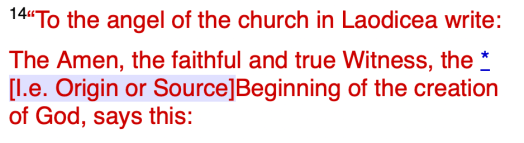
Actually, the NASB, which uses the word “BEGINNING” has a footnote provided by the translators in which they offer up the words “source” and “origin” as alternatives. In other words, the footnote demonstrates that the authors understood that the word “beginning” was meant to be understood in the sense that Jesus is the origin or source of creation.

When you click on the “asterisk”, the note is revealed:

Additionally, most translations do NOT use the word “beginning” in their translation.

The NLT translates Revelation 3:14 as:

“Write this letter to the angel of the church in Laodicea. This is the message from the one who is the Amen—the faithful and true witness, the ruler* [Or the source.] of God’s creation:

Note the translator’s “asterisk” that indicates that the word could mean “ruler” or “source”.

The NIV translates it this way:

14“To the angel of the church in Laodicea write:

These are the words of the Amen, the faithful and true witness, the ruler of God’s creation.

The Holman Christian Standard Bible translates it as:

14“Write to the angel of the church in Laodicea:

“The Amen, the faithful and true Witness, the Originator [Or Ruler, or Source, or Beginning] of God’s creation says:

The brackets are inserted by the translators to indicate different words that would be equally acceptable as translations of the Greek word “arche”.

The NET Bible offers this translation:

“To the angel of the church in Laodicea write the following:

“This is the solemn pronouncement of the Amen, the faithful and true witness, the originator54 of God’s creation:

Notice the number “54” just after the word “originator.” The NET Bible has extensive translation notes, which explain the decision process the translators used to arrive at their translation choices.

The summary of this note number 54 is that “beginning”, “ruler” or “originator” are all three linguistically possible. The editors explain that this term (Greek = arche) is well established in both the Septuagint (LXX) and intertestamental Jewish literature as meaning “ruler, authority.”

The truth is that  most translations do not use the word “beginning” for this verse and the translations that do use the word don’t use it to convey the meaning Jehovah’s Witnesses attribute to the verse.

In actuality, the word beginning is a fine word to use if you understand that Jesus literally is the first cause of creation. It is in that sense that he is the beginning. He is the source, the originator, the architect of creation. As such, he is ruler over creation.

One should also keep in mind that the author of Revelation is the apostle John, the same John who wrote the gospel of John and three shorter epistles near the end of the New Testament.

This same John identified Jesus as God in the opening verses of his gospel account, saying:

In the beginning was the Word, and the Word was with God, and the Word was God. 2He was in the beginning with God. (John 1:1, NASB)

To be fair, Jehovah’s Witnesses dispute the traditional Christian teaching of this verse, but I explain why their view is incorrect in my post “A Modern Day Version of an Ancient Heresy”.

This same John also wrote in his first epistle that

This is the message we have heard from Him and announce to you, that God is Light, and in Him there is no darkness at all. (1 John 1:5, NASB)

But in John 1, the author says this about Jesus:

In Him was life, and the life was the Light of men. 5The Light shines in the darkness, and the darkness did not comprehend it. (John 1:4-5)

John also said of Jesus that

All things came into being through Him, and apart from Him nothing came into being that has come into being. (John 1:3, NASB)

This does not sound like John believed that Jesus was created. Instead, John taught that Jesus created ALL things. If Jesus was the first created thing of Jehovah then John 1:3 would be a false statement as Jesus would be “something” that came into being.

A primary rule of Bible study is that Scripture interprets Scripture. In other words, if there is a verse that is confusing, we interpret it in light of other passages that are clear.

In Revelation 3:14, how are we to understand the word “beginning”? That is the debate between Jehovah’s Witnesses and traditional Christianity.

It’s clear that the translators all understood the word “beginning” in the sense that Jesus is the “beginner” or “first cause” of creation. This understanding is supported by all of the other words that could be used as a translation for the Greek word “arche”, including source, origin and ruler.

The Jehovah’s Witnesses explanation for the word “beginner” violates all of the other possible meanings while the traditional Christian understanding of the word “beginning” is in alignment with the other possible word choices.

In addition, the Jehovah’s Witness explanation of this verse contradicts other passages that clearly promote the same traditional Christian view.

In the final analysis, Revelation 3:14 doesn’t teach that Jesus is the first created being of Jehovah. On the contrary, it provides yet another substantial proof that Jesus is divine!


Did you enjoy this post? I’d love to hear your thoughts! Feel free to like, leave a comment below, and share it with your friends or on social media if you found it helpful or interesting. Your support keeps the conversation going!


Reflection

Given the fact that arche can mean “source”, “ruler” and “origin”, what logical explanation could explain how “beginning” means anything other than “first cause”? In other words, how do you explain the fact that the Jehovah’s Witness explanation of the Greek word “arche” does not match any of the other accepted definitions for the word?

Do you find the argument posed in this post against the Jehovah’s Witness’ interpretation of Revelation 3:14 convincing? Why or why not?

Some people argue that debating the nature of Jesus is fruitless and unnecessary. The argument is that as long as we believe that Jesus saves us, that’s all that matters. Everything else is just theological nit-picking. Do you agree with this sentiment? Why do you think it’s important to have a firm understanding of the nature of Jesus?

What has been your experience with Jehovah’s Witnesses? What verses or arguments have they made that you were not able to adequately respond to or refute?


Photo by Greg Rakozy on Unsplash

Did Jesus Die on the Cross or Merely Faint?

John 19

28Jesus knew that everything was now finished, and to fulfill the Scriptures he said, “I am thirsty.” 29A jar of sour wine was sitting there, so they soaked a sponge in it, put it on a hyssop branch, and held it up to his lips. 30When Jesus had tasted it, he said, “It is finished!” Then he bowed his head and gave up his spirit.

31The Jewish leaders didn’t want the victims hanging there the next day, which was the Sabbath (and a very special Sabbath at that, because it was the Passover), so they asked Pilate to hasten their deaths by ordering that their legs be broken. Then their bodies could be taken down. 32So the soldiers came and broke the legs of the two men crucified with Jesus. 33But when they came to Jesus, they saw that he was dead already, so they didn’t break his legs. 34One of the soldiers, however, pierced his side with a spear, and blood and water flowed out. 35This report is from an eyewitness giving an accurate account; it is presented so that you also can believe. 36These things happened in fulfillment of the Scriptures that say, “Not one of his bones will be broken,” 37and “They will look on him whom they pierced.” (John 19:28-37, NLT)


The Daily DAVEotional

Christianity stands or falls on one event – the resurrection.

Over the years, critics of Christianity have promoted a number of theories to argue that the resurrection never actually happened. If Jesus didn’t actually rise from the dead, Christianity is nothing more than another moral code.

One of the more novel theories to explain away a supernatural resurrection is the Swoon theory, which suggests that Jesus never actually died on the cross but merely fainted. Later, after he was buried, the cool air of the tomb revived him. He emerged from the tomb alive and people mistakenly believed that he had resurrected.

There are numerous problems with this theory.

First of all, if Jesus did indeed faint and then was revived, how is it that he had the strength to move a 2-ton boulder that covered the tomb entrance and then overcome the armed battalion that guarded the tomb?

Jesus was brutally whipped and scourged before he was even nailed to the cross. He was so weak from the lashes and the beating at the hands of the Roman soldiers that he wasn’t even able to carry his own cross to the crucifixion site.

He then hung on a cross for hours, which undoubtedly weakened him further. Even if he did not die, he was in critical condition. Yet this theory wants us to believe that a person in his condition was able to unravel himself from 75 pounds of grave clothes, then move a 2-ton boulder out of the way, fend off a contingency of elitely trained and armed Roman guards so that he could later appear to his followers and declare himself to be the resurrected Messiah. This would take more faith than believing in an actual resurrection.

Secondly, as C.S. Lewis has argued, if Jesus merely fainted and then emerged alive, declaring himself to be the resurrected Messiah, he would more aptly be compared to the devil than to God. Why is that?

In this scenario, Jesus would have foisted the greatest scam on people in the history of the world. Jesus, knowing he wasn’t God, would’ve had to have deceptively convinced people to give their lives for something that was a bold-faced lie.

As Lewis argued in Mere Christianity, this line of reasoning does not align with what we know about Jesus the man, namely that he was the greatest moral teacher the world has ever known.


Click here to see a A Comprehensive List of Blog Posts Based on Bible Passage Reference


Yet the Swoon theory forces us to believe that Jesus was not really a moral teacher as much as he was the best snake oil salesman who ever lived. He was so good, in fact, that most people still don’t realize they’ve been scammed.

Those are the philosophical reasons to reject the Swoon theory. However, there is evidence from this passage in John 19 that refutes the very basis of the Swoon theory.

The Swoon theory rests on the premise that Jesus didn’t actually die. Yet this passage provides convincing proof that Jesus indeed DID die.

How so?

Verse 31 tells us that the Jewish leaders didn’t want the crucified victims to be hanging on the cross during the Sabbath which was quickly approaching. The legs of crucifixion victims were often broken in order to hasten death. Essentially, the victims would no longer be able to push themselves up on the cross to inhale and they would suffocate rather quickly after their legs were broken. The text says that the soldiers broke the legs of the other two men who were crucified with Jesus. However, with Jesus, the soldiers saw that he was already dead, so there was no need to break his legs.

This is strong evidence that Jesus was already dead, contrary to those who might claim that he had only fainted or passed out.

There is another, even more convincing piece of evidence from this passage that demonstrates that Jesus was definitely dead when he came off that cross.

After the soldiers decided NOT to break Jesus’ legs, the text says that one of the soldiers took a spear and pierced Jesus’ side. There is no explanation as to why he decided to do that. What is interesting though is the description of what happened next. It says that “blood and water flowed out.”

The description of “blood and water” is significant. The author would not have had a medical understanding at that time that this was evidence of death. Blood and water would not have separated if Jesus were still alive but the fact that it WAS visibly separated PROVES that Jesus was dead.

Since this medical understanding was unknown in Jesus’ time, one cannot claim that the author deceptively described it this way in order to promote a false risen savior narrative.

One may still be unconvinced that Jesus resurrected, but one thing is certain, Jesus DID die. The idea that he fainted but then somehow emerged and declared himself to be the resurrected Messiah takes more faith than believing in the resurrection.

What this reveals is that for many, facts and rational explanations are not necessary in order to reject Jesus. All that’s necessary is a hardened heart.


Did you enjoy this post? I’d love to hear your thoughts! Feel free to like, leave a comment below, and share it with your friends or on social media if you found it helpful or interesting. Your support keeps the conversation going!


Reflection

Do you think the Swoon theory is an adequate explanation for Jesus’ death on the cross? Why or why not?

If Jesus did only faint on the cross instead of actually dying, how do you explain a) the soldiers not breaking his legs, b) the description of water and blood flowing from the pierced side, c) Jesus’ ability to move the stone that covered the entrance and d) his ability to fend off the armed soldiers who guarded the tomb?

Do you agree with C.S. Lewis, that Jesus could not be considered a good moral teacher if he in fact KNEW that he hadn’t died and had not resurrected but yet convinced people that he DID resurrect? How does Lewis’s argument bolster the case for a supernatural resurrection?

Why do you think someone would believe this alternate explanation which requires a number of logical leaps instead of just believing what the text claims, which is that Jesus was resurrected?


Photo by Nik Shuliahin 💛💙 on Unsplash

Did Jesus Teach that You Need to be Baptized to be Saved?

John 3

1Now there was a man of the Pharisees named Nicodemus, a member of the Jewish ruling council. 2He came to Jesus at night and said, “Rabbi, we know you are a teacher who has come from God. For no one could perform the miraculous signs you are doing if God were not with him.”

3In reply Jesus declared, “I tell you the truth, no one can see the kingdom of God unless he is born again.

4“How can a man be born when he is old?” Nicodemus asked. “Surely he cannot enter a second time into his mother’s womb to be born!”

5Jesus answered, “I tell you the truth, no one can enter the kingdom of God unless he is born of water and the Spirit. 6Flesh gives birth to flesh, but the Spirit gives birth to spirit. 7You should not be surprised at my saying, ‘You must be born again.’ 8The wind blows wherever it pleases. You hear its sound, but you cannot tell where it comes from or where it is going. So it is with everyone born of the Spirit.”

9“How can this be?” Nicodemus asked.

10“You are Israel’s teacher,” said Jesus, “and do you not understand these things? 11I tell you the truth, we speak of what we know, and we testify to what we have seen, but still you people do not accept our testimony. 12I have spoken to you of earthly things and you do not believe; how then will you believe if I speak of heavenly things? 13No one has ever gone into heaven except the one who came from heaven—the Son of Man. 14Just as Moses lifted up the snake in the desert, so the Son of Man must be lifted up, 15that everyone who believes in him may have eternal life.

16“For God so loved the world that he gave his one and only Son, that whoever believes in him shall not perish but have eternal life. 17For God did not send his Son into the world to condemn the world, but to save the world through him. 18Whoever believes in him is not condemned, but whoever does not believe stands condemned already because he has not believed in the name of God’s one and only Son. 19This is the verdict: Light has come into the world, but men loved darkness instead of light because their deeds were evil. 20Everyone who does evil hates the light, and will not come into the light for fear that his deeds will be exposed. 21But whoever lives by the truth comes into the light, so that it may be seen plainly that what he has done has been done through God.” (John 3:1-21, NIV)


The Daily DAVEotional

A few weeks ago, I had an online encounter with a Mormon who, in his quest to explain the legitimacy and necessity of the Mormon church, made the claim that the Bible teaches that baptism is necessary for salvation.

One of the passages he referenced to back up his claim was this passage from John 3, where Jesus has a conversation with Nicodemus, a Pharisee who came to Jesus secretly at night.

I previously wrote on this same passage (John 3:1-8) in my blog post “The Born-Again Redundancy” but that post, while it expounded some on the conversation Jesus had with Nicodemus, never addressed the issue of baptism.

There’s a good reason why my previous post did not talk about the issue of baptism and that’s because neither the word nor the concept is found anywhere in the passage.

But since this passage was offered up as a proof text for the view that baptism by immersion with water (what I’ll from here on out refer to as “water baptism” or “baptismal regeneration”) is essential for salvation, it seems necessary and appropriate to comment on what Jesus is actually teaching in this passage.

If the words “baptism” and “baptize” are nowhere to be found within this passage, why would someone use this passage as “evidence” that Jesus taught baptism was necessary for salvation?

In short, I believe this passage is used as evidence by those who hold to the necessity of baptism for salvation simply because Jesus mentions water.


Click here to see a A Comprehensive List of Blog Posts Based on Bible Passage Reference


As I conversed with this Mormon acquaintance online, he noted that Jesus himself said that in order to enter the Kingdom of God, one must be born of water and the Spirit. He argued that when Jesus mentioned being “born of water” he was referencing the ordinance of baptism.

This conclusion is actually a perfect example of the theological error known as eisegesis, which means “to read into the text.”

What exactly does that mean?

When we read and study the Bible, our goal should be to understand what the author meant when he wrote what he wrote. We do our best to place ourselves in the context of the person living at the time the text was written and seek to understand what it would have meant to a person living within that culture at that specific time. This is known as exegesis, or “drawing out of the text.”

When we understand what the author’s original intent was, we can then understand how the original hearer of the text would have understood what they were reading and hearing. That is the original message we want to capture, understand and apply to our own situation.

But eisegesis functions in the exact opposite way. Instead of seeking to understand what the text meant to the original audience, the person imports their preferred meaning into the text and then declares that to be the teaching.

So in our case, it looks like this:

Jesus had a conversation with Nicodemus about how one enters the kingdom of God and Jesus said that a person must be born of water and the Spirit.

Even though Jesus says nothing about baptism and it’s unclear at first glance what it means to be born of water and what it means to be born of the Spirit, the person who holds to baptismal regeneration has already concluded that the passage is talking about baptism.

Since the conclusion is already determined, reasons justifying that conclusion are then produced. In this case, the passage has the term water in it and baptism requires water so it is argued that this passage must be speaking about baptism.

This line of reasoning utterly fails.

Not only does Jesus not say baptism is necessary for salvation, he doesn’t even mention baptism in this interchange.

So then what is Jesus saying?

I explain this more fully in my blog post “The Born-Again Redundancy” but Jesus is explaining to Nicodemus that just as a person is born physically which leads to physical life, so a person must be born spiritually in order to experience spiritual life, or life in the kingdom of God.

Jesus himself explains what is meant by the phrase “being born of water and the Spirit” when he says just a few verses later that “flesh gives birth to flesh but the Spirit gives birth to spirit.”

It’s clear that being born of water refers to physical birth while being born of the Spirit refers to a spiritual birth. According to Jesus, both are necessary for salvation. In reality, everyone who has ever existed has already experienced physical birth just by being born.

So then, what is necessary to enter the kingdom of God is to experience a spiritual birth. This is the entire point Jesus is making to Nicodemus – to enter the kingdom of God, you must experience a spiritual birth.

The natural question then is “how does one experience a spiritual birth?”

Notice that as Jesus continues his discourse with Nicodemus, he does not mention baptism as a condition for salvation (spiritual birth). In fact, baptism is not mentioned anywhere in the passage.

What Jesus DOES mention as necessary for salvation, multiple times in fact, is BELIEF.

Specifically, in verse 15, Jesus says “that everyone who believes in him [Jesus] may have eternal life.”

Again, in verse 16, one of the most famously quoted verses in the entire Bible, Jesus says “that whoever believes in him [Jesus] shall not perish but have eternal life.”

So what is the verdict?

Concerning the charge that Jesus taught that baptism was/is necessary for salvation, the charge is false. Jesus did not teach that in this passage. Instead, he taught that a spiritual birth is necessary in order to know God and experience life in his kingdom. Jesus, as well as the other New Testament authors, taught that this spiritual birth comes as a result of BELIEF in the person and the work of Jesus on the cross.

To examine this issue further, see the following related posts:


Did you enjoy this post? I’d love to hear your thoughts! Feel free to like, leave a comment below, and share it with your friends or on social media if you found it helpful or interesting. Your support keeps the conversation going!


Reflection

What are some examples you have seen of eisegesis – when a person imports their doctrine or theological preference upon a text that doesn’t appear to be teaching that doctrine or idea at all?

If you believe that Jesus, in this passage, is talking about the importance of baptism to Nicodemus, what reasons do you have to support that interpretation?

Jesus told Nicodemus that in order to see the kingdom of God, a person must be “born again”. What do you think it means to be “born again?” How do you understand that phrase?

It’s clear that Nicodemus falsely understood Jesus’ term “born again” to be referring to a 2nd physical birth. Jesus corrects him and explains that he’s talking about a spiritual reality that must take place. Based on this passage, what does Jesus teach about how a person experiences this spiritual birth?

Have you personally experienced a spiritual birth? If not, what keeps you from taking that step?

If you want to learn more about experiencing a “spiritual birth” and experiencing eternal life and life in the kingdom of God, read my blog post “Four Points to Understand How to Experience Eternal Life.”


Photo by Daniel & Hannah Snipes: https://www.pexels.com/photo/outdoor-baptism-ceremony-in-south-carolina-30477080/

What is the Rapture?

1 Thessalonians 4

13And now, brothers and sisters, I want you to know what will happen to the Christians who have died so you will not be full of sorrow like people who have no hope. 14For since we believe that Jesus died and was raised to life again, we also believe that when Jesus comes, God will bring back with Jesus all the Christians who have died.

15I can tell you this directly from the Lord: We who are still living when the Lord returns will not rise to meet him ahead of those who are in their graves. 16For the Lord himself will come down from heaven with a commanding shout, with the call of the archangel, and with the trumpet call of God. First, all the Christians who have died will rise from their graves. 17Then, together with them, we who are still alive and remain on the earth will be caught up in the clouds to meet the Lord in the air and remain with him forever. 18So comfort and encourage each other with these words. (1 Thessalonians 4:13-18, NLT)


The Daily DAVEotional

You may have heard Christians talk about “the Rapture” and asked yourself, “what is that?”

The rapture is a biblical end times event that was popularized in the mid-to-late 20th century through books such as Hal Lindsey’s “Late Great Planet Earth” and the “Left Behind” book series from authors Tim LaHaye and Jerry Jenkins.

While most evangelical Christians embrace the doctrine of Jesus’ second coming, that Jesus will appear at the end of time to judge the world, eradicate evil and reign over creation forever, not all Christians hold to the doctrine known as “the rapture”, which is considered an event that is separate from and preceding to the second coming of Christ.

For those who do hold to a “rapture” as a distinct event from the second coming, this passage in 1 Thessalonians is a primary passage in support of their view.

In this passage, Paul is seeking to console the Thessalonians who are grieved that many of their loved ones have passed. Paul is correcting a misunderstanding these young believers had concerning what happens to believers after they have passed.


Click here to see a A Comprehensive List of Blog Posts Based on Bible Passage Reference


The Thessalonians apparently had mistakenly believed that because their loved ones were in the grave, they would miss out on “the rapture”.

What exactly is the rapture?

“The rapture” is a doctrine that says Jesus will appear unexpectedly to take believers from this earth so that they might be with Him for eternity.

The word rapture comes from the Latin word “rapturo” which comes from verse 17 where Paul says that when Jesus returns, believers will be “caught up” with Christ in the clouds and will remain with Him forever. The Latin word for “caught up” is rapturo.

So the rapture is that moment when believers will be “caught up” with Jesus upon His return.

Paul tells these Thessalonian believers that those who have already died and are in the grave will be raised up first to meet Jesus and then those who are alive will be “caught up” with them.

So the order of events, according to this passage from Paul, is as follows:

    • Jesus will come back at some point. The exact timing of His return is not known so believers are exhorted to always be ready and to not be caught off guard
    • When Jesus returns, all those who have died will be resurrected and will meet Jesus in the clouds
    • Those believers who are alive on earth when Jesus returns will also meet Jesus in the clouds AFTER those who have already died are raised

As has already been mentioned, not all Christians agree that what Paul is describing in this passage is a separate, distinct event from the second coming of Christ. There are valid arguments for each view – that the rapture is a separate event that precedes the second coming of Jesus, and that the rapture is simply a different description of the second coming of Christ.

Regardless of the view one might take, we know for certain from this passage that Jesus WILL come back. When he does, those who have already died WILL be raised from the dead and WILL meet Jesus. Additionally, those who are alive when Jesus returns WILL also meet Jesus.

Paul says that this teaching is designed to give us hope, knowing that we, as believers, have a purpose and a destiny beyond this life. If there is no resurrection and no hope for life beyond our earthly physical existence, then, as Paul says in 1 Corinthians 15, “we are to be pitied more than all men.” (See my blog post “Will Christians Really Experience a Bodily Resurrection?“)


Did you enjoy this post? I’d love to hear your thoughts! Feel free to like, leave a comment below, and share it with your friends or on social media if you found it helpful or interesting. Your support keeps the conversation going!


Reflection

What do you think happens to people after they die? What has been. your belief about the afterlife?

Have you heard of the rapture? What have you been taught about the events leading up to the “end times”?

Do you think it matters what a person believes about the end times? Why do you think it’s important that we, as Christians, understand what the Bible teaches about the end times?

If the rapture really is an event that is distinct from and preceding to the second coming of Jesus, how does that change how you think about the Christian life and live out the Christian life?


Photo by Mahmoud Yahyaoui: https://www.pexels.com/photo/dramatic-sunlight-through-fluffy-clouds-29286046/

Is Baptism Necessary for Salvation?

Luke 3

15Everyone was expecting the Messiah to come soon, and they were eager to know whether John might be the Messiah. 16John answered their questions by saying, “I baptize with water; but someone is coming soon who is greater than I am—so much greater that I am not even worthy to be his slave. He will baptize you with the Holy Spirit and with fire. 17He is ready to separate the chaff from the grain with his winnowing fork. Then he will clean up the threshing area, storing the grain in his barn but burning the chaff with never-ending fire.” 18John used many such warnings as he announced the Good News to the people.

19John also publicly criticized Herod Antipas, ruler of Galilee, for marrying Herodias, his brother’s wife, and for many other wrongs he had done. 20So Herod put John in prison, adding this sin to his many others.

21One day when the crowds were being baptized, Jesus himself was baptized. As he was praying, the heavens opened, 22and the Holy Spirit descended on him in the form of a dove. And a voice from heaven said, “You are my beloved Son, and I am fully pleased with you.” (Luke 3:15-22, NLT)

Acts 1

1Dear Theophilus:

In my first book I told you about everything Jesus began to do and teach 2until the day he ascended to heaven after giving his chosen apostles further instructions from the Holy Spirit. 3During the forty days after his crucifixion, he appeared to the apostles from time to time and proved to them in many ways that he was actually alive. On these occasions he talked to them about the Kingdom of God.

4In one of these meetings as he was eating a meal with them, he told them, “Do not leave Jerusalem until the Father sends you what he promised. Remember, I have told you about this before. 5John baptized with water, but in just a few days you will be baptized with the Holy Spirit.” (Acts 1:1-6, NLT)


The Daily DAVEotional

Is baptism necessary for salvation?

Some Christians will whole-heartedly say “YES”, while many Catholics might also agree.

I’ve engaged with others over this question many times before but was recently re-introduced to this debate from an unexpected source.

You may recall that around the beginning of June (2026) there was some controversy surrounding the government and the Mormon church. I’ve shared some details about that in my blog post “Should People Take the Mormon Challenge?” but the summary is that the Department of Defense, in an effort to simplify the job of military chaplains, decided to reduce the number of codes that identify the different religious affiliations that troop members might align with from over 200 down to about 30.

These codes included a number of different “Christian” affiliations, such as “Christian-Baptist” and “Christian-Presbyterian”. However, when identifying the Mormon church, the code was listed simply as “Latter Day Saint”.

This had a number of Mormons objecting that the government did not identify the Mormon church as a subset of  Christianity.

In the ensuing online debate, I ended up engaging with a Mormon who was attempting to explain the legitimacy of the Mormon church to those who were suggesting that Mormons aren’t Christians.

One of the points this person made was that the Mormon church had re-established the priesthood, which Mormonism claims had been lost by the church for nearly 1800 years, and that this “restored” priesthood now allowed for legitimate baptisms. This is important, according to Mormons, because since baptism is necessary for salvation (in their view), the church needs a legitimate priesthood in order to administer baptisms and thus “save” people.

There’s a lot of Mormon theology that could be debated here but for this post, I want to look strictly at the assertion this Mormon made that baptism is necessary for salvation.

As luck would have it, that next day, two of the chapters in my daily Bible reading were the two chapters listed above, both of which talk about baptism.

An exhaustive discussion of whether baptism is necessary for salvation would likely take more room to unpack than just this blog post but these two passages do give us some insight into the issue.

First of all, if water baptism is necessary for salvation, one has to wonder why Jesus was baptized. Did Jesus need to be saved?

Clearly, Jesus didn’t need to be saved so there must be a different reason for His baptism. This alone tells us that baptism is not always associated with salvation. I wrote about this issue in my blog post “Why Was Jesus Baptized?”

A second observation from these passages is the fact that there are clearly different kinds of baptism mentioned.


Click here to see a A Comprehensive List of Blog Posts Based on Bible Passage Reference


Note that John the Baptist himself said that he baptized with water but someone would come after Him (Jesus) who would baptize with the Holy Spirit and fire. John makes a point to say that this person who would come after him (Jesus) was greater than he was. This implies also that the baptism of Jesus was greater, better and more important than the baptism of John.

Jesus confirms this in the Acts passage when he reminds his disciples what they had been taught before, that John would baptize with water but He (Jesus) would baptize with the Holy Spirit.

Jesus then told them that this baptism with the Holy Spirit would take place “in just a few days”.

It’s clear from Scripture that Jesus was referencing the events of Pentecost in Acts 2, when the Holy Spirit descended upon these early believers and came to indwell them. It’s at this moment that the church was born.

So for the person who believes that water baptism is essential for salvation, the question they must ask is: why does Jesus emphasize His baptism of the Spirit over the water baptism that John the Baptist performed?

One thing is absolutely clear from these two passages: Jesus’ baptism is different from the baptism of John the Baptist. While John the Baptist baptized people with water, Jesus would baptize people with the Holy Spirit.

If we’re going to have any chance of resolving the question of whether baptism is necessary for salvation, we have to come to an understanding of what it means when Jesus said he would baptize with the Holy Spirit.

The problem that too many people experience when they’re faced with this issue is one of familiarity.

What I mean by that is that most people, when they hear the word “baptize”, immediately conjure up an image in their mind based on their own understanding of the word, which is primarily shaped by their own experience with baptism.

For most people, their only association with the word is that they’ve seen many people who have been baptized with water, either by sprinkling in the Catholic church and various Protestant traditions or by immersion in many evangelical traditions.

If your only exposure to the word “baptize” is seeing someone who has been baptized with water, then you naturally will assume that whenever you see the word, it must refer to being sprinkled or immersed with water.

But as these two texts above demonstrate, baptism is not always associated with water. Therefore, the idea that one must be sprinkled or immersed in water as a part of the salvation process is already in doubt. And since both John the Baptist and Jesus affirm that the baptism Jesus would bring was NOT water baptism, then there is virtually no reason to believe that being baptized with water is anything more than symbolism.

A more careful study of the word “baptize” reveals that this is exactly the case.

The more broad meaning of the word “baptize” is “to identify with.”

Hence, people who were baptized by John the Baptist were identifying with him. As a way to demonstrate publicly that they agreed with John’s preaching, they took the step to be baptized by him, thus identifying themselves with his core message of repentance. One might think of it as an initiation.

Jesus’ baptism is not one that is associated with water but the Holy Spirit. Being baptized in the Spirit means that the person now identifies with the Holy Spirit and thus is now a member of God’s family.

The apostles were all first identified with the Holy Spirit in Acts 2. They were “baptized” by the Spirit and “initiated” into the body of Christ, the family of God.

The question for us is when is the believer first associated with the Holy Spirit? Is it at the moment of being baptized with water, as Mormons and some Protestants claim? If that is the case, then we can affirm that water baptism is indeed necessary for salvation.

But Scripture tells us otherwise. Most notably, Paul, in Ephesians 1:13, says that the Holy Spirit is given to the Christian as a seal at the moment of belief, NOT at the moment of being immersed in water. I wrote about this aspect of the Holy Spirit in my blog post, “The Holy Spirit as a Seal.”

So then, if water baptism is not essential for savlation, what is the purpose? Why do it?

Like a lot of things in Scripture, water baptism is a physical representation of a spiritual reality.

In Scripture, water is often a symbol of the Holy Spirit. In John 7:37-39, Jesus addresses the crowds and tells them that if anyone is thirsty, they should come to Him and drink and streams of living water would flow from within them. The text follows by explaining that Jesus was talking about the Holy Spirit.

So the act of being baptized with water is simply an act whereby the believer is attesting to the fact that they now identify with Jesus and are a part of His family. The qualifying characteristic of being a part of the family of Jesus is that you must have the Holy Spirit. The believer, in being baptized with water, is making a declaration of faith – that they now have placed their trust in Christ and as a result, they have received the promised Holy Spirit and have been placed into the family of God.

So let’s circle back to our original question: “Is baptism necessary for salvation?” The answer is that it depends on what you’re referring to when you talk about baptism.

If you are asking whether a person needs to be baptized with water in order to be saved, the answer from Scripture is clearly NO.

But if you understand baptism to be an identification and union with the Holy Spirit, then the answer is YES, you absolutely must be SPIRITUALLY baptized in order to be saved, for one cannot be saved unless they become a member of the family of God and the prerequisite to becoming a member of the family of God IS receiving the Holy Spirit, which, according to Scripture, occurs the moment a person puts their faith in Jesus.


Did you enjoy this post? I’d love to hear your thoughts! Feel free to like, leave a comment below, and share it with your friends or on social media if you found it helpful or interesting. Your support keeps the conversation going!


Reflection

What has been your experience with baptism? What comes to your mind when you hear the word “baptize”?

What do you think is the purpose of baptism? If you have been baptized, how did you interpret that experience in terms of its meaning?

Would you agree that Jesus’ baptism is greater than and more important than John’s baptism? 

If Jesus’ baptism is more important that John’s baptism, then they must be different in some way. What do you think are the differences between these two kinds of baptism?

If the purpose of water baptism is to save people, then why do you think Jesus was baptized by John? Clearly Jesus didn’t need to be saved.


Photo by Paul Ndayambaje: https://www.pexels.com/photo/a-man-in-a-blue-dress-is-in-the-water-28181227/

What is the Significance of the “Sign of Jonah?”

Luke 11

29As the crowd pressed in on Jesus, he said, “These are evil times, and this evil generation keeps asking me to show them a miraculous sign. But the only sign I will give them is the sign of the prophet Jonah. 30What happened to him was a sign to the people of Nineveh that God had sent him. What happens to me will be a sign that God has sent me, the Son of Man, to these people.

31“The queen of Sheba will rise up against this generation on judgment day and condemn it, because she came from a distant land to hear the wisdom of Solomon. And now someone greater than Solomon is here—and you refuse to listen to him. 32The people of Nineveh, too, will rise up against this generation on judgment day and condemn it, because they repented at the preaching of Jonah. And now someone greater than Jonah is here—and you refuse to repent. (Luke 11:29-32, NLT)


The Daily DAVEotional

In this passage of Scripture, Jesus is responding to “others” from Luke 11:16 who were trying to test Jesus by asking “for a miraculous sign from heaven to see if he was from God.”

A similar incident occurs in Matthew 16, which I wrote about here. The summary in that passage as in this passage, is that Jesus says that those who demand a sign are evil. This is because all of the evidence needed to determine that Jesus is from God has already been given. I unpack this more in my blog post “When Someone DEMANDS Evidence!”

What’s interesting to me about this passage in Luke is what Jesus says about Jonah that is not in the Matthew passage.

Jesus says that “What happened to him [Jonah] was a sign to the people of Nineveh that God had sent him.”

I’ve read this statement from Jesus hundreds of times without realizing the significance of what Jesus is saying here.

So what’s he saying? Why is this significant?

Coincidentally, my men’s group just recently went through a short Bible study on the book of Jonah, which is only 4 chapters long with a total of 48 verses.


Click here to see a A Comprehensive List of Blog Posts Based on Bible Passage Reference


The summary of Jonah is as follows:

God tells Jonah to go to Nineveh, the capital of the Assyrian empire, and announce God’s judgment against the city.

Jonah rebels against God’s directive and flees by getting on a ship that is headed in the opposite direction from Nineveh.

God gets Jonah’s attention by causing a great storm that threatens the safety of those on the ship and Jonah gets thrown overboard by the other passengers as a way to quell the storm and save themselves.

As a result of the storm abating, these passengers, who all worshiped pagan gods, end up worshipping Yahweh and making vows to Him.

Jonah gets saved from drowning by being swallowed by a big fish. He’s in the belly of the fish for 3 days before being spit up on some unknown beach.

Some time after this (we don’t know how long exactly), God tells Jonah once again to go to Nineveh and announce God’s judgment against the city.

This time Jonah complies.

When he gets to Nineveh, Jonah once again announces God’s judgment with a very brief message.

The text of Jonah 3 says that the whole city repented, including the king. I’ve always thought their response was interesting and out of character given the haughty and braggadocious attitude of the Assyrians. At the time, the Assyrians were the biggest baddest dudes on the block and were  not afraid of any foreign deities or any other regional powers.

2 Kings 18 gives the account of the Assyrian siege of Jerusalem, in which Sennacherib’s representative said:

“Listen to this message from the great king of Assyria! 29This is what the king says: Don’t let King Hezekiah deceive you. He will never be able to rescue you from my power. 30Don’t let him fool you into trusting in the LORD by saying, ‘The LORD will rescue us! This city will never be handed over to the Assyrian king.’

. . . .

“Don’t listen to Hezekiah when he tries to mislead you by saying, ‘The LORD will rescue us!’ 33Have the gods of any other nations ever saved their people from the king of Assyria? 34What happened to the gods of Hamath and Arpad? And what about the gods of Sepharvaim, Hena, and Ivvah? Did they rescue Samaria from my power? 35What god of any nation has ever been able to save its people from my power? Name just one! So what makes you think that the LORD can rescue Jerusalem?” (2 Kings 18:28-30, 32-35, NLT)

The Assyrians were certainly NOT afraid of the God of Israel. To them, Yahweh was as weak as every other regional deity.

So how is it that in the account of Jonah, the Assyrians are so quick to repent?

Jesus’ words in Luke 11 give us additional insight as Jesus says that what happened to Jonah was a sign to the people of Nineveh that God had sent him.

Did you catch that?

The Assyrians had already heard of what happened to Jonah by the time he arrives with his message of impending doom. Somehow, the ordeal on the boat, in which Jonah’s God, Yahweh, had immediately calmed the storm, got back to the Assyrians. It seems most likely that the other passengers on that boat, the ones who ended up worshipping Yahweh and making vows to Him, told their story and the word quickly spread.

This scenario reminds me of the Israelite’s deliverance from slavery to the Egyptians, in which God not only demonstrated His power and sovereignty through the various plagues, but who also delivered the Israelites by parting the Red Sea while destroying the Egyptian army who attempted to follow.

When the Israelites finally arrived at the edge of the promised land, the multiple nations they would eventually displace had all heard of God’s great acts of deliverance, causing the Israelites to be greatly feared.

Tha Assyrians had gotten word about this powerful God, so much so that when Jonah finally arrives on the scene, he needs no introduction and barely has to say a word to convince the Assyrians that God means business.

The result is that this world empire that had seen themselves as invincible, were now on their knees begging the God of the universe not to bring impending disaster upon them.

Jonah’s rebellion led to a divine encounter for a group of pagan seafarers, whose story got back to the very nation Jonah was supposed to warn. So when Jonah finally gets to the destination to which God had sent him, the people are amazingly ready to respond.

Jesus’ message to those who want a sign is this: the Assyrians heard about Jonah so that when Jonah showed up, they knew he had been sent by God.

In the same way, what happened to Jesus would be THE sign that Jesus was sent by God.

What was it that happened to Jesus?

He was crucified and dramatically rose from the dead.

If the resurrection is not enough evidence for someone who demands a sign to know if Jesus really was sent by God, then no amount of evidence will do.


Did you enjoy this post? I’d love to hear your thoughts! Feel free to like, leave a comment below, and share it with your friends or on social media if you found it helpful or interesting. Your support keeps the conversation going!


Reflection

Are you a person who needs evidence, or a sign that Jesus is God? If so, what evidence would convince you?

Why do you think Jesus says that people who require a sign are part of “this evil generation?”

Many people have a hard time believing the story of Jonah, particularly the part where he is swallowed by a great fish. How does Jesus mentioning Jonah in this Luke passage add credibility to the story of Jonah?

Jesus says that He is greater than Jonah and yet people refuse to listen to Him. Why do you think people refuse to listen to Jesus? What steps can you take to ensure that you don’t stop listening to Jesus?


Photo by Francesco Ungaro: https://www.pexels.com/photo/majestic-whale-tail-above-ocean-waters-34392859/

Should People Take the Mormon “Challenge”?

Galatians 1

6I am shocked that you are turning away so soon from God, who in his love and mercy called you to share the eternal life he gives through Christ. You are already following a different way 7that pretends to be the Good News but is not the Good News at all. You are being fooled by those who twist and change the truth concerning Christ.

8Let God’s curse fall on anyone, including myself, who preaches any other message than the one we told you about. Even if an angel comes from heaven and preaches any other message, let him be forever cursed. 9I will say it again: If anyone preaches any other gospel than the one you welcomed, let God’s curse fall upon that person.

10Obviously, I’m not trying to be a people pleaser! No, I am trying to please God. If I were still trying to please people, I would not be Christ’s servant. (Galatians 1:6-10, NLT)


The Daily DAVEotional

If you haven’t noticed, Mormonism has been a huge topic on social media the last few days. The main topic of discussion and debate has been centered around the question of whether or not Mormons are Christians.

For context, the Department of Defense recently posted a memo regarding new abbreviated codes to identify the many different religious backgrounds that might be represented among the troops.

According to Secretary of War Pete Hegseth, the previous list of religious options was out of control, with over 200 different options. The goal was to simplify the number of codes and options, making it easier for chaplains to do their job of ministering to the troops.

The problem was that the new list had a number of different Christian denominations listed, such as “Christian-Baptist” and “Christian-Presbyterian” but the Mormon Church was not listed as Christian. Instead, it was listed simply as “Latter Day Saint.”

This set off a firestorm among many Mormon influencers and regular Mormon Joes who were offended that the U.S. government apparently didn’t consider Mormons to be Christian.

Chief among those speaking out online were Utah Senator Mike Lee (@basedMikeLee on X), who took every opportunity to post his thoughts and objections to this “egregious error” inflicted on Latter Day Saints.

This incident sparked a lot of online conversations about whether or not Mormons are Christians.

Mormons, of course, believe they ARE Christians, while evangelicals have argued that Mormons are NOT Christians because, despite the fact that Jesus Christ is in their name, they do not hold to the traditional Christian doctrinal views on Jesus, God, the Church, salvation, or the Scriptures.

The online discussion afforded many Mormons, including Senator Lee, the opportunity to inform and proselytize others regarding the Mormon faith.

In one of his posts, Senator Lee offered up what I’m calling the “Mormon challenge”:

This is the Mormon “trump” card so to speak. “Just read the Book of Mormon in it’s entirety”, they say, “and ask God humbly and with sincerity if it’s true.” This challenge is often offered as a gauntlet that is laid down for those who portend to be truth-seekers.

“What do you have to lose”, Mormons ask. The sentiment is, “Don’t be a chicken!”

Millions of Mormons attest that Mormonism is indeed true based on this challenge.

Should Christians accept this challenge?

The answer is a resounding NO.

There are two reasons why Christians should not take this challenge and neither of them have to do with being scared of the outcome.

The first reason you should not take this challenge is because it’s not falsifiable. The challenge is actually like the old “heads I win, tails you lose” proposition, which means that the challenge is designed to “prove” Mormonism is true regardless of the results of your humble and sincere prayer.

Think about it: if you pray and you say that you felt nothing or you didn’t get any firm and obvious confirmation from your prayer, the Mormon can just say that you were obviously not sincere enough, or humble enough or something similar.

Yet if you say that you DID feel something, that emotional response, regardless of how small or incomprehensible, is offered as proof that Mormonism is true.

In other words, the challenge simply appeals to an emotional response as evidence of veracity.

This leads to the second reason one should NOT take this challenge, which is that it’s unbiblical.

Nowhere in Scripture are people encouraged to evaluate truth claims by appealing to an emotional response.

Instead, we are exhorted to test a message against the clear revelation that has already been given by God.

Acts 17 is a good example of this. I have written about this passage in another blog post, “Fact-Checking and Misinformation in the New Testament” in which the Bereans were commended for testing Paul’s message against the Scriptures.

A second clear example of testing a message is in the Galatians passage listed above, in which Paul tells his audience that any “gospel” message that is not in alignment or in agreement with the gospel message he had already preached to them was to be rejected. Paul tells the Galatians that the person giving this false message is to be cursed.

We know exactly what the message was that Paul originally preached to the Galatians because he writes his letter to the Galatians to reinforce the original message and to correct their subsequent misunderstanding brought about by false teachers. The gospel message Paul preached was a message of justification by faith in Christ alone, apart from any works.

Since we already know that the Mormon message is different than Paul’s message on many different levels doctrinally, there is no need to “pray on it.” In fact, reading the Book of Mormon and praying on it could be considered disobedience to Paul’s admonition to outright reject so-called gospel messages that are different from what he taught the Galatians.

The debate about whether Mormons are Christian or not, while interesting, is in many ways irrelevant. The truth is that anyone can identify themselves as a Christian. Yet, it’s not as important what you call yourself as what you believe.

Mormons say they are Christians because they follow Jesus Christ. But so do Jehovah’s Witnesses, Catholics, Evangelical Christians, Liberal Christians and even Progressive Christians. Even Muslims will tell you that they respect and revere Jesus as a prophet.

All these groups, along with Latter Day Saints, have wildly different theological views on God, Jesus, salvation and the nature of the church, and yet, they all consider themselves “Christian”.

Are they Christian? The only way we can really know is to evaluate their beliefs in relation to what the Bible teaches.

With that in mind, I propose an alternate challenge to those who consider themselves Mormons…a challenge that is actually biblical. The challenge is to read the Bible cover to cover. Then compare the teachings of Mormonism with the teachings of the Bible, and specifically, compare the Mormon message with the gospel message taught by Jesus and the apostles in the New Testament.

Then tell me – does Mormonism line up with the already revealed and accepted teachings of Jesus and the apostles?

So Mike Lee (and other Mormons)….will you accept the challenge?


Did you enjoy this post? I’d love to hear your thoughts! Feel free to like, leave a comment below, and share it with your friends or on social media if you found it helpful or interesting. Your support keeps the conversation going!


Reflection

What is your definition of a Christian? According to the Bible and the gospel, how does one become a Christian?

What was the essence of the salvation message taught by Jesus and His disciples? What is the essence of the Mormon message regarding how a person is saved?

What is the traditional Christian teaching on the nature of Jesus? How do Mormons view the nature of Jesus? Are these two views the same? How do they differ?

Do you think it matters what a person believes about Jesus in order to be saved? Or is it simply enough to say you believe in Jesus? 


photo by Dave Lowe

What Does it Mean to Bear Fruit that Lasts?

John 15

16You did not choose me, but I chose you and appointed you to go and bear fruit]—fruit that will last. Then the Father will give you whatever you ask in my name. 17This is my command: Love each other. (John 15:16-17, NIV)


The Daily DAVEotional

Lately I’ve been giving a lot of thought to what makes a ministry effective – what it means to bear fruit.

Within our own ministry with Cru and certainly within the church where we’re involved, there’s a lot of ministry activity. Meetings, events, campaigns and lots of talk of growth and numbers. Statistics. Charts.

It’s all good stuff. I’m not complaining. I know that for every number, there’s a person whose life has been impacted. It’s good and appropriate to celebrate success and all that the Lord has done.

However, I sometimes wonder if Jesus’ own ministry might be considered an abject failure when evaluated by modern church growth strategies and metrics.

After all, though Jesus preached to the masses, he had a relatively small following of just over 100 men (and some women too), with only 12 men in his inner circle.

One of those 12 men betrayed Jesus, leading to His arrest and crucifixion, while the rest of His disciples ALL deserted Him when He was in His darkest hour.

I’m not sure Jesus’ ministry looked “fruitful” to the modern evangelical church.

However, in John 15:16, Jesus said to his disciples,

“You did not choose me, but I chose you and appointed you to go and bear fruit – fruit that will last.”

It seems that “fruit” is evaluated not by its immediate result, but its lasting impact.

A few months back, I took a trip to Northern California to visit friends and ministry partners, many of whom are former students from our many years of campus ministry.

One of my first meet-ups was with Eric and Lane, two friends and former students from our early years at San Jose State.

Lane (left) and Eric (center) were a part of small groups I led way back in my early years with Cru at San Jose State University.

Eric was one of the first students I ever met when I arrived at San Jose State University as a new Campus Crusdae for Christ staff member. He wasn’t a believer but soon placed his faith in Christ and, like Lane, has been on a trajectory of growth for the last 37 years. Both of these men are exhibiting enduring faith, walking with Christ even in the midst of unbelievably challenging life circumstances.

Mike got involved with Cru at UC Davis when we were just starting out and maybe had 5 students.He was a gifted leader and an amazing guitar player who had a heart for worship.

Mike was one of the first few students to get involved with Cru when we started the ministry at UC Davis nearly 30 years ago

Mike had a crazy vision to put a worship band together when we had only 15 students. It didn’t make sense to me at the time, but we went with it and that act of faith was highly “instrumental” (do you see what I did there?) in our ability to attract students and expose them to our vision.

That launched us on a growth trajectory that helped us grow our ministry from those original 5 students to over 300 in a decade. The fruit from those years is still having an impact today.

Now, almost 30 years later, Mike is still walking with Christ and leading worship at his church while exhibiting enduring faith.

At the close of my trip, I met with Sean, another one of those early students at UC Davis when we were just starting out.

Sean was one of our first students involved with Cru at UC Davis when we started the ministry there. After graduating, he spent 20+ years as a missionary in the Middle East before returning recently to the states with his family.

Sean was one of the first students from our ministry to heed the call to missionary service, spending 20+ years as a missionary to the Middle East before recently being called to return home with his family.

Sean, like these other men, is an example of the lasting fruit that Jesus referenced in John 15:16.

In a culture where so many are deconstructing their faith, leaving the church, or inventing a “new and enlightened” path wrapped in a thin Christian veneer, enduring faith is a faith that keeps going year after year, trial after trial, faithfully serving, trusting, staying true to the gospel and impacting others in small and often unnoticed ways.

This is fruit that lasts!


Did you enjoy this post? I’d love to hear your thoughts! Feel free to like, leave a comment below, and share it with your friends or on social media if you found it helpful or interesting. Your support keeps the conversation going!


Reflection

The post takes the position that “fruit that lasts” is enduring faith. Do you agree with this assessment? Why or why not? If you disagree, how would you define or describe “fruit that lasts”?

What are some examples in your own life of “fruit that lasts”?

If Jesus has appointed us to bear fruit that lasts, which is likened to faith that endures trials, struggles and the demands of life over time, what practical implications does that have for the way we do ministry and the way we evaluate fruitfulness?

What do you think the church (people) should do or could do in order to ensure that we are bearing fruit that lasts? In other words, if we’re called to bear fruit that lasts, how do you think we (the church) do that? 


Photo by jose alfonso sierra on Unsplash

Can Christians Pray Directly to Jesus or Only God the Father?

Acts 7

51“You stubborn people! You are heathen at heart and deaf to the truth. Must you forever resist the Holy Spirit? But your ancestors did, and so do you! 52Name one prophet your ancestors didn’t persecute! They even killed the ones who predicted the coming of the Righteous One—the Messiah whom you betrayed and murdered. 53You deliberately disobeyed God’s law, though you received it from the hands of angels. ”

54The Jewish leaders were infuriated by Stephen’s accusation, and they shook their fists in rage. 55But Stephen, full of the Holy Spirit, gazed steadily upward into heaven and saw the glory of God, and he saw Jesus standing in the place of honor at God’s right hand. 56And he told them, “Look, I see the heavens opened and the Son of Man standing in the place of honor at God’s right hand!”

57Then they put their hands over their ears, and drowning out his voice with their shouts, they rushed at him. 58They dragged him out of the city and began to stone him. The official witnesses took off their coats and laid them at the feet of a young man named Saul.

59And as they stoned him, Stephen prayed, “Lord Jesus, receive my spirit.” 60And he fell to his knees, shouting, “Lord, don’t charge them with this sin!” And with that, he died. (Acts 7:51-60, NLT)


The Daily DAVEotional

Last week on X (formerly Twitter), I saw an exchange that made me think. A pastor with a very large following was calling out a well-known politician who claims to be a Christian for the way he prayed.

Attached to the post was a screenshot of the text of the Lord’s Prayer in Matthew 6, along with the following admonition:

Someone should tell (name of politician) that Christians don’t pray to Jesus. We pray to God the Father in the name of Jesus.

My first thought was disappointment at the realization that we now appear to have an online Prayer Police force that is monitoring our actions over the internet.

My second thought was, “Wait, I pray to Jesus all the time. Have I been doing it wrong all these years? Have I been participating in a doctrinally dubious practice?”

It’s a valid question. How exactly are we to pray? Is there a right and wrong format? What are God’s expectations of us as we seek to engage with Him in the practice of prayer?

I’ve been a Christian for a looooong time and I’ve honestly never thought that a person could NOT pray directly to Jesus. After all, when I first heard the gospel as a young boy, I was told that Jesus was standing at the door of my heart and he was knocking (Revelation 3:20). If I was listening to his voice and if I opened the door, he would come into my life! In short, if I responded to Jesus, IN PRAYER, and invited him in, I would become a Christian and receive the gift of eternal life.

I’ve heard many prayers over the years where Jesus was addressed directly and I’ve never, even once, seen or heard someone be corrected for directing their prayers to Jesus, if this is indeed a wrong practice.

I suppose that’s why this post on X, from a pastor with a large following, and a PhD no less, seemed to be coming out of left field.

Disregarding the tone and posture of the tweet, which came off as more sanctimonious rebuke than loving correction, I found myself asking the question, “is he correct?”

The disciples had asked Jesus to teach them to pray. Jesus responded by telling them:

9“Pray, then, in this way:

‘Our Father who is in heaven,

Hallowed be Your name.

10‘Your kingdom come.

Your will be done,

On earth as it is in heaven.

11‘Give us this day our daily bread.

12‘And forgive us our debts, as we also have forgiven our debtors.

13‘And do not lead us into temptation, but deliver us from evil. [For Yours is the kingdom and the power and the glory forever. Amen.]’ (Matthew 6:9-13, NASB)

I decided to survey the prayers in the New Testament that I was aware of, mostly from the book of Acts.

What I found is that most of the prayers ARE directed to God the Father and NOT Jesus, EXCEPT this one example that we find from Stephen in our passage today.

We first meet Stephen in Acts 6 when he is selected, along with six other men, for the special task of meeting a critical need in the early church. These seven men were the first deacons of the church. The text says that Stephen was a man full of faith and the Holy Spirit. He was not a man of marginal commitment or questionable devotion. He walked with God.

By the end of chapter 6, Stephen is no longer serving as an administrator in the church’s food distribution program, but instead, he is having a major impact as an evangelistic preacher. Stephen’s influence had increased significantly and he was now a major leader in the early church movement.

One day, Stephen gets into a debate with some Jews and the text says that:

None of them was able to stand against the wisdom and Spirit by which Stephen spoke. (Acts 6:10, NLT)

They couldn’t defeat his arguments so they found some people to lie about him and he was arrested by the religious rulers and brought before the high council. The Council leaders ask Stephen to respond to the charges that had been brought against him. His response is recorded in Acts 7, which is a lengthy discourse on the history of the Jewish people, including their long-standing pattern of rebelling against God and resisting God’s appointed messengers (His prophets).

For brevity, I haven’t included the full text of that response (Acts 7 in its entirety), but it’s worth the read. For our purposes, I’ve included the relevant part at the end of Acts 7 where Stephen shifts his response from explaining the history of the nation of Israel to his indictment on its leaders for their pride and rebellion.

You can see that the Council leaders and its members don’t take too kindly to Stephen’s accusation and the result is that they dragged Stephen out of the city and stoned him.

What is interesting about this text is that Stephen, as he is being stoned, looks up toward heaven and he prays!

What does he pray?

“Lord Jesus, receive my spirit.” (Acts 7:59)

Stephen, a man who the text says was filled with the Spirit, prayed to Jesus, not the Father.

To me, this provided indisputable proof that it must be ok to direct our prayers to Jesus and not God the Father only.

So I responded to the pastor’s post on X by saying that praying to Jesus must be ok because we have an example in the New Testament with Stephen praying directly to Jesus.

The pastor replied to my response, doubling down by saying:

That was descriptive, not prescriptive.

What does that mean?

He’s actually correct. What that means is that the book of Acts is historical narrative, not didactic teaching. That means that Luke (the author of Acts) was simply recording things that happened. Just because he recorded an event does not mean that what is recorded is supposed to be the normal pattern for all believers.

But Jesus’ words in Matthew 6 are direct teaching. He is instructing us in what to do and how to do it.

So what this pastor was saying in his reply is that just because Stephen is recorded as praying to Jesus doesn’t mean we are supposed to, especially since Jesus’ prayer instruction shows the prayer addressing “our Father”.

So yes, it’s true. Jesus’ teaching is prescriptive, explaining to his disciples how we should pray. And the example of Stephen is descriptive. It’s part of a larger narrative that just describes an event. It’s not part of a passage that is teaching us how to pray.

Does that mean that the pastor’s assertion that we are only to pray to God the Father is correct? Is that the end of the discussion?

Not exactly.

While Jesus teaches the Lord’s prayer in Matthew 6 (and Luke 11), his teaching is not an exhaustive discourse on the subject of prayer. In other words, even though Jesus gives some teaching on prayer in these passages, what he says is not ALL there is to know and learn about prayer.

To make a determination of whether it’s ok to pray to Jesus directly, consider the following:

    • Jesus tells his disciples to pray “in this way”, and then he shares the Lord’s prayer. Does this mean that ALL prayers must repeat these words exactly? If so, why do we never see this exact prayer repeated in the New Testament?
    • Jesus gives his disciples a model, or example of how to pray, which includes addressing “our Father”. Does this mean that a person can never pray to Jesus? What about the Holy Spirit? Can you call on the Holy Spirit?
    • If we are not allowed to pray to Jesus, how are we supposed to respond to Him if he is at the door of our heart knocking? How exactly do we invite Him in?
    • If Jesus promises to come in and dine with us and have fellowship with us, how exactly do we have fellowship with someone we are not supposed to talk (pray) to directly?
    • It’s clear that Jesus is our High priest. The role of a priest is a mediator. Jesus is the mediator between us and holy God. It’s because of Jesus and his atoning sacrifice on the cross that we are able to boldly approach the throne of grace and enter the presence of God the Father. Are we really supposed to believe that Jesus is the mediator between man and God but we are not allowed to talk to him directly?

The whole premise seems a bit absurd. Based on all of the relevant data, it seems clear that while Jesus does instruct his followers to pray to God the Father, there is never a prohibition for believers to address Jesus directly.

It seems clear that because Jesus is our mediator and he is the one knocking at the door of our heart, wanting to come into our lives, that we CAN address him directly.

Furthermore, we have a documented case where a godly, Spirit-filled leader of the early church  (Stephen) addresses Jesus directly. There is no indication, anywhere in scripture, that this is somehow wrong.

One last item is worth mentioning. In the final words of the New Testament, John, in the book of Revelation, pens these words:

Amen! Come, Lord Jesus! (Revelation 22:20, NLT)

If the apostle John finds that it’s ok to pray to Jesus, inviting him to “come”, then I’d say that it’s ok for any of us to address our prayers to Jesus as well.


Did you enjoy this post? I’d love to hear your thoughts! Feel free to like, leave a comment below, and share it with your friends or on social media if you found it helpful or interesting. Your support keeps the conversation going!


Reflection

What would your response have been to this pastor who posted on X? How would you have either affirmed his position or argued against it?

What has been your pattern in prayer? Do you think it’s ok to pray directly to Jesus or should Christians pray ONLY to God the Father? What is the reasoning for your answer?

How have you used the Lord’s Prayer in your walk with Christ? Do you believe that Jesus taught that the Lord’s prayer was THE way to pray – that it is the ONLY pattern for praying? 

What do you think it means that Jesus is our high priest? What is the role of a priest? How do we interact with a priest or mediator?


Photo by Brian Lundquist on Unsplash

Will Christians Really Experience a Bodily Resurrection?

1 Corinthians 15

12But tell me this—since we preach that Christ rose from the dead, why are some of you saying there will be no resurrection of the dead? 13For if there is no resurrection of the dead, then Christ has not been raised either. 14And if Christ was not raised, then all our preaching is useless, and your trust in God is useless. 15And we apostles would all be lying about God, for we have said that God raised Christ from the grave, but that can’t be true if there is no resurrection of the dead. 16If there is no resurrection of the dead, then Christ has not been raised. 17And if Christ has not been raised, then your faith is useless, and you are still under condemnation for your sins. 18In that case, all who have died believing in Christ have perished! 19And if we have hope in Christ only for this life, we are the most miserable people in the world.

20But the fact is that Christ has been raised from the dead. He has become the first of a great harvest of those who will be raised to life again. (1 Corinthians 15:12-20, NLT)


The Daily DAVEotional

The resurrection of Jesus is one of the cornerstone doctrines that sets Christianity apart from all other religions.

The resurrection is vitally important because without the resurrection, there is no Christianity. What we think of as Christianity just becomes another religion where its followers seek to adhere to the advice and admonitions of a self-proclaimed guru.

Quite simply, the resurrection proves that Jesus is God, which is significant because only God could provide complete atonement for the sins of mankind. if you want to understand the theological ramifications of the resurrection, I explain more of the logical reasoning behind this idea in my post “He is Risen…Why Does it Matter?”

In this section of his letter to the Corinthians, Paul is responding to an apparent misunderstanding about the resurrection that was circulating within the church.

It seems that many in the church could not wrap their mind around the idea that they would experience a bodily resurrection. This aligns with prevalent Greek understanding at that time, in which the body was seen as a prison or a shell for the soul. Greek philosophy had a concept of the immortality of the soul but not so much for the body.

In this passage, Paul addresses the faulty thinking that denied a future bodily resurrection. His argument is as follows:

    • If there is no such thing as a resurrection, then obviously, Christ was not resurrected (verse 13)
    • If Christ hasn’t been raised (resurrected) then our preaching is in vain (wasted) and as a result, your faith is in vain because it is predicated on the message we preached (verse 14)
    • In addition, we are then false witnesses because we preached the resurrection of Jesus whom God did not raise (verse 15)
    • Hence, If Christ hasn’t been raised, your faith is worthless and you are still in your sins; they have not been paid for (verse 17)
    • Furthermore, those who have died then have perished (verse 18)
    • Therefore, if the hope of Christ is for this life only, we should be pitied (verse 19)

Paul then ends the argument in verse 20, saying:

But the fact is that Christ has been raised from the dead. He has become the first of a great harvest of those who will be raised to life again. [emphasis added]

In short, without a resurrection, there can be no salvation and as a result, this life is all there is. That makes life ultimately meaningless and Christianity is just a nihilistic ideology with lipstick.

The resurrection is not only the cornerstone of the Christian faith, proving that Jesus is God and therefore His death completely atones for the sins of mankind, but the resurrection also signifies that those who believe in Christ will ALSO experience a bodily resurrection, just as Jesus did.

So if you like your body, the good news is that you will have an even better model in eternity. And if you DON’T like your body for whatever reason, you can rest assured that your resurrected body will be an upgrade, free from defects, flaws and imperfections.


Did you enjoy this post? I’d love to hear your thoughts! Feel free to like, leave a comment below, and share it with your friends or on social media if you found it helpful or interesting. Your support keeps the conversation going!


Reflection

What has been your concept of life after death? In other words, what do you imagine heaven to be like for you and others who are there?

How does the concept of having a resurrected body align or contradict your thinking about heaven and eternal life?

How confident are you in the resurrection of Jesus? What are some reasons that cause you to doubt whether it is actually true?

If Jesus was not resurrected, how do you explain the crucifixion? What was it’s purpose? What did it accomplish?


Photo by Kelly Sikkema on Unsplash