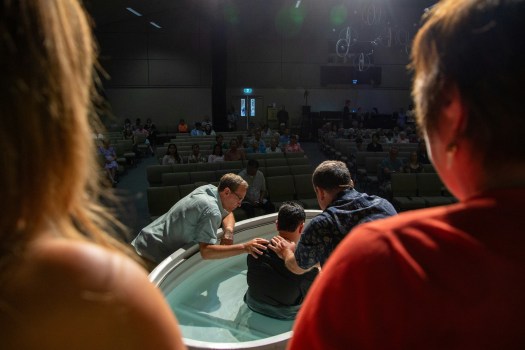
Is Baptism a Part of the Gospel Message?

1 Corinthians 1

10I appeal to you, brothers,] in the name of our Lord Jesus Christ, that all of you agree with one another so that there may be no divisions among you and that you may be perfectly united in mind and thought. 11My brothers, some from Chloe’s household have informed me that there are quarrels among you. 12What I mean is this: One of you says, “I follow Paul”; another, “I follow Apollos”; another, “I follow Cephas’”; still another, “I follow Christ.”

13Is Christ divided? Was Paul crucified for you? Were you baptized into the name of Paul? 14I am thankful that I did not baptize any of you except Crispus and Gaius, 15so no one can say that you were baptized into my name. 16(Yes, I also baptized the household of Stephanas; beyond that, I don’t remember if I baptized anyone else.) 17For Christ did not send me to baptize, but to preach the gospel—not with words of human wisdom, lest the cross of Christ be emptied of its power. (1 Corinthians 1:10-17, NIV)


The Daily DAVEotional

What is required for salvation?

That’s a basic question that every religious system should be able to answer.

Traditional Christianity says that salvation comes to those who place their faith in Jesus, who died on a cross to pay the penalty that we deserve for our sins.

However, there are some within the Christian tradition who hold to the view that baptism is an essential step in the salvation process. So in addition to believing in Jesus, one must also be physically baptized, with water, in order to be fully saved.

Is this true? Does one need to be baptized in order to be saved?

I think this passage in 1 Corinthians gives us some insight to address this question.

The context of this passage is that Paul is addressing some problems in the Corinthian church that were creating divisions.

The source of these divisions is that people in the church were aligning themselves with different leaders. I wrote about this passage and the divisions that we can experience in my blog post  “Name Dropping in the Early Church”as well as my post, “Political Divisions within the Church”.

What’s interesting about this passage, though, is that Paul, while addressing the divisions that were occurring in the church, tangentially speaks to the issue of baptism.


Click here to see a A Comprehensive List of Blog Posts Based on Bible Passage Reference


The source of the divisions is that people in the church were aligning themselves with various leaders. These leaders were becoming the central figure for each faction instead of Jesus being the central figure for the whole church. So in essence, you had the Paul faction, the Apollos faction, the Cephas faction and so on.

Paul’s argument is that Jesus isn’t divided. Therefore, his church shouldn’t be divided into factions of people who are identifying with certain popular figures. Instead, the church should be united with everyone identifying with and following Jesus.

To make his case, Paul asks a number of rhetorical questions:

Was Paul crucified for you? (Obviously, the answer is NO)

Were you baptized into the name of Paul? (Again, the answer is obviously NO)

Paul then makes an interesting statement. He says that he is thankful that he didn’t baptize many of the Corinthians. He is glad about that because then they could not claim to have been baptized into Paul’s name. Paul did not want believers making him more important than Jesus.

This begs the question: if baptism is essential for salvation, why would Paul be thankful and glad that he didn’t baptize many people? Wouldn’t he be sad that he hadn’t been able to save many people?

Paul completes his thought with the following statement:

For Christ did not send me to baptize, but to preach the gospel

it’s easy to gloss over this statement but what’s important is the fact that Paul is claiming that his goal, his mandate, was to preach the gospel.

A question I have often asked people when engaging in this discussion:

If a person responds to the gospel, will they be saved?

I think most Christians would agree that the gospel message contains everything that is necessary for a person to become saved if they respond positively to the message.

In fact, Paul, n Romans 1:16-17 says,

I am not ashamed of the gospel, because it is the power of God for the salvation of everyone who believes: first for the Jew, then for the Gentile. 17For in the gospel a righteousness from God is revealed, a righteousness that is by faith from first to last, just as it is written: “The righteous will live by faith.

According to Paul, the gospel “is the power of God unto salvation.”

Now if the gospel message saves people and Paul says that he was sent by Christ to preach the gospel and NOT baptize people, then clearly, baptism is NOT a part of the salvation message, which means it is NOT necessary for a person to be saved.

This does not mean that baptism is not important or that there isn’t some significance to it. There is. It’s just not necessary to be saved.

To learn more about what baptism is and its significance to the Christian, please read the following related posts:


Did you enjoy this post? I’d love to hear your thoughts! Feel free to like, leave a comment below, and share it with your friends or on social media if you found it helpful or interesting. Your support keeps the conversation going!


Reflection

What do you think are the essential elements of the gospel message? 

If baptism is necessary for salvation why does Paul say that Jesus did not send him to baptize but to preach the gospel?

If baptism is NOT necessary for salvation, what is the purpose? Why is it practiced?

In verse 13, Paul asks the question, “were you baptized into the name of Paul?” What do you think that means? What does it mean to be baptized “into the name” of another person? How does this understanding of the word “baptize” shed light on the issue of whether baptism is necessary for salvation or not?


Photo by Alex Shute on Unsplash

Does Acts 2:38 Teach That You Must Be Baptized to Be Saved?

Acts 2

37When the people heard this, they were cut to the heart and said to Peter and the other apostles, “Brothers, what shall we do?”

38Peter replied, “Repent and be baptized, every one of you, in the name of Jesus Christ for the forgiveness of your sins. And you will receive the gift of the Holy Spirit. 39The promise is for you and your children and for all who are far off—for all whom the Lord our God will call.”

40With many other words he warned them; and he pleaded with them, “Save yourselves from this corrupt generation.” 41Those who accepted his message were baptized, and about three thousand were added to their number that day.

(Acts 2:37-41, NIV)


The Daily DAVEotional

Over the last month or so, I’ve made a number of posts regarding baptism. The reason for this is that early in June of 2026, I had an online interaction with a Mormon who, in his attempt to argue for the legitimacy and necessity of the Mormon church, had made the claim that baptism was necessary for salvation. He posted a number of verse references as evidence for his position and I have been responding to the verses he mentioned as they turn up in my daily Bible reading.


Note: there are a number of mainline Christian denominations that also hold this view that baptism is essential for salvation, the most notable being the Church of Christ.


A few days ago, I read Acts 2, which includes what I would consider to be the cornerstone verse that is used by those who consider baptism to be essential for salvation (a doctrine known as “baptismal regeneration”).

The context for this passage is as follows:

In Acts 1, Jesus tells his disciples not to leave Jerusalem, but to wait, because in a few days they would all be baptized with the Holy Spirit. I expound on this passage more in my post “Is Baptism Necessary for Salvation?”

In Acts 2, on the day of Pentecost, the Holy Spirit descends upon the Jerusalem believers and the church is officially born.

The event causes a stir and a lot of locals are wondering what is happening as they can see the evidence of the Holy Spirit in the lives of these disciples. This provides an opportunity for Peter to preach the first gospel sermon to the many onlookers.

Our passage above picks up right at the conclusion of Peter’s sermon, which prompts a response from the audience, to which Peter gives the aforementioned Acts 2:38 directive.

On the surface,  Acts 2:38 appears to indeed teach that baptism is necessary in order to be granted forgiveness for sins. However, it’s important to understand that this verse was originally written in Greek. The Greek word “for” in this verse is “eis“, which can have two different meanings.

The first meaning this word can have is “in order that”. The verse would then be understood to mean that we should each repent and be baptized “in order that” we could experience forgiveness.

The second and equally valid meaning for the word “eis” is “because of“. This changes the entire meaning of the verse. The verse then teaches that each of us should repent and be baptized “because” we have forgiveness of sins.


Click here to see a A Comprehensive List of Blog Posts Based on Bible Passage Reference


Those who believe that baptism is essential for salvation (including the Mormon church) arbitrarily select the first meaning for the word “for“. There is nothing in the original Greek grammar or syntax that indicates that is the correct meaning. Therefore, the second meaning is equally valid. In fact, there are many examples in the New Testament that demonstrate the second meaning of the word “eis“.

For example, in Matthew 3:11, John the Baptist says

I baptize you with water for repentance.

Does this mean that he is baptizing them so that they will repent, or because they had repented? It is obvious that the second meaning is the correct interpretation.

Another example from Matthew 12:41 says:

they repented at (eis) the preaching of Jonah.

Does this mean that they repented so that Jonah would preach, or because Jonah had preached? The answer is obviously because Jonah had preached.

How about a modern example?

We’ve all seen posters that say “Wanted for Murder!” Do these posters indicate that they are looking for the individual so that he (or she) will commit murder? Or is it better to say that they are looking for the individual on the poster because he (or she) has committed murder? Obviously, the second meaning is the understood interpretation.

In the examples we’ve seen, the interpretation seems pretty obvious and straightforward, but in Acts 2:38, the meaning of the word “for” is not as obvious. How then do we determine the real meaning? Which definition should we give it? Is it “so that” or “because”?

Rather than arbitrarily picking the meaning, as those who subscribe to baptismal regeneration do, good Bible study technique tells us that the meaning of a passage is always determined by the context. If the immediate context doesn’t help in determining the meaning of the verse, then the broader context should be used to make the determination.

In other words, if the meaning of the passage is unclear or in doubt, we should interpret its meaning in the light of passages that are clear and not in doubt.

With that in mind let’s analyze Acts 2:38. There is nothing in the immediate context of the verse that tells us which meaning we should ascribe to the word “for“. However, if we look at the broader context, we do get some help.

In Acts 3:19, Peter gives another invitation to salvation. In this invitation he says,

“Repent, then, and turn to God, so that your sins may be wiped out, that times of refreshing may come from the Lord”.

In this sermon, Peter makes no mention of baptism. Forgiveness of sins is dependent only on turning to God. If Peter does not require baptism for salvation in Acts 3:19, then he must not require it in Acts 2:38 either. Otherwise, we would have a contradiction of Scripture, which would be a clear indication of interpretive error.

In Acts 10, Peter is sharing with some Gentiles how a person is saved. In this sermon Peter says:

“that everyone who believes in him receives forgiveness of sins through his name.”

In Acts 13, Paul is preaching about Christ. He says in verses 38-39,

Therefore, my brothers, I want you to know that through Jesus the forgiveness of sins is proclaimed to you. Through him everyone who believes is justified from everything you could not be justified from by the law of Moses.

Also, in Acts 16, the Philippian jailer directly asks Paul,

Sirs, what must I do to be saved?

Paul and Silas replied,

Believe in the Lord Jesus, and you will be saved.

All of these verses demonstrate that baptism is not a requirement for salvation. If baptism were indeed required for salvation, as those who hold to baptismal regeneration attest, wouldn’t we expect it to be mentioned in each of these examples?

Therefore, this indicates that the better interpretation of Acts 2:38 is “Repent and be baptized because you have forgiveness of sins.”


A List of Relevant Posts Regarding Baptism


As I’ve demonstrated in many of my other blog posts on this topic (see links to posts above), this interpretation not only fits our understanding of the meaning of baptism, but it fits perfectly with other passages that speak to how a person is saved and when and how a person receives the Holy Spirit.


Did you enjoy this post? I’d love to hear your thoughts! Feel free to like, leave a comment below, and share it with your friends or on social media if you found it helpful or interesting. Your support keeps the conversation going!


Reflection

The word “for” is a preposition that can indicate causality (in order that) or result (because of). What are some examples you can think of where the word “for” is used in each way?

If the word “for” can have either meaning, why do you think some groups like the Mormons and the Church of Christ insist on their interpretation? What might be some possible motivations?

If you believe that this verse does indeed teach that baptism is necessary for salvation, how do you explain the omission of baptism as a necessary requirement for salvation in all of the other documented gospel sermons in the New Testament?

If baptism ISN’T necessary for salvation as the author of this blog suggests, then what is its purpose? Why do we see it practiced in the New Testament?


Photo by BBC Creative on Unsplash

Did Jesus Teach that You Need to be Baptized to be Saved?

John 3

1Now there was a man of the Pharisees named Nicodemus, a member of the Jewish ruling council. 2He came to Jesus at night and said, “Rabbi, we know you are a teacher who has come from God. For no one could perform the miraculous signs you are doing if God were not with him.”

3In reply Jesus declared, “I tell you the truth, no one can see the kingdom of God unless he is born again.

4“How can a man be born when he is old?” Nicodemus asked. “Surely he cannot enter a second time into his mother’s womb to be born!”

5Jesus answered, “I tell you the truth, no one can enter the kingdom of God unless he is born of water and the Spirit. 6Flesh gives birth to flesh, but the Spirit gives birth to spirit. 7You should not be surprised at my saying, ‘You must be born again.’ 8The wind blows wherever it pleases. You hear its sound, but you cannot tell where it comes from or where it is going. So it is with everyone born of the Spirit.”

9“How can this be?” Nicodemus asked.

10“You are Israel’s teacher,” said Jesus, “and do you not understand these things? 11I tell you the truth, we speak of what we know, and we testify to what we have seen, but still you people do not accept our testimony. 12I have spoken to you of earthly things and you do not believe; how then will you believe if I speak of heavenly things? 13No one has ever gone into heaven except the one who came from heaven—the Son of Man. 14Just as Moses lifted up the snake in the desert, so the Son of Man must be lifted up, 15that everyone who believes in him may have eternal life.

16“For God so loved the world that he gave his one and only Son, that whoever believes in him shall not perish but have eternal life. 17For God did not send his Son into the world to condemn the world, but to save the world through him. 18Whoever believes in him is not condemned, but whoever does not believe stands condemned already because he has not believed in the name of God’s one and only Son. 19This is the verdict: Light has come into the world, but men loved darkness instead of light because their deeds were evil. 20Everyone who does evil hates the light, and will not come into the light for fear that his deeds will be exposed. 21But whoever lives by the truth comes into the light, so that it may be seen plainly that what he has done has been done through God.” (John 3:1-21, NIV)


The Daily DAVEotional

A few weeks ago, I had an online encounter with a Mormon who, in his quest to explain the legitimacy and necessity of the Mormon church, made the claim that the Bible teaches that baptism is necessary for salvation.

One of the passages he referenced to back up his claim was this passage from John 3, where Jesus has a conversation with Nicodemus, a Pharisee who came to Jesus secretly at night.

I previously wrote on this same passage (John 3:1-8) in my blog post “The Born-Again Redundancy” but that post, while it expounded some on the conversation Jesus had with Nicodemus, never addressed the issue of baptism.

There’s a good reason why my previous post did not talk about the issue of baptism and that’s because neither the word nor the concept is found anywhere in the passage.

But since this passage was offered up as a proof text for the view that baptism by immersion with water (what I’ll from here on out refer to as “water baptism” or “baptismal regeneration”) is essential for salvation, it seems necessary and appropriate to comment on what Jesus is actually teaching in this passage.

If the words “baptism” and “baptize” are nowhere to be found within this passage, why would someone use this passage as “evidence” that Jesus taught baptism was necessary for salvation?

In short, I believe this passage is used as evidence by those who hold to the necessity of baptism for salvation simply because Jesus mentions water.


Click here to see a A Comprehensive List of Blog Posts Based on Bible Passage Reference


As I conversed with this Mormon acquaintance online, he noted that Jesus himself said that in order to enter the Kingdom of God, one must be born of water and the Spirit. He argued that when Jesus mentioned being “born of water” he was referencing the ordinance of baptism.

This conclusion is actually a perfect example of the theological error known as eisegesis, which means “to read into the text.”

What exactly does that mean?

When we read and study the Bible, our goal should be to understand what the author meant when he wrote what he wrote. We do our best to place ourselves in the context of the person living at the time the text was written and seek to understand what it would have meant to a person living within that culture at that specific time. This is known as exegesis, or “drawing out of the text.”

When we understand what the author’s original intent was, we can then understand how the original hearer of the text would have understood what they were reading and hearing. That is the original message we want to capture, understand and apply to our own situation.

But eisegesis functions in the exact opposite way. Instead of seeking to understand what the text meant to the original audience, the person imports their preferred meaning into the text and then declares that to be the teaching.

So in our case, it looks like this:

Jesus had a conversation with Nicodemus about how one enters the kingdom of God and Jesus said that a person must be born of water and the Spirit.

Even though Jesus says nothing about baptism and it’s unclear at first glance what it means to be born of water and what it means to be born of the Spirit, the person who holds to baptismal regeneration has already concluded that the passage is talking about baptism.

Since the conclusion is already determined, reasons justifying that conclusion are then produced. In this case, the passage has the term water in it and baptism requires water so it is argued that this passage must be speaking about baptism.

This line of reasoning utterly fails.

Not only does Jesus not say baptism is necessary for salvation, he doesn’t even mention baptism in this interchange.

So then what is Jesus saying?

I explain this more fully in my blog post “The Born-Again Redundancy” but Jesus is explaining to Nicodemus that just as a person is born physically which leads to physical life, so a person must be born spiritually in order to experience spiritual life, or life in the kingdom of God.

Jesus himself explains what is meant by the phrase “being born of water and the Spirit” when he says just a few verses later that “flesh gives birth to flesh but the Spirit gives birth to spirit.”

It’s clear that being born of water refers to physical birth while being born of the Spirit refers to a spiritual birth. According to Jesus, both are necessary for salvation. In reality, everyone who has ever existed has already experienced physical birth just by being born.

So then, what is necessary to enter the kingdom of God is to experience a spiritual birth. This is the entire point Jesus is making to Nicodemus – to enter the kingdom of God, you must experience a spiritual birth.

The natural question then is “how does one experience a spiritual birth?”

Notice that as Jesus continues his discourse with Nicodemus, he does not mention baptism as a condition for salvation (spiritual birth). In fact, baptism is not mentioned anywhere in the passage.

What Jesus DOES mention as necessary for salvation, multiple times in fact, is BELIEF.

Specifically, in verse 15, Jesus says “that everyone who believes in him [Jesus] may have eternal life.”

Again, in verse 16, one of the most famously quoted verses in the entire Bible, Jesus says “that whoever believes in him [Jesus] shall not perish but have eternal life.”

So what is the verdict?

Concerning the charge that Jesus taught that baptism was/is necessary for salvation, the charge is false. Jesus did not teach that in this passage. Instead, he taught that a spiritual birth is necessary in order to know God and experience life in his kingdom. Jesus, as well as the other New Testament authors, taught that this spiritual birth comes as a result of BELIEF in the person and the work of Jesus on the cross.

To examine this issue further, see the following related posts:


Did you enjoy this post? I’d love to hear your thoughts! Feel free to like, leave a comment below, and share it with your friends or on social media if you found it helpful or interesting. Your support keeps the conversation going!


Reflection

What are some examples you have seen of eisegesis – when a person imports their doctrine or theological preference upon a text that doesn’t appear to be teaching that doctrine or idea at all?

If you believe that Jesus, in this passage, is talking about the importance of baptism to Nicodemus, what reasons do you have to support that interpretation?

Jesus told Nicodemus that in order to see the kingdom of God, a person must be “born again”. What do you think it means to be “born again?” How do you understand that phrase?

It’s clear that Nicodemus falsely understood Jesus’ term “born again” to be referring to a 2nd physical birth. Jesus corrects him and explains that he’s talking about a spiritual reality that must take place. Based on this passage, what does Jesus teach about how a person experiences this spiritual birth?

Have you personally experienced a spiritual birth? If not, what keeps you from taking that step?

If you want to learn more about experiencing a “spiritual birth” and experiencing eternal life and life in the kingdom of God, read my blog post “Four Points to Understand How to Experience Eternal Life.”


Photo by Daniel & Hannah Snipes: https://www.pexels.com/photo/outdoor-baptism-ceremony-in-south-carolina-30477080/

What is Baptism?

Romans 6

1What shall we say, then? Shall we go on sinning so that grace may increase? 2By no means! We died to sin; how can we live in it any longer? 3Or don’t you know that all of us who were baptized into Christ Jesus were baptized into his death? 4We were therefore buried with him through baptism into death in order that, just as Christ was raised from the dead through the glory of the Father, we too may live a new life.

5If we have been united with him like this in his death, we will certainly also be united with him in his resurrection. 6For we know that our old self was crucified with him so that the body of sin might be done away with, that we should no longer be slaves to sin— 7because anyone who has died has been freed from sin.

8Now if we died with Christ, we believe that we will also live with him. 9For we know that since Christ was raised from the dead, he cannot die again; death no longer has mastery over him. 10The death he died, he died to sin once for all; but the life he lives, he lives to God.

11In the same way, count yourselves dead to sin but alive to God in Christ Jesus. (Romans 6:1-11, NIV)


The Daily DAVEotional

Is baptism necessary for salvation?

This is the question I posed in a recent post of the same title.

My prompt for delving into this topic was a recent online conversation I had with a Mormon, who, in making his case for the legitimacy and necessity of the Mormon church, had made the claim that the Bible teaches that baptism is necessary for salvation.

Mormons teach that a great apostasy occurred shortly after the apostles died and the authoritative line for administering baptisms was lost….for nearly 1800 years! (I’ll address this theological error in a different post.) But fortunately, according to Mormonism, Jesus supposedly restored the priestly line and authority for baptisms through Joseph Smith and the Mormon church.

I argued in my post “Is Baptism Necessary for Salvation?” that those who hold to this view, that baptism is necessary for salvation, often have an inaccurate understanding of what baptism is.

Many have an understanding of baptism that is informed only by their own religious experience. Hence, they think that any time the word appears in the Bible, it must be referring to the act of immersing someone in water for some efficacious religious purpose, i.e. cleansing of their sins and completing the salvation process.

But the meaning of the word “baptism” is broader than our own religious experience dictates and is often used in the Bible in ways that have nothing to do with any kind of immersive water experience.

So what is baptism exactly?

This passage in Romans is one of the clearest in terms of helping us understand exactly what baptism is and how it was understood by the apostles.

Specifically, there are two parallel statements that give clarification regarding what baptism is.

Verse 3 says, “don’t you know that all of us who were baptized into Christ Jesus were baptized into his death?”

But verse 5 says, “If we have been united with him like this in his death, we will certainly also be united with him in his resurrection.”

Clearly, these two parallel verses demonstrate that to be “baptized into Christ and his death” is to be “united with Christ and His death.”

Hence, baptism is union with Christ.

This fits exactly with the broader biblical meaning of the word “baptize” which is identification. 


Click here to see a A Comprehensive List of Blog Posts Based on Bible Passage Reference


Paul is saying that when one identifies with Christ, they are identified with His death. This is exactly what the gospel teaches. When a person receives Jesus as their Lord and Savior, they experience a change in identity. Instead of being a person who is alienated and separated from God, the new believer enters into a union with Christ that is characterized by a new family relationship – they are now a child of God – an adopted son or daughter.

This new identity takes place at the moment a person believes in Jesus. They receive forgiveness precisely because they are united with Jesus in His death. Simply put, when a person receives Jesus, they are indicating that they want Jesus’ death to pay for their sins instead of having to pay the penalty for their sins on their own, which leads to judgment and eternal death.

Jesus’ death now counts for the believer. His death pays for all their sins and as a result, they experience complete and total forgiveness.

Those who hold to baptismal regeneration (the belief that baptism by immersion is necessary for salvation) might argue that this new identity doesn’t happen until a person is baptized with water by immersion.

But this contradicts what Scripture teaches, which is that a person is justified by faith alone and that believers receive the Holy Spirit (the sign that we are now members of God’s family) at the moment of belief, not at the moment of being baptized.

Furthermore, if the broader understanding of baptism is one of identification, then it makes sense that the purpose of water baptism is not to complete some salvation formula but is simply a way of identifying to the world in a physical way (being immersed in water) to a spiritual reality that has already taken place. The spiritual reality is that the person, based on their belief and trust in Jesus, now identifies with Jesus and Jesus’ death and is now a member of God’s family.

So what is baptism?

Baptism is a union with Jesus that takes place when we put our faith in Him and His death. At the very moment we do that, we become united with Jesus AND we become united with His death. Being united with His death means that His death now pays for my sins, which means I can experience forgiveness and I can escape the punishment I deserve for the sins I’ve committed.

This union with Christ means that I have a new identity – I’m a child of God!


Did you enjoy this post? I’d love to hear your thoughts! Feel free to like, leave a comment below, and share it with your friends or on social media if you found it helpful or interesting. Your support keeps the conversation going!


Reflection

What was your experience with baptism growing up? Were you baptized? If so, what meaning was attributed to this religious ceremony by your religious tradition?

What do you think it means to be united with Christ?

If you think baptism is a religious ceremony that completes the salvation process, what do you think was the reason and purpose for Jesus being baptized? (See my post “Why Was Jesus Baptized?”)

If baptism was necessary for salvation, how do you explain Jesus’ words to the thief on the cross, who was never baptized, but was promised by Jesus that he would be with Jesus in paradise that very day?


Photo by Logan Gutierrez on Unsplash

Should People Take the Mormon “Challenge”?

Galatians 1

6I am shocked that you are turning away so soon from God, who in his love and mercy called you to share the eternal life he gives through Christ. You are already following a different way 7that pretends to be the Good News but is not the Good News at all. You are being fooled by those who twist and change the truth concerning Christ.

8Let God’s curse fall on anyone, including myself, who preaches any other message than the one we told you about. Even if an angel comes from heaven and preaches any other message, let him be forever cursed. 9I will say it again: If anyone preaches any other gospel than the one you welcomed, let God’s curse fall upon that person.

10Obviously, I’m not trying to be a people pleaser! No, I am trying to please God. If I were still trying to please people, I would not be Christ’s servant. (Galatians 1:6-10, NLT)


The Daily DAVEotional

If you haven’t noticed, Mormonism has been a huge topic on social media the last few days. The main topic of discussion and debate has been centered around the question of whether or not Mormons are Christians.

For context, the Department of Defense recently posted a memo regarding new abbreviated codes to identify the many different religious backgrounds that might be represented among the troops.

According to Secretary of War Pete Hegseth, the previous list of religious options was out of control, with over 200 different options. The goal was to simplify the number of codes and options, making it easier for chaplains to do their job of ministering to the troops.

The problem was that the new list had a number of different Christian denominations listed, such as “Christian-Baptist” and “Christian-Presbyterian” but the Mormon Church was not listed as Christian. Instead, it was listed simply as “Latter Day Saint.”

This set off a firestorm among many Mormon influencers and regular Mormon Joes who were offended that the U.S. government apparently didn’t consider Mormons to be Christian.

Chief among those speaking out online were Utah Senator Mike Lee (@basedMikeLee on X), who took every opportunity to post his thoughts and objections to this “egregious error” inflicted on Latter Day Saints.

This incident sparked a lot of online conversations about whether or not Mormons are Christians.

Mormons, of course, believe they ARE Christians, while evangelicals have argued that Mormons are NOT Christians because, despite the fact that Jesus Christ is in their name, they do not hold to the traditional Christian doctrinal views on Jesus, God, the Church, salvation, or the Scriptures.

The online discussion afforded many Mormons, including Senator Lee, the opportunity to inform and proselytize others regarding the Mormon faith.

In one of his posts, Senator Lee offered up what I’m calling the “Mormon challenge”:

This is the Mormon “trump” card so to speak. “Just read the Book of Mormon in it’s entirety”, they say, “and ask God humbly and with sincerity if it’s true.” This challenge is often offered as a gauntlet that is laid down for those who portend to be truth-seekers.

“What do you have to lose”, Mormons ask. The sentiment is, “Don’t be a chicken!”

Millions of Mormons attest that Mormonism is indeed true based on this challenge.

Should Christians accept this challenge?

The answer is a resounding NO.

There are two reasons why Christians should not take this challenge and neither of them have to do with being scared of the outcome.

The first reason you should not take this challenge is because it’s not falsifiable. The challenge is actually like the old “heads I win, tails you lose” proposition, which means that the challenge is designed to “prove” Mormonism is true regardless of the results of your humble and sincere prayer.

Think about it: if you pray and you say that you felt nothing or you didn’t get any firm and obvious confirmation from your prayer, the Mormon can just say that you were obviously not sincere enough, or humble enough or something similar.

Yet if you say that you DID feel something, that emotional response, regardless of how small or incomprehensible, is offered as proof that Mormonism is true.

In other words, the challenge simply appeals to an emotional response as evidence of veracity.

This leads to the second reason one should NOT take this challenge, which is that it’s unbiblical.

Nowhere in Scripture are people encouraged to evaluate truth claims by appealing to an emotional response.

Instead, we are exhorted to test a message against the clear revelation that has already been given by God.

Acts 17 is a good example of this. I have written about this passage in another blog post, “Fact-Checking and Misinformation in the New Testament” in which the Bereans were commended for testing Paul’s message against the Scriptures.

A second clear example of testing a message is in the Galatians passage listed above, in which Paul tells his audience that any “gospel” message that is not in alignment or in agreement with the gospel message he had already preached to them was to be rejected. Paul tells the Galatians that the person giving this false message is to be cursed.

We know exactly what the message was that Paul originally preached to the Galatians because he writes his letter to the Galatians to reinforce the original message and to correct their subsequent misunderstanding brought about by false teachers. The gospel message Paul preached was a message of justification by faith in Christ alone, apart from any works.

Since we already know that the Mormon message is different than Paul’s message on many different levels doctrinally, there is no need to “pray on it.” In fact, reading the Book of Mormon and praying on it could be considered disobedience to Paul’s admonition to outright reject so-called gospel messages that are different from what he taught the Galatians.

The debate about whether Mormons are Christian or not, while interesting, is in many ways irrelevant. The truth is that anyone can identify themselves as a Christian. Yet, it’s not as important what you call yourself as what you believe.

Mormons say they are Christians because they follow Jesus Christ. But so do Jehovah’s Witnesses, Catholics, Evangelical Christians, Liberal Christians and even Progressive Christians. Even Muslims will tell you that they respect and revere Jesus as a prophet.

All these groups, along with Latter Day Saints, have wildly different theological views on God, Jesus, salvation and the nature of the church, and yet, they all consider themselves “Christian”.

Are they Christian? The only way we can really know is to evaluate their beliefs in relation to what the Bible teaches.

With that in mind, I propose an alternate challenge to those who consider themselves Mormons…a challenge that is actually biblical. The challenge is to read the Bible cover to cover. Then compare the teachings of Mormonism with the teachings of the Bible, and specifically, compare the Mormon message with the gospel message taught by Jesus and the apostles in the New Testament.

Then tell me – does Mormonism line up with the already revealed and accepted teachings of Jesus and the apostles?

So Mike Lee (and other Mormons)….will you accept the challenge?


Did you enjoy this post? I’d love to hear your thoughts! Feel free to like, leave a comment below, and share it with your friends or on social media if you found it helpful or interesting. Your support keeps the conversation going!


Reflection

What is your definition of a Christian? According to the Bible and the gospel, how does one become a Christian?

What was the essence of the salvation message taught by Jesus and His disciples? What is the essence of the Mormon message regarding how a person is saved?

What is the traditional Christian teaching on the nature of Jesus? How do Mormons view the nature of Jesus? Are these two views the same? How do they differ?

Do you think it matters what a person believes about Jesus in order to be saved? Or is it simply enough to say you believe in Jesus? 


photo by Dave Lowe

What Does it Mean to Have Eternal Life?

John 17

1After Jesus said this, he looked toward heaven and prayed:

“Father, the time has come. Glorify your Son, that your Son may glorify you.  2For you granted him authority over all people that he might give eternal life to all those you have given him. 3Now this is eternal life: that they may know you, the only true God, and Jesus Christ, whom you have sent. (John 17:1-3, NIV)


The Daily DAVEotional

An overwhelming number of people in the U.S. believe in an afterlife. According to a major Pew research study in 2023-24 and released in 2025, 70% of Americans believe there is, or there probably is an afterlife.

If there really is an afterlife, what does it look like and, more importantly, how do we experience it?

Christianity teaches that after people die physically, they experience either eternal life or eternal death.

But what exactly is eternal life?

I’ve asked hundreds, if not thousands of people that exact question over the course of my years in ministry and the most common answer I received is that eternal life is “living forever after you die”.

Now that’s obvious isn’t it? The word “eternal” means “forever” and “life” is the opposite of “death” so it kind of seems obvious that “eternal life” must be “living forever” because that’s exactly what the words mean.

Many people are surprised to learn, however, that Jesus actually defined eternal life and his definition doesn’t exactly line up with our traditional understanding of the term.

Most people think of eternal life as something you receive AFTER you die, like going to heaven.

But Jesus defined eternal life as something you can have NOW and then it continues on into eternity.

In John 17:3, Jesus defined eternal life as knowing God – having a relationship with Him. Hence, eternal life is beginning a relationship with Jesus now, on earth, so that when you die, you will live with Him for eternity.

This distinction might seem insignificant but it’s actually quite important.

If eternal life is just going to heaven when I die, then it’s not necessarily something I need to worry about until later in life.

But if eternal life is a relationship with God – something I can experience NOW, then waiting to receive eternal life will result in me missing out on a relationship with God.

Jesus didn’t go to the cross and die for us just so we could go to heaven after we die. Jesus died on the cross to give us LIFE….NOW!

Jesus wants us to know Him and that’s something we can begin to experience now in this life. Knowing Jesus simply means responding to the invitation of forgiveness that He offers through His death on the cross for us.

When we respond to Jesus’ invitation, Jesus comes into our lives and we become adopted sons and daughters in His family.

At that moment, our real life begins. This relationship with Jesus is permanent and never-ending.

Do you want to experience eternal life? You don’t have to wait until you die to experience it. You can experience eternal life right now, simply by entering into a relationship with Jesus, which simply requires that you put your trust in Him.

For more information on what it means to begin a relationship with Jesus, read the short article “FOUR POINTS TO UNDERSTAND HOW TO EXPERIENCE ETERNAL LIFE”.


Did you enjoy this post? I’d love to hear your thoughts! Feel free to like, leave a comment below, and share it with your friends or on social media if you found it helpful or interesting. Your support keeps the conversation going!


Reflection

Before reading this short post, what was your understanding of “eternal life”? How did you define it?

Most people think of eternal life as going to heaven after you die. But Jesus defined eternal life as knowing God and having a relationship with Jesus? How does this difference impact you? In what ways does this change or impact your desire to have eternal life?

On a scale of 0-100 (0 being no desire and 100 being the highest level of desire possible), how would you rate your desire to know God? What factors caused you to choose the number that you did?

On that same scale of 0-100, what do you think is God’s desire for you to know Him?

What would keep you from putting your faith in Jesus and beginning a relationship with Him?


Photo by Jon Tyson on Unsplash

Signs of Spiritual Renewal

“Christianity has an image problem.”

These are the opening words from “UnChristian”, the 2007 book by David Kinnaman, President of Barna Research Group, and Gabe Lyons, founder and president of THINQ Media. The purpose of of the book was to highlight the perceptions of the church from those who are unchurched, in order to give meaning and understanding to the decades-long decline in the influence of the church on the culture at large.

In 2011, Kinnaman published “You Lost Me”, which sought to explain why so many Young Adults who had grown up in the church were leaving the church.

For those of us who are older and have been Christians a long time, it’s been obvious that the church’s influence has been waning for years, perhaps even decades. But recently, we’ve seen that lack of influence breach the barrier of the church, as hoards of young people have been leaving the church for one reason or another.

Recently, however, there have been signs of a spiritual renewal in the U.S. and beyond.

You may recall that in February 2023, a routine chapel service at Asbury College in Kentucky turned into a 16-day outpouring of spiritual renewal that impacted nearly 50,000 people, mostly young adults. (See article here)

Many Christians pointed to that event as a possible starting point for the greater spiritual awakening that we’ve spent decades praying for.

Since then, signs indicating a spiritual renewal here in the U.S. and beyond have amplified. We hear reports of new people attending church for the first time and people returning to church after a long absence.

Since the tragic assassination of Charlie Kirk, renewed interest in church and Christianity has seemingly increased even more, in the U.S. and beyond.

You may know that Jen has been a part-time student at Talbot Seminary for the past several years, pursuing a degree in Spiritual Formation.

This semester she’s taking an online Theology course and one of the other participants is from the UK. The professor asked the UK student if the rumors he has heard about an increase in church attendance in the UK are true. The student confirmed that from what he’s seen, church attendance definitely seems to be on the rise.

Still, it’s sometimes hard to know the actual substance of what we’re hearing.

Are these reports merely anecdotal, or are they actually reflective of a larger trend of spiritual renewal?

It appears that these stories are not just isolated events but are actually mirroring a larger trend of renewal.

Earlier today, I saw a post on X.com with an image that showed that Bible sales in the U.S. have increased by over 40% in the last 3 years. Downloads of spiritual apps and Christian music are also way up.

Barna research confirms that there are signs of a spiritual awakening in the U.S. The surprising aspect of their research is that this awakening is being fueled by Young Adults!

According to a Barna report released in April 2025, there has been an increase in the number of Young Adults who claim to have made a commitment to Jesus. At the same time, many of those who say they’ve made a commitment might not identify themselves as “Christian”.

While this may seem contradictory, it actually reflects how the younger generation is attracted to the person of Jesus (at least their understanding of Him) but are often skeptical and wary of institutional religion.

A more recent report from Barna in September 2025 indicates that there has been a resurgence recently in church attendance and it has largely been led by Young Adults.

What’s surprising is that contrary to past experience, young adults are going to church more frequently than older generations.

Even more surprising is that young adult men are outpacing women in their spiritual interest.

While there are many reasons to rejoice and be hopeful, there are still challenges. Kinnaman notes that even though Young adults are attending church more frequently, they still are only attending less than 2 times per month and “churchgoing alone does not in itself create devoted disciples…there is still the challenge of shaping hearts and minds to live out their faith beyond church participation.”

This is why we are focused on Young Adults. We seek to fill in that gap – to provide coaching, mentoring and discipleship for Young Adults to help them thrive spiritually and live with purpose.

Thank you for your partnership in ministering to this vital community. Please pray for us and with us, that a spiritual renewal would continue across the U.S. and beyond and that young adults would continue to turn to Jesus as the only one who can fulfill their core needs and desires!

FOUR POINTS TO UNDERSTAND HOW TO EXPERIENCE ETERNAL LIFE

What do you think happens after we die?

Most people believe in an afterlife, such as the Christian concept of heaven. But, assuming heaven exists, how does one get there?

In my thousands of conversations with people, I’ve found that people overwhelmingly believe that if they were to die, they would make it into heaven. However, when asked the question,

What is God’s criteria for deciding who makes it into heaven?

Most people I’ve conversed with don’t know.

To me, that’s a bit like studying for a final exam without having any idea what is going to be on the exam.


Read this article “How Do You Prepare for God’s Final Exam” for a fuller explanation of this idea.


The Bible tells us that God’s plan from the beginning was that we would know Him and experience life in His presence. Man freely interacted with God and it was good.

Genesis 1:29-31 gives a picture of God’s initial creation:

27So God created man in his own image,
in the image of God he created him;
male and female he created them.
28God blessed them and said to them, “Be fruitful and increase in number; fill the earth and subdue it. Rule over the fish of the sea and the birds of the air and over every living creature that moves on the ground.”
29Then God said, “I give you every seed-bearing plant on the face of the whole earth and every tree that has fruit with seed in it. They will be yours for food. 30And to all the beasts of the earth and all the birds of the air and all the creatures that move on the ground—everything that has the breath of life in it—I give every green plant for food.” And it was so.
31God saw all that he had made, and it was very good.


POINT 1: GOD’S PLAN

GOD LOVES YOU AND CREATED YOU FOR A PURPOSE

God’s Love

The Bible is clear that one of God’s attributes is love.

1 John 4:8-9 says:

Whoever does not love does not know God, because God is love. This is how God showed his love among us: He sent his one and only Son into the world that we might live through him.

God demonstrated His love by sending His Son Jesus into the world to ultimately die on our behalf.

God’s Purpose

In John 10:10 (NLT), Jesus gives a glimpse into his purpose. He said:

The thief’s purpose is to steal and kill and destroy. My purpose is to give life in all its fullness.

Jesus came so that we might experience life in all its fullness – that we would begin to fulfill the purpose for which we’ve been created, which is to know Him and experience His presence in our lives.


REFLECT
What do you think it means to experience life in all its fulness? What would that look like?


“Fullness of Life” Expanded

Here’s another way to think about it. When Jesus says that His purpose is to give “life” in all its fulness, He’s talking about giving eternal life.

In John 17:3 (NIV), Jesus said this:

Now this is eternal life: that they may know you, the only true God, and Jesus Christ, whom you have sent.

Jesus defines eternal life as knowing God – experiencing a relationship with Him. Therefore, when Jesus says His purpose to give life in all its fullness, what He’s saying is that He has come to offer people a relationship with Him (life) and He wants people to experience that relationship to the fullest extent possible.


REFLECT
Why do you think people are not experiencing life in all its fullness? What keeps them from knowing God?


POINT 2: OUR PROBLEM

WE’VE REBELLED AGAINST GOD AND ARE THEREFORE SEPARATED FROM HIM. AS A RESULT, WE CANNOT EXPERIENCE HIS PURPOSE FOR OUR LIVES, WHICH IS TO KNOW HIM.

The Fall – the Original Rebellion

According the Bible, God’s good creation was distorted when man disobeyed God and was exiled from God’s presence. Genesis 3 tells the story of the fall of mankind (Read Genesis 3).

Adam and Eve freely interacted with God, who had given them free reign over the entire garden. They took care of it and they were given every seed-bearing plant for their food. However, there was one tree they were forbidden from eating – the fruit from the tree of the knowledge of good and evil.

Adam and Eve were deceived by the serpent (Satan) to eat this forbidden fruit. Because of their disobedience, God banished them from the garden.


Have you ever wondered why God forbade Adam and Eve from eating from that one particular tree? Was it random? Or was there a reason why that specific tree was off limits. Read this article (Why Did God Forbid this One Fruit?) to understand why this particular tree was off limits.


The rest of the Bible is the story of God’s plan to restore man’s relationship with Him and to reverse the curse that was inflicted upon creation as a result of this original sin.

The Results of Sin

It’s at this point that one might argue that we should not be punished for Adam and Eve’s rebellion. But the Bible is clear that EVERYONE has sinned against God.

Romans 3:23 says:

For all have sinned; all fall short of God’s glorious standard. (NLT) [Emphasis added]

But I’m a Good Person

In my experience, I’ve found that most people tend to think of themselves as “good”.

In our society goodness and badness are relative terms that are used in comparison to other people. I’ve found that most people consider themselves to be good because they compare themselves to others who, in their mind, have done more egregious and heinous acts. But comparing ourselves to other people is using the wrong standard of comparison.

The Bible says that only God is truly good. What this means is that God’s standard for goodness is perfect holiness and by this standard, He is the only one who is truly good.

Notice the diagram to the right. God is holy and man is sinful and there’s a great chasm that separates man from God. The arrows illustrate that man continually tries to reach God through various efforts, such as religion, good works, etc. But all of these efforts ultimately fall short because God is perfectly holy, and there is no amount of good works that will enable man to achieve God’s standard of perfection.

Here is a short article (What is Your Definition of Good?) that explains how God defines “good”.


REFLECT
How does your definition of goodness compare or contrast with what the Bible says about goodness?


What is Sin?

The word “sin” is one of those churchy, religious words that many people associate with behaviors that others don’t approve of but we think is no big deal. For example, you may see nothing wrong with drinking while some “uptight, religious people” think drinking is a “sin”.


REFLECT
How do you define sin? What do you think sin is?


Sin Explained

Photo by Annie Spratt on Unsplash

Sin not just a list of immoral or socially unacceptable behaviors. When Romans 3:23 says that “all have sinned”, the Greek word for sin is actually an archery term.

In a competition, the archer would shoot the arrow and the goal was to hit the bullseye on the target. If the archer missed the bullseye, even if it was only by a fraction of an inch, it was considered an imperfect mark, which was called a sin.

So when the Bible says we’ve all sinned, it means that no matter how hard you’ve tried and no matter how good you think you are, you (and all people) have missed the mark of God’s standard, which is perfect holiness.

That raises the bar quite a bit doesn’t it?

Things are complicated by the fact that God is not only perfectly holy, but He’s perfectly just, and as a result, He must punish sin. He cannot just overlook it or ignore it. Sin is a violation of the very nature and character of God and His goodness, so sin must be punished.

According to Romans 6:23, the punishment, or penalty for sin is DEATH!

For the wages of sin is death, but the free gift of God is eternal life through Christ Jesus our Lord.

You might be thinking, “well we’re all going to die so what does it matter?”

Death here refers to being separated from God. So, the result of sin, or the punishment for sin is that we will experience a separation from God, FOR ETERNITY! This is literally what hell is – the complete absence of God and everything good.


POINT 3: GOD’S PROVISION

JESUS CHRIST PROVIDES THE ONLY SOLUTION TO MAN’S SIN.
Through Jesus, the barriers that kept us from experiencing God’s purpose have been removed – we now have access to God and can know Him.

If everyone has sinned and God, in His justice, must punish sin, then it seems as if there is no solution to our problem. We are all seemingly doomed to punishment!

But God, in His goodness, creates a solution that only He can provide. The solution is in His son Jesus.

Christ Died for Us

Romans 5:8 says,

But God showed his great love for us by sending Christ to die for us while we were still sinners.


REFLECT
If God can forgive sin, why couldn’t he just declare it to be forgiven?
Why do you think Jesus had to die to pay for sin?


Why did Jesus Have to Die?

Why do you think Jesus had to die in order to pay for sin?

Jesus had to die to pay for sin because God’s justice demands that the only valid payment for sin is death.

For the wages of sin is death…Romans 6:23

Jesus died in our place, thus paying the penalty that God’s justice demanded (death) but doing it in a way that allows humankind to avoid the penalty.

The reason that Jesus could do this is because He is God. As God, He has the very righteousness that God requires for those who wish to come into His presence. Through Jesus’ death, we can be forgiven for our sins and not only avoid the penalty for sin, but experience a relationship with God!

Colossians 1:13, 14 says,

For he has rescued us from the one who rules in the kingdom of darkness, and he has brought us into the Kingdom of his dear Son. God has purchased our freedom with his blood and has forgiven all our sins.

Christ Rose from the Dead

Not only did Jesus die for us, but the Bible says that He rose from the dead.

1 Corinthians 15:3-6 states:

For what I received I passed on to you as of first importance: that Christ died for our sins according to the Scriptures, that he was buried, that he was raised on the third day according to the Scriptures, and that he appeared to Peter, and then to the Twelve. After that, he appeared to more than five hundred of the brothers at the same time,


REFLECT
If Jesus had never risen from the dead, would it make any difference?
What do you think is the significance of the resurrection?


Read this article, He is Risen….Why Does it Matter? to understand the significance of the resurrection to the Christian message.


Jesus is the Only Way to God

In John 14: 6, Jesus says:

“I am the way and the truth and the life. No one comes to the Father except through me.”

Notice that He doesn’t say, “I’m one of the ways, I’m one of the truths, I’m one of the lives. There are lots of ways to get to the Father, but I’m a pretty good way, so check me out, I’m cool!”

NO!

He says, “I am the way, the truth, and the life; no one comes to the Father, but through Me.”

He could say this because He is the only one who has made a valid payment for sin. Hence, only Jesus can take away our sin.

The image above demonstrates that God realized that man could not bridge the gap that separated them because of man’s sin. The distance is too wide. If you think about it, God is infinitely holy so the gap between His holiness and man’s is an INFINITE gap!

Because we could not bridge the gap ourselves, God bridged the gap for us. He sent His son Jesus, who is INFINITELY holy and righteous. Jesus’ death bridges the gap and creates a path for people to come into God’s presence and experience a relationship with Him.


POINT 4: OUR RESPONSE

We each must receive the free gift that Jesus offers – His death as payment for our sins. Only then can we experience His purpose, which is to KNOW Him.

Knowing this information doesn’t make a person a Christian. Even if you agree with everything that has been outlined so far, it doesn’t mean you are a Christian.

What makes a person a Christian is when they respond to the invitation of Jesus to accept Him and His death as a free gift that pays for your sin and provides complete forgiveness.

John 1:12 (NLT) says,

But to all who believed him and accepted him, he gave the right to become children of God.

If you want to become a Christian (a child of God), then you must believe in Jesus and accept Him.


REFLECT
What do you think it means to accept Jesus?


We Receive Christ Through Faith

Ephesians 2:8, 9 (NIV) says,

For it is by grace you have been saved, through faith—and this not from yourselves, it is the gift of God— not by works, so that no one can boast.

Accepting Him simply means you accept the free gift that He offers of being saved by His death on the cross. It means that you acknowledge that His death alone can pay for sin and you put your trust in His death to provide forgiveness instead of trusting in your own good works to earn favor with God.

We Receive Christ by Personal Invitation

In Revelation 3:20, Jesus gives this invitation:

Here I am! I stand at the door and knock. If anyone hears my voice and opens the door, I will come in and eat with him, and he with me.


REFLECT
What do you think the door represents in this verse?
How do you think a person opens the door?


Opening the Door

The door represents your heart (your will). Jesus is inviting you to open yourself up and let Him in. The way you do that is simply by putting your trust in Jesus and His death to save you instead of trusting in your own perceived goodness to “earn” your way into heaven.


KEY QUESTIONS:

Have you ever opened the door of your life and let Jesus in to begin a relationship with Him?

If so, when was that? What were the circumstances that led you to make that decision?

If not, do you want to open the door of your life to Jesus and begin a relationship with Him?


Photo by Jan Tinneberg on Unsplash

Opening the Door 2

The key to opening the door is to decide to put your trust in Jesus instead of trusting yourself. One way you can express your faith to God is simply telling Him that you want to accept His free gift and you want Jesus to come into your life. We call this prayer. Take a minute right now to express your faith and desire for Jesus to come into your life by repeating the following prayer:

Lord Jesus, I need you. I acknowledge that I am a sinner and there is no way I can earn my way into heaven. I want to trust in Jesus and His death to pay the penalty for my sins and provide forgiveness. I open the door of my life now and I invite Jesus to come in so that I might begin a relationship with Him and know Him. Amen.


Things to Remember…

God’s criteria for who makes it into heaven is not how good you are but whether you have the Son (Jesus).

And this is the testimony: God has given us eternal life, and this life is in his Son. He who has the Son has life; he who does not have the Son of God does not have life. (1 John 5:11-12, NIV)

You can KNOW you have eternal life, if you have the Son.

Jesus defined eternal life as knowing Him (John 17:3). Hence, you can have eternal life if you have the Son – if you have a relationship with Him.

You can have the Son (Jesus), simply by accepting Him and the free gift that He offers – His death on the cross as a payment for all of your sins.

Jesus gives an invitation to everyone. He is standing at the door of each person’s heart. He’s knocking. He wants to come into your life and begin a relationship.

But we have to open the door.

Opening the door is a matter of choosing to put our trust in Jesus instead of trusting in our own goodness. It means that we acknowledge that we have sinned and we cannot earn our way to God. We recognize that Jesus ALONE can pay for sin and we accept the free gift of His death as a payment for our sins.

When we make that decision to open the door to Jesus, we experience complete forgiveness of sin and Jesus enters our life, establishing a relationship with us.

Once we have the Son (Jesus), we have the life, which is defined by Jesus as knowing Him.


QUESTIONS FOR REFLECTION

1.    Did you open the door an invite Jesus into your life?

2.    Where is Jesus right now in relation to you?

3.    After a person receives Christ, what do you think a person has to do in order to keep Jesus in their life? What do you think is required?

4.    What questions do you have about the Christian faith?


WHAT NOW?

If you prayed that prayer to invite Jesus into your life, the Bible says that you are a new creation. You are now a child of God!

You can request some free resources and next steps by going to our Prayer Page, giving us your name and writing in the box, “I received Christ and would like to know how to begin growing in my new faith.”

We will respond to you with some resources and help to take some next steps.

What is Your Definition of Truth?

John 14

1“Don’t be troubled. You trust God, now trust in me. 2There are many rooms in my Father’s home, and I am going to prepare a place for you. If this were not so, I would tell you plainly. 3When everything is ready, I will come and get you, so that you will always be with me where I am. 4And you know where I am going and how to get there.”

5“No, we don’t know, Lord,” Thomas said. “We haven’t any idea where you are going, so how can we know the way?”

6Jesus told him, “I am the way, the truth, and the life. No one can come to the Father except through me.”

(John 14:1-6, NLT)


The Daily DAVEotional

What is truth?

I think the best way of defining truth is “that which corresponds to reality.”

We live in a time and culture where many people are not too concerned with truth, especially as it relates to religious beliefs.

The predominant view regarding religion today is that of pluralism, the idea that there is no ONE right view or true religion. Most people think that whatever works best for you is good for you. If you think about it, this totally fits our postmodern culture.

Postmodernism is a reaction or a rejection to the philosophy of modernism, which is also known as naturalism. While naturalism emphasized logic and repeated observation and experience to arrive at truth (seen most notably in modern science and the scientific method), postmodernism emphasizes one’s own experience as the basis for truth.

Hence, for most people, there is not ONE truth, but there can be many truths, because truth is whatever your experience tells you it is.

Enter Jesus in John 14. Jesus is interacting with his disciples shortly before he is arrested and crucified. In preparing his disciples for what they will soon encounter with his death, resurrection and ascension, he tells them that he’s going to prepare a place for them. He also tells them that they know the way to get to where he’s going.

The disciples are confused. “We don’t know where you’re going….so how could we know how to get there?”

In typical fashion, the disciples are perplexed because Jesus is talking about a spiritual reality while the disciples are thinking only about the physical reality they’re currently in.

Jesus’ response to his disciples is profound and has far-reaching implications. He says:

“I am the way, the truth, and the life. No one can come to the Father except through me.”

Jesus uses three separate terms to describe himself:

I am the way – Jesus defines himself as THE way, not “a” way. In our diverse world of religious pluralism, Jesus does not describe himself as one alternative path among many. Jesus is not an option that suits some people while Buddha, Mohammad or Confucius might be more preferable for others. Jesus is not a preference. Jesus is THE option.

I am the truth – Jesus says that he is THE truth. If truth is that which corresponds to reality, then Jesus is saying that he is the ultimate reality. His life and His words accurately depict what is real. What this means is that Jesus’ words are not mere suggestions to consider. Instead, they are the basis of reality for everyone, not just those people who prefer Jesus over some other religious leader or humanistic ideology.

I am the life – Jesus also describes himself as THE LIFE. Jesus is not just a way to experience a better life as if he is a self-help guru. He is the source of all life itself. John says this about Jesus in the introductory words of his gospel:

He created everything there is. Nothing exists that he didn’t make. 4Life itself was in him, and this life gives light to everyone. (John 1:3-4, NLT)

Perhaps you have heard the analogy that getting to God is like a trek to the top of a mountain. While God is at the top, there are many routes that one might traverse in order to get to the top and reach God.


Click here to see a A Comprehensive List of Blog Posts Based on Bible Passage Reference


This analogy adequately illustrates what many believe today. God is whatever or however you might define him and your path to getting to him is whatever path you might choose to take.

Jesus stands in stark contrast to this way of thinking. God is not whatever or whomever you might want him to be. Making God out to be whoever you might prefer him to be is what the Bible calls idol worship and it’s an egregious sin. Israel’s engagement in idol worship is a main theme in the Old Testament and was the primary reason for their punishment and exile at the hands of foregien powers. (See my blog posts “Are You an Idol Worshiper” and “A Discourse on the Foolishness of Idols”).

Jesus says that if you want to get to God the Father, you MUST go through Him. Contrary to what our modern day religious pluralism says, Jesus IS the only way. Jesus can make that claim because He’s the only one who has made a valid payment for sin. No other religious leader or ideology even offers a solution to the problem of sin before a holy God. Jesus is the only one who does, and therefore, His claims are exclusive.

Christianity does not fit well in today’s religious pluralistic culture because it makes exclusive claims about God and salvation. Jesus himself claimed to be the ONLY way to God and this view was supported by his disciples and the New Testament writings (see my blog post “Is Christianity an Exclusive Religion?“)

We live in a pluralistic society and as a result, we’re tolerant of others and their views and beliefs. However, tolerance is not truth. Tolerance says that we respect the rights of others to hold views and beliefs that are different than ours. It doesn’t mean that we agree that their views are right. Truth is that which corresponds to reality. Jesus is truth. His words are truth. He is the only one who has paid the price for sin and therefore, He indeed is the only way to get to God.


Did you enjoy this post? I’d love to hear your thoughts! Feel free to like, leave a comment below, and share it with your friends or on social media if you found it helpful or interesting. Your support keeps the conversation going!


Reflection

How would you define truth?

What is your response to those who say all religions are basically the same? How would you go about distinguishing Christianity from other religions and ideologies?

How do you respond to those who object to Christianity’s exclusive claims? 

Do you think that Christianity is intolerant because it teaches that there is only ONE way to reach God? Why or why not? How do you define tolerance?


Photo by Brett Jordan on Unsplash

Is it Unbiblical to Teach That Salvation is About “Accepting Jesus”?

John 1

10But although the world was made through him, the world didn’t recognize him when he came. 11Even in his own land and among his own people, he was not accepted. 12But to all who believed him and accepted him, he gave the right to become children of God. 13They are reborn! This is not a physical birth resulting from human passion or plan—this rebirth comes from God. (John 1:10-13, NLT)


The Daily DAVEotional

I’ve been a Christian for a long time and ever since I can remember, I was told that becoming a Christian, or getting “saved” was simply a matter of “accepting” Jesus into your heart.

Not too long ago, I saw the above photo from one of my Facebook friends who regularly shows up in my feed. I respect Voddie Baucham as a teacher so I was curious about the context of the quote that seems to indicate that the idea of “accepting Jesus” is unbiblical.

Is it true that the New Testament nowhere mentions salvation being about “accepting Jesus”?

I think the short answer to that is NO.

John 1:12 is the most clear verse that would challenge that assertion as John states:

But to all who believed him and accepted him, he gave the right to become children of God. [emphasis added]

Now to be fair, my Scripture reference is from the New Living Translation (NLT) which is the only translation I’m aware of that uses the phrase “accepted him.” Most other translations, including the NIV, King James, NASB, ESV and others, all use the phrase “received him“. So I suppose it’s possible, if you exclude the NLT, that one could argue that the Bible doesn’t say anything about “accepting Jesus” when it comes to salvation.

In my mind, though, this could be considered theological nit-picking. It seems apparent to me that the words “accept” and “receive” are synonyms. So why make the argument that salvation has nothing to do with “accepting Jesus”?

Honestly, I could not find a link to the sermon in which Dr. Baucham made the quoted statement, so it’s hard to know exactly what he’s getting at or why he felt compelled to make the statement in the first place.

The problem sometimes with sound-bite quotes is that you don’t always get the context and so the quote can appear to be saying something entirely different than what the author was really intending to communicate.

I can say, however, that in my many years of ministry, this is not the first time I have heard someone make a statement like this. So I’ll address the statement as I’ve heard it shared from others, not necessarily from Dr. Baucham’s perspective, which, as I’ve stated, I was not able to clearly determine.

In my experience, the argument that salvation is not about just “accepting Jesus” is often made by those who are seeking to address the problem of spiritual mediocrity within the church.

An overwhelming number of people claim to be Christians and yet, as we look around at the landscape of our culture, it’s hard to imagine that there are really that many people who legitimately ARE Christians. In other words, the lifestyles of most people do not seem to indicate that most people are indeed Christians.

So what is the problem?


Click here to see a A Comprehensive List of Blog Posts Based on Bible Passage Reference


Some people would argue that a major problem is in our evangelistic message – that we are not calling people to repentance but instead, we’re peddling a soft message that requires little to no commitment. Note that Dr. Baucham’s quote appeals to the need to “repent and believe.”

The argument is that if we tell people that salvation is simply a matter of “accepting Jesus” into their life, we’re giving them the impression that being saved is merely a verbal transaction where, if we say the right words, and “ask Jesus into our hearts”, we can escape the punishment of hell and then go on our merry way doing whatever we were doing.

This kind of approach, the argument goes, lacks commitment and ultimately is not transformational. Instead of producing mature believers whose lives reflect Jesus, it produces worldly people who think of themselves as Christians simply because they said “the sinner’s prayer.”

The oft-suggested solution to this perceived problem is to refrain from telling people that salvation is about “accepting Jesus” and instead, communicate that it’s about a higher level of commitment that requires repentance.

As I see it, there are two problems with this solution.

The first problem is that the idea of “accepting Jesus” logically includes the idea of repentance.

Repentance literally means to turn and change direction. One cannot legitimately accept Jesus while maintaining the view that they can earn their salvation through their own good works.

Accepting Jesus is NOT just saying some prescribed prayer. It requires an attitude of humility that recognizes we fall short because of our sin and that Jesus is the ONLY one who can offer forgiveness through His shed blood on the cross.

Accepting Jesus, or receiving Christ, means that we accept the free gift of salvation that Jesus offers to all people. How do we do this? Ephesians 2:8-9 says that we do this by faith.

What that means is that I literally change direction (repentance). Instead of my former course where I trusted in my own good works to earn God’s favor, I now choose a new course, where I place my trust in Jesus alone to provide forgiveness and to save me from the penalty of my sins.

There’s a second problem with the solution of saying we should refrain from saying that salvation is about “accepting Jesus”. The second problem is that even if we were to stop talking about “accepting Jesus” and even if we were to convince everyone to use the different language of “repent and believe” in our evangelistic presentations, there is no reason to believe that the outcome would be any different than it already is.

The reason for this is because spiritual mediocrity in the church is largely a reflection of the hearts of people rather than the specific wording of the evangelistic messages that are being promoted.  Mark 4 tells us that there are 4 different soils that represent the different heart attitudes of people who hear the message of the gospel. (See my blog post: Which Soil Are You?)

Sharing a message of “Repent and Believe” to a person who has a hard heart, rocky heart or thorny heart is likely to yield the same result as sharing a message of “Accept Jesus”. Regardless of the specific verbiage of your message, the outcome will be the same, because it is already determined by the heart condition of the hearer.

Please note that I’m not saying that our evangelistic message and approach doesn’t matter. Our message should be biblically correct. However, the idea that one biblical approach  will produce better results than another, equally biblical approach is wishful thinking and places too much emphasis on the sower for the results.

There is no silver bullet message or approach that will guarantee the hearer will become a fruitful Christian.

In addition, since we know that spiritual mediocrity among professing believers has been a problem since the outset of the church, it stands to reason that it’s an issue of discipleship more than evangelism. The issue was addressed repeatedly in the New Testament and has been a source of controversy for 2000 years. We’re not likely to see a change in this phenomenon, though we should certainly do our best to disciple believers to maturity, just as the apostles did.

(See my blog post: Why Some Christians Never Grow)

The most important thing we can do when communicating with a non-Christian is to give a clear and understandable explanation of what Jesus is offering. (See my blog post: What Does it Look Like to Follow Jesus?)

I think it’s clear that linking salvation to the idea of “accepting Jesus” is not unbiblical, as long as we help the hearer understand that accepting Jesus involves repenting of our sins and believing in Jesus as our one and only Savior.


Did you enjoy this post? I’d love to hear your thoughts! Feel free to like, leave a comment below, and share it with your friends or on social media if you found it helpful or interesting. Your support keeps the conversation going!


Reflection

What has been your understanding of the idea that people must “accept Jesus” in order to be saved? What are they accepting?

What do you think are the main reasons why some Christians don’t grow? How should we change our evangelistic approach to ensure greater fruitfulness among believers?

Do you agree with the statement by the author of this blog that mediocrity among professing Christians is more a result of discipleship than evangelism? What are your reasons for agreeing or disagreeing?

How can we disciple others to greater levels of maturity and fruitfulness? What steps can be taken? What resources do you think are needed?


Photo is a screenshot from a Facebook post at Voddie Baucham’s Facebook Page (https://www.facebook.com/photo/?fbid=10221114209364128&set=a.1532880861226)