35James and John, the two sons of Zebedee, *came up to Jesus, saying, “Teacher, we want You to do for us whatever we ask of You.” 36And He said to them, “What do you want Me to do for you?” 37They said to Him, “Grant that we may sit, one on Your right and one on Your left, in Your glory.” 38But Jesus said to them, “You do not know what you are asking. Are you able to drink the cup that I drink, or to be baptized with the baptism with which I am baptized?” 39They said to Him, “We are able.” And Jesus said to them, “The cup that I drink you shall drink; and you shall be baptized with the baptism with which I am baptized. 40“But to sit on My right or on My left, this is not Mine to give; but it is for those for whom it has been prepared.” (Mark 10:35-40, NASB)
Luke 12
50“But I have a baptism to undergo, and how distressed I am until it is accomplished! (Luke 12:50, NASB)
This person argued that baptism by water is not only necessary for salvation but it is necessary to receive the Holy Spirit.
If you’ve read any of my many posts on baptism (see list below), you know that my position is that water baptism is symbolic, a physical illustration of a spiritual reality.
My argument is simple: most people import their modern understanding of baptism onto the New Testament texts that mention the word. But in the New Testament, the words “baptize” and “baptism” have a broader meaning than our narrower modern definition.
Most of us, when we hear the words “baptize” and “baptism”, automatically think of the religious rite whereby a person is either immersed in water or sprinkled with water.
While it’s true that in the New Testament, baptism often refers to the religious ritual that we’re most familiar with, there are a number of instances where the word doesn’t refer to the ritual cleansing we tend to think of when we hear the word.
I’ve highlighted, via my blog, many different instances where the words “baptize” and “baptism” are used in ways that don’t match our typical modern understanding.
The passages above from Mark 10 and Luke 12 are further examples of how the words “baptize” and “baptism” have a broader meaning in the New Testament than we typically account for.
In the Mark passage, James and John come to Jesus and ask for Jesus to do them a favor. Essentially, they ask Jesus to put them in positions of authority next to Jesus when He enters His glory.
Jesus responds by asking them if they are able “to be baptized with the baptism with which I am baptized?”
What is Jesus referring to here?
Jesus cannot be referring to a water baptism as he was already baptized by John the Baptist earlier in the storyline (see Luke 3:21-22). So what is this “baptism” that Jesus is going to experience?
In Luke 12, Jesus references a “baptism” that is distressing him.
Clearly, the use of the words “baptize” and “baptism” in these two passages is not the same as we tend to think of it. Jesus is not talking about immersing others in a pool of water in order to cleanse them from their sins so that they might experience eternal life.
It’s obvious from the context that Jesus is talking about his impending suffering at the hands of the religious leaders, a suffering that will include not only physical beating and torture but an excruciatingly painful death as well.
Jesus is asking James and John if they are able to “identify” with the suffering that he’s going to be identified with.
Essentially, Jesus is saying to James and John:
Oh, so you want to have a position of authority in heaven right next to me? Ok. Are you able to endure the suffering that I’m going to endure? Are you able to accomplish the mission that I’m about to undertake?
James and John, in their ignorance, tell Jesus that “Sure, we can do that!”
In as diplomatic a way as possible, Jesus tells them that they really don’t know what they’re asking. At the same time, Jesus lets them in on a secret, that yes, they WILL experience suffering and endure persecution for the sake of Jesus, but NO, Jesus will NOT be promising them a position of authority next to him in heaven.
What is the point of unpacking these stories?
The point is to demonstrate that the words “baptize” and “baptism” have a broader meaning in the New Testament than our modern definition.
In the New Testament, the broader meaning of “baptize” is “identification”. The context determines what the person is being identified with. When John the Baptist was baptizing people, the people were identifying with his message of repentance.
But Jesus’ baptism is different than John’s. According to the Scriptures, Jesus’ baptism is greater than John the Baptist’s and it is characterized by the Holy Spirit, not by water.
Jesus’ baptism entailed people becoming identified with the person of the Holy Spirit. It’s at that point that the person becomes united with the Holy Spirit and becomes identified as a member of the body of Christ – they become a member of the family of God (see Romans 6:1-6 and 1 Corinthians 12:13).
In the Bible, water is a symbol for the Holy Spirit. Therefore, water baptism is an illustration for the spiritual baptism that has already taken place in the life of the believer.
When a person is baptized with water, they are identifying themselves as a member of God’s family. The process itself is symbolic. The person, who was formerly dead in their sins and alienated from God, is immersed in water (a symbol of the Holy Spirit). This immersion signifies the union that happens the moment the Holy Spirit comes into our lives.
When the person is raised from the water it symbolizes the new life that now exists as a result of their new union with God via the Holy Spirit.
So what is baptism?
Baptism is not just a religious rite whereby a person is either immersed in or sprinkled with water. Baptism has a much deeper meaning. At it’s core, the baptism that Jesus offers is identification with the Holy Spirit, signifying a union with God and an initiation into the family of God.
Did you enjoy this post? I’d love to hear your thoughts! Feel free to like, leave a comment below, and share it with your friends or on social media if you found it helpful or interesting. Your support keeps the conversation going!
Reflection
If you hold to the view that baptism in water is necessary for salvation, what do you think was the purpose of Jesus being baptized? Do you think Jesus needed to saved?
Jesus clearly uses the terms “baptize” and “baptism” in ways that do not match our modern understanding. How do you explain Jesus’ use of these terms? What do they mean in this context?
John the Baptist said that while he baptized with water, one was coming after him who was much greater and he [Jesus] would baptize with the Holy Spirit. If Jesus baptizes with the Spirit, why do you think people put so much emphasis on water baptism?
Paul, in Ephesians 4:5 says that there is only one Lord, one faith, one baptism. What do you think is the baptism that Paul is referring to?
If the words “baptize” and “baptism” have a broader meaning of “identification”, how does this change your understanding of the ordinance of baptism within the church?
But fudge can also be bad, depending on the context, as Ralphie demonstrated in this classic scene from “A Christmas Story”.
Using “fudge” as a replacement for the F-word is obviously bad.
But there’s another situation in which fudge is considered bad, and that’s when someone provides misleading or incomplete information in order to direct an outcome or conclusion that they want.
In their book “I Don’t Have Enough Faith to Be an Atheist”, authors Norman Geisler and Frank Turek tell the story of Albert Einstein and the development of his general theory of relativity.
According to the authors, Einstein, in the early development of his theory, didn’t like where his calculations were leading. Einstein, like a lot of scientists at the time, had always assumed that the universe was eternal. If the universe is eternal, then there is no need for God as an explanation for its existence.
But as Einstein continued to work out the calculations of his theory, it was becoming more apparent that the universe, including all space, time, matter and energy, did indeed have a beginning.
Einstein was irritated by this development because he didn’t like the implication that followed, namely that if the universe was caused, there must be something, or someone, who caused it.
To address this irritation, Einstein introduced a universal constant into his equations that served to show that the universe was static and was NOT caused.
The problem with Einstein’s constant, which came to be known as a “fudge factor”, is that it was shown to be false, a mathematical error that appeared to be introduced purely for philosophical reasons.
Einstein’s theory of relativity, along with the corresponding Big Bang Theory are now as universally accepted scientific truths as gravity, and are the basis for the Cosmological argument for the existence of God.
The Cosmological argument is a logical proof that demonstrates that God must exist. The argument can be stated as follows:
Everything that had a beginning had a cause
The universe had a beginning
Therefore, the universe had a cause
The theist argues that the cause of the universe is God, while the atheist, who for years could always appeal to the universe as an eternally existing uncaused reality, now has to come up with an explanation for the existence of the universe without appealing to God as the first cause.
So what motivates a person to “fudge” the data?
The simple answer is that people don’t like where the data is leading so “fudging” the data is an attempted method of controlling a narrative.
So “fudge” can be good or it can be bad, depending on the context.
It turns out that the Jehovah’s Witnesses LOVE fudge, and not the good kind, because the evidence shows that Jehovah’s Witnesses, like Einstein, introduce lots of “fudge factors” into their arguments and even into the Scriptures in order to preserve the narrative to which they are committed.
How do the Jehovah’s Witnesses introduce “fudge” into their arguments?
The Jehovah’s Witnesses introduce “fudge” in a variety of ways, including ignoring context, twisting and changing the meaning of words, and even inserting words that are not in the original text, all for the purpose of controlling the interpretation of the biblical passages that most challenge their doctrinal preferences.
Ignoring Context
The most obvious example of the Jehovah’s Witnesses ignoring context is their interpretation of John 10:30, in which Jesus declares to the Pharisees that “I and the Father are one.”
I analyze this passage in greater detail in my blog post “Evidence that Jesus is God” and give a rebuttal to typical Jehovah’s Witness responses in my follow-up post “Evidence that Jesus is God – Part 2” but the summary is that Jesus makes the aforementioned statement (“I and the Father are one”) and the response from the Pharisees is to pick up stones to stone Jesus.
Jesus asks them why they want to stone him and their response is that they’re stoning him for blasphemy, that “you, a mere man, have made yourself God.”
The context clearly shows that the Pharisees understood Jesus’ statement to be a declaration of deity.
So how do Jehovah’s Witnesses explain this passage?
Simple. They whip up some theological fudge and completely ignore the context and clear meaning of the passage by claiming that Jesus, in declaring himself to be one with the Father, was simply affirming that he was “one in purpose” with the Father.
When challenged with this interpretation by appealing to the context, which clearly shows that the Jehovah’s Witness explanation is NOT the understanding the Pharisees had, Jehovah’s Witnesses double down by pointing to John 17, in which Jesus prays that his followers will be “one” as he and the Father are one.
So Jehovah’s Witnesses ignore the immediate context of John 10, which clearly indicates the Pharisees understood Jesus to be making a claim of deity, and appeal instead to a passage seven chapters later, in which Jesus is praying for his followers to experience missional and relational unity, and they apply that understanding to the John 10 passage.
This is some pretty rich doctrinal fudge.
Later in John 10:38, Jesus doubles down by saying, “understand that the Father is in me, and I in the Father.“ After making this follow-up statement of relational unity and equality with God, the Pharisees “again tried to seize him.”
The Jehovah’s Witnesses churn up some doctrinal fudge by ignoring immediate context, which clearly shows that Jesus was making a claim to deity, and applying a more distant and unrelated passage to promote the explanation that Jesus was simply asserting that he and the Father were in agreement on missional objectives.
It turns out that fudge is really helpful in providing alternative explanations for uncomfortable passages.
Changing the Meaning of Words
Another way the Jehovah’s Witnesses introduce fudge into their doctrinal arguments is by changing or twisting the plain meaning of biblical words, which effectively alters the plain meaning of straightforward verses.
The headline is that the word “firstborn”, which appears in well over 100 verses in the Scriptures, can mean “first in chronological birth order” but only when it is used in speaking of parent-child relationships. For example, when the text says, “Reuben was Jacob’s firstborn”, it clearly means that Reuben was the first in chronological order of all of Jacob’s offspring.
However, when the word “firstborn” is not used in relation to a parent-child relationship, it never carries the meaning “first in chronological order”. Instead, it always carries the meaning of “pre-eminence” or “highest rank”.
So when Paul speaks of Jesus as “firstborn of creation” or “firstborn from the dead” it’s obvious that he’s not speaking of a parent-child relationship. Jehovah’s Witnesses bake up some doctrinal fudge by claiming that the word “firstborn” in both of these cases means something like “first in line.”
It should be noted that in this passage, Jehovah’s Witnesses also add the fudge of ignoring context, since it’s clear that Paul is seeking to establish Jesus’ superiority over all things when he explains “that in everything he [Jesus] might have the supremacy.”
Even though the word “firstborn”, when used in the way Paul uses it in Colossians, always has the meaning of “pre-eminence”, and even though the context demonstrates that Paul is making a case for Jesus’ supremacy in all things, Jehovah’s Witnesses still opt for the alternate interpretation that “firstborn” here actually means that Jesus was “first-created” by Jehovah. They insist that Paul’s intention was to communicate that Jesus was Jehovah’s first created being, despite the fact that there is a specific Greek word that literally means “first-created” and Paul does not use that word.
There’s another clear example of how the Jehovah’s Witnesses twist the meaning of words in order to change the meaning of a passage to more accurately reflect their theological preference.
In Hebrews chapter 1, the author is making the case that Jesus is superior to angels.
In verse 3, the writer says directly that “Jesus is the exact representation of His [God’s] nature.”
If this were not evidence enough that Jesus possesses a divine nature, just a few verses later in verse 6, God explicitly says,
“Let all God’s angels worship him.”
We know that only God is to be worshiped and here the angels are commanded to worship Jesus. What other conclusion is there but that Jesus is God, possessing a divine nature and exactly representing the nature of God?
The conclusion seems airtight, yet the Jehovah’s Witnesses apply a fresh batch of doctrinal fudge to explain this verse.
The Greek word for “worship” is “proskuneo” which literally means “to worship”. And yet, the Jehovah’s Witnesses change the meaning of “proskuneo” from “worship” to “do obeisance”.
It’s interesting to note that the 1961 version of the New World Translation rendered Hebrews 1:6 exactly as other bible translations do – in which God says, “Let all God’s angels worship him.” However, starting with the 1971 version of the New World Translation, and with all versions moving forward, the translation of this verse was changed to “let all of God’s angels do obeisance to him.”
The Greek word is still the same word (proskuneo) but the translation was changed.
What is the reason for the change?
Jehovah’s Witnesses cite the context as the reason for the change. Yet here is another clear example of the context being ignored and the plain meaning of the words being altered in order to promote an interpretation that aligns with the Jehovah’s Witnesses preferred doctrinal preference.
The context clearly demonstrates that Jesus is to be worshiped because he is God, for the text says that Jesus:
is the radiance of the Father’s glory
is the exact representation of the Father’s nature
is the appointed heir of all things
made the universe
sustains all things by the power of his word
sits at the right hand of Majesty
All of these statements point to and argue for the deity and supremacy of Jesus and yet, Jehovah’s Witnesses apply the “fudge factor” by ignoring context and changing or twisting the meaning of words to suit their prior theological interpretation.
Adding Words to the Text
There’s a third way Jehovah’s Witnesses add some doctrinal fudge to their theological arguments and that is by adding words to the biblical text that are not there originally.
The most obvious example of this is in their handling of John 1:1, in which the apostle John says,
1In the beginning was the Word, and the Word was with God, and the Word was God.
John, one of Jesus’ closest disciples, begins his gospel with words that clearly demonstrate that Jesus is divine.
The context makes this clear as John asserts that “Jesus was with God in the beginning”, indicating that Jesus existed BEFORE everything was created. That means Jesus is eternal.
John also states that Jesus made everything and is the source of life.
These are all qualities that point to divinity, supporting the first verse in which John states that Jesus was WITH God and Jesus IS God.
How do the Jehovah’s Witnesses handle this passage that seems to clearly demonstrate the divine nature of Jesus?
They apply a “fudge factor”.
In contrast to every other translation of the Bible and Greek scholars everywhere, the Jehovah’s Witnesses, in their New World translation, add the indefinite article “a’ into the text, even though it is not there in the original Greek, thus completely changing the meaning of the verse.
John 1:1 in the New World Translation reads,
In the beginning was the Word, and the Word was with God, and the Word was a god.
Notice the fudge factor insertion of the word “a” which has the effect of making Jesus a lesser “god” instead of equal with God.
Why exactly would they insert this word? What is the justification?
There is no contextual reason to do it for we’ve already seen that the context supports the original translation, which is that Jesus is divine in his nature.
Nor is there any grammatical reason to add the word. It’s not there in the original Greek and no non-Jehovah’s Witness translators have translated the verse in this way. In fact, the Jehovah’s Witness’ translation has been universally panned by the biblical translation community.
Unfortunately, this is not the only example of the Jehovah’s Witnesses fudging the data by adding words to the text.
In Colossians 1:16-17, the New World Translation adds the word “other” four times even though the word is not there in the original Greek (see my blog post “How Does Isaiah 44 Demonstrate that Jesus is God?”, which goes into greater detail on the Jehovah’s Witnesses mishandling of this verse).
Here is the NIV translation of Colossians 1:16-17, which matches just about every bible translation you will find:
For by him all things were created: things in heaven and on earth, visible and invisible, whether thrones or powers or rulers or authorities; all things were created by him and for him. 17He is before all things, and in him all things hold together.
The plain meaning of these verses indicate that Jesus is the creator of all things, he existed before all things and he holds all things together. Clearly, these two verses demonstrate Jesus’ power and his eternal nature, both qualities that provide strong evidence that Jesus is God.
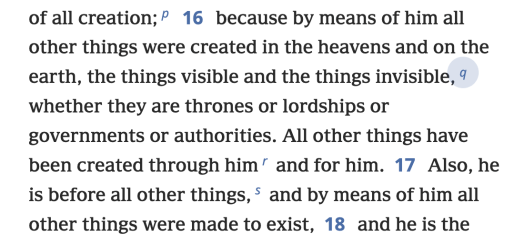
Now look at how the Jehovah’s Witnesses translate this same verse in their New World Translation:
because by means of him all other things were created in the heavens and on the earth, the things visible and the things invisible, whether they are thrones or lordships or governments or authorities. All other things have been created through him and for him.17 Also, he is before all other things, and by means of him all other things were made to exist (Colossians 1:16-17, New World Translation)
I’ve highlighted the four instances of the word “other” that have been inserted into the text by the Jehovah’s Witnesses in order diminish the divine nature of Jesus.
What is the justification for adding the word “other”?
According to the Jehovah’s Witnesses, the word “other” is added in order to make the text more readable. They cite other verses, such as Luke 13:2 where the word “other” is inserted to distinguish all the “other” Galileans from the subset of Galileans that Jesus had just mentioned.
This explanation is not sufficient as the insertion of “other” in Luke 13:2 does not change the meaning of the verse, while the insertion of “other” in Colossians 1:16-17 completely changes the meaning of the passage, making Jesus a created being instead of the eternally self-existent author of creation.
And that’s the point. in complete violation of standard translation practices, Jehovah’s Witnesses add words in order to change the clear meaning of the text to match their pre-determined theological preferences!
In short, Jehovah’s Witnesses, like Einstein with his theory of relativity, don’t like the implications of the passage, as it contradicts their preferred theological understanding. To rectifiy the situation, they insert a “fudge factor” to altar the equation, which yields a result that fits their ideological choice.
Jehovah’s Witnesses consistently engage in the theological Bible study error known as eisegesis, which means “to read into the text.”
What that means is that instead of allowing the Scriptures to inform their theological view, the Jehovah’s Witnesses conform the text to match their theological view. This is dishonest. It’s “fudging” the data to create the conclusion they want.
The Jehovah’s Witnesses have decided that Jesus is a created being, a lesser god, if you will, than almighty Jehovah. They establish this conclusion first and then every verse that seems to challenge their concusion must be interpreted in a way that affirms this prior doctrinal choice.
As has been shown, this is extremely difficult to do with the Scriptures because of the plethora of passages that point to Jesus’ divinity and support the traditional Christian doctrine that Jesus, in his very nature, is God.
The Jehovah’s Witnesses approach this difficulty in the same way Einstein did with his general theory of relativity, by inserting “fudge factors” into the text and into their explanations.
They insert these “fudge factors” in three different ways: by ignoring the immediate context that substantiates the traditional meaning and interpretation of debated texts, by changing and twisting the meaning of words beyond their normal and accepted use in order to force their interpretations onto the passage, and by inserting words into the text that are not there in the original Greek. The net effect of these “fudge factors” is to alter the plain and obvious meaning of passages that clearly refute their doctrinal view.
One would think that Einstein’s discovery that the universe had a beginning would have been a fatal blow to atheism, but it wasn’t. In fact, atheism as an ideology is more popular now than it was 100 years ago when Einstein was first formulating his theory.
Whenever someone is faced with evidence that challenges their official narrative, it creates ideological tension. How one deals with that ideological tension is very telling.
In the case of atheism, they simply dismiss or ignore any and all evidence that refutes their view. This is known as confirmation bias and it’s been around forever. Saul, later known as Paul, provides a clear example of confirmation bias, which I explain in my blog post “Saul’s Conversion and Confirmation Bias”.
In the case of Jehovah’s Witnesses, they reinterpret the evidence that challenges their narrative by introducing “fudge factors” that conform the evidence to their narrative. This is what is known as “cognitive dissonance”, a phenomenon in which information is not ignored or dismissed but is reinterpreted in such a way that the original narrative is maintained (see my blog post “Job’s Case of Cognitive Dissonance” for a biblical example).
The Jehovah’s Witnesses do this through their generous use of “fudge factors” – ignoring context, changing the meaning of words and adding words to change the clear and intended meaning of passages.
The Jehovah’s Witnesses are just like atheists in this respect: they are so committed to their ideology that they will resort to “fudging” the data as a way to explain and maintain their view.
Fudge as a dessert may taste good, but when used in misleading and dishonest ways, it can end up leaving a bad taste in your mouth. Just ask Ralphie, he’ll tell you.
More blog posts related to Jehovah’s Witness Beliefs
1In the past God spoke to our forefathers through the prophets at many times and in various ways, 2but in these last days he has spoken to us by his Son, whom he appointed heir of all things, and through whom he made the universe. 3The Son is the radiance of God’s glory and the exact representation of his being, sustaining all things by his powerful word. After he had provided purification for sins, he sat down at the right hand of the Majesty in heaven. 4So he became as much superior to the angels as the name he has inherited is superior to theirs.
5For to which of the angels did God ever say,
“You are my Son; today I have become your Father”?
Or again,
“I will be his Father, and he will be my Son”
6And again, when God brings his firstborn into the world, he says,
“Let all God’s angels worship him.”
7In speaking of the angels he says,
“He makes his angels winds, his servants flames of fire.”
8But about the Son he says,
“Your throne, O God, will last for ever and ever, and righteousness will be the scepter of your kingdom.
9You have loved righteousness and hated wickedness; therefore God, your God, has set you above your companions by anointing you with the oil of joy.”
10He also says,
“In the beginning, O Lord, you laid the foundations of the earth, and the heavens are the work of your hands.
11They will perish, but you remain; they will all wear out like a garment.
12You will roll them up like a robe; like a garment they will be changed.
But you remain the same, and your years will never end.”
13To which of the angels did God ever say,
“Sit at my right hand until I make your enemies a footstool
14Are not all angels ministering spirits sent to serve those who will inherit salvation? (Hebrews 1:1-14, NIV)
The Daily DAVEotional
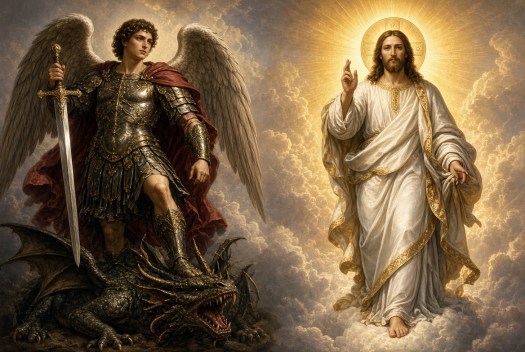
Did you know that the Jehovah’s Witnesses believe that Jesus is actually the archangel Michael?
Jehovah’s Witnesses teach that Jesus is Jehovah’s first created being, and that after creating Jesus, Jehovah used Jesus to create everything else.
Additionally, Jehovah’s Witnesses believe that as a created being, Jesus is actually the archangel Michael, who assumed the name Jesus when he became a man in order to pay the ransom that was required to redeem mankind by reversing the disastrous consequences of Adam’s sin.
The first chapter of Hebrews provides a sound refutation to the Jehovah’s Witnesses’ doctrine that Jesus is an exalted angel as the author effectively argues that Jesus is much better than the angels. In the process, this passage provides even more evidence for the traditional Christian doctrine that Jesus is God.
I previously wrote about the first 3 verses of Hebrews 1 in my blog post, “Better Than…” which sought to explain the purpose of the writing of the book of Hebrews, which was to demonstrate the superiority of Jesus over angels, Moses, the Old Covenant and the entire Jewish legal system, all in an effort to convince Jewish Christians not to revert back to the old Jewish legal system as a means of attempting to gain favor with God.
In this first chapter, the writer to the Hebrews provides at least 6 reasons why Jesus is better than the angels.
REASON #1 – Jesus is a son, the angels are not
In verse 5, the writer quotes two different Old Testament verses (Psalm 2:7 and 2 Samuel 7:14) to show that Jesus was the promised Messiah who fulfilled the prophecies related to the Davidic covenant.
In the Old Testament, angels are often referenced as “sons of God”, but angels are never referenced as “God’s Son”. Jesus is distinctly unique in this respect. Hence, he is greater than the angels.
REASON #2 – The angels worship Jesus
In verse 6, the angels are directly commanded to worship Jesus. Since the lesser always worships the greater, Jesus must be greater than the angels.
Incidentally, this verse provides still more evidence for Jesus’ divine nature for it’s clear in Scripture that only God is to be worshiped (see Exodus 20:3-5, Exodus 34:14, Deuteronomy 6:13 and Matthew 4:10). Also, in Revelation 22:8-9, John falls down in worship to an angel who had shown him the things he was seeing. John is rebuked by the angel who tells John,
“Do not do that. I am a fellow servant of yours and of your brethren the prophets and of those who heed the words of this book. Worship God.”
If only God is to be worshiped and the angels are commanded to worship Jesus, it not only confirms that Jesus is better than the angels but provides strong evidence that Jesus must possess the nature of God.
REASON #3 – The angels are God’s ministers but the Son is God, ruling with righteousness
The writer to the Hebrews explains that angels are ministering spirits whose purpose is to serve those who will inherit salvation (verse 14). By contrast, verses 8-9 show that Jesus’ purpose is to reign in righteousness.
These verses further demonstrate the divine nature of Jesus as the son is referred to as “God” in verse 8 and again in verse 9.
The writer also attributes to Jesus a throne that will last forever and ever. Jesus is depicted as reigning forever on a throne of righteousness while being called “God”.
Jesus is indeed better than the angels because Jesus is God!
REASON #4 – Jesus is creator of the heavens and the earth
The writer states in verse 2 that God “made the world” through Jesus and that Jesus “upholds all things by the word of his power.”
Later, in verse 10, Jesus is referred to as “Lord” by God himself and is demonstrated to be the author of all creation. Jesus “laid the foundations of the earth” and “the heavens are the work of your [Jesus’] hands!”
Jesus is the creator while angels are created. Hence, Jesus is better than the angels.
REASON #5 – The creation perishes, but the creator, Jesus, remains
Because we are finite creatures, we tend to look at the world and see it as permanent and unchangeable. But the truth is, the world and the universe is decaying and energy is running down. The writer to the Hebrews tells us that the creation will eventually wear out just like an old garment, but Jesus remains the same. This is strong evidence for his immutability, which further buttresses the case for his divinity.
Verse 12 says that the creation not only changes but it will come to an end. On the other hand, Jesus’ years will NOT come to an end because he is eternal.
So Jesus is both immutable and eternal, both characteristics which demonstrate divinity.
REASON #6 – Jesus sits at the right hand of the Father and all enemies are subjected to him
Verse 14 shows that angels are ministering spirits who come before God and serve him while Jesus is seated at the right hand of God with his enemies under his feet.
This demonstrates that Jesus has ultimate authority and sovereignty over every living thing. Being seated at the right hand of God demonstrates his equality with God, which is yet another evidence for his divinity.
This entire passage clearly shows that Jesus is greater than the angels, and yet, Jehovah’s Witnesses contend that Jesus actually IS an angel.
If Jesus is better than angels, as the writer to the Hebrews clearly demonstrates, how is it possible that he himself is an angel?
Jesus is better than the angels not just because he has a higher position, as Jehovah’s Witnesses may argue, but Jesus is better than the angels because he has a better nature.
Jesus is divine. He is God. Therefore, he cannot be the archangel Michael.
More blog posts related to Jehovah’s Witness Beliefs
Did you enjoy this post? I’d love to hear your thoughts! Feel free to like, leave a comment below, and share it with your friends or on social media if you found it helpful or interesting. Your support keeps the conversation going!
Reflection
What do you think it means when it says that Jesus is the exact representation of the nature of God? In what ways does this description of Jesus argue against the idea that Jesus is an angel?
Do you think an angel can have the attributes and qualities that the writer of Hebrews assigns to Jesus? For example, do you think it’s possible that an angel has the power to “uphold all things by the power of his word?” What descriptions about Jesus argue most strongly against Jesus being an angel?
If Jesus is actually the archangel Michael, why do you think God would command all the angels to worship him?
If only God is to be worshiped, which is clear from Scripture, what does it tell you about the nature of Jesus that God commands all the angels to worship him?
If Jesus actually is the archangel Michael, as Jehovah’s Witnesses assert, why would the writer of Hebrews not disclose that in this passage, especially when the whole purpose is to contrast Jesus with angels?
If Jesus is the archangel Michael, how do you interpret the verse that says,
“For to which of the angels did God ever say, “You are my Son; today I have become your Father”?”
Wouldn’t the answer to this question obviously be “Michael. That is the angel to which God has said this”?
15He is the image of the invisible God, the firstborn over all creation. 16For by him all things were created: things in heaven and on earth, visible and invisible, whether thrones or powers or rulers or authorities; all things were created by him and for him. 17He is before all things, and in him all things hold together. 18And he is the head of the body, the church; he is the beginning and the firstborn from among the dead, so that in everything he might have the supremacy. 19For God was pleased to have all his fullness dwell in him, 20and through him to reconcile to himself all things, whether things on earth or things in heaven, by making peace through his blood, shed on the cross. (Colossians 1:15-20, NIV)
The Daily DAVEotional
About a year ago, I posted my thoughts on this very passage, explaining the meaning of the term “firstborn” and why it doesn’t teach that Jesus is a created being, as the Jehovah’s Witnesses argue.
I don’t want to rehash all of my points from that post so if you haven’t read it, I encourage you to read the original post, “What Does it Mean that Jesus is the Firstborn?” to get up to speed on the debate between the traditional Christian understanding of Jesus and the Arian view that Jehovah’s Witnesses hold.
My purpose in this post is to provide a response to some of the arguments levied by Jehovah’s Witnesses who argue against my interpretation of this passage.
In my initial post, I made the claim that the primary meaning of “firstborn” in Colossians 1:15 and 18 is “preeminence”. I reasoned that this makes the most sense since Paul uses “firstborn” in conjunction with two different terms, “creation” and “death”, neither of which have anything to do with a parent. Therefore, it seems most natural that Paul is using the term to demonstrate Jesus’ supremacy (pre-eminence) over creation and death.
In recent weeks, I’ve encountered a number of committed Jehovah’s Witnesses online who disagree with my interpretation and have offered up their own explanations for this passage.
The standard Jehovah’s Witness talking point as it relates to the meaning of “firstborn” in Colossians 1 is that the term means something like “first in line.”
The argument is that the term “firstborn” most often refers to the first offspring of a particular person. Therefore, the word should be interpreted in a similar manner when it’s used in a verse that is not referencing offspring.
If you agree with the Jehovah’s Witness logic, then the interpretation of Colossians 1 yields the following:
Jesus is the firstborn of creation, which means that he was the first one to be created by Jehovah.
Jesus is the firstborn from among the dead, which means he’s the first one to overcome death.
To some, particularly Jehovah’s Witnesses and others who hold to an Arian view of Christ, the debate is over. In their mind, the logic is irrefutable.
But is it?
Sound Bible study methods dictate that we investigate their claims. Is their understanding of the word the standard interpretation?
I did a Bible search and found that the word “firstborn” shows up in 111 Bible verses, all but 9 of which are found in the Old Testament. In some verses, the word “firstborn” appears multiple times. Hence, the term is used more than 120 times throughout the Bible.
I’ve catalogued every verse where the term shows up, so you can see for yourself. You can access this list of verses in my blog post “Bible References to the Term “Firstborn”“.
The Jehovah’s Witnesses are right in this respect – a majority of the references to the term “firstborn” do actually refer to the first one born to a particular person. However, it is rather obvious from the context of all of those passages that this is the meaning.
Take Genesis 10:15 for example, which is the very first occurrence of the term. The verse says,
Canaan became the father of Sidon, his firstborn.
In a majority of the occurrences of the term “firstborn”, it’s used in this same manner where the term is by itself, but referencing a parent. Occasionally, the term is referenced to another living creature as in Exodus 11:5 which states that God was going to kill the firstborn of Pharaoh as well as the firstborn of all cattle.
It’s clear in these situations that the term does mean “first offspring” primarily because the verse gives the name of the parent and the son or daughter.
But how is the word understood when it is not used in conjunction with a living being (man or animal)? Is it understood in the same way?
Typically not.
One of the first occurrences where firstborn is used in a non-traditional way is Exodus 4:22, which says,
“Then you shall say to Pharaoh, ‘Thus says the LORD, “Israel is My son, My firstborn. 23“So I said to you, ‘Let My son go that he may serve Me’; but you have refused to let him go. Behold, I will kill your son, your firstborn.”’”
Notice that the term shows up twice. In the second instance it’s used in the same way we typically see the word being used, in reference to the first offspring of a person. In this case, it’s referring to the first offspring of Pharaoh.
But in the first instance of the term “firstborn”, it is not used in the typical fashion.
According to Jehovah’s Witness’ argumentation, the word should have the same meaning even when it’s used in a non-traditional way.
It turns out that the first instance of “firstborn” in this passage CANNOT mean what the Jehovah’s Witnesses attribute to the term. God specifically states that Israel, the nation, is his firstborn. If we understand “firstborn” to be “first in line”, in what sense is Israel the “first in line”?
Israel was not the first nation to be created. And God doesn’t “birth” nations anyway, so the word cannot mean “first offspring”.
It’s clear by the context that the first occurrence of “firstborn” in this verse is to be understood as Israel having a favored status. God selected Israel for a distinct and unique purpose – to be a nation through which all the other nations would be blessed and come to know the one true God.
In this case, the meaning of “preeminent” is clearly the correct understanding.
Genesis 48 provides an insightful story that helps us understand the significance of the firstborn.
In this passage, Joseph brings his sons Manasseh and Ephraim to Jacob in order to receive a blessing before Jacob passes.
Jacob is old and his vision is failing. As he reaches out to bless Joseph’s sons, he crosses his arms so that his right hand is on Ephraim instead of Manasseh who is the first offspring of Joseph and therefore the firstborn.
Genesis 48:14 says,
But Israel stretched out his right hand and laid it on the head of Ephraim, who was the younger, and his left hand on Manasseh’s head, crossing his hands, although Manasseh was the firstborn.
In Genesis 48:18, Joseph tries to correct his father, saying,
“Not so, my father, for this one is the firstborn. Place your right hand on his head.”
Jacob tells Joseph that he is aware of the situation and he knows what he is doing. He tells Joseph that Ephraim, though he is the younger, will have a higher position over his brother. He will be the firstborn, the favored son.
Just a few verses later, in the next chapter, Jacob is giving his final words to each of his sons. Here is what he says to Reuben, his first son, in Genesis 49:3-4,
“Reuben, you are my firstborn; My might and the beginning of my strength, Preeminent in dignity and preeminent in power. 4“Uncontrolled as water, you shall not have preeminence, Because you went up to your father’s bed; Then you defiled it —he went up to my couch.
Jacob not only defines the term “firstborn” for us but expounds on its significance. The firstborn IS the might of the father AND the beginning of the father’s strength. The firstborn is PREEMINENT.
Jacob tells Reuben that he is the firstborn in terms of offspring. But he would NOT be firstborn in terms of preeminence.
These passages, which show up early in the biblical narrative, demonstrate clearly that the idea of “preeminence” was nearly synonymous with the term “firstborn”.
Though Manasseh was Joseph’s first offspring, it turns out that he was not considered the “firstborn” in terms of stature and rank. In Jeremiah 31:9, God confirms that “Ephraim is my firstborn.”
In 1 Chronicles 2:13, we read that,
Jesse became the father of Eliab his firstborn, then Abinadab the second, Shimea the third,
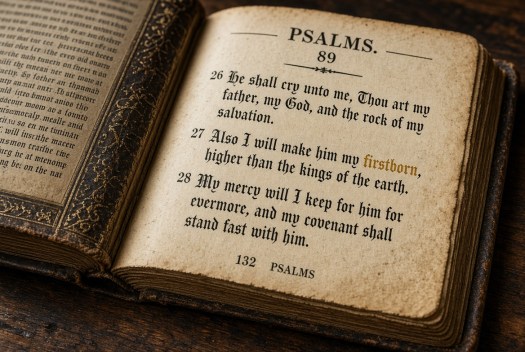
In verse 14, we learn that David was the eighth and last son born to Jesse. Yet, in Psalm 89:27, God says about David,
“I also shall make him Myfirstborn,
The highest of the kings of the earth.
David was not the first offspring of Jesse, but God made David His firstborn.
What does that mean?
It cannot mean that David was “first in line” because David was neither the first offspring of Jesse nor was he the first king of Israel.
What it means is that David was made by God to assume the highest rank among rulers. David was made firstborn – he was made to be preeminent.
The context dictates the meaning and sense of the word and so far, when the word is used in a way that doesn’t mean “first offspring”, it carries the meaning of “preeminence.”
There’s an interesting passage in Job that uses the term firstborn. It’s found in Job 18:13, which says:
“His skin is devoured by disease,
The firstborn of death devours his limbs.
This occurrence is informative because it uses the term “firstborn” with the prepositional phrase “of….” that doesn’t have a person or animal following. Whenever we see a person or animal (cattle, herd) follow, as in “firstborn of Jacob” or “firstborn of cattle”, the term always refers to the first offspring.
But in this case, the “firstborn of” phrase is not followed by a person or animal.
Does the standard Jehovah’s Witness meaning of “first in line” follow?
Not really.
Death is inanimate. It’s not a living organism that gives birth as humans and mammals do.
So what is this verse saying?
This verse is part of a larger discourse by Bildad in which he’s communicating his ideology that the wicked eventually get the punishment they deserve. He’s using this argumentation to try to prove that the reason Job has experienced so much trauma and suffering is because Job’s sin has finally caught up to him.
In describing the punishment the wicked will endure, Bildad claims that the skin of the wicked gets devoured by disease AND the “firstborn of death” devours his limbs. It’s obvious that Bildad is making reference to Job’s physical ailments as a proof of Job’s supposed secret sin.
But what is meant by “firstborn of death”?
Note that this term is very similar to how Paul uses “firstborn” in Colossians 1:18.
If “firstborn” means “first in line” in these kinds of cases, what exactly does that mean?
The context will not allow that interpretation because if you assume that meaning, you end up with a garbled mess of a sentence that is completely incoherent.
It’s clear in this context that death is afflicting its victim. There is no sense in which the term “firstborn of death” includes the meaning “first in line”. Death does not birth anything and does not produce a literal offspring.
But death CAN rule. Death CAN overwhelm. That is the sense that is being conveyed here. There is no meaningful or coherent sense in which “first in line” as a meaning applies to the term “firstborn” here.
There’s another uncommon use of the term “firstborn” in Isaiah that does not follow the typical examples that are littered throughout the Old Testament.
Isaiah 14:30 in the ESV says,
And the firstborn of the poor will graze,
And the needy lie down in safety; but I will kill your root with famine, and your remnant it will slay.
Here is another example of the word “firstborn” being used in connection with something that is a non-person and a non-animal, negating the traditional meaning of “first offspring.”
What exactly, then is the “firstborn of the poor” and does the definition of “first in line” fit here given the context?
This verse is part of a prophecy that the Lord is giving to Philistia. God warns that Philistia will experience complete devastation and that only “the firstborn of the poor will graze.”
What exactly does that mean?
One thing it doesn’t mean is “first in line”. If we apply the meaning of “highest rank” or “supreme” then it means that those who are the MOST poor will graze (be fed). In other words, it’s going to be bad, and only the most poor, or the poorest of the poor will survive.
It appears that in pretty much every case where the term “firstborn” is used in a way that doesn’t include the parent with the first offspring, the term means “preeminent.”
As mentioned at the outset, there are only 9 verses in the New Testament that use the term “firstborn”.
There are two verses in Luke 2 that use the term, and in both cases, the term “firstborn” is used to refer to Jesus as Mary’s first offspring.
In Hebrews 11:28, the term “firstborn” is referencing the Egyptian plague when the angel of death passed over the Israelites and all of the firstborn of the Israelites were shielded from the plague.
That leaves 6 more verses that use the term “firstborn” including the two in Colossians. None of these other verses use the term in the normal sense where it obviously refers to the first offspring of a certain person.
I’ll examine each of the non-Colossians verses before coming back to Colossians and then summarizing what this tells us.
Romans 8:29 says,
For those whom He foreknew, He also predestined to become conformed to the image of His Son, so that He would be the firstborn among many brethren;
What is this verse saying?
It’s saying that those who become children of God are predestined to be conformed to the image of Jesus. That is, believers ultimately are going to be LIKE him. We won’t just be declared righteous, we will BE righteous because in the end, our sin nature will finally be eradicated.
This is the sense that we will fully be Christ’s brethren. Though we will be LIKE him, we will not be equal to him. Jesus will be the firstborn among all these brethren, which simply means, he will be preeminent. He will be supreme.
So this verse, as applied to Jesus, does not state that he is the first of Jehovah’s creation. It’s stating that he will have a preeminent position among all of the brethren.
This interpretation makes complete sense if we understand that Jesus is a son by nature but we are sons (and daughters) by adoption.
Hebrews 1:6 says,
And when He again brings the firstborn into the world, He says,
“AND LET ALL THE ANGELS OF GOD WORSHIP HIM.”
The term “firstborn” in this verse clearly refers to Jesus, but does it mean that he was the first offspring?
That is a doubtful interpretation for reasons that have already been enumerated. Jesus was not born. Therefore, the more logical understanding of this term as applied to Jesus is “preeminent one”.
This makes sense given the context of Hebrews 1. This passage, starting in verse 5 and ending with verse 13, is demonstrating that Jesus is superior to, or better than the angels.
So when the firstborn, the preeminent one, comes into the world, God says “let all the angels worship Him.” It logically follows that the angels are commanded to worship Jesus because he is preeminent over them.
Now two things should be said about this. First of all, it’s clear from Scripture that only God is to be worshipped. So what does it say about Jesus that God instructs the angels to worship Him?
Secondly, the Jehovah’s Witnesses believe that Jesus is actually the archangel Michael. They believe that Michael is the highest of angels and that God the Father (Jehovah to the Jehovah’s Witnesses) gave Michael the task of coming into the world to redeem humanity. Michael took on a human nature and changed his name for some reason. When his mission was complete, Jesus returned to heaven and assumed his prior identity as Michael the archangel.
So according to the Jehovah’s Witnesses, a powerful angel came to earth, took on a human body and God the Father instructed all the other angels to WORSHIP him.
This doesn’t sound like an angel or even someone who is god-like, as Jehovah’s Witnesses will say. This sounds like someone who possesses the divine nature. In fact, this is exactly what Hebrews 1:3 -4 teaches, that Jesus is the EXACT representation of God’s nature AND he is BETTER than the angels. How can he be better than the angels if he himself IS an angel?
Hebrews 12:23 says,
to the general assembly and church of the firstborn who are enrolled in heaven, and to God, the Judge of all, and to the spirits of the righteous made perfect,
There is some debate about what the term “church of the firstborn” refers to but we know it does NOT refer to Jesus. It clearly refers to a group of people in heaven. It’s also clear that the idea of “first offspring” is not in view here.
I think the most likely understanding of “firstborn” in this verse is either “favored status” or “inheritance.” Remember that the firstborn son had a favored status and received a double portion of the inheritance. So both of these ideas are already inherent in the term.
In this sense, the phrase “church of the firstborn” likely refers to those who have received the inheritance. In other words, it’s referring to those who, because they have placed their faith in Jesus and belong to him, receive exclusive spiritual blessings that are not available to those who are not in the church.
This view makes more sense than anything resembling “first in line”.
Revelation 1:5 says,
and from Jesus Christ, the faithful witness, the firstborn of the dead, and the ruler of the kings of the earth. To Him who loves us and released us from our sins by His blood—
This is the last occurrence of the term “firstborn” in the Bible and it’s the one occurrence that most resembles the usage of Colossians, especially Colossians 1:18.
So what does this mean?
Jehovah’s Witnesses will likely argue for the interpretation that they hold for Colossians 1:18, namely that this means that Jesus is the first to overcome death, that Jesus is “first in line”.
But given the context, noting that John follows this phrase by saying that Jesus is the RULER of the kings of the earth, it makes more sense that John is using the term to communicate that Jesus is the one who is preeminent over death. In other words, Jesus rules over death, just as he rules over the kings of earth.
It bears repeating that Jesus was not born. So what would be the purpose of using the term “firstborn” if it does not apply to Jesus as it applied to Reuben, Manasseh and the dozens of other references that referred to the first offspring of some person?
In other words, the term firstborn, in a majority of cases, was used to identify the first offspring of a person in order to distinguish that person from other siblings who were not first. But since Jesus has no spiritual “siblings”, there is no need to use the term “firstborn” to distinguish him from rival siblings.
Clearly, John is pointing to Jesus’ special status. To conclude otherwise is to stretch or twist the context of these passages and phrases to unnatural and incoherent meanings.
Now let’s circle back to the Colossians verses that use the term “firstborn”.
What we’ve seen in every use of the term “firstborn” is that it most often refers to “first offspring”. But it never means “first offspring” when the term “firstborn” is used in conjunction with a non-person or non-mammal. In those cases, some form of preeminence, rule or supremacy is meant.
One thing that is clear is that there are no verses where the term firstborn means “first in line”. Yes, it means “first offspring” when speaking of a person or animal that bears offspring in the natural way. However, when “firstborn” is coupled with a non-person, the idea of “first in line” is never in view.
Yet that is exactly what the Jehovah’s Witnesses contend that it means in these two verses in Colossians. They argue that Colossians 1:15 means that Jesus was first in line to be created and Colossians 1:18 means that Jesus was first in line to be raised from the dead.
Their argument is that this understanding is demanded because it is the normal meaning when you see the term.
But, as we’ve seen, it’s only normal when the term is used to refer to “first offspring”. There is no instance where it carries that meaning apart from the term “firstborn” being connected with a living person or an animal such as “cattle” or “herd”.
When the term “firstborn” is used apart from a living person or animal, it always has the meaning of preeminence, supremacy or highest rank.
This rendering makes the most sense in Colossians, especially when you look at the context and realize that Paul is seeking to demonstrate that “in everything Christ might have supremacy.”
If Paul’s argument is designed to show that Christ will have supremacy in everything (verse 18), then it makes sense that he is going to support that argument by showing that Jesus has supremacy over creation and over death.
So why do Jehovah’s Witnesses still insist that “firstborn”, when attributed to Jesus, means “first in line” when it’s never used that way in any other example?
The answer is that they have manufactured this definition as a way to maintain their theological view that Jesus is a created being.
Jehovah’s Witnesses demonstrate the most egregious form of the Bible study error known as eisegesis, which means to “read into the text.”
In simple terms, the Jehovah’s Witnesses do not approach the text in order to inform their theology. Instead, they add phrases to the text and change the normal meaning of words in order to conform the text to their theology.
It’s clear that, as it relates to Jesus, Paul is using the term “firstborn” in the sense of “preeminence”. This is how the word is used in cases that clearly don’t refer to “first offspring.”
Additionally, the context supports the idea of “preeminence” as the meaning of firstborn.
Paul states that Jesus is the “firstborn of creation” which means Jesus is preeminent over creation.
In the verses that follow, Paul states that Jesus is the creator of all things. So Jesus is preeminent over creation because he is the creator.
The Jehovah’s Witnesses have to manufacture a meaning of firstborn to mean something like “first in line” in order to convince you that Paul is trying to tell you that Jesus is the first created being of Jehovah.
Yet if Paul was trying to communicate that Jesus was “first-created”, he would have used the Greek word “protoktisis” which literally means “first-created.”
That Paul didn’t use that word speaks volumes.
The Jehovah’s Witnesses then have to add the word “other” to the text four times in order to change the meaning of the text to show that Jesus is not really the creator as the original Greek text indicates.
The Jehovah’s Witnesses are like the person who tells a small lie to promote a false narrative but are then forced to create bigger lies in order to maintain the fabricated story.
They first had to offer up a definition for “firstborn” that is literally not used in any of the more than 100 occurrences of the term.
Then, to keep their narrative alive that Jesus is a created being, they have to add the word “other” to the passage four times. Their explanations and justifications for their interpretive choices get increasingly more complicated and logically convoluted in their effort to maintain their theological view.
The most direct, plain and understandable meaning of this passage is that Jesus is preeminent over creation because he is the creator. Additionally, Jesus is preeminent over death because he conquered death. All of this demonstrates that Jesus will come to have first place (i.e. preeminence) in everything!
No extra words and no uncommon and unnatural definitions are required to arrive at this understanding.
So we are back to my original premise in my first blog post, which is that the word “firstborn” does not mean what the Jehovah’s Witnesses think it means.
Jehovah’s Witnesses would do well to heed the advice of Inigo Montoya, who famously said,
Did you enjoy this post? I’d love to hear your thoughts! Feel free to like, leave a comment below, and share it with your friends or on social media if you found it helpful or interesting. Your support keeps the conversation going!
Reflection
Do you agree with the Jehovah’s Witnesses’ interpretation of Colossians 1;15 and Colossians 1:18 that the term “firstborn” should be understood as “first in line”? If so, how do you interpret the other passages that use “firstborn” in a context that doesn’t refer to “first offspring”?
Have you ever told a small lie that escalated into much bigger fabrications? What is the motivation for lying in the first place? What are the reasons a person might continue to promote a falsehood?
What are some examples you can think of where a person is so committed to their narrative that they resort to convoluted logic and distorted definitions in an attempt to justify their narrative?
If the term “firstborn” means “first in line” in Colossians, as Jehovah’s Witnesses assert, what exactly is the meaning of the phrase “firstborn from among the dead”? How does the idea of “first in line” apply to Jesus’ death?
Photo is a screenshot from the movie “The Princess Bride”
This is a complete list of all Bible verses that contain the word “firstborn”. This list is provided for convenience to those who want to do a word study to determine the meaning and the usage of the word “firstborn”, particularly so you can accurately interpret the meaning of “firstborn” as it relates to Jesus in Colossians 1:15 and Colossians 1:18.
The Jehovah’s Witnesses insist that the meaning of the word “firstborn” in those verses is the normal standard meaning of one born first. Or to put it another way, they claim the word means something like “first in line” or “first in chronology.”
To determine whether their interpretation is correct or even a valid option, it is helpful to see how the word is used throughout Scripture. Specifically, we want to see if the word is ever used with the meaning they attribute in Colossians. If the word is used in other parts of Scripture in the way they define it in Colossians then it lends more credibility to their interpretation.
All references are in the New American Standard Bible, unless otherwise noted
Old Testament
Genesis
Genesis 10:15 – Canaan became the father of Sidon, his firstborn
Genesis 19:31 – Then the firstborn said to the younger, “Our father is old, and there is not a man on earth to come in to us after the manner of the earth.
Lot’s daughter, the firstborn, hatched a plan with her younger sister to get their father to impregnate them in order to ensure that they would have offspring
Genesis 19:33 – So they made their father drink wine that night, and the firstborn went in and lay with her father;
Genesis 19:34 – On the following day, the firstborn said to the younger, “Behold, I lay last night with my father;
Genesis 19:37 – The firstborn bore a son, and called his name Moab
Lot’s oldest bore a son who became the father of the Moabites. The younger daughter bore a son who became the father of the Ammonites.
Genesis 22:20-21 – “Behold, Milcah also has borne children to your brother Nahor: 21Uz his firstborn and Buz his brother
Uz was Abraham’s nephew, the firstborn of Abraham’s brother Nahor
Genesis 25:13 – and these are the names of the sons of Ishmael, by their names, in the order of their birth: Nebaioth, the firstborn of Ishmael, and Kedar and Adbeel and Mibsam
Genesis 27:19 – Jacob said to his father, “I am Esau your firstborn; I have done as you told me. Get up, please, sit and eat of my game, that you may bless me.”
Jacob was deceiving Isaac, pretending to be Esau, the firstborn son
Genesis 27:32 – Isaac his father said to him, “Who are you?” And he said, “I am your son, your firstborn, Esau.”
Genesis 29:26 – But Laban said, “It is not the practice in our place to marry off the younger before the firstborn.
Leah was the firstborn. She was older than Rachel so the custom was that she should be married off first
Genesis 35:23 – the sons of Leah: Reuben, Jacob’s firstborn, then Simeon and Levi and Judah and Issachar and Zebulun;
Genesis 36:15 – The sons of Eliphaz, the firstborn of Esau, are chief Teman, chief Omar, chief Zepho, chief Kenaz
Genesis 38:6 – Now Judah took a wife for Er his firstborn, and her name was Tamar.
Genesis 38:7 – But Er, Judah’s firstborn, was evil in the sight of the LORD, so the LORD took his life.
Genesis 41:51 – Joseph named the firstborn Manasseh,
Genesis 43:33 – Now they were seated before him, the firstborn according to his birthright and the youngest according to his youth, and the men looked at one another in astonishment.
Joseph had seated his brothers according to their birth order. Joseph’s brothers were amazed, as they still were unaware that it was Joseph
Genesis 46:8 – Now these are the names of the sons of Israel, Jacob and his sons, who went to Egypt: Reuben, Jacob’s firstborn.
Genesis 48:14 – But Israel stretched out his right hand and laid it on the head of Ephraim, who was the younger, and his left hand on Manasseh’s head, crossing his hands, although Manasseh was the firstborn.
Jacob intentionally gave Ephraim the blessing of the firstborn even though he was NOT the firstborn
Genesis 48:18 – Joseph said to his father, “Not so, my father, for this one is the firstborn. Place your right hand on his head.”
Joseph tried to correct his father to give the favored blessing to Manasseh, who held that status as the firstborn. In the next verse, Genesis 48:19, Jacob tells Joseph that he realizes Manasseh is the firstborn, yet he knows what he’s doing, so Ephraim received the blessing of the firstborn.
Genesis 49:3-4 – “Reuben, you are my firstborn; My might and the beginning of my strength, Preeminent in dignity and preeminent in power. 4“Uncontrolled as water, you shall not have preeminence, Because you went up to your father’s bed; Then you defiled it —he went up to my couch.
A critical passage in which the definition of “firstborn” is provided by Jacob as he tells Reuben that even though he’s the firstborn, he would not experience the preeminence that is due the firstborn
Exodus
Exodus 4:22 – “Then you shall say to Pharaoh, ‘Thus says the LORD, “Israel is My son, My firstborn. 23“So I said to you, ‘Let My son go that he may serve Me’; but you have refused to let him go. Behold, I will kill your son, your firstborn.”’”
A critical passage in which the term “firstborn” appears twice. The first time, it refers to the nation of Israel. Obviously, the meaning of this first occurrence is NOT that Israel was born first, for Israel was not born in the same sense that people are. They were chosen. It must be stated that Israel was NOT created first. They were NOT the first nation to appear. They were “firstborn” in the sense that they were “preeminent” – they had a special status and unique favor by God as the nation through which God’s blessings would extend to the world.
NOTE that the second occurrence of “firstborn” in this verse is the typical usage – it refers to the literal firstborn son of Pharaoh.
Exodus 4:23 – “So I said to you, ‘Let My son go that he may serve Me’; but you have refused to let him go. Behold, I will kill your son, your firstborn.”’”
Exodus 6:14 – These are the heads of their fathers’ households. The sons of Reuben, Israel’s firstborn: Hanoch and Pallu, Hezron and Carmi; these are the families of Reuben.
Exodus 11:5 – and all the firstborn in the land of Egypt shall die, from the firstborn of the Pharaoh who sits on his throne, even to the firstborn of the slave girl who is behind the millstones; all the firstborn of the cattle as well.
Four occurrences of the term “firstborn”. Notice the first occurrence generally refers to all the firstborn, whether people or animals. The following occurrences serve to clarify or provide more specifics. The second occurrence refers to Pharaoh’s firstborn. The third and fourth occurrences are interesting because this is the first time we see the word “firstborn” used with a prepositional phrase “of….” That does not include the name of the father. We’ve seen “Reuben, firstborn of Jacob” but this is “firstborn of the slave girl” and “firstborn of the cattle”. So we deduce that this refers to the literal first person born of slave girls or cattle. Note though that these are living beings who bear offspring in natural ways. They BIRTH their offspring. Hence, their first offspring can naturally be referred to as “firstborn”. This is noted because the word “firstborn” is not used in this way in Colossians 1.
Exodus 12:12 – ‘For I will go through the land of Egypt on that night, and will strike down all the firstborn in the land of Egypt, both man and beast; and against all the gods of Egypt I will execute judgments—I am the LORD.
Exodus 12:29 – Now it came about at midnight that the LORD struck all the firstborn in the land of Egypt, from the firstborn of Pharaoh who sat on his throne to the firstborn of the captive who was in the dungeon, and all the firstborn of cattle.
Exodus 13:2 – “Sanctify to Me every firstborn, the first offspring of every womb among the sons of Israel, both of man and beast; it belongs to Me.”
After the Passover, God issues a decree that the firstborn of people and cattle should be consecrated to the Lord
Exodus 13:12 (ESV) – you shall set apart to the LORD all that first opens the womb. All the firstborn of your animals that are males shall be the LORD’s.
Exodus 13:13 (ESV) – Every firstborn of a donkey you shall redeem with a lamb, or if you will not redeem it you shall break its neck. Every firstborn of man among your sons you shall redeem.
Another example of the word “firstborn” being used with the phrase “of”. In this case “of man” makes it clear that it’s speaking of the first offspring of all men
Exodus 13:15 – ‘It came about, when Pharaoh was stubborn about letting us go, that the LORD killed every firstborn in the land of Egypt, both the firstborn of man and the firstborn of beast. Therefore, I sacrifice to the LORD the males, the first offspring of every womb, but every firstborn of my sons I redeem.’
Exodus 22:29 – “You shall not delay the offering from your harvest and your vintage. The firstborn of your sons you shall give to Me.
Exodus 34:19 (ESV) – All that open the womb are mine, all your male livestock, the firstborn of cow and sheep.
Exodus 34:20 (ESV) – The firstborn of a donkey you shall redeem with a lamb, or if you will not redeem it you shall break its neck. All the firstborn of your sons you shall redeem. And none shall appear before me empty-handed.
Leviticus
Leviticus 27:26 – However, a firstborn among animals, which as a firstborn belongs to the LORD, no man may consecrate it; whether ox or sheep, it is the LORD’s.
Numbers
Numbers 1:20 – Now the sons of Reuben, Israel’s firstborn, their genealogical registration by their families, by their fathers’ households, according to the number of names, head by head, every male from twenty years old and upward, whoever was able to go out to war,
Numbers 3:2 – These then are the names of the sons of Aaron: Nadab the firstborn, and Abihu, Eleazar and Ithamar.
Numbers 3:12 – “Now, behold, I have taken the Levites from among the sons of Israel instead of every firstborn, the first issue of the womb among the sons of Israel. So the Levites shall be Mine.
Numbers 3:13 – “For all the firstborn are Mine; on the day that I struck down all the firstborn in the land of Egypt, I sanctified to Myself all the firstborn in Israel, from man to beast. They shall be Mine; I am the LORD.”
Numbers 3:40 – Then the LORD said to Moses, “Number every firstborn male of the sons of Israel from a month old and upward, and make a list of their names.
Numbers 3:41 – “You shall take the Levites for Me, I am the LORD, instead of all the firstborn among the sons of Israel, and the cattle of the Levites instead of all the firstborn among the cattle of the sons of Israel.”
Numbers 3:42 – So Moses numbered all the firstborn among the sons of Israel, just as the LORD had commanded him
Numbers 3:43 – and all the firstborn males by the number of names from a month old and upward, for their numbered men were 22,273.
Numbers 3:45 – “Take the Levites instead of all the firstborn among the sons of Israel and the cattle of the Levites. And the Levites shall be Mine; I am the LORD.
Numbers 3:46 – “For the ransom of the 273 of the firstborn of the sons of Israel who are in excess beyond the Levites,
Numbers 8:16 – for they are wholly given to Me from among the sons of Israel. I have taken them for Myself instead of every first issue of the womb, the firstborn of all the sons of Israel.
Numbers 8:17 – “For every firstborn among the sons of Israel is Mine, among the men and among the animals; on the day that I struck down all the firstborn in the land of Egypt I sanctified them for Myself.
Numbers 8:18 – “But I have taken the Levites instead of every firstborn among the sons of Israel.
Numbers 18:15 – “Every first issue of the womb of all flesh, whether man or animal, which they offer to the LORD, shall be yours; nevertheless the firstborn of man you shall surely redeem, and the firstborn of unclean animals you shall redeem.
NOTE the use of firstborn of man, and of animals. These are living creatures that bear offspring through live birth. Hence, firstborn here refers to their FIRST offspring.
Numbers 18:17 – “But the firstborn of an ox or the firstborn of a sheep or the firstborn of a goat, you shall not redeem; they are holy. You shall sprinkle their blood on the altar and shall offer up their fat in smoke as an offering by fire, for a soothing aroma to the LORD.
Numbers 26:5 – Reuben, Israel’s firstborn, the sons of Reuben: of Hanoch, the family of the Hanochites; of Pallu, the family of the Palluites;
Here, Israel refers to Jacob. Reuben was Israel’s (Jacob’s) first born son.
Numbers 33:4 – while the Egyptians were burying all their firstborn whom the LORD had struck down among them. The LORD had also executed judgments on their gods.
Deuteronomy
Deuteronomy 12:6 – “There you shall bring your burnt offerings, your sacrifices, your tithes, the contribution of your hand, your votive offerings, your freewill offerings, and the firstborn of your herd and of your flock.
Herds and flocks are living creatures whose offspring enter via live birth. Hence, the firstborn of herds and flocks refers to the first offspring.
Deuteronomy 12:17 – “You are not allowed to eat within your gates the tithe of your grain or new wine or oil, or the firstborn of your herd or flock, or any of your votive offerings which you vow, or your freewill offerings, or the contribution of your hand.
Deuteronomy 14:23 – “You shall eat in the presence of the LORD your God, at the place where He chooses to establish His name, the tithe of your grain, your new wine, your oil, and the firstborn of your herd and your flock, so that you may learn to fear the LORD your God always.
Deuteronomy 15:19 – “You shall consecrate to the LORD your God all the firstborn males that are born of your herd and of your flock; you shall not work with the firstborn of your herd, nor shear the firstborn of your flock.
Deuteronomy 21:15 – “If a man has two wives, the one loved and the other unloved, and both the loved and the unloved have borne him sons, if the firstborn son belongs to the unloved,
Deuteronomy 21:16 – then it shall be in the day he wills what he has to his sons, he cannot make the son of the loved the firstborn before the son of the unloved, who is the firstborn.
Deuteronomy 21:17 – “But he shall acknowledge the firstborn, the son of the unloved, by giving him a double portion of all that he has, for he is the beginning of his strength; to him belongs the right of the firstborn.
Deuteronomy 25:6 – “It shall be that the firstborn whom she bears shall assume the name of his dead brother, so that his name will not be blotted out from Israel.
Deuteronomy 33:17 –
“As the firstborn of his ox, majesty is his,
And his horns are the horns of the wild ox;
With them he will push the peoples,
All at once, to the ends of the earth.
And those are the ten thousands of Ephraim,
And those are the thousands of Manasseh.”
This is a prophecy related to Joseph (see Deuteronomy 33:13. Joseph represented Israel’s firstborn ox. Literally, Joseph was Jacob’s strength. His double blessing was represented by Ephraim and Manasseh
Joshua
Joshua 6:26 – Then Joshua made them take an oath at that time, saying, “Cursed before the LORD is the man who rises up and builds this city Jericho; with the loss of his firstborn he shall lay its foundation, and with the loss of his youngest son he shall set up its gates.”
This was a curse…the person who rebuilt Jericho would lose their firstborn. This curse was fulfilled in 1 Kings 16:34
Joshua 17:1 – Now this was the lot for the tribe of Manasseh, for he was the firstborn of Joseph. To Machir the firstborn of Manasseh, the father of Gilead, were allotted Gilead and Bashan, because he was a man of war.
Manasseh was LITERALLY the first one born to Joseph. So yes, he was firstborn in the sense that he was born first. But he was NOT firstborn in the sense of preeminence and favor. That was reserved for Ephraim (see Jeremiah 31:9).
Judges
Judges 8:20 – So he said to Jether his firstborn, “Rise, kill them.” But the youth did not draw his sword, for he was afraid, because he was still a youth.
1 Samuel
1 Samuel 8:2 – Now the name of his firstborn was Joel, and the name of his second, Abijah; they were judging in Beersheba.
1 Samuel 14:49 – Now the sons of Saul were Jonathan and Ishvi and Malchi-shua; and the names of his two daughters were these: the name of the firstborn Merab and the name of the younger Michal.
1 Samuel 17:13 – The three older sons of Jesse had gone after Saul to the battle. And the names of his three sons who went to the battle were Eliab the firstborn, and the second to him Abinadab, and the third Shammah.
The next verse, 1 Samuel 17:14 says that David was the YOUNGEST. Yet Psalm 89:27 says David was the “firstborn”
2 Samuel
2 Samuel 3:2 – Sons were born to David at Hebron: his firstborn was Amnon, by Ahinoam the Jezreelitess;
1 Kings
1 Kings 16:34 – In his days Hiel the Bethelite built Jericho; he laid its foundations with the loss of Abiram his firstborn, and set up its gates with the loss of his youngest son Segub, according to the word of the LORD, which He spoke by Joshua the son of Nun.
1 Chronicles
1 Chronicles 1:13 – Canaan became the father of Sidon, his firstborn, Heth, 14and the Jebusites, the Amorites, the Girgashites, 15the Hivites, the Arkites, the Sinites, 16the Arvadites, the Zemarites and the Hamathites.
Canaan’s firstborn was Sidon, father of the Sidonians. Canaan also fathered, Heth and the various other nations listed. All came from Canaan.
1 Chronicles 1:29 – These are their genealogies: the firstborn of Ishmael was Nebaioth, then Kedar, Adbeel, Mibsam,
Note that Ishmael was literally the first one born to Isaac but he was NOT the firstborn. Isaac was the firstborn.
1 Chronicles 2:3 – The sons of Judah were Er, Onan and Shelah; these three were born to him by Bath-shua the Canaanitess. And Er, Judah’s firstborn, was wicked in the sight of the LORD, so He put him to death.
1 Chronicles 2:13 – and Jesse became the father of Eliab his firstborn, then Abinadab the second, Shimea the third,
The next verse continues and demonstrates that David was the SEVENTH born to Jesse
1 Chronicles 2:25 – Now the sons of Jerahmeel the firstborn of Hezron were Ram the firstborn, then Bunah, Oren, Ozem and
1 Chronicles 2:27 – The sons of Ram, the firstborn of Jerahmeel, were Maaz, Jamin and Eker.
1 Chronicles 2:42 – Now the sons of Caleb, the brother of Jerahmeel, were Mesha his firstborn, who was the father of Ziph; and his son was Mareshah, the father of Hebron.
1 Chronicles 2:50 – The sons of Hur, the firstborn of Ephrathah, were Shobal the father of Kiriath-jearim,
1 Chronicles 3:1 – Now these were the sons of David who were born to him in Hebron: the firstbornwas Amnon, by Ahinoam the Jezreelitess; the second was Daniel, by Abigail the Carmelitess;
1 Chronicles 3:15 – The sons of Josiah were Johanan the firstborn, and the second was Jehoiakim, the third Zedekiah, the fourth Shallum.
1 Chronicles 4:4 – Penuel was the father of Gedor, and Ezer the father of Hushah. These were the sons of Hur, the firstborn of Ephrathah, the father of Bethlehem.
1 Chronicles 5:1 – Now the sons of Reuben the firstborn of Israel (for he was the firstborn, but because he defiled his father’s bed, his birthright was given to the sons of Joseph the son of Israel; so that he is not enrolled in the genealogy according to the birthright.
1 Chronicles 5:3 – the sons of Reuben the firstborn of Israel were Hanoch and Pallu, Hezron and Carmi.
1 Chronicles 6:28 – The sons of Samuel were Joel the firstborn, and Abijah the second.
1 Chronicles 8:1 – And Benjamin became the father of Bela his firstborn, Ashbel the second, Aharah the third,
1 Chronicles 8:30 – and his firstborn son was Abdon, then Zur, Kish, Baal, Nadab,
1 Chronicles 8:39 – he sons of Eshek his brother were Ulam his firstborn, Jeush the second and Eliphelet the third.
1 Chronicles 9:5 – From the Shilonites were Asaiah the firstborn and his sons.
1 Chronicles 9:31 – Mattithiah, one of the Levites, who was the firstborn of Shallum the Korahite, had the responsibility over the things which were baked in pans.
1 Chronicles 9:35-37 – In Gibeon Jeiel the father of Gibeon lived, and his wife’s name was Maacah, 36and his firstborn son was Abdon, then Zur, Kish, Baal, Ner, Nadab, 37Gedor, Ahio, Zechariah and Mikloth.
1 Chronicles 26:10 – Meshelemiah had sons: Zechariah the firstborn, Jediael the second, Zebadiah the third, Jathniel the fourth,
2 Chronicles
2 Chronicles 21:3 – Their father [Jehoshaphat] gave them many gifts of silver, gold and precious things, with fortified cities in Judah, but he gave the kingdom to Jehoram because he was the firstborn.
Nehemiah
Nehemiah 10:36 – and bring to the house of our God the firstborn of our sons and of our cattle, and the firstborn of our herds and our flocks as it is written in the law, for the priests who are ministering in the house of our God.
Job
Job 18:13 –
“His skin is devoured by disease,
The firstborn of death devours his limbs.
An interesting use of the word “firstborn”. This is part of a larger discourse by Bildad pontificating on the fate of the wicked. Bildad postulates that the wicked ultimate get trapped and they get theirs. He is thus inferring that the reason Job has experienced such calamity is because his wickedness (sin) has finally caught up.
But note the use of the term “firstborn”. It is very similar to Colossians 1:18 in which Paul refers to Jesus as the firstborn from the dead.
Are we to believe that the use of “firstborn” in this case means “first in line”? Clearly, this verse in Job firstborn of death refers to the author of death. Literally, “death devours his limbs”.
Death does not birth anything and does not have a literal first offspring. But death CAN rule. Death can overwhelm. That is the sense that is being conveyed here.
Psalms
Psalms 78:51 –
And smote all the firstborn in Egypt,
The first issue of their virility in the tents of Ham.
Psalms 89:27 –
“I also shall make him Myfirstborn,
The highest of the kings of the earth.
This Psalm is speaking about David, who was NOT the firstborn son of Jesse. David was the SEVENTH son, literally the last son of Jesse.
But God elevated him to the position of preeminence. Hence, David was the firstborn.
Psalms 105:36 –
He also struck down all the firstborn in their land,
The first fruits of all their vigor.
Psalms 135:8 –
He smote the firstborn of Egypt,
Both of man and beast.
Psalms 136:10 –
To Him who smote the Egyptians in their firstborn,
For His lovingkindness is everlasting,
Isaiah
Isaiah 14:30 (ESV) –
And the firstborn of the poor will graze,
And the needy lie down in safety;
but I will kill your root with famine,
and your remnant it will slay.
Another interesting use of “firstborn” where it is used in a phrase that does not include a person or animal. Therefore, the “firstborn” CANNOT refer to first offspring.
So what does it mean to be “firstborn of the poor”
The Jehovah’s Witnesses want to twist and stretch the meaning of firstborn in Colossians to mean something like “first in line” or “first one to experience”. They have to create this meaning in order to make its usage with respect to Jesus fit their theological understanding of his nature, namely that he is NOT God, but is a created being.
So if that is the meaning of the word “firstborn” in that case, then that same meaning and usage should fit here, in a similar usage. Does it work?
Hardly.
What exactly would this mean if its saying the first to be poor? Or how could the Philistines (those to whom this prophecy is directed be the first ones to experience being poor?
The meaning of the word cannot mean what Jehovah’s Witnesses contend. If it did, you would end up with a garbled, incoherent mess.
But if firstborn is taken to mean preeminence or rank, then this verse is saying that those who are supremely poor will be fed. Or another way of thinking about it is “those who are the MOST poor”. This is why the NIV doesn’t even translate the word “firstborn.” It simply says “the poorest of the poor.” The NASB, which is one of the most literal translations doesn’t even use the word “firstborn” for this verse. This verse will not show up in a search of the NASB1995 (though it will in 2020 version). The NASB1995 translates this “those who are most helpless will eat.”
Jeremiah
Jeremiah 31:9 –
“With weeping they will come,
And by supplication I will lead them;
I will make them walk by streams of waters,
On a straight path in which they will not stumble;
For I am a father to Israel,
And Ephraim is My firstborn.”
An important verse in this discussion. We’ve already seen that Manasseh was Joseph’s first offspring. (See Genesis 48:14 and Genesis 48:18)
Yet even though Manasseh was the firstborn in terms of being the first offspring, Ephraim was the “firstborn” in terms of preeminence.
It’s clear that preeminence is MORE important than birth order. True, the first offspring normally held the preeminent position, but not always.
Hence, when spoken of Christ, who had NO spiritual brothers to share the inheritance, is it more likely that the term “firstborn” is being used to let us know that he was the first in a line of children, or is it more likely that it is being used to let us know that he is preeminent?
I think the answer is obvious. Since he has NO sibling rivals to compete for the birthright, there is no need to inform us that he is the “first offspring”.
Ezekiel
Ezekiel 20:26 – and I pronounced them unclean because of their gifts, in that they caused all their firstborn to pass through the fire so that I might make them desolate, in order that they might know that I am the LORD.’”
The Israelites had offered their firstborn children as sacrifices to pagan idols
Micah
Micah 6:7 –
Does the LORD take delight in thousands of rams,
In ten thousand rivers of oil?
Shall I present my firstbornfor my rebellious acts,
The fruit of my body for the sin of my soul?
This verse is akin to the modern day saying, “what do I have to do? Give you my firstborn?”
Zechariah
Zechariah 12:10 – “I will pour out on the house of David and on the inhabitants of Jerusalem, the Spirit of grace and of supplication, so that they will look on Me whom they have pierced; and they will mourn for Him, as one mourns for an only son, and they will weep bitterly over Him like the bitter weeping over a firstborn.
New Testament
Luke
Luke 2:7 – And she gave birth to her firstborn son; and she wrapped Him in cloths, and laid Him in a manger, because there was no room for them in the inn.
Yes, Jesus WAS the firstborn son of Mary. He was literally the first of her offspring
Luke 2:23 – (as it is written in the Law of the Lord, “EVERY firstborn MALE THAT OPENS THE WOMB SHALL BE CALLED HOLY TO THE LORD”),
Romans
Romans 8:29 – For those whom He foreknew, He also predestined to become conformed to the image of His Son, so that He would be the firstborn among many brethren;
What is this verse saying?
It’s saying that those who become children of God are predestined to be conformed to the image of Jesus. That is, we are going to be LIKE him. We will be sinless and holy and righteous in reality. We won’t just be declared righteous, we will BE righteous because in the end, our sin nature will finally be eradicated.
This is the sense that we will fully be Christ’s brethren. But he is the firstborn among all these brethren. Which simply means, he is preeminent. He is supreme.
So this verse, as applied to Jesus does not state that he is the first of Jehovah’s creation. It’s stating that he will have a preeminent position among all the brethren.
This makes sense if we understand that Jesus is a son by nature but we are sons (and daughters) by adoption.
Colossians
Colossians 1:15 – He is the image of the invisible God, the firstborn of all creation.
This is one of the passages in dispute with Jehovah’s Witnesses. They contend that this verse means that Jesus is the first one created by Jehovah. So firstborn here means something like “first in line” or “first one to experience…”
But as we’ve seen, there is no other verse where this is the meaning of “firstborn”, even in verses of similar construction. It cannot mean that Jesus is literally the first offspring of creation for creation cannot have offspring.
Jehovah’s Witnesses claim that the use of firstborn here should carry the normal meaning that is seen in the majority of verses in Scripture. But we’ve seen that the normal usage applies to the first child of normal parents who bore that child through natural child birthing. But this cannot describe Jesus because even if you believe that he was created, he certainly was not birthed in the same way that people are. Jesus did not have a spiritual mother who “bore” him.
Additionally, Jesus has no spiritual siblings. Therefore, there is no need to distinguish him from rival siblings in terms of the firstborn status.
First born does NOT mean first-created. There is a different word that specifically communicates that, and Paul did not use that word to describe Jesus.
Therefore, the logical understanding of the term “firstborn” in this verse is preeminence or rule. The idea is that Jesus reigns over creation. Why? Because he is creator, as the verses that follow teach.
Colossians 1:18 – He is also head of the body, the church; and He is the beginning, the firstborn from the dead, so that He Himself will come to have first place in everything.
The second verse in this passage that uses the term “firstborn”. How do the Jehovah’s Witnesses explain this occurrence?
They pull out their made up meaning of “first in line”. Remember there has been no other occurrence of the term “firstborn” in the more than 100 instances where the idea is anything similar to “first in line.”
Their understanding of this verse is that Jesus was “first in line” to come “from the dead”.
This is faulty for a number of reasons. First of all, Jesus was not the first to die and he was NOT the first to be resurrected.
The response from Jehovah’s Witnesses is that Jesus was the first to be raised to immortality. But this doesn’t make sense within the Jehovah’s Witnesses’ framework, for they do not even believe that Jesus was raised with a physical body. They believe that Jesus was raised from the dead (so was Lazarus) and Jesus now has returned to his pre-incarnate state of being the archangel, Michael. So Jesus is still alive. But so is Moses and Elijah. They appeared with Jesus at the transfiguration.
The Jehovah’s Witnesses’ view here that Jesus was the first to overcome death doesn’t make sense, especially given the statement that follows from Paul, “so that He Himself will come to have first place in everything.”
The meaning of preeminence for the word “firstborn” makes complete sense in this verse, as well as the prior verse and it fits perfectly with the context, including the statement that follows.
Jesus is preeminent over creation, he RULES over creation because he’s the creator. Jesus is preeminent over death, he RULES over death because he CONQUERED death. As a result, He himself will have first place in everything.” Jesus will have supremacy.
And when He again brings the firstborn into the world, He says,
“AND LET ALL THE ANGELS OF GOD WORSHIP HIM.”
This verse is interesting because firstborn clearly refers to Jesus, but does it mean that he was the first offspring?
That is a doubtful interpretation for reasons that have already been enumerated. Jesus was not born. The more logical understanding of this term as applied to Jesus is “preeminent one”.
This makes sense given the context. This passage starting in verse 5 and ending with verse 13 is designed to demonstrate that Jesus is superior (better than) the angels.
So when the firstborn, the preeminent one comes into the world, God says “let all the angels worship Him.”
Now two things should be said about this. First of all, only God should be worshipped. So what does it say about Jesus that God instructs the angels to worship Him?
Secondly, the Jehovah’s Witnesses believe that Jesus is actually the archangel Michael. They believe that he is the highest of angels and God the Father (Jehovah to the Jehovah’s Witnesses) tasked Michael with the task of coming into the world to redeem humanity. Michael took on a human nature and changed his name, for some reason. When his task was complete, he returned to heaven and assumed his prior identity.
So you have an angel coming to earth, taking on a human nature and God the Father is instructing all the other angels to WORSHIP him. This does not sound like an angel or even someone who is god-like, as Jehovah’s Witnesses will say. This sounds like someone who possesses the divine nature. Indeed, this is what Hebrews says in Hebrews 1:3 and 4. Jesus is the EXACT representation of God’s nature AND he is BETTER than the angels. How can he be better than the angels if he himself is an angel?
Hebrews 11:28 – By faith he kept the Passover and the sprinkling of the blood, so that he who destroyed the firstborn would not touch them.
This verse is talking about Moses. Moses was faithful to follow the Passover instructions so that the angel of death would not touch the firstborn children of Israel.
Hebrews 12:23 – to the general assembly and church of the firstborn who are enrolled in heaven, and to God, the Judge of all, and to the spirits of the righteous made perfect,
There is some debate about what the term “church of the firstborn” refers to but we know it does NOT refer to Jesus. It’s referring to a group of people in heaven. It’s also clear that the idea of “first offspring” is not in view here. It cannot mean that because it’s talking about people who are in heaven with the Lord so it doesn’t make sense that it’s referring to people who are born first.
Revelation
Revelation 1:5 – and from Jesus Christ, the faithful witness, the firstborn of the dead, and the ruler of the kings of the earth. To Him who loves us and released us from our sins by His blood—
This is the last occurrence of the term “firstborn” and it is the one occurrence that most resembles the usage of Colossians, especially Colossians 1:18.
So what does this mean?
Jehovah’s Witnesses will argue for the interpretation that they hold for Colossians 1:18, namely that this means that Jesus is the first to overcome death, that Jesus is “first in line”.
But given the context, that John follows this phrase by saying that Jesus is the RULER of the kings of the earth, it makes more sense that John is using the term to communicate that Jesus is the one who is preeminent over death. Jesus rules over death, just as he rules over the kings of earth.
A reminder that Jesus was not born. So what would be the purpose of using the term “firstborn” if it does not apply to Jesus as it applied to Reuben, Manasseh and the hundred other references that referred to the first offspring of some person?
Clearly, John is pointing to Jesus’ special status. To conclude otherwise is to stretch or twist the context of these passages and phrases to unnatural and incoherent meanings.
5Your attitude should be the same as that of Christ Jesus:
6Who, being in very nature God, did not consider equality with God something to be grasped, 7but made himself nothing, taking the very nature* of a servant, being made in human likeness. 8And being found in appearance as a man, he humbled himself and became obedient to death—even death on a cross!
9Therefore God exalted him to the highest place and gave him the name that is above every name, 10that at the name of Jesus every knee should bow, in heaven and on earth and under the earth, 11and every tongue confess that Jesus Christ is Lord, to the glory of God the Father. (Philippians 2:5-11, NIV)
The Daily DAVEotional
For those who deny the deity of Christ, such as today’s Jehovah’s Witnesses, Philippians 2 offers one of the clearest passages in the New Testament to attest to the divine nature of Jesus.
Verse 6 is the key statement as Paul says that Jesus, “who being in very nature God…”
According to this verse, Jesus possessed the very nature of God, which means, of course, that Jesus IS God.
How do the Jehovah’s Witnesses explain this passage?
Jehovah’s Witnesses strongly deny that this passage teaches that Jesus is divine. They point to the Greek word “morphe” that the NIV translates as “nature”.
This Greek word “morphe” actually means “form”.
Here then is how the passage is translated by the New American Standard Bible:
5Have this attitude in yourselves which was also in Christ Jesus, 6who, although He existed in the form of God, did not regard equality with God a thing to be grasped, 7but emptied Himself, taking the form of a bond-servant, and being made in the likeness of men. 8Being found in appearance as a man, He humbled Himself by becoming obedient to the point of death, even death on a cross. 9For this reason also, God highly exalted Him, and bestowed on Him the name which is above every name, 10so that at the name of Jesus EVERY KNEE WILL BOW, of those who are in heaven and on earth and under the earth, 11and that every tongue will confess that Jesus Christ is Lord, to the glory of God the Father. (Philippians 2:5-11, NASB)
Let’s look at this passage where it is translated with the word “form” and try to determine which interpretation makes more sense – the traditional Christian understanding or the Jehovah’s Witnesses’ understanding.
While most Biblical translators contend that this passage strongly communicates that Jesus, in his very nature, existed as God, which explains why the NIV uses the phrase “being in very nature God”, the Jehovah’s Witnesses argue that this passage demonstrates that Jesus is NOT God.
Their argument is as follows:
Verse 6 says that Jesus existed in the “form” of God.
What is God’s form?
According to John 4:24, “God is Spirit.”
Hence, when Philippians 2:6 says that Jesus existed in the “form of God”, it’s saying that Jesus existed as a spirit.
This argument is not convincing and fails on many levels.
First of all, their understanding of the word “form” does not align with the underlying meaning of the Greek word morphe.
[morphe] denotes the special or characteristic form or feature” of a person or thing; it is used with particular significance in the NT, only of Christ, in Philippians 2:6–Philippians 2:7, in the phrases “being in the form of God,” and “taking the form of a servant.” An excellent definition of the word is that of Gifford: “morphe is therefore properly the nature or essence, not in the abstract, but as actually subsisting in the individual, and retained as long as the individual itself exists. … Thus in the passage before us morphe Theou is the Divine nature actually and inseparably subsisting in the Person of Christ.
The Jehovah’s Witnesses assign a meaning to the word “form” that is more akin to “shape”, “pattern”, or “that which is seen externally.” The problem is that there is a different Greek word that communicates that idea (G1491, eidos) and Paul did not use that word.
Secondly, if Paul was trying to communicate that Jesus existed as a spirit, why does he say that Jesus existed in the “form of God” instead of the “form of a spirit”? Would that not communicate exactly what the Jehovah’s Witnesses teach without any of the confusion?
Alternatively, why would Paul not just say that Jesus existed in the “form of an angelic being” since Jehovah’s Witnesses teach that Jesus is the exalted archangel Michael?
Furthermore, in verse 7, Paul says that Jesus “emptied himself, taking the form of a bond-servant”.
What exactly is the form of a bond-servant?
The Jehovah’s Witnesses will likely respond that the form of a bond-servant is a person, or a man.
If that’s the case, why does Paul not just say that Jesus took the “form of a person” or the “form of a man”?
If we’re to adopt the Jehovah’s Witnesses’ interpretation of this passage, we are forced to believe that Paul used the phrases “form of God” and “form of a bond-servant” as euphemisms to communicate the simple concept that Jesus was once a “spirit”who then became a “man”.
This is a curious interpretation indeed. Instead of assuming that Paul used the phrases that he did for a particular purpose, we’re asked to believe that Paul used the phrases as sort of intermediate codes that actually point to a different meaning that is not as obvious as the original text. It’s as if we need secret decoder rings to decipher what these phrases actually mean.
There’s another reason why the Jehovah’s Witnesses’ understanding of these terms is flawed.
Later in verse 7, Paul says that Jesus was “made in the likeness of men”. So he explicitly says later in the same verse, using a different phrase, that Jesus became a man. So how can one argue that the phrase “taking the form of a bond-servant” means that Jesus became a man when Paul communicates that very idea later in the same verse but with a different phrase?
According to the Jehovah’s Witnesses’ interpretation, if we swap out Paul’s “form of” phrases for the meaning that the Jehovah’s Witnesses ascribe to them, we’re left with the following bizarre rendering of verse 7:
Jesus emptied himself….he became a man, and being made in likeness of men.
We end up with a garbled redundancy that makes no sense. The Jehovah’s Witnesses’ explanation of this passage is a classic example of Scripture twisting. In their effort to make the passage say something other than what it clearly states, we end up with meaningless phrases and incoherent sentences.
It’s obvious that the phrase “form of” carries the meaning of “nature”, which means that Jesus possessed the nature of God but then took on the nature of a bond-servant. There is no other reasonable explanation for why Paul would couple the terms “God” and “bond-servant” with the phrase “form of” if he only intended to communicate that Jesus existed as a “spirit” but then became a “man.”
Paul must be using these phrases for a specific reason, otherwise, why use them?
This understanding of the word “form” is confirmed by Vines, which states:
The true meaning of morphe [nature] in the expression ‘form of God’ is confirmed by its recurrence in the corresponding phrase, ‘form of a servant.’ It is universally admitted that the two phrases are directly antithetical, and that ‘form’ must therefore have the same sense in both.” * [* From Gillford, “The Incarnation,” pp. 16,19,39.] (bold brackets added)
It’s clear that a bond-servant is a particular type of man. A bond-servant is a “man” who possesses specific characteristics which Jesus then embodied.
Similarly, God is Spirit, but not just any spirit. He is DIVINE spirit. Therefore, Paul is communicating that Jesus is a spirit who embodied the qualities of God. His statement is literally one of the clearest declarations of the divine nature of Jesus in all of Scripture.
There’s no doubt why Paul is using these terms and exactly what is being communicated – Jesus existed with the form, i.e. the nature of God, but he emptied himself, meaning he gave up his rights and his position as God in order to take on the form, i.e. the nature of a bond-servant, someone who was completely obedient to the Father, in order to accomplish the purpose of redeeming and reconciling mankind.
If there was any doubt that this is the correct understanding of verses 6 & 7, we only need to look at the verses that follow, which indicate that as a result of Jesus’ death on the cross, the Father exalts Jesus so that EVERY knee will bow and EVERY tongue will confess that Jesus is Lord.
Jesus will be worshiped by EVERYONE. Since only God can legitimately receive worship, Paul is clearly communicating that Jesus possesses the nature of God and will eventually be worshiped as such by the entire created order.
If one adopts the Jehovah’s Witnesses’ understanding of this verse, you have the awkward situation where Jesus, who is NOT divine, is exalted to a position where he is clearly worshiped by all of creation.
How exactly does that work? How can Jesus receive worship if he is not God?
Clearly, the Jehovah’s Witnesses do not allow the biblical text to inform their theology. Instead, they have a consistent pattern of conforming the biblical text to their pre-determined theological conclusion, namely, their view that Jesus is NOT God.
To make the Scriptures conform to this theological outcome, they must add words to various texts, while changing the meaning of words in other texts, all the while ignoring context and plain logic.
Did you enjoy this post? I’d love to hear your thoughts! Feel free to like, leave a comment below, and share it with your friends or on social media if you found it helpful or interesting. Your support keeps the conversation going!
Reflection
Are you convinced by the Jehovah’s Witnesses’ explanation of this verse? Why or why not?
If Jesus is NOT divine, as the Jehovah’s Witnesses contend, how do you explain the fact that Jesus will be exalted and EVERY knee will bow and EVERY tongue will confess that Jesus is Lord? In other words, how can Jesus be worshiped if he is not God?
The author of the post says that Jehovah’s Witnesses do not allow the biblical text to inform their theology but instead they conform the biblical text to their theology. What do you think that means? In what ways do you see people, including Christians, doing the same thing? What is the danger of interpreting the Bible in this way?
Paul invites the reader to have the same attitude that Jesus had. What is that attitude? How can you demonstrate that same attitude in your life today? This week?
22Then came the Feast of Dedication at Jerusalem. It was winter, 23and Jesus was in the temple area walking in Solomon’s Colonnade. 24The Jews gathered around him, saying, “How long will you keep us in suspense? If you are the Christ, tell us plainly.”
25Jesus answered, “I did tell you, but you do not believe. The miracles I do in my Father’s name speak for me, 26but you do not believe because you are not my sheep. 27My sheep listen to my voice; I know them, and they follow me. 28I give them eternal life, and they shall never perish; no one can snatch them out of my hand. 29My Father, who has given them to me, is greater than all; no one can snatch them out of my Father’s hand. 30I and the Father are one.”
31Again the Jews picked up stones to stone him, 32but Jesus said to them, “I have shown you many great miracles from the Father. For which of these do you stone me?”
33“We are not stoning you for any of these,” replied the Jews, “but for blasphemy, because you, a mere man, claim to be God.”
34Jesus answered them, “Is it not written in your Law, ‘I have said you are gods’? 35If he called them ‘gods,’ to whom the word of God came—and the Scripture cannot be broken— 36what about the one whom the Father set apart as his very own and sent into the world? Why then do you accuse me of blasphemy because I said, ‘I am God’s Son’? 37Do not believe me unless I do what my Father does. 38But if I do it, even though you do not believe me, believe the miracles, that you may know and understand that the Father is in me, and I in the Father.” 39Again they tried to seize him, but he escaped their grasp. (John 10:22-39, NIV)
The Daily DAVEotional
Lately I’ve had a number of online conversations with some Jehovah’s Witnesses regarding the nature of Jesus. Most of the discussions have come about as a result of a Jehovah’s Witness responding to one of my many blog posts on the topic, including the following:
One recent discussion has centered around my blog post “Evidence that Jesus is God” which is based on Jesus’ interaction with the religious leaders in John 10:22-33.
I encourage you to read the entire post to get the full argument, but the summary of that post is as follows:
Jesus claimed that he and the Father are one which I argued was a clear claim of divinity by Jesus.
Jehovah’s Witnesses typically respond that Jesus was only claiming to be “one in purpose” with the Father – he was not claiming deity.
But the context of the passage shows that the explanation offered by the Jehovah’s Witnesses is unlikely as the Jewish leaders picked up stones to kill him.
When Jesus asks why they want to stone him, they respond, “for blasphemy – you being a mere man claim to be God.” It’s clear from the context that the Jewish religious leaders understood Jesus to be making a claim of deity. Why else would they accuse him of blasphemy?
I point out that if Jesus was only “one in purpose” with the Father, if he was NOT claiming to be God, then why did Jesus not correct their misunderstanding as Paul and Barnabas did in Acts 14 when the locals mistook them for gods?
I argued that the reason Jesus didn’t correct the religious leaders was because their understanding of the claim he was making was clearly correct.
In this recent online encounter, a committed Jehovah’s Witness responded to my post by quoting the fuller text of John 10:22-38, arguing that in the verses that followed (which I had not included in my original post) Jesus DID correct their misunderstanding by claiming to be a “little g” god instead of a “big G” God.
His argument is that Jesus explained to these Jewish leaders that he is God’s son in the same way that others in the Old Testament were called “gods.” This is conclusive proof, according to this Jehovah’s Witness, that Jesus has defined for us what he means when he calls himself the Son of God – he does NOT claim equality with the Father, but is simply claiming a status as a “little g” god, which has been attributed to many other “mere men” in the past.
What are we to make of this argument? Is he on to something that has been overlooked and ignored by the traditional church for the last 2000 years?
I think the answer is clearly NO, and I’ll explain why.
As you read through the gospels, it’s apparent that the Jewish religious leaders are opposed to Jesus. They don’t like him and in fact, they resort to seeking to kill him.
The deeper question is why don’t they like him? Why are they so opposed to him? Regardless of what you believe about Jesus’ nature, most agree that he was the greatest moral teacher to ever live. Jesus traveled around healing and helping people. Isn’t that a good thing? So why are these religious leaders so intent on killing him?
In Jesus’ encounters with the religious leaders there is one thing in common – he seeks to expose their hard-heartedness. He does this in various ways by unmasking their selfishness, their hypocrisy and their duplicitous nature.
Jesus’ harshest words are reserved for these very religious leaders, who not only opposed him but are often seen trying to entrap him into saying or doing something that could be used against him.
Though Jesus has healed the sick, raised the dead, exorcised the demon-possessed and performed numerous miracles, they still come to him demanding a sign. I wrote about their unreasonable demands and Jesus’ response in my blog post “When Someone DEMANDS Evidence!”
So what is Jesus doing in this passage? What’s he saying to these religious leaders?
Jesus is setting a logical trap for these religious leaders.
How exactly does he do this?
Let’s look at the full interaction.
Jesus is walking around minding his own business when he’s encountered by the religious leaders who once again ask,
“how long will you keep us in suspense? If you’re the Christ, tell us plainly.”
Jesus responds that he’s already told them plainly but they just don’t want to believe. He then appeals to the many miracles he had done in the Father’s name, evidence which he says speaks for itself.
The next two verses are important to the foundation Jesus is laying for the intellectual trap that he’s setting: Jesus says that the reason they don’t believe is because they are NOT his sheep. His sheep hear his voice and follow him, but they’re incapable of hearing his voice and following him because they are NOT his sheep.
Remember, he had a similar encounter with the religious leaders just two chapters earlier in John 8, where Jesus told them that their true father is the devil. I wrote about this critical exchange in my post “Who’s Your Daddy?”
Jesus is addressing the hardness of their heart. They see the miracles just like everyone else yet it has no effect. They come to Jesus and demand more evidence, more miracles, more proof. Jesus isn’t playing their game. He’s telling them that the miracles he has done speak for themselves and so he has no need to provide any more evidence.
In verse 28, Jesus continues speaking about his sheep, his true followers, saying that he gives them eternal life, they will never perish and that no one can snatch them out of his hand.
Who but God can grant eternal life and promise eternal protection for his followers?
Jesus is telling these religious leaders that he performs activities that are attributed only to God. This is an additional evidence for Jesus’ deity. Not only does Jesus make direct claims of deity, but he performs acts and possesses qualities that can only be attributed to God.
Jesus then says that the Father has given him the sheep and no one can snatch them out of the Father’s hand. So in two consecutive verses, Jesus has said that no one can snatch the followers out of his hand AND no one can snatch them out of the Father’s hand.
In the very next verse (John 10:30) Jesus says,
I and the Father are one.
This is not simply “oneness of purpose” as Jehovah’s Witnesses argue. This is oneness of essence and activity. Jesus is appealing to a special relational unity.
It’s clear from the response that the Jewish religious leaders understood what Jesus was saying as they picked up stones to stone him. When Jesus asks why they’re picking up stones, they reply that it’s not because of his works,
but for blasphemy, because you, a mere man, claim to be God.
Now this is where we get into the response from my recent online conversation with a Jehovah’s Witness.
He argues that what follows in the text is Jesus’ explanation of his true nature, that he is just a man who is a servant of God and so when he calls himself the son of God, it’s just like Psalm 82:6 (which Jesus himself references) when other men were called “gods”.
Unfortunately, my online Jehovah’s Witness friend completely misunderstands and misinterprets what is happening in this exchange.
Remember, Jesus’ encounters with the religious leaders often showed him exposing the hardness of their heart – their greed, their selfishness, their hypocrisy, their lust for power, their stubborn unwillingness to believe. This encounter is no different. Jesus has now set the trap that will reveal their true intentions.
How so?
They’ve already said that they believe that Jesus is a mere man who is claiming to be God. This was their basis for charging him with blasphemy. So Jesus appeals to Psalm 82:6 and essentially says, “well if I’m just a man, what reason do you have to accuse me of blasphemy? Wouldn’t I be just like these other ‘mere men’ who were servants of God?”
For emphasis, Jesus adds “this is in your Law!”
The argument made by my online Jehovah’s Witness opponent is that Jesus has just admitted to being a “mere man” who is a servant of God. Therefore, he is a “little g” god. This fits perfectly with the doctrine of Jehovah’s Witnesses, which denies that Jesus is God but says that he’s “god-like”.
But Jesus has not stated that he’s a “little g” god. He has simply referenced a passage from Psalm 82:6 in order to set the trap.
Jesus continues with his response by saying that if the Scriptures, which cannot be broken, called these other people “gods” then
“what about the one whom the Father set apart as his very own and sent into the world?”
Instead of calling himself a “god”, Jesus has just established that he’s superior to the so-called “gods” of Psalm 82:6 by virtue of his unique and special relationship with the Father. Jesus then reasserts that he does what the Father does.
Jesus then tells these religious leaders essentially, “look, if you don’t believe what I say, at least believe the miracles that I’m doing. This should prove to you that the Father is in me, and I in the Father.”
This last statement is another declaration of the special unity that Jesus has with the Father. This is more than just “oneness of purpose” as if Jesus has simply adopted allegiance to a corporate mission statement.
Jesus has consistently communicated a unity with the Father that the religious leaders interpreted as a claim of deity. This is clear throughout the gospels as Jesus encounters the religious leaders. And it’s the exact reason why they sought to kill him and eventually did kill him.
Verse 39 makes this clear as it says,
Again they tried to seize him, but he escaped their grasp.
The point that was made in the initial post, “Evidence that Jesus is God” still stands. Jesus made a statement about himself that his opponents interpreted as a claim of deity. Jesus does not correct their misunderstanding. Yes, Jesus refers to Psalm 82:6, which references people as “gods” but he does so as a tactic to reveal to the religious leaders that their problem was not that Jesus wasn’t clear and it was not that he hadn’t provided enough evidence of who he was.
Their problem was that their will (heart) refused to believe what their minds knew to be true. This is hard-heartedness, which will cause us to defy logic and all rationality in our attempt to hold to a pre-suppositional belief.
The Jewish religious leaders are an illustration for humanity – we have been given all the evidence we need to believe that Jesus is the Messiah, the Son of God, God in the flesh, and yet if we refuse to believe, it’s because we don’t want to. That is the very definition of a hard heart.
Did you enjoy this post? I’d love to hear your thoughts! Feel free to like, leave a comment below, and share it with your friends or on social media if you found it helpful or interesting. Your support keeps the conversation going!
Reflection
When is a time that you did not want to believe a truth that was clearly presented to you? What are examples in your own life where you’ve demonstrated a hardness of your heart?
If Jesus did admit to the religious leaders that he was not deity, but only a “god” in the sense demonstrated in Psalm 82:6, as Jehovah’s Witnesses contend, how do you explain the Jewish leaders’ continued desire to seize him and kill him for blasphemy?
What do you think Jesus means when he claims that he and the Father are one?
What do you think Jesus means when he says “that the Father is in me, and I in the Father”?
What do you think is the benefit of engaging in this kind of discussion about the nature of Jesus? Do you think it really matters how we view him? Why or why not?
If you’re wondering why there is an image of a pretzel with a side of mustard for a blog post related to Isaiah 44, read to the end of the post to find out
Isaiah 44
24The LORD, your Redeemer and Creator, says: “I am the LORD, who made all things. I alone stretched out the heavens. By myself I made the earth and everything in it. (Isaiah 44:24, NLT)
However, at the end of Isaiah 44, the prophecy shifts as God gives His people hope regarding the future restoration of the holy city of Jerusalem, which has been decimated due to the fact that many of its inhabitants have been exiled to Babylon. It’s this later passage that I want to focus on in this post, specifically, the first verse in that section.
You’re probably asking, “how exactly does Isaiah 44 demonstrate that Jesus is God, especially since Jesus isn’t mentioned at all in the passage?”
That’s a good question. To answer that question, we must first look at a New Testament passage from Colossians 1.
Speaking of Jesus, Paul, in Colossians 1:16-17, says:
16For by him all things were created: things in heaven and on earth, visible and invisible, whether thrones or powers or rulers or authorities; all things were created by him and for him. 17He is before all things, and in him all things hold together. (NIV)
The clear teaching of these verses is unmistakeable. Jesus is the creator of ALL things. As such, He CANNOT himself be a created thing. In addition, He is BEFORE all things, which means He existed before all things. That means He is eternal. Lastly, He holds all things together, which means He is all-powerful.
By every possible measure, these two verses unequivocally teach that Jesus is God, for He possesses attributes that only God possesses (eternality, omnipotence) and He performs acts that only God could perform, namely creating ALL things.
What’s interesting though is how this same passage is interpreted by the Jehovah’s Witnesses. The Jehovah’s Witnesses do not use any of the standard Christian Bible translations that you’re probably familiar with. Instead, they have their own translation, The New World Translation (NWT), which renders Colossians 1:16-17 this way:
16 because by means of him all other things were created in the heavens and on the earth, the things visible and the things invisible, whether they are thrones or lordships or governments or authorities. All other things have been created through him and for him.17 Also, he is before all other things, and by means of him all other things were made to exist, (NWT)
Do you notice the differences between these two translations?
The Jehovah’s Witnesses’ New World Translation inserts the word “other” into the text four times despite the fact that the word “other” is nowhere in the original Greek text. So why is this word inserted four times into the text when it’s not in the original Greek text?
It’s obvious that the Jehovah’s Witnesses add the word “other” multiple times in order to dilute the clear meaning of the original Greek text, which is that Jesus is the creator of ALL things.
Not only do the Jehovah’s Witnesses unjustifiably add the word “other” to the text, but they do so deceptively.
It’s customary in Bible translations to put any added word in brackets if isn’t in the original Greek text. When the reader sees a word in brackets, it’s a cue that the word is not original to the text but has been added by the translators for some reason, usually for readability.
The online version of the Jehovah’s Witnesses New World Translation. Note that Colossians 1:16-17 does not have brackets around the four occurrences of the word “other” despite the fact that the word “other” appears nowhere in the original Greek text.
It is highly unusual that a translator would add a word to the translation that isn’t in the original Greek and NOT put it in brackets, especially when the addition of the word completely changes the meaning of the text. One can only conclude that the Jehovah’s Witnesses omit the brackets in order to deceive the average person, who will naturally assume that the Jehovah’s Witnesses version of the text accurately reflects what the original Greek text says.
The obvious teaching from Colossians 1:16-17 is uncomfortable to Jehovah’s Witnesses who are so committed to their doctrine that Jesus is a created being that they MUST add the word “other” in order to make the passage fit their doctrinal bias.
Now I’m certain that after I post this online, I’ll encounter many Jehovah’s Witnesses who will attempt to educate me on why it’s ok and even necessary for their translators to add the word “other” to this passage.
Their argument is that the Greek word “panta” can be translated “all other” in some contexts in order to make the reading more “smooth”. They will undoubtedly point to Luke 13:2 as an example where “panta” is translated as “all other Galileans” instead of just “all Galileans”.
While it’s true that panta can be translated as “all other” in some contexts, it’s not true that it can be translated “all other” whenever the word occurs. The general rule is that the addition of the word “other” is acceptable if it makes the verse more readable BUT DOES NOT CHANGE THE MEANING OF THE VERSE.
The Jehovah’s Witnesses violate this rule by adding the word “other” four times to Colossians 1:16-17 because that is the only way to make those two verses align with their teaching that Jesus is a created being.
So what does any of this have to do with Isaiah 44:24, which is supposed to be the subject of this devotional blog post?
I’m glad you asked.
Let’s assume for one moment that grammatically, the Jehovah’s Witnesses addition of the word “other” four times is linguistically allowed. It’s not, since the word appears nowhere in the original Greek text, but let’s just play along for the sake of argument.
The Jehovah’s Witnesses theological position is that Jehovah created Jesus and THEN Jesus created everything else (all other things).
But Isaiah 44:24 directly refutes this position, as Jehovah says:
I am the LORD, who made all things. I alone stretched out the heavens. By myself I made the earth and everything in it.
Did you catch that?
Jehovah says that he acted ALONE and created ALL THINGS by HIMSELF. He made the earth and EVERYTHING in it.
This directly refutes the Jehovah’s Witnesses doctrinal teaching that Jesus was first created and then created all “other” things.
The Jehovah’s Witnesses teaching is therefore logically false. In order to accept their teaching, one must ignore certain scriptures altogether while directly altering other verses in an effort to bring them into alignment with their prescribed viewpoint.
Nowhere in Scripture does it say that Jesus is created and then Jesus created all “other” things. This view is communicated only in the Jehovah’s Witnesses own translation (the NWT) which conveniently changes key verses in order to force them to agree with their heretical christological view.
Colossians 1:16-17 clearly teaches that all things were created by Jesus, which means he himself cannot be created. Adding the word “other” becomes problematic for Jehovah’s Witnesses as it means they must either deny the clear teaching of Isaiah 44:24 or try to explain it using some other kind of pretzel logic.
The problem for Jehovah’s Witnesses is that they have created so many doctrinal pretzels with their edited translation that their isn’t enough theological mustard available in the world to help us choke down what they’re serving.
Did you enjoy this post? I’d love to hear your thoughts! Feel free to like, leave a comment below, and share it with your friends or on social media if you found it helpful or interesting. Your support keeps the conversation going!
Reflection
If Jesus created all “other” things, how is it possible that Jehovah alone created all things by himself?
How do you explain the fact that all major Bible translations omit the word “other” from Colossians 1:16-17 but the Jehovah’s Witnesses add the word four times?
If Jesus is indeed the creator of all things, and is indeed before all things, what does that imply about his nature?
If Jesus is a created being, as the Jehovah’s Witnesses claim, how does Jesus secure salvation for humankind? In other words, how is it possible that a being who is not eternal and who is not infinitely holy can secure forgiveness and redemption for mankind?
The Amen, the faithful and true Witness, the Beginning of the creation of God, says this:
(Revelation 3:14, NASB)
The Daily DAVEotional
I’ve written a number of blog posts on Revelation 3:14-22, including this post on why Jesus would rebuke the “lukewarm” Christian but not the “cold” Christian, and this post, which explains why it’s legitimate to use Revelation 3:20 in gospel conversations with non-believers.
So why yet ANOTHER post on this passage, and why highlight only one verse?
Some background
Last week, I happened to post on X a tweet referencing my blog post from Proverbs 8 where I explain that Proverbs 8 is NOT a passage that demonstrates that Jesus is a created being, as Jehovah’s Witnesses will claim. In fact, Proverbs 8 is not about Jesus at all.
Jehovah’s Witnesses point to Proverbs 8 to say Jesus was created.
But the chapter personifies Wisdom as a woman calling out.
My tweet got some replies, including a Jehovah’s Witness from Nigeria who decided to take the opportunity to set me straight on my theology.
We had quite the online back and forth exchange, with many verses being offered up as evidence for our respective views.
If you weren’t aware, Jehovah’s Witnesses do not believe that Jesus is God. They teach that he is the first created being of Jehovah and as such, he is not to be worshipped.
They are the modern day torch-bearers of the ancient heretical doctrine known as Arianism. I first wrote about the Jehovah’s Witnesses and their views on Jesus in my post “A Modern Day Version of an Ancient Heresy.”
In my online exchange with this Nigerian Jehovah’s Witness, he presented to me all the usual verses in an attempt to demonstrate that Jesus is not God, including Colossians 1:15, which I addressed in my blog post, “What Does it Mean that Jesus is the Firstborn”, and John 10:30, which I addressed in my blog post “Evidence that Jesus is God” .
One verse that this online JW evangelist offered as evidence that Jesus is not God but is a created being, was Revelation 3:14, the verse that is highlighted in this devotional.
Jehovah’s Witnesses routinely cite Revelation 3:14 as conclusive proof that Jesus is created. After all, the verse literally says that Jesus is the BEGINNING of creation.
What this means, according to the Jehovah’s Witness, is that Jesus is the first created thing of Jehovah’s creation. He is the “beginning” of creation.
However, as is often the case when dialoguing with Jehovah’s Witnesses, the verse does not mean what they THINK it means.
How can that be?
Well, the Greek word in Revelation 3:14 that is translated as “beginning” is the Greek word “arche” (pronounced by sounding out the letters “R” and “K”). It is where we get our English word “architect.”
This word has a number of possible meanings, one of which is “beginning”.
If you look up this word in a Greek lexicon, it says that the word means origin, source, beginning. It also can mean rule.
Biblical translators are in agreement that the meaning of this word is not that Jesus is the first to be created but that Jesus is the source of creation, the author of creation, the BEGINNER of creation or the ORIGIN of creation. Because Jesus is the author of creation, he is the RULER of creation.
So why does it say that Jesus is the BEGINNING of creation? Why not use one of these other words?
Actually, the NASB, which uses the word “BEGINNING” has a footnote provided by the translators in which they offer up the words “source” and “origin” as alternatives. In other words, the footnote demonstrates that the authors understood that the word “beginning” was meant to be understood in the sense that Jesus is the origin or source of creation.
When you click on the “asterisk”, the note is revealed:
Additionally, most translations do NOT use the word “beginning” in their translation.
The NLT translates Revelation 3:14 as:
“Write this letter to the angel of the church in Laodicea. This is the message from the one who is the Amen—the faithful and true witness, the ruler* [Or the source.] of God’s creation:
Note the translator’s “asterisk” that indicates that the word could mean “ruler” or “source”.
The NIV translates it this way:
14“To the angel of the church in Laodicea write:
These are the words of the Amen, the faithful and true witness, the ruler of God’s creation.
The Holman Christian Standard Bible translates it as:
14“Write to the angel of the church in Laodicea:
“The Amen, the faithful and true Witness, the Originator [Or Ruler, or Source, or Beginning] of God’s creation says:
The brackets are inserted by the translators to indicate different words that would be equally acceptable as translations of the Greek word “arche”.
The NET Bible offers this translation:
“To the angel of the church in Laodicea write the following:
“This is the solemn pronouncement of the Amen, the faithful and true witness, the originator54 of God’s creation:
Notice the number “54” just after the word “originator.” The NET Bible has extensive translation notes, which explain the decision process the translators used to arrive at their translation choices.
The summary of this note number 54 is that “beginning”, “ruler” or “originator” are all three linguistically possible. The editors explain that this term (Greek = arche) is well established in both the Septuagint (LXX) and intertestamental Jewish literature as meaning “ruler, authority.”
The truth is that most translations do not use the word “beginning” for this verse and the translations that do use the word don’t use it to convey the meaning Jehovah’s Witnesses attribute to the verse.
In actuality, the word beginning is a fine word to use if you understand that Jesus literally is the first cause of creation. It is in that sense that he is the beginning. He is the source, the originator, the architect of creation. As such, he is ruler over creation.
One should also keep in mind that the author of Revelation is the apostle John, the same John who wrote the gospel of John and three shorter epistles near the end of the New Testament.
This same John identified Jesus as God in the opening verses of his gospel account, saying:
In the beginning was the Word, and the Word was with God, and the Word was God. 2He was in the beginning with God. (John 1:1, NASB)
To be fair, Jehovah’s Witnesses dispute the traditional Christian teaching of this verse, but I explain why their view is incorrect in my post “A Modern Day Version of an Ancient Heresy”.
This same John also wrote in his first epistle that
This is the message we have heard from Him and announce to you, that God is Light, and in Him there is no darkness at all. (1 John 1:5, NASB)
But in John 1, the author says this about Jesus:
In Him was life, and the life was the Light of men. 5The Light shines in the darkness, and the darkness did not comprehend it. (John 1:4-5)
John also said of Jesus that
All things came into being through Him, and apart from Him nothing came into being that has come into being. (John 1:3, NASB)
This does not sound like John believed that Jesus was created. Instead, John taught that Jesus created ALL things. If Jesus was the first created thing of Jehovah then John 1:3 would be a false statement as Jesus would be “something” that came into being.
A primary rule of Bible study is that Scripture interprets Scripture. In other words, if there is a verse that is confusing, we interpret it in light of other passages that are clear.
In Revelation 3:14, how are we to understand the word “beginning”? That is the debate between Jehovah’s Witnesses and traditional Christianity.
It’s clear that the translators all understood the word “beginning” in the sense that Jesus is the “beginner” or “first cause” of creation. This understanding is supported by all of the other words that could be used as a translation for the Greek word “arche”, including source, origin and ruler.
The Jehovah’s Witnesses explanation for the word “beginner” violates all of the other possible meanings while the traditional Christian understanding of the word “beginning” is in alignment with the other possible word choices.
In addition, the Jehovah’s Witness explanation of this verse contradicts other passages that clearly promote the same traditional Christian view.
In the final analysis, Revelation 3:14 doesn’t teach that Jesus is the first created being of Jehovah. On the contrary, it provides yet another substantial proof that Jesus is divine!
Did you enjoy this post? I’d love to hear your thoughts! Feel free to like, leave a comment below, and share it with your friends or on social media if you found it helpful or interesting. Your support keeps the conversation going!
Reflection
Given the fact that arche can mean “source”, “ruler” and “origin”, what logical explanation could explain how “beginning” means anything other than “first cause”? In other words, how do you explain the fact that the Jehovah’s Witness explanation of the Greek word “arche” does not match any of the other accepted definitions for the word?
Do you find the argument posed in this post against the Jehovah’s Witness’ interpretation of Revelation 3:14 convincing? Why or why not?
Some people argue that debating the nature of Jesus is fruitless and unnecessary. The argument is that as long as we believe that Jesus saves us, that’s all that matters. Everything else is just theological nit-picking. Do you agree with this sentiment? Why do you think it’s important to have a firm understanding of the nature of Jesus?
What has been your experience with Jehovah’s Witnesses? What verses or arguments have they made that you were not able to adequately respond to or refute?
28Jesus knew that everything was now finished, and to fulfill the Scriptures he said, “I am thirsty.” 29A jar of sour wine was sitting there, so they soaked a sponge in it, put it on a hyssop branch, and held it up to his lips. 30When Jesus had tasted it, he said, “It is finished!” Then he bowed his head and gave up his spirit.
31The Jewish leaders didn’t want the victims hanging there the next day, which was the Sabbath (and a very special Sabbath at that, because it was the Passover), so they asked Pilate to hasten their deaths by ordering that their legs be broken. Then their bodies could be taken down. 32So the soldiers came and broke the legs of the two men crucified with Jesus. 33But when they came to Jesus, they saw that he was dead already, so they didn’t break his legs. 34One of the soldiers, however, pierced his side with a spear, and blood and water flowed out. 35This report is from an eyewitness giving an accurate account; it is presented so that you also can believe. 36These things happened in fulfillment of the Scriptures that say, “Not one of his bones will be broken,” 37and “They will look on him whom they pierced.” (John 19:28-37, NLT)
The Daily DAVEotional
Christianity stands or falls on one event – the resurrection.
Over the years, critics of Christianity have promoted a number of theories to argue that the resurrection never actually happened. If Jesus didn’t actually rise from the dead, Christianity is nothing more than another moral code.
One of the more novel theories to explain away a supernatural resurrection is the Swoon theory, which suggests that Jesus never actually died on the cross but merely fainted. Later, after he was buried, the cool air of the tomb revived him. He emerged from the tomb alive and people mistakenly believed that he had resurrected.
There are numerous problems with this theory.
First of all, if Jesus did indeed faint and then was revived, how is it that he had the strength to move a 2-ton boulder that covered the tomb entrance and then overcome the armed battalion that guarded the tomb?
Jesus was brutally whipped and scourged before he was even nailed to the cross. He was so weak from the lashes and the beating at the hands of the Roman soldiers that he wasn’t even able to carry his own cross to the crucifixion site.
He then hung on a cross for hours, which undoubtedly weakened him further. Even if he did not die, he was in critical condition. Yet this theory wants us to believe that a person in his condition was able to unravel himself from 75 pounds of grave clothes, then move a 2-ton boulder out of the way, fend off a contingency of elitely trained and armed Roman guards so that he could later appear to his followers and declare himself to be the resurrected Messiah. This would take more faith than believing in an actual resurrection.
Secondly, as C.S. Lewis has argued, if Jesus merely fainted and then emerged alive, declaring himself to be the resurrected Messiah, he would more aptly be compared to the devil than to God. Why is that?
In this scenario, Jesus would have foisted the greatest scam on people in the history of the world. Jesus, knowing he wasn’t God, would’ve had to have deceptively convinced people to give their lives for something that was a bold-faced lie.
As Lewis argued in Mere Christianity, this line of reasoning does not align with what we know about Jesus the man, namely that he was the greatest moral teacher the world has ever known.
Yet the Swoon theory forces us to believe that Jesus was not really a moral teacher as much as he was the best snake oil salesman who ever lived. He was so good, in fact, that most people still don’t realize they’ve been scammed.
Those are the philosophical reasons to reject the Swoon theory. However, there is evidence from this passage in John 19 that refutes the very basis of the Swoon theory.
The Swoon theory rests on the premise that Jesus didn’t actually die. Yet this passage provides convincing proof that Jesus indeed DID die.
How so?
Verse 31 tells us that the Jewish leaders didn’t want the crucified victims to be hanging on the cross during the Sabbath which was quickly approaching. The legs of crucifixion victims were often broken in order to hasten death. Essentially, the victims would no longer be able to push themselves up on the cross to inhale and they would suffocate rather quickly after their legs were broken. The text says that the soldiers broke the legs of the other two men who were crucified with Jesus. However, with Jesus, the soldiers saw that he was already dead, so there was no need to break his legs.
This is strong evidence that Jesus was already dead, contrary to those who might claim that he had only fainted or passed out.
There is another, even more convincing piece of evidence from this passage that demonstrates that Jesus was definitely dead when he came off that cross.
After the soldiers decided NOT to break Jesus’ legs, the text says that one of the soldiers took a spear and pierced Jesus’ side. There is no explanation as to why he decided to do that. What is interesting though is the description of what happened next. It says that “blood and water flowed out.”
The description of “blood and water” is significant. The author would not have had a medical understanding at that time that this was evidence of death. Blood and water would not have separated if Jesus were still alive but the fact that it WAS visibly separated PROVES that Jesus was dead.
Since this medical understanding was unknown in Jesus’ time, one cannot claim that the author deceptively described it this way in order to promote a false risen savior narrative.
One may still be unconvinced that Jesus resurrected, but one thing is certain, Jesus DID die. The idea that he fainted but then somehow emerged and declared himself to be the resurrected Messiah takes more faith than believing in the resurrection.
What this reveals is that for many, facts and rational explanations are not necessary in order to reject Jesus. All that’s necessary is a hardened heart.
Did you enjoy this post? I’d love to hear your thoughts! Feel free to like, leave a comment below, and share it with your friends or on social media if you found it helpful or interesting. Your support keeps the conversation going!
Reflection
Do you think the Swoon theory is an adequate explanation for Jesus’ death on the cross? Why or why not?
If Jesus did only faint on the cross instead of actually dying, how do you explain a) the soldiers not breaking his legs, b) the description of water and blood flowing from the pierced side, c) Jesus’ ability to move the stone that covered the entrance and d) his ability to fend off the armed soldiers who guarded the tomb?
Do you agree with C.S. Lewis, that Jesus could not be considered a good moral teacher if he in fact KNEW that he hadn’t died and had not resurrected but yet convinced people that he DID resurrect? How does Lewis’s argument bolster the case for a supernatural resurrection?
Why do you think someone would believe this alternate explanation which requires a number of logical leaps instead of just believing what the text claims, which is that Jesus was resurrected?