A Wise Person Thinks About Death?

Ecclesiastes 7

A good reputation is more valuable than the most expensive perfume. In the same way, the day you die is better than the day you are born. It is better to spend your time at funerals than at festivals. For you are going to die, and you should think about it while there is still time. Sorrow is better than laughter, for sadness has a refining influence on us. A wise person thinks much about death, while the fool thinks only about having a good time now.  – Ecclesiastes 7:1-4 (NLT)


The Daily DAVEotional

At first glance, this passage seems kind of morbid. How in the world is it better to spend time at funerals than festivals? Who in their right mind likes going to funerals? With all that’s going on in the world, why would I want to intentionally think about death?

At closer inspection, this passage has profound wisdom that is especially appropriate as we begin a new year.

The author might have communicated his point in a different way, by inviting you to ask yourself this question: when you get to the end of your life, what do you want to be true of you? Or to put it another way, how do you want to be eulogized by others?

The fool only thinks about the here and now (verse 4) and what kind of fun they can have (festivals). But the wise person thinks about what kind of person they want to become (their reputation) and what will be said about them by others when they die.

As we embark on another year, it’s only natural to think about the things you want to accomplish in the coming year. Perhaps you want to lose weight and get healthy. Or maybe you want to advance in your profession or develop yourself educationally.

It’s ok to set material and professional goals but don’t neglect your character and your reputation. The wise person realizes that this is the most important area to think about and reflect on.

What steps can you take this year to move toward becoming the kind of person you want to ultimately be known as? What resources do you need to help you get there?

If you’re a Young Adult, contact us about coaching and other resources that can help you grow and develop in all areas of your life.

Here’s to a Happy and blessed New Year!

Reflection

What do you hope will be said about you by others at your memorial service?

What needs to change now for you to become the kind of person you want to be remembered as when you die?

What do you think are the reasons people tend to think about the here and now instead of the long-term?

What are some of the reasons it’s more difficult to set and focus on character goals versus material and professional goals?


Photo by Pavel Danilyuk: https://www.pexels.com/photo/people-sitting-on-the-bench-7317734/

The Kremlin Conspiracy – Book Review

The Kremlin ConspiracyThe Kremlin Conspiracy by Joel C. Rosenberg
My rating: 5 of 5 stars

Rosenberg is at it again….this time introducing a new character in a new political theater – Russia. Rosenberg delicately weaves the backstory of the principal characters while slowly creating a tense geo-political scenario that could easily be mistaken for current headlines.

Rosenberg understands the world’s political landscape, and it comes out in his novels, which are addictive page-turners.

I blame Rosenberg for keeping me up late last night, reading page after page to see how it all ends.

SPOILER ALERT: Readers will have to read the next book in the series to see how the story unfolds!

View all my reviews

Discipleship and Change Through Coaching

Eric, with now wife Suemi, as a student at San Jose State University

I first met Eric thirty-one years ago. I was a brand-spanking new staff member with Cru at San Jose State University. It was a Friday night and we were hosting a Prayer night at the Crusade house where I lived with 12 other guys.

Eric opened the front door and walked in, looking for a friend who lived at the house. He felt like a deer caught in the headlights as he realized there was a prayer meeting happening. To avoid embarrassment, Eric played coy, acting as if he had intended to join.

Later that next week I met Eric on campus and we got into a deep spiritual conversation. Though Eric had a Christian background, he had never placed his faith in Christ, until that day.

Eric, taking time to reflect on God’s Word. As a new Christian, Eric spent the summer of 1990 on a Cru missions project in Santa Cruz getting vital discipleship training.

Over the next four years, Eric and I developed a close friendship as I helped him grow in his newfound faith. Since that time, we’ve stayed connected and remained friends, occasionally connecting as families as the opportunity has presented itself.

Earlier this year, I contacted Eric about coaching. I was looking to gain experience in implementing the training Jen and I had received last fall and I needed people to help me get started.

Unbeknownst to me, Eric had specifically prayed last fall that the Lord would give him wisdom and help him make progress in an area of his life that he’s struggled with for a long time – his health…specifically, his weight.

For years, Eric has tried to gain control of his weight, with very mixed results. There was a certain sense of urgency this time though as Eric’s doctor presented certain health related realities that were a direct result of his weight.

Can you relate? Is there an issue you’ve struggled with for as long as you can remember? It may not be weight or health-related but we all have areas in our lives that seem to hold us back.

Eric in 2002, attending a Sacramento area Cru Vision Dinner.

Eric and I officially began our coaching relationship right before Covid hit and the primary issue we’ve been tackling is Eric’s goal to lose 90 pounds.

If that sounds like a big goal, it is. Coaching isn’t a panacea. It’s not the silver bullet that solves all issues or problems. Primarily, it’s an avenue for self-discovery that empowers those who want to see growth and change make progress in areas that matter most to them.

For Eric, the journey has been long and hard. There have been many ups and downs. But with setbacks, coaching provides a structure for support that makes it a bit easier to keep going instead of throwing in the towel.

Eric has now lost 45 pounds and is half-way to his goal. He feels better, has more energy and is starting to see improvement in some of his weight-related health concerns.

Recently, I asked Eric about the spiritual connections he’s made through his weight loss journey.

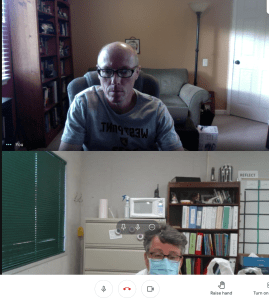
Eric and I using Google Meet for a virtual coaching call.

Eric said that he came to realize that losing weight was about more than just eating the right foods and exercising more, as important as those things are.

“There comes a point where you realize you can’t just will yourself to get the results you want to achieve. We lack discipline, focus and will power.” Eric went on to explain that we need help from others, whether that’s in the form of support and motivation or instruction and tools.

What Eric described to me is a picture of grace. Grace is applied when we can’t reach a standard we’ve set on our own and we need help to reach the goal.

Jesus is the ultimate grace-giver. He came to die for us, achieving the standard of righteousness required to experience a relationship with God that we couldn’t meet via our own efforts.

God answered Eric’s initial request from last fall by bringing others into his life to support him in his journey. I’ve been blessed to play a part in helping him hear the Lord’s voice through our coaching relationship.

How about you? What are the areas where you need the Lord to give you wisdom and grace to move forward to see significant life change? Who can you invite into your process to provide support and encouragement?

Coaching is an avenue that can help you gain greater awareness of your situation and provide support and encouragement to help you achieve goals that may have seemed out of reach.

Without Warning – Book Review

Without Warning (J. B. Collins, #3)Without Warning by Joel C. Rosenberg
My rating: 5 of 5 stars

The third and final installment of Joel Rosenberg’s J.B. Collins trilogy does not disappoint.

Without Warning lives up to its name with unexpected plot twists and turns that keep the reader engaged right up until the very end.

Packed with drama, intrigue and plenty of action, Rosenberg once again weaves together a story that includes themes of redemption, forgiveness, justice, love and sacrifice. Like many of Rosenberg’s novels, the characters and story-line are fictional, but the political climate and circumstances seem so current and real that the reader is left to sift through what is fictional and what isn’t.

Rosenberg is gifted in writing political thrillers that mirror our current political environment, and his knowledge and understanding of the Middle East political climate is once again on display.

View all my reviews

Faulty Earbuds?

My typical running gear includes dri-fit shirt, sunglasses, running hat and earbuds to listen to audiobooks or music.
Photo by Dave Lowe

A few weeks ago, I left the house for my daily run. I had my phone to track my route and also provide the tunes to keep me moving during the 6 mile trek.

As I was nearing the end of my run, I noticed I was not getting any sound out of my left earbud.

I tried pushing the earpiece harder into my ear, but that didn’t work. I wondered if maybe the earphone jack was not in all the way. No, that wasn’t the problem.

I jiggled the wire, thinking maybe there was a short. That didn’t work either. I started thinking maybe these earbuds had reached the end of their lifespan and I was bummed at the thought of having to buy new ones. I’ve been told I’m cheap that way!

When I finally got home, I thought I’d try one more thing. Perhaps it was a software issue. I figured a reboot of my phone would solve it if that was the issue. But that didn’t work either.

I had one more idea to determine if it was a problem with my phone or the earbuds. I decided to plug the earbuds into my computer and listen to some music. If the earbuds still only gave sound out of only one ear, then I would know it’s the earbuds and not the phone.

However, as I was getting ready to plug the earbuds into my computer, I looked more closely at the earpiece that wasn’t producing sound and I quickly realized the issue. There, in the small opening where the sound was supposed to come out, was a small glob of ear wax that was fully covering the opening.

The opening on these earbuds is small. It doesn’t take much to clog the opening, making it harder for sound to come through.
Photo by Dave Lowe

Yes, I know it’s kind of gross, but we all produce the stuff, and to be honest, I really can’t tell you the purpose. I just know that when I removed the small piece plugging the hole, I was suddenly able to hear perfectly again out of both earbuds.

I had a problem hearing and all of my initial thoughts were that it was a problem with something else – my phone, the earbuds, the jack, the wire, etc. The reality is that I was having issues hearing clearly because of me – something I produced and wasn’t even aware of.

I think there’s a spiritual illustration here. Often I’m wanting to hear from the Lord and He’s not responding, at least not the way I want. I wonder why He’s not answering my prayers or responding clearly to my requests.

Sometimes, the reason I’m not hearing from God is because of me. Sometimes the Lord IS wanting to speak to me but my attitude, or my heart blocks my spirit from hearing the Lord.

I’ve found that there are often several reasons why I’m not hearing from the Lord.

A primary way the Lord speaks to us is through His Word. Yet, it’s easy to get distracted by other things.
Photo by Nick Bondarev from Pexels

One reason I sometimes don’t hear from God is because of unconfessed sin in my heart. Psalm 66:18 says “If I had not confessed the sin in my heart, my Lord would not have listened.”

Sometimes, I’m not even fully aware of my own sin, such as unresolved conflict or anger. This is why it’s so important to invite the Lord to examine our hearts and reveal to us any areas in our lives and hearts that may be keeping us from experiencing His presence (See Psalm 139:23, 24).

A second reason I may not be hearing from the Lord is distractions. Sometimes Jen will be telling me something important but my focus is on something else, like my computer screen or the TV. I find that when I’m not fully engaged in what she’s saying I often have to ask her to repeat what she’s just said.

I often do the same thing with the Lord. I read my Bible but my mind is thinking about something else. I’m spending time in prayer but distracted by notifications that are popping up on my phone.

I cannot always expect to hear directly from the Lord when I want. But as a follower of Christ, I can make sure that the airways are clear and that there are no impediments that would keep me from hearing His voice when He does speak to me.

What keeps you from hearing clearly from the Lord?

What have you found to be helpful in keeping you focused and tuned in to hearing the Lord’s voice?

We appreciate your continued prayers for us as we continue to wait on the Lord during this challenging season!

If you’d like us to pray for you, click on the Prayer tab and send us your request!

Extortion – a book Review

Extortion: How Politicians Extract Your Money, Buy Votes, and Line Their Own PocketsExtortion: How Politicians Extract Your Money, Buy Votes, and Line Their Own Pockets by Peter Schweizer
My rating: 5 of 5 stars

How many times have you heard a local candidate state that they’re running as a Washington outsider who aims to “clean up the system”? And yet, year after year, we find that nothing in Washington really ever changes, as those outsiders always seem to be quickly absorbed and corrupted by the system they pledged to overhaul.

I’ve long been an advocate for term limits for Congress because of the influence of special interest groups. It is believed by many that special interest groups have corrupted our politicians, making them especially susceptible to being bought.

However, in his book “Extortion”, Peter Schweizer paints a much uglier and troubling picture than I had imagined. Schweizer outlines a system in which the Permanent Political Class (i.e. congressmen & congresswomen) aren’t being bought as much as they are using their influence to extort money from corporations in a mafioso-like scheme that boils down to an elaborate protection scheme. And it’s all perfectly legal.

With pain-staking detail and specific examples, Schweizer explains exactly how congressional leaders use and abuse their influence to milk large corporations and industry executives to contribute to their campaigns and PACs.

Schweizer also outlines the many ways congressional leaders make money off the system – from loaning their campaigns personal funds from which they extract insanely large amounts of usury, to using PAC money for lavish trips and personal expenditures.

I’ve always wondered how career politicians were able to become lavishly wealthy on the meager salaries they receive. Schweizer will open your eyes to how they do it, demonstrating the many different ways politicians are milking the system, milking corporations and rewarding friends and family….all for personal and political gain.

This book is well-researched and the foot-notes are extensive. Schweizer holds nothing back and gives examples from both sides of the aisle.

This is one of those books that is both good and bad. It’s good in that it’s well written and well-researched and very interesting to read as Schweizer navigates the reader through specific bills and laws and shows how the shake downs work.

But it’s also bad in the sense that, if you’re like me, you’ll finish this book with an extremely sick feeling in your stomach as you realize that the depth of greed and corruption from career politicians is much deeper than maybe you had previously thought!

View all my reviews

Developing Resilience

What is resilience? Is it a skill? Is it an ingrained character quality?

A Picture of resilience – a lone tree somehow thrives in a harsh environment where plant life is sparse
Photo by Patrick Hendry on Unsplash

Marcus Buckingham, researcher and developer of the Gallup StrengthsFinder assessment addressed this question last month at the 2020 Global Leadership Summit, which Jen and I had the opportunity to attend virtually.

Buckingham and his team of researchers were interested in understanding this quality of resilience that some people seem to have, which gives them the ability to face incredible challenges without breaking or buckling.

Buckingham’s research determined that resilience isn’t a skill but a quality that can be developed. His talk focused on how to build resilience in others and in ourselves. Specifically, he shared 3 different ways we can build resilience in ourselves.

Resilient people have learned the importance of rest and recovery
Photo by Shane on Unsplash

First, Buckingham talked about a concept he called Agency, which simply refers to items we can control. One of the things we can control is the rhythms in our lives. Remember the morning and evening commute? As much as you might have hated that time in the car, it created an obvious separation between home life and work life. For many, that natural break is gone, disrupting the natural rhythm that existed.

The research on resilience, according to Buckingham, suggests that resilient people work hard and then take a break – they recognize the value of recovery. This sounds a lot like the idea of sabbath (rest), doesn’t it?

What are some ways you can create natural breaks in your schedule that would lead to rest, recovery and resilience?

Secondly, Buckingham elaborated on the idea of Compartmentalization, which means that different parts of our lives have different feelings and different outcomes. The most resilient people seem to understand that we have many different lanes in our lives and if we’re not doing well in one lane, there are other lanes. This doesn’t mean we deny the things that are going bad in that one area of life, but it’s a realization that there are other areas where I can see success and progress.

We all have different areas or lanes in our lives. If we’re struggling in one area, we can still succeed and see progress in other lanes.
Photo by Andrew McElroy on Unsplash

Dr. Henry Cloud, in his book Changes that Heal calls this the Good/Bad split, referring to our tendency to look at life as either “all good” if everything is going well, or “all bad” if something unexpected or undesirable happens.

The truth is, life is a mixture of good and bad. Resilient people are able to separate the good and bad and recognize that even when things happen that we wouldn’t prefer, there are often many other things that are going well which we can celebrate and for which we can be grateful.

What are the different lanes in your life where you’re seeing success? How can you leverage your experience in those areas to help you in the areas where you’re struggling?

According to Buckingham, the third way to develop resilience in ourselves is through our Strengths in Work. Resilient people have figured out how to utilize their strengths to derive meaning, purpose and joy from the circumstances they’re in.

Interestingly, Mayo Clinic research indicates that you don’t need to fill up your whole week with those invigorating activities in order to create resilience. If we can fill up just 20% of our schedules with the kinds of activities that bring life to our souls, we can develop resiliency that enables us to withstand the more difficult life circumstances which we may encounter.

What are the things that bring life to you? How can you inject a few of these joy-producing activities into your schedule to help build resilience?

Young Professionals face unique challenges, even apart from Covid, that makes resilience an important quality to develop. Many are struggling to find a supportive community while dealing with extreme financial issues and an uncertain job market.

We’re privileged to be able to help Young Professionals develop resiliency through coaching, Strengths assessments and awareness and Leadership Development.

If you’d like to learn more about resources and opportunities we provide to help people grow in their resilience, please contact us!

The Mamba Mentality – Book Review

The Mamba Mentality: How I PlayThe Mamba Mentality: How I Play by Kobe Bryant
My rating: 4 of 5 stars

This book was not what I expected. I thought it would be the typical auto-biography of one of the greatest sports stars of the last 25 years, complete with details of his upbringing, family history, introduction to basketball, high school years and then a detailed description of his nearly 20 years as a Los Angeles Laker.

I was expecting detailed stories of what happened before the draft and what it was like to be a 17 year old in the NBA.

I wanted to know about his rookie year and growth as a player….the real story on his relationship with Shaq and Phil along with his decision to remain a Laker when he had the chance to leave via free agency.

This book really isn’t about any of that.

Instead, it’s a first person account of Kobe and his approach to the game. Most pages are short vignettes on a thought Kobe expounds on. It might be a name of a player he faced followed by Kobe’s thoughts on that player or how he would defend him or exploit him on offense. Or it might be thoughts on his pre-game ritual or his off-season training regimen.

Kobe gives analysis of dozens of players he faced over the years and how he prepared to defend and attack them. He also shares his personal thoughts on numerous team-mates he played with over the course of his career, including Olympic team-mates.

I found this book to be pretty easy to read and very entertaining. There were lots of photos from long-time Laker photographer Andrew Bernstein. It was interesting to hear Kobe share his thoughts on the game and as I read the words on each page, I imagined his voice speaking to me as if I were listening to an audiobook.

If you’re a Kobe fan, you’ll love this book. It doesn’t give the complete picture of who Kobe was or how he came to be the competitor that he was; we probably need an autobiography to fill in all those details for us. But this book was an interesting peek into the mind of a Laker legend and a basketball icon who sadly left us way too early.

View all my reviews

Live Like Molly Day

It may be the worst fear of every parent – to be awakened in the middle of the night by a phone call telling you your child has been in a car accident.

For my friends Doug and Doris Griffin, their worst fears became reality in the early morning hours of February 22nd, 2015 when they received news that their 23 year old daughter, Molly, had died earlier in a fatal car crash caused by a drunk driver.

I cannot even imagine the searing pain and unthinkable grief that one experiences as a result of such a tragedy.

I don’t know about you, but when I’m hurting and experiencing extreme emotional pain, I’m not a generally kind person. I remember a pastor once say that “a wounded animal is a dangerous animal.” It’s true of people too. When we’re wounded emotionally, we can be dangerously unkind, hurtful and even volatile to those around us.

Amazingly, my friends Doug and Doris, when first confronted by reporters regarding the tragic death of their daughter, did not respond as you might expect.

Doug wrote about his experience in the book Defining Moments: Coping With the Loss of a Child. In the chapter titled “Molly Day”, Doug wrote,

As word spread and people started showing up at our house, it came rather quickly to me that I had to forgive the driver. Even before knowing any details. I wish I could say that by my willpower and through some courageous act I made this decision. But that would be a lie. This time, perspective came quickly calling through the Holy Spirit: “Do you not remember driving as a young man while intoxicated yourself? Did you not come within an eyelash of dying in a car accident yourself when you were 22? Are you not commanded to forgive in order to be forgiven? And what is it that you hate more than anything? Hypocrisy.”

Later, when the first reporter showed up at their house, Doug said that the first words out of his mouth were, “I just want you to know that we have forgiven the driver.”

In this era of cancel culture and vigilante mobs who demand immediate and swift justice, what would compel a person to so quickly forgive a person they’ve never met, who’s committed an egregious crime and taken away one of the most precious things we love? This response does not seem natural, as evidenced by the reporter’s shocked expression.

Indeed, Doug and Doris’s response WASN’T natural….it was Supernatural!

Doug continued his explanation to the reporter:

“You see we are Christians and we are commanded to forgive. Did you know that Jesus forgave the very men who murdered him from the cross? If he can do that, I can forgive the driver.”

Doug also admitted that he “didn’t want to become known as the angry father who screamed for retribution or revenge.”

Later, when the time came for the driver to be sentenced, Doug and Doris were in the courtroom. California law requires that judges allow anyone who was impacted by a crime be allowed to speak at the time of sentencing. When it was Doris’s turn to speak, she pushed through the pain and the grief and expressed her forgiveness to the driver. Then Doug spoke. He writes,

…as I then rose to speak, I fought through the tears, I shared with
the drunk driver what I was sure Molly would say: “You took my life, you nearly killed my friends and you hurt every person I ever loved…And I forgive you.

(Side Note: You can read my related blog post about cancel culture and Forgiveness here.)

How does one move on after losing a loved one? As Doug asked, “how do we lean into this unceasing grief?”

Many people will do something to try to preserve the memory of their loved one. Some may set up a scholarship fund. Others may set up a charitable foundation. Doug and Doris opted for a different avenue to honor Molly’s memory and legacy.

Doug writes, “I told Doris that we needed to celebrate Molly’s life on her birthday and not focus on how she died. I said we needed to have an annual Molly Day. Doris, with a little help from her friends, took my idea and put it on steroids. She turned it into #LiveLikeMolly and came up with the perfect way to honor her: perform acts of kindness for others to establish her legacy as the kind, loving, wonderful person she was.”

Wednesday, August 26 will be the 6th annual “Molly Day”!

And so every year in early August, we get a postcard from Doug and Doris that reminds us of Molly and her birthday. This Wednesday, August 26th would have been Molly’s 29th birthday. Instead, it’s the 6th annual “Molly Day”, where those who knew Molly and those who have come to know her story are encouraged to #LiveLikeMolly by participating in random acts of kindness to those around them.

I wish I could say that I live EVERY day like Molly Day, but I don’t. I’m selfish and I often just think of my own needs instead of others. But this Wednesday, I invite you to join me in “Molly Day 2020”. Use the hashtag #LiveLikeMolly on Facebook, Twitter and Instagram to share your stories of something kind and unselfish that you were able to do for someone else.

Together, we can help honor the memory of Molly while at the same time providing small moments of cheer and joy, something I think we all could desperately use right about now!

Use the hashtag #LiveLikeMolly to share your stories of how you are able to bless others!

#LiveLikeMolly

The First Hostage – Book Review

The First Hostage (J.B. Collins, #2)The First Hostage by Joel C. Rosenberg
My rating: 5 of 5 stars

The First Hostage is the second in a trilogy of political thrillers by author Joel Rosenberg involving JB Collins, an international journalist for the New York Times.

Collins finds himself in the middle of a massive manhunt as American and Middle Eastern forces align themselves in a race against the clock to prevent an Isis-initiated jihadist Armageddon.

Rosenberg once again weaves a tale that mixes current affairs in the middle east with fictional scenarios that, a few years from now, might seem like historical narrative.

For example, given the current political climate in the Middle East, it’s not hard to imagine a joint military operation between Israel and neighboring Jordan. After all, these neighbors, once enemies, are now allies and have been allies for a number of years.

But who would imagine a joint Israeli-UAE military campaign? Nobody but Rosenberg. Yet, in just the last few weeks, we’ve learned that these two nations, long opposed to one another, have formally announced diplomatic relations.

If you read any of Rosenberg’s books, you’ll find that he often appears to be clairvoyant, including political details in his stories which seem far-fetched at the time yet often seem to develop not long afterwards in real life.

The First Hostage will keep you glued to the page and, as is the case with many of Rosenberg’s books, when the last page is turned, your next step will be to search when and where you can get the next book in the series!

The First Hostage is available on Amazon and other book sellers’ websites.

View all my reviews