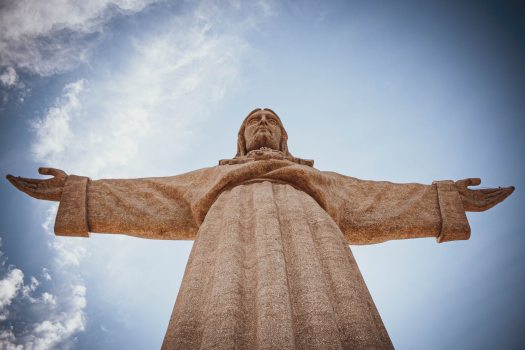
The Trilemma of Jesus

Matthew 26

57Then the people who had arrested Jesus led him to the home of Caiaphas, the high priest, where the teachers of religious law and other leaders had gathered. 58Meanwhile, Peter was following far behind and eventually came to the courtyard of the high priest’s house. He went in, sat with the guards, and waited to see what was going to happen to Jesus.

59Inside, the leading priests and the entire high council were trying to find witnesses who would lie about Jesus, so they could put him to death. 60But even though they found many who agreed to give false witness, there was no testimony they could use. Finally, two men were found 61who declared, “This man said, ‘I am able to destroy the Temple of God and rebuild it in three days.’”

62Then the high priest stood up and said to Jesus, “Well, aren’t you going to answer these charges? What do you have to say for yourself?” 63But Jesus remained silent. Then the high priest said to him, “I demand in the name of the living God that you tell us whether you are the Messiah, the Son of God.”

64Jesus replied, “Yes, it is as you say. And in the future you will see me, the Son of Man, sitting at God’s right hand in the place of power and coming back on the clouds of heaven.”

65Then the high priest tore his clothing to show his horror, shouting, “Blasphemy! Why do we need other witnesses? You have all heard his blasphemy. 66What is your verdict?”

“Guilty!” they shouted. “He must die!”

67Then they spit in Jesus’ face and hit him with their fists. And some slapped him, 68saying, “Prophesy to us, you Messiah! Who hit you that time?” (Matthew 26:57-68, NLT)


The Daily DAVEotional

Perhaps the greatest question you can ask and answer is the question, “Who is Jesus?”

Jesus asked this question of His disciples in an encounter that is recorded in Matthew 16:13-20 and also in Mark 8:27-30. I previously wrote about that encounter in a blog post entitled “The Most Important Question to Ask Yourself”.

One of the hallmark doctrines of Christianity is the divinity of Jesus. Christians believe that Jesus is God.

Those who deny the divinity of Jesus, such as Muslims, Jehovah’s Witnesses and others, often will say that divinity was something Jesus’ followers attributed to Him but that He Himself did not claim. To them, Jesus was simply a prophet, a good teacher or something else, but He certainly was not God.

The problem is that there are a number of passages where Jesus clearly identifies Himself as God. One such passage is John 10:30, where Jesus claimed to be “one with the Father”. Jehovah’s Witnesses have an explanation for that passage that I don’t think fits the facts. I wrote about that passage in a blog post “Evidence that Jesus is God”.

The account here in Matthew 26 of Jesus’ trial before the Sanhedrin is another passage that gives strong evidence that Jesus claimed deity for Himself.

How exactly does this passage demonstrate that Jesus claimed divinity for Himself?

In this section, Matthew records the trial of Jesus. After His betrayal and arrest, Jesus appears before the Sanhedrin, which is the Jewish religious authority.

A cursory reading of the gospels makes it clear that the religious rulers were out to get Jesus. They sent experts to try to entrap him, looking for any possible offense that they could use against him.

It’s interesting to see Jesus’ response to the high priest, who demanded that Jesus respond to his question about whether Jesus thought of Himself as the Messiah, the Son of God.

As soon as the high priest makes this demand, Jesus responds in the affirmative. “Yes, it is as you say.”

But Jesus doesn’t stop there. He continues,

And in the future you will see me, the Son of Man, sitting at God’s right hand in the place of power and coming back on the clouds of heaven.

It turns out that Jesus is referencing Daniel 7:13, in which the Messiah receives authority from the Ancient of Days to reign as the supreme king over all the earth.

The high priest had all the evidence he needed. He, along with the other religious leaders were very familiar with the passage Jesus was referencing. Here was Jesus, clearly associating himself as God. The high priest and the ruling religious leaders did not accept that Jesus was divine so they charged Him with blasphemy and sentenced Him to death.

The question that we have to wrestle with is the same one that C.S. Lewis postulated, and that is, who do you think Jesus is?

Regarding Jesus and his identity, Lewis formulated what has come to be known as the trilemma – Lord, Liar or Lunatic.

The basic premise is that when confronted with the person of Jesus, we have only these three possibilities. Either Jesus was a liar,  He was a crazy person (a lunatic) or He is Lord.

“A man who was merely a man and said the sort of things Jesus said would not be a great moral teacher. He would either be a lunatic — on the level with the man who says he is a poached egg — or else he would be the Devil of Hell. You must make your choice. Either this man was, and is, the Son of God, or else a madman or something worse. — C.S. LEWIS, “Mere Christianity”

There can be no doubt that Jesus made claims of deity for himself. This passage is one of the clearest examples and it is the reason why the religious leaders crucified Him. If he was not making direct claims of deity, there would have been no reason to sentence Him.

Since it’s indisputable that Jesus made claims of deity for Himself, we must each decide how to interpret those claims. Was Jesus lying? If you believe He was lying then you cannot call Him a good teacher. Lewis states that it would be more appropriate to call Him the devil, for He convinced people to follow Him, entrusting their eternal destiny to Him and his teachings. That would be the most devious thing one could imagine….to convince others to follow you because you had the power to save them when in reality, you knew that to be false.

The second option is that Jesus was crazy. Lewis says that this level of craziness would be similar to a person who believed himself to be a poached egg.

Does Jesus see Himself as a poached egg? Does He exhibit any of the signs we normally associate with mental instability or cognitive impairment?

Hardly.

Actually, Jesus comes across as the most rational, logical and mentally coherent person who ever lived.

The only other possibility, then, is that Jesus is Lord.

How about you? Who do you think Jesus is?

Reflection

What has been. your understanding of the nature of Jesus before reading this passage and devotional post? How have you characterized the nature of Jesus to others in the past?

How would you respond to someone who did not believe that Jesus was divine? What arguments and passages would you use to demonstrate His divinity?

Explain the argument that if Jesus was lying about His divinity, then He cannot be a “good teacher.”

If Jesus is not God, what reasons would a person have for following Him and trusting Him as Savior?

What other passages, besides this one and the John 10:30 passage mentioned, give evidence that Jesus claimed to be God in human flesh?


Photo by Bree Anne on Unsplash

A Psalm about the Nature of God

Psalm 90

1Lord, you have been our dwelling place

throughout all generations.

2Before the mountains were born

or you brought forth the earth and the world,

from everlasting to everlasting you are God.

3You turn men back to dust,

saying, “Return to dust, O sons of men.”

4For a thousand years in your sight

are like a day that has just gone by,

or like a watch in the night.

(Psalm 90:1-4, NLT)


The Daily DAVEotional

A.W. Tozer is famously quoted as saying, “what comes into our minds when we think about God is the most important thing about us.”

What do you think about when you think about God? What do you think God is like? How would you describe Him? What are some of his attributes?

How we think about God is extremely important. In fact, the second of the ten commandments says that we are not to fashion an idol in the form of an animal and worship it (see Exodus 20). This is because God is not an animal. Since God created all the animals, God is GREATER than any animal. Hence, it is demeaning to think of God as an animal – something that he actually created.

So what is God like?

The psalmist paints a partial picture of God with some incredible attributes, including the following:

    • “Before the creation of the world, you are God”. In other words, God existed before the world did, which means that He is distinct from His creation.
    • “For a thousand years in your sight are like a day that has just gone by.” What this means is that God is not subject to the same laws of time as we are. God is outside of time. Hence, a day is like a thousand years and a thousand years is like a day.

The psalmist is accurately describing the eternal first cause.

Philosophers understand that when thinking about the origin of the universe, there must be an eternal first cause or else you run into the problem of infinite regression.

What is infinite regression?

Infinite regression is when you find yourself caught in an infinite series of questions and responses concerning the creation. For example, suppose a 5-year old asks, “where did I come from?”

You answer, “from your parents.” He follows up by asking, “but where did they come from?”

You reply, “from their parents.”

He replies to your reply with the same question, “but where did they come from?” And you reply each time with the same response, “from their parents.”

This chain of questions and responses regarding origins could go on forever – to infinity, UNLESS you arrive at a first cause that was itself eternal and uncaused.

For years, scientists and philosophers assumed that the universe itself was eternal, that it has ALWAYS existed. In that case, when one asks, “but where did the universe come from?” the answer is that it didn’t come from anyone or anywhere. It has always existed. It has always been there. Since it has always existed, we do not need to answer the question, “where did it come from?”

The problem is that we now know scientifically that the universe is NOT eternal. We know that it had a beginning. In fact, the Big Bang states that all matter, energy, space AND TIME came into existence at a point about 13.7 billion years ago. This demonstrates that the universe itself is NOT eternal.

So we are back to the question, “where did the universe come from?”

According to the psalmist, the universe came from God, who existed BEFORE the universe was created and BEFORE the concept of time. Hence, two major attributes of God are that 1) He is outside of space (creation) and  2) He is outside of time.

There is much more that could be said about God and his attributes but these two characteristics of God are foundational to understanding who He is. If he is outside of creation (space) and outside of time, then God must be eternally self-existent and He must be infinitely greater than any of us can even imagine. This is why any attempt to depict him in a way that is finite, such as a created animal, is demeaning to God. It is an offense to His very nature.

Reflection

What is your concept of God? What words and phrases would you use to describe Him?

Tozer says that what we think about God is the most important thing about us. Do you agree? Why or why not?

What reasons would you give someone when explaining why it is wrong to worship a created image?

The Big Bang states that the universe came into existence about 13.7 billion years ago. How does this scientific fact provide evidence for God’s existence?


Photo by Greg Rakozy on Unsplash

Is the Holy Spirit like “The Force” in Star Wars?


Acts 5

1There was also a man named Ananias who, with his wife, Sapphira, sold some property. 2He brought part of the money to the apostles, but he claimed it was the full amount. His wife had agreed to this deception.

3Then Peter said, “Ananias, why has Satan filled your heart? You lied to the Holy Spirit, and you kept some of the money for yourself. 4The property was yours to sell or not sell, as you wished. And after selling it, the money was yours to give away. How could you do a thing like this? You weren’t lying to us but to God.”

5As soon as Ananias heard these words, he fell to the floor and died. Everyone who heard about it was terrified. 6Then some young men wrapped him in a sheet and took him out and buried him.

7About three hours later his wife came in, not knowing what had happened. 8Peter asked her, “Was this the price you and your husband received for your land?”

“Yes,” she replied, “that was the price.”

9And Peter said, “How could the two of you even think of doing a thing like this—conspiring together to test the Spirit of the Lord? Just outside that door are the young men who buried your husband, and they will carry you out, too.”

10Instantly, she fell to the floor and died. When the young men came in and saw that she was dead, they carried her out and buried her beside her husband. 11Great fear gripped the entire church and all others who heard what had happened. (Acts 5:1-11, NLT)


The Daily DAVEotional

During Covid I started running. I hated it at first but I kept at it and now I typically run about 6 miles per day. Most days I tend to run the same route that includes a 3.1 mile loop around Lake Mission Viejo, a small man-made lake in our community.

One interesting piece of trivia is that the 1984 Olympic Cycling event included a segment around this lake that I run almost every single day. In fact, the finish line for that race is memorialized, not only in the street, with a cement strip that says “Finish” but also on the sidewalk with benches and a plaque that gives tribute to the 20th anniversary of the Olympic event.

Finish Line for the 1984 Olympic Cycling Event
Memorial marking the 20th anniversary of the 1984 Olympic Cycling event, which took place in Mission Viejo, CA

Occasionally, when I run by this spot on the loop I will see some members of the Jehovah’s Witnesses sitting on the bench with a portable kiosk filled with religious paraphernalia. Their hope, I’m sure, is that people walking the loop might stop and take some religious material or even engage in some spiritual conversation.

If you’re not familiar with the Jehovah’s Witnesses, they are a religious group based in New York. Their roots are in Christianity but they are NOT a Christian group.

One of the main differences between traditional, orthodox Christianity and the Jehovah’s Witnesses is that they reject the doctrine of the divinity of Jesus. I wrote about the Jehovah’s Witnesses misunderstanding of Jesus in some previous blog posts here (A Modern Day Version of an Ancient Heresy) and here (Evidence that Jesus is God).

Another main difference between Jehovah’s Witness teachings and traditional Christianity is their rejection of the doctrine of the trinity, which they believe was a pagan belief introduced to the church by Constantine early in the 4th century.

While the church teaches that God is triune – that is, the Father is God, the Son is God and the Holy Spirit is God, and yet there is only ONE God, the Jehovah’s Witnesses teach that Jesus is a created being and the Holy Spirit is a force, not a person.

In the book “You Can Live Forever in Paradise on Earth”, the Holy Spirit is described as God’s active force and is compared to an electrical power grid that provides electricity to an entire suburb from a nearby power source.

Is this an accurate depiction of the Holy Spirit? Is the Holy Spirit God’s active force, much like “The Force” in Star Wars?

According to this passage in Acts 5, the answer is clearly “NO”.

This passage tells the story of Ananias and Sapphira, a husband and wife who sold some property and gave the proceeds to the church. But they lied about how much they made and as a result, they both were struck dead. In a previous post, I wrote about why they experienced such harsh consequences for what seems like a minor offense.

While this text is often used to highlight the serious quest for righteousness and purity in the early church, there is an often overlooked theological nugget in this passage that aids in our understanding regarding the nature of the Holy Spirit.

Look at verse 3, in which Peter says, ““Ananias, why has Satan filled your heart? You lied to the Holy Spirit, and you kept some of the money for yourself.”

First off, notice that Peter tells Ananias that he lied to the Holy Spirit when he kept some of the money for himself. This is clear evidence that the Holy Spirit is a person, not a force, because you cannot lie to something that is inanimate, such as a force or an electrical power grid. You can only lie to a person, and since Ananias lied to the Holy Spirit, then clearly, the Holy Spirit must be a person.

Secondly, look at the end of verse 4, in which Peter says to Ananias, “How could you do a thing like this? You weren’t lying to us but to God.

In verse 3, Peter says that Ananias lied to the Holy Spirit, and then in verse 4 Peter says that Ananias lied to GOD!

There’s the smoking gun right there. Clear evidence that Peter, one of the foremost apostles of the New Testament church, believed that the Holy Spirit was God.

Perhaps you’ve never given much thought to the Holy Spirit – who He is or what He is. One thing is certain – the Holy Spirit is NOT a force, as the Jehovah’s Witnesses teach. The Bible clearly teaches that the Holy Spirit is a person, and He is God!

Reflection

Traditional Christianity teaches that God is a triune God, or a trinity? What do you think that means? How would you explain the triune nature of God to someone else?

The author asserts that lying to the Holy Spirit is clear evidence that the Holy Spirit is a person? Do you agree that you can only lie to a person? What other attributes would demonstrate personhood? In other words, what are some attributes that only PEOPLE  can have and what are some actions that only PEOPLE can commit?

What has been your understanding of the Holy Spirit in the past?

Do you agree that the Holy Spirit is God? If not, why not? 


Photos by Dave Lowe


The Fourth Day Anomaly

Genesis 1

1In the beginning God created the heavens and the earth. 2The earth was empty, a formless mass cloaked in darkness. And the Spirit of God was hovering over its surface. 3Then God said, “Let there be light,” and there was light. 4And God saw that it was good. Then he separated the light from the darkness. 5God called the light “day” and the darkness “night.” Together these made up one day.

6And God said, “Let there be space between the waters, to separate water from water.” 7And so it was. God made this space to separate the waters above from the waters below. 8And God called the space “sky.” This happened on the second day.

9And God said, “Let the waters beneath the sky be gathered into one place so dry ground may appear.” And so it was. 10God named the dry ground “land” and the water “seas.” And God saw that it was good. 11Then God said, “Let the land burst forth with every sort of grass and seed-bearing plant. And let there be trees that grow seed-bearing fruit. The seeds will then produce the kinds of plants and trees from which they came.” And so it was. 12The land was filled with seed-bearing plants and trees, and their seeds produced plants and trees of like kind. And God saw that it was good. 13This all happened on the third day.

14And God said, “Let bright lights appear in the sky to separate the day from the night. They will be signs to mark off the seasons, the days, and the years. 15Let their light shine down upon the earth.” And so it was. 16For God made two great lights, the sun and the moon, to shine down upon the earth. The greater one, the sun, presides during the day; the lesser one, the moon, presides through the night. He also made the stars. 17God set these lights in the heavens to light the earth, 18to govern the day and the night, and to separate the light from the darkness. And God saw that it was good. 19This all happened on the fourth day. (Genesis 1:1-19, NLT)


The Daily DAVEotional

No doubt you’ve probably read Genesis 1 dozens of times, if not more. It’s usually the first chapter we all read on January 1st when we make our New Year’s Resolution to read through the Bible in a year (I know you’ve made that resolution before, but have you failed at it as many times as I have?) . How far we get into the book of Genesis as we seek to fulfill our commitment is another story.

This first chapter describes the details of God’s creation. Though there is some debate among Christians about the length, age and process of creation, one thing all Christians can agree on is verse 1 – “in the beginning God created the heavens and the earth”GOD CREATED!

The mere fact that the universe exists and that we are here on this planet to witness it is a testament to the creativity of God. The first chapter of Genesis proclaims that what we see and experience in this universe is not a result of random chance, but of a creative mind and an intentional process that directed the outcome we now see and observe.

But there is a slight problem with the creation narrative that maybe you’ve never noticed. It’s easy to gloss over, but for some, it has been a sticking point.

The problem is with creation Day Four.

The text declares that on day four, God created the stars, the sun and the moon for marking off the seasons and the days and the years.

So if the sun, moon and stars aren’t created until day four, how can we have days one, two and three before them? In other words, if there is no sun and moon to mark off days until day four, how can you have something called a “day” before you have the objects in place that dictate what a day is?

For the anti-theist, this might seem like the smoking gun to prove the Bible is, at best, a fairy tale aimed at explaining something that people in ancient times were not smart enough to understand scientifically.

But as College Game Day icon Lee Corso would say, “Not so fast my friend.”

“Not so fast my friend!” (Photo from wikimedia.org – Creative Commons 3.0) [[File:091507-USCNeb-CorsoHerbstreit.jpg|091507-USCNeb-CorsoHerbstreit]]
This anomaly can be explained and these verses, which seem to contradict one another, can be reconciled.

The key is to understand that the frame of reference for this creation narrative is from the perspective of someone who is observing it from the surface of the earth.

Notice that light is actually created on day one. In fact, the text says that there was light and darkness – one day.

But the initial conditions of the early earth were such that the sun, moon and stars were not visible from the surface. This is because in those early stages of development, the atmosphere was likely filled with various gases and clouds that obscured the sun, moon and stars from the surface. Think about a planet like Venus or one of the moons of Jupiter. It’s possible that the earth, in these early stages, resembled one of these celestial orbs.

By the time we get to day four, however, God’s creative work and processes have progressed to the point where earth’s atmospheric conditions are able to sustain the more advanced life forms that are created on days five and six.

So in the end, day four is really not an anomaly or a contradiction. The sun, moon and stars were created on the first day, but the atmospheric conditions on the earth did not allow those celestial bodies to be routinely visible until day four, after which God was able to introduce sea and land animals to his creation, followed by his crowning creative achievement – man!

It turns out that what science tells us about the development of earth and our environment matches the details described in Genesis chapter one almost exactly. Amazingly, Moses, the probable author of Genesis, understood the process of the earth’s development that concluded in an environment that could sustain advanced life thousands of years before science would uncover it. This is yet another of many evidences for the divine origin of the text, as only God himself could have known these processes that Moses wrote about.

For a more detailed and scientific explanation of Day Four, read, “Hazy Early Earth: More Affirmation for Creation Day 4” a blog post by astrophysicist Hugh Ross, found on his Reasons to Believe website at reasons.org.

Reflection

It’s easy to gloss over the idea that God created? What thoughts, feelings and emotions come to your mind when you think about the fact that GOD CREATED?

If God didn’t create the universe and everything else in it, what is your explanation for how the universe came into being and why we are here?

Hugh Ross, and others, explain the Day Four anomaly by saying that the sun and moon were created on day one but atmospheric conditions obscured their visibility until Day four. Do you agree with this explanation? Why or why not?

If you don’t agree with this explanation, what alternate explanations do you think better reconcile the verses in the text?

How are you doing on your Bible reading resolution for this year (if you set one)?


Photo by Alex Gindin on Unsplash

Evidence that Jesus is God

John 10

22It was now winter, and Jesus was in Jerusalem at the time of Hanukkah. 23He was at the Temple, walking through the section known as Solomon’s Colonnade. 24The Jewish leaders surrounded him and asked, “How long are you going to keep us in suspense? If you are the Messiah, tell us plainly.”

25Jesus replied, “I have already told you, and you don’t believe me. The proof is what I do in the name of my Father. 26But you don’t believe me because you are not part of my flock. 27My sheep recognize my voice; I know them, and they follow me. 28I give them eternal life, and they will never perish. No one will snatch them away from me, 29for my Father has given them to me, and he is more powerful than anyone else. So no one can take them from me. 30The Father and I are one.”

31Once again the Jewish leaders picked up stones to kill him. 32Jesus said, “At my Father’s direction I have done many things to help the people. For which one of these good deeds are you killing me?”

33They replied, “Not for any good work, but for blasphemy, because you, a mere man, have made yourself God.” (John 10:22-33, NLT)

Acts 14

8While they were at Lystra, Paul and Barnabas came upon a man with crippled feet. He had been that way from birth, so he had never walked. 9He was listening as Paul preached, and Paul noticed him and realized he had faith to be healed. 10So Paul called to him in a loud voice, “Stand up!” And the man jumped to his feet and started walking.

11When the listening crowd saw what Paul had done, they shouted in their local dialect, “These men are gods in human bodies!” 12They decided that Barnabas was the Greek god Zeus and that Paul, because he was the chief speaker, was Hermes. 13The temple of Zeus was located on the outskirts of the city. The priest of the temple and the crowd brought oxen and wreaths of flowers, and they prepared to sacrifice to the apostles at the city gates.

14But when Barnabas and Paul heard what was happening, they tore their clothing in dismay and ran out among the people, shouting, 15“Friends, why are you doing this? We are merely human beings like yourselves! We have come to bring you the Good News that you should turn from these worthless things to the living God, who made heaven and earth, the sea, and everything in them. 16In earlier days he permitted all the nations to go their own ways, 17but he never left himself without a witness. There were always his reminders, such as sending you rain and good crops and giving you food and joyful hearts.” 18But even so, Paul and Barnabas could scarcely restrain the people from sacrificing to them. (Acts 14:8-18, NLT)


The Daily DAVEotional

A number of years ago, I had some conversations with two Jehovah’s Witnesses who came to my door seeking to proselytize me. I wrote about that encounter in a previous post here.

The Jehovah’s Witnesses are a religious group that has its roots in Christianity but is not Christian in their theology. That’s because they deny both the traditional Christian doctrine of the trinity, which they believe is rooted in paganism, and the doctrine of the divinity of Christ, which they assert was not the belief of the early church but was introduced as a false doctrine by Constantine at the Council of Nicea.

Jehovah’s Witnesses believe that Jesus is a created being and they argue that Jesus never claimed deity for himself and nowhere in Scripture does it even hint at this “false” teaching.

In my conversation with the Jehovah’s Witnesses who came to my door, I referenced this passage in John 10 and asked, “what do you make of John 10:30, where Jesus says, ‘I and the Father are one?’ Isn’t this an evidence of Jesus’ divinity?”

Their response was interesting. They said, “Jesus was only claiming to be one in purpose with God the Father. He was not claiming divinity.”

My response was, “the context doesn’t support your view. Look at verse 31. It says that the Jewish leaders picked up stones to kill him. Why would they want to kill him if he was simply stating that he was one in purpose with God the Father? Aren’t you one in purpose with God the Father?”

They responded by saying that the Jewish leaders had misunderstood what Jesus was saying. Yes, they picked up stones to kill him but it was because they THOUGHT that Jesus was asserting equality with God but he really wasn’t.

If this was really the case, that the leaders simply misunderstood what Jesus was saying, then why didn’t Jesus correct their false understanding?

Think about it.

Jesus makes a statement about being unified with God in purpose and suddenly a mob is trying to kill him. Jesus asks, “why are you trying to kill me?” and they tell him it’s for blasphemy…that he, being a mere man has made himself God!

If Jesus WASN’T God, as the Jehovah’s Witnesses assert, why did Jesus not correct their misunderstanding?

Interestingly, in Acts 14, Paul and Barnabas heal a crippled man and the crowd is so amazed at the miracle they had performed that they determined Paul and Barnabas must be gods in human form. They are prepared to make sacrifices to them at the city gates when Paul and Barnabas realize what’s happening. What do they do?

They don’t allow their misunderstanding about who they are to go uncorrected. They plainly and directly explain that they are NOT gods and that they should not be worshiped. Instead, they tell their audience that they are simply messengers sent to explain to them about the God they SHOULD worship – Jesus.

So the Jehovah’s Witness argument doesn’t make sense. They say that Jesus was only claiming to be one in purpose with God but the religious leaders misunderstood what Jesus meant and so they decided to stone him for blasphemy. If Jesus were not God he would have corrected their misunderstanding just as Paul and Barnabas did with those who mistook them for Greek gods. Yet Jesus didn’t correct their supposed misunderstanding. The simple explanation for why He didn’t is because they DIDN’T misunderstand what He was saying. He really was claiming equality with God the Father.

The context of this passage clearly communicates that Jesus believed He was equal with God and He communicated that belief to others. That is why the Jewish leaders picked up stones to kill him. They clearly didn’t believe Jesus was God but they clearly understood Jesus was making the claim. That is why they picked up stones to kill Him. They believed He was guilty of blasphemy.

To reach the Jehovah’s Witnesses understanding of this passage requires one to add details to the narrative that simply are not there. The text doesn’t say anywhere that the leaders had misunderstood Jesus. The Jehovah’s Witnesses though are forced to embrace this false narrative because it is the only way to hold to their preconceived view of Jesus – namely, their belief that Jesus is not God and never claimed to be.

The Jehovah’s Witness’s understanding and explanation of this passage fails. It fails because they deny what the passage clearly and plainly teaches and they add details that aren’t there in order to change the meaning of the passage  so that it fits their preconceived theological bias.

Reflection

What do you think Jesus meant when He said “I and the Father are one”?

How likely do you think it is that the religious leaders simply misunderstood what Jesus was saying?

If Jesus was simply misunderstood. what reasons can you think of to explain why He didn’t correct this misunderstanding?

What is your view of Jesus? Do you believe He is God, as traditional Christianity teaches or do you think He is simply a created being as the Jehovah’s Witnesses teach?

Do you think it even matters what we believe about Jesus? Why do you think our understanding of the nature of Jesus is important? What difference do you think it makes?


Photo by Tim Hüfner on Unsplash

Who is Jesus?

I have to admit that this past Christmas season was interesting. With all of the travel we had scheduled and with our house being in such disarray due to repairs from our slab leak damage, it was difficult to get in the Christmas spirit.

Normal Christmas reminders were absent as we weren’t able to put up any decorations until just a few days before Christmas.

When life is crazy and chaotic, as it has been for us, it’s easy to lose sight of Jesus.

A few days ago, the Cru Facebook page that I help to monitor received a message from a user in Africa named Mathias.

The message was a simple question: Who is Jesus?

The question “who is Jesus?” is perhaps the most important question that anyone can answer.

Jesus himself asked this question of his followers. In the book of Mark, Jesus recruits 12 men to follow him. Through his teaching, ministry, and many miracles Jesus slowly reveals his identity to his disciples. At the midpoint of the book, Jesus asks his disciples, “who do people say that I am?”

The disciples respond with the popular views of the culture at that time: some say you’re John the Baptist or Elijah; others say you’re a prophet.

Our society has a lot of answers to the question, “who is Jesus?”

Some people believe that Jesus was a great moral teacher – an example for us to follow. Others believe he was a prophet. A few people believe Jesus was a political revolutionary.

Jesus follows with a more pointed question, “who do YOU say that I am?”

Peter answers with the only valid response that hits the mark: Jesus is the Messiah; he is God!

In our fast-paced, materialistic culture, we can sometimes forget who Jesus really is and what he offers. For those of us who have known Jesus for a long-time, the Christmas season can seem rote or routine.

But I’m reminded that there are millions of people who don’t know Jesus, and the idea that God is real and personal is incredibly new and exciting.

People like John, also from Africa, message us every day, wanting to know who God is and how they can know Him.

Though this is a very minimal part of our job, it’s a privilege to be able to tell people all over the world who Jesus is and how they can know Him.

It really is amazing that the God of the universe stepped into humanity in the person of Jesus. He alone offers hope and peace to a world that is desperate and hopeless!


For more information on the Biblical evidence for Jesus’ deity, see my short article “Is Jesus God?”

Some related blog posts you might find helpful:

Does Your Understanding of the Nature of Jesus Really Matter?

Is Your View of Jesus Really that Important? (Part 2)

Further Proof That Jesus is God


Which Hoax Do You Believe?

Matthew 27

62The next day—on the first day of the Passover ceremonies*—the leading priests and Pharisees went to see Pilate. 63They told him, “Sir, we remember what that deceiver once said while he was still alive: ‘After three days I will be raised from the dead.’ 64So we request that you seal the tomb until the third day. This will prevent his disciples from coming and stealing his body and then telling everyone he came back to life! If that happens, we’ll be worse off than we were at first.”

65Pilate replied, “Take guards and secure it the best you can.” 66So they sealed the tomb and posted guards to protect it. (Matthew 27:62-66, NLT)

. . . . . . . . . . . .

Matthew 28

11As the women were on their way into the city, some of the men who had been guarding the tomb went to the leading priests and told them what had happened. 12A meeting of all the religious leaders was called, and they decided to bribe the soldiers. 13They told the soldiers, “You must say, ‘Jesus’ disciples came during the night while we were sleeping, and they stole his body.’ 14If the governor hears about it, we’ll stand up for you and everything will be all right.” 15So the guards accepted the bribe and said what they were told to say. Their story spread widely among the Jews, and they still tell it today. (Matthew 28:11-15, NLT)


The Daily DAVEotional

Christianity stands or falls on the resurrection of Jesus Christ. Even Paul, in 1 Corinthians 15 says that if Jesus has not been raised from the dead, we are still in our sins. Hence, if you can disprove the resurrection, you can disprove the entire Christian faith.

The early church could have been squashed before it even got off the ground if the religious leaders did just one simple thing – produce the body of Jesus, thereby demonstrating that Jesus had not risen from the dead but was still resting in the tomb exactly where he had been laid.

The religious leaders were aware of Jesus’ prediction that he would rise from the dead on the third day, so they went to Pilate to secure reinforcements and armed security at the tomb to make sure that the disciples wouldn’t be able to steal the body and perpetuate a hoax on the people.

But as it turns out, Jesus rose from the dead anyway, and with his body now gone, the religious leaders found themselves in an unusual predicament. One option is they could realize that Jesus must be who He claimed to be all along and repent of their hard-heartedness and wickedness that led them to crucify Jesus.

Or they could go the other route, which is to do whatever is necessary to maintain their power and position over the people they lead.

Not surprisingly, the religious leaders chose the second route, which included bribing the soldiers who guarded the tomb to tell people that the disciples had stolen the body while they were sleeping.

The irony of this whole situation is that the religious leaders secured the tomb site in order to prevent the disciples from being able to perpetuate a hoax, but instead, the religious leaders ended up creating and perpetuating a different hoax of their own.

This story – that the disciples stole the body and then claimed that Jesus had been resurrected – is still being promoted today among those who staunchly dispute that Jesus was resurrected.

Though it’s a popular theory that seeks to explain the empty tomb, this story has so many holes in it that it is easily debunked.

First off, if the soldiers were sleeping, how would they know who it was that supposedly stole the body?

Second, how likely is it that all the guards were sleeping at the same time? Given that sleeping while on duty was punishable by death, what is the likelihood that JUST ONE of them had fallen asleep? VERY LOW.

Now what is the likelihood that ALL of them were asleep at the same time? EXTREMELY LOW.

And if they were to have fallen asleep, how is it that the disciples were able to move a HUGE stone (estimated to be at least 2000 pounds or more) without waking any of these guards?

It takes more faith to believe this story than it does to believe that Jesus rose from the dead, removed the stone and emerged from the tomb alive!

In addition to the details of their story not lining up, this explanation also requires us to believe that the disciples, who had all scattered when Jesus was arrested, somehow came together and mustered up the bravery to steal the body of Jesus so that they could perpetuate a resurrection narrative that they not only knew to be false, but that brought persecution upon them and ultimately led to their death.

Most people will do whatever it takes to save themselves from pain and death. It is simply not believable that all the disciples were willing to die for something that they knew to be a lie.

Lastly, this theory doesn’t explain the many post-resurrection appearances Jesus made. It’s reported that after His resurrection, Jesus made multiple appearances to many different people and once appeared to more than 500 people at the same time.

So in the end, we must decide which hoax fits the facts more reasonably.

Is it more believable that the disciples are the ones perpetuating an elaborate hoax that has deceived billions of people over the centuries? This hoax requires us to believe that trained soldiers fell asleep on the job, yet still somehow knew that the disciples were the ones who stole the body.

Furthermore, what was the motive of the disciples’ fabrication? This hoax requires us to believe that these disciples, who were afraid for their lives when Jesus was arrested, suddenly became brave enough to steal the body of Jesus and declare Him to be resurrected to an unsuspecting populace. This elaborate deception resulted, not only in intense ongoing persecution, but ultimately in their deaths.

Or is it more believable that the religious leaders are the ones who perpetuated a hoax for the purpose of maintaining their power and authority over the people? The Scriptures tell us that they bribed the soldiers and told them to propagate the stolen body story in order to explain the empty tomb.

In the end, the religious leader’s hoax is the more likely hoax because the one thing it requires me to believe is eminently believable – that people are selfish and will often go to great lengths to maintain their power and authority over others.

Reflection

Which of these two hoaxes do you think is more believable and why?

Describe a time when you lied in order to protect yourself? Conversely, when is a time you lied for the purpose of bringing about great pain and hardship?

Given the circumstances, why do you think the religious leaders continued to resist Jesus as the Messiah?

Can you think of a time in your life when your stubbornness caused you to act irrationally? What was the situation? How did you overcome your stubbornness? What happened to help change your attitude?


Photo by Karolina Grabowska from Pexels


He is Risen Indeed!

Christianity stands or falls on the fact of the resurrection of Jesus Christ. Even the apostle Paul, in his 1st letter to the Corinthians, said

“and if Christ has not been raised, your faith is worthless; you are still in your sins.” [i]

According to the Biblical record, three days after being crucified, Jesus overcame death and was resurrected. He then appeared to many of his followers in several different settings and on several different occasions. During this period, Jesus issued the command for His followers to go and tell the world about Himself, His love for mankind and His resurrection from the dead. It was from this foundation that Christianity began to spread throughout the Roman world.

Many who oppose the Christian faith discount the resurrection. Yet the fact remains that on the third day, the tomb where Jesus lay was empty. If Jesus was not resurrected, what happened to the body?

Over the centuries, there have been numerous theories presented to try to explain the empty tomb in a way that would make a bodily resurrection unnecessary.

Maybe the Disciples Stole the Body!

Some believe that the disciples stole the body and fabricated the resurrection story in order to gain followers in their new “Christian” religion. The theory alleges that Jesus Himself had predicted His own death and resurrection. The disciples then stole the body so that they could claim that Jesus had indeed risen.

This theory really makes no sense when you consider all of the facts. Jesus’ disciples all deserted Him when He was arrested. Why? It’s because they were afraid (see Matthew 26:56). Also, the Jewish and Roman authorities took precautions to prevent the body from being stolen.

62 Now on the next day, which is the one after the preparation, the chief priests and the Pharisees gathered together with Pilate, 63 and said, “Sir, we remember that when He was still alive that deceiver [referring to Jesus] said, ‘After three days I am to rise again.’ 64 “Therefore, give orders for the grave to be made secure until the third day, lest the disciples come and steal Him away and say to the people, ‘He has risen from the dead,’ and the last deception will be worse than the first.” 65 Pilate said to them, “You have a guard; go, make it as secure as you know how.” 66 And they went and made the grave secure, and along with the guard they set a seal on the stone. [ii]

In order to prevent the body from being stolen, a Roman guard was placed at the tomb with the Roman seal. A Roman guard consisted of anywhere from 4 to 16 men. For the disciples to have stolen the body, they would’ve had to overcome at least four highly trained military men, roll away a 4000 pound stone, and carry away a dead cadaver covered with over 100 pounds of grave wrappings.

But maybe the Roman guards fell asleep!

It’s highly unlikely that the Roman soldiers would’ve fallen asleep on duty. The Roman soldiers of the day were an elite group of fighting men who were highly trained and extremely well disciplined. The punishment for falling asleep on duty was death. Considering the consequences, it’s improbable that even one soldier would fall asleep. For all of them to fall asleep on duty at the same time is next to impossible. Besides, even if the whole guard had fallen asleep, it’s not likely that they would’ve remained asleep while the disciples struggled to move a two-ton stone away from the tomb entrance.

What makes this theory even more unbelievable is that after stealing the body, the disciples then supposedly fabricated a resurrection story for the purpose of gaining followers. What would be the motive for recruiting people to something which you knew was a lie? It’s interesting to note that none of the disciples ever denied this “resurrection story” even though for most of them, it led to their own execution. Not many people will die for something they know to be untrue. A whole crowd of people dying for something that they know to be a lie is even more unbelievable.

Maybe the Jewish leaders or the Roman authorities stole the body!

Why would the Jewish and Roman authorities steal the body? What would be their motive for doing such a thing? Neither the Jewish leaders nor the Roman authorities had anything to gain by stealing the body. Remember that the Jews were afraid of what a missing body might mean to the public. The reason they wanted to get rid of Jesus in the first place was so that they could neutralize His teachings and the following that He had. They recognized that a resurrected Jesus would not neutralize Jesus’ following, but instead would energize His cause. That’s why they had a Roman guard placed at the entrance of the tomb to protect the body from being stolen.

What if the Jews and Romans moved the body to protect it from being stolen?

If the Jews or Romans had moved the body as a precautionary measure, they could’ve easily produced the body at the first moment that someone claimed that Jesus had resurrected. Yet they never did. Christianity could’ve been diffused before it ever got off the ground simply by producing the body.

One more problem with the stolen body theory is that it doesn’t explain the many eyewitness accounts of the resurrected Jesus. Weekend at Bernie’s may have been a funny movie, but I doubt that the disciples could’ve passed a dead Jesus off as a resurrected Savior to an unsuspecting crowd.

Maybe the eyewitnesses never really did see Jesus. Maybe they were just hallucinating.

Remember that Jesus appeared to many different people on many different occasions. He even “appeared to more than five hundred brethren at one time” [iii]. It’s highly unlikely that 500 people would all hallucinate the same thing at the same time. Even so, the authorities still did not produce a body to refute the peoples’ claims that they had seen Jesus.

Maybe Jesus never died in the first place.

 One of the more popular theories to explain the empty tomb and resurrection sightings is what’s known as the Swoon theory. This theory hypothesizes that Jesus never actually died on the cross, but only fainted (or swooned). Later, the cool air of the tomb revived Him. After regaining consciousness, Jesus appeared from the tomb and declared Himself resurrected to His followers.

The Swoon theory is an attempt to explain the empty tomb apart from supernatural intervention but ignores many of the facts surrounding the case.

The historical record clearly indicates that Jesus was dead, not just fainted. John gives this account of the crucifixion:

32 The soldiers therefore came, and broke the legs of the first man, and of the other man who was crucified with Him; 33 but coming to Jesus, when they saw that He was already dead, they did not break His legs; [iv]

 Crucifixion is one of the cruelest forms of execution ever devised. It was a prolonged death by asphyxiation. In order to breathe, one would have to push himself up with his feet in order to give the lungs an opportunity to expand. It was not too uncommon for some crucifixions to last for hours, as the victim would continually struggle to push himself up and breathe. Occasionally, the soldiers would grow tired of waiting for the person to die and so, in order to hasten death, they would break the victim’s legs, making it impossible to push up and breathe. Once the legs were broken, death was almost immediate.

The account of Jesus shows that the two criminals who were crucified with Him both had their legs broken but Jesus’ legs weren’t broken. This is because they realized that His legs didn’t need to be broken. He was already dead.

Maybe the soldiers made a mistake!

 Is it possible that the soldiers thought Jesus was dead but were mistaken? It’s not likely. Even though the soldiers didn’t break Jesus’ legs, one of them did thrust a spear into His side:

34 but one of the soldiers pierced His side with a spear, and immediately there came out blood and water. [v]

 The description of “blood and water” is incredibly important from a medical standpoint because it demonstrates that Jesus was indeed dead. In discussing this topic, Josh McDowell quotes C. Truman Davis, a medical doctor:

“…there was an escape of watery fluid from the sac surrounding the heart. We, therefore, have rather conclusive post-mortem evidence that [Christ] died, not the usual crucifixion death by suffocation, but of heart failure due to shock and constriction of the heart by fluid in the pericardium.” [vi]

McDowell goes on to say, “Pilate required certification of Christ’s death before the body could be turned over to Joseph of Arimathea. He consented to Christ’s being removed from the cross only after four executioners had certified His death.” [vii]

What makes the Swoon theory particularly unbelievable is how it deals with facts of the story after Jesus was buried in the tomb.

If the Swoon theory were accurate , we would need to believe that Jesus was beaten, scourged, and whipped to the point that He was hardly recognizable. He then endured a lengthy ordeal on the cross and was even pierced in the side with a soldier’s spear. Yet Jesus did not die, he merely fainted. Though not dead, Jesus was wrapped with about 100 pounds of spices and linen. Jesus was then laid in a tomb with a two-ton stone placed at the entrance while a guard was placed in front of the tomb to protect it from robbers.

Even though Jesus was critically injured and had no medical attention or food for three days, He was able to breathe through his wrappings and regain consciousness and the strength needed to shed His grave clothes and hobble over to the tomb’s entrance. He then mustered up the strength to move a two-ton stone by Himself. Upon exiting the tomb, Jesus either slipped past the guards undetected, or He was able to overcome them in a physical struggle after which He reentered Jerusalem and rejoined His followers, who mistakenly believed that He had been resurrected.

Believing the Swoon Theory takes more faith than believing in the actual resurrection!

Isn’t it irrational to believe that Jesus was resurrected?

 It’s not irrational to believe that Jesus was resurrected because the evidence overwhelmingly supports that conclusion.

Simon Greanleaf, a man who is credited with helping the Harvard Law school achieve it’s stature, “concluded that the resurrection of Christ was one of the best supported events in history, according to the laws of legal evidence administered in courts of justice.” [viii]

While it’s not irrational to believe something that is supported by the facts, it is irrational to believe a theory that cannot be completely reconciled with the facts.

One professor came up with just such a theory, explaining that “Jesus must’ve had a twin brother that no one (not even Mary) knew about. After Jesus’ death, the twin appeared and claimed to be the resurrected Jesus.” *  Not only does this theory violate many of the facts in the case (i.e. if there was a twin, then Jesus’ body would still be in the ground. Still, no one ever produced the body, etc.), but it is harder to believe than an actual resurrection. It’s amazing the lengths to which some people will go to explain away the resurrection.

Reflection

Have you already made up your mind that Jesus Christ could not have been resurrected?

If so, how do you explain the empty tomb?

Is your explanation more believable than a resurrection itself? 


End Notes

[i] 1 Corinthians 15:17, The New American Standard Bible, (La Habra, California: The Lockman Foundation) 1977.

[ii] Matthew 27:62-66, The New American Standard Bible, (La Habra, California: The Lockman Foundation) 1977.

[iii] 1 Corinthians 15:6, The New American Standard Bible, (La Habra, California: The Lockman Foundation) 1977.

[iv] John 19:32, 33, The New American Standard Bible, (La Habra, California: The Lockman Foundation) 1977.

[v] John 19:34, The New American Standard Bible, (La Habra, California: The Lockman Foundation) 1977.

[vi] McDowell, Josh. A Ready Defense. Nashville: Thomas Nelson Publishers, 1993, p. 224

[vii] Ibid.

[viii] McDowell, Josh. More Than a Carpenter, Wheaton: Tyndale House Publishers, 1977, p. 97.

* This story was related by Dr. Paul Cox, a professor at Biola University, for a class on Christian World View, which was conducted for Campus Crusade for Christ. The class was held at Colorado State University during the summer of 1997.


Empty Tomb Photo by Pisit Heng on Unsplash

When Someone DEMANDS Evidence!

Matthew 16

1One day the Pharisees and Sadducees came to test Jesus’ claims by asking him to show them a miraculous sign from heaven.

2He replied, “You know the saying, ‘Red sky at night means fair weather tomorrow, 3red sky in the morning means foul weather all day.’ You are good at reading the weather signs in the sky, but you can’t read the obvious signs of the times! 4Only an evil, faithless generation would ask for a miraculous sign, but the only sign I will give them is the sign of the prophet Jonah.” Then Jesus left them and went away. (Matthew 16:1-4, NLT)


The Daily DAVEotional

A few weeks ago, I was engaged in an online discussion with an atheist regarding the existence of God. It started off civil but at one point, even after I had presented several sound scientific and logical arguments for God’s existence, the atheist chirped back that I needed to present IRREFUTABLE evidence for God’s existence, otherwise, his assertion that all gods are imaginary would stand. (Yes, the word “irrefutable” was typed in all caps)

I’ve conversed and debated with a fair number of atheists over the years and it is not uncommon for them to demand evidence, even after evidence is presented.

One person with whom I was recently conversing told me I needed to provide “evidence” for God’s existence. I responded by asking, “what would constitute evidence to you?”

Their response was that the evidence they required was the kind I likely could not provide, as they rely on science for their evidence. It was a subtle back-handed jab that implied I must not be smart enough or scientific enough to provide the “real” kind of proof that educated people who have advanced beyond the childish fairy tale stage engage in.

I proceeded to lay out an argument for God’s existence that is based on the scientifically accepted fact of the Big Bang, which states that all matter, space, time and energy came into existence at a point around 13.7 billion years ago. Since the universe is not eternal, it must be created. Anything that is created must have a creator. That creator must be something that exists outside of space, time matter and energy. In other words, the creator must be immaterial and timeless. These qualities of this creative entity accurately describe God.

What was the person’s response to my argument, which included the kind of evidence they required? This person rejected my argument and asserted that the universe itself must be eternal.

What is the point of all this and how does this relate to the passage above?

The point is that when people demand evidence and resort to arguing, yelling, and name-calling while expecting unreasonable levels of proof in order to even consider your position to be reasonable, that is a clear sign that they actually require NO evidence because they have already made up their mind on the matter.

People like this are not actually looking for honest debate or civil discourse. They are more likely looking for an argument in which they can embarrass the other person or trap them in a faulty line of reasoning.

This was the situation Jesus was in with this group of Pharisees and Sadducees in Matthew 16. Their issue wasn’t belief in God but whether Jesus was the Messiah. They came to Jesus, asking him to show them some miraculous sign despite the fact that they had first hand knowledge of all of Jesus’ teachings and miraculous deeds up to that point.

Jesus often spoke of the stubbornness and hard-heartedness of the religious leaders and this was just another example. Their request is the same as the atheist who declares to his audience, “if God exists, he will appear right here and right now before us on this stage”, and then when it doesn’t happen, wryly concludes, “Well there you have it folks; God must not exist!”

How does Jesus respond to these hard-hearted leaders?

Jesus tells them that just as people have the tools that enable them to predict the weather for that day, so they have all the tools to make a determination concerning Jesus and His identity. After all, they are the religious leaders and they have the Law and the prophets which give them all the signs regarding when the Messiah would come, where He would be and what He would do.

Jesus rebukes these leaders for their faithlessness and capricious demands and he tells them that the only sign they will get from him is the sign of the prophet Jonah.

Now if you don’t know who Jonah is, Jesus’ words might be lost on you.

The short version of the story is that Jonah was an Old Testament prophet who ran away when God commanded him to go to the city of Nineveh and preach a message of judgment for their wickedness. In the course of fleeing God, Jonah got thrown off of the ship he was on which was going in the opposite direction. God caused a big fish to swallow Jonah, thus sparing his life and redirecting him to the mission God had called him to.

Jonah spent 3 nights in the belly of the fish. So when Jesus says he will give them the sign of Jonah, he is referring to his death and the 3 days he would spend lying in the ground before being resurrected on the third day.

Jesus wasn’t going to respond to their request as if he were a genie who just emerged from 1000 years in a lamp. If you want evidence, look around you, there’s plenty of evidence for you to examine. But if you require evidence on demand, well, sorry, there is no dog and pony show for you. You get the same evidence everyone else gets. Jesus’ death and resurrection should be enough evidence for anyone.

Sadly though many of the people of Jesus’ day rejected this evidence just as people today still do.

Notice what Jesus did next. He left them and went away. There is no point in engaging those whose only aim is to entrap you.

When a person has already decided what they think about an issue and it’s obvious from their tone and their rhetoric that their heart is not open for discussion, then there is no point in debating or trying to reason.

As Jonathan Swift once famously said, “Reasoning will never make a Man correct an ill Opinion, which by Reasoning he never acquired.”

Reflection

When is a time in your life when you were stubborn and proud and wouldn’t listen to reason? What were the circumstances? What caused your heart to change (assuming it did)?

What are some qualities or indicators that a person has a hard heart and is not really interested in honest, open discourse? (Tone, actions, words, etc)

What do you think is the reason some people demand evidence even when it is presented? What causes a person’s heart to become hard?

What do you think are some ways we can and should respond to people who are not open to reason and demand irrefutable evidence?


Photo by Nick Fewings on Unsplash


The Implications of Belief in No God!

Psalm 53

1Only fools say in their hearts,“ There is no God.” They are corrupt, and their actions are evil; no one does good!

2God looks down from heaven on the entire human race; he looks to see if there is even one with real understanding, one who seeks for God.

3But no, all have turned away from God; all have become corrupt. No one does good, not even one!

4Will those who do evil never learn? They eat up my people like bread; they wouldn’t think of praying to God.

5But then terror will grip them, terror like they have never known before. God will scatter the bones of your enemies. You will put them to shame, for God has rejected them.

6Oh, that salvation would come from Mount Zion to rescue Israel! For when God restores his people, Jacob will shout with joy, and Israel will rejoice.

(Psalm 53:1-6, NLT)


The Daily DAVEotional

In this Psalm, David is pondering the moral implications of life without God.

Two observations are worth noting.

First, David plainly states that only a fool says in their heart that there is no God.

It’s interesting to notice that the fool doesn’t conclude God’s non-existence through reason or evidence but what makes a person a fool is that they say “in their heart” that there is no God.

What exactly is meant by this phrase “in their heart”?

I think the best way to think of the heart is the will – the control center of a person’s life. Your will, which equates to your desires, will motivate and compel you to act in ways that are contrary to reason and what you know is right. If you decide “in your heart” that you want to pursue a certain course of action (whether good or bad), nothing will convince you otherwise.

So in this context, the fool is someone who has decided that there is no God, despite whatever evidence may be presented. Reason and facts don’t matter because he or she has already made a decision of their will (a decision of the heart) what they intend to believe and how they intend to respond and move forward.

David says that the belief that there is no God is foolish. Why? Because it is a denial of that which is observably apparent, namely that we exist and the universe exists and that something grander and larger and much more powerful than the universe must have created it.

The second thing that David addresses is the moral implications of believing in no God.

Without God, there is no moral foundation. Hence, the actions of the atheist ultimately devolve to evil. It doesn’t mean that people who believe there is no god are not capable of doing good – they are. It does mean, however, that without the moral foundation that God alone provides, there is no anchor to call anything good. Therefore, moral values can easily shift, where things that were once considered evil are now considered acceptable, even good.

The implications of this are huge. David says that when God looks down on the human race he cannot find anyone who is truly good. This certainly contradicts the prevailing view on morality in today’s culture.

In our culture today, it’s popular to hold the belief that people are generally good and only do bad things because they are exposed to evil, corrupt or unfair environments.

These verses (particularly verse 3) explicitly refute this ideology, affirming that NO ONE is good. This does not mean that people are incapable of doing good things. What it means, however, is that no one is able to meet the standard of goodness as defined by God.

What is God’s standard of goodness?

God’s standard of goodness is himself – perfect righteousness. Humans are not able to meet this standard. Hence no one is good, not even one.

By the way, those who claim that people are good and only do evil things because of the influence of their environment, never explain how those environments were able to corrupt people in the first place.

In other words, if man is basically good, how did the environment that supposedly caused his negative actions become bad enough to influence his negative actions? This is never explained by those who believe in man’s goodness.

So to summarize, David says that  someone who makes a decision of the heart to believe in no God is a fool. It’s foolish because it defies logic and reason and that which is observably apparent.

Secondly, without God, there is no basis to call anything good and therefore, people will make their own standards for what they think is right and wrong. These standards will be constantly shifting and fall far short of God’s standard for goodness, which is Himself. As a result, God says NO ONE is good. NOT ONE. We are all sinful and corrupt and have turned away from God.

As I look at the culture we live in today, I’d say David’s words look more like prophecy than ancient poetry.

Reflection

What has been your standard of goodness that you’ve used to evaluate your own life?

What is your response to the idea that someone who decides “in their heart” that God doesn’t exist is a fool? 

How would you respond to someone who makes the claim that people are basically good but they only do bad things because of the negative influences of their environment?

What would you say to someone who doesn’t believe in God but believes that they can be moral?


Photo by Dave Lowe