Filling a God-Shaped Hole

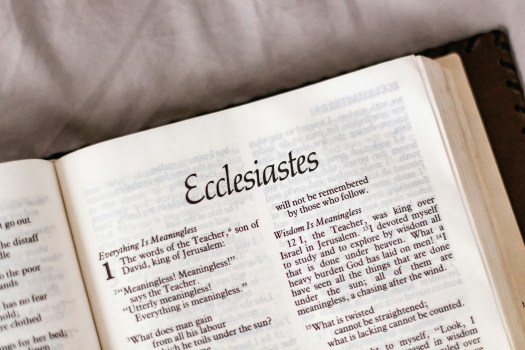
Ecclesiastes 2

1I said to myself, “Come now, let’s give pleasure a try. Let’s look for the ‘good things’ in life.” But I found that this, too, was meaningless. 2“It is silly to be laughing all the time,” I said. “What good does it do to seek only pleasure?” 3After much thought, I decided to cheer myself with wine. While still seeking wisdom, I clutched at foolishness. In this way, I hoped to experience the only happiness most people find during their brief life in this world.

4I also tried to find meaning by building huge homes for myself and by planting beautiful vineyards. 5I made gardens and parks, filling them with all kinds of fruit trees. 6I built reservoirs to collect the water to irrigate my many flourishing groves. 7I bought slaves, both men and women, and others were born into my household. I also owned great herds and flocks, more than any of the kings who lived in Jerusalem before me. 8I collected great sums of silver and gold, the treasure of many kings and provinces. I hired wonderful singers, both men and women, and had many beautiful concubines. I had everything a man could desire!

9So I became greater than any of the kings who ruled in Jerusalem before me. And with it all, I remained clear-eyed so that I could evaluate all these things. 10Anything I wanted, I took. I did not restrain myself from any joy. I even found great pleasure in hard work, an additional reward for all my labors. 11But as I looked at everything I had worked so hard to accomplish, it was all so meaningless. It was like chasing the wind. There was nothing really worthwhile anywhere.

12So I decided to compare wisdom and folly, and anyone else would come to the same conclusions I did. 13Wisdom is of more value than foolishness, just as light is better than darkness. 14For the wise person sees, while the fool is blind. Yet I saw that wise and foolish people share the same fate. 15Both of them die. Just as the fool will die, so will I. So of what value is all my wisdom? Then I said to myself, “This is all so meaningless!” 16For the wise person and the fool both die, and in the days to come, both will be forgotten.

17So now I hate life because everything done here under the sun is so irrational. Everything is meaningless, like chasing the wind. 18I am disgusted that I must leave the fruits of my hard work to others. 19And who can tell whether my successors will be wise or foolish? And yet they will control everything I have gained by my skill and hard work. How meaningless!

20So I turned in despair from hard work. It was not the answer to my search for satisfaction in this life. 21For though I do my work with wisdom, knowledge, and skill, I must leave everything I gain to people who haven’t worked to earn it. This is not only foolish but highly unfair. 22So what do people get for all their hard work? 23Their days of labor are filled with pain and grief; even at night they cannot rest. It is all utterly meaningless.

24So I decided there is nothing better than to enjoy food and drink and to find satisfaction in work. Then I realized that this pleasure is from the hand of God. 25For who can eat or enjoy anything apart from him? 26God gives wisdom, knowledge, and joy to those who please him. But if a sinner becomes wealthy, God takes the wealth away and gives it to those who please him. Even this, however, is meaningless, like chasing the wind. (Ecclesiastes 2:1-26, NLT)


The Daily DAVEotional

Blaise Pascal, the famous 17th century French mathematician and inventor, is often credited with saying,

​There is a God-shaped vacuum in the heart of every man which cannot be filled by any created thing, but only by God, the Creator, made known through Jesus Christ.

Interestingly, Pascal never actually said this exact quote, though he did express the sentiment when he said,

“What else does this craving, and this helplessness, proclaim but that there was once in man a true happiness, of which all that now remains is the empty print and trace? This he tries in vain to fill with everything around him, seeking in things that are not there the help he cannot find in those that are, though none can help, since this infinite abyss can be filled only with an infinite and immutable object; in other words by God himself”

As it turns out, this sentiment from Pascal, which has been shortened into the pithy quote that we all see today, was probably derived from Solomon, who explored the nature of meaning and fulfillment in this second chapter of Ecclesiastes.

So what exactly does Solomon say?

It’s important to understand the context on which Ecclesiastes 2 rests. In chapter 1, Solomon is trying to derive meaning and purpose to our existence. His initial position, based on observations and lived experience, is that life is meaningless.

It’s a sad existence indeed if there is absolutely no purpose or meaning in life. Yet that is what Solomon initially concludes.

In this chapter of Ecclesiastes, we’re subjected to a bit of Solomon’s ontological journey.

The first thing he says is that he tried to find meaning and fulfillment in pleasure, or what we call hedonism. But physical pleasure provides no lasting satisfaction. The exhilarating rush that pleasure brings quickly fades, leaving one grasping for the next opportunity to experience that physical and emotional high.

Solomon then turns his attention to the pursuit of materialism. Perhaps acquiring lots of stuff, overseeing grand construction projects or building tremendous wealth could ascribe meaning and value to life. But Solomon found that lacking as well. The allure that extreme wealth promises is never quite  achieved. John Rockefeller, who was the richest person to ever live, was once asked, “how much is enough?” His response was “just a little bit more.” He apparently did not subscribe to Solomon’s conclusion that extreme wealth does not ultimately satisfy.

Perhaps fame and taking pride in one’s work could provide the kind of satisfaction that pleasure and materialism couldn’t. But Solomon ultimately realized the utter futility of that pursuit. Fame is fleeting and whatever work we may accomplish is forgotten as quickly as we are when we die.

Solomon reasoned that hard work and wealth are ultimately meaningless because we all die. What good are those things after you die? Someone else will take possession of and oversee all that we’ve worked to produce. That hardly seems fair. You work your tail off to produce wealth and build an empire only to leave it to someone else who did nothing to earn or produce what you’ve left?

None of this makes sense on the surface. What is the point?

Solomon gives a glimpse into the ultimate purpose in verses 24-25, when he says,

24So I decided there is nothing better than to enjoy food and drink and to find satisfaction in work. Then I realized that this pleasure is from the hand of God. 25For who can eat or enjoy anything apart from him?

Is pleasure, wealth, fame and work all meaningless? Apart from God, the answer is yes. But with God, all of these things are meaningful because they are gifts from God, the ultimate gift-giver!

So we’re back to our opening line that is often attributed to Pascal. There is something inside each person that is searching and striving for meaning and purpose. Man, in his fallenness, seeks to satiate this inner desire with all kinds of things – pleasure, power, wealth and fame. But none of these things bring true satisfaction or fulfillment. That’s because God is the only one who can ultimately fulfill our basic human need for meaning and purpose. It’s part of His design.

Apart from God there is no ultimate meaning and purpose. As Christian philosopher and apologist Frank Turek says, we are just “moist robots” who appear one day and then one day we’re gone.

If that is the case, then Solomon’s initial assessment is true – life is indeed meaningless. But with God, life not only has purpose and meaning but work, pleasure and wealth all make sense.


Did you enjoy this post? I’d love to hear your thoughts! Feel free to like, leave a comment below, and share it with your friends or on social media if you found it helpful or interesting. Your support keeps the conversation going!


Reflection

What do you turn to in order to experience purpose and meaning in life?

Which of the following do you struggle with the most: the pursuit of pleasure, wealth, power or fame?

What do you think are the reasons you or people in general pursue other things to satisfy their inner needs rather than pursuing God Himself?

In what ways can you turn to God as your source of true satisfaction and fulfillment?


Photo by Sincerely Media on Unsplash

Is Extreme Wealth Evil?

Job 1

1There was a man named Job who lived in the land of Uz. He was blameless, a man of complete integrity. He feared God and stayed away from evil. 2He had seven sons and three daughters. 3He owned seven thousand sheep, three thousand camels, five hundred teams of oxen, and five hundred female donkeys, and he employed many servants. He was, in fact, the richest person in that entire area.

4Every year when Job’s sons had birthdays, they invited their brothers and sisters to join them for a celebration. On these occasions they would get together to eat and drink. 5When these celebrations ended—and sometimes they lasted several days—Job would purify his children. He would get up early in the morning and offer a burnt offering for each of them. For Job said to himself, “Perhaps my children have sinned and have cursed God in their hearts.” This was Job’s regular practice.

6One day the angels came to present themselves before the LORD, and Satan the Accuser came with them. 7“Where have you come from?” the LORD asked Satan.

And Satan answered the LORD, “I have been going back and forth across the earth, watching everything that’s going on.”

8Then the LORD asked Satan, “Have you noticed my servant Job? He is the finest man in all the earth—a man of complete integrity. He fears God and will have nothing to do with evil.”

9Satan replied to the LORD, “Yes, Job fears God, but not without good reason! 10You have always protected him and his home and his property from harm. You have made him prosperous in everything he does. Look how rich he is! 11But take away everything he has, and he will surely curse you to your face!” (Job 1:1-11, NLT)


The Daily DAVEotional

What does the Bible say about money and wealth? Actually, the Bible says a lot about money and riches, but what the Bible says may surprise you.

In today’s culture, there are many who decry wealth as being evil. Politically, there is a whole movement that seeks to take from those who have and redistribute it to those who don’t have.

Some have argued that God is “against the wealthy” and “for the poor”. I’ve argued extensively against this thinking in a number of posts that explain key biblical texts on money and wealth. You can read some of my thoughts, here, here, here and here.

So what does any of this have to do with Job?

Job actually provides an interesting example of how God views rich people. Some people assume that God is automatically against the wealthy, because, well, they’re wealthy and God must hate wealth.

But nothing could be further from the truth.

In this opening chapter of Job, we find out some interesting things about the man. The first thing stated about him is that “he was blameless, a man of complete integrity.”

The second thing we learn about Job is that he was extremely wealthy. He owned land and livestock and the text says that “He was, in fact, the richest person in that entire area.” In today’s vernacular, we might say that he was INSANELY rich!

Another thing we learn from this passage is that God does not consider wealth evil. Notice in verse 8 that God tells Satan that Job is “the finest man in all the earth – a man of complete integrity.” God continues, saying that Job “fears God and will have nothing to do with evil.”

If God opposes wealth because it is evil, He could not claim that Job, who was in fact the richest man in the entire area, will have nothing to do with evil.

It’s clear from this passage that God does not consider wealth to be evil.

It’s also interesting to note that Satan himself recognized that Job was wealthy because God had made him prosperous.

For those who consider wealth to be bad or even evil, how is this explained? How is it that God could make Job the most prosperous man in the entire area and yet call him blameless – a man of complete integrity who will have nothing to do with evil?

Clearly, wealth is not evil.

I sometimes encounter others who will stipulate that wealth is not evil but what they really believe is that having SOME wealth is ok but having EXTREME wealth is bad. They may hesitate to call extreme wealth evil, knowing that nowhere in the Bible does God condemn wealth but they’ll use other words such as insane, outrageous or even “filthy rich”.

The truth is that we don’t understand what we haven’t experienced ourselves. I think it’s common for people to want to make themselves the norm and anything that is outside that norm is an easy target for criticism.

For example, I live in a South Orange County, an area that is known for it’s wealth. That doesn’t mean everyone who lives in this area is extremely wealthy but there are many communities in this area that are known to be areas where extremely wealthy people reside.

I find that it’s easy to criticize the person who lives in the “extremely wealthy” community and ask questions like, “why does that person need to drive that expensive kind of car when a less expensive car will do just fine?” Or, “why does a person need a house with 7 bedrooms and 5 bathrooms?” Or, “why does anyone need to own a vacation home, or a boat, or a yacht, etc.?”

This line of questioning and reasoning is senseless and meaningless. It tells us nothing about real people. After all, while you are questioning why a person in that rich community needs to live in a 4000 square foot house with 7 bedrooms, 5 bathrooms and a 4 car garage, there’s another guy, in the next town over, who is questioning why you need to live in a 2500 sqare foot house with 4 bedrooms and 3 baths when he himself is only living in an 1850 square foot house with 3 bedrooms and 2 baths.

The truth is that nobody really NEEDS to own those things. Plenty of people get along just fine without them.

I think our sin nature causes us to view those who have more than we do as ostentatious and we can question their motives and integrity.

Job teaches us a valuable lesson about this. First off, Job certainly didn’t NEED all the things he owned but God blessed him in such a way that he was EXTREMELY wealthy. God gave him way more than he actually needed and didn’t consider it bad or evil. Apparently, God doesn’t evaluate our integrity based on how much. or how little we have.

This was actually the nature of the the challenge Satan posed to God. He insisted that Job’s integrity was a result of his wealth. He contended that Job was not righteous at his core but it was simply an act based on the fact that he was well off. God allowed Satan to test Job in order to demonstrate that Job’s integrity was not dependent on his wealth and his circumstances.

So where does that leave us?

It leaves us with this conclusion: wealth is not bad. And EXTREME wealth is not bad either. Our integrity is not determined by how wealthy or poor we are.

Hence, there may be some extremely wealthy people who lack integrity and demonstrate an evil heart, but it is not the wealth that made them that way. At the same time, there are plenty of people who are extremely wealthy who have integrity and are blameless, wanting nothing to do with evil, just like Job.

Reflection

What are your thoughts and feelings towards people who are EXTREMELY wealthy? Do you have a hard time thinking that they could be godly people who are blameless and have integrity? If so, why do you think you struggle with those views?

Why do you think God would allow people to have enormous amounts of material possessions well beyond what they actually NEED? 

If God doesn’t evaluate integrity based on wealth, how do you think He makes that determination?

What do you think are the reasons that many people (Christians included) oppose those who are rich? What are some possible reasons driving those views?


Photo by Anastase Maragos on Unsplash

He Who Dies with the Most Toys Wins!

Matthew 6

19“Don’t store up treasures here on earth, where they can be eaten by moths and get rusty, and where thieves break in and steal. 20Store your treasures in heaven, where they will never become moth-eaten or rusty and where they will be safe from thieves. 21Wherever your treasure is, there your heart and thoughts will also be.

22“Your eye is a lamp for your body. A pure eye lets sunshine into your soul. 23But an evil eye shuts out the light and plunges you into darkness. If the light you think you have is really darkness, how deep that darkness will be!

24“No one can serve two masters. For you will hate one and love the other, or be devoted to one and despise the other. You cannot serve both God and money. (Matthew 6:19-24, NLT)


The Daily DAVEotional

What does Jesus think about money and wealth?

Many insist that Jesus condemned wealth. Numerous passages are cited as proof that Jesus was a wealth buster. This passage is among them.

The argument that this passage condemns wealth goes something like this:

    • Jesus clearly teaches that we are NOT to store up treasures (i.e. money/possessions) on earth because those things have no eternal value. Instead, we should focus our efforts on storing up treasures in heaven.
    • Furthermore, Jesus warned that wherever our treasure is our heart will be also. So if we are storing up treasures on earth, then our heart will be focused on earthly things, whereas if our treasures are stored in heaven, then our heart will be focused on heavenly, or spiritual things.
    • Hence, Jesus clearly is teaching against earthly wealth.

I’ve written many blog posts on this issue, arguing that the Bible does not condemn wealth or the rich. This includes Jesus. Some of the more pertinent “wealth-condemning” passages are addressed here (Luke 12),  here (1 Timothy 6), and here (Ecclesiastes 5).

As is the case in those other passages, this passage, though using money (or treasures) as a context, is actually addressing a deeper issue.

This passage is addressing the issue of what we invest in. The question being posed is how exactly will we orient our lives?

On the one hand, we can orient our lives to pursue material possessions. This attitude is known as materialism.

Materialism is an ideology or an attitude that elevates material possessions above all else. Similar to being greedy, a person who is materialistic attempts to accumulate as many material goods as possible, seeking security, pleasure and even status through the things they own.

If you’re a person who lived through the 1980’s, you may remember a popular bumper sticker from that decade that read:

“He who dies with the most toys wins!”

This bumper sticker accurately and succinctly summarizes the main premise of materialism, that somehow, the main goal in life is to accumulate things, as if we’re all playing a giant game of Monopoly.

Jesus warns against this approach. When he talks about “storing up treasures on earth” I can’t help but think of someone who owns every new gadget and gizmo and even enjoys flaunting his innumerable toys to others.

In ancient times, one of the ways people flaunted their wealth and promoted their status was through their clothing. People didn’t have luxury cars they could drive around to show off their status, and they didn’t have the plethora of clothing options that we have today. But it was possible to have expensive clothes (see Matthew 11:8).

Jesus is saying that expensive clothes can be eaten by moths and rust can destroy fancy jewelry. Furthermore, any treasured item can be stolen. Of what value is it then?

The alternative to an ideology of materialism is to be kingdom-minded. Jesus urges His listeners to store up for themselves “treasures in heaven”. What exactly does that mean?

Jesus is talking about investing our time, our money, our very lives into things that will not be destroyed….EVER.

There are only 3 things that will last forever: God, His Word, and people. Therefore, it makes sense to invest our time and our treasure (money) into things that will have eternal impact – things that will make an eternal difference.

So Jesus is not saying wealth is bad and he’s certainly not condemning people who are rich. What he is condemning is materialism – the attitude that by hoarding material possessions, I will somehow experience purpose, meaning and fulfillment in life.

Jesus says that “where your treasure is, there your heart and thoughts will also be.” He also says that we cannot serve two masters. We cannot serve both God and money.

It turns out that materialism is self-defeating. If you make it your focus to accumulate things, then those things will ultimately become your focus. Essentially, it will become an idol in your life, squeezing God out of His rightful place at the center of your life.

So we have a choice. We can live by the bumper sticker adage that “He who dies with the most toys wins”, reveling in our many possessions while flaunting our status to others. Or we can recognize the futility of that approach, and choose to follow the suggestion of Jesus by serving God and living in such a way that our lives impact others for eternity.

Jesus reminds us that our earthly possessions don’t last and therefore are of no value to us in the next life.

As the rival 1980’s bumper sticker retorted,

“He who dies with the most toys still dies.”

Reflection

How would you respond to someone who says that Jesus is against money and wealth? 

Based on this passage, what do you think is the purpose or value of owning things?

Jesus is speaking against materialism, the idea that material possessions will bring meaning, security and even success. Do you think materialism is something that only wealthy people struggle with? Explain.

What do you think are some practical steps a person can take to avoid materialism?

What are some of the ways our culture promotes materialism? 

What are some practical ways a person can “store up treasures in heaven”?


Photo by Dave Lowe

Biblical Investing Advice

Ecclesiastes 11

2Divide your gifts among many, for you do not know what risks might lie ahead. (Ecclesiastes 11:2, NLT)


The Daily DAVEotional

The Bible has a lot to say about money and wealth. Despite what many people in our culture think today, the Bible doesn’t condemn wealth or making money. Actually, Jesus himself encourages the wise steward  to multiply the resources entrusted to him/her by God and to seek to make a profit. I’ve written a number of blog posts on the subject of whether wealth is immoral. You can read my previous posts here, here and here.  Additionally, I wrote about God’s stance towards the rich here.

Though the Bible encourages people to make a profit and to multiply their financial resources, it doesn’t give a lot of guidance on how exactly we’re supposed to do that. When it comes to investing, the Bible has little to say that will yield any specific steps or strategies to guide us.

There is one verse however, that gives some financial wisdom on the topic of investing, and it’s found in Ecclesiastes 11:2.

In this verse, Solomon tells us to divide our “gifts” among many in order to hedge against risk.

What’s he talking about?

I like the way the NIV states this verse. It says it this way:

2Give portions to seven, yes to eight, for you do not know what disaster may come upon the land. (Ecclesiastes 11:2, NIV)

In this verse, Solomon is encouraging the reader to divide his investments into 7 or 8 different portions. Essentially, he’s encouraging the reader to diversify their assets in order to hedge against a potential disaster.

I found a blog post by Alice A. Anacioco to be especially helpful. She explains this passage this way:

You may be surprised to read King Solomon offering financial counsel as he nears the end of Ecclesiastes. But accordingly, Solomon was deeply involved in international trades with merchants. And just like today, one of the main trade commodities was grain.

The merchants of Solomon’s day would load their grains on ships and send them off. But instead of loading all of their grains in just one ship, he tells his merchants to put them in several ships and send them out in a diversified way so that if one of the ships should sink, he would not lose everything.

The main advice the Bible gives when it comes to investing is to diversify your investments. The idea is to spread your money out among different types of assets so that if one type of asset is negatively impacted by an economic event, the other assets may be unaffected and as a result, the entire portfolio will not be completely devastated.

Be careful though. Many people assume they are following this advice because they have placed their investment money into mutual funds. Many financial advisors will advise their clients to diversify their stock portfolio among many different stocks so that if one company performs badly, the positive performances of the other stocks may shield the portfolio from being completely torpedoed.

Mutual funds provide some level of inherent diversity because a mutual fund is already a portfolio of many stocks. Hence, if one company within the fund goes down, other companies may go up and thus the value of the fund may go up as well despite the poor performance of one or a few companies.

But being invested in a number of stocks or even mutual funds does not mean you are diversified. To truly be diversified and hedged against disastrous economic events, one needs to have their funds invested in different asset classes altogether.

Think about it. Stocks and mutual funds are part of the same asset class. When the market crashed in 2000 due to the dotcom bubble bursting, many people who had all their money in the stock market had their entire portfolio decimated. Again, in 2008 when the market crashed as a result of the real estate bubble bursting, many who were “diversified” because they owned many different stocks or mutual funds took major hits to their bottom line.

I have heard and seen too many stories of people who had their entire nest egg cut in half or worse by one of these two market events. And for those who were in retirement when it happened, the results have been disastrous. There simply is no time to rebound from these market crashes when you’re already taking disbursements during retirement.

Solomon’s advice is basically “don’t put all your eggs in one basket”. So if you really want to diversify, don’t have all your money in stocks and mutual funds. Invest in other assets as well (such as real estate, precious metals, commodities, etc.) That way, if the stock market crashes, as it inevitably will do, only a portion of your entire portfolio will be affected. And who knows, even while the market is crashing, perhaps the other assets will be unaffected or even increase. You may find that you are gaining overall instead of losing it all.

Reflection

What is or has been your investing strategy?

What steps have you taken or are you taking to diversify your financial portfolio?

Besides stocks and mutual funds, what are some other asset classes you could invest in to begin to create a truly diversified portfolio?


Photo by Precondo CA on Unsplash


Are You Good Enough?

Mark 10

17As Jesus started on his way, a man ran up to him and fell on his knees before him. “Good teacher,” he asked, “what must I do to inherit eternal life?”

18“Why do you call me good?” Jesus answered. “No one is good—except God alone. 19You know the commandments: ‘Do not murder, do not commit adultery, do not steal, do not give false testimony, do not defraud, honor your father and mother.’”

20“Teacher,” he declared, “all these I have kept since I was a boy.”

21Jesus looked at him and loved him. “One thing you lack,” he said. “Go, sell everything you have and give to the poor, and you will have treasure in heaven. Then come, follow me.”

22At this the man’s face fell. He went away sad, because he had great wealth.

23Jesus looked around and said to his disciples, “How hard it is for the rich to enter the kingdom of God!”

24The disciples were amazed at his words. But Jesus said again, “Children, how hard it is to enter the kingdom of God! 25It is easier for a camel to go through the eye of a needle than for a rich man to enter the kingdom of God.”

26The disciples were even more amazed, and said to each other, “Who then can be saved?”

27Jesus looked at them and said, “With man this is impossible, but not with God; all things are possible with God.” (Mark 10:17-27, NLT)


The Daily DAVEotional

This story in Mark 10 is also shared by Matthew in the 19th chapter of his account of the life of Jesus. I wrote about this story about a year ago here, in which I addressed the question of whether or not Jesus requires rich people to give up their possessions in order to be saved.

You can read my thoughts about that in the previous blog post as I’m not intending to regurgitate all my thoughts again here. Instead, I want to focus on an often overlooked part of the exchange Jesus has with this person of extreme wealth.

The passage starts with the man coming to Jesus and asking Jesus what is required to inherit eternal life. But what is often overlooked is how he addresses Jesus. He calls Jesus “good teacher”.

Jesus picks up on this and replies in verse 18, “Why do you call me good?….No one is good except God alone.”

You almost never hear any sermon that focuses on this verse or gives any explanation of why it’s there. In fact, if you just eliminated verse 18 from the story altogether, the main idea and explanation seems to remain unchanged. In other words. Jesus’ response to how the man addressed him does not appear to be central to the main point of the story, which is the idea that coming to Jesus and inheriting eternal life requires us to recognize our spiritual brokenness and our need for a savior.

So if Jesus’ response is not important to the main idea in the story, why is it there?

Jesus is using this exchange to fundamentally change our idea of what is considered good.

Think about it. Almost everyone everywhere thinks that making it to heaven is a matter of being a good person and I’ve never met a person who, no matter what bad things they may have done in their lives, didn’t consider themselves to be good. Jesus’s response alters the equation of what is required to gain eternal life, which is the central query of the rich young ruler.

Do you think you’re a good person? Jesus says that ONLY GOD is good. Jesus also indirectly points to his own deity in the process when he asks, “why do you call me good….no one is good except God.” Jesus is pressing the implication that calling him good is tantamount to calling him God, since only God is good.

The rest of the story is simply a process by which Jesus reveals to the rich young ruler that he does not measure up to the standard of goodness (perfection) that is required to gain eternal life.

The disciples asked, “Who then can be saved?”

Jesus responded that with man, it is impossible. Why? Because no man can achieve the perfect goodness required to save himself.

But all things are possible with God. Jesus makes the impossible possible through His death on the cross!

Reflection

What has been your concept of goodness in the past? What is the standard you use to determine whether a person is good or not?

Do you agree with people who say that most people are basically good? Why or why not?

Do you think it’s possible for people to save themselves?

What do you think is required to inherit eternal life? How would you explain it to someone else?


Photo by Hello I’m Nik on Unsplash

Is Wealth Immoral? (Part 3)

Ecclesiastes 5

10Those who love money will never have enough. How absurd to think that wealth brings true happiness! 11The more you have, the more people come to help you spend it. So what is the advantage of wealth—except perhaps to watch it run through your fingers!

12People who work hard sleep well, whether they eat little or much. But the rich are always worrying and seldom get a good night’s sleep.

13There is another serious problem I have seen in the world. Riches are sometimes hoarded to the harm of the saver, 14or they are put into risky investments that turn sour, and everything is lost. In the end, there is nothing left to pass on to one’s children. 15People who live only for wealth come to the end of their lives as naked and empty-handed as on the day they were born.

16And this, too, is a very serious problem. As people come into this world, so they depart. All their hard work is for nothing. They have been working for the wind, and everything will be swept away. 17Throughout their lives, they live under a cloud—frustrated, discouraged, and angry.

18Even so, I have noticed one thing, at least, that is good. It is good for people to eat well, drink a good glass of wine, and enjoy their work—whatever they do under the sun—for however long God lets them live. 19And it is a good thing to receive wealth from God and the good health to enjoy it. To enjoy your work and accept your lot in life—that is indeed a gift from God. 20People who do this rarely look with sorrow on the past, for God has given them reasons for joy. (Ecclesiastes 5:10-20)


The Daily DAVEotional

You may have seen in the news recently that President Joe Biden has decided to implement a “wealth tax” in his next proposed budget. The idea would be to tax those who make over $100 million a minimum of 20%.

Predictably, some are heralding this move as a positive step as it’s “about time the rich pay their fair share” while others have noted that the majority of taxes collected by the IRS are already paid by the rich, so what is the limit of what is fair?

My point is not to take a side in this particular legislation but to demonstrate that we live in an era where it has become fashionable by many, including Christians, to decry wealth as being immoral. Jesus himself seemed to care for the underserved and underprivileged so it is even asserted by some that Jesus was against wealth.

I wrote about this last year in a series of posts here and here. The problem for Christians who think that wealth is immoral is that there is nowhere in Scripture where wealth is actually condemned. Additionally, many righteous men and women of faith were people of great means.

I explain how these ideas are reconciled biblically in the previous posts but here, in today’s passage, Solomon, one of the wealthiest men in the Biblical record, helps us understand more deeply God’s view of wealth.

Here are some of the highlights:

    • Solomon doesn’t condemn wealth. He himself was EXTREMELY wealthy. But he does point out that the LOVE of money is futile because it cannot bring true happiness (verse 10).
    • One problem that comes along with great wealth is that others come to help you spend it. Many lottery winners have commented on how much more stressful life became when they hit it big. Not only was there the worry of how to keep what they have won but suddenly, everyone you’ve ever known shows up wanting a piece of the pie (verse 11).
    • People who have great wealth can sometimes lose it all because, as Solomon points out, the money is put into risky investments (verses 13-14). How many sad stories are told of athletes who made millions while playing but who are living in poverty because they didn’t know how to manage their money?

Solomon’s admonition against the dangers of wealth can be summed up in verse 15:

People who live only for wealth come to the end of their lives as naked and empty-handed as on the day they were born.

Notice that Solomon doesn’t condemn wealth but warns against “living only for wealth”. This is another way of describing greed. The problem with living only for wealth is that you can’t take it with you. Wealthy people will die with nothing just as everyone else does. Jesus made this same point in the Luke 12 passage that I blogged about here.

Solomon ends his short discourse by actually saying that receiving wealth from God is a GOOD thing. He declares that wealth and the good health to enjoy it is a gift from God.

It seems clear from Scripture that wealth in and of itself is not bad. The real issues that are problematic are greed and envy. These two sinful vices are not reserved for the wealthy alone but for anyone regardless of your financial position.

Whatever your net worth is, the biblical admonition is to be content, not envying what others have or being greedy for more of what you think might make life more comfortable and enjoyable.

We should heed Solomon’s admonition to “enjoy your work and accept your lot in life….People who do this rarely look with sorrow on the past, for God has given them reasons for joy.” (Ecclesiastes 5:19-20)

Reflection

On a scale of 1-10, how would you rate your contentment with your current financial position?

Do you think money can bring true happiness? What are you relying on to provide happiness in your own life?

Do you agree with Solomon’s statement that people should enjoy their work and accept their lot in life? Why or why not?

What does it look like to “live only for money”? Have you ever had this attitude or disposition towards money?

When was a time when you experienced feelings of greed or envy? How can you ensure that your own heart motivations towards money and wealth are godly?


Photo by David McBee: https://www.pexels.com/photo/bitcoins-and-u-s-dollar-bills-730547/

Is Wealth Immoral? (Part 2)

1 Timothy 6

6Yet true religion with contentment is great wealth. 7After all, we didn’t bring anything with us when we came into the world, and we certainly cannot carry anything with us when we die. 8So if we have enough food and clothing, let us be content. 9But people who long to be rich fall into temptation and are trapped by many foolish and harmful desires that plunge them into ruin and destruction. 10For the love of money is at the root of all kinds of evil. And some people, craving money, have wandered from the faith and pierced themselves with many sorrows. (1 Timothy 6:6-10, NLT)

Ecclesiastes 11

1Give generously, for your gifts will return to you later.
(Ecclesiastes 11:1, NLT)


The Daily DAVEotional

Yesterday, I posted here about a passage on wealth from Luke 12, in which Jesus tells a story calling a rich person foolish because he tore down his barns to build bigger barns so he would have a place to store his massive amounts of material possessions.

My post sought to address the issue of whether Jesus was condemning wealth in His story.

You see, there’s a lot of talk about equity these days and one of the areas where people are seeing inequity is in the wide array of financial positions held by people in our society. Some people are poor and some people are extremely rich, and a lot of people are somewhere in between.

In our very polarized society, it’s become fashionable to point to those who have extreme amounts of wealth and declare it to be immoral. It is assumed or implied that the only way people could have that much money is because of greed. To be fair, not everyone is directly declaring it to be immoral, but using words like “insane”, “outrageous”, “crazy” and “unnecessary” to describe the amount of wealth some people have makes the same point. Whether expressed directly or indirectly, many people are offended by the amount of wealth that some people have.

But is it immoral to be wealthy? Was Jesus, in his story, condemning wealth? You can read the details and explanation of my response here but the short answer is no, I do not believe Jesus was condemning wealth. What He was condemning was greed.

As if to reinforce that point, a portion of my reading today consisted of the passages above, which also speak to the issues of money, wealth and greed.

In 1 Timothy 6, Paul speaks to the need for contentment and then follows with a warning of the dangers that exist for people who “want to get rich”. Paul is speaking about greed.

Paul says that when people are greedy they find themselves “trapped by many foolish desires that plunge them into ruin and destruction.” There are many examples of how this could play out but I initially think of a person who, in their hopes of making a big score, wastes all of their money playing the lottery or gambling.

The key verse in this passage is verse 10, where Paul says “the LOVE of money is at the root of all kinds of evil.”

Notice that Paul doesn’t say that money is evil. He says that the love of money is the problem. He continues by saying that many who crave money have wandered away from the faith. To “crave money” is another way of describing greed.

Just as Jesus’ story in Luke 12 was predicated on His warning to not be greedy, this passage from Paul also is delivered primarily as a warning against greed, not a condemnation of wealth.

As was stated in yesterday’s post, wealth is simply a tool. It is neither good nor bad, but can be used for good and honorable purposes or it can be used for evil and destructive purposes.

The Ecclesiastes verse above is a reminder that we are to be generous no matter how much money we have. If you have a lot of money, you have the opportunity be extremely generous.

Most of us are not in that extremely wealthy category, so it’s easy to look at those who have more than enough and wonder, “how can they possess so much money?” We might even begin to entertain the idea that it’s unfair and unjust, which is just a small step away from deciding that it’s immoral.

But be careful. Jesus doesn’t condemn wealth per se and as I demonstrated yesterday, there are many biblical figures who were, in fact, quite wealthy. How do we reconcile these truths if God is against wealth?

Instead of pointing to those who have more than enough and calling it unfair or even immoral, we should check our own heart and motives first. Greed is not a sin that just afflicts the rich. Anyone, from any socio-economic background can be lured by greed. However, those of us who aren’t rich can often cloak our greed by attempting to disguise our envy as justice.

Reflection

What do you think is the difference between greed and envy? When have you struggled with greed or envy in the past?

Paul warns of the dangers of “craving money”. When have you craved money, or any other material possession?

What examples can you think of in your own life or circle, where someone was “plunged into ruin and destruction” because of their “love for money”?

What steps can you take to avoid or resist greed and envy?

Do you agree or disagree with the idea that some people may attempt to point to extreme wealth as a sort of attempt to right an “injustice” when they may be simply expressing their own greed in the form of envy? Explain your view.


Photo by Tima Miroshnichenko from Pexels

Is it Immoral to Be Wealthy?

Luke 12

13Then someone called from the crowd, “Teacher, please tell my brother to divide our father’s estate with me.”

14Jesus replied, “Friend, who made me a judge over you to decide such things as that?” 15Then he said, “Beware! Don’t be greedy for what you don’t have. Real life is not measured by how much we own.”

16And he gave an illustration: “A rich man had a fertile farm that produced fine crops. 17In fact, his barns were full to overflowing.18So he said, ‘I know! I’ll tear down my barns and build bigger ones. Then I’ll have room enough to store everything. 19And I’ll sit back and say to myself, My friend, you have enough stored away for years to come. Now take it easy! Eat, drink, and be merry!’

20“But God said to him, ‘You fool! You will die this very night. Then who will get it all?’

21“Yes, a person is a fool to store up earthly wealth but not have a rich relationship with God.” (Luke 12:13-21, NLT)


The Daily DAVEotional

A few weeks ago I saw the following tweet from Dave Ramsey who quoted and then commented on a statement from Larry Burkett.

If you don’t know who Dave Ramsey is, he’s well known for teaching thousands, if not millions of people biblical principles for managing money, getting out of debt and building wealth.

Larry Burkett was Dave Ramsey before Dave Ramsey.  Burkett, founder of Crown Ministries, was one of the main voices teaching biblical money-management principles from the 1970’s through the 1990’s before his passing in 2003. Personally, I remember reading a number of Larry Burkett books in the early 1990’s that helped me get out of debt, stay out of debt and begin to save money that would become foundational for my future marriage and family.

Why do I bring this up? What’s the big deal about this tweet?

Actually, I only saw Dave Ramsey’s tweet because of a response to his tweet that showed up on my timeline.

In the response, the tweeter made the comment that he’s heard too many sermons that try to explain away passages like this by saying that it’s not wealth that is being condemned but it’s the motivation for that wealth that Jesus is condemning.

The problem, according to the tweeter, is that these Bible passages, like the one we’re looking at today, don’t talk about “attitude” but only mention the bigger barns and the tremendous wealth.

The implication is that Jesus was condemning great wealth and that building bigger barns is immoral. After all, that is what is stated in the story.

The responder had a follow-up tweet in which he stated that the challenge he was bringing up isn’t just a challenge for Ramsey but it’s a challenge for himself as well, because as a middle class American, he’s wealthy by global standards. Therefore, he is just like the fool who is building bigger barns.

Is this tweeter on to something? Is it true that Jesus was condemning great wealth?  Is it also true that if you are a middle class American, you too are a fool because you have great wealth by global standards? In short, Is it immoral to have wealth?

If Jesus is condemning wealth then he would be instituting a radical shift in understanding regarding what was taught and understood from the Bible regarding wealth.

Consider the following facts:

    • Abraham, the patriarch of the Jewish people. was quite wealthy, as were his sons Isaac and Jacob. It is clear that God blessed them and their wealth was God-ordained.
    • David too was wealthy, as was his son Solomon. In fact, God provided tremendous wealth for Solomon because he asked God for wisdom to guide his people instead of asking for wealth. God gave him what he asked for (wisdom) and threw in what he didn’t ask for (wealth) as a bonus.
    • Job was tremendously wealthy. In fact, the scriptures say he was the wealthiest man in the area. After he lost everything, God restored his wealth and gave him even more. Job is consistently described as righteous, despite his wealth, which is never condemned.

How do we reconcile the tremendous wealth of these great bible characters with this “new understanding” that Jesus is supposedly condemning great wealth?

A basic tenet of Bible study is that scripture interprets scripture. What that means, simply, is that our understanding of a passage must align with what is taught in other passages. Otherwise, we end up with the Bible contradicting itself, which would be quite problematic.

Given the fact that wealth in the Old Testament wasn’t condemned as immoral and that there are numerous examples of God Himself providing and blessing people with great wealth, it should be clear that Jesus must not be condemning wealth outright.

So what’s Jesus saying? What’s the point of His story.

If we take a closer look at the passage, it’s clear from the outset what the point of the story is. Jesus tells us plainly in verse 15 when he says:

“Beware! Don’t be greedy for what you don’t have. Real life is not measured by how much we own.”

What Jesus is condemning is greed, which is clearly sin. Jesus’ example uses a rich man who decides to tear down his barns and build bigger barns because otherwise, he would not be able to store all the crops that his fields are producing. Because Jesus’ example involved a “rich” man, one might conclude that Jesus must be against the rich. But that’s not the case.

Jesus defines what is foolish in verse 21 when He says:

“a person is a fool to store up earthly wealth but not have a rich relationship with God.”

What makes a person a fool is being greedy, which leads to an attitude of always wanting and needing more. This is why the rich man felt the need to build bigger barns.

It’s also clear from this passage that another aspect of being a fool is NOT having a rich relationship with God.

What’s the bottom line?

The bottom line is that people are foolish when they are not content with what they have. Greed is not just a problem for people with money. Anyone can be greedy. Conversely, just because a person has wealth doesn’t mean they are greedy.

Greed is sinful because we seek to gain satisfaction and significance from material possessions instead of from our relationship with God. This is what Jesus is condemning.

We need to be very careful not to assume or project our motives onto others, particularly those who are wealthy. It’s become fashionable lately to malign those who have great wealth and condemn them as greedy.

The problem is that we cannot really know the inner motives of those who have an abundance of material resources. They “may” be greedy or they may not be.

The irony is that when we assume that those who have much are greedy and when we call for them to be stripped of what they have so that it can be redistributed to others who don’t have as much, it actually demonstrates our own envy and sinful desires.

Wealth is not immoral. Greed is. Wealth is just a tool that can be used for good by those who are generous or it can be used for evil by those who are greedy.

Lastly, God Himself owns everything. He’s the wealthiest person in existence. The fact that He owns everything does not make Him selfish or greedy or immoral. He is none of those things. Instead, He’s extremely generous.

As believers, we should not be consumed with those who have more than us. We should be content with what we have and if we are blessed by God with much, we should be generous, just as God is.

Reflection

What has been your attitude towards people who are wealthy? What about people who have extreme wealth, such as billionaires? What has been your attitude towards their wealth?

What are some examples in your own life when you’ve been envious of others? What are some examples of greed in your own life?  How can you combat these attitudes and cultivate an attitude of generosity?

Do you agree with the tweeter or this author regarding how God views wealth? How does your view align with what the rest of Scripture teaches about wealth?

Why do you think so many people nowadays are attacking those who are rich and seeking to redistribute their wealth to others? What do you think are the reasons and motivations? 


Photo by Pixabay from Pexels