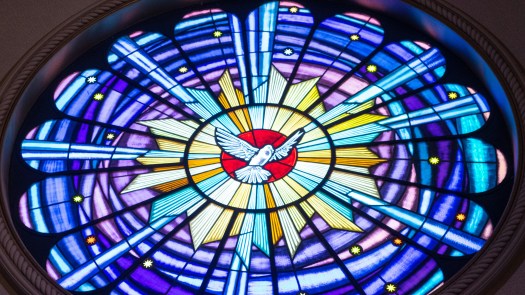
What is the Baptism of the Holy Spirit?

1 Corinthians 12

12The human body has many parts, but the many parts make up only one body. So it is with the body of Christ. 13Some of us are Jews, some are Gentiles, some are slaves, and some are free. But we have all been baptized into Christ’s body by one Spirit, and we have all received the same Spirit. (1 Corinthians 12:12-13, NLT)


The Daily DAVEotional

It’s a sad reality that many Christians know next to nothing about the Holy Spirit.

I grew up in a baptist tradition and while I had heard of the Holy Spirit, I don’t ever recall a sermon or message teaching on the role or ministry of the Holy Spirit in the life of the believer.

When I recommitted myself to Christ in college, I got involved in Campus Crusade for Christ and someone shared a booklet with me that explained the ministry of the Holy Spirit in the life of the believer, specifically, how I, as a Christian, could be FILLED with the Spirit. (I wrote about what it means to be filled with the Spirit in my blog post “Under the Influence”).

I had been a Christian for 13 years but really had no clue as to how the Holy Spirit could empower me as a believer to live a full and abundant Christian life. This was primarily because of a theological gap that existed between more conservative/fundamentalist traditions like the one I had been raised in, and the more charismatic/Pentecostal traditions regarding the role of the Holy Spirit in the modern church and in the life of the believer.

The charismatic and Pentecostal traditions seemed to over-emphasize the Holy Spirit, with what seemed to many as an extreme emphasis on the gifts of the Spirit in the daily life of the Christian, while the more fundamentalist traditions, many of which taught that the miraculous gifts of tongues and healing were no longer active in the church (a view known as “cessationism”) seemed to ignore the Holy Spirit altogether.

In the 1970’s, with the spread of the Jesus movement, churches like Calvary Chapel created a sort of doctrinal middle ground, helping to bridge the theological gap that existed between the charismatic arm of the church and the more fundamentalist arm of the church. The net result is that over the last 50 years or so, there has been a renewed interest and emphasis on the Holy Spirit within theological traditions that, in the past, had seemingly neglected the Holy Spirit.

Still, despite the fact that the Holy Spirit is no longer seen as just a topic among charismatic believers, I’ve found that the ministry of the Holy Spirit is still a mystery to many Christians. In particular, one of the most confusing concepts for evangelicals related to the Holy Spirit is the baptism of the Spirit.

Many associate the baptism of the Spirit with a charismatic experience because many of the charismatic traditions have taught that the baptism of the Spirit is a second blessing bestowed upon believers that gives them access to the signs and wonders gifts such as tongues, healings, miracles, etc.

This is not what Paul taught regarding the baptism of the Spirit as this passage in 1 Corinthians 12 demonstrates.


Click here to see a A Comprehensive List of Blog Posts Based on Bible Passage Reference


The context of this passage is spiritual gifts. There was a lot of confusion and chaos in the Corinthian church because spiritual gifts were being used improperly, causing disruption and disorder within the church worship service.

Paul is writing this passage to explain the proper use of the different gifts.

He compares the diversity of gifts to a human body. Just as a body has many parts that make up the one body, so the Spirit distributes many different gifts to the members of the one church.

Paul has already made the point that nobody has ALL the gifts and nobody should seek any specific gift.

We are all different and we have different gifts.

BUT.

Why the but?

What is the contrast Paul is trying to make?

We’re all different and we all have different gifts BUT there is ONE way in which we are all the same.

We ALL have been baptized by the Spirit.

According to Paul, the Holy Spirit baptizes ALL believers into the body.

What exactly does that mean?

It means that even though believers get different spiritual gifts, we all get the same Holy Spirit, who baptizes, or identifies us as being part of the body of Christ.

In other words, being baptized by the Spirit is our initiation into the family of God.

The Holy Spirit joins us to the body of Christ and we become a part of the family of God (see John 1:12). The Holy Spirit is our seal (see my post “The Holy Spirit as a Seal”) and our pledge (see my post “The Holy Spirit as a Deposit”) showing that we belong to Christ. It’s like the brand of cattle. It shows ownership. The Holy Spirit, in a way, is like our new family “crest”.

The tense of the verb indicates that this baptism Paul is speaking of is a past action, which means that it is something all believers (even carnal ones) have experienced.

This means that the baptism of the Spirit is not a religious experience that some Christians encounter at some point after coming to faith, giving them the ability to speak in tongues and perform other miraculous signs and wonders. The baptism of the Spirit is something that is common to ALL believers. It’s the moment at which the believer becomes identified with God’s Spirit, uniting them to Christ and ushering them into the family of God (see my post “What is Baptism?”).

Paul says that this baptism, this union, happens at the moment of belief in Christ. In that instant, everything changes. We become adopted sons and daughters in God’s family. We have a new life and a new identity, along with the promise of eternal life.


Did you enjoy this post? I’d love to hear your thoughts! Feel free to like, leave a comment below, and share it with your friends or on social media if you found it helpful or interesting. Your support keeps the conversation going!


Reflection

What is the theological tradition in which you were raised? What did. your tradition teach about the role of the Holy Spirit in the life of the believer?

What do you think are some of the disadvantages of being involved in a tradition that does not emphasize or teach much regarding the nature and ministry of the Holy Spirit?

What do you think are some disadvantages of being involved in a tradition that emphasizes the necessity of the signs and wonders gifts in the every day life of believers?

What do you believe about the baptism of the Spirit? What do you think it means? 

How does one come to a biblical understanding of the Holy Spirit and the role of the Spirit while avoiding the dangers of theological extremism?


Photo by Mateus Campos Felipe on Unsplash

What Does it Mean to Walk in the Spirit?

Galatians 5

16But I say, walk by the Spirit, and you will not carry out the desire of the flesh. 17For the flesh sets its desire against the Spirit, and the Spirit against the flesh; for these are in opposition to one another, so that you may not do the things that you please. 18But if you are led by the Spirit, you are not under the Law. 19Now the deeds of the flesh are evident, which are: immorality, impurity, sensuality, 20idolatry, sorcery, enmities, strife, jealousy, outbursts of anger, disputes, dissensions, factions, 21envying, drunkenness, carousing, and things like these, of which I forewarn you, just as I have forewarned you, that those who practice such things will not inherit the kingdom of God. 22But the fruit of the Spirit is love, joy, peace, patience, kindness, goodness, faithfulness, 23gentleness, self-control; against such things there is no law. 24Now those who belong to Christ Jesus have crucified the flesh with its passions and desires.

25If we live by the Spirit, let us also walk by the Spirit. 26Let us not become boastful, challenging one another, envying one another.

(Galatians 5:16-26, NASB)


The Daily DAVEotional

The letter to the Galatians was written to a church that was struggling with Jewish legalism. Some Pharisees who had accepted Jesus as the Messiah were telling the Galatians that it wasn’t enough to believe in Jesus to be saved; they were teaching these recent Gentile converts that they must also adopt all of the Jewish legal rituals as well. Basically, they were telling them that they needed to convert to Judaism if they wanted the Jewish Messiah to be valid for them.

This was a huge controversy in the early church. The issue revolved around what is necessary to be saved. The essential question that needed to be answered was, “do Gentiles have to become Jewish in order to accept Jesus as their Messiah?”

This controversy became so polarizing that the early church convened a Council to address the issue and decide on the matter. I wrote about that in my blog post “A Pivotal Council in the Early Church”. The summary is that the early church leaders unanimously agreed that Gentile converts did not need to become culturally Jewish in order to be saved. Jesus was enough and adherence to all of the Old Testament rituals and legal requirements was not necessary.

That didn’t stop these false teachers though from infiltrating churches and spreading their skewed version of the gospel, which was not really good news at all.

In this section of his letter, Paul is expounding on his argument that following the Law could never save anyone, which is why Jesus came in the first place.

We really have only two choices when it comes to salvation. We can seek to gain God’s favor through our own human efforts (our flesh), or we can seek God’s favor by following the Spirit. Paul says that these two options are diametrically opposed to one another and they yield completely different results.

In fact, the only way one can experience real transformation is by following the Spirit, or, as Paul puts it, walking in the Spirit. What exactly does it mean to walk in the Spirit?

There are three words and phrases in this passage that give clarity to the idea of walking in the spirit.

In verse 16, Paul says that if we “walk by the Spirit” we “will not carry out the desire of the flesh.” The NIV translation is slightly different, encouraging us to “live by the Spirit”.

What comes to your mind when you think about going on a walk? Typically, I think about a relaxing walk in nature or on the beach or in a serene location with my wife or a trusted friend. The idea is that there is a relational connection and a reliance on God when we are walking with Him.

The second word that gives clarity to walking in the spirit is in verse 18, which says “if you are led by the Spirit, you are not under the Law.”

The Holy Spirit is a guide. He leads us. He directs us. I think about being on a hike in a national park where there is an experienced guide leading us along a path. Because they are familiar with the terrain and all of the trails, they serve as a leader, showing us the way to our destination while alerting us to dangers and pitfalls along the way.

The third word that gives clarity to “walking in the Spirit” is in verse 25, which says, “If we live by the Spirit, let us also walk by the Spirit.” Interestingly, the word “walk” in this verse is not the same word used for “walk” in verse 16. The NIV translates it this way:

Since we live by the Spirit, let us keep in step with the Spirit.

This word translated “walk” in the NASB is translated “keep in step” by the NIV. The word is really a military term that describes soldiers as they are marching together.

If you’ve ever seen a military parade, or even a marching band, you know that there is a leader, a drill sergeant or a drum major, who is giving commands that others follow. There is a rhythm and a synchronicity that exists between the leader and the followers.

Walking in the Spirit is a conscious act whereby we, as followers, willingly put ourselves in a subservient position, taking our cues from the Lord as our companion and guide. We don’t resist or question His orders and directives, but we keep in step and rhythm with where He’s going and what He’s doing.

Paul says that the natural result of walking in the spirit is that we will bear the fruit of the Spirit – our character will begin to transform, taking on God’s selfless character instead of the selfish, ungodly character that our flesh produces.


Did you enjoy this post? I’d love to hear your thoughts! Feel free to like, leave a comment below, and share it with your friends or on social media if you found it helpful or interesting. Your support keeps the conversation going!


Reflection

How is life like a walk?

Think about a time you went on a relaxing walk. Who was with you? Where were you? What words would describe your emotions and your demeanor.  What made it so refreshing?

What does it mean to be led by someone? What is required on our part in order to be led by someone else?

What characterizes soldiers as they march? How do you think you can “march” in step with the Spirit?


Photo by Henry Xu on Unsplash


The Holy Spirit as a Deposit

Ephesians 1

13And you also were included in Christ when you heard the word of truth, the gospel of your salvation. Having believed, you were marked in him with a seal, the promised Holy Spirit, 14who is a deposit guaranteeing our inheritance until the redemption of those who are God’s possession—to the praise of his glory. (Ephesians 1:13, 14, NIV)


The Daily DAVEotional

What do you know about the Holy Spirit? To many Christians, the Holy Spirit remains a mystery. We know He’s important because He’s mentioned along with the Father and the Son as a member of the Holy Trinity. But for many Christians, that’s the extent of their knowledge and understanding of the Holy Spirit.

I mentioned in a previous post how Francis Chan referred to the Holy Spirit as the “Forgotten God”, which was the title of a book he wrote on the Holy Spirit.

The Holy Spirit’s role in the life of the believer is absolutely critical even though many Christians are blissfully unaware of who the Holy Spirit is or what role He plays in their lives.

So who IS the Holy Spirit and what is His role?

I wrote about the nature of the Holy Spirit in my blog post, “Is the Holy Spirit Like the Force in Star Wars?“, in which I demonstrated that the Holy Spirit is God.

I also wrote recently here about two verses in Ephesians that tell us ONE aspect of the Holy Spirit’s role in the life of those who follow Christ, namely that the Holy Spirit functions as a seal.

Closely related to His function as a seal, the Holy Spirit, according to Ephesians 1:14, functions as a deposit.

What exactly does Paul mean when he says that the Holy Spirit is a deposit?

To answer that question, I’ll ask you a different question.

Have you ever taken out a loan for a car or for a home?

If you have, it’s likely that you made a down payment or put down a deposit. Unless of course you paid cash in full for your purchase. If you did that, then Dave Ramsey would be very proud of you.

For most people, having enough cash on hand to buy a car might be possible, but it’s less likely that you are paying cash in full to buy a house. Especially in this market (have you seen the prices of homes lately?)

Anyhow, if you took out a loan for a house or a real nice car, you likely put down a deposit, or a down payment. Also if you’ve ever rented an apartment or a home, you likely put down a deposit to secure the lease.

The deposit has one function – skin in the game. The purpose of a deposit is for you to put a portion of your own hard-earned money into the loan. This gives the lender confidence that you are a responsible borrower and you are more likely to make the payments on the loan.

In the event that you as a borrower fail to make the payments on the loan, you forfeit your deposit. Most borrowers will not want to lose their deposit, especially if it represents a significant amount of money.

This verse says that the Holy Spirit functions like a deposit. The Holy Spirit is given to the believer as a down payment, guaranteeing that God will ultimately deliver on all future salvation promises.

When we make a down payment on a loan, we are promising the lender that we are “good for the balance”. We’re saying that we will make all the payments until the loan is fully paid.

However, even though we may have good intentions. a loan default is still possible. As humans, we don’t always keep our promises. But even though WE may not always fulfill our financial obligations, what are the chances that God will fail to keep His promises related to salvation? ZERO.  God cannot default on Himself. It is impossible for Him to be unfaithful.

So when the Bible says that the Holy Spirit is a deposit, it means that everything God has promised us related to our full and future redemption as believers WILL come to pass. You can take that to the bank!

Reflection

Have you ever made a down payment on a loan – for a house or car, or other item? If so, what was it?

Have you, or someone you know ever defaulted on a loan? What were the circumstances?

Have you ever been a renter and not received your full deposit back when you moved out? What were the reasons why you did not get all of your deposit back?

What do you think it means that the Holy Spirit is a deposit, guaranteeing our future redemption as believers?

What is the future redemption that the text speaks about? What exactly is the involved in the future redemption, which the Holy Spirit has secured for us as believer?


Photo by RDNE Stock project: https://www.pexels.com/photo/close-up-photo-of-an-agreement-on-a-paper-7841821/


The Holy Spirit as a Seal

Ephesians 1

13And you also were included in Christ when you heard the word of truth, the gospel of your salvation. Having believed, you were marked in him with a seal, the promised Holy Spirit, (Ephesians 1:13, NIV)

Ephesians 4

30And do not grieve the Holy Spirit of God, with whom you were sealed for the day of redemption. (Ephesians 4:30, NIV)


The Daily DAVEotional

In 2009, popular speaker and Christian author Francis Chan wrote and released his book “Forgotten God.” The book was an aptly titled treatise on the Holy Spirit, the often misunderstood and neglected third member of the Trinity.

Many Christians are confused about the role of the Holy Spirit. We understand God the Father. We imagine Moses talking to the Father as he encounters the burning bush. Or we think of the Old Testament prophets communicating with “The Father”.

We also understand Jesus because we read about Him in the gospels and the New Testament epistles. In our minds, we see the actions of Jesus and we hear His words as He teaches the crowds and interacts with His disciples.

But who is this Holy Spirit character? We know He’s a part of the Trinity but we often don’t know what He does or why He’s important.

I wrote about the nature of the Holy Spirit in my blog post “Is the Holy Spirit like the Force in Star Wars“, demonstrating that the Holy Spirit is God!

Beyond knowing that the Holy Spirit is a person and that He is God, what exactly is the role of the Holy Spirit in my life? What does He do? Does it even matter?

There’s a whole theology built around understanding the nature and the person of the Holy Spirit. It’s called Pneumatology, The Greek word “pneuma” (pronounced “nooma”) means “breath, wind, or spirit.” Hence, pneumatology is the study of the Holy Spirit.

To understand the Holy Spirit completely would take more time than just a brief blog post, but we do learn something specific about the role of the Holy Spirit in the life of believers from these two verses in Ephesians.

From these two verses, we learn that the Holy Spirit is a seal. What exactly does that mean?

A seal has many purposes.

For one, a seal was used to demonstrate ownership. In modern times, ranchers will brand their cattle and livestock with a branding iron, which is like a seal. This brand is a specific logo or emblem that represents that ranch and all livestock branded with that emblem are owned by that ranch.

Ephesians 1:13 says that we “were marked in Him with a seal, the promised Holy Spirit.” One role of The Holy Spirit then is to act as a seal, essentially imprinting a God-tattoo on our soul, demonstrating that we now belong to God.

A second purpose of the seal is to demonstrate authority.

In ancient times, a seal was used to identify an individual. The seal authenticated a person via an emblem or a device that could be used to make an impression in wax or clay.


Genesis 38 tells the story of Tamar who disguises herself as a prostitute in order to sleep with her father-in-law, Judah. When Judah asks her what he can give her as security while she waits for payment for services rendered, she replies,

“I want your identification seal, your cord, and the walking stick you are carrying.” So Judah gave these items to her. She then let him sleep with her, and she became pregnant. (Genesis 38:18, NLT)

In today’s culture, a seal is often used by official entities (like the government) to demonstrate the authority and authenticity of a document. As I look at my driver’s license, for example, it is embossed with the “Great Seal of the State of California”, which demonstrates that the identification is authentic and legal.

So the Holy Spirit is given to us as believers to authenticate our relationship with God. It is real. It is authentic. It is officially from God.

A third purpose of a seal is one of security. A seal was often used in official communication to ensure the security of the message. A document would be folded and a piece of wax or clay would be used to “seal” the fold. The seal of the person (often a signet ring) was used to press into the wax and create an official image that represented that person. If the seal was broken before reaching the recipient, the recipient would know that the communication was perhaps compromised.

According to Ephesians 4:30, the Holy Spirit “seals” the believer for the day of redemption. What that means is that the Holy Spirit is given to believers to secure all of the promised elements related to our future salvation.

Of course there’s a lot more to know and understand about the role the Holy Spirit plays in our lives as believers. But one important role is that He is a seal, which shows that we now belong to God, we are authentic members of His family and that all of God’s future promises related to salvation are secure.

Reflection

At the outset, it was suggested that the Holy Spirit is the often over-looked, misunderstood third member of the Trinity (the Forgotten God). What has been your understanding and experience with the Holy Spirit as a believer? Before reading this post, what has been your relationship with the Holy Spirit in your daily Christian life?

What are some examples in your own experience of a seal?

One purpose of the seal is to show ownership, like a brand on livestock. When you think about being “owned” by God, how does this affect you as a follower of Christ? What impact, either positive or negative, does this have on you as you seek to live out the Christian life?

Another purpose of a seal is security. What do you think it means that the Holy Spirit secures all of the promises related to our future salvation? What exactly is He securing? What difference does this make in how you live out your faith?


Photo by Anna Tarazevich: https://www.pexels.com/photo/close-up-photo-of-a-stamp-on-a-paper-5425648/

Is the Holy Spirit like “The Force” in Star Wars?


Acts 5

1There was also a man named Ananias who, with his wife, Sapphira, sold some property. 2He brought part of the money to the apostles, but he claimed it was the full amount. His wife had agreed to this deception.

3Then Peter said, “Ananias, why has Satan filled your heart? You lied to the Holy Spirit, and you kept some of the money for yourself. 4The property was yours to sell or not sell, as you wished. And after selling it, the money was yours to give away. How could you do a thing like this? You weren’t lying to us but to God.”

5As soon as Ananias heard these words, he fell to the floor and died. Everyone who heard about it was terrified. 6Then some young men wrapped him in a sheet and took him out and buried him.

7About three hours later his wife came in, not knowing what had happened. 8Peter asked her, “Was this the price you and your husband received for your land?”

“Yes,” she replied, “that was the price.”

9And Peter said, “How could the two of you even think of doing a thing like this—conspiring together to test the Spirit of the Lord? Just outside that door are the young men who buried your husband, and they will carry you out, too.”

10Instantly, she fell to the floor and died. When the young men came in and saw that she was dead, they carried her out and buried her beside her husband. 11Great fear gripped the entire church and all others who heard what had happened. (Acts 5:1-11, NLT)


The Daily DAVEotional

During Covid I started running. I hated it at first but I kept at it and now I typically run about 6 miles per day. Most days I tend to run the same route that includes a 3.1 mile loop around Lake Mission Viejo, a small man-made lake in our community.

One interesting piece of trivia is that the 1984 Olympic Cycling event included a segment around this lake that I run almost every single day. In fact, the finish line for that race is memorialized, not only in the street, with a cement strip that says “Finish” but also on the sidewalk with benches and a plaque that gives tribute to the 20th anniversary of the Olympic event.

Finish Line for the 1984 Olympic Cycling Event
Memorial marking the 20th anniversary of the 1984 Olympic Cycling event, which took place in Mission Viejo, CA

Occasionally, when I run by this spot on the loop I will see some members of the Jehovah’s Witnesses sitting on the bench with a portable kiosk filled with religious paraphernalia. Their hope, I’m sure, is that people walking the loop might stop and take some religious material or even engage in some spiritual conversation.

If you’re not familiar with the Jehovah’s Witnesses, they are a religious group based in New York. Their roots are in Christianity but they are NOT a Christian group.

One of the main differences between traditional, orthodox Christianity and the Jehovah’s Witnesses is that they reject the doctrine of the divinity of Jesus. I wrote about the Jehovah’s Witnesses misunderstanding of Jesus in some previous blog posts here (A Modern Day Version of an Ancient Heresy) and here (Evidence that Jesus is God).

Another main difference between Jehovah’s Witness teachings and traditional Christianity is their rejection of the doctrine of the trinity, which they believe was a pagan belief introduced to the church by Constantine early in the 4th century.

While the church teaches that God is triune – that is, the Father is God, the Son is God and the Holy Spirit is God, and yet there is only ONE God, the Jehovah’s Witnesses teach that Jesus is a created being and the Holy Spirit is a force, not a person.

In the book “You Can Live Forever in Paradise on Earth”, the Holy Spirit is described as God’s active force and is compared to an electrical power grid that provides electricity to an entire suburb from a nearby power source.

Is this an accurate depiction of the Holy Spirit? Is the Holy Spirit God’s active force, much like “The Force” in Star Wars?

According to this passage in Acts 5, the answer is clearly “NO”.

This passage tells the story of Ananias and Sapphira, a husband and wife who sold some property and gave the proceeds to the church. But they lied about how much they made and as a result, they both were struck dead. In a previous post, I wrote about why they experienced such harsh consequences for what seems like a minor offense.

While this text is often used to highlight the serious quest for righteousness and purity in the early church, there is an often overlooked theological nugget in this passage that aids in our understanding regarding the nature of the Holy Spirit.

Look at verse 3, in which Peter says, ““Ananias, why has Satan filled your heart? You lied to the Holy Spirit, and you kept some of the money for yourself.”

First off, notice that Peter tells Ananias that he lied to the Holy Spirit when he kept some of the money for himself. This is clear evidence that the Holy Spirit is a person, not a force, because you cannot lie to something that is inanimate, such as a force or an electrical power grid. You can only lie to a person, and since Ananias lied to the Holy Spirit, then clearly, the Holy Spirit must be a person.

Secondly, look at the end of verse 4, in which Peter says to Ananias, “How could you do a thing like this? You weren’t lying to us but to God.

In verse 3, Peter says that Ananias lied to the Holy Spirit, and then in verse 4 Peter says that Ananias lied to GOD!

There’s the smoking gun right there. Clear evidence that Peter, one of the foremost apostles of the New Testament church, believed that the Holy Spirit was God.

Perhaps you’ve never given much thought to the Holy Spirit – who He is or what He is. One thing is certain – the Holy Spirit is NOT a force, as the Jehovah’s Witnesses teach. The Bible clearly teaches that the Holy Spirit is a person, and He is God!

Reflection

Traditional Christianity teaches that God is a triune God, or a trinity? What do you think that means? How would you explain the triune nature of God to someone else?

The author asserts that lying to the Holy Spirit is clear evidence that the Holy Spirit is a person? Do you agree that you can only lie to a person? What other attributes would demonstrate personhood? In other words, what are some attributes that only PEOPLE  can have and what are some actions that only PEOPLE can commit?

What has been your understanding of the Holy Spirit in the past?

Do you agree that the Holy Spirit is God? If not, why not? 


Photos by Dave Lowe


Under the Influence

Ephesians 5

15So be careful how you live, not as fools but as those who are wise. 16Make the most of every opportunity for doing good in these evil days. 17Don’t act thoughtlessly, but try to understand what the Lord wants you to do. 18Don’t be drunk with wine, because that will ruin your life. Instead, let the Holy Spirit fill and control you. 19Then you will sing psalms and hymns and spiritual songs among yourselves, making music to the Lord in your hearts. 20And you will always give thanks for everything to God the Father in the name of our Lord Jesus Christ. (Ephesians 5:15-20, NLT)


The Daily DAVEotional

In this section of Ephesians Paul is summarizing what He’s shared earlier in chapter 5 where he has given a number of examples and admonitions for what it means to follow God.

The summary of all the guidelines is to live wisely instead of foolishly.

What does it mean to live wisely and what does it look like to live foolishly?

Examples of wisdom and foolishness are replete throughout the Bible. The book of Proverbs contains a wealth of knowledge contrasting wisdom from foolishness. Additionally, Paul gives many exhortations and commands in his many New Testament letters, including what he’s shared earlier in chapter 5.

However, in this short segment, Paul summarizes wise and foolish living with 3 ideas:

First, people who live wisely make the most of their time. They don’t waste their time, but use their time for doing good.

Secondly, the wise person doesn’t act thoughtlessly but considers what the Lord’s will is. The implication here is that the wise person KNOWS the Lord and His word. Knowing God’s word is vital to understanding His will because it is the primary means by which we understand God’s character and His purposes.

Third, the wise person doesn’t get drunk but instead is filled with the Holy Spirit.

I think it’s interesting that Paul compares and contrasts being filled with the Spirit with being drunk. Why does he do this? How are these two things similar and how are they different?

Most states have strict laws about driving while drunk but if you get pulled over and charged, the official term is often “DUI”, which stands for driving under the influence.

When we drink too much, we are under the influence of alcohol and it affects us mentally, physically and emotionally. In short, we lose control of ourselves and often do things and act in ways that are totally out of character.

In the same way, to be filled with the Spirit is to be under the Spirit’s control. It means that I allow God’s Spirit to lead me and influence my decisions and my actions.

According to verse 18, the end result of being drunk is that it ruins our lives. Some translations say that being drunk leads to “dissipation”, which means “wasteful living.” The idea is that really nothing good comes from being drunk. It’s a waste of time and energy that leads to nothing good or productive.

The key question is: who is in control of my life? Is it me? If I’m in control, making my own decisions and living for myself, then I’m living foolishly and I’m apt to do foolish things, just as someone who is drunk.

However, if God’s Spirit is in control, then I’m living wisely, following His lead, doing good instead of evil and as a result, my life has purpose and direction.

Another way of looking at this is to ask the question: what influences you? We are all influenced by something. Whatever is influencing you is ultimately controlling you. Paul’s admonition is that the believer should be under the influence of the Holy Spirit. Being under the influence of anything else is foolish.

Reflection

How are you using your time? In what ways does your schedule reflect God’s priorities? Are there things in your schedule that are time wasters? 

What are some examples that come to mind that demonstrate how drunkenness can lead to ruined lives or wasteful living?

Paul contrasts being drunk with being filled with the Spirit. How can a person be controlled by God’s Spirit? What steps can one take to be under the influence of God’s Spirit?

If you were to create your own list of foolish living versus wise living, what items would be on each list? What is the source of items for each of your lists?

How can you know what God’s will is? What steps and actions can you take to understand God’s will and ensure that you’re following God’s will?


Photo by Vinicius “amnx” Amano on Unsplash