
Does Philippians 2 Prove Jesus is God? Examining the Jehovah’s Witnesses’ Claim

Philippians 2

5Your attitude should be the same as that of Christ Jesus:

6Who, being in very nature God, did not consider equality with God something to be grasped, 7but made himself nothing, taking the very nature* of a servant, being made in human likeness. 8And being found in appearance as a man, he humbled himself and became obedient to deatheven death on a cross!

9Therefore God exalted him to the highest place and gave him the name that is above every name, 10that at the name of Jesus every knee should bow, in heaven and on earth and under the earth, 11and every tongue confess that Jesus Christ is Lord, to the glory of God the Father. (Philippians 2:5-11, NIV)


The Daily DAVEotional

For those who deny the deity of Christ, such as today’s Jehovah’s Witnesses, Philippians 2 offers one of the clearest passages in the New Testament to attest to the divine nature of Jesus.

Verse 6 is the key statement as Paul says that Jesus, “who being in very nature God…”

According to this verse, Jesus possessed the very nature of God, which means, of course, that Jesus IS God.

How do the Jehovah’s Witnesses explain this passage?

Jehovah’s Witnesses strongly deny that this passage teaches that Jesus is divine. They point to the Greek word “morphe” that the NIV translates as “nature”.

This Greek word “morphe” actually means “form”.

Here then is how the passage is translated by the New American Standard Bible:

5Have this attitude in yourselves which was also in Christ Jesus, 6who, although He existed in the form of God, did not regard equality with God a thing to be grasped, 7but emptied Himself, taking the form of a bond-servant, and being made in the likeness of men. 8Being found in appearance as a man, He humbled Himself by becoming obedient to the point of death, even death on a cross. 9For this reason also, God highly exalted Him, and bestowed on Him the name which is above every name, 10so that at the name of Jesus EVERY KNEE WILL BOW, of those who are in heaven and on earth and under the earth, 11and that every tongue will confess that Jesus Christ is Lord, to the glory of God the Father. (Philippians 2:5-11, NASB)

Let’s look at this passage where it is translated with the word “form” and  try to determine which interpretation makes more sense – the traditional Christian understanding or the Jehovah’s Witnesses’ understanding.

While most Biblical translators contend that this passage strongly communicates that Jesus, in his very nature, existed as God, which explains why the NIV uses the phrase “being in very nature God”, the Jehovah’s Witnesses argue that this passage demonstrates that Jesus is NOT God.

Their argument is as follows:

Verse 6 says that Jesus existed in the “form” of God.

What is God’s form?

According to John 4:24, “God is Spirit.”

Hence, when Philippians 2:6 says that Jesus existed in the “form of God”, it’s saying that Jesus existed as a spirit.

This argument is not convincing and fails on many levels.

First of all, their understanding of the word “form” does not align with the underlying meaning of the Greek word morphe.

Vine’s Expository Dictionary of New Testament Words gives this definition for the word “morphe” [G3444, morphe]:

[morphe] denotes the special or characteristic form or feature” of a person or thing; it is used with particular significance in the NT, only of Christ, in Philippians 2:6Philippians 2:7, in the phrases “being in the form of God,” and “taking the form of a servant.” An excellent definition of the word is that of Gifford: “morphe is therefore properly the nature or essence, not in the abstract, but as actually subsisting in the individual, and retained as long as the individual itself exists. … Thus in the passage before us morphe Theou is the Divine nature actually and inseparably subsisting in the Person of Christ.

The Jehovah’s Witnesses assign a meaning to the word “form” that is more akin to “shape”, “pattern”, or “that which is seen externally.” The problem is that there is a different Greek word that communicates that idea (G1491, eidos) and Paul did not use that word.

Secondly, if Paul was trying to communicate that Jesus existed as a spirit, why does he say that Jesus existed in the “form of God” instead of the “form of a spirit”? Would that not communicate exactly what the Jehovah’s Witnesses teach without any of the confusion?

Alternatively, why would Paul not just say that Jesus existed in the “form of an angelic being” since Jehovah’s Witnesses teach that Jesus is the exalted archangel Michael?

Furthermore, in verse 7, Paul says that Jesus “emptied himself, taking the form of a bond-servant”.

What exactly is the form of a bond-servant?

The Jehovah’s Witnesses will likely respond that the form of a bond-servant is a person, or a man.

If that’s the case, why does Paul not just say that Jesus took the “form of a person” or the “form of a man”?


Click here to see a A Comprehensive List of Blog Posts Based on Bible Passage Reference


If we’re to adopt the Jehovah’s Witnesses’ interpretation of this passage, we are forced to believe that Paul used the phrases “form of God” and “form of a bond-servant” as euphemisms to communicate the simple concept that Jesus was once a “spirit”who then became a “man”.

This is a curious interpretation indeed. Instead of assuming that Paul used the phrases that he did for a particular purpose, we’re asked to believe that Paul used the phrases as sort of intermediate codes that actually point to a different meaning that is not as obvious as the original text. It’s as if we need secret decoder rings to decipher what these phrases actually mean.

There’s another reason why the Jehovah’s Witnesses’ understanding of these terms is flawed.

Later in verse 7, Paul says that Jesus was “made in the likeness of men”. So he explicitly says later in the same verse, using a different phrase, that Jesus became a man. So how can one argue that the phrase “taking the form of a bond-servant” means that Jesus became a man when Paul communicates that very idea later in the same verse but with a different phrase?

According to the Jehovah’s Witnesses’ interpretation, if we swap out Paul’s “form of” phrases for the meaning that the Jehovah’s Witnesses ascribe to them, we’re left with the following bizarre rendering of verse 7:

Jesus emptied himself….he became a man, and being made in likeness of men.

We end up with a garbled redundancy that makes no sense. The Jehovah’s Witnesses’ explanation of this passage is a classic example of Scripture twisting. In their effort to make the passage say something other than what it clearly states, we end up with meaningless phrases and incoherent sentences.

It’s obvious that the phrase “form of” carries the meaning of “nature”, which means that Jesus possessed the nature of God but then took on the nature of a bond-servant. There is no other reasonable explanation for why Paul would couple the terms “God” and “bond-servant” with the phrase “form of” if he only intended to communicate that Jesus existed as a “spirit” but then became a “man.”

Paul must be using these phrases for a specific reason, otherwise, why use them?

This understanding of the word “form” is confirmed by Vines, which states:

The true meaning of morphe [nature] in the expression ‘form of God’ is confirmed by its recurrence in the corresponding phrase, ‘form of a servant.’ It is universally admitted that the two phrases are directly antithetical, and that ‘form’ must therefore have the same sense in both.” * [* From Gillford, “The Incarnation,” pp. 16,19,39.] (bold brackets added)

It’s clear that a bond-servant is a particular type of man. A bond-servant is a “man” who possesses specific characteristics which Jesus then embodied.

Similarly, God is Spirit, but not just any spirit. He is DIVINE spirit. Therefore, Paul is communicating that Jesus is a spirit who embodied the qualities of God. His statement is literally one of the clearest declarations of the divine nature of Jesus in all of Scripture.

There’s no doubt why Paul is using these terms and exactly what is being communicated – Jesus existed with the form, i.e. the nature of God, but he emptied himself, meaning he gave up his rights and his position as God in order to take on the form, i.e. the nature of a bond-servant, someone who was completely obedient to the Father, in order to accomplish the purpose of redeeming and reconciling mankind.

If there was any doubt that this is the correct understanding of verses 6 & 7, we only need to look at the verses that follow, which indicate that as a result of Jesus’ death on the cross, the Father exalts Jesus so that EVERY knee will bow and EVERY tongue will confess that Jesus is Lord.

Jesus will be worshiped by EVERYONE. Since only God can legitimately receive worship, Paul is clearly communicating that Jesus possesses the nature of God and will eventually be worshiped as such by the entire created order.

If one adopts the Jehovah’s Witnesses’ understanding of this verse, you have the awkward situation where Jesus, who is NOT divine, is exalted to a position where he is clearly worshiped by all of creation.

How exactly does that work? How can Jesus receive worship if he is not God?

Clearly, the Jehovah’s Witnesses do not allow the biblical text to inform their theology. Instead, they have a consistent pattern of conforming the biblical text to their pre-determined theological conclusion, namely, their view that Jesus is NOT God.

To make the Scriptures conform to this theological outcome, they must add words to various texts, while changing the meaning of words in other texts, all the while ignoring context and plain logic.


Did you enjoy this post? I’d love to hear your thoughts! Feel free to like, leave a comment below, and share it with your friends or on social media if you found it helpful or interesting. Your support keeps the conversation going!


Reflection

Are you convinced by the Jehovah’s Witnesses’ explanation of this verse? Why or why not?

If Jesus is NOT divine, as the Jehovah’s Witnesses contend, how do you explain the fact that Jesus will be exalted and EVERY knee will bow and EVERY tongue will confess that Jesus is Lord? In other words, how can Jesus be worshiped if he is not God?

The author of the post says that Jehovah’s Witnesses do not allow the biblical text to inform their theology but instead they conform the biblical text to their theology. What do you think that means? In what ways do you see people, including Christians, doing the same thing? What is the danger of interpreting the Bible in this way?

Paul invites the reader to have the same attitude that Jesus had. What is that attitude? How can you demonstrate that same attitude in your life today? This week? 


Image created by Grok
Revisiting the Story of the Prodigal Son

Luke 15

11To illustrate the point further, Jesus told them this story: “A man had two sons. 12The younger son told his father, ‘I want my share of your estate now, instead of waiting until you die.’ So his father agreed to divide his wealth between his sons.

13“A few days later this younger son packed all his belongings and took a trip to a distant land, and there he wasted all his money on wild living. 14About the time his money ran out, a great famine swept over the land, and he began to starve. 15He persuaded a local farmer to hire him to feed his pigs. 16The boy became so hungry that even the pods he was feeding the pigs looked good to him. But no one gave him anything.

17“When he finally came to his senses, he said to himself, ‘At home even the hired men have food enough to spare, and here I am, dying of hunger! 18I will go home to my father and say, “Father, I have sinned against both heaven and you, 19and I am no longer worthy of being called your son. Please take me on as a hired man.”’

20“So he returned home to his father. And while he was still a long distance away, his father saw him coming. Filled with love and compassion, he ran to his son, embraced him, and kissed him. 21His son said to him, ‘Father, I have sinned against both heaven and you, and I am no longer worthy of being called your son.

22“But his father said to the servants, ‘Quick! Bring the finest robe in the house and put it on him. Get a ring for his finger, and sandals for his feet. 23And kill the calf we have been fattening in the pen. We must celebrate with a feast, 24for this son of mine was dead and has now returned to life. He was lost, but now he is found.’ So the party began. (Luke 15:11-24, NLT)


The Daily DAVEotional

Imagine you are the son (or daughter) of a very wealthy man. You have no job and you still live under his roof.

Now imagine you go to your father and you say, “You know what old man? I wish you were dead, and I wish I could cash out my inheritance right now and blow this popsicle stand.”

This is not too far off from the scenario that Jesus paints in the story of the “lost son”, more commonly referred to as the “prodigal son.”

The son in the story doesn’t use the words I’ve chosen but the effect is pretty much the same, for in the Jewish culture, it was the ultimate slap in the face to ask your father for your inheritance while he was still living. It was more than a slap in the face actually. It was the ultimate sign of disrespect, akin to giving the father the finger.

Now if you happened to be living the imagined scenario I painted at the outset, what kind of response might you expect from your father after telling him you wished he was dad and you wanted your money…NOW?

Amazingly, in the story Jesus tells, the father willingly complies. He doesn’t demonstrate anger or resentment or any kind of vindictiveness, all emotions I imagine I’d express if I were the father in this scenario.

So the son gets his wish. And what does he do?

He goes to a distant land and wastes ALL the money on wild living (i.e. partying and prostitutes). In some ways, the story mutes the degree of nastiness in which the son treats his father and exploits his wealth. But make no mistake, the son is the most extreme example of a rebel that you can fathom.

When you have no job and your sole purpose is to experience hedonism to its fullest extent, eventually you run out of money to support that crazy lifestyle. And that’s exactly what happened here too. The son had no money, no plan and no prospects. He was desperate.

He finally gets a job feeding slop to pigs. Take note of this detail. He was feeding PIGS.

Pigs were unclean animals to Jews, which is just one more detail revealing how far off the son had strayed.

It’s at this point that the story turns. The key passage in this whole story comes in verses 17-19, which says:

17“When he finally came to his senses, he said to himself, ‘At home even the hired men have food enough to spare, and here I am, dying of hunger! 18I will go home to my father and say, “Father, I have sinned against both heaven and you, 19and I am no longer worthy of being called your son. Please take me on as a hired man.”’

The son “came to his senses”. This is a biblical picture of repentance. The son came face to face with reality. He had hit rock bottom and he was finally willing to humble himself and admit the stupidity of his decisions that led to his current situation. In short, he finally took responsibility for his actions.

But he didn’t stop there. He humbled himself and was willing to admit his sin to his father. So he swallowed his pride and returned home to face his father.

Imagine if you were the son in that situation. How difficult would it be to face your father and admit you were wrong? Personally, I think a typical father would be angry and I’d expect their response to follow suit. I’d expect to be berated and “made an example of”. I’m certain I’d need to learn my lesson and take my medicine. Essentially, I’d expect to experience some kind of penalty and punishment.

But that’s not what happens in this case. The text says that when the son was still a long way off, the father SAW HIM COMING. That means the father had to be watching and waiting for the son to return.

The father doesn’t react the way we would expect because he’s like no earthly father any of us have ever experienced. The father doesn’t berate his son. He doesn’t say “I told you so”. He doesn’t require any groveling or penance. He just embraces the son and welcomes him back into the family, with full rights and privileges restored.

The story highlights the incredible love and patience God the Father has for His children.

God is not a dictator. He allows us to choose our own path. He doesn’t restrict our choices but he also doesn’t shield us from the consequences of those choices. He patiently waits for us to return. And if and when we do return, He welcomes us back with a lavish love that is beyond any kind of earthly love we could experience.

On the flip side, the son is an example of the most egregious offenses one could commit. And yet, the Father extends His love and immediately forgives and restores the son. It’s incredible.

This tells me a couple of things. First, there is nothing I can do that God won’t forgive. NOTHING. I only need to come to my senses (repent), humble myself and admit my sin, just as the son in the story did.

God doesn’t require us to grovel or do penance to receive His love and forgiveness. He freely gives it to those who come to Him with a humble heart of surrender. His love is infinite and He freely and unconditionally lavishes it on those who come to Him.

Now imagine experiencing the love of THAT Father!


Did you enjoy this post? I’d love to hear your thoughts! Feel free to like, leave a comment below, and share it with your friends or on social media if you found it helpful or interesting. Your support keeps the conversation going!


Reflection

What was your relationship like with your earthly father?

If you had done something wrong that you know he would be offended by, what would it have been like for you to think about approaching Him? What kind of reaction might you expect?

When you think of God, what words come to mind? How would you describe God to someone else?

When you find yourself sinning and “straying” from God’s plan, how easy is it for you to “come to your senses”? What keeps you from coming to your senses and returning to God?

What amazes you most about this story?


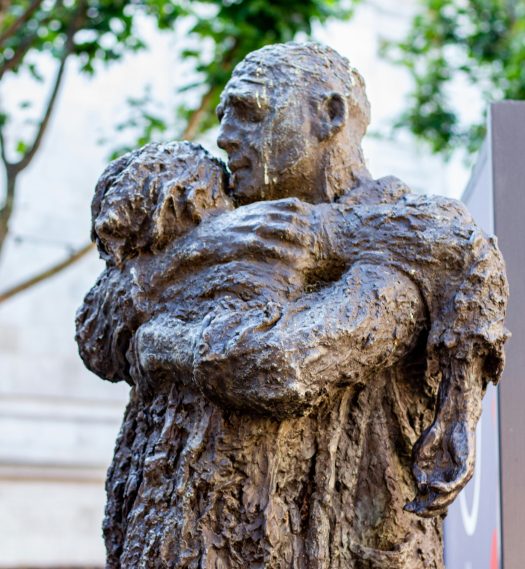
Photo by IP Withers on Unsplash – Charlie Mackesy’s Return of the Prodigal Son statue outside HTB Church London

Does God Help Those Who Help Themselves?

Matthew 5

3“Blessed are the poor in spirit, for theirs is the kingdom of heaven. (Matthew 5:3, NIV)


The Daily DAVEotional

Have you ever heard someone say that “God helps those who help themselves”?

It’s a popular notion that’s been around for years. But is it biblical?

To be fair, there are numerous passages in the Proverbs that extol the virtues of hard work and the foolishness of being lazy. (See Proverbs 10:4; 12:24, 27; 13:4; 19:15, among others)

Additionally, in 2 Thessalonians 3:10, Paul issues this admonition:

“Even while we were with you, we gave you this rule: “Whoever does not work should not eat.”

However the sentiment of this popular bit of cultural wisdom is not meant to discourage laziness but instead, it promotes an attitude of self-sufficiency and rugged individualism that is associated more with American culture than biblical values.

Jesus teaches the exact opposite. Instead of teaching that “God helps those who help themselves”, Jesus teaches that ”God helps those who CANNOT help themselves.”

To be poor in spirit means to recognize your own spiritual need; to recognize the poverty of your own soul. The New Living Translation says it this way:

“God blesses those who realize their need for him, for the Kingdom of Heaven is given to them.” (Matthew 5:3, NLT)

The reality is that we are all broken and there is nothing we can do to help ourselves. Many people mistakenly believe that we come to Jesus only to be rescued from an eternity in hell.

While Jesus does save us from the judgment we deserve, we still need Jesus every day, even beyond our initial conversion experience. We are broken and only Jesus can empower us to live the kinds of righteous and holy lives He desires. Only Jesus can provide fullness of life.

Jesus doesn’t just promise to save us from hell. He promises us LIFE. REAL LIFE. Unfortunately, we cannot experience that life if we subscribe to the idea that we must help ourselves first. NO. We cannot help ourselves. We need Jesus to help us every moment of every day!


Did you enjoy this post? I’d love to hear your thoughts! Feel free to like, leave a comment below, and share it with your friends or on social media if you found it helpful or interesting. Your support keeps the conversation going!


Reflection

What are some ways our culture promotes the kind of attitude that is expressed in the saying, “God helps those who help themselves.”?

In what ways have you seen this kind of thinking filter into our church and Christian doctrine?

Besides your conversion experience what are some other times or situations where you recognized your own brokenness and need for Jesus?

What are some ways that people can cultivate an attitude of being “poor in spirit”?


Photo by Tim Mossholder on Unsplash

Is it Always Wrong to Judge Others?

Matthew 7

1“Stop judging others, and you will not be judged. 2For others will treat you as you treat them. Whatever measure you use in judging others, it will be used to measure how you are judged. 3And why worry about a speck in your friend’s eye when you have a log in your own? 4How can you think of saying, ‘Let me help you get rid of that speck in your eye,’ when you can’t see past the log in your own eye? 5Hypocrite! First get rid of the log from your own eye; then perhaps you will see well enough to deal with the speck in your friend’s eye.
(Matthew 7:1-5, NLT)


The Daily DAVEotional

“DON’T JUDGE ME!”

Have you ever heard someone say this? It’s become fashionable to criticize others for being judgmental, which is ironic because when you criticize someone for judging, you are, in fact, exercising a judgment against them.

Many Christians have concluded, largely based on this passage, that we’re never to judge others. EVER. To do so would be un-Christlike and a violation of Jesus’ clear teachings.

But is that true? I don’t think so. Let me explain why.

First of all, it’s not possible to eliminate all judgments, at least not in the technical sense. To make a judgment is simply to form an opinion or conclusion based on your own personal evaluation. We do this hundreds of times a day as we make decisions.

We form opinions (judgments) about others based on our personal interactions with them and other relevant data that gives us a window into their character and their personality.

Typically, when people “feel judged”, what they usually mean is that they feel criticized or shamed for something they have done or some viewpoint that they hold.

Is it always wrong to “judge” people or be critical of their actions or their viewpoints?

Clearly, the answer is NO. If that is true, then Jesus himself violates his own teaching as he often had encounters with religious leaders in which he was critical of their teachings and their practices. So Jesus must not be saying that you can NEVER confront, rebuke or correct someone for something they’ve done or said.

Then what is Jesus saying exactly?

The key word in this passage is “Hypocrite”. Remember that we said that Jesus often had encounters with the Pharisees, whom he accused of being hypocrites on numerous occasions.

The word “hypocrite” was an acting term. Actors would play several parts in a live play and would simply wear different masks to take on different parts. So, to be a hypocrite is to wear a mask; to project an image of yourself that doesn’t match the true self.

The Pharisees were hypocrites because they made a living out of pointing out every small flaw in others while giving the impression that they were living sinless lives.

The problem with the Pharisees was their attitude. They were extremely self-righteous, thinking that they were completely blameless, while pointing out to others even the smallest infractions.

Jesus is warning against the kind of religious sanctimony in which you are critical of others for the very things of which you yourself are guilty.

This is clear from the outset as Jesus says that whatever standard you judge others by is the same standard by which YOU will be judged. If you have a standard of judging others that points out every flaw or indiscretion while giving yourself a pass on all the little things, then this is an incongruent application of standards. Jesus points out that this is hypocrisy.

So what’s the solution?

The solution isn’t to NEVER look to correct other’s bad behavior or to NEVER point out another person’s indiscretions or errors.  The solution is to confront and correct others in a way that is not hypocritical. We do this by correcting our own behavior first and by being open to examining our own errors first.

We call this humility.

By having an attitude of humility you’ll gain the respect and attention of others and they will be more likely to listen to you and value your feedback.

If we’re not humble in our approach toward others, if we are unloving or condescending as we point out their faults and indiscretions, it is less likely they will pay attention to anything we are saying to them. More than likely, their defenses will immediately go up and they probably will curtly respond, “DON’T JUDGE ME!”

Reflection

What are some situations you’ve been in that made you feel judged? What was it about that situation that caused you to feel judged?

What reasons could you give to demonstrate that Jesus clearly doesn’t mean that we should never confront others for their actions or be critical of the things they say or believe?

Based on the passage, how would you explain Jesus’ teachings on judging?

What are some things you can do to ensure that you’re not being hypocritical in your actions and encounters with others?


Photo by Alesia Kozik from Pexels