The Allure of Cheap Substitutes

Jeremiah 2

1The LORD gave me another message. He said, 2“Go and shout in Jerusalem’s streets: ‘This is what the LORD says: I remember how eager you were to please me as a young bride long ago, how you loved me and followed me even through the barren wilderness. 3In those days Israel was holy to the LORD, the first of my children. All who harmed my people were considered guilty, and disaster fell upon them. I, the LORD, have spoken!’”

4Listen to the word of the LORD, people of Jacob—all you families of Israel! 5This is what the LORD says: “What sin did your ancestors find in me that led them to stray so far? They worshiped foolish idols, only to become foolish themselves. 6They did not ask, ‘Where is the LORD who brought us safely out of Egypt and led us through the barren wilderness—a land of deserts and pits, of drought and death, where no one lives or even travels?’

7“And when I brought you into a fruitful land to enjoy its bounty and goodness, you defiled my land and corrupted the inheritance I had promised you. 8The priests did not ask, ‘Where is the LORD?’ The judges ignored me, the rulers turned against me, and the prophets spoke in the name of Baal, wasting their time on nonsense. 9Therefore, I will bring my case against you and will keep on accusing you, even against your children’s children in the years to come. I, the LORD, have spoken!

10“Go west to the land of Cyprus; go east to the land of Kedar. Think about what you see there. See if anyone has ever heard of anything as strange as this. 11Has any nation ever exchanged its gods for another god, even though its gods are nothing? Yet my people have exchanged their glorious God for worthless idols! 12The heavens are shocked at such a thing and shrink back in horror and dismay, says the LORD. 13For my people have done two evil things: They have forsaken me—the fountain of living water. And they have dug for themselves cracked cisterns that can hold no water at all! (Jeremiah 2:1-13, NLT)


The Daily DAVEotional

Jeremiah was a prophet of Judah who prophesied from about 627 B.C. to 587 B.C. He is known as the “weeping prophet” because he expressed deep sorrow in his writings over the sins of his people toward God.

You may remember that the Jewish nation was divided in two after Solomon’s reign. The northern kingdom, known as Israel in the Old Testament historical books, was conquered by the Assyrians in about 722 B.C. and many of it’s inhabitants were exiled.

The southern kingdom was known as Judah. This was the royal line of David and Solomon. The southern kingdom was invaded by Babylon in 605 BC at which time they became a vassal state, though the kings of Judah continued to resist Babylonian control. It was during this period that Jeremiah prophesied to the kings of Judah with a message that they should concede to Babylonian rule as their punishment for their continued sins of rebellion and rejection of God.

And just what did they do to sin against and reject God? Verse 11 demonstrates that the major sin was that they exchanged their allegiance to the one true God, the God who delivered them from the Egyptians and brought them into the promised land, for “worthless gods” who are “nothing.”

God’s people were guilty of idol worship. This was a recurring issue with God’s people that happened over, and over and over again. They were constantly forsaking God in order to worship idols in the form of regional gods of the people they had displaced as well as the gods of people who lived in proximity to them.

I’ve written many times about the problem of idol worship within the Israelite communities, including here, and here.

Jeremiah gives an illustration to demonstrate just how foolish the people of Judah had been. In verse 13, he states,

For my people have done two evil things: They have forsaken me—the fountain of living water. And they have dug for themselves cracked cisterns that can hold no water at all!

The climate in Israel was hot and arid and they depended on rainfall for drinking water and the development of their crops.

A cistern was used as a way of collecting water during the rainy season to use later when it was dry.

A cistern is not a well. It’s more like an underground storage tank. While there were different methods for constructing a cistern, a common cistern was a masonry cistern which allowed for more versatility in terms of the shape and size of the storage area.

Basically a large cavity or hole was unearthed and then quarried stones or bricks were used with mortar to create the structure – the walls and the floor. The structure was then sealed with plaster to prevent leaks.

So now that you know what a cistern is, let’s look at what the charge is against God’s people.

God says HIs people have rejected Him, the fountain of living water.

This right here is key. It’s easy to overlook the importance of water to the people in ancient Israel. Water represents life. You cannot live without water. You will die of thirst or of starvation if there is no water to drink and grow your crops.

In our modern society, we just go into the bathroom or kitchen and we turn on the faucet, and out comes the water – as much as we want. Most of us haven’t had to think at all about where our water will come from for that day.

But in the Ancient Near East, water was vital, and thinking about water was paramount. Water had to be retrieved on a daily basis for life’s needs – whether it was for drinking, cooking, cleaning or growing crops.

Retrieving water was not as easy as turning on a faucet and streaming water out of a hose into a bucket or cooking pot. One had to walk to wherever the well was located or wherever there was a cistern. Water had to painstakingly be lifted up out of the well or cistern. If you did happen to live near a river, you would have to walk to retrieve it and whatever you retrieved you’d have to carry back. The larger the bucket, the heavier the load. The smaller the bucket, the more times you had to visit the water source to retrieve the amount of water you needed.

To us, we can easily take water for granted. In that culture, nobody took water for granted. It was everything.

God says that He is like a fountain of living water. Since water is essential for life, God is saying that He is like a fountain of life. He is the one who sustains life.

Instead of coming to this source of pure living water, God’s people have chosen to retrieve their water from cisterns that are cracked. A cracked cistern not only would leak its water, which made for an unreliable source, but it would also allow earth sediment to leak in via the cracks so that whatever water remained would be dirty and impure.

This is what we tend to do as humans. On the one hand, there exists a fountain of pure water that never runs dry. On the other hand, there’s a cracked cistern that may have some water in it. It’s unreliable because it leaks. If there is water in it, it’s dirty and stagnant.

Now imagine you’re really thirsty. From which source do you choose to retrieve water to satisfy your thirst?

You’d think that we would choose the fountain of pure living water every time. But we don’t. We consistently choose cheap substitutes that we think will give us life but ultimately, doesn’t quench our thirst.

The Israelites were constantly worshiping false gods and idols that they created out of wood, stone and various metals. These idols could not save them, nor could they protect them, nor could they provide for them. Only God could do that.

We may not be carving idols out of wood, clay, stone and metal and then worshiping them. But we do make this same exchange that Jeremiah warns about. Anything in our life that we turn to in order to provide for us can be an idol.

What is it that you have exchanged for God in your life? What is it that you turn to in order to provide joy, happiness or contentment? Where do you go when you’re sad, anxious or lonely? If you don’t turn to God and trust Him for these things, it’s possible that you are settling for a cheap substitute that cannot quench your real thirst or satisfy your deepest need. Only God can do that.


Did you enjoy this post? I’d love to hear your thoughts! Feel free to like, leave a comment below, and share it with your friends or on social media if you found it helpful or interesting. Your support keeps the conversation going!


Reflection

How do you see people in today’s culture forsaking God? What does forsaking God look like today?

What are some typical things people today tend to turn to for fulfillment, joy and satisfaction in life?

What would you say is your deepest need? How can God help you meet that need?

How can you safeguard your life to ensure you don’t exchange God for some cheap substitute that cannot ultimately provide for your deepest needs?


Photo by Seval Torun on Unsplash

A Tale of Two Sisters

Ezekiel 23

1This message came to me from the LORD: 2“Son of man, once there were two sisters who were daughters of the same mother. 3They became prostitutes in Egypt. Even as young girls, they allowed themselves to be fondled and caressed. 4The older girl was named Oholah, and her sister was Oholibah. I married them, and they bore me sons and daughters. I am speaking of Samaria and Jerusalem, for Oholah is Samaria and Oholibah is Jerusalem.

5“Then Oholah lusted after other lovers instead of me, and she gave her love to the Assyrians, her neighbors. 6They were all attractive young men, captains and commanders dressed in handsome blue, dashing about on their horses. 7And so she prostituted herself with the most desirable men of Assyria, worshiping their idols and defiling herself. 8For when she left Egypt, she did not leave her spirit of prostitution behind. She was still as lewd as in her youth, when the Egyptians satisfied their lusts with her and robbed her of her virginity. 9And so I handed her over to her Assyrian lovers, whom she desired so much. 10They stripped her and killed her and took away her children as their slaves. Her name was known to every woman in the land as a sinner who had received what she deserved.

11“Yet even though Oholibah saw what had happened to Oholah, her sister, she followed right in her footsteps. And she was even more depraved, abandoning herself to her lust and prostitution. 12She fawned over her Assyrian neighbors, those handsome young men on fine horses, those captains and commanders in handsome uniforms—all of them desirable. 13I saw the way she was going, defiling herself just like her older sister.

14“Then she carried her prostitution even further. She fell in love with pictures that were painted on a wall—pictures of Babylonian*[Or Chaldean.] military officers, outfitted in striking red uniforms. 15Handsome belts encircled their waists, and flowing turbans crowned their heads. They were dressed like chariot officers from the land of Babylonia.*[Or Chaldea; also in 23:16.] 16When she saw these paintings, she longed to give herself to them, so she sent messengers to Babylonia to invite them to come to her. 17So they came and committed adultery with her, defiling her in the bed of love. But later, she became disgusted with them and broke off their relationship.

18“So I became disgusted with Oholibah, just as I was with her sister, because she flaunted herself before them and gave herself to satisfy their lusts. 19But that didn’t bother her. She turned to even greater prostitution, remembering her youth when she was a prostitute in Egypt. 20She lusted after lovers whose attentions were gross and bestial. 21And so, Oholibah, you celebrated your former days as a young girl in Egypt, when you first allowed yourself to be fondled and caressed.  (Ezekiel 23: 1-21, NLT)


The Daily DAVEotional

The prophet Ezekiel is one of the major prophets of the Old Testament. He was exiled to Babylon along with other Jews living in the nation of Judah. His ministry was primarily to those living in Babylonian exile and his message was a reminder of the sins that the nation and people had committed that led to them being conquered by the Babylonians and taken into exiled captivity.

In this chapter, Ezekiel receives a message from the Lord in the form of a parable. Two sisters (from the same mother) both become prostitutes in Egypt and then later marry the same man (God, in the parable). We’re told clearly that the two sisters represent Samaria, the northern kingdom of Israel, and Judah, the southern kingdom. The parable serves as an illustration of the unfaithfulness of these two related kingdoms, which resulted in the conquering and captivity of its people.

There are a number of interesting things to note from this parable.

First of all, the relationship between God and His people (the separate kingdoms of Samaria and Judah) is likened to a marriage. This was true of His people in the Old Testament and it’s true of His people now. I wrote about God’s desire that we would essentially enter into a marriage covenant with Him here.

Secondly, the imagery of prostitution or adultery is often used to depict the unfaithfulness of God’s people to their covenant relationship with Him. The unfaithfulness of God’s people is often demonstrated through their worship of idols and false gods. This was a recurring problem amongst the Israelites and it became a constant theme in many Old Testament writings, some of which I’ve written about here and here.

The parable mentions early prostitution in Egypt, “allowing themselves to be fondled and caressed.” This is clearly a reference to Exodus 32, when Aaron, with the help of the people, made a calf of gold, which the people promptly began worshiping as God.

However, prostitution in this parable refers more to the two nations’ desires to align themselves politically with these foreign powers rather than rely on God alone for protection and provision. Oholah (Samaria) was enamored with Assyria and was eventually overrun and conquered by the very nation with whom they sought an alliance. Likewise, Oholibah (Judah) was enamored politically by both Assyria, by whom they avoided conquest, and later Babylon, who eventually conquered them and took many of their citizens into exile. It is many of these exiles who Ezekiel is addressing with his prophetic messages.

Third, Oholoh, which represents Samaria, is listed as the older sister. Why is that? If you don’t know anything about the history of Samaria and Judah, here are some relevant bullet points:

    • Israel was one unified kingdom through the reign of Solomon. But because Solomon was unfaithful to the Lord at the end of his life, the Lord, as a consequence, promised to divide his kingdom.
    • Rehoboam was Solomon’s son. He decided he would rule as an iron-fisted tyrant and that ticked off all of the northern tribes, who revolted and elected their own king. Rehoboam remained the king over the Southern kingdom, which included the tribes of Judah and Benjamin. All the other tribes became loyal to Jeroboam, who was anointed as the king of Israel (the northern kingdom).
    • The Northern kingdom became associated with Samaria when King Omri made Samaria the capital of the northern kingdom.

If royal succession were being used as a determining factor, Judah would be considered older, since Samaria represents a splintering or off-shoot of the royal dynasty.

However, in the parable, it appears that Oholah (Samaria) is considered the older sister since she was the first to be taken into captivity.

Fourth, Judah, who avoided captivity by the Assyrians only to later be conquered and exiled by the Babylonians, is considered in the parable as the greater offender, largely because she did not learn from the fate of her older sister (Samaria) when she was taken into captivity by the Assyrians.

The message of the Lord in this parable is that Judah saw what happened to Samaria and should have learned from her mistakes. Instead, Judah followed down the same path of destruction by committing the same sins of idolatry and political unfaithfulness that Samaria had committed.

I think there’s a relevant lesson here for us today. There’s a danger in life when people take the attitude “that can’t happen to me”, which seems to be the posture that Judah took when Samaria was being overrun by the Assyrians. But, as Judah soon found out, it can happen, especially if we forsake the Lord’s protection and provision to pursue the affection of others.

Reflection

What do you think unfaithfulness to the Lord looks like in our culture today?

What are the idols or potential idols in your life that might draw you away from worshiping God alone?

One of the messages of the parable is that unfaithfulness is not just worshiping idols or false gods. In the case of Samaria and Judah, it was also seeking protection and provision from others besides the Lord via political alliances instead of depending on the Lord alone. Who or what are you prone to seek for protection, provision and security instead of the Lord?

What are some practical ways you can ensure that you are less likely be unfaithful to the Lord?


Photo by Benjamin Grull on Unsplash

The Shortest (Non) Prayer in the Bible

Nehemiah 2

1Early the following spring, during the twentieth year of King Artaxerxes’ reign, I was serving the king his wine. I had never appeared sad in his presence before this time. 2So the king asked me, “Why are you so sad? You aren’t sick, are you? You look like a man with deep troubles.”

Then I was badly frightened, 3but I replied, “Long live the king! Why shouldn’t I be sad? For the city where my ancestors are buried is in ruins, and the gates have been burned down.”

4The king asked, “Well, how can I help you?”

With a prayer to the God of heaven, 5I replied, “If it please Your Majesty and if you are pleased with me, your servant, send me to Judah to rebuild the city where my ancestors are buried.”

6The king, with the queen sitting beside him, asked, “How long will you be gone? When will you return?” So the king agreed, and I set a date for my departure. (Nehemiah 2:1-6, NLT)


The Daily DAVEotional

The book of Nehemiah is a classic study on effective leadership.

Nehemiah is a Jew in exile who happens to be the cupbearer to the King. When Nehemiah gets word that the wall in the city of Jerusalem is in ruins he’s understandably distraught. The king notices Nehemiah’s sullen demeanor, which could have been disastrous for Nehemiah given his position, but fortunately, the king is compassionate and inquires about the nature of Nehemiah’s anguish.

Nehemiah shares about the news he received concerning Jerusalem and to Nehemiah’s surprise, the king asks, “well, how can I help you?”

What comes next in the text is what I find most interesting. It says, “With a prayer to the God of heaven, I replied…”

Nehemiah prayed to God before making his request to the king, a request which was certainly bold in nature.

It might be easy to overlook the significance of this verse. After all, it seems quite reasonable that Nehemiah would pray before making such a bold request of the king.

But think about it for just a moment. Did Nehemiah really pray? It’s not likely he had the time to pause, kneel, close his eyes and pray to the Lord, at least not as we tend to think about prayer.

This “prayer” was made in the middle of a back-and-forth conversation with the king. Nehemiah did not have the time to beseech the Lord in the traditional way we think of prayer. It would not have even been appropriate for Nehemiah to make a traditional prayer in the king’s presence while he awaited a response from Nehemiah to his question.

So if Nehemiah didn’t actually pray, how is it that the text can say Nehemiah prayed?

I think the key is the phrase “with a prayer to the God of heaven, I replied…”

Nehemiah didn’t stop to pray as we think about it. Instead, he prayed AS he replied to the king. In other words, at the same time he was engaging the king, he was inviting the God of heaven to give him wisdom, to give him favor in the eyes of the king and to grant the request he was about to make.

This may be a paradigm shift in how you think about prayer. Prayer is not JUST a focused time where we lift our requests up to God. Prayer is not JUST a dedicated time of solitude where we pause, reflect and lift up our praises and requests to God. Instead, prayer is an attitude of dependence and reliance on God that we can practice at all times. Prayer, essentially, is directing our thoughts towards God, whether it is audible or not, visible or invisible.

In Nehemiah’s case, he obviously didn’t stop, pause and lift up an audible prayer to God. Nehemiah’s prayer was in reality more of a heart attitude toward God in which he, in that moment, was acknowledging his dependence on God and exercising faith that God would speak through him and grant him favor in the king’s eyes.

And God honored Nehemiah’s prayer and granted his request before the king.

You may not be able to set aside hours each day for dedicated prayer. You may not be able to set aside even 30 minutes, though this discipline can have many benefits. But no matter how much time you may have to set aside for uninterrupted prayer, Nehemiah’s example demonstrates that we can pray at any moment and dedicated, focused time in prayer is not requisite in order to connect with the God of heaven!

Reflection

What has been your practice and discipline with prayer in the past?

How have you thought of prayer in the past? How have you defined and understood the nature and practice of prayer?

In what ways does Nehemiah’s example challenge your view and understanding of prayer?

In what ways can you implement Nehemiah’s example and make prayer more of an ongoing connection with God in which you are constantly directing your thoughts towards Him?

Photo by Rock Staar on Unsplash


Living and Ministering in Digital Babylon

Based on recent Barna research, Faith For Exiles is the latest book by David Kinnaman.

As I read the words on the very first page, I was hooked. David Kinnaman, in his latest book, Faith For Exiles, was describing what it was like to drop his oldest daughter off at college, with all of the emotions that you would expect. Having just dropped our twins off at schools that are 3000 miles away, I could relate to Kinnaman’s fears and anxieties concerning the question of how your child will fare spiritually in this new and secular environment without our guidance. Is their faith strong enough? Have we built the right character into them? Did we do a good job of preparing them spiritually for what lies ahead?

TOP LEFT: Jacob (left) waits in line to get on a bus to enter summer training for the Naval Academy
TOP RIGHT: Joshua waits in line to enter summer training for West Point
BOTTOM: Sign at West Point directing new students where to go

Kinnaman’s 2011 book, You Lost Me, argued that the church has a dropout problem. Research at the time showed that 59% of Young Adults who claimed a faith upbringing had left the church. New research shows the problem has gotten worse, with 64% of Young Adults abandoning the faith of their youth.     

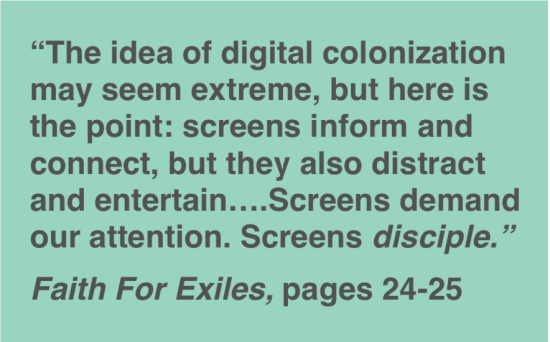
What accounts for such a mass exodus? Kinnaman, and his co-author Mark Matlock, argue that our culture is “especially and insidiously faith repellant.” The biggest culprit, they contend, is our smart devices, which have created a digital culture that actually works against us. As a result, believers are swimming upstream, fighting to maintain their values and their faith beliefs in a culture that is becoming increasingly opposed and in some cases hostile to these values and beliefs.

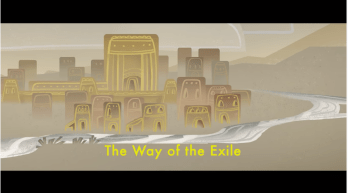
Click on the image to watch this short video from thebibleproject.com, which explains what exile is and how the theme of “exile” is woven throughout the Bible

The Old Testament highlights God’s promise that if His people followed Him and worshiped Him alone, they would prosper. But He warned them that if they were disobedient, He would bring judgment in the form of invading armies who would conquer them and take them into captivity. Much of the Old Testament is story after story of the nation of Israel forsaking God to pursue false gods. God continually sends prophets to warn them of impending doom but His message inevitably falls on deaf ears.

Click on the image to watch this short video from thebibleproject.com, which highlights what it was supposed to look like for the Israelites who were living in exile in Babylon and what it means for us as believers “living in exile.”

God finally hands his people over to the Babylonians, who take the Israelites into exile, where they live for 70 years in a foreign land, amidst a foreign culture that serves foreign gods and does not share their religious and cultural values. In fact, one of the goals of taking a conquered people into captivity was the systematic dismantling and eradication of their culture and the assimilation and adoption of the invading empire’s culture and values.

Imagine what it was like to be a Jew living in Babylon. How hard would it be to resist adopting the culture in which you’re thoroughly steeped, while trying to keep your own faith and religious views alive?

Young Adults spend an enormous time on their phones and the content is not always helpful to to maintaining a vibrant faith. Photo by KAL VISUALS on Unsplash

We haven’t been taken into captivity and we’re not living in a foreign land, as the Israelites did, but the authors make the case that the internet age in which we’re living has created what they refer to as “Digital Babylon.” A sobering graphic shows that the average 15-23 year old spends nearly 2800 hours in a typical year engaging with media on their phone. For the average 15-23 year old who is not a Christian, only 153 of those 2800 hours contain ANY kind of spiritual or biblical content. The Christian Young Adult fares only slightly better, with 291 hours of biblical content to offset the nearly 2800 hours of input they’re getting.

Our “smart” devices have created a digital environment that is slowly indoctrinating us to views and values that are contrary to our faith. This is what it means to live in “Digital Babylon”.

It’s not all bad news though. There is a segment of Young Adults, identified as “resilient disciples” who are thriving spiritually even in this current cultural context. The book is really about the practices of this group that enable them to maintain a vibrant faith. It turns out that we’ve already identified many of these practices as critical to thriving spiritually and as a result, we’ve already implemented many of these practices in our own ministry to Young Adults.

Our prayer is that our influence would increase and the Lord would show us new ways and avenues to impact Young Adults, who are seeking to live as resilient disciples in “Digital Babylon.”

We greatly appreciate your partnership and your prayers as we strive to this end!