Did Jesus Teach that You Need to be Baptized to be Saved?

John 3

1Now there was a man of the Pharisees named Nicodemus, a member of the Jewish ruling council. 2He came to Jesus at night and said, “Rabbi, we know you are a teacher who has come from God. For no one could perform the miraculous signs you are doing if God were not with him.”

3In reply Jesus declared, “I tell you the truth, no one can see the kingdom of God unless he is born again.

4“How can a man be born when he is old?” Nicodemus asked. “Surely he cannot enter a second time into his mother’s womb to be born!”

5Jesus answered, “I tell you the truth, no one can enter the kingdom of God unless he is born of water and the Spirit. 6Flesh gives birth to flesh, but the Spirit gives birth to spirit. 7You should not be surprised at my saying, ‘You must be born again.’ 8The wind blows wherever it pleases. You hear its sound, but you cannot tell where it comes from or where it is going. So it is with everyone born of the Spirit.”

9“How can this be?” Nicodemus asked.

10“You are Israel’s teacher,” said Jesus, “and do you not understand these things? 11I tell you the truth, we speak of what we know, and we testify to what we have seen, but still you people do not accept our testimony. 12I have spoken to you of earthly things and you do not believe; how then will you believe if I speak of heavenly things? 13No one has ever gone into heaven except the one who came from heaven—the Son of Man. 14Just as Moses lifted up the snake in the desert, so the Son of Man must be lifted up, 15that everyone who believes in him may have eternal life.

16“For God so loved the world that he gave his one and only Son, that whoever believes in him shall not perish but have eternal life. 17For God did not send his Son into the world to condemn the world, but to save the world through him. 18Whoever believes in him is not condemned, but whoever does not believe stands condemned already because he has not believed in the name of God’s one and only Son. 19This is the verdict: Light has come into the world, but men loved darkness instead of light because their deeds were evil. 20Everyone who does evil hates the light, and will not come into the light for fear that his deeds will be exposed. 21But whoever lives by the truth comes into the light, so that it may be seen plainly that what he has done has been done through God.” (John 3:1-21, NIV)


The Daily DAVEotional

A few weeks ago, I had an online encounter with a Mormon who, in his quest to explain the legitimacy and necessity of the Mormon church, made the claim that the Bible teaches that baptism is necessary for salvation.

One of the passages he referenced to back up his claim was this passage from John 3, where Jesus has a conversation with Nicodemus, a Pharisee who came to Jesus secretly at night.

I previously wrote on this same passage (John 3:1-8) in my blog post “The Born-Again Redundancy” but that post, while it expounded some on the conversation Jesus had with Nicodemus, never addressed the issue of baptism.

There’s a good reason why my previous post did not talk about the issue of baptism and that’s because neither the word nor the concept is found anywhere in the passage.

But since this passage was offered up as a proof text for the view that baptism by immersion with water (what I’ll from here on out refer to as “water baptism” or “baptismal regeneration”) is essential for salvation, it seems necessary and appropriate to comment on what Jesus is actually teaching in this passage.

If the words “baptism” and “baptize” are nowhere to be found within this passage, why would someone use this passage as “evidence” that Jesus taught baptism was necessary for salvation?

In short, I believe this passage is used as evidence by those who hold to the necessity of baptism for salvation simply because Jesus mentions water.


Click here to see a A Comprehensive List of Blog Posts Based on Bible Passage Reference


As I conversed with this Mormon acquaintance online, he noted that Jesus himself said that in order to enter the Kingdom of God, one must be born of water and the Spirit. He argued that when Jesus mentioned being “born of water” he was referencing the ordinance of baptism.

This conclusion is actually a perfect example of the theological error known as eisegesis, which means “to read into the text.”

What exactly does that mean?

When we read and study the Bible, our goal should be to understand what the author meant when he wrote what he wrote. We do our best to place ourselves in the context of the person living at the time the text was written and seek to understand what it would have meant to a person living within that culture at that specific time. This is known as exegesis, or “drawing out of the text.”

When we understand what the author’s original intent was, we can then understand how the original hearer of the text would have understood what they were reading and hearing. That is the original message we want to capture, understand and apply to our own situation.

But eisegesis functions in the exact opposite way. Instead of seeking to understand what the text meant to the original audience, the person imports their preferred meaning into the text and then declares that to be the teaching.

So in our case, it looks like this:

Jesus had a conversation with Nicodemus about how one enters the kingdom of God and Jesus said that a person must be born of water and the Spirit.

Even though Jesus says nothing about baptism and it’s unclear at first glance what it means to be born of water and what it means to be born of the Spirit, the person who holds to baptismal regeneration has already concluded that the passage is talking about baptism.

Since the conclusion is already determined, reasons justifying that conclusion are then produced. In this case, the passage has the term water in it and baptism requires water so it is argued that this passage must be speaking about baptism.

This line of reasoning utterly fails.

Not only does Jesus not say baptism is necessary for salvation, he doesn’t even mention baptism in this interchange.

So then what is Jesus saying?

I explain this more fully in my blog post “The Born-Again Redundancy” but Jesus is explaining to Nicodemus that just as a person is born physically which leads to physical life, so a person must be born spiritually in order to experience spiritual life, or life in the kingdom of God.

Jesus himself explains what is meant by the phrase “being born of water and the Spirit” when he says just a few verses later that “flesh gives birth to flesh but the Spirit gives birth to spirit.”

It’s clear that being born of water refers to physical birth while being born of the Spirit refers to a spiritual birth. According to Jesus, both are necessary for salvation. In reality, everyone who has ever existed has already experienced physical birth just by being born.

So then, what is necessary to enter the kingdom of God is to experience a spiritual birth. This is the entire point Jesus is making to Nicodemus – to enter the kingdom of God, you must experience a spiritual birth.

The natural question then is “how does one experience a spiritual birth?”

Notice that as Jesus continues his discourse with Nicodemus, he does not mention baptism as a condition for salvation (spiritual birth). In fact, baptism is not mentioned anywhere in the passage.

What Jesus DOES mention as necessary for salvation, multiple times in fact, is BELIEF.

Specifically, in verse 15, Jesus says “that everyone who believes in him [Jesus] may have eternal life.”

Again, in verse 16, one of the most famously quoted verses in the entire Bible, Jesus says “that whoever believes in him [Jesus] shall not perish but have eternal life.”

So what is the verdict?

Concerning the charge that Jesus taught that baptism was/is necessary for salvation, the charge is false. Jesus did not teach that in this passage. Instead, he taught that a spiritual birth is necessary in order to know God and experience life in his kingdom. Jesus, as well as the other New Testament authors, taught that this spiritual birth comes as a result of BELIEF in the person and the work of Jesus on the cross.

To examine this issue further, see the following related posts:


Did you enjoy this post? I’d love to hear your thoughts! Feel free to like, leave a comment below, and share it with your friends or on social media if you found it helpful or interesting. Your support keeps the conversation going!


Reflection

What are some examples you have seen of eisegesis – when a person imports their doctrine or theological preference upon a text that doesn’t appear to be teaching that doctrine or idea at all?

If you believe that Jesus, in this passage, is talking about the importance of baptism to Nicodemus, what reasons do you have to support that interpretation?

Jesus told Nicodemus that in order to see the kingdom of God, a person must be “born again”. What do you think it means to be “born again?” How do you understand that phrase?

It’s clear that Nicodemus falsely understood Jesus’ term “born again” to be referring to a 2nd physical birth. Jesus corrects him and explains that he’s talking about a spiritual reality that must take place. Based on this passage, what does Jesus teach about how a person experiences this spiritual birth?

Have you personally experienced a spiritual birth? If not, what keeps you from taking that step?

If you want to learn more about experiencing a “spiritual birth” and experiencing eternal life and life in the kingdom of God, read my blog post “Four Points to Understand How to Experience Eternal Life.”


Photo by Daniel & Hannah Snipes: https://www.pexels.com/photo/outdoor-baptism-ceremony-in-south-carolina-30477080/
FOUR POINTS TO UNDERSTAND HOW TO EXPERIENCE ETERNAL LIFE

What do you think happens after we die?

Most people believe in an afterlife, such as the Christian concept of heaven. But, assuming heaven exists, how does one get there?

In my thousands of conversations with people, I’ve found that people overwhelmingly believe that if they were to die, they would make it into heaven. However, when asked the question,

What is God’s criteria for deciding who makes it into heaven?

Most people I’ve conversed with don’t know.

To me, that’s a bit like studying for a final exam without having any idea what is going to be on the exam.


Read this article “How Do You Prepare for God’s Final Exam” for a fuller explanation of this idea.


The Bible tells us that God’s plan from the beginning was that we would know Him and experience life in His presence. Man freely interacted with God and it was good.

Genesis 1:29-31 gives a picture of God’s initial creation:

27So God created man in his own image,
in the image of God he created him;
male and female he created them.
28God blessed them and said to them, “Be fruitful and increase in number; fill the earth and subdue it. Rule over the fish of the sea and the birds of the air and over every living creature that moves on the ground.”
29Then God said, “I give you every seed-bearing plant on the face of the whole earth and every tree that has fruit with seed in it. They will be yours for food. 30And to all the beasts of the earth and all the birds of the air and all the creatures that move on the ground—everything that has the breath of life in it—I give every green plant for food.” And it was so.
31God saw all that he had made, and it was very good.


POINT 1: GOD’S PLAN

GOD LOVES YOU AND CREATED YOU FOR A PURPOSE

God’s Love

The Bible is clear that one of God’s attributes is love.

1 John 4:8-9 says:

Whoever does not love does not know God, because God is love. This is how God showed his love among us: He sent his one and only Son into the world that we might live through him.

God demonstrated His love by sending His Son Jesus into the world to ultimately die on our behalf.

God’s Purpose

In John 10:10 (NLT), Jesus gives a glimpse into his purpose. He said:

The thief’s purpose is to steal and kill and destroy. My purpose is to give life in all its fullness.

Jesus came so that we might experience life in all its fullness – that we would begin to fulfill the purpose for which we’ve been created, which is to know Him and experience His presence in our lives.


REFLECT
What do you think it means to experience life in all its fulness? What would that look like?


“Fullness of Life” Expanded

Here’s another way to think about it. When Jesus says that His purpose is to give “life” in all its fulness, He’s talking about giving eternal life.

In John 17:3 (NIV), Jesus said this:

Now this is eternal life: that they may know you, the only true God, and Jesus Christ, whom you have sent.

Jesus defines eternal life as knowing God – experiencing a relationship with Him. Therefore, when Jesus says His purpose to give life in all its fullness, what He’s saying is that He has come to offer people a relationship with Him (life) and He wants people to experience that relationship to the fullest extent possible.


REFLECT
Why do you think people are not experiencing life in all its fullness? What keeps them from knowing God?


POINT 2: OUR PROBLEM

WE’VE REBELLED AGAINST GOD AND ARE THEREFORE SEPARATED FROM HIM. AS A RESULT, WE CANNOT EXPERIENCE HIS PURPOSE FOR OUR LIVES, WHICH IS TO KNOW HIM.

The Fall – the Original Rebellion

According the Bible, God’s good creation was distorted when man disobeyed God and was exiled from God’s presence. Genesis 3 tells the story of the fall of mankind (Read Genesis 3).

Adam and Eve freely interacted with God, who had given them free reign over the entire garden. They took care of it and they were given every seed-bearing plant for their food. However, there was one tree they were forbidden from eating – the fruit from the tree of the knowledge of good and evil.

Adam and Eve were deceived by the serpent (Satan) to eat this forbidden fruit. Because of their disobedience, God banished them from the garden.


Have you ever wondered why God forbade Adam and Eve from eating from that one particular tree? Was it random? Or was there a reason why that specific tree was off limits. Read this article (Why Did God Forbid this One Fruit?) to understand why this particular tree was off limits.


The rest of the Bible is the story of God’s plan to restore man’s relationship with Him and to reverse the curse that was inflicted upon creation as a result of this original sin.

The Results of Sin

It’s at this point that one might argue that we should not be punished for Adam and Eve’s rebellion. But the Bible is clear that EVERYONE has sinned against God.

Romans 3:23 says:

For all have sinned; all fall short of God’s glorious standard. (NLT) [Emphasis added]

But I’m a Good Person

In my experience, I’ve found that most people tend to think of themselves as “good”.

In our society goodness and badness are relative terms that are used in comparison to other people. I’ve found that most people consider themselves to be good because they compare themselves to others who, in their mind, have done more egregious and heinous acts. But comparing ourselves to other people is using the wrong standard of comparison.

The Bible says that only God is truly good. What this means is that God’s standard for goodness is perfect holiness and by this standard, He is the only one who is truly good.


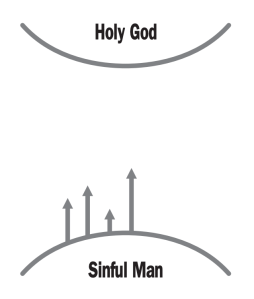
Notice the diagram to the right. God is holy and man is sinful and there’s a great chasm that separates man from God. The arrows illustrate that man continually tries to reach God through various efforts, such as religion, good works, etc. But all of these efforts ultimately fall short because God is perfectly holy, and there is no amount of good works that will enable man to achieve God’s standard of perfection.

Here is a short article (What is Your Definition of Good?) that explains how God defines “good”.


REFLECT
How does your definition of goodness compare or contrast with what the Bible says about goodness?


What is Sin?

The word “sin” is one of those churchy, religious words that many people associate with behaviors that others don’t approve of but we think is no big deal. For example, you may see nothing wrong with drinking while some “uptight, religious people” think drinking is a “sin”.


REFLECT
How do you define sin? What do you think sin is?


Sin Explained

Photo by Annie Spratt on Unsplash

Sin not just a list of immoral or socially unacceptable behaviors. When Romans 3:23 says that “all have sinned”, the Greek word for sin is actually an archery term.

In a competition, the archer would shoot the arrow and the goal was to hit the bullseye on the target. If the archer missed the bullseye, even if it was only by a fraction of an inch, it was considered an imperfect mark, which was called a sin.

So when the Bible says we’ve all sinned, it means that no matter how hard you’ve tried and no matter how good you think you are, you (and all people) have missed the mark of God’s standard, which is perfect holiness.

That raises the bar quite a bit doesn’t it?

Things are complicated by the fact that God is not only perfectly holy, but He’s perfectly just, and as a result, He must punish sin. He cannot just overlook it or ignore it. Sin is a violation of the very nature and character of God and His goodness, so sin must be punished.

According to Romans 6:23, the punishment, or penalty for sin is DEATH!

For the wages of sin is death, but the free gift of God is eternal life through Christ Jesus our Lord.

You might be thinking, “well we’re all going to die so what does it matter?”

Death here refers to being separated from God. So, the result of sin, or the punishment for sin is that we will experience a separation from God, FOR ETERNITY! This is literally what hell is – the complete absence of God and everything good.


POINT 3: GOD’S PROVISION

JESUS CHRIST PROVIDES THE ONLY SOLUTION TO MAN’S SIN.
Through Jesus, the barriers that kept us from experiencing God’s purpose have been removed – we now have access to God and can know Him.

If everyone has sinned and God, in His justice, must punish sin, then it seems as if there is no solution to our problem. We are all seemingly doomed to punishment!

But God, in His goodness, creates a solution that only He can provide. The solution is in His son Jesus.

Christ Died for Us

Romans 5:8 says,

But God showed his great love for us by sending Christ to die for us while we were still sinners.


REFLECT
If God can forgive sin, why couldn’t he just declare it to be forgiven?
Why do you think Jesus had to die to pay for sin?


Why did Jesus Have to Die?

Why do you think Jesus had to die in order to pay for sin?

Jesus had to die to pay for sin because God’s justice demands that the only valid payment for sin is death.

For the wages of sin is death…Romans 6:23

Jesus died in our place, thus paying the penalty that God’s justice demanded (death) but doing it in a way that allows humankind to avoid the penalty.

The reason that Jesus could do this is because He is God. As God, He has the very righteousness that God requires for those who wish to come into His presence. Through Jesus’ death, we can be forgiven for our sins and not only avoid the penalty for sin, but experience a relationship with God!

Colossians 1:13, 14 says,

For he has rescued us from the one who rules in the kingdom of darkness, and he has brought us into the Kingdom of his dear Son. God has purchased our freedom with his blood and has forgiven all our sins.

Christ Rose from the Dead

Not only did Jesus die for us, but the Bible says that He rose from the dead.

1 Corinthians 15:3-6 states:

For what I received I passed on to you as of first importance: that Christ died for our sins according to the Scriptures, that he was buried, that he was raised on the third day according to the Scriptures, and that he appeared to Peter, and then to the Twelve. After that, he appeared to more than five hundred of the brothers at the same time,


REFLECT
If Jesus had never risen from the dead, would it make any difference?
What do you think is the significance of the resurrection?


Read this article, He is Risen….Why Does it Matter? to understand the significance of the resurrection to the Christian message.


Jesus is the Only Way to God

In John 14: 6, Jesus says:

“I am the way and the truth and the life. No one comes to the Father except through me.”

Notice that He doesn’t say, “I’m one of the ways, I’m one of the truths, I’m one of the lives. There are lots of ways to get to the Father, but I’m a pretty good way, so check me out, I’m cool!”

NO!

He says, “I am the way, the truth, and the life; no one comes to the Father, but through Me.”

He could say this because He is the only one who has made a valid payment for sin. Hence, only Jesus can take away our sin.

The image above demonstrates that God realized that man could not bridge the gap that separated them because of man’s sin. The distance is too wide. If you think about it, God is infinitely holy so the gap between His holiness and man’s is an INFINITE gap!

Because we could not bridge the gap ourselves, God bridged the gap for us. He sent His son Jesus, who is INFINITELY holy and righteous. Jesus’ death bridges the gap and creates a path for people to come into God’s presence and experience a relationship with Him.


POINT 4: OUR RESPONSE

We each must receive the free gift that Jesus offers – His death as payment for our sins. Only then can we experience His purpose, which is to KNOW Him.

Knowing this information doesn’t make a person a Christian. Even if you agree with everything that has been outlined so far, it doesn’t mean you are a Christian.

What makes a person a Christian is when they respond to the invitation of Jesus to accept Him and His death as a free gift that pays for your sin and provides complete forgiveness.

John 1:12 (NLT) says,

But to all who believed him and accepted him, he gave the right to become children of God.

If you want to become a Christian (a child of God), then you must believe in Jesus and accept Him.


REFLECT
What do you think it means to accept Jesus?


We Receive Christ Through Faith

Ephesians 2:8, 9 (NIV) says,

For it is by grace you have been saved, through faith—and this not from yourselves, it is the gift of God— not by works, so that no one can boast.

Accepting Him simply means you accept the free gift that He offers of being saved by His death on the cross. It means that you acknowledge that His death alone can pay for sin and you put your trust in His death to provide forgiveness instead of trusting in your own good works to earn favor with God.

We Receive Christ by Personal Invitation

In Revelation 3:20, Jesus gives this invitation:

Here I am! I stand at the door and knock. If anyone hears my voice and opens the door, I will come in and eat with him, and he with me.


REFLECT
What do you think the door represents in this verse?
How do you think a person opens the door?


Opening the Door

The door represents your heart (your will). Jesus is inviting you to open yourself up and let Him in. The way you do that is simply by putting your trust in Jesus and His death to save you instead of trusting in your own perceived goodness to “earn” your way into heaven.


KEY QUESTIONS:

Have you ever opened the door of your life and let Jesus in to begin a relationship with Him?

If so, when was that? What were the circumstances that led you to make that decision?

If not, do you want to open the door of your life to Jesus and begin a relationship with Him?


Photo by Jan Tinneberg on Unsplash

Opening the Door 2

The key to opening the door is to decide to put your trust in Jesus instead of trusting yourself. One way you can express your faith to God is simply telling Him that you want to accept His free gift and you want Jesus to come into your life. We call this prayer. Take a minute right now to express your faith and desire for Jesus to come into your life by repeating the following prayer:

Lord Jesus, I need you. I acknowledge that I am a sinner and there is no way I can earn my way into heaven. I want to trust in Jesus and His death to pay the penalty for my sins and provide forgiveness. I open the door of my life now and I invite Jesus to come in so that I might begin a relationship with Him and know Him. Amen.


Things to Remember…

God’s criteria for who makes it into heaven is not how good you are but whether you have the Son (Jesus).

And this is the testimony: God has given us eternal life, and this life is in his Son. He who has the Son has life; he who does not have the Son of God does not have life. (1 John 5:11-12, NIV)

You can KNOW you have eternal life, if you have the Son.

Jesus defined eternal life as knowing Him (John 17:3). Hence, you can have eternal life if you have the Son – if you have a relationship with Him.

You can have the Son (Jesus), simply by accepting Him and the free gift that He offers – His death on the cross as a payment for all of your sins.

Jesus gives an invitation to everyone. He is standing at the door of each person’s heart. He’s knocking. He wants to come into your life and begin a relationship.

But we have to open the door.

Opening the door is a matter of choosing to put our trust in Jesus instead of trusting in our own goodness. It means that we acknowledge that we have sinned and we cannot earn our way to God. We recognize that Jesus ALONE can pay for sin and we accept the free gift of His death as a payment for our sins.

When we make that decision to open the door to Jesus, we experience complete forgiveness of sin and Jesus enters our life, establishing a relationship with us.

Once we have the Son (Jesus), we have the life, which is defined by Jesus as knowing Him.


QUESTIONS FOR REFLECTION

1.    Did you open the door an invite Jesus into your life?

2.    Where is Jesus right now in relation to you?

3.    After a person receives Christ, what do you think a person has to do in order to keep Jesus in their life? What do you think is required?

4.    What questions do you have about the Christian faith?


WHAT NOW?

If you prayed that prayer to invite Jesus into your life, the Bible says that you are a new creation. You are now a child of God!

You can request some free resources and next steps by going to our Prayer Page, giving us your name and writing in the box, “I received Christ and would like to know how to begin growing in my new faith.”

We will respond to you with some resources and help to take some next steps.

Is it Unbiblical to Teach That Salvation is About “Accepting Jesus”?

John 1

10But although the world was made through him, the world didn’t recognize him when he came. 11Even in his own land and among his own people, he was not accepted. 12But to all who believed him and accepted him, he gave the right to become children of God. 13They are reborn! This is not a physical birth resulting from human passion or plan—this rebirth comes from God. (John 1:10-13, NLT)


The Daily DAVEotional

I’ve been a Christian for a long time and ever since I can remember, I was told that becoming a Christian, or getting “saved” was simply a matter of “accepting” Jesus into your heart.

Not too long ago, I saw the above photo from one of my Facebook friends who regularly shows up in my feed. I respect Voddie Baucham as a teacher so I was curious about the context of the quote that seems to indicate that the idea of “accepting Jesus” is unbiblical.

Is it true that the New Testament nowhere mentions salvation being about “accepting Jesus”?

I think the short answer to that is NO.

John 1:12 is the most clear verse that would challenge that assertion as John states:

But to all who believed him and accepted him, he gave the right to become children of God. [emphasis added]

Now to be fair, my Scripture reference is from the New Living Translation (NLT) which is the only translation I’m aware of that uses the phrase “accepted him.” Most other translations, including the NIV, King James, NASB, ESV and others, all use the phrase “received him“. So I suppose it’s possible, if you exclude the NLT, that one could argue that the Bible doesn’t say anything about “accepting Jesus” when it comes to salvation.

In my mind, though, this could be considered theological nit-picking. It seems apparent to me that the words “accept” and “receive” are synonyms. So why make the argument that salvation has nothing to do with “accepting Jesus”?

Honestly, I could not find a link to the sermon in which Dr. Baucham made the quoted statement, so it’s hard to know exactly what he’s getting at or why he felt compelled to make the statement in the first place.

The problem sometimes with sound-bite quotes is that you don’t always get the context and so the quote can appear to be saying something entirely different than what the author was really intending to communicate.

I can say, however, that in my many years of ministry, this is not the first time I have heard someone make a statement like this. So I’ll address the statement as I’ve heard it shared from others, not necessarily from Dr. Baucham’s perspective, which, as I’ve stated, I was not able to clearly determine.

In my experience, the argument that salvation is not about just “accepting Jesus” is often made by those who are seeking to address the problem of spiritual mediocrity within the church.

An overwhelming number of people claim to be Christians and yet, as we look around at the landscape of our culture, it’s hard to imagine that there are really that many people who legitimately ARE Christians. In other words, the lifestyles of most people do not seem to indicate that most people are indeed Christians.

So what is the problem?


Click here to see a A Comprehensive List of Blog Posts Based on Bible Passage Reference


Some people would argue that a major problem is in our evangelistic message – that we are not calling people to repentance but instead, we’re peddling a soft message that requires little to no commitment. Note that Dr. Baucham’s quote appeals to the need to “repent and believe.”

The argument is that if we tell people that salvation is simply a matter of “accepting Jesus” into their life, we’re giving them the impression that being saved is merely a verbal transaction where, if we say the right words, and “ask Jesus into our hearts”, we can escape the punishment of hell and then go on our merry way doing whatever we were doing.

This kind of approach, the argument goes, lacks commitment and ultimately is not transformational. Instead of producing mature believers whose lives reflect Jesus, it produces worldly people who think of themselves as Christians simply because they said “the sinner’s prayer.”

The oft-suggested solution to this perceived problem is to refrain from telling people that salvation is about “accepting Jesus” and instead, communicate that it’s about a higher level of commitment that requires repentance.

As I see it, there are two problems with this solution.

The first problem is that the idea of “accepting Jesus” logically includes the idea of repentance.

Repentance literally means to turn and change direction. One cannot legitimately accept Jesus while maintaining the view that they can earn their salvation through their own good works.

Accepting Jesus is NOT just saying some prescribed prayer. It requires an attitude of humility that recognizes we fall short because of our sin and that Jesus is the ONLY one who can offer forgiveness through His shed blood on the cross.

Accepting Jesus, or receiving Christ, means that we accept the free gift of salvation that Jesus offers to all people. How do we do this? Ephesians 2:8-9 says that we do this by faith.

What that means is that I literally change direction (repentance). Instead of my former course where I trusted in my own good works to earn God’s favor, I now choose a new course, where I place my trust in Jesus alone to provide forgiveness and to save me from the penalty of my sins.

There’s a second problem with the solution of saying we should refrain from saying that salvation is about “accepting Jesus”. The second problem is that even if we were to stop talking about “accepting Jesus” and even if we were to convince everyone to use the different language of “repent and believe” in our evangelistic presentations, there is no reason to believe that the outcome would be any different than it already is.

The reason for this is because spiritual mediocrity in the church is largely a reflection of the hearts of people rather than the specific wording of the evangelistic messages that are being promoted.  Mark 4 tells us that there are 4 different soils that represent the different heart attitudes of people who hear the message of the gospel. (See my blog post: Which Soil Are You?)

Sharing a message of “Repent and Believe” to a person who has a hard heart, rocky heart or thorny heart is likely to yield the same result as sharing a message of “Accept Jesus”. Regardless of the specific verbiage of your message, the outcome will be the same, because it is already determined by the heart condition of the hearer.

Please note that I’m not saying that our evangelistic message and approach doesn’t matter. Our message should be biblically correct. However, the idea that one biblical approach  will produce better results than another, equally biblical approach is wishful thinking and places too much emphasis on the sower for the results.

There is no silver bullet message or approach that will guarantee the hearer will become a fruitful Christian.

In addition, since we know that spiritual mediocrity among professing believers has been a problem since the outset of the church, it stands to reason that it’s an issue of discipleship more than evangelism. The issue was addressed repeatedly in the New Testament and has been a source of controversy for 2000 years. We’re not likely to see a change in this phenomenon, though we should certainly do our best to disciple believers to maturity, just as the apostles did.

(See my blog post: Why Some Christians Never Grow)

The most important thing we can do when communicating with a non-Christian is to give a clear and understandable explanation of what Jesus is offering. (See my blog post: What Does it Look Like to Follow Jesus?)

I think it’s clear that linking salvation to the idea of “accepting Jesus” is not unbiblical, as long as we help the hearer understand that accepting Jesus involves repenting of our sins and believing in Jesus as our one and only Savior.


Did you enjoy this post? I’d love to hear your thoughts! Feel free to like, leave a comment below, and share it with your friends or on social media if you found it helpful or interesting. Your support keeps the conversation going!


Reflection

What has been your understanding of the idea that people must “accept Jesus” in order to be saved? What are they accepting?

What do you think are the main reasons why some Christians don’t grow? How should we change our evangelistic approach to ensure greater fruitfulness among believers?

Do you agree with the statement by the author of this blog that mediocrity among professing Christians is more a result of discipleship than evangelism? What are your reasons for agreeing or disagreeing?

How can we disciple others to greater levels of maturity and fruitfulness? What steps can be taken? What resources do you think are needed?


Photo is a screenshot from a Facebook post at Voddie Baucham’s Facebook Page (https://www.facebook.com/photo/?fbid=10221114209364128&set=a.1532880861226)

A Spiritual Milestone

50 years ago TODAY (June 9, 1974), I went forward in response to an altar call at the end of the Sunday morning service of Beaty Avenue Baptist Church in Whittier, California. After attending church for 6 months with my family, I responded to the pastor’s invitation for anyone to come forward if they wanted to respond to Jesus’ free gift of salvation.

As a kid, it was one of the scariest things I ever did, as I could feel all eyes staring at me as I made the trek out of the pew, into the outer aisle and toward the front of the church sanctuary. I slowly walked to the front while everyone was still  singing what was commonly known as “the hymn of invitation.”.

When I arrived at the front, I was greeted by an older gentleman who escorted me into a private room in the back where he shared this little gold booklet with me called “the Four Spiritual Laws.” Little did I know that years later, I would end up sharing that same booklet with thousands of people as a missionary.

I recognized that I was a sinner and that Jesus had died on a cross to pay the penalty that I deserved for sin. I invited Jesus to come into my life, forgive me for every wrong thing I ever did or ever would do and begin the spiritual journey for which I had been created – to KNOW Him.

That evening, at the Sunday evening service (yes, old time baptist churches often had Sunday evening services, as well as mid-week Wednesday night services), I was baptized, along with my two brothers.

I remember that day because it was the same weekend as my mother’s birthday, which was yesterday. She would be 84 years old if she were still alive.

We only attended that church for about a year before moving to another church. That old Beaty Avenue Baptist church building is still there, though it is home to a different church.

Here is a photo of myself from that time frame. I have very few photos of me growing up as most of my childhood photos were destroyed in a house fire in 2000. This photo was taken about a year before the events I describe above.

Photo taken at what used to be known as East Norwalk Little League off Shoemaker in Norwalk, CA. According to current Norwalk Little League website, this field is the Zimmerman Field that is part of current Norwalk Little League.

Also included is a Google street view photo of the church that used to be known as Beaty Avenue Baptist Church.

Google Street view of church building that at one time was Beaty Ave. Baptist Church in South Whitter, CA

I don’t remember the name of the person who shared with me in that back room, though somewhere in a box at my house, I have that very booklet with a phone number written on the back.

I’m grateful for the many people who played a role in me making a decision on that day, including my parents, Sunday school teachers, the pastor of that Beaty Avenue Baptist church and the gentleman who shared the gospel message with me in that private room.

Life changed on that day in June of 1974. Real life actually began on that day!

A Biblical Gospel Presentation in ONE Six-verse Passage

Titus 3

3Once we, too, were foolish and disobedient. We were misled by others and became slaves to many wicked desires and evil pleasures. Our lives were full of evil and envy. We hated others, and they hated us.

4But then God our Savior showed us his kindness and love. 5He saved us, not because of the good things we did, but because of his mercy. He washed away our sins and gave us a new life through the Holy Spirit. 6He generously poured out the Spirit upon us because of what Jesus Christ our Savior did. 7He declared us not guilty because of his great kindness. And now we know that we will inherit eternal life. 8These things I have told you are all true. I want you to insist on them so that everyone who trusts in God will be careful to do good deeds all the time. These things are good and beneficial for everyone. (Titus 3:3-8, NLT)


The Daily DAVEotional

Have you ever tried to share your faith with another person? What do you say? How do you go about it?

There are a number of great evangelism tools that have been created over the years to help Christians share the message of Christ to others. There’s the Roman’s Road, the Navigator’s “Bridge to Life” and of course, the old school “Four Spiritual Laws.”  (a tool I was trained in)

There are quite a number of newer resources as well, such as The Four Circles by James Chuong, or The Three Circles by Jimmy Scroggins, both of which emphasize sharing the message graphically over sharing a predominantly written narrative.

However, if you want ONE biblical passage from which you can share the gospel message, this passage from Titus 3 is a good choice. Just about every relevant point needed to share the gospel with another person is covered in these six verses. Here’s the summary of what Paul shares:

Our Problem – We were sinners

Many gospel presentations highlight our sinful condition, or in some cases, our brokenness. Paul too highlights our sinful state in verse 3:

Once we, too, were foolish and disobedient. We were misled by others and became slaves to many wicked desires and evil pleasures. Our lives were full of evil and envy. We hated others, and they hated us.

Notice the words and phrases Paul uses to describe us:

    • foolish and disobedeint
    • misled by others
    • slaves to many wicked desires and evil pleasures
    • lives that are full of evil and envy
    • hatred towards others

Paul could have just said we were sinful and alienated from God, but instead, he paints a robust picture of the depth and root of our alienation – it comes from our wicked desires and evil nature, which leads to disobedience and ultimately, enmity towards others. In other words, our rebellion is extensive. It doesn’t just affect our relationship with God; it affects our relationships with others as well!

God’s Solution – Jesus Saved Us

Paul spends 4 verses explaining that God saved us from our rebellious condition. These 4 verses are PACKED with information about the nature of God and what He’s done for us. He says:

4But then God our Savior showed us his kindness and love. 5He saved us, not because of the good things we did, but because of his mercy. He washed away our sins and gave us a new life through the Holy Spirit. 6He generously poured out the Spirit upon us because of what Jesus Christ our Savior did. 7He declared us not guilty because of his great kindness. And now we know that we will inherit eternal life.

First and foremost, salvation is rooted in the nature of God. Paul says that God showed us His kindness and love. Salvation is not based on our good works, but because of God’s mercy. Mercy is when something bad that we deserve is withheld. In this case, we deserve punishment, but because God is merciful, he saves us from judgment.

Second, Paul says that salvation involves forgiveness. Verse 5 says that our sins have been washed away, which is another way of saying that our sins have been paid for.

Salvation also involves new life through the Holy Spirit, who has been generously poured out on us.

Lastly, Paul says that salvation involves justification, which simply means that we are declared righteous, or “not guilty”. Because we are no longer under judgment for our sin, Paul says that we can KNOW that we will inherit eternal life.

Our Response

Verse 8 highlights our response. If we want to experience these benefits, Paul says we simply need to trust what Jesus has done for us.

These things I have told you are all true. I want you to insist on them so that everyone who trusts in God will be careful to do good deeds all the time. These things are good and beneficial for everyone.

Interestingly, Paul mentions trusting in God, not Jesus. But it’s clear from this passage (specifically verses 4 and 6) that Jesus IS God. I previously wrote about this in my blog post, “Further Evidence that Jesus is God.” Please read that post for a more detailed explanation of how we know that Jesus is God from this passage.

What I love about these 6 verses is that it hits all the main points you typically would want to share when presenting the gospel to another person:

    • We are sinful and alienated from God and others (verse 3)
    • We are slaves to our sinful desires – hence we cannot help ourselves (verse 3)
    • God is kind, loving and merciful (verses 4, 7)
    • Salvation is not based on our good works but based on God’s kindness, love and mercy (verse 5)
    • Our sins have been forgiven and we’ve been declared “not guilty” (verses 5, 7)
    • We’ve been given new life through the Holy Spirit (verse 5)
    • Salvation is based on what Jesus did for us (verse 6)
    • We can KNOW that we have eternal life (verse 7)

Of course there are shortcoming with using these 6 verses alone, just as almost any short evangelistic presentation is incomplete on its own. As much as these 6 verses outline the basic gospel message, we know that the fullest expression of the gospel includes the greater context of God’s original design, the nature and scope of the fall as well as God’s redemptive plan to restore His creation.

The Bible takes a full 66 books to outline the full redemptive narrative.

With that in mind, no five, ten or even thirty minute presentation can share everything that is written in the Bible regarding God’s redemptive plan. But these tools are useful in giving a person a basic framework for the Biblical story and introducing them to a relationship with God.

By highlighting these 6 verses in Titus, I don’t mean to imply that the evangelism tools mentioned at the outset are deficient or ineffective. All of them have actually proven to be helpful and beneficial to many Christians.

However, this passage from Titus is simply a different approach one might use. Instead of being based on a written or graphical presentation, it’s based on ONE six-verse BIBLICAL passage that can be easily shared with anyone.

Reflection

What has been your practice or habit in sharing the gospel with others? What tools or gospel outlines do you use? What do you like about that tool? 

What do you think are the relevant points that must be shared in any gospel presentation?

When you think of the main ideas that must be shared when presenting the gospel, which ones are covered by this passage in Titus? Which ones are missing?

What do you see as the main advantages of using this passage as a gospel presentation outline? What are some reasons why you might prefer not to use this passage?

Which of the statements that Paul uses to describe our condition (foolish, disobedient, slaves, etc.) resonate with you the most? Explain.


Photo by Jon Tyson on Unsplash

Can Revelation 3:20 be Used in Evangelism to Non-Christians?

Revelation 3

14“To the angel of the church in Laodicea write:

The Amen, the faithful and true Witness, the Beginning of the creation of God, says this:

15‘I know your deeds, that you are neither cold nor hot; I wish that you were cold or hot. 16‘So because you are lukewarm, and neither hot nor cold, I will spit you out of My mouth. 17‘Because you say, “I am rich, and have become wealthy, and have need of nothing,” and you do not know that you are wretched and miserable and poor and blind and naked, 18I advise you to buy from Me gold refined by fire so that you may become rich, and white garments so that you may clothe yourself, and that the shame of your nakedness will not be revealed; and eye salve to anoint your eyes so that you may see. 19‘Those whom I love, I reprove and discipline; therefore be zealous and repent. 20‘Behold, I stand at the door and knock; if anyone hears My voice and opens the door, I will come in to him and will dine with him, and he with Me. 21‘He who overcomes, I will grant to him to sit down with Me on My throne, as I also overcame and sat down with My Father on His throne. 22‘He who has an ear, let him hear what the Spirit says to the churches.’”  (Revelation 3:14-22, NASB)


The Daily DAVEotional

I recently wrote about how this message to the church at Laodicea might be the most well-known of the seven messages in Revelation 2 and 3 because it’s the origin of the phrase “lukewarm Christian”. You can read my post here.

But there’s another reason why this passage may be the most well-known of the seven church messages. In Revelation 3:20, Jesus is famously quoted as saying,

Behold, I stand at the door and knock; if anyone hears My voice and opens the door, I will come in to him and will dine with him, and he with Me. (NASB)

This particular verse has been used by many Christians around the world, in tracts and evangelistic presentations, to invite those who don’t know Christ to respond to Jesus’s offer of salvation.

“Jesus wants to begin a relationship with you”, the Christian might say to the non-Christian. “He’s standing outside the door of your life and He’s knocking. He wants to come in. But you have to open the door.”

I myself have used this verse with thousands of people as I’ve shared the gospel with them, inviting them to respond to God’s offer of love and forgiveness. I’ve echoed these exact words more times than I can count.

But there’s a potential problem with using this verse in an evangelistic setting.

A few years ago I was taking an online theology course. The professor wanted to create a virtual dialogue, so part of the grade required students to respond to discussion questions he posted online. In order to gain full credit, students were required to respond thoughtfully to each discussion question AND we were also required to respond at least one time to another student’s post. These responses created a sort of “class discussion” but in an online thread.

I vividly remember engaging in a robust exchange with another student who argued that because the message to the church at Laodicea was a message to believers, Revelation 3:20 could not be used as an invitation to non-Christians. In other words, it was argued that Jesus’s invitation in Revelation 3:20 was an invitation for Christians who were worldly to get right with God; it was not an invitation for non-believers to enter into a relationship with God.

It created a very lively class discussion, especially since many of us in the class had been trained to share our faith with others using tracts and presentations that used Revelation 3:20 in precisely the way our classmate was arguing against.

Is what this other person shared true? Are all the evangelistic tracts that utilize Revelation 3:20 as an invitation for non-believers to invite Jesus to come into their life theologically incorrect?

There is no doubt that when Jesus was talking to the church at Laodicea, He was addressing real churches that existed at that time. Therefore we must assume that they were believers.

HOWEVER, just because Jesus was addressing Christians does not mean that we can only quote Revelation 3:20 when we are talking to other Christians.

The truth is that Jesus died for EVERYONE. We all know this. John 3:16, perhaps the most popular verse in the whole Bible, clearly states “For God so loved THE WORLD…” (emphasis mine)

In addition, in 2 Peter 3:9, Peter says, “The Lord is not slow in keeping his promise, as some understand slowness. He is patient with you, not wanting anyone to perish, but EVERYONE to come to repentance.” (NIV, emphasis mine)

Many more verses demonstrate God’s desire for ALL people to come to know Him, including Mark 10:45, Luke 19:10, John 10:10 and 1 Timothy 4:10.

Consequently, since Scripture teaches that God’s desire is for ALL people to be in an intimate fellowship with Him (not just Christians), it is appropriate to use Revelation 3:20 with non-believers, even though it was initially written to a group of believers.

As Dr. Thomas Constable says in his Bible notes on Revelation 3:20;

“This verse expresses a truth taught elsewhere in Scripture, namely, that Jesus Christ desires intimate fellowship with all people (cf. Song 5:2-6; Mk 10:45; Lk 19:10; Jn 10:10; 1Ti 4:10). Consequently, I believe it is appropriate to use it in evangelism. It expresses God’s universal desire very graphically, by way of application, not interpretation.”

In other words, the imagery of Revelation 3:20 expresses a truth that can be applied beyond the context for which it was written. Since we know from Scripture that God’s desire is for intimate fellowship with ALL people, the image conveyed in this verse can be extended beyond the initial context.

Reflection

What has been your experience with evangelistic conversations?

Do you think it is wrong to use Revelation 3:20 in an evangelistic conversation? Why or why not?

If you believe that Revelation 3:20 should not be used when sharing the gospel with others, how would you go about sharing God’s desire to enter into a relationship with the non-believer?

What illustrations could you use to graphically illustrate to a non-believer that God desires to come into their life but it is their decision to let Him in?


Photo by valérie faiola on Unsplash

There’s an App for That!

Can you believe it’s been 17 years since the iPhone was introduced? Technically, the iPhone is not considered the first smart phone. That distinction belongs to a phone designed by IBM in 1992 called the Simon Personal Computer (SPC), which was released in 1994. It’s considered the first smart phone because it was the first phone to include apps.

However, it was really the iPhone that revolutionized cell phones as we know it. Flip phones and Blackberries, which were ubiquitous up until then, are but a memory now.

Back in 2008, when smart phones were still relatively new, Apple embarked on an ad campaign that was highly successful and no doubt aided in the early lead the iPhone had over competitors in the newly created smartphone market.

The theme of the ad campaign was: There’s an app for that! Commercials touted the abundance of apps that were available for the iPhone compared to other smart phone platforms. Just about anything you might need to do with your phone, there was an app available that could do it for you.

Here’s an example of one of those early iPhone commercials:

Recently, I had my own “There’s an app for that” moment.

I was meeting with my friend Mike, a guy I’ve been coaching over the last few years. I met Mike in a grocery store parking lot during the pandemic and we’ve been connecting ever since. You can read about that story here in our January 2021 Newsletter at Lowedown.com.

Mike has a passion for basketball and after spending some time as a high school coach Mike has been trying to make the leap into the difficult world of coaching at the collegiate level.

After volunteer coaching for several years at Azusa Pacific, Mike is now an assistant coach for Biola University.

Mike was recently hired as an assistant coach at Biola University, where he now has the opportunity to influence the young men on the team, not just in their basketball skills, but in their spiritual lives as well.

Mike and I were going over some new discipleship material I’ve been developing. The idea is to create a menu of lessons that anyone can use to help another person take concrete steps in their relationship with God. I’ve been going through the content with Mike to get his feedback and to see if this is the kind of material he might be able to use in his basketball ministry.

After we finished the content, Mike told me, “I wish I could translate this into Japanese.” Mike has a significant ministry to Japanese kids and teens both here and in Japan, through the many youth basketball camps he hosts.

He shared how he thought the content we were going over could be super helpful but he wouldn’t be able to share it with a Japanese student because he doesn’t know Japanese well enough to translate the content himself. It launched us into a conversation about how even here in Southern California, there is often a need for material to be available in multiple languages besides English.

The GodTools app is available at the App Store for iOS devices and the Google Play store for Android devices.

Though my content is currently in English only, our conversation made me think about the GodTools app that Cru has created for evangelistic and spiritual conversations. 

I had assumed that Mike probably was familiar with the app and probably had it on his phone, but when I mentioned it, I found out that he not only doesn’t have the app, but he was only vaguely familiar with it.

I pulled up the app on my phone and showed him how he could have access to a number of different gospel presentations as well as a presentation on the ministry of the Holy Spirit….all at his fingertips. 

To demonstrate, I opened up the Four Spiritual Laws presentation and began to scroll through the pages.

The GodTools app can be shared in 90 different languages and the Parallel feature allows you to toggle between multiple languages at once. You can even share your screen with the person you’re sharing with.

One of the best things about the app though is not just having a gospel tract on you at all times, but the fact that you can share the presentations in any one of 90 languages. And there’s also an option to toggle the screen between 2 languages (English and Japanese for example). 

Mike was excited to learn there was an app at his disposal that would allow him to share a number of tools with his Japanese friends in their native tongue and he didn’t have to spend the money to hire a professional to translate it.

It turns out that if you want to share your faith with others, there’s an app for that. And if you need to share it in a foreign language, there’s an app for that as well!

If you haven’t downloaded the GodTools app yourself, consider adding it to the other Bible apps on your phone. Go to GodToolsapp.com for more information on the features of the app and for suggestions on how to use it in your conversations. 

Please pray for Mike as he continues to establish himself as a collegiate coach and pray for us as we seek to continue helping Young Professionals multiply their lives into others.

Finishing the Task

Matthew 24

1As Jesus was leaving the Temple grounds, his disciples pointed out to him the various Temple buildings. 2But he told them, “Do you see all these buildings? I assure you, they will be so completely demolished that not one stone will be left on top of another!”

3Later, Jesus sat on the slopes of the Mount of Olives. His disciples came to him privately and asked, “When will all this take place? And will there be any sign ahead of time to signal your return and the end of the world?”

4Jesus told them, “Don’t let anyone mislead you. 5For many will come in my name, saying, ‘I am the Messiah.’ They will lead many astray. 6And wars will break out near and far, but don’t panic. Yes, these things must come, but the end won’t follow immediately. 7The nations and kingdoms will proclaim war against each other, and there will be famines and earthquakes in many parts of the world. 8But all this will be only the beginning of the horrors to come.

9“Then you will be arrested, persecuted, and killed. You will be hated all over the world because of your allegiance to me. 10And many will turn away from me and betray and hate each other. 11And many false prophets will appear and will lead many people astray.12Sin will be rampant everywhere, and the love of many will grow cold. 13But those who endure to the end will be saved. 14And the Good News about the Kingdom will be preached throughout the whole world, so that all nations will hear it; and then, finally, the end will come. (Matthew 24:1-14, NLT)


The Daily DAVEotional

Last weekend at Saddleback Church, there was a Rick Warren sighting. If you didn’t know, Rick Warren stepped down as the Lead pastor of Saddleback Church last August (2022) after more than 40 years at the helm of one of the largest churches in America. I wrote about Pastor Rick’s replacement in a blog post here.

Pastor Rick showed up in a video at church sharing about some of the current needs of the Finishing the Task initiative of which he has taken oversight.

Finishing the Task is a network comprised of hundreds of churches, denominations and missions organizations that are all committed to “finishing the task” that was given to the church 2000 years ago when Jesus commissioned his first disciples to “go and make disciples of every nation…” This task is commonly referred to as the Great Commission.

Matthew 24 is one of the few passages where Jesus speaks prophetically about future events. In this passage, the disciples point out to Jesus the various temple buildings and Jesus uses this as a launching pad to share with his disciples about future events.

The first thing Jesus points out is that the Temple buildings that his disciples are so fondly admiring would one day be completely demolished. This actually happened not long after Jesus’s death and resurrection as the Temple was completely destroyed in 70 A.D. and has never been rebuilt.

Later, at the Mount of Olives, the disciples ask Jesus the question of timing: “When will all this take place? And what signs will accompany your return?”

Jesus responds with some general information about the state of the world that would precipitate His return. He says the following things will be true before His return:

    • There will be many false prophets…many who will claim to be the Messiah and will lead many astray
    • There will be wars and rumors of wars among the nations
    • There will be famines and earthquakes

There is no doubt that this list so far has been fulfilled as these conditions have been true for many years. Yet Jesus says that these conditions are only the beginning of the horrors. In other words, these signs alone aren’t enough to signal that the end is near. There are additional signs that will signal the nearness of Jesus’s return:

    • Christians will be arrested, persecuted, killed and hated for their allegiance to Jesus.
    • Many followers will fall away and more false prophets will lead others astray
    • Sin will be rampant everywhere.

These additional conditions begin to bring more focus to the state the world will be in before Jesus returns. One only has to take a cursory glance at daily headlines to see that Christians are being persecuted and killed around the world. Sin is rampant everywhere and many Christians, in an effort to placate the culture, are compromising on Biblical standards of morality and ethics.

Still, whether or not the stage is set for Jesus’s imminent return is still somewhat of a subjective evaluation. One could claim, in just about any decade since Jesus uttered the words of Matthew 24, that these conditions have been met.

Yet Jesus gives one more condition that must be met before His return will be imminent, a condition that is not subjective but can be objectively evaluated . That condition relates to the spread of the gospel around the world. Jesus says that this gospel of the kingdom will be preached around the world so that all the nations will hear it, and THEN the end will come.

So even though all the conditions seem ripe for Jesus’s return we know that His return is not imminent until this final condition is met – the gospel must be preached so that all the nations (people groups) hear it. Once that happens, we know that Jesus’s return is imminent.

This doesn’t mean that Jesus will return the instant the last people group hears. It simply means that the stage is set and we have no reason to doubt that he may come at any moment.

What’s exciting is that the Finishing the Task initiative, which was launched in 2000 as a cooperative, collaborative effort between hundreds of churches, denominations and missions organizations, has made amazing progress in taking the gospel to the remaining 3500 people groups that were previously unengaged. This YouTube video from 2020 not only gives a history of the Finishing the Task initiative, but also highlights the progress made in the 20 years since the group was formed.

And now, Rick Warren has made it his remaining life mission to give leadership to this network as they push to reach every remaining unengaged people group within the next 10 years. As he says in this short video, “it’s time for Finishing the Task 2.0”

We are living in exciting times as we are quite possibly the generation who will be alive to see the fulfillment of Jesus’s command to take the gospel to all people groups and make disciples of all the nations.

Lord, may you mobilize your people and empower us by your Holy Spirit to fulfill the command that you gave to your initial disciples 2000 years ago!

Amen.


Did you enjoy this post? I’d love to hear your thoughts! Feel free to like, leave a comment below, and share it with your friends or on social media if you found it helpful or interesting. Your support keeps the conversation going!


Reflection

Are you familiar with the idea of the Great Commission? What has been your experience in making disciples and going to the nations?

What thoughts and feelings do you have when you think about the idea that Christ could return, possibly in your lifetime?

One of the things Jesus says is true of the world just before he returns is that there are many false prophets and many will fall away. What do you think makes someone a false prophet? In other words, how can you tell if someone is a false teacher? 

What steps can you take to ensure that you are not one of the faithful followers who is led astray? 

What do you think are some practical ways you could be involved in helping to “finish the task”?


Logo from the Finishing the Task website


Helping New Believers Via Digital Discipleship

Last fall, I shared about how Cru is reaching people all over the world through our evangelistic websites EveryStudent.com and EveryPerson.com.

In August, over 5.3 million people visited one of our sites and well over 100,000 people made a decision to become followers of Jesus. If you do the math, that’s over 3300 people EACH DAY making a decision to accept Jesus as their personal Lord and Savior!

Every month, we receive hundreds of messages from people all around the world whose lives have been impacted. 

Lalit, from India, emailed us to say, “I now know that Jesus has sacrificed for us and he covered us by his blood, so our sins could be washed away. And I am really so happy because my life will be changed now by God. I tell many about God who is like this.” 

After accepting Christ, Hadijah from Uganda shared, ”I’m so glad that I accepted Jesus in my life. I love this change. I’ve been through tough times, but I’m feeling some change ever since I accepted Christ.”

Hundreds of thousands of people from all around the world are coming to Christ each month by reading evangelistic articles on the Cru websites at EveryStudent.com and EveryPerson.com.

Many of those accepting Christ are coming from the most challenging countries in the world (Muslim, Buddhist, Hindu and Atheistic Nations). The websites allow them to come privately, safely, and at their moment of interest/questioning.

But what happens to people once they’ve made a commitment to accept Christ into their lives?

Did you know that Cru also has a website aimed at discipling new believers as they begin their journey with Christ?

StartingwithGod.com is a Cru website that helps new believers build a strong spiritual foundation by introducing them to foundational principles of walking with Christ.

Those who indicate a new decision for Christ are invited to go to the site and sign up for the Spiritual Starter Kit, which initiates a series of emails that link to articles that explain important concepts for spiritual growth.

One of the articles, The Nature of Faith, helps new believers understand what it means to trust God in every day life. I wrote this article years ago as an adaptation of a talk I gave to Cru students.

Signing up for the spiritual starter kit at StartingwithGod.com allows new believers an easy way to take a next step in their new relationship with God.

Earlier this year, I learned about the impact the article is having in the lives of people around the world. 

Last year alone (2021), the article was read by over 10,000 new believers in English, Spanish and Portuguese  in addition to countless more who read the article in languages such as Albanian, Armenian, Arabic, Chinese, French, German, Indonesian, Japanese, Russian and many others.

If you’re looking for a simple way to introduce others to Jesus with little effort and no pressure, consider inviting your friends to visit EveryPerson.com where they can explore their spirituality and address their questions with complete freedom and anonymity.

An easy way to help others build a foundation for their faith is to encourage them to go to StartingwithGod.com and sign up for the Spiritual Starter Kit or one of the other email discipleship opportunities.

Please join us in praying for the continued impact of these sites to those around the world who are spiritually thirsty and seeking answers to life’s challenges. 

Thank you for your partnership, which enables us to minister to Young Professionals personally as well as people around the world digitally!

Making Jesus “Findable” to the World!

Did you know that one of the most frequented internet sites for people wanting to know more about God and Jesus is hosted by Cru?

Since 2002, more than 4 million people have indicated a decision to trust Jesus as a result of visiting one of our evangelistic sites.

Back in February I wrote about how Cru is reaching millions of people through our digital websites everystudent.com and everyperson.com. By utilizing strategic google advertising, literally millions of people from around the world are visiting our sites to learn what it means to trust Jesus for salvation and experience His peace through the adversities of life.

I got involved earlier this year in helping to monitor our Facebook page, which has seen increased interaction as we’ve begun to utilize more advertising on that platform to attract seekers to our site.

A few months ago, Marilyn Adamson, the director of our everystudent.com site sent out a quick e-mail update to let people know how effective the site has been in recent months. I thought you might be encouraged to hear some of the results.

In July, nearly 6 million people visited one of our sites with over 80,000 people indicating a decision for Christ. That’s nearly 2600 people every day making a commitment to Jesus!

Everystudent.com has been translated into more than 40 different languages, giving people from nearly every country in the world an opportunity to access the information on the site in their own language.

Marilyn says, “Many of these people are in India, UK, Egypt, South Africa, Pakistan, China, Australia…all over the world, actually. Some come via a VPN because they live in difficult countries, under threats to them. Yet, in private, God is leading them to EveryStudent.com, then to himself, and revealing himself to them as they grow.”

It’s exciting to see so many lives being changed and it’s especially encouraging to hear from those whose lives have been impacted.

People like Adarkwah, who says, “I appreciate what you are doing for me and am very grateful. I hope by the end of this lesson, I will be the one to tell people how wonderful God is.”

Nikitha says simply, “Thank you so much…my new life has begun.”

Anne wrote, “Thank you for sharing your sites. I read everything you send and more on your sites. Finding this has opened my understanding of faith, grace, etc. It’s amazing! I mean amazing!! I’ll never be able to thank you enough.”

Many of those whose lives have changed by coming to the site and hearing the truth about God and Jesus, are in turn, sharing with others and becoming multiplying disciples.

It’s amazing to me how God uses every avenue at his disposal to reach those who are earnestly seeking him.

The great news is that you can use the site to reach those in your community and sphere of influence as well. To find out how you can make Jesus findable to those around you by utilizing the resources of these websites, go to http://www.everystudent.info. There, you’ll find a wealth of resources that will help you to see the various ways you can actively and passively point people to the site.

Thank you for your prayers and partnership as we seek to make Jesus Findable to Young Adults and the world!