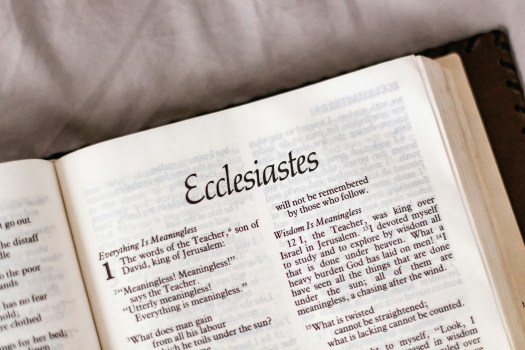
Filling a God-Shaped Hole

Ecclesiastes 2

1I said to myself, “Come now, let’s give pleasure a try. Let’s look for the ‘good things’ in life.” But I found that this, too, was meaningless. 2“It is silly to be laughing all the time,” I said. “What good does it do to seek only pleasure?” 3After much thought, I decided to cheer myself with wine. While still seeking wisdom, I clutched at foolishness. In this way, I hoped to experience the only happiness most people find during their brief life in this world.

4I also tried to find meaning by building huge homes for myself and by planting beautiful vineyards. 5I made gardens and parks, filling them with all kinds of fruit trees. 6I built reservoirs to collect the water to irrigate my many flourishing groves. 7I bought slaves, both men and women, and others were born into my household. I also owned great herds and flocks, more than any of the kings who lived in Jerusalem before me. 8I collected great sums of silver and gold, the treasure of many kings and provinces. I hired wonderful singers, both men and women, and had many beautiful concubines. I had everything a man could desire!

9So I became greater than any of the kings who ruled in Jerusalem before me. And with it all, I remained clear-eyed so that I could evaluate all these things. 10Anything I wanted, I took. I did not restrain myself from any joy. I even found great pleasure in hard work, an additional reward for all my labors. 11But as I looked at everything I had worked so hard to accomplish, it was all so meaningless. It was like chasing the wind. There was nothing really worthwhile anywhere.

12So I decided to compare wisdom and folly, and anyone else would come to the same conclusions I did. 13Wisdom is of more value than foolishness, just as light is better than darkness. 14For the wise person sees, while the fool is blind. Yet I saw that wise and foolish people share the same fate. 15Both of them die. Just as the fool will die, so will I. So of what value is all my wisdom? Then I said to myself, “This is all so meaningless!” 16For the wise person and the fool both die, and in the days to come, both will be forgotten.

17So now I hate life because everything done here under the sun is so irrational. Everything is meaningless, like chasing the wind. 18I am disgusted that I must leave the fruits of my hard work to others. 19And who can tell whether my successors will be wise or foolish? And yet they will control everything I have gained by my skill and hard work. How meaningless!

20So I turned in despair from hard work. It was not the answer to my search for satisfaction in this life. 21For though I do my work with wisdom, knowledge, and skill, I must leave everything I gain to people who haven’t worked to earn it. This is not only foolish but highly unfair. 22So what do people get for all their hard work? 23Their days of labor are filled with pain and grief; even at night they cannot rest. It is all utterly meaningless.

24So I decided there is nothing better than to enjoy food and drink and to find satisfaction in work. Then I realized that this pleasure is from the hand of God. 25For who can eat or enjoy anything apart from him? 26God gives wisdom, knowledge, and joy to those who please him. But if a sinner becomes wealthy, God takes the wealth away and gives it to those who please him. Even this, however, is meaningless, like chasing the wind. (Ecclesiastes 2:1-26, NLT)


The Daily DAVEotional

Blaise Pascal, the famous 17th century French mathematician and inventor, is often credited with saying,

​There is a God-shaped vacuum in the heart of every man which cannot be filled by any created thing, but only by God, the Creator, made known through Jesus Christ.

Interestingly, Pascal never actually said this exact quote, though he did express the sentiment when he said,

“What else does this craving, and this helplessness, proclaim but that there was once in man a true happiness, of which all that now remains is the empty print and trace? This he tries in vain to fill with everything around him, seeking in things that are not there the help he cannot find in those that are, though none can help, since this infinite abyss can be filled only with an infinite and immutable object; in other words by God himself”

As it turns out, this sentiment from Pascal, which has been shortened into the pithy quote that we all see today, was probably derived from Solomon, who explored the nature of meaning and fulfillment in this second chapter of Ecclesiastes.

So what exactly does Solomon say?

It’s important to understand the context on which Ecclesiastes 2 rests. In chapter 1, Solomon is trying to derive meaning and purpose to our existence. His initial position, based on observations and lived experience, is that life is meaningless.

It’s a sad existence indeed if there is absolutely no purpose or meaning in life. Yet that is what Solomon initially concludes.

In this chapter of Ecclesiastes, we’re subjected to a bit of Solomon’s ontological journey.

The first thing he says is that he tried to find meaning and fulfillment in pleasure, or what we call hedonism. But physical pleasure provides no lasting satisfaction. The exhilarating rush that pleasure brings quickly fades, leaving one grasping for the next opportunity to experience that physical and emotional high.

Solomon then turns his attention to the pursuit of materialism. Perhaps acquiring lots of stuff, overseeing grand construction projects or building tremendous wealth could ascribe meaning and value to life. But Solomon found that lacking as well. The allure that extreme wealth promises is never quite  achieved. John Rockefeller, who was the richest person to ever live, was once asked, “how much is enough?” His response was “just a little bit more.” He apparently did not subscribe to Solomon’s conclusion that extreme wealth does not ultimately satisfy.

Perhaps fame and taking pride in one’s work could provide the kind of satisfaction that pleasure and materialism couldn’t. But Solomon ultimately realized the utter futility of that pursuit. Fame is fleeting and whatever work we may accomplish is forgotten as quickly as we are when we die.

Solomon reasoned that hard work and wealth are ultimately meaningless because we all die. What good are those things after you die? Someone else will take possession of and oversee all that we’ve worked to produce. That hardly seems fair. You work your tail off to produce wealth and build an empire only to leave it to someone else who did nothing to earn or produce what you’ve left?

None of this makes sense on the surface. What is the point?

Solomon gives a glimpse into the ultimate purpose in verses 24-25, when he says,

24So I decided there is nothing better than to enjoy food and drink and to find satisfaction in work. Then I realized that this pleasure is from the hand of God. 25For who can eat or enjoy anything apart from him?

Is pleasure, wealth, fame and work all meaningless? Apart from God, the answer is yes. But with God, all of these things are meaningful because they are gifts from God, the ultimate gift-giver!

So we’re back to our opening line that is often attributed to Pascal. There is something inside each person that is searching and striving for meaning and purpose. Man, in his fallenness, seeks to satiate this inner desire with all kinds of things – pleasure, power, wealth and fame. But none of these things bring true satisfaction or fulfillment. That’s because God is the only one who can ultimately fulfill our basic human need for meaning and purpose. It’s part of His design.

Apart from God there is no ultimate meaning and purpose. As Christian philosopher and apologist Frank Turek says, we are just “moist robots” who appear one day and then one day we’re gone.

If that is the case, then Solomon’s initial assessment is true – life is indeed meaningless. But with God, life not only has purpose and meaning but work, pleasure and wealth all make sense.


Did you enjoy this post? I’d love to hear your thoughts! Feel free to like, leave a comment below, and share it with your friends or on social media if you found it helpful or interesting. Your support keeps the conversation going!


Reflection

What do you turn to in order to experience purpose and meaning in life?

Which of the following do you struggle with the most: the pursuit of pleasure, wealth, power or fame?

What do you think are the reasons you or people in general pursue other things to satisfy their inner needs rather than pursuing God Himself?

In what ways can you turn to God as your source of true satisfaction and fulfillment?


Photo by Sincerely Media on Unsplash

What Does it Mean to Have Eternity in The Human Heart?

Ecclesiastes 3

9What do people really get for all their hard work? 10I have thought about this in connection with the various kinds of work God has given people to do. 11God has made everything beautiful for its own time. He has planted eternity in the human heart, but even so, people cannot see the whole scope of God’s work from beginning to end. 12So I concluded that there is nothing better for people than to be happy and to enjoy themselves as long as they can. 13And people should eat and drink and enjoy the fruits of their labor, for these are gifts from God. (Ecclesiastes 3:9-13, NLT)


The Daily DAVEotional

In Ecclesiastes 3, Solomon contemplates the meaning and purpose of work by asking the question, “what do people really get for all their hard work?”

Solomon’s answer is interesting as he states that “people cannot see the whole scope of God’s work from beginning to end.”

Basically, people are too limited in their comprehension and their perspective to fully know and understand God and His purposes.

But in his response, Solomon uses an interesting phrase to make his point about meaning and purpose. He says that God “has planted eternity in the human heart,..”

What exactly does that mean?

I think it means that God has placed within people this innate understanding that we are eternal beings and that we have been created with purpose and meaning.

Think about it. Just the fact that Solomon is able to contemplate the purpose and meaning of work, as all humans are, is something that sets us apart from animals. We may not completely understand everything around us, like the purpose and meaning of our work, but we DO understand that there is something that sets us apart and gives us meaning and value.

Don Richardson, a famous missionary and author, takes this phrase even deeper. In his book “Eternity in their Hearts”, Richardson argues that within every people group and culture, God has placed a redemptive analogy that will enable them to understand and accept the gospel more readily.

In the book, he supports his premise with many stories of how the gospel has been communicated to various peoples and tribes.

In one story, he tells about the Sawi tribe of Indonesia. They were one of only a few tribes globally that practiced both head-hunting and cannibalism.

When they were approached by missionaries and the gospel story was communicated to them, there was a very unexpected response. The Sawi actually thought that Judas was the hero.

This was because the Sawi admired the characteristic of treachery. They would often deceive people into a friendship all the while they were only fattening their future victims.

The Sawi had an interesting tradition, however, to avoid acts of treachery from being performed on them. A Sawi chief would offer his child to another chief as a “peace child.” Acts of war and aggression would be avoided in the future because to attack that tribe might result in the death of your own son.

When the missionaries learned of this tradition, they had their redemptive analogy in hand. They then re-explained the gospel message,  presenting Jesus as the ultimate Peace Child. This time, the Sawi understood and they did not look at Judas as the hero, for to betray a Peace Child was considered the ultimate offense.

With this new understanding of Jesus, it wasn’t long before the Sawi accepted Jesus as their Peace Child.

So what does it mean that God has placed eternity in the human heart? At minimum, it means that people have an inner sense that we are not finite creatures and that we have been created by someone greater than us for a greater purpose.

This inner “understanding” means that the gospel message can be explained and understood by people around the world in a way that uniquely helps them understand the person and nature of Jesus as their Creator and Savior.

Reflection

What do you think it means that God has placed eternity in the human heart?

Author Don Richardson contends that God has placed a redemptive analogy within each people group to make the gospel more readily understandable and acceptable to them. Do you agree with Richardson’s assertion? Why or why not? How do you think this view lines up with other Biblical passages?

How would you answer Solomon’s initial question – what do people really get for all their hard work? What do you think is the purpose of work?

Solomon says that even though God has placed eternity with the human heart, “people cannot see the whole scope of God’s work from beginning to end.” What do you think he means by this statement? How would you explain its meaning to someone else?


Photo by Chang Duong on Unsplash

Photo – Text added by Dave Lowe

Biblical Investing Advice

Ecclesiastes 11

2Divide your gifts among many, for you do not know what risks might lie ahead. (Ecclesiastes 11:2, NLT)


The Daily DAVEotional

The Bible has a lot to say about money and wealth. Despite what many people in our culture think today, the Bible doesn’t condemn wealth or making money. Actually, Jesus himself encourages the wise steward  to multiply the resources entrusted to him/her by God and to seek to make a profit. I’ve written a number of blog posts on the subject of whether wealth is immoral. You can read my previous posts here, here and here.  Additionally, I wrote about God’s stance towards the rich here.

Though the Bible encourages people to make a profit and to multiply their financial resources, it doesn’t give a lot of guidance on how exactly we’re supposed to do that. When it comes to investing, the Bible has little to say that will yield any specific steps or strategies to guide us.

There is one verse however, that gives some financial wisdom on the topic of investing, and it’s found in Ecclesiastes 11:2.

In this verse, Solomon tells us to divide our “gifts” among many in order to hedge against risk.

What’s he talking about?

I like the way the NIV states this verse. It says it this way:

2Give portions to seven, yes to eight, for you do not know what disaster may come upon the land. (Ecclesiastes 11:2, NIV)

In this verse, Solomon is encouraging the reader to divide his investments into 7 or 8 different portions. Essentially, he’s encouraging the reader to diversify their assets in order to hedge against a potential disaster.

I found a blog post by Alice A. Anacioco to be especially helpful. She explains this passage this way:

You may be surprised to read King Solomon offering financial counsel as he nears the end of Ecclesiastes. But accordingly, Solomon was deeply involved in international trades with merchants. And just like today, one of the main trade commodities was grain.

The merchants of Solomon’s day would load their grains on ships and send them off. But instead of loading all of their grains in just one ship, he tells his merchants to put them in several ships and send them out in a diversified way so that if one of the ships should sink, he would not lose everything.

The main advice the Bible gives when it comes to investing is to diversify your investments. The idea is to spread your money out among different types of assets so that if one type of asset is negatively impacted by an economic event, the other assets may be unaffected and as a result, the entire portfolio will not be completely devastated.

Be careful though. Many people assume they are following this advice because they have placed their investment money into mutual funds. Many financial advisors will advise their clients to diversify their stock portfolio among many different stocks so that if one company performs badly, the positive performances of the other stocks may shield the portfolio from being completely torpedoed.

Mutual funds provide some level of inherent diversity because a mutual fund is already a portfolio of many stocks. Hence, if one company within the fund goes down, other companies may go up and thus the value of the fund may go up as well despite the poor performance of one or a few companies.

But being invested in a number of stocks or even mutual funds does not mean you are diversified. To truly be diversified and hedged against disastrous economic events, one needs to have their funds invested in different asset classes altogether.

Think about it. Stocks and mutual funds are part of the same asset class. When the market crashed in 2000 due to the dotcom bubble bursting, many people who had all their money in the stock market had their entire portfolio decimated. Again, in 2008 when the market crashed as a result of the real estate bubble bursting, many who were “diversified” because they owned many different stocks or mutual funds took major hits to their bottom line.

I have heard and seen too many stories of people who had their entire nest egg cut in half or worse by one of these two market events. And for those who were in retirement when it happened, the results have been disastrous. There simply is no time to rebound from these market crashes when you’re already taking disbursements during retirement.

Solomon’s advice is basically “don’t put all your eggs in one basket”. So if you really want to diversify, don’t have all your money in stocks and mutual funds. Invest in other assets as well (such as real estate, precious metals, commodities, etc.) That way, if the stock market crashes, as it inevitably will do, only a portion of your entire portfolio will be affected. And who knows, even while the market is crashing, perhaps the other assets will be unaffected or even increase. You may find that you are gaining overall instead of losing it all.

Reflection

What is or has been your investing strategy?

What steps have you taken or are you taking to diversify your financial portfolio?

Besides stocks and mutual funds, what are some other asset classes you could invest in to begin to create a truly diversified portfolio?


Photo by Precondo CA on Unsplash


Is Wealth Immoral? (Part 3)

Ecclesiastes 5

10Those who love money will never have enough. How absurd to think that wealth brings true happiness! 11The more you have, the more people come to help you spend it. So what is the advantage of wealth—except perhaps to watch it run through your fingers!

12People who work hard sleep well, whether they eat little or much. But the rich are always worrying and seldom get a good night’s sleep.

13There is another serious problem I have seen in the world. Riches are sometimes hoarded to the harm of the saver, 14or they are put into risky investments that turn sour, and everything is lost. In the end, there is nothing left to pass on to one’s children. 15People who live only for wealth come to the end of their lives as naked and empty-handed as on the day they were born.

16And this, too, is a very serious problem. As people come into this world, so they depart. All their hard work is for nothing. They have been working for the wind, and everything will be swept away. 17Throughout their lives, they live under a cloud—frustrated, discouraged, and angry.

18Even so, I have noticed one thing, at least, that is good. It is good for people to eat well, drink a good glass of wine, and enjoy their work—whatever they do under the sun—for however long God lets them live. 19And it is a good thing to receive wealth from God and the good health to enjoy it. To enjoy your work and accept your lot in life—that is indeed a gift from God. 20People who do this rarely look with sorrow on the past, for God has given them reasons for joy. (Ecclesiastes 5:10-20)


The Daily DAVEotional

You may have seen in the news recently that President Joe Biden has decided to implement a “wealth tax” in his next proposed budget. The idea would be to tax those who make over $100 million a minimum of 20%.

Predictably, some are heralding this move as a positive step as it’s “about time the rich pay their fair share” while others have noted that the majority of taxes collected by the IRS are already paid by the rich, so what is the limit of what is fair?

My point is not to take a side in this particular legislation but to demonstrate that we live in an era where it has become fashionable by many, including Christians, to decry wealth as being immoral. Jesus himself seemed to care for the underserved and underprivileged so it is even asserted by some that Jesus was against wealth.

I wrote about this last year in a series of posts here and here. The problem for Christians who think that wealth is immoral is that there is nowhere in Scripture where wealth is actually condemned. Additionally, many righteous men and women of faith were people of great means.

I explain how these ideas are reconciled biblically in the previous posts but here, in today’s passage, Solomon, one of the wealthiest men in the Biblical record, helps us understand more deeply God’s view of wealth.

Here are some of the highlights:

    • Solomon doesn’t condemn wealth. He himself was EXTREMELY wealthy. But he does point out that the LOVE of money is futile because it cannot bring true happiness (verse 10).
    • One problem that comes along with great wealth is that others come to help you spend it. Many lottery winners have commented on how much more stressful life became when they hit it big. Not only was there the worry of how to keep what they have won but suddenly, everyone you’ve ever known shows up wanting a piece of the pie (verse 11).
    • People who have great wealth can sometimes lose it all because, as Solomon points out, the money is put into risky investments (verses 13-14). How many sad stories are told of athletes who made millions while playing but who are living in poverty because they didn’t know how to manage their money?

Solomon’s admonition against the dangers of wealth can be summed up in verse 15:

People who live only for wealth come to the end of their lives as naked and empty-handed as on the day they were born.

Notice that Solomon doesn’t condemn wealth but warns against “living only for wealth”. This is another way of describing greed. The problem with living only for wealth is that you can’t take it with you. Wealthy people will die with nothing just as everyone else does. Jesus made this same point in the Luke 12 passage that I blogged about here.

Solomon ends his short discourse by actually saying that receiving wealth from God is a GOOD thing. He declares that wealth and the good health to enjoy it is a gift from God.

It seems clear from Scripture that wealth in and of itself is not bad. The real issues that are problematic are greed and envy. These two sinful vices are not reserved for the wealthy alone but for anyone regardless of your financial position.

Whatever your net worth is, the biblical admonition is to be content, not envying what others have or being greedy for more of what you think might make life more comfortable and enjoyable.

We should heed Solomon’s admonition to “enjoy your work and accept your lot in life….People who do this rarely look with sorrow on the past, for God has given them reasons for joy.” (Ecclesiastes 5:19-20)

Reflection

On a scale of 1-10, how would you rate your contentment with your current financial position?

Do you think money can bring true happiness? What are you relying on to provide happiness in your own life?

Do you agree with Solomon’s statement that people should enjoy their work and accept their lot in life? Why or why not?

What does it look like to “live only for money”? Have you ever had this attitude or disposition towards money?

When was a time when you experienced feelings of greed or envy? How can you ensure that your own heart motivations towards money and wealth are godly?


Photo by David McBee: https://www.pexels.com/photo/bitcoins-and-u-s-dollar-bills-730547/

Is Wealth Immoral? (Part 2)

1 Timothy 6

6Yet true religion with contentment is great wealth. 7After all, we didn’t bring anything with us when we came into the world, and we certainly cannot carry anything with us when we die. 8So if we have enough food and clothing, let us be content. 9But people who long to be rich fall into temptation and are trapped by many foolish and harmful desires that plunge them into ruin and destruction. 10For the love of money is at the root of all kinds of evil. And some people, craving money, have wandered from the faith and pierced themselves with many sorrows. (1 Timothy 6:6-10, NLT)

Ecclesiastes 11

1Give generously, for your gifts will return to you later.
(Ecclesiastes 11:1, NLT)


The Daily DAVEotional

Yesterday, I posted here about a passage on wealth from Luke 12, in which Jesus tells a story calling a rich person foolish because he tore down his barns to build bigger barns so he would have a place to store his massive amounts of material possessions.

My post sought to address the issue of whether Jesus was condemning wealth in His story.

You see, there’s a lot of talk about equity these days and one of the areas where people are seeing inequity is in the wide array of financial positions held by people in our society. Some people are poor and some people are extremely rich, and a lot of people are somewhere in between.

In our very polarized society, it’s become fashionable to point to those who have extreme amounts of wealth and declare it to be immoral. It is assumed or implied that the only way people could have that much money is because of greed. To be fair, not everyone is directly declaring it to be immoral, but using words like “insane”, “outrageous”, “crazy” and “unnecessary” to describe the amount of wealth some people have makes the same point. Whether expressed directly or indirectly, many people are offended by the amount of wealth that some people have.

But is it immoral to be wealthy? Was Jesus, in his story, condemning wealth? You can read the details and explanation of my response here but the short answer is no, I do not believe Jesus was condemning wealth. What He was condemning was greed.

As if to reinforce that point, a portion of my reading today consisted of the passages above, which also speak to the issues of money, wealth and greed.

In 1 Timothy 6, Paul speaks to the need for contentment and then follows with a warning of the dangers that exist for people who “want to get rich”. Paul is speaking about greed.

Paul says that when people are greedy they find themselves “trapped by many foolish desires that plunge them into ruin and destruction.” There are many examples of how this could play out but I initially think of a person who, in their hopes of making a big score, wastes all of their money playing the lottery or gambling.

The key verse in this passage is verse 10, where Paul says “the LOVE of money is at the root of all kinds of evil.”

Notice that Paul doesn’t say that money is evil. He says that the love of money is the problem. He continues by saying that many who crave money have wandered away from the faith. To “crave money” is another way of describing greed.

Just as Jesus’ story in Luke 12 was predicated on His warning to not be greedy, this passage from Paul also is delivered primarily as a warning against greed, not a condemnation of wealth.

As was stated in yesterday’s post, wealth is simply a tool. It is neither good nor bad, but can be used for good and honorable purposes or it can be used for evil and destructive purposes.

The Ecclesiastes verse above is a reminder that we are to be generous no matter how much money we have. If you have a lot of money, you have the opportunity be extremely generous.

Most of us are not in that extremely wealthy category, so it’s easy to look at those who have more than enough and wonder, “how can they possess so much money?” We might even begin to entertain the idea that it’s unfair and unjust, which is just a small step away from deciding that it’s immoral.

But be careful. Jesus doesn’t condemn wealth per se and as I demonstrated yesterday, there are many biblical figures who were, in fact, quite wealthy. How do we reconcile these truths if God is against wealth?

Instead of pointing to those who have more than enough and calling it unfair or even immoral, we should check our own heart and motives first. Greed is not a sin that just afflicts the rich. Anyone, from any socio-economic background can be lured by greed. However, those of us who aren’t rich can often cloak our greed by attempting to disguise our envy as justice.

Reflection

What do you think is the difference between greed and envy? When have you struggled with greed or envy in the past?

Paul warns of the dangers of “craving money”. When have you craved money, or any other material possession?

What examples can you think of in your own life or circle, where someone was “plunged into ruin and destruction” because of their “love for money”?

What steps can you take to avoid or resist greed and envy?

Do you agree or disagree with the idea that some people may attempt to point to extreme wealth as a sort of attempt to right an “injustice” when they may be simply expressing their own greed in the form of envy? Explain your view.


Photo by Tima Miroshnichenko from Pexels

A Wise Person Thinks About Death?

Ecclesiastes 7

A good reputation is more valuable than the most expensive perfume. In the same way, the day you die is better than the day you are born. It is better to spend your time at funerals than at festivals. For you are going to die, and you should think about it while there is still time. Sorrow is better than laughter, for sadness has a refining influence on us. A wise person thinks much about death, while the fool thinks only about having a good time now.  – Ecclesiastes 7:1-4 (NLT)


The Daily DAVEotional

At first glance, this passage seems kind of morbid. How in the world is it better to spend time at funerals than festivals? Who in their right mind likes going to funerals? With all that’s going on in the world, why would I want to intentionally think about death?

At closer inspection, this passage has profound wisdom that is especially appropriate as we begin a new year.

The author might have communicated his point in a different way, by inviting you to ask yourself this question: when you get to the end of your life, what do you want to be true of you? Or to put it another way, how do you want to be eulogized by others?

The fool only thinks about the here and now (verse 4) and what kind of fun they can have (festivals). But the wise person thinks about what kind of person they want to become (their reputation) and what will be said about them by others when they die.

As we embark on another year, it’s only natural to think about the things you want to accomplish in the coming year. Perhaps you want to lose weight and get healthy. Or maybe you want to advance in your profession or develop yourself educationally.

It’s ok to set material and professional goals but don’t neglect your character and your reputation. The wise person realizes that this is the most important area to think about and reflect on.

What steps can you take this year to move toward becoming the kind of person you want to ultimately be known as? What resources do you need to help you get there?

If you’re a Young Adult, contact us about coaching and other resources that can help you grow and develop in all areas of your life.

Here’s to a Happy and blessed New Year!

Reflection

What do you hope will be said about you by others at your memorial service?

What needs to change now for you to become the kind of person you want to be remembered as when you die?

What do you think are the reasons people tend to think about the here and now instead of the long-term?

What are some of the reasons it’s more difficult to set and focus on character goals versus material and professional goals?


Photo by Pavel Danilyuk: https://www.pexels.com/photo/people-sitting-on-the-bench-7317734/