Einstein, the Jehovah’s Witnesses and the “Fudge Factor”

Do you like fudge?

Who doesn’t?

Fudge is deliciously rich chocolatey goodness.

But fudge can also be bad, depending on the context, as Ralphie demonstrated in this classic scene from “A Christmas Story”.

Using “fudge” as a replacement for the F-word is obviously bad.

But there’s another situation in which fudge is considered bad, and that’s when someone provides misleading or incomplete information in order to direct an outcome or conclusion that they want.

In their book “I Don’t Have Enough Faith to Be an Atheist”, authors Norman Geisler and Frank Turek tell the story of Albert Einstein and the development of his general theory of relativity.

According to the authors, Einstein, in the early development of his theory, didn’t like where his calculations were leading. Einstein, like a lot of scientists at the time, had always assumed that the universe was eternal. If the universe is eternal, then there is no need for God as an explanation for its existence.

But as Einstein continued to work out the calculations of his theory, it was becoming more apparent that the universe, including all space, time, matter and energy, did indeed have a beginning.

Einstein was irritated by this development because he didn’t like the implication that followed, namely that if the universe was caused, there must be something, or someone, who caused it.

To address this irritation, Einstein introduced a universal constant into his equations that served to show that the universe was static and was NOT caused.

The problem with Einstein’s constant, which came to be known as a “fudge factor”, is that it was shown to be false, a mathematical error that appeared to be introduced purely for philosophical reasons.

Einstein’s theory of relativity, along with the corresponding Big Bang Theory are now as universally accepted scientific truths as gravity, and are the basis for the Cosmological argument for the existence of God.

The Cosmological argument is a logical proof that demonstrates that God must exist. The argument can be stated as follows:

    1. Everything that had a beginning had a cause
    2. The universe had a beginning
    3. Therefore, the universe had a cause

The theist argues that the cause of the universe is God, while the atheist, who for years could always appeal to the universe as an eternally existing uncaused reality, now has to come up with an explanation for the existence of the universe without appealing to God as the first cause.

So what motivates a person to “fudge” the data?

The simple answer is that people don’t like where the data is leading so “fudging” the data is an attempted method of controlling a narrative.

So “fudge” can be good or it can be bad, depending on the context.

It turns out that the Jehovah’s Witnesses LOVE fudge, and not the good kind, because the evidence shows that Jehovah’s Witnesses, like Einstein, introduce lots of “fudge factors” into their arguments and even into the Scriptures in order to preserve the narrative to which they are committed.

How do the Jehovah’s Witnesses introduce “fudge” into their arguments?

The Jehovah’s Witnesses introduce “fudge” in a variety of ways, including ignoring context, twisting and changing the meaning of words, and even inserting words that are not in the original text, all for the purpose of controlling the interpretation of the biblical passages that most challenge their doctrinal preferences.

Ignoring Context

The most obvious example of the Jehovah’s Witnesses ignoring context is their interpretation of John 10:30, in which Jesus declares to the Pharisees that “I and the Father are one.”

I analyze this passage in greater detail in my blog post “Evidence that Jesus is God” and give a rebuttal to typical Jehovah’s Witness responses in my follow-up post “Evidence that Jesus is God – Part 2” but the summary is that Jesus makes the aforementioned statement (“I and the Father are one”) and the response from the Pharisees is to pick up stones to stone Jesus.

Jesus asks them why they want to stone him and their response is that they’re stoning him for blasphemy, that “you, a mere man, have made yourself God.”

The context clearly shows that the Pharisees understood Jesus’ statement to be a declaration of deity.

So how do Jehovah’s Witnesses explain this passage?

Simple. They whip up some theological fudge and completely ignore the context and clear meaning of the passage by claiming that Jesus, in declaring himself to be one with the Father, was simply affirming that he was “one in purpose” with the Father.

When challenged with this interpretation by appealing to the context, which clearly shows that the Jehovah’s Witness explanation is NOT the understanding the Pharisees had, Jehovah’s Witnesses double down by pointing to John 17, in which Jesus prays that his followers will be “one” as he and the Father are one.

So Jehovah’s Witnesses ignore the immediate context of John 10, which clearly indicates the Pharisees understood Jesus to be making a claim of deity, and appeal instead to a passage seven chapters later, in which Jesus is praying for his followers to experience missional and relational unity, and they apply that understanding to the John 10 passage.

This is some pretty rich doctrinal fudge.

Later in John 10:38, Jesus doubles down by saying, “understand that the Father is in me, and I in the Father. After making this follow-up statement of relational unity and equality with God, the Pharisees “again tried to seize him.”

The Jehovah’s Witnesses churn up some doctrinal fudge by ignoring immediate context, which clearly shows that Jesus was making a claim to deity, and applying a more distant and unrelated passage to promote the explanation that Jesus was simply asserting that he and the Father were in agreement on missional objectives.

It turns out that fudge is really helpful in providing alternative explanations for uncomfortable passages.

Changing the Meaning of Words

Another way the Jehovah’s Witnesses introduce fudge into their doctrinal arguments is by changing or twisting the plain meaning of biblical words, which effectively alters the plain meaning of straightforward verses.

A clear example of how they do this is with the word “firstborn” in Colossians 1:15 and 18. Again, I have outlined in detail the meaning of this passage in my blog post “What Does it Mean that Jesus is the Firstborn?” and my follow-up post “What Does it Mean that Jesus is the Firstborn? (Part 2)”.

The headline is that the word “firstborn”, which appears in well over 100 verses in the Scriptures, can mean “first in chronological birth order” but only when it is used in speaking of parent-child relationships. For example, when the text says, “Reuben was Jacob’s firstborn”, it clearly means that Reuben was the first in chronological order of all of Jacob’s offspring.

However, when the word “firstborn” is not used in relation to a parent-child relationship, it never carries the meaning “first in line”. Instead, it always carries the meaning of “pre-eminence” or “highest rank”.

So when Paul speaks of Jesus as “firstborn of creation” or “firstborn from the dead” it’s obvious that he’s not speaking of a parent-child relationship. Jehovah’s Witnesses bake up some doctrinal fudge by claiming that the word “firstborn” in both of these cases means something like “first in line.”

It should be noted that in this passage, Jehovah’s Witnesses also add the fudge of ignoring context, since it’s clear that Paul is seeking to establish Jesus’ superiority over all things when he explains “that in everything he [Jesus] might have the supremacy.”

Even though the word “firstborn”, when used in the way Paul uses it in Colossians, always has the meaning of “pre-eminence”, and even though the context demonstrates that Paul is making a case for Jesus’ supremacy in all things, Jehovah’s Witnesses still opt for the alternate interpretation that “firstborn” here actually means that Jesus was “first-created” by Jehovah. They insist that Paul’s intention was to communicate that Jesus was Jehovah’s first created being, despite the fact that there is a specific Greek word that literally means “first-created” and Paul does not use that word.

There’s another clear example of how the Jehovah’s Witnesses twist the meaning of words in order to change the meaning of a passage to more accurately reflect their theological preference.

In Hebrews chapter 1, the author is making the case that Jesus is superior to angels.

In verse 3, the writer says directly that “Jesus is the exact representation of His [God’s] nature.”

If this were not evidence enough that Jesus possesses a divine nature, just a few verses later in verse 6, God explicitly says,

“Let all God’s angels worship him.”

We know that only God is to be worshiped and here the angels are commanded to worship Jesus. What other conclusion is there but that Jesus is God, possessing a divine nature and exactly representing the nature of God?

The conclusion seems airtight, yet the Jehovah’s Witnesses apply a fresh batch of doctrinal fudge to explain this verse.

The Greek word for “worship” is “proskuneo” which literally means “to worship”. And yet, the Jehovah’s Witnesses change the meaning of “proskuneo” from “worship” to “do obeisance”.

It’s interesting to note that the 1961 version of the New World Translation rendered Hebrews 1:6 exactly as other bible translations do – in which God says, “Let all God’s angels worship him.” However, starting with the 1971 version of the New World Translation, and with all versions moving forward, the translation of this verse was changed to “let all of God’s angels do obeisance to him.”

The Greek word is still the same word (proskuneo) but the translation was changed.

What is the reason for the change?

Jehovah’s Witnesses cite the context as the reason for the change. Yet here is another clear example of the context being ignored and the plain meaning of the words being altered in order to promote an interpretation that aligns with the Jehovah’s Witnesses preferred doctrinal preference.

The context clearly demonstrates that Jesus is to be worshiped because he is God, for the text says that Jesus:

    • is the radiance of the Father’s glory
    • is the exact representation of the Father’s nature
    • is the appointed heir of all things
    • made the universe
    • sustains all things by the power of his word
    • sits at the right hand of Majesty

All of these statements point to and argue for the deity and supremacy of Jesus and yet, Jehovah’s Witnesses apply the “fudge factor” by ignoring context and changing or twisting the meaning of words to suit their prior theological interpretation.

Adding Words to the Text

There’s a third way Jehovah’s Witnesses add some doctrinal fudge to their theological arguments and that is by adding words to the biblical text that are not there originally.

The most obvious example of this is in their handling of John 1:1, in which the apostle John says,

1In the beginning was the Word, and the Word was with God, and the Word was God.

I explain and analyze this text in greater detail in my blog post, “A Modern Day Version of an Ancient Heresy”.

John, one of Jesus’ closest disciples, begins his gospel with words that clearly demonstrate that Jesus is divine.

The context makes this clear as John asserts that “Jesus was with God in the beginning”, indicating that Jesus existed BEFORE everything was created. That means Jesus is eternal.

John also states that Jesus made everything and is the source of life.

These are all qualities that point to divinity, supporting the first verse in which John states that Jesus was WITH God and Jesus IS God.

How do the Jehovah’s Witnesses handle this passage that seems to clearly demonstrate the divine nature of Jesus?

They apply the “fudge factor”.

In contrast to every other translation of the Bible and Greek scholars everywhere, the Jehovah’s Witnesses, in their New World translation, add the indefinite article “a’ into the text, even though it is not there in the original Greek, thus completely changing the meaning of the verse.

John 1:1 in the New World Translation reads,

In the beginning was the Word, and the Word was with God, and the Word was a god.

Notice the fudge factor insertion of the word “a” which has the effect of making Jesus a lesser “god” instead of equal with God.

Why exactly would they insert this word? What is the justification?

There is no contextual reason to do it for we’ve already seen that the context supports the original translation, which is that Jesus is divine in his nature.

Nor is there any grammatical reason to add the word. It’s not there in the original Greek and no non-Jehovah’s Witness translators have translated the verse in this way. In fact, the Jehovah’s Witness’ translation has been universally panned by the biblical translation community.

Unfortunately, this is not the only example of the Jehovah’s Witnesses fudging the data by adding words to the text.

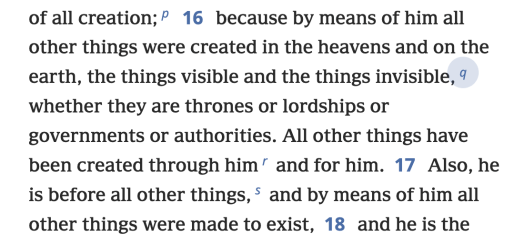
In Colossians 1:16-17, the New World Translation adds the word “other” four times even though the word is not there in the original Greek (see my blog post “How Does Isaiah 44 Demonstrate that Jesus is God?”, which goes into greater detail on the Jehovah’s Witnesses mishandling of this verse).

Here is the NIV translation of Colossians 1:16-17, which matches just about every bible translation you will find:

For by him all things were created: things in heaven and on earth, visible and invisible, whether thrones or powers or rulers or authorities; all things were created by him and for him. 17He is before all things, and in him all things hold together.

The plain meaning of these verses indicate that Jesus is the creator of all things, he existed before all things and he holds all things together. Clearly, these two verses demonstrate Jesus’ power and his eternal nature, both qualities that provide strong evidence that Jesus is God.

Now look at how the Jehovah’s Witnesses translate this same verse in their New World Translation:

because by means of him all other things were created in the heavens and on the earth, the things visible and the things invisible, whether they are thrones or lordships or governments or authorities. All other things have been created through him and for him. 17  Also, he is before all other things, and by means of him all other things were made to exist (Colossians 1:16-17, New World Translation)

I’ve highlighted the four instances of the word “other” that have been inserted into the text by the Jehovah’s Witnesses in order diminish the divine nature of Jesus.

What is the justification for adding the word “other”?

According to the Jehovah’s Witnesses, the word “other” is added in order to make the text more readable. They cite other verses, such as Luke 13:2 where the word “other” is inserted to distinguish all the “other” Galileans from the subset of Galileans that Jesus had just mentioned.

This explanation is not sufficient as the insertion of “other” in Luke 13:2 does not change the meaning of the verse, while the insertion of “other” in Colossians 1:16-17 completely changes the meaning of the passage, making Jesus a created being instead of the eternally self-existent author of creation.

In short, Jehovah’s Witnesses, like Einstein with his theory of relativity, don’t like the implications of the passage, as it contradicts their preferred theological understanding. To rectifiy the situation, they insert a “fudge factor” to altar the equation, which yields a result that fits their ideological choice.

Jehovah’s Witnesses consistently engage in the theological Bible study error known as eisegesis, which means “to read into the text.”

What that means is that instead of allowing the Scriptures to inform their theological view, the Jehovah’s Witnesses conform the text to match their theological view. This is dishonest. It’s “fudging” the data to create the conclusion they want.

The Jehovah’s Witnesses have decided that Jesus is a created being, a lesser god, if you will, than almighty Jehovah. They establish this conclusion first and then every verse that seems to challenge their concusion must be interpreted in a way that affirms this prior doctrinal choice.

As has been shown, this is extremely difficult to do with the Scriptures because of the plethora of passages that point to Jesus’ divinity and support the traditional Christian doctrine that Jesus, in his very nature, is God.

The Jehovah’s Witnesses approach this difficulty in the same way Einstein did with his general theory of relativity, by inserting “fudge factors” into the text and into their explanations.

They insert these “fudge factors” in three different ways: by ignoring the immediate context that substantiates the traditional meaning and interpretation of debated texts, by changing and twisting the meaning of words beyond their normal and accepted use in order to force their interpretations onto the passage, and by inserting words into the text that are not there in the original Greek. The net effect of these “fudge factors” is to alter the plain and obvious meaning of passages that clearly refute their doctrinal view.

One would think that Einstein’s discovery that the universe had a beginning would have been a fatal blow to atheism, but it wasn’t. In fact, atheism as an ideology is more popular now than it was 100 years ago when Einstein was first formulating his theory.

Whenever someone is faced with evidence that challenges their official narrative, it creates ideological tension. How one deals with that ideological tension is very telling.

In the case of atheism, they simply dismiss or ignore any and all evidence that refutes their view. This is known as confirmation bias and it’s been around forever. Saul, later known as Paul, provides a clear example of confirmation bias, which I explain in my blog post “Saul’s Conversion and Confirmation Bias”.

In the case of Jehovah’s Witnesses, they reinterpret the evidence that challenges their narrative by introducing “fudge factors” that conform the evidence to their narrative. This is what is known as “cognitive dissonance”, a phenomenon in which information is not ignored or dismissed but is reinterpreted in such a way that the original narrative is maintained (see my blog post “Job’s Case of Cognitive Dissonance” for a biblical example).

The Jehovah’s Witnesses do this through their generous use of “fudge factors” – ignoring context, changing the meaning of words and adding words to change the intended meaning.

The Jehovah’s Witnesses are just like atheists in this respect: they are so committed to their ideology that they will resort to “fudging” the data as a way to explain and maintain their view.

Fudge as a dessert may taste good, but when used in misleading and dishonest ways, it can end up leaving a bad taste in your mouth. Just ask Ralphie, he’ll tell you.


More blog posts related to Jehovah’s Witness Beliefs


Photo by American Heritage Chocolate on Unsplash

What Does it Mean that Jesus is the Firstborn? (Part 2)

Colossians 1

15He is the image of the invisible God, the firstborn over all creation. 16For by him all things were created: things in heaven and on earth, visible and invisible, whether thrones or powers or rulers or authorities; all things were created by him and for him. 17He is before all things, and in him all things hold together. 18And he is the head of the body, the church; he is the beginning and the firstborn from among the dead, so that in everything he might have the supremacy. 19For God was pleased to have all his fullness dwell in him, 20and through him to reconcile to himself all things, whether things on earth or things in heaven, by making peace through his blood, shed on the cross. (Colossians 1:15-20, NIV)


The Daily DAVEotional

About a year ago, I posted my thoughts on this very passage, explaining the meaning of the term “firstborn” and why it doesn’t teach that Jesus is a created being, as the Jehovah’s Witnesses argue.

I don’t want to rehash all of my points from that post so if you haven’t read it, I encourage you to read the original post, “What Does it Mean that Jesus is the Firstborn?” to get up to speed on the debate between the traditional Christian understanding of Jesus and the Arian view that Jehovah’s Witnesses hold.

My purpose in this post is to provide a response to some of the arguments levied by Jehovah’s Witnesses who argue against my interpretation of this passage.

In my initial post, I made the claim that the primary meaning of “firstborn” in Colossians 1:15 and 18 is “preeminence”. I reasoned that this makes the most sense since Paul uses “firstborn” in conjunction with two different terms, “creation” and “death”, neither of which have anything to do with a parent. Therefore, it seems most natural that Paul is using the term to demonstrate Jesus’ supremacy (pre-eminence) over creation and death.

In recent weeks, I’ve encountered a number of committed Jehovah’s Witnesses online who disagree with my interpretation and have offered up their own explanations for this passage.

The standard Jehovah’s Witness talking point as it relates to the meaning of “firstborn” in Colossians 1 is that the term means something like “first in line.”

The argument is that the term “firstborn” most often refers to the first offspring of a particular person. Therefore, the word should be interpreted in a similar manner when it’s used in a verse that is not referencing offspring.

If you agree with the Jehovah’s Witness logic, then the interpretation of Colossians 1 yields the following:

Jesus is the firstborn of creation, which means that he was the first one to be created by Jehovah.

Jesus is the firstborn from among the dead, which means he’s the first one to overcome death.

To some, particularly Jehovah’s Witnesses and others who hold to an Arian view of Christ, the debate is over. In their mind, the logic is irrefutable.

But is it?

Sound Bible study methods dictate that we investigate their claims. Is their understanding of the word the standard interpretation?

Let’s see.


Click here to see a A Comprehensive List of Blog Posts Based on Bible Passage Reference


I did a Bible search and found that the word “firstborn” shows up in 111 Bible verses, all but 9 of which are found in the Old Testament. In some verses, the word “firstborn” appears multiple times. Hence, the term is used more than 120 times throughout the Bible.

I’ve catalogued every verse where the term shows up, so you can see for yourself. You can access this list of verses in my blog post “Bible References to the Term “Firstborn”“.

The Jehovah’s Witnesses are right in this respect – a majority of the references to the term “firstborn” do actually refer to the first one born to a particular person. However, it is rather obvious from the context of all of those passages that this is the meaning.

Take Genesis 10:15 for example, which is the very first occurrence of the term. The verse says,

Canaan became the father of Sidon, his firstborn.

In a majority of the occurrences of the term “firstborn”, it’s used in this same manner where the term is by itself, but referencing a parent. Occasionally, the term is referenced to another living creature as in Exodus 11:5 which states that God was going to kill the firstborn of Pharaoh as well as the firstborn of all cattle.

It’s clear in these situations that the term does mean “first offspring” primarily because the verse gives the name of the parent and the son or daughter.

But how is the word understood when it is not used in conjunction with a living being (man or animal)? Is it understood in the same way?

Typically not.

One of the first occurrences where firstborn is used in a non-traditional way is Exodus 4:22, which says,

“Then you shall say to Pharaoh, ‘Thus says the LORD, “Israel is My son, My firstborn23“So I said to you, ‘Let My son go that he may serve Me’; but you have refused to let him go. Behold, I will kill your son, your firstborn.”’”

Notice that the term shows up twice. In the second instance it’s used in the same way we typically see the word being used, in reference to the first offspring of a person. In this case, it’s referring to the first offspring of Pharaoh.

But in the first instance of the term “firstborn”, it is not used in the typical fashion.

According to Jehovah’s Witness’ argumentation, the word should have the same meaning even when it’s used in a non-traditional way.

It turns out that the first instance of “firstborn” in this passage CANNOT mean what the Jehovah’s Witnesses attribute to the term. God specifically states that Israel, the nation, is his firstborn. If we understand “firstborn” to be “first in line”, in what sense is Israel the “first in line”?

Israel was not the first nation to be created. And God doesn’t “birth” nations anyway, so the word cannot mean “first offspring”.

It’s clear by the context that the first occurrence of “firstborn” in this verse is to be understood as Israel having a favored status. God selected Israel for a distinct and unique purpose – to be a nation through which all the other nations would be blessed and come to know the one true God.

In this case, the meaning of “preeminent” is clearly the correct understanding.

Genesis 48 provides an insightful story that helps us understand the significance of the firstborn.

In this passage, Joseph brings his sons Manasseh and Ephraim to Jacob in order to receive a blessing before Jacob passes.

Jacob is old and his vision is failing. As he reaches out to bless Joseph’s sons, he crosses his arms so that his right hand is on Ephraim instead of Manasseh who is the first offspring of Joseph and therefore the firstborn.

Genesis 48:14 says,

But Israel stretched out his right hand and laid it on the head of Ephraim, who was the younger, and his left hand on Manasseh’s head, crossing his hands, although Manasseh was the firstborn.

In Genesis 48:18, Joseph tries to correct his father, saying,

“Not so, my father, for this one is the firstborn. Place your right hand on his head.”

Jacob tells Joseph that he is aware of the situation and he knows what he is doing. He tells Joseph that Ephraim, though he is the younger, will have a higher position over his brother. He will be the firstborn, the favored son.

Just a few verses later, in the next chapter, Jacob is giving his final words to each of his sons. Here is what he says to Reuben, his first son, in Genesis 49:3-4,

“Reuben, you are my firstborn; My might and the beginning of my strength, Preeminent in dignity and preeminent in power. 4“Uncontrolled as water, you shall not have preeminence, Because you went up to your father’s bed; Then you defiled it —he went up to my couch.

Jacob not only defines the term “firstborn” for us but expounds on its significance. The firstborn IS the might of the father AND the beginning of the father’s strength. The firstborn is PREEMINENT.

Jacob tells Reuben that he is the firstborn in terms of offspring. But he would NOT be firstborn in terms of preeminence.

These passages, which show up early in the biblical narrative, demonstrate clearly that the idea of “preeminence” was nearly synonymous with the term “firstborn”.

Though Manasseh was Joseph’s first offspring, it turns out that he was not considered the “firstborn” in terms of stature and rank. In Jeremiah 31:9, God  confirms that “Ephraim is my firstborn.”

In 1 Chronicles 2:13, we read that,

Jesse became the father of Eliab his firstborn, then Abinadab the second, Shimea the third,

In verse 14, we learn that David was the seventh and last son born to Jesse. Yet, in Psalm 89:27, God says about David,

“I also shall make him My firstborn,
The highest of the kings of the earth.

David was not the first offspring of Jesse, but God made David His firstborn.

What does that mean?

It cannot mean that David was “first in line” because David was neither the first offspring of Jesse nor was he the first king of Israel.

What it means is that David was made by God to assume the highest rank among rulers. David was made firstborn – he was made to be preeminent.

The context dictates the meaning and sense of the word and so far, when the word is used in a way that doesn’t mean “first offspring”, it carries the meaning of “preeminence.”

There’s an interesting passage in Job that uses the term firstborn. It’s found in Job 18:13, which says:

“His skin is devoured by disease,
The firstborn of death devours his limbs.

This occurrence is informative because it uses the term “firstborn” with the prepositional phrase “of….” that doesn’t have a person or animal following. Whenever we see a person or animal (cattle, herd) follow, as in “firstborn of Jacob” or “firstborn of cattle”, the term always refers to the first offspring.

But in this case, the “firstborn of” phrase is not followed by a person or animal.

Does the standard Jehovah’s Witness meaning of “first in line” follow?

Not really.

Death is inanimate. It’s not a living organism that gives birth as humans and mammals do.

So what is this verse saying?

This verse is part of a larger discourse by Bildad in which he’s communicating his ideology that the wicked eventually get the punishment they deserve. He’s using this argumentation to try to prove that the reason Job has experienced so much trauma and suffering is because Job’s sin has finally caught up to him.

In describing the punishment the wicked will endure, Bildad claims that the skin of the wicked gets devoured by disease AND the “firstborn of death” devours his limbs. It’s obvious that Bildad is making reference to Job’s physical ailments as a proof of Job’s supposed secret sin.

But what is meant by “firstborn of death”?

Note that this term is very similar to how Paul uses “firstborn” in Colossians 1:18.

If “firstborn” means “first in line” in these kinds of cases, what exactly does that mean?

The context will not allow that interpretation because if you assume that meaning, you end up with a garbled mess of a sentence that is completely incoherent.

It’s clear in this context that death is afflicting its victim. There is no sense in which the term “firstborn of death” includes the meaning “first in line”. Death does not birth anything and does not produce a literal offspring.

But death CAN rule. Death CAN overwhelm. That is the sense that is being conveyed here. There is no meaningful or coherent sense in which “first in line” as a meaning applies to the term “firstborn” here.

There’s another uncommon use of the term “firstborn” in Isaiah that does not follow the typical examples that are littered throughout the Old Testament.

Isaiah 14:30 in the ESV says,

And the firstborn of the poor will graze,
And the needy lie down in safety;
but I will kill your root with famine,
and your remnant it will slay.

Here is another example of the word “firstborn” being used in connection with something that is a non-person and a non-animal, negating the traditional meaning of “first offspring.”

What exactly, then is the “firstborn of the poor” and does the definition of “first in line” fit here given the context?

This verse is part of a prophecy that the Lord is giving to Philistia. God warns that Philistia will experience complete devastation and that only “the firstborn of the poor will graze.”

What exactly does that mean?

One thing it doesn’t mean is “first in line”. If we apply the meaning of “highest rank” or “supreme” then it means that those who are the MOST poor will graze (be fed). In other words, it’s going to be bad, and only the most poor, or the poorest of the poor will survive.

It appears that in pretty much every case where the term “firstborn” is used in a way that doesn’t include the parent with the first offspring, the term means “preeminent.”

As mentioned at the outset, there are only 9 verses in the New Testament that use the term “firstborn”.

There are two verses in Luke 2 that use the term, and in both cases, the term “firstborn” is used to refer to Jesus as Mary’s first offspring.

In Hebrews 11:28, the term “firstborn” is referencing the Egyptian plague when the angel of death passed over the Israelites and all of the firstborn of the Israelites were shielded from the plague.

That leaves 6 more verses that use the term “firstborn” including the two in Colossians. None of these other verses use the term in the normal sense where it obviously refers to the first offspring of a certain person.

I’ll examine each of the non-Colossians verses before coming back to Colossians and then summarizing what this tells us.

Romans 8:29 says,

For those whom He foreknew, He also predestined to become conformed to the image of His Son, so that He would be the firstborn among many brethren;

What is this verse saying?

It’s saying that those who become children of God are predestined to be conformed to the image of Jesus. That is, believers ultimately are going to be LIKE him. We won’t just be declared righteous, we will BE righteous because in the end, our sin nature will finally be eradicated.

This is the sense that we will fully be Christ’s brethren. Though we will be LIKE him, we will not be equal to him. Jesus will be the firstborn among all these brethren, which simply means, he will be preeminent. He will be supreme.

So this verse, as applied to Jesus, does not state that he is the first of Jehovah’s creation. It’s stating that he will have a preeminent position among all of the brethren.

This interpretation makes complete sense if we understand that Jesus is a son by nature but we are sons (and daughters) by adoption.

Hebrews 1:6 says,

And when He again brings the firstborn into the world, He says,
“AND LET ALL THE ANGELS OF GOD WORSHIP HIM.”

The term “firstborn” in this verse clearly refers to Jesus, but does it mean that he was the first offspring?

That is a doubtful interpretation for reasons that have already been enumerated. Jesus was not born. Therefore, the more logical understanding of this term as applied to Jesus is “preeminent one”.

This makes sense given the context of Hebrews 1. This passage, starting in verse 5 and ending with verse 13, is demonstrating that Jesus is superior to, or better than the angels.

So when the firstborn, the preeminent one, comes into the world, God says “let all the angels worship Him.” It logically follows that the angels are commanded to worship Jesus because he is preeminent over them.

Now two things should be said about this. First of all, it’s clear from Scripture that only God is to be worshipped. So what does it say about Jesus that God instructs the angels to worship Him?

Secondly, the Jehovah’s Witnesses believe that Jesus is actually the archangel Michael. They believe that Michael is the highest of angels and that God the Father (Jehovah to the Jehovah’s Witnesses) gave Michael the task of coming into the world to redeem humanity. Michael took on a human nature and changed his name for some reason. When his mission was complete, Jesus returned to heaven and assumed his prior identity as Michael the archangel.

So according to the Jehovah’s Witnesses, a powerful angel came to earth, took on a human body and God the Father instructed all the other angels to WORSHIP him.

This doesn’t sound like an angel or even someone who is god-like, as Jehovah’s Witnesses will say. This sounds like someone who possesses the divine nature. In fact, this is exactly what Hebrews 1:3 -4 teaches, that Jesus is the EXACT representation of God’s nature AND he is BETTER than the angels. How can he be better than the angels if he himself IS an angel?

Hebrews 12:23 says,

to the general assembly and church of the firstborn who are enrolled in heaven, and to God, the Judge of all, and to the spirits of the righteous made perfect,

There is some debate about what the term “church of the firstborn” refers to but we know it does NOT refer to Jesus. It clearly refers to a group of people in heaven. It’s also clear that the idea of “first offspring” is not in view here.

I think the most likely understanding of “firstborn” in this verse is either “favored status” or “inheritance.” Remember that the firstborn son had a favored status and received a double portion of the inheritance. So both of these ideas are already inherent in the term.

In this sense, the phrase “church of the firstborn” likely refers to those who have received the inheritance. In other words, it’s referring to those who, because they have placed their faith in Jesus and belong to him, receive exclusive spiritual blessings that are not available to those who are not in the church.

This view makes more sense than anything resembling “first in line”.

Revelation 1:5 says,

and from Jesus Christ, the faithful witness, the firstborn of the dead, and the ruler of the kings of the earth. To Him who loves us and released us from our sins by His blood—

This is the last occurrence of the term “firstborn” in the Bible and it’s the one occurrence that most resembles the usage of Colossians, especially Colossians 1:18.

So what does this mean?

Jehovah’s Witnesses will likely argue for the interpretation that they hold for Colossians 1:18, namely that this means that Jesus is the first to overcome death, that Jesus is “first in line”.

But given the context, noting that John follows this phrase by saying that Jesus is the RULER of the kings of the earth, it makes more sense that John is using the term to communicate that Jesus is the one who is preeminent over death. In other words, Jesus rules over death, just as he rules over the kings of earth.

It bears repeating that Jesus was not born. So what would be the purpose of using the term “firstborn” if it does not apply to Jesus as it applied to Reuben, Manasseh and the dozens of other references that referred to the first offspring of some person?

In other words, the term firstborn, in a majority of cases, was used to identify the first offspring of a person in order to distinguish that person from other siblings who were not first. But since Jesus has no spiritual “siblings”, there is no need to use the term “firstborn” to distinguish him from rival siblings.

Clearly, John is pointing to Jesus’ special status. To conclude otherwise is to stretch or twist the context of these passages and phrases to unnatural and incoherent meanings.

Now let’s circle back to the Colossians verses that use the term “firstborn”.

What we’ve seen in every use of the term “firstborn” is that it most often refers to “first offspring”. But it never means “first offspring” when the term “firstborn” is used in conjunction with  a non-person or non-mammal. In those cases, some form of preeminence, rule or supremacy is meant.

One thing that is clear is that there are no verses where the term firstborn means “first in line”. Yes, it means “first offspring” when speaking of a person or animal that bears offspring in the natural way. However, when “firstborn” is coupled with a non-person, the idea of “first in line” is never in view.

Yet that is exactly what the Jehovah’s Witnesses contend that it means in these two verses in Colossians. They argue that Colossians 1:15 means that Jesus was first in line to be created and Colossians 1:18 means that Jesus was first in line to be raised from the dead.

Their argument is that this understanding is demanded because it is the normal meaning when you see the term.

But, as we’ve seen, it’s only normal when the term is used to refer to “first offspring”. There is no instance where it carries that meaning apart from the term “firstborn” being connected with a living person or an animal such as “cattle” or “herd”.

When the term “firstborn” is used apart from a living person or animal, it always has the meaning of preeminence, supremacy or highest rank.

This rendering makes the most sense in Colossians, especially when you look at the context and realize that Paul is seeking to demonstrate that “in everything Christ might have supremacy.” 

If Paul’s argument is designed to show that Christ will have supremacy in everything (verse 18), then it makes sense that he is going to support that argument by showing that Jesus has supremacy over creation and over death.

So why do Jehovah’s Witnesses still insist that “firstborn”, when attributed to Jesus, means “first in line” when it’s never used that way in any other example?

The answer is that they have manufactured this definition as a way to maintain their theological view that Jesus is a created being.

Jehovah’s Witnesses demonstrate the most egregious form of the Bible study error known as eisegesis, which means to “read into the text.”

In simple terms, the Jehovah’s Witnesses do not approach the text in order to inform their theology. Instead, they add phrases to the text and change the normal meaning of words in order to conform the text to their theology.

It’s clear that, as it relates to Jesus, Paul is using the term “firstborn” in the sense of “preeminence”. This is how the word is used in cases that clearly don’t refer to “first offspring.”

Additionally, the context supports the idea of “preeminence” as the meaning of firstborn.

Paul states that Jesus is the “firstborn of creation” which means Jesus is preeminent over creation.

In the verses that follow, Paul states that Jesus is the creator of all things. So Jesus is preeminent over creation because he is the creator.

The Jehovah’s Witnesses have to manufacture a meaning of firstborn to mean something like “first in line” in order to convince you that Paul is trying to tell you that Jesus is the first created being of Jehovah.

Yet if Paul was trying to communicate that Jesus was “first-created”, he would have used the Greek word “protoktisis” which literally means “first-created.”

That Paul didn’t use that word speaks volumes.

The Jehovah’s Witnesses then have to add the word “other” to the text four times in order to change the meaning of the text to show that Jesus is not really the creator as the original Greek text indicates.

The Jehovah’s Witnesses are like the person who tells a small lie to promote a false narrative but are then forced to create bigger lies in order to maintain the fabricated story.

They first had to offer up a definition for “firstborn” that is literally not used in any of the more than 100 occurrences of the term.

Then, to keep their narrative alive that Jesus is a created being, they have to add the word “other” to the passage four times. Their explanations and justifications for their interpretive choices get increasingly more complicated and logically convoluted in their effort to maintain their theological view.

The most direct, plain and understandable meaning of this passage is that Jesus is preeminent over creation because he is the creator. Additionally, Jesus is preeminent over death because he conquered death. All of this demonstrates that Jesus will come to have first place (i.e. preeminence) in everything!

No extra words and no uncommon and unnatural definitions are required to arrive at this understanding.

So we are back to my original premise in my first blog post, which is that the word “firstborn” does not mean what the Jehovah’s Witnesses think it means.

Jehovah’s Witnesses would do well to heed the advice of Inigo Montoya, who famously said,


Did you enjoy this post? I’d love to hear your thoughts! Feel free to like, leave a comment below, and share it with your friends or on social media if you found it helpful or interesting. Your support keeps the conversation going!


Reflection

Do you agree with the Jehovah’s Witnesses’ interpretation of Colossians 1;15 and Colossians 1:18 that the term “firstborn” should be understood as “first in line”? If so, how do you interpret the other passages that use “firstborn” in a context that doesn’t refer to “first offspring”?

Have you ever told a small lie that escalated into much bigger fabrications? What is the motivation for lying in the first place? What are the reasons a person might continue to promote a falsehood?

What are some examples you can think of where a person is so committed to their narrative that they resort to convoluted logic and distorted definitions in an attempt to justify their narrative?

If the term “firstborn” means “first in line” in Colossians, as Jehovah’s Witnesses assert, what exactly is the meaning of the phrase “firstborn from among the dead”? How does the idea of “first in line” apply to Jesus’ death?


Photo is a screenshot from the movie “The Princess Bride”

How Does Isaiah 44 Demonstrate that Jesus is God?

If you’re wondering why there is an image of a pretzel with a side of mustard for a blog post related to Isaiah 44, read to the end of the post to find out

Isaiah 44

24The LORD, your Redeemer and Creator, says: “I am the LORD, who made all things. I alone stretched out the heavens. By myself I made the earth and everything in it. (Isaiah 44:24, NLT)


The Daily DAVEotional

The lion’s share of verses in Isaiah 44 deal with the foolishness of idols, which I wrote about in my blog post “A Discourse on the Foolishness of Idols”.

However, at the end of Isaiah 44, the prophecy shifts as God gives His people hope regarding the future restoration of the holy city of Jerusalem, which has been decimated due to the fact that many of its inhabitants have been exiled to Babylon. It’s this later passage that I want to focus on in this post, specifically, the first verse in that section.

You’re probably asking, “how exactly does Isaiah 44 demonstrate that Jesus is God, especially since Jesus isn’t mentioned at all in the passage?”

That’s a good question. To answer that question, we must first look at a New Testament passage from Colossians 1.

Speaking of Jesus, Paul, in Colossians 1:16-17, says:

16For by him all things were created: things in heaven and on earth, visible and invisible, whether thrones or powers or rulers or authorities; all things were created by him and for him. 17He is before all things, and in him all things hold together. (NIV)

The clear teaching of these verses is unmistakeable. Jesus is the creator of ALL things. As such, He CANNOT himself be a created thing. In addition, He is BEFORE all things, which means He existed before all things. That means He is eternal. Lastly, He holds all things together, which means He is all-powerful.

By every possible measure, these two verses unequivocally teach that Jesus is God, for He possesses attributes that only God possesses (eternality, omnipotence) and He performs acts that only God could perform, namely creating ALL things.

What’s interesting though is how this same passage is interpreted by the Jehovah’s Witnesses. The Jehovah’s Witnesses do not use any of the standard Christian Bible translations that you’re probably familiar with. Instead, they have their own translation, The New World Translation (NWT), which renders Colossians 1:16-17 this way:

16  because by means of him all other things were created in the heavens and on the earth, the things visible and the things invisible, whether they are thrones or lordships or governments or authorities. All other things have been created through him and for him.  17  Also, he is before all other things, and by means of him all other things were made to exist,  (NWT)

Do you notice the differences between these two translations?

The Jehovah’s Witnesses’ New World Translation inserts the word “other” into the text four times despite the fact that the word “other” is nowhere in the original Greek text. So why is this word inserted four times into the text when it’s not in the original Greek text?


Click here to see a A Comprehensive List of Blog Posts Based on Bible Passage Reference


It’s obvious that the Jehovah’s Witnesses add the word “other” multiple times in order to dilute the clear meaning of the original Greek text, which is that Jesus is the creator of ALL things.

Not only do the Jehovah’s Witnesses unjustifiably add the word “other” to the text, but they do so deceptively.

It’s customary in Bible translations to put any added word in brackets if isn’t in the original Greek text. When the reader sees a word in brackets, it’s a cue that the word is not original to the text but has been added by the translators for some reason, usually for readability.

The online version of the Jehovah’s Witnesses New World Translation. Note that Colossians 1:16-17 does not have brackets around the four occurrences of the word “other” despite the fact that the word “other” appears nowhere in the original Greek text.

It is highly unusual that a translator would add a word to the translation that isn’t in the original Greek and NOT put it in brackets, especially when the addition of the word completely changes the meaning of the text. One can only conclude that the Jehovah’s Witnesses omit the brackets in order to deceive the average person, who will naturally assume that the Jehovah’s Witnesses version of the text accurately reflects what the original Greek text says.

The obvious teaching from Colossians 1:16-17 is uncomfortable to Jehovah’s Witnesses who are so committed to their doctrine that Jesus is a created being that they MUST add the word “other” in order to make the passage fit their doctrinal bias.

Now I’m certain that after I post this online, I’ll encounter many Jehovah’s Witnesses who will attempt to educate me on why it’s ok and even necessary for their translators to add the word “other” to this passage.

Their argument is that the Greek word “panta” can be translated “all other” in some contexts in order to make the reading more “smooth”.  They will undoubtedly point to Luke 13:2 as an example where “panta” is translated as “all other Galileans” instead of just “all Galileans”.

While it’s true that panta can be translated as “all other” in some contexts, it’s not true that it can be translated “all other” whenever the word occurs. The general rule is that the addition of the word “other” is acceptable if it makes the verse more readable BUT DOES NOT CHANGE THE MEANING OF THE VERSE.

The Jehovah’s Witnesses violate this rule by adding the word “other” four times to Colossians 1:16-17 because that is the only way to make those two verses align with their teaching that Jesus is a created being.

So what does any of this have to do with Isaiah 44:24, which is supposed to be the subject of this devotional blog post?

I’m glad you asked.

Let’s assume for one moment that grammatically, the Jehovah’s Witnesses addition of the word “other” four times is linguistically allowed. It’s not, since the word appears nowhere in the original Greek text, but let’s just play along for the sake of argument.

The Jehovah’s Witnesses theological position is that Jehovah created Jesus and THEN Jesus created everything else (all other things).

But Isaiah 44:24 directly refutes this position, as Jehovah says:

I am the LORD, who made all things. I alone stretched out the heavens. By myself I made the earth and everything in it.

Did you catch that?

Jehovah says that he acted ALONE and created ALL THINGS by HIMSELF. He made the earth and EVERYTHING in it.

This directly refutes the Jehovah’s Witnesses doctrinal teaching that Jesus was first created and then created all “other” things.

The Jehovah’s Witnesses teaching is therefore logically false. In order to accept their teaching, one must ignore certain scriptures altogether while directly altering other verses in an effort to bring them into alignment with their prescribed viewpoint.

Nowhere in Scripture does it say that Jesus is created and then Jesus created all “other” things. This view is communicated only in the Jehovah’s Witnesses own translation (the NWT) which conveniently changes key verses in order to force them to agree with their heretical christological view.

Colossians 1:16-17 clearly teaches that all things were created by Jesus, which means he himself cannot be created. Adding the word “other” becomes problematic for Jehovah’s Witnesses as it means they must either deny the clear teaching of Isaiah 44:24 or try to explain it using some other kind of pretzel logic.

The problem for Jehovah’s Witnesses is that they have created so many doctrinal pretzels with their edited translation that their isn’t enough theological mustard available in the world to help us choke down what they’re serving.


Did you enjoy this post? I’d love to hear your thoughts! Feel free to like, leave a comment below, and share it with your friends or on social media if you found it helpful or interesting. Your support keeps the conversation going!


Reflection

If Jesus created all “other” things, how is it possible that Jehovah alone created all things by himself?

How do you explain the fact that all major Bible translations omit the word “other” from Colossians 1:16-17 but the Jehovah’s Witnesses add the word four times?

If Jesus is indeed the creator of all things, and is indeed before all things, what does that imply about his nature?

If Jesus is a created being, as the Jehovah’s Witnesses claim, how does Jesus secure salvation for humankind? In other words, how is it possible that a being who is not eternal and who is not infinitely holy can secure forgiveness and redemption for mankind?


Photo Created with Grok

How Do We Experience Peace?

Colossians 3

15Let the peace of Christ rule in your hearts, since as members of one body you were called to peace. And be thankful. 16Let the word of Christ dwell in you richly as you teach and admonish one another with all wisdom, and as you sing psalms, hymns and spiritual songs with gratitude in your hearts to God. 17And whatever you do, whether in word or deed, do it all in the name of the Lord Jesus, giving thanks to God the Father through him. (Colossians 3:15-17, NIV)


The Daily DAVEotional

If you haven’t noticed, we are experiencing an epidemic of anxiety in our country. The American Psychiatric Association’s annual mental health poll indicated a sharp rise in anxiety levels among American adults.

Young adults are even more likely to report high levels of anxiety these days according to a Pew survey cited in this article.

There’s even been a popular book written about “The Anxious Generation.” In this book, author Jonathan Haidt argues that smartphones, social media, and helicopter parenting has contributed to an increased level of anxiety and depression among today’s youth.

Experiencing peace seems as elusive as sighting a unicorn.

So how exactly can we experience peace?

In his letter to the Colossians, Paul gives some insight into experiencing peace.

The first thing he says is that we should let peace “rule” in our hearts. The Greek word for “rule” means “arbitration”. The idea is that peace should govern our hearts.

Ok. But how do we do that? It’s not like most people can turn peace on and off like a light switch.

Fortunately, there are some key words in this passage that help us to understand a potential pathway to peace.

Three times in this passage, Paul uses the similar words “thankful” (verse 15), “gratitude” (verse 16), and “thanks” (verse 17).

Philippians 4:6-7 is perhaps the most oft-quoted passage regarding peace. Paul says,

6Do not be anxious about anything, but in everything, by prayer and petition, with thanksgiving, present your requests to God. 7And the peace of God, which transcends all understanding, will guard your hearts and your minds in Christ Jesus.

It’s interesting to note that in this passage, Paul also talks about thanksgiving. When we share our anxieties with God, and we do it with an attitude of thanksgiving, Paul says that we will experience the peace of God in a way that transcends our understanding.

I might not be able to manufacture peace on demand. But I can choose my attitude and what I will allow my mind to dwell on.

Paul tells us to be thankful  and to offer up our anxieties to the Lord in prayer with an attitude of thanksgiving and gratitude.

Something happens when we choose to be grateful. You see, we can’t be grateful unless we stop and think about the things we should be grateful for. Doing this refocuses our attention on God’s goodness and it gets our minds off of the negative thoughts that are the root of our anxieties.

My wife and I recently saw the movie “Soul on Fire”, which is the real-life story of John O’Leary, who, as a child, suffered burns over his entire body when he accidentally set his family’s house on fire. It’s a powerful story of identity, redemption and forgiveness.

As an adult, John decides he can use his story to make a difference in the lives of others as a motivational speaker.

In one of his first speaking engagements he finds himself talking to a group of hardened criminals in a state prison. His main message is about the importance of gratitude. He then invites the prisoners to share something they’re grateful for.

At first, nobody speaks. They’re mostly skeptical and wondering what they’re even doing there. Finally, one prisoner stands up and says:

“I’m grateful for prison, because if I wasn’t here, I’d be dead. And here’s what else I’m grateful for:

    • Heat in the winter.
    • Air-conditioning in the summer.
    • Three square meals a day—no cooking, no dishes.
    • A clean bed every night.
    • Laundry service—I never had that on the outside.
    • Medical care, even if it’s basic.
    • A library full of books I never read before.
    • Time to think, really think about my life.
    • Brothers here who get it, who share my struggles.
    • Letters from my kids—I miss ’em, but they keep comin’.
    • The chaplain who prays with us.
    • Fresh coffee in the morning.
    • Outdoor rec time—blue sky, even behind fences.
    • A job, Payin’ a little, but it’s honest work.
    • No bills pilin’ up.
    • Safety from the streets I ran on
    • Programs to learn skills, like anger management.
    • Holidays with visits from family.
    • Music on the radio—reminds me of better days.
    • Clean water, hot showers.
    • Counselors who listen without judgin’.
    • The chance to apologize to folks I hurt.
    • Faith groups—Bible study saved my soul.
    • Exercise yard—keeps me strong.
    • Mail call—somethin’ to look forward to.
    • No more chasin’ highs that wrecked me.
    • Rules that keep me from hurtn’ others.
    • Dreams at night—hope for what’s next.
    • Laughter with the guys—ain’t nothin’ like it.
    • This talk today—remindin’ me gratitude changes everything.
    • And God… for second chances.”

Later in the movie, John is struggling, feeling sorry for himself and the situation he’s in. He can motivate others through his speaking but, like us, he often struggles to apply the principles of his own TED talk.

There’s a scene where he visits his family. His dad is in a wheel chair, suffering from the effects of advanced Parkinson’s disease. And yet, his father is joyful, positive and at peace.

John asks his father, “How can you be so positive?”

His dad responds “John, how can I complain when my life is so good, when I’m just so blessed?”

John is confused. He’s thinking, “how can you see yourself as blessed when you’re in this horrible condition?” It’s really a victim mentality. And we all can tend towards this, can’t we?

His dad then elaborates on his gratitude, listing reasons like the extra time he has for reflection, the deeper family bonds he’s developed, his appreciation for caregivers and the empathy he’s developed for the struggles of others. Gratitude has enabled him to transform his limitations and potential sources of anxiety into sources of joy and peace.

There is no doubt that we live in a complex and chaotic world that’s filled with challenges that can produce anxieties of all kinds – health, job, finances and family issues, just to name a few.

However, even though we can’t produce peace in our hearts on demand, we can choose to be thankful and grateful for the good things that God has provided for us. If we make this our regular pattern, our lives will be less anxious and we’ll begin to experience more peace in our hearts.


Did you enjoy this post? I’d love to hear your thoughts! Feel free to like, leave a comment below, and share it with your friends or on social media if you found it helpful or interesting. Your support keeps the conversation going!


Reflection

What are the things creating anxiety in your life right now? What keeps you from sharing those things with the Lord?

What have you found helpful in your own life to get your mind off of your problems and anxieties and onto the positive things in your life?

If you were to create a list of things you’re grateful for, like the prisoner did, what would be on your list? What are the things in your life that you can express gratitude for?


Photo by Tom Shakir on Unsplash

What Does it Mean that Jesus is the Firstborn?

Colossians 1

15He is the image of the invisible God, the firstborn over all creation. 16For by him all things were created: things in heaven and on earth, visible and invisible, whether thrones or powers or rulers or authorities; all things were created by him and for him. 17He is before all things, and in him all things hold together. 18And he is the head of the body, the church; he is the beginning and the firstborn from among the dead, so that in everything he might have the supremacy. 19For God was pleased to have all his fullness dwell in him, 20and through him to reconcile to himself all things, whether things on earth or things in heaven, by making peace through his blood, shed on the cross. (Colossians 1:15-20, NIV)


The Daily DAVEotional

In the first chapter of Colossians, Paul pens one of the greatest treatises on the divine nature of Christ in all of Scripture. And yet, some have used this very section to promote a false understanding of Jesus.

The Jehovah’s Witnesses are a religious group that was birthed in the late 1870’s when Charles Taze Russell, who had been highly influenced by Adventist teachings, determined that certain Christian doctrines, such as the Trinity and divinity of Christ, were not supported by Scripture.

I’ve written a number of posts regarding the Jehovah’s Witnesses and their view that Jesus is not God, including the following posts:

The bottom line with Jehovah’s Witnesses is that they don’t believe in the trinity. Therefore, they don’t believe that Jesus is God. They teach a doctrine that is known as Arianism (see post here), which teaches that Jesus is a created being who does not possess a divine nature.

The Jehovah’s Witnesses are highly committed to their understanding of Jesus as a created being, and they believe that this passage, in Colossians 1, serves as strong evidence in support of their view.

Specifically, this passage twice describes Jesus as being “firstborn”. The thinking goes that if Jesus was born, then he must be created. If he was created then he clearly isn’t God. If he isn’t God, then he’s just a man. Hence, the view that Jesus is a created being without a divine nature must be the correct view.

That logic might sound correct on the surface, but there is one small problem, as our good friend Inigo Montoya will explain:

The problem is that we interpret the word “firstborn” based on our modern understanding. Naturally, we see the word “born” and assume that it refers to a birth. We assume therefore that the passage is saying that Jesus was “born”, just as all people are naturally born.

But that’s not at all what the passage is saying.

To understand this passage, we need to understand a little bit about the culture of the Ancient Near East, particularly how the family heirs were treated.

In the Ancient Near East culture, it was customary for the oldest son to receive a double portion of any inheritance. The oldest son enjoyed this benefit because of his status as the highest in rank of all the sons. So, if you had two sons, your assets would be divided into 3 parts. The oldest son would get 2 shares and the youngest son would get one share.


Click here to see a A Comprehensive List of Blog Posts Based on Bible Passage Reference


The oldest son was therefore the pre-eminent, or favored son. The oldest son was the highest in rank – usually.

However, there are a number of Biblical examples where this was not the case.

Take Jacob and Esau for example. Esau was the oldest son but God favored Jacob, who received Isaac’s blessing over Esau.

Jacob’s sons are another example. Jacob had 12 sons. Reuben was the oldest and therefore, was considered the pre-eminent son, eligible for the double portion.

However, Reuben forfeited his rank and the blessing associated with the oldest son when he slept with one of his father’s wives. As a result, Jacob made Joseph the pre-eminent son, even though he was NOT born first. In fact, he was the eleventh born! (see 1 Chronicles 5:1)

When you see a list of the tribes of Israel (Jacob’s new name), you never see Joseph listed. Why is that? It’s because Joseph was given two shares. Joseph’s shares are represented by his two sons, Ephraim and Manasseh.

The Greek word that is translated “firstborn” is the word “prototokos”. While the word is translated as “firstborn”, it doesn’t mean that Jesus was created. If Paul wanted to communicate that Jesus was the first-created, he would have used a different word, “protoktisos”, which literally means “first-created.”

How do we know that Paul is not trying to communicate that Jesus was “born” if he indeed uses this word which translates to “firstborn”?

It’s clear from the context that Paul is not using the word in the way the Jehovahs Witnesses assert.

In the first instance of the word, Paul says that Jesus is “the firstborn over all creation.” If Paul were communicating that Jesus was “born” then he’s also saying that “creation” is the parent. That doesn’t make sense. If Paul was communicating that Jesus was literally born, shouldn’t the passage say that Jesus was the “firstborn of God”?

In the second instance of the word “firstborn”, Paul states that Jesus is firstborn from among the dead. Again, this language doesn’t make sense if Jesus is actually born. How can Jesus be parented by creation and also by “the dead”?

This passage makes complete sense if we understand that the word “firstborn” carries the meaning of pre-eminence or rank, just as the firstborn child of any ancient near eastern family held pre-eminent status over his siblings due to his higher rank.

In this case, Paul says in verse 15 that Jesus is pre-eminent over creation. Why? Paul gives the answer in the very next verse. It’s because Jesus is the CREATOR. Jesus is pre-eminent (firstborn) over creation because he is the author of ALL of creation.

In the same way, Jesus is pre-eminent over death precisely because he has demonstrated supremacy over death by rising from the dead.

So in the end, this passage doesn’t teach that Jesus is a created being as the Jehovah’s Witnesses teach. Instead, this passage teaches the exact opposite. Jesus is the uncreated creator of all things in whom the fullness of deity dwells and through whom all things are reconciled by His shed blood on the cross.

Jesus is indeed firstborn. He has demonstrated supremacy over creation and death precisely because He is GOD!


Read the follow-up to this post: “What Does it Mean that Jesus is the Firstborn? (Part 2)” in which I respond to some common Jehovah’s Witnesses’ objections to my interpretation of this passage.


Did you enjoy this post? I’d love to hear your thoughts! Feel free to like, leave a comment below, and share it with your friends or on social media if you found it helpful or interesting. Your support keeps the conversation going!


Reflection

Genesis 41:51-52 says, “Joseph named his firstborn Manasseh…. 52The second son he named Ephraim”. Yet in Jeremiah 31:9 it says, “Ephraim is my firstborn son”. How can Ephraim be the second son in the Genesis passage but the firstborn in Jeremiah? How do you explain this apparent contradiction?

David was the last born son of Jesse but Psalm 89:27 calls him the “firstborn”. How do you explain this? How could David be the “firstborn” if he was not born first?

If Jesus is a created being, as the Jehovah’s Witnesses contend, what do you think are the implications in terms of Jesus’ ability to save humanity? In other words, how can a savior who is not divine atone for the sins of the world?

What are some personal examples you can think of where the first born son (or daughter) did not enjoy the favored status you might expect?

What are some other qualities of Jesus that you learn from this short passage in Colossians? What else can we say about Jesus from these verses?


Photo is a screenshot from the movie “The Princess Bride”

It’s Not How You Start, but How You Finish!

Acts 15

36After some time Paul said to Barnabas, “Let’s return to each city where we previously preached the word of the Lord, to see how the new believers are getting along.” 37Barnabas agreed and wanted to take along John Mark. 38But Paul disagreed strongly, since John Mark had deserted them in Pamphylia and had not shared in their work. – Acts 15:36-37, NLT

Colossians 4

14Dear Doctor Luke sends his greetings, and so does Demas.  – Colossians 4:14, NLT

2 Timothy 4

9Please come as soon as you can. 10Demas has deserted me because he loves the things of this life and has gone to Thessalonica. Crescens has gone to Galatia, and Titus has gone to Dalmatia. 11Only Luke is with me. Bring Mark with you when you come, for he will be helpful to me. 12I sent Tychicus to Ephesus. 13When you come, be sure to bring the coat I left with Carpus at Troas. Also bring my books, and especially my papers.  – 2 Timothy 4:9-13, NLT


The Daily DAVEotional

In December (2022) an amazing thing happened in an NFL football game. At half-time, the Minnesota Vikings were getting taken to the woodshed, down 33-0 to the Indianapolis Colts. It was a surprising development, given the Vikings had one of the best records in football and the Colts were widely regarded as one of the worst teams in the league.

I remember seeing the half-time score and thinking that game was all but over.

Later I learned that the Vikings had made a complete turn around in the second half, tied the game up and won 39-36, on a last second field goal in overtime. It was the greatest comeback in NFL history.


Proof once again that it’s not how you start, but how you finish.

The same is true in the Christian life. The Bible is replete with stories about people who did not finish well.

In 2 Timothy 4, Paul mentions two guys who are going in opposite directions. Paul mentions both by name.

The first is Demas. You might remember Demas from Colossians 4, where Paul mentions him as one of his co-workers who offers a greeting to the recipients of Paul’s epistle. Demas was on the right track, seemingly walking with Christ and serving with Paul for the furtherance of the gospel ministry in Asia Minor.

But something happened. We’re not given all the details but later, when Paul pens his final letter to Timothy, it’s clear that Demas has abandoned the faith in favor of a worldly lifestyle.

In contrast to Demas is Mark. Mark did not get off to a good start. He joined Paul and Barnabas on their missionary journey as an assistant in Acts 13:5 but didn’t last very long, abandoning them before their journey was complete (Acts 13:13).

In Acts 15, when Paul and Barnabas decide to go out on another missionary journey, Barnabas wants to take Mark with them but Paul is not in favor of this plan because Mark had previously abandoned them. Their disagreement was so sharp that the Paul and Barnabas band broke up and each decided to go solo, taking on new partners, Paul taking Silas while Mark accompanied Barnabas. I wrote about this first “church split” in a previous blog post, “Who Was at Fault for the First Recorded Church Split?”

Later, when Paul is older and about to leave this earth for his heavenly abode, Paul makes a final request of Timothy – “bring Mark with you when you come, for he will be helpful to me.”

Paul had no use for Mark early on, for Mark had clearly tubed out on the mission. But though Mark started off shaky, he finished well, so much so that later, when Paul was nearing death, Paul came to see Mark as tremendously useful.

These two guys, both mentioned in the same ending lines of Paul’s letter to Timothy, illustrate that no matter where you’re at or what you’ve done, you can always re-direct your path and finish well. Like Mark, we can change the narrative of our lives and become “useful” to the Lord and His purposes.

Likewise, even if you may find yourself on the right path now, it’s no guarantee that you will finish well. Like Demas, we can be lured by worldly forces to abandon our first love for mere earthly pleasures.

My hope is to finish well like Mark did, while avoiding the pitfalls of Demas!

Reflection

In what ways do you relate to Mark? In what ways can you relate to Demas?

What are some examples in your own circle of friends and acquaintances of people who seemed to start strong but ultimately didn’t finish?

Demas left Paul because he “loved the things of this life”. What are some of the things in this life that tend to be alluring to you and could possibly sidetrack you from wholehearted devotion to Christ?

What safeguards can you place in your own life to ensure you finish like Mark and not like Demas?


Photo by Joshua Hoehne on Unsplash