15Let the peace of Christ rule in your hearts, since as members of one body you were called to peace. And be thankful. 16Let the word of Christ dwell in you richly as you teach and admonish one another with all wisdom, and as you sing psalms, hymns and spiritual songs with gratitude in your hearts to God. 17And whatever you do, whether in word or deed, do it all in the name of the Lord Jesus, giving thanks to God the Father through him. (Colossians 3:15-17, NIV)
The Daily DAVEotional
If you haven’t noticed, we are experiencing an epidemic of anxiety in our country. The American Psychiatric Association’s annual mental health poll indicated a sharp rise in anxiety levels among American adults.
Young adults are even more likely to report high levels of anxiety these days according to a Pew survey cited in this article.
There’s even been a popular book written about “The Anxious Generation.” In this book, author Jonathan Haidt argues that smartphones, social media, and helicopter parenting has contributed to an increased level of anxiety and depression among today’s youth.
Experiencing peace seems as elusive as sighting a unicorn.
So how exactly can we experience peace?
In his letter to the Colossians, Paul gives some insight into experiencing peace.
The first thing he says is that we should let peace “rule” in our hearts. The Greek word for “rule” means “arbitration”. The idea is that peace should govern our hearts.
Ok. But how do we do that? It’s not like most people can turn peace on and off like a light switch.
Fortunately, there are some key words in this passage that help us to understand a potential pathway to peace.
Three times in this passage, Paul uses the similar words “thankful” (verse 15), “gratitude” (verse 16), and “thanks” (verse 17).
Philippians 4:6-7 is perhaps the most oft-quoted passage regarding peace. Paul says,
6Do not be anxious about anything, but in everything, by prayer and petition, with thanksgiving, present your requests to God. 7And the peace of God, which transcends all understanding, will guard your hearts and your minds in Christ Jesus.
It’s interesting to note that in this passage, Paul also talks about thanksgiving. When we share our anxieties with God, and we do it with an attitude of thanksgiving, Paul says that we will experience the peace of God in a way that transcends our understanding.
I might not be able to manufacture peace on demand. But I can choose my attitude and what I will allow my mind to dwell on.
Paul tells us to be thankful and to offer up our anxieties to the Lord in prayer with an attitude of thanksgiving and gratitude.
Something happens when we choose to be grateful. You see, we can’t be grateful unless we stop and think about the things we should be grateful for. Doing this refocuses our attention on God’s goodness and it gets our minds off of the negative thoughts that are the root of our anxieties.
My wife and I recently saw the movie “Soul on Fire”, which is the real-life story of John O’Leary, who, as a child, suffered burns over his entire body when he accidentally set his family’s house on fire. It’s a powerful story of identity, redemption and forgiveness.
As an adult, John decides he can use his story to make a difference in the lives of others as a motivational speaker.
In one of his first speaking engagements he finds himself talking to a group of hardened criminals in a state prison. His main message is about the importance of gratitude. He then invites the prisoners to share something they’re grateful for.
At first, nobody speaks. They’re mostly skeptical and wondering what they’re even doing there. Finally, one prisoner stands up and says:
“I’m grateful for prison, because if I wasn’t here, I’d be dead. And here’s what else I’m grateful for:
Heat in the winter.
Air-conditioning in the summer.
Three square meals a day—no cooking, no dishes.
A clean bed every night.
Laundry service—I never had that on the outside.
Medical care, even if it’s basic.
A library full of books I never read before.
Time to think, really think about my life.
Brothers here who get it, who share my struggles.
Letters from my kids—I miss ’em, but they keep comin’.
The chaplain who prays with us.
Fresh coffee in the morning.
Outdoor rec time—blue sky, even behind fences.
A job, Payin’ a little, but it’s honest work.
No bills pilin’ up.
Safety from the streets I ran on
Programs to learn skills, like anger management.
Holidays with visits from family.
Music on the radio—reminds me of better days.
Clean water, hot showers.
Counselors who listen without judgin’.
The chance to apologize to folks I hurt.
Faith groups—Bible study saved my soul.
Exercise yard—keeps me strong.
Mail call—somethin’ to look forward to.
No more chasin’ highs that wrecked me.
Rules that keep me from hurtn’ others.
Dreams at night—hope for what’s next.
Laughter with the guys—ain’t nothin’ like it.
This talk today—remindin’ me gratitude changes everything.
And God… for second chances.”
Later in the movie, John is struggling, feeling sorry for himself and the situation he’s in. He can motivate others through his speaking but, like us, he often struggles to apply the principles of his own TED talk.
There’s a scene where he visits his family. His dad is in a wheel chair, suffering from the effects of advanced Parkinson’s disease. And yet, his father is joyful, positive and at peace.
John asks his father, “How can you be so positive?”
His dad responds “John, how can I complain when my life is so good, when I’m just so blessed?”
John is confused. He’s thinking, “how can you see yourself as blessed when you’re in this horrible condition?” It’s really a victim mentality. And we all can tend towards this, can’t we?
His dad then elaborates on his gratitude, listing reasons like the extra time he has for reflection, the deeper family bonds he’s developed, his appreciation for caregivers and the empathy he’s developed for the struggles of others. Gratitude has enabled him to transform his limitations and potential sources of anxiety into sources of joy and peace.
There is no doubt that we live in a complex and chaotic world that’s filled with challenges that can produce anxieties of all kinds – health, job, finances and family issues, just to name a few.
However, even though we can’t produce peace in our hearts on demand, we can choose to be thankful and grateful for the good things that God has provided for us. If we make this our regular pattern, our lives will be less anxious and we’ll begin to experience more peace in our hearts.
Did you enjoy this post? I’d love to hear your thoughts! Feel free to like, leave a comment below, and share it with your friends or on social media if you found it helpful or interesting. Your support keeps the conversation going!
Reflection
What are the things creating anxiety in your life right now? What keeps you from sharing those things with the Lord?
What have you found helpful in your own life to get your mind off of your problems and anxieties and onto the positive things in your life?
If you were to create a list of things you’re grateful for, like the prisoner did, what would be on your list? What are the things in your life that you can express gratitude for?
1The LORD gave me another message. He said, 2“Go and shout in Jerusalem’s streets: ‘This is what the LORD says: I remember how eager you were to please me as a young bride long ago, how you loved me and followed me even through the barren wilderness. 3In those days Israel was holy to the LORD, the first of my children. All who harmed my people were considered guilty, and disaster fell upon them. I, the LORD, have spoken!’”
4Listen to the word of the LORD, people of Jacob—all you families of Israel! 5This is what the LORD says: “What sin did your ancestors find in me that led them to stray so far? They worshiped foolish idols, only to become foolish themselves. 6They did not ask, ‘Where is the LORD who brought us safely out of Egypt and led us through the barren wilderness—a land of deserts and pits, of drought and death, where no one lives or even travels?’
7“And when I brought you into a fruitful land to enjoy its bounty and goodness, you defiled my land and corrupted the inheritance I had promised you. 8The priests did not ask, ‘Where is the LORD?’ The judges ignored me, the rulers turned against me, and the prophets spoke in the name of Baal, wasting their time on nonsense. 9Therefore, I will bring my case against you and will keep on accusing you, even against your children’s children in the years to come. I, the LORD, have spoken!
10“Go west to the land of Cyprus; go east to the land of Kedar. Think about what you see there. See if anyone has ever heard of anything as strange as this. 11Has any nation ever exchanged its gods for another god, even though its gods are nothing? Yet my people have exchanged their glorious God for worthless idols! 12The heavens are shocked at such a thing and shrink back in horror and dismay, says the LORD. 13For my people have done two evil things: They have forsaken me—the fountain of living water. And they have dug for themselves cracked cisterns that can hold no water at all! (Jeremiah 2:1-13, NLT)
The Daily DAVEotional
Jeremiah was a prophet of Judah who prophesied from about 627 B.C. to 587 B.C. He is known as the “weeping prophet” because he expressed deep sorrow in his writings over the sins of his people toward God.
You may remember that the Jewish nation was divided in two after Solomon’s reign. The northern kingdom, known as Israel in the Old Testament historical books, was conquered by the Assyrians in about 722 B.C. and many of it’s inhabitants were exiled.
The southern kingdom was known as Judah. This was the royal line of David and Solomon. The southern kingdom was invaded by Babylon in 605 BC at which time they became a vassal state, though the kings of Judah continued to resist Babylonian control. It was during this period that Jeremiah prophesied to the kings of Judah with a message that they should concede to Babylonian rule as their punishment for their continued sins of rebellion and rejection of God.
And just what did they do to sin against and reject God? Verse 11 demonstrates that the major sin was that they exchanged their allegiance to the one true God, the God who delivered them from the Egyptians and brought them into the promised land, for “worthless gods” who are “nothing.”
God’s people were guilty of idol worship. This was a recurring issue with God’s people that happened over, and over and over again. They were constantly forsaking God in order to worship idols in the form of regional gods of the people they had displaced as well as the gods of people who lived in proximity to them.
I’ve written many times about the problem of idol worship within the Israelite communities, including here, and here.
Jeremiah gives an illustration to demonstrate just how foolish the people of Judah had been. In verse 13, he states,
For my people have done two evil things: They have forsaken me—the fountain of living water. And they have dug for themselves cracked cisterns that can hold no water at all!
The climate in Israel was hot and arid and they depended on rainfall for drinking water and the development of their crops.
A cistern was used as a way of collecting water during the rainy season to use later when it was dry.
A cistern is not a well. It’s more like an underground storage tank. While there were different methods for constructing a cistern, a common cistern was a masonry cistern which allowed for more versatility in terms of the shape and size of the storage area.
Basically a large cavity or hole was unearthed and then quarried stones or bricks were used with mortar to create the structure – the walls and the floor. The structure was then sealed with plaster to prevent leaks.
So now that you know what a cistern is, let’s look at what the charge is against God’s people.
God says HIs people have rejected Him, the fountain of living water.
This right here is key. It’s easy to overlook the importance of water to the people in ancient Israel. Water represents life. You cannot live without water. You will die of thirst or of starvation if there is no water to drink and grow your crops.
In our modern society, we just go into the bathroom or kitchen and we turn on the faucet, and out comes the water – as much as we want. Most of us haven’t had to think at all about where our water will come from for that day.
But in the Ancient Near East, water was vital, and thinking about water was paramount. Water had to be retrieved on a daily basis for life’s needs – whether it was for drinking, cooking, cleaning or growing crops.
Retrieving water was not as easy as turning on a faucet and streaming water out of a hose into a bucket or cooking pot. One had to walk to wherever the well was located or wherever there was a cistern. Water had to painstakingly be lifted up out of the well or cistern. If you did happen to live near a river, you would have to walk to retrieve it and whatever you retrieved you’d have to carry back. The larger the bucket, the heavier the load. The smaller the bucket, the more times you had to visit the water source to retrieve the amount of water you needed.
To us, we can easily take water for granted. In that culture, nobody took water for granted. It was everything.
God says that He is like a fountain of living water. Since water is essential for life, God is saying that He is like a fountain of life. He is the one who sustains life.
Instead of coming to this source of pure living water, God’s people have chosen to retrieve their water from cisterns that are cracked. A cracked cistern not only would leak its water, which made for an unreliable source, but it would also allow earth sediment to leak in via the cracks so that whatever water remained would be dirty and impure.
This is what we tend to do as humans. On the one hand, there exists a fountain of pure water that never runs dry. On the other hand, there’s a cracked cistern that may have some water in it. It’s unreliable because it leaks. If there is water in it, it’s dirty and stagnant.
Now imagine you’re really thirsty. From which source do you choose to retrieve water to satisfy your thirst?
You’d think that we would choose the fountain of pure living water every time. But we don’t. We consistently choose cheap substitutes that we think will give us life but ultimately, doesn’t quench our thirst.
The Israelites were constantly worshiping false gods and idols that they created out of wood, stone and various metals. These idols could not save them, nor could they protect them, nor could they provide for them. Only God could do that.
We may not be carving idols out of wood, clay, stone and metal and then worshiping them. But we do make this same exchange that Jeremiah warns about. Anything in our life that we turn to in order to provide for us can be an idol.
What is it that you have exchanged for God in your life? What is it that you turn to in order to provide joy, happiness or contentment? Where do you go when you’re sad, anxious or lonely? If you don’t turn to God and trust Him for these things, it’s possible that you are settling for a cheap substitute that cannot quench your real thirst or satisfy your deepest need. Only God can do that.
Did you enjoy this post? I’d love to hear your thoughts! Feel free to like, leave a comment below, and share it with your friends or on social media if you found it helpful or interesting. Your support keeps the conversation going!
Reflection
How do you see people in today’s culture forsaking God? What does forsaking God look like today?
What are some typical things people today tend to turn to for fulfillment, joy and satisfaction in life?
What would you say is your deepest need? How can God help you meet that need?
How can you safeguard your life to ensure you don’t exchange God for some cheap substitute that cannot ultimately provide for your deepest needs?
Most people believe in an afterlife, such as the Christian concept of heaven. But, assuming heaven exists, how does one get there?
In my thousands of conversations with people, I’ve found that people overwhelmingly believe that if they were to die, they would make it into heaven. However, when asked the question,
What is God’s criteria for deciding who makes it into heaven?
most people I’ve conversed with don’t know.
To me, that’s a bit like studying for a final exam without having any idea what is going to be on the exam.
The Bible tells us that God’s plan from the beginning was that we would know Him and experience life in His presence. Man freely interacted with God and it was good.
Genesis 1:29-31 gives a picture of God’s initial creation:
27So God created man in his own image,
in the image of God he created him;
male and female he created them. 28God blessed them and said to them, “Be fruitful and increase in number; fill the earth and subdue it. Rule over the fish of the sea and the birds of the air and over every living creature that moves on the ground.” 29Then God said, “I give you every seed-bearing plant on the face of the whole earth and every tree that has fruit with seed in it. They will be yours for food. 30And to all the beasts of the earth and all the birds of the air and all the creatures that move on the ground—everything that has the breath of life in it—I give every green plant for food.” And it was so. 31God saw all that he had made, and it was very good.
POINT 1: GOD’S PLAN
GOD LOVES YOU AND CREATED YOU FOR A PURPOSE
God’s Love
The Bible is clear that one of God’s attributes is love.
1 John 4:8-9 says:
Whoever does not love does not know God, because God is love. This is how God showed his love among us: He sent his one and only Son into the world that we might live through him.
God demonstrated His love by sending His Son Jesus into the world to ultimately die on our behalf.
God’s Purpose
In John 10:10 (NLT), Jesus gives a glimpse into his purpose. He said:
The thief’s purpose is to steal and kill and destroy. My purpose is to give life in all its fullness.
Jesus came so that we might experience life in all its fullness – that we would begin to fulfill the purpose for which we’ve been created, which is to know Him and experience His presence in our lives.
REFLECT What do you think it means to experience life in all its fulness? What would that look like?
“Fullness of Life” Expanded
Here’s another way to think about it. When Jesus says that His purpose is to give “life” in all its fulness, He’s talking about giving eternal life.
In John 17:3 (NIV), Jesus said this:
Now this is eternal life: that they may know you, the only true God, and Jesus Christ, whom you have sent.
Jesus defines eternal life as knowing God – experiencing a relationship with Him. Therefore, when Jesus says His purpose to give life in all its fullness, what He’s saying is that He has come to offer people a relationship with Him (life) and He wants people to experience that relationship to the fullest extent possible.
REFLECT Why do you think people are not experiencing life in all its fullness? What keeps them from knowing God?
POINT 2: OUR PROBLEM
WE’VE REBELLED AGAINST GOD AND ARE THEREFORE SEPARATED FROM HIM. AS A RESULT, WE CANNOT EXPERIENCE HIS PURPOSE FOR OUR LIVES, WHICH IS TO KNOW HIM.
The Fall – the Original Rebellion
According the Bible, God’s good creation was distorted when man disobeyed God and was exiled from God’s presence. Genesis 3 tells the story of the fall of mankind (Read Genesis 3).
Adam and Eve freely interacted with God, who had given them free reign over the entire garden. They took care of it and they were given every seed-bearing plant for their food. However, there was one tree they were forbidden from eating – the fruit from the tree of the knowledge of good and evil.
Adam and Eve were deceived by the serpent (Satan) to eat this forbidden fruit. Because of their disobedience, God banished them from the garden.
Have you ever wondered why God forbade Adam and Eve from eating from that one particular tree? Was it random? Or was there a reason why that specific tree was off limits. Read this article (Why Did God Forbid this One Fruit?) to understand why this particular tree was off limits.
The rest of the Bible is the story of God’s plan to restore man’s relationship with Him and to reverse the curse that was inflicted upon creation as a result of this original sin.
The Results of Sin
It’s at this point that one might argue that we should not be punished for Adam and Eve’s rebellion. But the Bible is clear that EVERYONE has sinned against God.
Romans 3:23 says:
For all have sinned; all fall short of God’s glorious standard. (NLT) [Emphasis added]
But I’m a Good Person
In my experience, I’ve found that most people tend to think of themselves as “good”.
In our society goodness and badness are relative terms that are used in comparison to other people. I’ve found that most people consider themselves to be good because they compare themselves to others who, in their mind, have done more egregious and heinous acts. But comparing ourselves to other people is using the wrong standard of comparison.
The Bible says that only God is truly good. What this means is that God’s standard for goodness is perfect holiness and by this standard, He is the only one who is truly good.

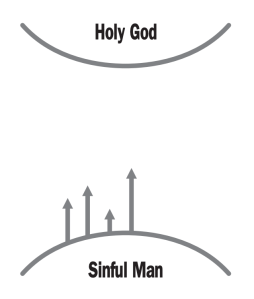
Notice the diagram to the right. God is holy and man is sinful and there’s a great chasm that separates man from God. The arrows illustrate that man continually tries to reach God through various efforts, such as religion, good works, etc. But all of these efforts ultimately fall short because God is perfectly holy, and there is no amount of good works that will enable man to achieve God’s standard of perfection.
REFLECT How does your definition of goodness compare or contrast with what the Bible says about goodness?
What is Sin?
The word “sin” is one of those churchy, religious words that many people associate with behaviors that others don’t approve of but we think is no big deal. For example, you may see nothing wrong with drinking while some “uptight, religious people” think drinking is a “sin”.
REFLECT How do you define sin? What do you think sin is?
Sin not just a list of immoral or socially unacceptable behaviors. When Romans 3:23 says that “all have sinned”, the Greek word for sin is actually an archery term.
In a competition, the archer would shoot the arrow and the goal was to hit the bullseye on the target. If the archer missed the bullseye, even if it was only by a fraction of an inch, it was considered an imperfect mark, which was called a sin.
So when the Bible says we’ve all sinned, it means that no matter how hard you’ve tried and no matter how good you think you are, you (and all people) have missed the mark of God’s standard, which is perfect holiness.
That raises the bar quite a bit doesn’t it?
Things are complicated by the fact that God is not only perfectly holy, but He’s perfectly just, and as a result, He must punish sin. He cannot just overlook it or ignore it. Sin is a violation of the very nature and character of God and His goodness, so sin must be punished.
According to Romans 6:23, the punishment, or penalty for sin is DEATH!
For the wages of sin is death, but the free gift of God is eternal life through Christ Jesus our Lord.
You might be thinking, “well we’re all going to die so what does it matter?”
Death here refers to being separated from God. So, the result of sin, or the punishment for sin is that we will experience a separation from God, FOR ETERNITY! This is literally what hell is – the complete absence of God and everything good.
POINT 3: GOD’S PROVISION
JESUS CHRIST PROVIDES THE ONLY SOLUTION TO MAN’S SIN. Through Jesus, the barriers that kept us from experiencing God’s purpose have been removed – we now have access to God and can know Him.
If everyone has sinned and God, in His justice, must punish sin, then it seems as if there is no solution to our problem. We are all seemingly doomed to punishment!
But God, in His goodness, creates a solution that only He can provide. The solution is in His son Jesus.
Christ Died for Us
Romans 5:8 says,
But God showed his great love for us by sending Christ to die for us while we were still sinners.
REFLECT If God can forgive sin, why couldn’t he just declare it to be forgiven? Why do you think Jesus had to die to pay for sin?
Why did Jesus Have to Die?
Why do you think Jesus had to die in order to pay for sin?
Jesus had to die to pay for sin because God’s justice demands that the only valid payment for sin is death.
For the wages of sin is death…Romans 6:23
Jesus died in our place, thus paying the penalty that God’s justice demanded (death) but doing it in a way that allows humankind to avoid the penalty.
The reason that Jesus could do this is because He is God. As God, He has the very righteousness that God requires for those who wish to come into His presence. Through Jesus’ death, we can be forgiven for our sins and not only avoid the penalty for sin, but experience a relationship with God!
Colossians 1:13, 14 says,
For he has rescued us from the one who rules in the kingdom of darkness, and he has brought us into the Kingdom of his dear Son. God has purchased our freedom with his blood and has forgiven all our sins.
Christ Rose from the Dead
Not only did Jesus die for us, but the Bible says that He rose from the dead.
1 Corinthians 15:3-6 states:
For what I received I passed on to you as of first importance: that Christ died for our sins according to the Scriptures, that he was buried, that he was raised on the third day according to the Scriptures, and that he appeared to Peter, and then to the Twelve. After that, he appeared to more than five hundred of the brothers at the same time,
REFLECT If Jesus had never risen from the dead, would it make any difference? What do you think is the significance of the resurrection?
Read this article, He is Risen….Why Does it Matter? to understand the significance of the resurrection to the Christian message.
Jesus is the Only Way to God
In John 14: 6, Jesus says:
“I am the way and the truth and the life. No one comes to the Father except through me.”
Notice that He doesn’t say, “I’m one of the ways, I’m one of the truths, I’m one of the lives. There are lots of ways to get to the Father, but I’m a pretty good way, so check me out, I’m cool!”
NO!
He says, “I am the way, the truth, and the life; no one comes to the Father, but through Me.”
He could say this because He is the only one who has made a valid payment for sin. Hence, only Jesus can take away our sin.
The image above demonstrates that God realized that man could not bridge the gap that separated them because of man’s sin. The distance is too wide. If you think about it, God is infinitely holy so the gap between His holiness and man’s is an INFINITE gap!
Because we could not bridge the gap ourselves, God bridged the gap for us. He sent His son Jesus, who is INFINITELY holy and righteous. Jesus’ death bridges the gap and creates a path for people to come into God’s presence and experience a relationship with Him.
POINT 4: OUR RESPONSE
We each must receive the free gift that Jesus offers – His death as payment for our sins. Only then can we experience His purpose, which is to KNOW Him.
Knowing this information doesn’t make a person a Christian. Even if you agree with everything that has been outlined so far, it doesn’t mean you are a Christian.
What makes a person a Christian is when they respond to the invitation of Jesus to accept Him and His death as a free gift that pays for your sin and provides complete forgiveness.
John 1:12 (NLT) says,
But to all who believed him and accepted him, he gave the right to become children of God.
If you want to become a Christian (a child of God), then you must believe in Jesus and accept Him.
REFLECT What do you think it means to accept Jesus?
We Receive Christ Through Faith
Ephesians 2:8, 9 (NIV) says,
For it is by grace you have been saved, through faith—and this not from yourselves, it is the gift of God— not by works, so that no one can boast.
Accepting Him simply means you accept the free gift that He offers of being saved by His death on the cross. It means that you acknowledge that His death alone can pay for sin and you put your trust in His death to provide forgiveness instead of trusting in your own good works to earn favor with God.
We Receive Christ by Personal Invitation
In Revelation 3:20, Jesus gives this invitation:
Here I am! I stand at the door and knock. If anyone hears my voice and opens the door, I will come in and eat with him, and he with me.
REFLECT What do you think the door represents in this verse? How do you think a person opens the door?
Opening the Door
The door represents your heart (your will). Jesus is inviting you to open yourself up and let Him in. The way you do that is simply by putting your trust in Jesus and His death to save you instead of trusting in your own perceived goodness to “earn” your way into heaven.
KEY QUESTIONS:
Have you ever opened the door of your life and let Jesus in to begin a relationship with Him?
If so, when was that? What were the circumstances that led you to make that decision?
If not, do you want to open the door of your life to Jesus and begin a relationship with Him?
The key to opening the door is to decide to put your trust in Jesus instead of trusting yourself. One way you can express your faith to God is simply telling Him that you want to accept His free gift and you want Jesus to come into your life. We call this prayer. Take a minute right now to express your faith and desire for Jesus to come into your life by repeating the following prayer:
Lord Jesus, I need you. I acknowledge that I am a sinner and there is no way I can earn my way into heaven. I want to trust in Jesus and His death to pay the penalty for my sins and provide forgiveness. I open the door of my life now and I invite Jesus to come in so that I might begin a relationship with Him and know Him. Amen.
Things to Remember…
God’s criteria for who makes it into heaven is not how good you are but whether you have the Son (Jesus).
And this is the testimony: God has given us eternal life, and this life is in his Son. He who has the Son has life; he who does not have the Son of God does not have life. (1 John 5:11-12, NIV)
You can KNOW you have eternal life, if you have the Son.
Jesus defined eternal life as knowing Him (John 17:3). Hence, you can have eternal life if you have the Son – if you have a relationship with Him.
You can have the Son (Jesus), simply by accepting Him and the free gift that He offers – His death on the cross as a payment for all of your sins.
Jesus gives an invitation to everyone. He is standing at the door of each person’s heart. He’s knocking. He wants to come into your life and begin a relationship.
But we have to open the door.
Opening the door is a matter of choosing to put our trust in Jesus instead of trusting in our own goodness. It means that we acknowledge that we have sinned and we cannot earn our way to God. We recognize that Jesus ALONE can pay for sin and we accept the free gift of His death as a payment for our sins.
When we make that decision to open the door to Jesus, we experience complete forgiveness of sin and Jesus enters our life, establishing a relationship with us.
Once we have the Son (Jesus), we have the life, which is defined by Jesus as knowing Him.
QUESTIONS FOR REFLECTION
1. Did you open the door an invite Jesus into your life?
2. Where is Jesus right now in relation to you?
3. After a person receives Christ, what do you think a person has to do in order to keep Jesus in their life? What do you think is required?
4. What questions do you have about the Christian faith?
WHAT NOW?
If you prayed that prayer to invite Jesus into your life, the Bible says that you are a new creation. You are now a child of God!
You can request some free resources and next steps by going to our Prayer Page, giving us your name and writing in the box, “I received Christ and would like to know how to begin growing in my new faith.”
We will respond to you with some resources and help to take some next steps.
Helping out our Cru Military ministry at the FamilyLife Conference in Anaheim
Lately, we’ve been thinking a lot about marriage. In November, Jen and I attended a Weekend to Remember Marriage Conference hosted by FamilyLife. It was excellent. If you haven’t been to one, we highly recommend it.
In February, Jen and I helped out at a Weekend to Remember Conference in Anaheim. There were a number of military couples attending and our Cru Military ministry had a special booth and specific resources to help military families navigate the unique marital struggles they encounter.
In February, our church embarked on a 3 year plan that will lay the foundation for the next 45 years. One of the initiatives that is laid out as part of the “Dream Now” vision is strengthening families. A statistic that was shared is that 70% of all marriages in Orange County end in divorce.
We know all too well how the breakdown of the family has impacted the Young Adults of today. The landscape of families has encountered a seismic shift in the last 40-50 years.
An often quoted statistic about the spiritual influence men have with their family
When I was a kid, I didn’t know anyone whose parents were divorced. Today, divorce is so common that it’s almost strange to meet a Young Adult whose parents are still together.
All of this has created some unique challenges and opportunities when it comes to ministry.
Young Adults are less likely to have a strong extended family to rely on for support, whether it’s emotional or financial.
Because the nuclear family has been so fractured over the past 50 years, many Young Adults are longing for older adults who can provide mentoring and sage life advice that older family members have traditionally provided. I can’t tell you how often a Young Adult has mentioned to me or to Jen that they have nobody in their life who is older with whom they can discuss life issues.
For the last few years, I’ve been very involved in men’s ministry at our church (Jen is also very involved in the women’s ministry). I do some occasional teaching and I give leadership to a group of men who meet early on a weekly basis.
I’ve enjoyed applying all of the ministry training and experience I’ve accrued over the years to help older guys grow in their spiritual lives.
As I’ve connected with men over the years, I’ve realized that spiritually speaking, old guys have the same needs as young guys. Men want to make a difference and they want their lives to count. Men often want to take steps to grow spiritually but many times, they don’t know what to do beyond attending church, giving money and being involved in a small group.
Lately, we’ve been wondering if we can somehow “marry” our day job (Young Adults) with our part-time ministry to older adults.
Young Adults overwhelmingly indicate they want older people in their lives to function as mentors and even spiritual guides.
Older adults often communicate a strong desire to make an impact in others, particularly the younger generation.
Partnering with Cru Military at a Family Life Conference. Multiple ministries collaborating and intersecting.
What if we could help older Christians take steps to mentor and influence the young adults around them?
We’ve actually had this idea for a while but it’s been brought to the forefront more recently as God has provided numerous situations and personal examples that have made this need obvious and undeniable.
Our vision is not just to mentor Young Adults directly, though we are doing that. What we really want to do is to multiply our impact by equipping others, particularly older, wiser and more mature believers to take steps to pour into and impact Young adults. We believe that there is a golden opportunity for those who are entering their golden years!
Perhaps that sounds interesting. If so, let us know. We’d love to hear your thoughts and provide support and help for you to take meaningful steps that would enable you to make an impact in the lives of others!
Thank you for your continued prayers and partnership that enables us to minister to Young Adults…and Old Adults as well!
1“I am the true vine, and my Father is the gardener. 2He cuts off every branch in me that bears no fruit, while every branch that does bear fruit he prunes so that it will be even more fruitful. 3You are already clean because of the word I have spoken to you. 4Remain in me, and I will remain in you. No branch can bear fruit by itself; it must remain in the vine. Neither can you bear fruit unless you remain in me.
5“I am the vine; you are the branches. If a man remains in me and I in him, he will bear much fruit; apart from me you can do nothing. 6If anyone does not remain in me, he is like a branch that is thrown away and withers; such branches are picked up, thrown into the fire and burned. 7If you remain in me and my words remain in you, ask whatever you wish, and it will be given you. 8This is to my Father’s glory, that you bear much fruit, showing yourselves to be my disciples. (John 15:1-8, NIV)
The Daily DAVEotional
Have you ever wondered what the Christian life is all about? For many people, living as a Christian has been reduced to a series of religious activities, such as attending church, being in a bible study and serving in various ministry capacities.
While these activities aren’t bad, Jesus is clear that the goal of the Christian life is to “bear much fruit, showing yourselves to be my disciples.”
So how exactly does one “bear fruit”? HINT – it doesn’t happen because of our religious activities.
In John 15, Jesus gives a picture of fruitfulness by describing the relationship between a vine and its branches.
Being in a more agrarian society, Jesus’ audience likely would have understood the analogy in greater depth than we might, given that most of us probably didn’t grow up on a farm and may never have had much experience with vines or vineyards.
Nevertheless, it’s not a complicated concept to understand. Similar to a tree trunk, which gets its nourishment from a well-developed root system and then delivers it to the branches, a vine is the source of nourishment for the branches that are connected to it.
The key to bearing fruit for a branch is staying connected to the vine. If a branch is disconnected from the vine somehow, it will not produce fruit. Jesus emphasizes this point with the phrase “remain in me”, which he repeats six times in these eight verses.
What does Jesus mean when He says to “remain in me”?
The greek word used here is the word “meno”, the primary meaning of which is to stay in a given place, state or relation. Other words that help define the word “meno” are abide, continue, dwell, endure, be present, remain, and stand.
To remain in Jesus means we are to stay relationally present with Him. That word “dwell” evokes an image of Jesus being present with me in my living room, in my car when I’m driving, at my work place, when I’m out and about, when I’m hanging out with the guys or when I’m alone with no one around me to see what I’m doing. In short, I’m aware of Jesus’ presence in my life wherever I’m at and whatever I’m doing.
You don’t have to be a viticulturalist to know that the natural outcome of a branch that is connected to a vine is fruit. If there is no fruit, you know there is a problem somewhere. The same is true in our spiritual lives. If there is no fruit in your spiritual life, there is a problem.
So what are the problems that might result in a lack of fruit?
Verse 2 says that He “cuts off” branches that don’t produce fruit, while He “prunes” some branches that do bear fruit so that they will be more fruitful.
The Greek word that is translated as “cuts off” in the NIV, and “takes away” in the NASB is the Greek word “airo” which literally means “to lift up”.
In a vineyard, some branches would end up on the ground and would not have access to sunlight. These branches would grow but they wouldn’t produce grapes. Jesus is saying that branches that were lying on the ground would be “lifted up” so that they would have access to sunlight and thus would be able to bear fruit.
It’s easy to think we’re connected to Jesus because our lives are filled with religious activities, but remaining with Jesus means that I understand that He is the onlysource of spiritual life. He is the true vine.
As part of our fallen nature, we all try to fill the needs and cravings in our life in inauthentic ways, whether it’s work, hobbies, money, entertainment, sex or whatever. None of these avenues can truly satisfy us. Only Jesus can provide TRUE spiritual life and nourishment that satisfies and fulfills.
So if you’re not bearing fruit, perhaps it’s because you’re not depending on Jesus alone as your true source of spiritual nourishment and fulfillment. Jesus wants to lift you up out of the dirt and bring you into the light of His word and His truth so that you can begin to bear fruit.
Another possible reason we may be experiencing a lack of fruit is that we need to be “pruned”. Jesus says that He (God the Father) prunes every branch that does bear fruit so that it will bear more fruit.
The word that is translated “prune” is the greek word “kathairo” which means “to cleanse, to prune.” Vinedressers would routinely clean and wash the branches on the vine to rid them of pests that might destroy the leaves and interrupt the fruit-bearing process.
If you’re lacking fruit in your life, perhaps you need Jesus to cleanse you. In other words, maybe there is a sin issue that is keeping you from being fully dependent on Jesus and as a result, is negatively impacting your ability to bear fruit in your life.
Are you starting to get the picture? Jesus wants us to bear fruit, just as a branch connected to a vine would produce fruit.
But we are unable to produce fruit on our own. Only Jesus can produce fruit. We bear fruit if we simply stay connected to Him in a dependent relationship.
If we are lacking fruit, it is likely because we are depending on something apart from Jesus to provide fulfillment in our lives.
Did you enjoy this post? I’d love to hear your thoughts! Feel free to like, leave a comment below, and share it with your friends or on social media if you found it helpful or interesting. Your support keeps the conversation going!
Reflection
What are some of the inauthentic ways you seek to fulfill the needs and cravings in your life?
Describe a time when you realized that you were not producing fruit? What was happening in your life? What caused you to realize that you were not fruitful?
What are some practical ways you can seek to remain in Jesus? How do you demonstrate your dependence on Him?
What do you think spiritual fruit is? How do you define it? What does it look like in your life to produce “fruit”?
What are the religious activities you are regularly involved in? In what ways are these activities helping you grow in your dependence on Jesus? How can you avoid falling into the trap of thinking that these religious activities alone will produce “fruit” in your life?
16But I say, walk by the Spirit, and you will not carry out the desire of the flesh. 17For the flesh sets its desire against the Spirit, and the Spirit against the flesh; for these are in opposition to one another, so that you may not do the things that you please. 18But if you are led by the Spirit, you are not under the Law. 19Now the deeds of the flesh are evident, which are: immorality, impurity, sensuality, 20idolatry, sorcery, enmities, strife, jealousy, outbursts of anger, disputes, dissensions, factions, 21envying, drunkenness, carousing, and things like these, of which I forewarn you, just as I have forewarned you, that those who practice such things will not inherit the kingdom of God. 22But the fruit of the Spirit is love, joy, peace, patience, kindness, goodness, faithfulness, 23gentleness, self-control; against such things there is no law. 24Now those who belong to Christ Jesus have crucified the flesh with its passions and desires.
25If we live by the Spirit, let us also walk by the Spirit. 26Let us not become boastful, challenging one another, envying one another.
(Galatians 5:16-26, NASB)
The Daily DAVEotional
The letter to the Galatians was written to a church that was struggling with Jewish legalism. Some Pharisees who had accepted Jesus as the Messiah were telling the Galatians that it wasn’t enough to believe in Jesus to be saved; they were teaching these recent Gentile converts that they must also adopt all of the Jewish legal rituals as well. Basically, they were telling them that they needed to convert to Judaism if they wanted the Jewish Messiah to be valid for them.
This was a huge controversy in the early church. The issue revolved around what is necessary to be saved. The essential question that needed to be answered was, “do Gentiles have to become Jewish in order to accept Jesus as their Messiah?”
This controversy became so polarizing that the early church convened a Council to address the issue and decide on the matter. I wrote about that in my blog post “A Pivotal Council in the Early Church”. The summary is that the early church leaders unanimously agreed that Gentile converts did not need to become Jewish in order to be saved. Jesus was enough and adherence to all of the Old Testament rituals and legal requirements was not necessary.
That didn’t stop these false teachers though from infiltrating churches and spreading their skewed version of the gospel, which was not really good news at all.
In this section of his letter, Paul is expounding on his argument that following the Law could never save anyone, which is why Jesus came in the first place.
We really have only two choices when it comes to salvation. We can seek to gain God’s favor through our own human efforts, our flesh, or we can seek God’s favor by following the Spirit. Paul says that these two options are diametrically opposed to one another and they yield completely different results.
In fact, the only way one can experience real transformation is by following the Spirit, or, as Paul puts it, walking in the Spirit. What exactly does it mean to walk in the Spirit?
There are three words and phrases in this passage that give clarity to the idea of walking in the spirit.
In verse 16, Paul says that if we “walk by the Spirit” we “will not carry out the desire of the flesh.” The NIV translation is slightly different, encouraging us to “live by the Spirit”.
What comes to your mind when you think about going on a walk? Typically, I think about a relaxing walk in nature or on the beach or in a serene location with my wife or a trusted friend. The idea is that there is a connection and a reliance on God when we are walking with Him.
The second word that gives clarity to walking in the spirit is in verse 18, which says “if you are led by the Spirit, you are not under the Law.”
The Holy Spirit is a guide. He leads us. I think about being on a hike in a national park where there is an experienced guide leading us along a path. Because they are familiar with the terrain and all of the trails, they serve as a leader, showing us the way to our destination while alerting us to dangers and pitfalls along the way.
The third word that gives clarity to “walking in the Spirit” is in verse 25, which says, “If we live by the Spirit, let us also walk by the Spirit.” Interestingly, the word “walk” in this verse is not the same word used for “walk” in verse 16. The NIV translates it this way:
Since we live by the Spirit, let us keep in step with the Spirit.
This word translated “walk” in the NASB is translated “keep in step” by the NIV. The word is really a military term that describes soldiers as they are marching together.
If you’ve ever seen a military parade, or even a marching band, you know that there is a leader, a drill sergeant or a drum major, who is giving commands that others follow. There is a rhythm and a synchronicity that exists between the leader and the followers.
Walking in the Spirit is a conscious act whereby we, as followers, willingly put ourselves in a subservient position, taking our cues from the Lord as our companion and guide. We don’t resist or question His orders and directives, but we keep in step and rhythm with where He’s going and what He’s doing.
Paul says that the natural result of walking in the spirit is that we will bear the fruit of the Spirit – our character will begin to transform, taking on God’s selfless character instead of the selfish, ungodly character that our flesh produces.
Reflection
How is life like a walk?
Think about a time you went on a relaxing walk. Who was with you? Where were you? What words would describe your emotions and your demeanor. What made it so refreshing?
What does it mean to be led by someone? What is required on our part in order to be led by someone else?
What characterizes soldiers as they march? How do you think you can “march” in step with the Spirit?
22“If someone has committed a crime worthy of death and is executed and then hanged on a tree, 23the body must never remain on the tree overnight. You must bury the body that same day, for anyone hanging on a tree is cursed of God. Do not defile the land the LORD your God is giving you as a special possession. (Deuteronomy 21:22-23, NLT)
Galatians 3
1Oh, foolish Galatians! What magician has cast an evil spell on you? For you used to see the meaning of Jesus Christ’s death as clearly as though I had shown you a signboard with a picture of Christ dying on the cross. 2Let me ask you this one question: Did you receive the Holy Spirit by keeping the law? Of course not, for the Holy Spirit came upon you only after you believed the message you heard about Christ. 3Have you lost your senses? After starting your Christian lives in the Spirit, why are you now trying to become perfect by your own human effort? 4You have suffered so much for the Good News. Surely it was not in vain, was it? Are you now going to just throw it all away?
5I ask you again, does God give you the Holy Spirit and work miracles among you because you obey the law of Moses? Of course not! It is because you believe the message you heard about Christ.
6In the same way, “Abraham believed God, so God declared him righteous because of his faith.” 7The real children of Abraham, then, are all those who put their faith in God.
8What’s more, the Scriptures looked forward to this time when God would accept the Gentiles, too, on the basis of their faith. God promised this good news to Abraham long ago when he said, “All nations will be blessed through you.” 9And so it is: All who put their faith in Christ share the same blessing Abraham received because of his faith.
10But those who depend on the law to make them right with God are under his curse, for the Scriptures say, “Cursed is everyone who does not observe and obey all these commands that are written in God’s Book of the Law.” 11Consequently, it is clear that no one can ever be right with God by trying to keep the law. For the Scriptures say, “It is through faith that a righteous person has life.” 12How different from this way of faith is the way of law, which says, “If you wish to find life by obeying the law, you must obey all of its commands.” 13But Christ has rescued us from the curse pronounced by the law. When he was hung on the cross, he took upon himself the curse for our wrongdoing. For it is written in the Scriptures, “Cursed is everyone who is hung on a tree.” 14Through the work of Christ Jesus, God has blessed the Gentiles with the same blessing he promised to Abraham, and we Christians receive the promised Holy Spirit through faith. (Galatians 3:1-14, NLT)
The Daily DAVEotional
In 1956, Jalacy “Screamin’ Jay” Hawkins recorded his most famous song, “I Put a Spell on You.” The song (which you can listen to here) became a cult classic that’s been covered by a number of artists over the years, including Nina Simone, Annie Lennox and Alan Price.
To have a spell put on you means that you’re completely held by something, whether a person or an idea. Dictionary.com describes it as “a state of being enchanted, entranced or fascinated.”
In this 3rd chapter of Paul’s letter to the Galatians, Paul is asking the question, “who put a spell on you?” Paul is so dumbfounded by the change he has seen in how the Galatians are living out the Christian life that it’s as if they have been put in a trance by an evil trickster posing as a servant of Christ.
The issue that Paul was addressing is highlighted in verse 3 where Paul says, “Have you lost your senses? After starting your Christian lives in the Spirit, why are you now trying to become perfect by your own human effort?” [emphasis added]
This problem is one that is actually pretty commonplace among believers even today. Many Christians place their faith in Christ to BEGIN the Christian life, and then resort to a works based system in order to MAINTAIN the Christian life.
Paul is saying that this approach to the Christian life is so contrary to the actual gospel message that it’s EVIL.
Twice in the first 5 verses Paul asks the question: did you receive the Holy Spirit by keeping the Law? The question is rhetorical in nature, but Paul answers it anyway with an emphatic NO!
How does a person receive the Holy Spirit? Through belief, or “by faith”.
If you are a Christian, you came to Christ by placing your faith, or trust, in Jesus to pardon your debt of sin and provide forgiveness through His death on the cross. This is why Paul, in the very first verse, references the cross of Christ. Every Christian who has ever existed has come to Christ in the same way, by believing in Jesus and His death on the cross as a payment for personal sin.
According to Ephesians 1:13, at the moment of belief in Christ, all Christians receive the promised Holy Spirit, who comes to live inside the life of the new believer.
The problem for many Christians is what follows that initial conversion experience. After beginning the Christian life by placing their faith in Christ, many Christians fail to continue the Christian life in faith, empowered by the Spirit. Instead, they opt for a rules-based approach in which they seek to please God through their “human effort” (see verse 3).
This was not just a problem with the Galatians. Paul also addressed this issue in Romans 4. I wrote about it in my blog post, “How Good Do You Have to Be to Be Saved?”
This problem persists today as well.
In our rebelliousness, we desire to make ourselves the center of the universe. Most religions are man-centered, meaning that the religion is centered around human effort and good deeds.
Biblical Christianity, on the other hand, is God-centered. It is the ONE major religion or philosophy that does not depend on what man DOES but is instead ordered around what God DID via Christ’s death on the cross.
The issue with the Galatians was that while they began the Christian life in the Spirit by faith, they sought to maintain their standing with God by following the Law, the Jewish religious code.
Paul reasons that if you didn’t come to Christ by adhering to the Law, why are you trying to maintain your relationship with God by adhering to the Law?
Essentially, Paul is saying that you can’t mix and match these two approaches. They started out with a God-centered approach based on faith but then shifted to a man-centered approach based on human effort. This makes no sense. If you want to base it it on adhering to the Law, you will have to obey the whole Law. Otherwise, you are under a curse.
The other option is to base your approach on faith, which is preferable, because in this approach, Jesus was a curse for us via his death on the cross (see verse 13).
By switching from a God-centered approach back to a man-centered religion (the Law) as a means of seeking God’s approval, you are invalidating the whole reason why Christ was necessary in the first place, which is why Paul asks the Galatians, “Are you now going to just throw it all away?”
The Christian life is a life of faith. We don’t just come to Christ by faith. We live the Christian life by faith as well. In this way, God is the center at all times.
If you are under the impression that we come to Jesus by placing our faith in Him but then we must follow some sort of religious moral code in order to keep our standing with God, well then Paul’s question to the Galatians extends to you – who put a spell on you? That is not just a minor misunderstanding or small theological difference of opinion. Paul says this ideology is evil and man-centered, designed to keep people living as slaves instead of living in freedom and experiencing true transformation.
Reflection
What is your reaction to the idea that we are under the curse of the Law, but Jesus, by hanging on a tree, became a curse for us? What imagery does this create in your mind? What thoughts and emotions does it provoke?
What do you think are the reasons why Paul calls the Galatians approach to the Christian life evil?
What are some examples you can think of in which people tend to make Christianity man-centered instead of faith-based and centered on God?
What do you think it looks like practically to continue the Christian life in faith instead of human effort?
10But although the world was made through him, the world didn’t recognize him when he came. 11Even in his own land and among his own people, he was not accepted. 12But to all who believed him and accepted him, he gave the right to become children of God. 13They are reborn! This is not a physical birth resulting from human passion or plan—this rebirth comes from God. (John 1:10-13, NLT)
The Daily DAVEotional
I’ve been a Christian for a long time and ever since I can remember, I was told that becoming a Christian, or getting “saved” was simply a matter of “accepting” Jesus into your heart.
Not too long ago, I saw the above photo from one of my Facebook friends who regularly shows up in my feed. I respect Voddie Baucham as a teacher so I was curious about the context of the quote that seems to indicate that the idea of “accepting Jesus” is unbiblical.
Is it true that the New Testament nowhere mentions salvation being about “accepting Jesus”?
I think the short answer to that is NO.
John 1:12 is the most clear verse that would challenge that assertion as John states:
But to all who believed him and accepted him, he gave the right to become children of God. [emphasis added]
Now to be fair, my Scripture reference is from the New Living Translation (NLT) which is the only translation I’m aware of that uses the phrase “accepted him.” Most other translations, including the NIV, King James, NASB, ESV and others, all use the phrase “received him“. So I suppose it’s possible, if you exclude the NLT, that one could argue that the Bible doesn’t say anything about “accepting Jesus” when it comes to salvation.
In my mind, though, this could be considered theological nit-picking. It seems apparent to me that the words “accept” and “receive” are synonyms. So why make the argument that salvation has nothing to do with “accepting Jesus”?
Honestly, I could not find a link to the sermon in which Dr. Baucham made the quoted statement, so it’s hard to know exactly what he’s getting at or why he felt compelled to make the statement in the first place.
The problem sometimes with sound-bite quotes is that you don’t always get the context and so the quote can appear to be saying something entirely different than what the author was really intending to communicate.
I can say, however, that in my many years of ministry, this is not the first time I have heard someone make a statement like this. So I’ll address the statement as I’ve heard it shared from others, not necessarily from Dr. Baucham’s perspective, which, as I’ve stated, I was not able to clearly determine.
In my experience, the argument that salvation is not about just “accepting Jesus” is often made by those who are seeking to address the problem of spiritual mediocrity within the church.
An overwhelming number of people claim to be Christians and yet, as we look around at the landscape of our culture, it’s hard to imagine that there are really that many people who legitimately ARE Christians. In other words, the lifestyles of most people do not seem to indicate that most people are indeed Christians.
So what is the problem?
Some people would argue that a major problem is in our evangelistic message – that we are not calling people to repentance but instead, we’re peddling a soft message that requires little to no commitment. Note that Dr. Baucham’s quote appeals to the need to “repent and believe.”
The argument is that if we tell people that salvation is simply a matter of “accepting Jesus” into their life, we’re giving them the impression that being saved is merely a verbal transaction where, if we say the right words, and “ask Jesus into our hearts”, we can escape the punishment of hell and then go on our merry way doing whatever we were doing.
This kind of approach, the argument goes, lacks commitment and ultimately is not transformational. Instead of producing mature believers whose lives reflect Jesus, it produces worldly people who think of themselves as Christians simply because they said “the sinner’s prayer.”
The oft-suggested solution to this perceived problem is to refrain from telling people that salvation is about “accepting Jesus” and instead, communicate that it’s about a higher level of commitment that requires repentance.
As I see it, there are two problems with this solution.
The first problem is that the idea of “accepting Jesus” logically includes the idea of repentance.
Repentance literally means to turn and change direction. One cannot legitimately accept Jesus while maintaining the view that they can earn their salvation through their own good works.
Accepting Jesus is NOT just saying some prescribed prayer. It requires an attitude of humility that recognizes we fall short because of our sin and that Jesus is the ONLY one who can offer forgiveness through His shed blood on the cross.
Accepting Jesus, or receiving Christ, means that we accept the free gift of salvation that Jesus offers to all people. How do we do this? Ephesians 2:8-9 says that we do this by faith.
What that means is that I literally change direction (repentance). Instead of my former course where I trusted in my own good works to earn God’s favor, I now choose a new course, where I place my trust in Jesus alone to provide forgiveness and to save me from the penalty of my sins.
There’s a second problem with the solution of saying we should refrain from saying that salvation is about “accepting Jesus”. The second problem is that even if we were to stop talking about “accepting Jesus” and even if we were to convince everyone to use the different language of “repent and believe” in our evangelistic presentations, there is no reason to believe that the outcome would be any different than it already is.
The reason for this is because spiritual mediocrity in the church is largely a reflection of the hearts of people rather than the specific wording of the evangelistic messages that are being promoted. Mark 4 tells us that there are 4 different soils that represent the different heart attitudes of people who hear the message of the gospel. (See my blog post: Which Soil Are You?)
Sharing a message of “Repent and Believe” to a person who has a hard heart, rocky heart or thorny heart is likely to yield the same result as sharing a message of “Accept Jesus”. Regardless of the specific verbiage of your message, the outcome will be the same, because it is already determined by the heart condition of the hearer.
Please note that I’m not saying that our evangelistic message and approach doesn’t matter. Our message should be biblically correct. However, the idea that one biblical approach will produce better results than another, equally biblical approach is wishful thinking and places too much emphasis on the sower for the results.
There is no silver bullet message or approach that will guarantee the hearer will become a fruitful Christian.
In addition, since we know that spiritual mediocrity among professing believers has been a problem since the outset of the church, it stands to reason that it’s an issue of discipleship more than evangelism. The issue was addressed repeatedly in the New Testament and has been a source of controversy for 2000 years. We’re not likely to see a change in this phenomenon, though we should certainly do our best to disciple believers to maturity, just as the apostles did.
The most important thing we can do when communicating with a non-Christian is to give a clear and understandable explanation of what Jesus is offering. (See my blog post: What Does it Look Like to Follow Jesus?)
I think it’s clear that linking salvation to the idea of “accepting Jesus” is not unbiblical, as long as we help the hearer understand that accepting Jesus involves repenting of our sins and believing in Jesus as our one and only Savior.
Reflection
What has been your understanding of the idea that people must “accept Jesus” in order to be saved? What are they accepting?
What do you think are the main reasons why some Christians don’t grow? How should we change our evangelistic approach to ensure greater fruitfulness among believers?
Do you agree with the statement by the author of this blog that mediocrity among professing Christians is more a result of discipleship than evangelism? What are your reasons for agreeing or disagreeing?
How can we disciple others to greater levels of maturity and fruitfulness? What steps can be taken? What resources do you think are needed?
1It was now two days before the Passover celebration and the Festival of Unleavened Bread. The leading priests and the teachers of religious law were still looking for an opportunity to capture Jesus secretly and put him to death. 2“But not during the Passover,” they agreed, “or there will be a riot.”
3Meanwhile, Jesus was in Bethany at the home of Simon, a man who had leprosy. During supper, a woman came in with a beautiful jar of expensive perfume. She broke the seal and poured the perfume over his head. 4Some of those at the table were indignant. “Why was this expensive perfume wasted?” they asked. 5“She could have sold it for a small fortune and given the money to the poor!” And they scolded her harshly.
6But Jesus replied, “Leave her alone. Why berate her for doing such a good thing to me? 7You will always have the poor among you, and you can help them whenever you want to. But I will not be here with you much longer. 8She has done what she could and has anointed my body for burial ahead of time. 9I assure you, wherever the Good News is preached throughout the world, this woman’s deed will be talked about in her memory.” (Mark 14:1-9, NLT)
The Daily DAVEotional
Have you heard of this idea known as virtue signaling? While the phrase may be fairly recent, the concept is as old as man.
Virtue signaling is when a person makes a comment or does something in public to try to make themselves appear virtuous when the truth often is the exact opposite of the claim they are trying to make.
Virtue signaling has become especially popular with the rise of social media, which has given people a wider platform to broadcast their “virtuous character.”
It’s not uncommon for those who “virtue signal” to draw attention to themselves by pointing to the supposed lack of virtue in others.
This is the situation in Mark 14.
In this passage, a woman comes to Jesus with a very expensive jar of perfume and she proceeds to pour the jar over Jesus’ head.
The value of the perfume was about 300 denarii. ONE denarius was equivalent to a typical day’s wage, which means that this one jar of perfume was worth almost an entire year’s worth of wages.
The text says that there were those who were there to witness this act who were INDIGNANT.
To be indignant is to be extremely angry or annoyed because of some perceived unjust or unfair treatment.
From this passage, we don’t know who these people are that were indignant but John 12:4-6 gives us additional insight into the context:
4But Judas Iscariot, one of his disciples—the one who would betray him—said, 5“That perfume was worth a small fortune.It should have been sold and the money given to the poor.” 6Not that he cared for the poor—he was a thief who was in charge of the disciples’ funds, and he often took some for his own use.
So here we have it – Judas is upset that this expensive jar of perfume is being poured out over Jesus’ head. He chastises the woman for being wasteful and having wrong priorities. He claims that this expensive perfume should have been sold so that the poor could be taken care of. Essentially, he’s accusing this woman of not caring about the poor. In his mind, why else would someone waste a whole year’s worth of money on something as unnecessary as a jar of perfume?
The reality is that Judas didn’t care about the poor; he just wanted others to think that he did. What better way to draw attention to his “care” for the poor than to scold a woman who had the means to give a significant sum to the poor but didn’t?
The text indicates that Judas’s real motive was himself. As the treasurer, he often helped himself to some of the money. Judas saw this extravagant act by this woman as a missed opportunity for himself.
It’s not likely that many people read this passage and identify with Judas. After all, John tells us that Judas had an ulterior motive – he was a thief. And we also know that Judas betrayed Jesus. For most of us, we don’t think of ourselves as anything like Judas.
But I think that most of us are more like Judas than we would care to admit.
Be honest. How do you react when you hear of someone spending what would cost you a year’s worth of work on something as unnecessary and trivial as a bottle of perfume?
In my experience, I see more people responding like Judas.
For some reason, we tend to have this idea that our standards are normal and reasonable while those who are living beyond our standards must be greedy or gluttonous. We attribute sinful motives to those who don’t think and act exactly as we might in a given situation.
This is true of Judas. He sees this expensive perfume as being needless and wasteful and he assumes that by pointing this out to the group he will be praised and honored. But he doesn’t get the response that he expects.
Instead of vilifying the woman and praising Judas, Jesus honors the woman and rebukes Judas.
Apparently, what Judas sees as needless and wasteful, Jesus sees as having an honorable and good purpose.
I think there are two lessons here from this passage.
First, I should be careful not to assign sinful or dubious motives to those whose lifestyle is more “expensive” than mine. It’s possible that the items that I think are wasteful and unnecessary can actually have an honorable purpose and be used in such a way that God is honored and glorified.
Secondly, I should be careful not to castigate others whom I know next to nothing about. Just because a person has more money than I do and might spend some of it on things I never would doesn’t mean they can’t care about things that are important to God’s heart. After all, nobody cares more about the poor than Jesus does and He has no problem with this woman taking an expensive jar of perfume and using it for His benefit.
Ironically, we don’t demonstrate ourselves to be virtuous if we have to disparage others to prove how much better we are than them. While it’s always easy to point the finger at others, we should be more concerned with caring for and cultivating our own heart toward God than pointing out all the flaws we perceive in others, especially when our primary intent is to make ourselves look good to others.
Reflection
What is your reaction and response to people whose lifestyle is more extravagant than yours? Have you ever found yourself questioning the things they own and value as wasteful and needless?
When is a time when you questioned another person’s “virtue” because they bought or owned something that you saw as unnecessary or needless? When have you responded like Judas to another person’s choice?
What is your reaction to the fact that Jesus honors and praises the woman who uses a whole bottle of perfume, that cost a year’s worth of wages, on Him?
How do you reconcile the fact that God loves and cares for the poor more than you or I could and yet He says, “you will always have the poor among you.”?
What steps are you taking to cultivate your own heart to ensure you are become a true person of virtue? How do you think a person would go about becoming more virtuous?
18“When the world hates you, remember it hated me before it hated you. 19The world would love you if you belonged to it, but you don’t. I chose you to come out of the world, and so it hates you. 20Do you remember what I told you? ‘A servant is not greater than the master.’ Since they persecuted me, naturally they will persecute you. And if they had listened to me, they would listen to you! 21The people of the world will hate you because you belong to me, for they don’t know God who sent me. 22They would not be guilty if I had not come and spoken to them. But now they have no excuse for their sin. 23Anyone who hates me hates my Father, too. 24If I hadn’t done such miraculous signs among them that no one else could do, they would not be counted guilty. But as it is, they saw all that I did and yet hated both of us—me and my Father. 25This has fulfilled what the Scriptures said: ‘They hated me without cause.’ 26“But I will send you the Counselor—the Spirit of truth. He will come to you from the Father and will tell you all about me. 27And you must also tell others about me because you have been with me from the beginning.
(John 15:18-27, NLT)
The Daily DAVEotional
Have you noticed that there is a lot of hate in our culture today. A LOT.
What I find interesting is that our culture seems to have redefined what the word hate even means. If you disagree with someone, you are quickly labeled a “hater.”
This is very problematic for Christians because we believe that Jesus has given us moral guidelines to live by and to promote as good for our society at large.
But many of the moral guidelines Christians hold to are not accepted by our culture. So what is the response? Christians are labeled as haters.
There are lots of names that can be found in the hate bucket. Racist, Sexist, Misogynist. Homophobic. Transphobic. Judgmental. Hypocritical.
There is no doubt that there are those who identify as Christians who are racist, or sexist or judgmental, or any number of other labels. ALL have sinned. ALL do sin. We should be honest about that and appeal to Jesus to not only forgive but transform.
Still, no matter what you say or do, some are going to hate you. This should not surprise us as Jesus Himself warned that this would be the case.
And yet, I find that many Christians cannot stomach the fact that the world hates them. So what is the response? For many, the response is accommodation. I see quite a number of Christians, churches and denominations who are changing their theology, their moral stances and in some cases, their entire worldview – all so that they won’t be hated by others.
And while the culture has redefined what hate is, I think many believers have redefined what love is. In a desperate attempt to not be seen as any of the “hate” words listed above, I see long-standing, biblical beliefs and moral principles being accommodated and compromised, in the name of “love”. The thinking for many is that if others hate you, then you must not be “loving.”
Nothing could be further from the truth. Loving people has nothing to do with getting them to like you. This passage is a proof text for that. Jesus was and is the most loving person who ever lived and yet He was hated so much that He was crucified by His haters. His love for them was not enough to get them to “like” Him.
In this passage, Jesus implores His followers to recognize this same principle. Some people are so hard-hearted toward God that anyone who represents Him or reflects His moral guidance is a target for personal wrath and ire. We cannot avoid this. We simply must endure it.
Fortunately, Jesus sends us the Counselor, the Spirit of TRUTH, who gives us the courage to tell others about Jesus and empowers us with the strength to endure the hatred that may be directed toward us.
Reflection
As Christians, we are commanded to love others. What do you think that looks like? How do you love people who hate you and what you stand for?
When Jesus says that the world will hate His followers, what do you think that means?
How do you think Christians should respond to hate they experience from the world?
Do you think it’s possible for Christians to be liked by the world? Why or why not?
Jesus says that we are to tell others about Him. What exactly about Jesus do you think we are to communicate? What do you think are the best ways to communicate about Jesus to others?