Fact-Checking and Misinformation in the New Testament

Acts 17

10That very night the believers sent Paul and Silas to Berea. When they arrived there, they went to the synagogue. 11And the people of Berea were more open-minded than those in Thessalonica, and they listened eagerly to Paul’s message. They searched the Scriptures day after day to check up on Paul and Silas, to see if they were really teaching the truth. 12As a result, many Jews believed, as did some of the prominent Greek women and many men. (Acts 17:10-12, NLT)


The Daily DAVEotional

The advent of social media has completely changed the landscape of how information is disseminated to the masses. Prior to social media, people relied primarily on what is now known as “legacy media” – national broadcast news networks and major metropolitan newspapers.

But now with social media, anyone and everyone can be a journalist, investigative reporter, podcaster or blogger. Competing ideas and opinions abound, making it increasingly more difficult to separate fact from fiction.

With such an affluence of free-flowing information, two terms have been introduced into the mainstream cultural vernacular in recent years – misinformation and disinformation. These terms have primarily been used by politicians and pundits on both sides of the aisle to label the speech and narratives of their opponents as false. Alarmingly, our own government has cited “misinformation” as a basis for seeking to censor the speech and thus limit the reach of those whose ideas and beliefs are not aligned with the official position of the party in power.

This effort to limit speech has been evident in the last few political cycles, through an increased effort to put pressure on social media platforms to limit and even censor speech that is deemed as “misinformation”.

But who exactly determines what is misinformation?

Social media outlets have employed “fact-checkers” to determine what information is accurate and what should be labeled as “misinformation”.

A fact-checker is someone who evaluates the truthfulness of a statement and then renders a judgment. These fact-checkers are expected to be neutral but the problem, as we’ve seen, is that they’re rarely unbiased. Who then fact-checks the fact-checkers?

In this segment of Acts 17, the Bereans are commended for their ability to fact-check the information that was being promoted.

Paul was a missionary who traveled throughout Asia Minor proclaiming the message of Christ and planting churches among those who believed his message.

But just like today, there was no shortage of ideological grifters and religious charlatans traveling from village to village looking for a market to sell their ideological snake oil.

With so many traveling religious preachers, how does one determine who, if anyone, is telling the truth?

The Bereans were commended because they “fact-checked” Paul’s message by “searching the Scriptures” to determine it’s veracity.

“The Scriptures” in this case refers to the Old Testament. The Bereans listened intently at Paul’s message and “day after day” they checked the message and compared it to what they already knew was true – the Old Testament Scriptures.

Fact-checking is a good thing, as long as the facts are being checked honestly against an objective, truthful standard. As we’ve seen recently, people are often biased, meaning they are rarely objective and often will stretch the truth, or in some cases, even deny the truth in order to fit their own biases.

But God’s word is both objective and true because it is the very word of God, who is by definition, truth.

So if you really want to check your facts, be sure they are not misaligned with what the Scriptures say. If they are, you can be certain that your facts are indeed “misinformation”.


Did you enjoy this post? I’d love to hear your thoughts! Feel free to like, leave a comment below, and share it with your friends or on social media if you found it helpful or interesting. Your support keeps the conversation going!


Reflection

What are some beliefs and ideas that you may tend to hold more because of your own personal  bias than the fact that it is true?

What is the standard that you use to determine if a religious statement is true or not?

What examples have you seen in your own experience of fact-checkers who were too biased to be trusted?

How do you think it’s possible that two different people can evaluate the same “facts” and arrive at completely different conclusions?

How can you ensure that you are not being misled and falling for misinformation when it comes to some of the ideological narratives that are being promoted in our culture?


Photo by Samuel Regan-Asante on Unsplash

Can You Make the Bible an Idol?

Psalm 119

16I delight in your decrees; I will not neglect your word.

20My soul is consumed with longing for your laws at all times.

24Your statutes are my delight; they are my counselors.

40How I long for your precepts! Preserve my life in your righteousness.

43Do not snatch the word of truth from my mouth, for I have put my hope in your laws.

47for I delight in your commands because I love them.

48I lift up my hands to your commands, which I love, and I meditate on your decrees.

70Their hearts are callous and unfeeling, but I delight in your law.

72The law from your mouth is more precious to me than thousands of pieces of silver and gold.

77Let your compassion come to me that I may live, for your law is my delight.

92If your law had not been my delight, I would have perished in my affliction.

97Oh, how I love your law! I meditate on it all day long.

103How sweet are your words to my taste, sweeter than honey to my mouth!

111Your statutes are my heritage forever; they are the joy of my heart.

113I hate double-minded men, but I love your law.

119All the wicked of the earth you discard like dross; therefore I love your statutes.

120My flesh trembles in fear of you; I stand in awe of your laws.

127Because I love your commands more than gold, more than pure gold,

129Your statutes are wonderful; therefore I obey them.

140Your promises have been thoroughly tested, and your servant loves them.

143Trouble and distress have come upon me, but your commands are my delight.

159See how I love your precepts; preserve my life, O LORD, according to your love.

163I hate and abhor falsehood but I love your law.

165Great peace have they who love your law, and nothing can make them stumble.

167I obey your statutes, for I love them greatly.

174I long for your salvation, O LORD, and your law is my delight.

(Psalm 119 – selected verses, NLT)

NOTE: Psalm 119 is the longest chapter in the entire Bible. I’ve included selected verses that reflect the content of this blog post


The Daily DAVEotional

A while back, I read a social media post from a person with a sizable following in which he exhorted people, “Don’t make the Bible an idol.”

My first thought was, “what does that even mean?”

Is it possible to make the Bible an idol? What would that even look like?

I immediately thought about this Psalm (119), which is the longest chapter in the entire Bible and is an extended discourse on the wonders and virtues of God’s word. I’ve written about this Psalm before in my post “The Endless Virtues of God’s Word.”

It’s well worth your time to read the entire Psalm but due to the sheer length of the text, I’ve only included selected verses that highlight the devotion, awe and love that the psalmist has for God’s word.

If ever someone might be accused of worshiping God’s Word and making it an idol, it would be the author of Psalm 119. Notice some of the language he uses to express his feelings about God’s laws, statutes and precepts.

Words like delight, love, long, hope, consumed, sweet, joy, precious and awe are all used to describe how the psalmist feels about God’s laws.

There is clearly a reverence and respect and a deep LOVE for God’s word. But does that equate to idol worship?

To answer that question, we need to understand what idol worship is.

I wrote in a previous blog post, “A Discourse on the Foolishness of Idols” that an idol can be thought of as a substitutionary object of trust. Instead of trusting in God as your deliverer, your provider, your protector, your source of life, your savior, etc, you transfer that trust to something or someone else.

But you can also think of an idol as anything that takes priority or precedence in your heart over God.

So how about this Psalmist? Is he guilty of idol worship? Is it possible to elevate the Bible to a position over God in our lives?

I suppose that if I were to worship the physical book of the Bible as if it were a deity itself, I could be accused of idol worship. But I don’t think that is what’s happening with the psalmist.

The word of the Lord – his law, precepts, ordinances and statutes – are all merely an extension of God Himself. They are not God, but they are a revelation of the character of the true God.

When the psalmist says he loves God’s law, and he delights in His word, he’s making a statement about God’s character. He’s acknowledging that God’s word is a source of revelation about God’s nature and in it, God has provided wisdom and instruction for righteous living.

God’s word tells us who He is and how we’re to live. The psalmist simply acknowledges these facts. Moreover, he’s speaking directly to God when he makes these statements. Therefore, the praise and adoration is directed toward God and not some inanimate scroll.

Think of it this way – let’s say you read a book that you really loved. Then one day you meet the author at a book signing. While you’re at the table, you go on and on about how much you loved the book. You share that the character development, plot lines and context were all relatable and engrossing. Do you think the author will be offended because you praised his/her work and not the author directly? No, the book is an extension of them and it is obvious to all that your praise is directed toward the author.

That is exactly what is happening in this psalm. The psalmist is simply recognizing that God’s laws and statutes are righteous and life-giving.

So why would this online social media influencer bark out that we should not make the Bible an idol? Why is this even a concern?

My desire to answer this question led me down an online rabbit hole. This particular influencer, and others who also warn that we should not make the Bible an idol, belongs to a strain of religious faith that is known as Progressive Christianity.

Progressive Christianity uses the word “Christianity” but it is hardly Christian. While they utilize the same language and reference the same characters as traditional Christianity, they redefine the meaning of words, concepts and even characters in order to suit their own theological preferences.

Progressive Christians occupy a broad spectrum of beliefs but there are some things that tend to be common among most who identify themselves as being a part of this camp.

Perhaps the hallmark value of Progressive Christianity is their view that God is always evolving. Hence, there is an emphasis on searching and questioning, while those claiming to know truth may be labeled as unenlightened or immature.

Progressive Christianity tends to be very ecumenical, embracing all faith religions and ideologies as equally valid and helpful. Loving others means you shouldn’t offend others by telling them that their beliefs might be wrong. Hence, Jesus has been recast from His role as exclusive Savior of the world to that of a moral teacher whose example we’re to follow.

Standing in contrast to Progressive Christianity is Orthodox Christianity, which teaches that God can be known because He has revealed Himself to us through His word and through the person of Jesus.

In addition, orthodox Christianity teaches that God is NOT evolving. He has laid out for us in His word what His standards are for living and because God doesn’t change, the standards and statutes set forth in His word apply to us today.

Perhaps you are starting to see the problem. If God doesn’t change, then that means His moral code and His rules for righteous living are not optional and must be obeyed today.

The Progressive Christian attempts to get around this by doubling down on the assertion that God IS evolving while adding the caveat that the Bible is not written by God.

Their claim is that the Bible we have is simply a record of writings by fallible men; they are NOT God’s spoken words. While the Bible may be helpful and inspiring, it is only a tool that you may choose to use; it is NOT authoritative for our lives. If the Bible lacks authority, then it logically follows that I don’t have to abide by all of its restrictive and antiquated rules and regulations.

This is where the rubber meets the road. For the evangelical (orthodox) believer, the Bible is authoritative, for it reveals God’s very nature to us and it contains His laws, statutes, precepts and ordinances for righteous living. This is what the psalmist was extolling in Psalm 119.

The Progressive Christian denies that God is the author of Scripture and so for anyone who believes in the authority of Scripture, they are told by the Progressive Christian, “Don’t make the Bible an idol.”

So you see that this whole argument is based on a completely different foundational view of God’s nature and how he reveals Himself to mankind. The Progressive Christian denies that the Bible is an authoritative tome that accurately reflects God’s nature and provides rules and guidance for living. To them, there are many other ways God may communicate to us apart from the Bible, including other faith traditions.

This denigration of the authority of Scripture allows the Progressive Christian to decide for himself which of the statutes in the Bible are valid for today and which ones aren’t. Conveniently, this allows the Progressive Christian to formulate a view of God that matches their preferences and proclivities exactly, which, strangely, is exactly the definition of forming an idol.

Amazingly, we’ve come full circle. The Progressive Christian tells us not to make the Bible an idol because doing so limits God and restricts our view of Him to how He is portrayed in Scripture.

Meanwhile, the Progressive Christian untethers themselves from the shackles of Biblical revelation of God as an immutable template for representing who God is, opting instead for the freedom to develop an image of God that is highly influenced by their own experiences and preferences.

Ironically, that sounds like idol worship to me.


To learn more about Progressive Christianity and what they believe, watch this 12 minute video from apologist Alisa Childers


Reflection

What is your view of the Bible? Do you see it as God’s word or a collection of writings written by fallible men?

What is the source of your information about God? How can you know if your view of God is accurate to who God really is rather than just an image you developed about Him that suits your preferences?

Do you think that the commands of the Bible are valid for people today or are they optional? What are the reasons for your position?

What has been your experience with Progressive Christianity? Do you think Progressive Christianity is compatible with traditional, orthodox Christianity? Why or why not?

Why do you think people opt for a Progressive version of Christianity instead of traditional, orthodox Christianity? What do you think are some of the main reasons and driving forces?


Photo by Pixabay on Pexels.com

Political Divisions Within Church

1 Corinthians 1

10Now, dear brothers and sisters, I appeal to you by the authority of the Lord Jesus Christ to stop arguing among yourselves. Let there be real harmony so there won’t be divisions in the church. I plead with you to be of one mind, united in thought and purpose. 11For some members of Chloe’s household have told me about your arguments, dear brothers and sisters. 12Some of you are saying, “I am a follower of Paul.” Others are saying, “I follow Apollos,” or “I follow Peter,” or “I follow only Christ.” 13Can Christ be divided into pieces?

Was I, Paul, crucified for you? Were any of you baptized in the name of Paul? 14I thank God that I did not baptize any of you except Crispus and Gaius, 15for now no one can say they were baptized in my name. 16(Oh yes, I also baptized the household of Stephanas. I don’t remember baptizing anyone else.) 17For Christ didn’t send me to baptize, but to preach the Good News—and not with clever speeches and high-sounding ideas, for fear that the cross of Christ would lose its power. (1 Corinthians 1:10-17, NLT)


The Daily DAVEotional

If you haven’t noticed, there is a lot of political division in our country these days. And this political division has seeped into the church.

Perhaps it’s always been there. But with the advent of social media, it’s definitely more pervasive and widespread.

The first letter from Paul to the Corinthians was written in part to address the problem of divisions in the church. I wrote my thoughts on this passage a few years ago in my blog post “Name Dropping in the Early Church“. Members of the church in Corinth were aligning themselves with different church leaders, which was causing conflicts and divisions in the church.

Certainly, there is no problem with following certain pastors and religious leaders. The problem comes when we elevate those figures to celebrity status and begin to idolize them or place them on a pedestal, where they may take precedence over even Jesus himself.

As I re-read this passage recently, it occurred to me that perhaps the biggest source of division within the church today is political divisions. People within the church are aligning themselves with certain political figures and ideologies, which is causing major divisions within the global church.

These last 8-10 years in the United States have been a breeding ground for the enemy to sow hatred, divisiveness and discord among Jesus’ followers.

It’s become apparent that for many who call themselves Christ followers, their political party and candidate of choice is more important than Jesus himself. This heightened commitment to politicians and political parties  is driving their behaviors and greatly influencing their views of others and even their understanding of what it means to be a Christian.

It’s been amazing to me to see people who claim to be followers of Jesus, belittling others, bullying others and berating others who don’t share their love and devotion for a particular candidate or political party.

For example, I’ve seen people on various social media platforms who have made the statement, “I don’t see how you can be a Christian and vote for                                . ” I’ve also seen “Christians” claim that God hates candidate “X” while other “Christians” have rebutted that God actually hates candidate “Y”.

Ironically, Christians on both sides, in defending their preferred candidate and ideology, are appealing to the need to “love” people, all while demonstrating hate towards those who disagree with them.

Let me be clear. It is not unbiblical to have a preferred candidate or a preferred political party. But when we place those candidates and parties above Jesus himself, and when we’re incapable of basic civility towards those with whom we disagree, we’ve unwittingly made an idol out of our political identity.

Paul, in this passage, has some words of wisdom for us. Was Donald Trump crucified for you? Were any of you baptized in the name of Joe Biden or Kamala Harris? Christ did not send us to promote the Democratic or the Republican party platforms BUT TO PREACH THE GOSPEL.

It’s apparent that we all have different ideas about how to solve the problems that we face as a nation and as a culture. While it’s ok to promote our views, as Christians, NOTHING should take precedence over Jesus and the gospel message. To do so could become idol worship or worse, the promotion of a false gospel.

Reflection

What steps do you think Christians can take to ensure that they don’t promote politics over Jesus?

Do you think it’s possible to be a Christian and also be heavily involved in politics?

What would you say to someone who says that a certain political party is the only party a “true” Christian could support?

How do you reconcile the different political views with the gospel message? What do you think is the proper way to integrate our political views with the gospel message?


Photo by cottonbro studio: https://www.pexels.com/photo/two-people-standing-face-to-face-10350693/

“Sticks and Stones…” Revisited

Proverbs 18

4 A person’s words can be life-giving water; words of true wisdom are as refreshing as a bubbling brook. (Proverbs 18:4)

14 The human spirit can endure a sick body, but who can bear it if the spirit is crushed? (Proverbs 18:14)

20 Words satisfy the soul as food satisfies the stomach; the right words on a person’s lips bring satisfaction. (Proverbs 18:20)

21 Those who love to talk will experience the consequences, for the tongue can kill or nourish life. (Proverbs 18:21)


The Daily DAVEotional

When I was about 5 or 6 years old, my parents invited some friends over to the house. They had kids who were about the same age as me and my brother so while my parents were entertaining their guests, we were hanging out as a group of kids.

I’m the youngest in my family and was always very small for my age. As a result, I was often teased by older kids and even peers for being small.

I vividly remember being teased in this setting. Though I don’t remember the exact nature of the teasing, I do remember going to my mother and telling her that the other kids were making fun of me.

Her response was the classic line, “You tell them that ‘Sticks and stones may break my bones but words can never hurt me.’

I soon learned that this phrase was a stock response to schoolyard bullying and verbal jabs and I used it frequently, until of course, I discovered more sophisticated ways of responding to the insults of others, such as the mocking “Neener, neener” and the classic “I know you are but what am I?”

The problem with the “Sticks and Stones” phrase is that it’s not true.

Of course there’s an element of truth to the saying. Yes, words cannot inflict physical damage on our bodies. But as Proverbs 18 shows, our words can bring life and healing to others OR they can wound or kill others.

The phrase disregards the sensitive nature of our emotions and our spirit.

Think about it. Our bodies have an immune system which fights off infections when we are sick.

Our bodies also have a repair system that kicks in when we are injured. An open wound will heal and even broken or fractured bones will heal themselves, though obviously, compound fractures may require special setting in order for proper healing to take place.

We don’t have an emotional immune system though to repair our minds when we are discouraged or damaged emotionally. We can carry the scars and wounds of emotional trauma for years.

We live in a culture where we can instantly communicate with just about anyone we want, and with social media, our words have an extensive reach that was unthinkable even 20 or 30 years ago.

There is a lot of anger and vitriol these days, especially on Social media platforms. Personally, I need constant reminders of the power of my words so that I don’t give in to the temptation to berate and belittle others, with no regard for the impact it has on them.

Reflection

Think of a time when you were teased as a kid? How did it make you feel? What emotions and thoughts do you have now as you remember that experience?

When is a time when your words wounded another person? What did you say? Have you asked for forgiveness and reconciled with that person?

When was a time when someone gave you life-giving words that nourished your soul? What was the context and in what ways did those words lift your spirit?

What has been your experience with your words on social media? What steps can you take to ensure that your words on social media are life-giving and not wounding or harming others?


Photo by Simon Wilkes on Unsplash


An Ancient Example of Cancel Culture

Esther 3

1Some time later, King Xerxes promoted Haman son of Hammedatha the Agagite to prime minister, making him the most powerful official in the empire next to the king himself.  2All the king’s officials would bow down before Haman to show him respect whenever he passed by, for so the king had commanded. But Mordecai refused to bow down or show him respect.  3Then the palace officials at the king’s gate asked Mordecai, “Why are you disobeying the king’s command?”  4They spoke to him day after day, but still he refused to comply with the order. So they spoke to Haman about this to see if he would tolerate Mordecai’s conduct, since Mordecai had told them he was a Jew.  5When Haman saw that Mordecai would not bow down or show him respect, he was filled with rage.  6So he decided it was not enough to lay hands on Mordecai alone. Since he had learned that Mordecai was a Jew, he decided to destroy all the Jews throughout the entire empire of Xerxes.  7So in the month of April, during the twelfth year of King Xerxes’ reign, lots were cast (the lots were called purim) to determine the best day and month to take action. And the day selected was March 7, nearly a year later.  8Then Haman approached King Xerxes and said, “There is a certain race of people scattered through all the provinces of your empire. Their laws are different from those of any other nation, and they refuse to obey even the laws of the king. So it is not in the king’s interest to let them live.  9If it please Your Majesty, issue a decree that they be destroyed, and I will give 375 tons of silver to the government administrators so they can put it into the royal treasury.”  10The king agreed, confirming his decision by removing his signet ring from his finger and giving it to Haman son of Hammedatha the Agagite—the enemy of the Jews. 11“Keep the money,” the king told Haman, “but go ahead and do as you like with these people.” (Esther 3:1-11, NLT)


The Daily DAVEotional

Have you heard of this social phenomenon called “cancel culture”? It’s when someone commits an offense, whether intentional or unintentional, that so offends another person that they seek retributive justice in the form of public shaming and ridicule, often for the purpose of seeking a viral response of outrage that might lead to larger consequences, such as loss of job or livelihood.

As I read the third chapter of Esther, it occurred to me that this phenomenon of cancel culture isn’t new. In fact, it has existed for centuries, even millennia.

Haman is actually an ancient example of cancel culture. He gets so offended by the fact that Mordecai won’t bow to him that he decides that it’s not enough to punish Mordecai, but Haman decides to eradicate, erase, yes CANCEL, anyone even associated with Mordecai. (Does this sound familiar?) Hence, Haman approaches the king and arranges for the execution of all Jews throughout the empire on a determined date about a year into the future.

What motivates a person to want to completely cancel or even eradicate another person or race? Verse 5 gives a clue as it says that Haman was “filled with rage.”

Unfortunately, we live in a culture where many people are filled with rage. We can easily become offended and demonstrate unloving and unforgiving behavior towards others (see my post on January 3, 2021 regarding “Online Interactions”). When offended, our tendency is to react and seek immediate justice instead of slowing down and responding in a loving and gracious way.

Cancel culture is real and it’s a symptom of a greater problem – humankind’s sinfulness and self-centeredness. Contrary to what we might think, it’s been around for a long time, and I suspect it won’t be going away any time soon!

Reflection

When have you experienced cancel culture, either as the recipient or initiator?

What issues might cause the kind of outrage in you that would lead to wanting to cancel others?

How can you invite the Lord to develop within you the kind of heart that would demonstrate love, grace and forgiveness to others?


Photo by Markus Winkler: https://www.pexels.com/photo/a-typewriter-with-the-word-cancel-culture-written-on-it-18500633/

About Online Interactions

2 Timothy 3

You should also know this, Timothy, that in the last days there will be very difficult times. For people will love only themselves and their money. They will be boastful and proud, scoffing at God, disobedient to their parents, and ungrateful. They will consider nothing sacred. They will be unloving and unforgiving; they will slander others and have no self-control; they will be cruel and have no interest in what is good. They will betray their friends, be reckless, be puffed up with pride, and love pleasure rather than God. They will act as if they are religious, but they will reject the power that could make them godly. You must stay away from people like that. (2 Timothy 3:1-5, NLT)


The Daily DAVEotional

Is it just me or do people seem angrier and more polarized these days?

Two hallmark characteristics of Christianity are love and forgiveness. Jesus raised the bar by telling us to love our enemies (Matthew 5:44) and to forgive others an unlimited number of times (Matthew 18:22). Yet even among Christians it’s sometimes difficult to see these qualities of Jesus expressed.

Social media, in particular, has contributed to an environment where it’s easy to argue with and even slander others with whom we disagree. If you spend any amount of time on social media platforms like Facebook, Twitter and Nextdoor, you’ll quickly see conversations devolve into the equivalent of a digital junior high food fight. It often seems as if kindness and civil discourse no longer exist. We can often fall into the trap of arguing with others to prove our point.

Alan Jacobs, in a 2017 blog post (https://blog.ayjay.org/vengeance/) warned about the dangers of vengeance and vindictiveness online:

When a society rejects the Christian account of who we are, it doesn’t become less moralistic but far more so, because it retains an inchoate sense of justice but has no means of offering and receiving forgiveness. The great moral crisis of our time is not, as many of my fellow Christians believe, sexual licentiousness, but rather vindictiveness. Social media serve as crack for moralists: there’s no high like the high you get from punishing malefactors.

Paul’s words to Timothy are especially relevant to us today. Given the environment in our culture and on digital platforms, it’s often easier to look like the people Paul describes than the people Jesus invites us to be.

Reflection

In what ways do you find yourself mirroring the people Paul describes?

What would help you to maintain the loving and forgiving posture of Jesus in your interactions with others?

As we enter 2021, my prayer is for an extra measure of self-control so my  engagements with others will be seasoned with grace, love and kindness!

Is Healthier Social Media Possible?

Last week, I was scrolling through my Facebook feed and came across a post from a friend who was announcing they were taking a break from Facebook mainly because of all the misinformation, politicizing and negative interactions.

Many people are taking a break or Sabbath from social media because of the negative interactions and anxiety it causes
Photo by Thought Catalog on Unsplash

I feel ya! Going on social media these days can feel like entering the gladiator ring. You never know what political viewpoint is going to be thrown at you or who is going to challenge your ideology or what news article is going to pop up in your feed.

You innocently start off with a desire to see “What’s up?” with some of your friends and before you know it you’re engaged in a heated debate with a person you never met about some political policy on which you disagree. It’s easy to get worked up and riled up.

One of my favorite authors, John Ortberg, describes his book The Life You’ve Always Wanted as “Spiritual Disciplines for Dummies”, and says that the purpose of spiritual disciplines is really to train ourselves to love God and love others more.

Ortberg suggests that sleep could be a spiritual discipline, reasoning that If lack of sleep causes you to be grumpy and irritable, then a good night’s sleep could help us become more loving people! Photo by Daniele Levis Pelusi on Unsplash

In one of the chapters, Ortberg makes the case that for some people, the most important discipline they could practice is getting a good night’s sleep. His reasoning is that if being sleep deprived makes you moody and grumpy, then the best thing you can do to love God and others is to ensure you are well rested.

Maybe Ortberg is on to something! Given the polarizing nature of social media these days, it’s easy to see why so many people are deciding to take a break from it. The sad part about it though is that in this season where we’re sheltering at home and not physically able to connect with others, we could use the benefits of social media now more than ever. Is healthier social media even possible?

A friend of mine thinks so. Mike was a student I discipled years ago during my early days with Cru at San Jose State. Years later we’re still in touch and Mike and his family are living in Kansas City. After working as a graphic designer for most of his career, Mike has teamed up with a couple of believers who not only think that healthier social media is possible, they’ve created an app that aims to prove it.

Mike DeVincenzi is one of the developers of The Jump, a new app that seeks to provide a healthier social media ecosystem. Go to: thejump.com for more info. Photo courtesy of thejump.com

The Jump is an app that markets itself as “Healthier Social Media” with a mission of “bringing together authentic community, robust tools and a positive culture to create a better ecosystem.”

How are they doing that?

You can learn more at thejump.com but here are a few benefits:

For one, there are no ads, so you won’t be endlessly bombarded with posts urging you to buy an item that you happened to search for online last week.

Second, there are no algorithms. Tech giants like Facebook and Twitter use sophisticated algorithms to push content to you that THEY think you want, instead of just letting you determine what you want to see for yourself.

Additionally, in our high tech world, privacy is always a concern. Who has my data and what are they doing with it? The developers of The Jump are just as concerned about privacy as you are and pledge not to sell your data to third parties.

Last year I spent some time using The Jump app with my boys Cross Country team and was really impressed with how it functions. It seems to work especially well for teams and groups.

Check Out My Jump “The Lowedown” by clicking the image or the following link:
https://plm4.app.link/XH0QcDNap5

Personally, I love the idea of social media enabling me to stay connected with the people who are important to me, but much of the current social media culture is toxic and polarizing. The Jump may just be the alternative we’ve all been looking for.

I’ve created a Jump (group) on the app for those who want to stay connected to us and our ministry (Group icon is shown at left).

I invite you to try it out by texting 54293 to (913) 828-0100. You’ll receive a personal invitation to download the app and join our Jump.

In these crazy, uncertain times, now more than ever, we need a way to stay connected to encourage and support one another. Please let us know, in whatever fashion works for you (text, e-mail, snail-mail, The Jump, or whatever), how you’re doing and how we can pray for you!

We are so grateful for you and we pray that the Lord is protecting you and meeting you in the midst of this global crisis!

Living and Ministering in Digital Babylon

Based on recent Barna research, Faith For Exiles is the latest book by David Kinnaman.

As I read the words on the very first page, I was hooked. David Kinnaman, in his latest book, Faith For Exiles, was describing what it was like to drop his oldest daughter off at college, with all of the emotions that you would expect. Having just dropped our twins off at schools that are 3000 miles away, I could relate to Kinnaman’s fears and anxieties concerning the question of how your child will fare spiritually in this new and secular environment without our guidance. Is their faith strong enough? Have we built the right character into them? Did we do a good job of preparing them spiritually for what lies ahead?

TOP LEFT: Jacob (left) waits in line to get on a bus to enter summer training for the Naval Academy
TOP RIGHT: Joshua waits in line to enter summer training for West Point
BOTTOM: Sign at West Point directing new students where to go

Kinnaman’s 2011 book, You Lost Me, argued that the church has a dropout problem. Research at the time showed that 59% of Young Adults who claimed a faith upbringing had left the church. New research shows the problem has gotten worse, with 64% of Young Adults abandoning the faith of their youth.     

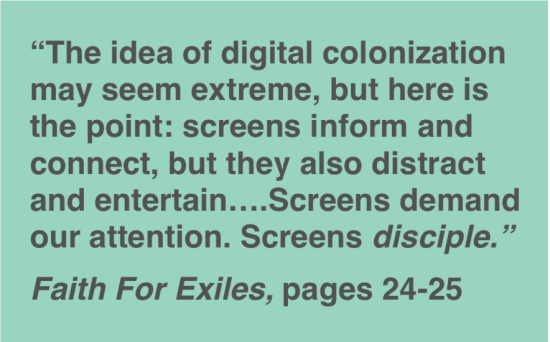
What accounts for such a mass exodus? Kinnaman, and his co-author Mark Matlock, argue that our culture is “especially and insidiously faith repellant.” The biggest culprit, they contend, is our smart devices, which have created a digital culture that actually works against us. As a result, believers are swimming upstream, fighting to maintain their values and their faith beliefs in a culture that is becoming increasingly opposed and in some cases hostile to these values and beliefs.

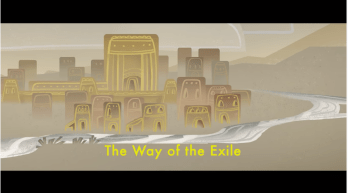
Click on the image to watch this short video from thebibleproject.com, which explains what exile is and how the theme of “exile” is woven throughout the Bible

The Old Testament highlights God’s promise that if His people followed Him and worshiped Him alone, they would prosper. But He warned them that if they were disobedient, He would bring judgment in the form of invading armies who would conquer them and take them into captivity. Much of the Old Testament is story after story of the nation of Israel forsaking God to pursue false gods. God continually sends prophets to warn them of impending doom but His message inevitably falls on deaf ears.

Click on the image to watch this short video from thebibleproject.com, which highlights what it was supposed to look like for the Israelites who were living in exile in Babylon and what it means for us as believers “living in exile.”

God finally hands his people over to the Babylonians, who take the Israelites into exile, where they live for 70 years in a foreign land, amidst a foreign culture that serves foreign gods and does not share their religious and cultural values. In fact, one of the goals of taking a conquered people into captivity was the systematic dismantling and eradication of their culture and the assimilation and adoption of the invading empire’s culture and values.

Imagine what it was like to be a Jew living in Babylon. How hard would it be to resist adopting the culture in which you’re thoroughly steeped, while trying to keep your own faith and religious views alive?

Young Adults spend an enormous time on their phones and the content is not always helpful to to maintaining a vibrant faith. Photo by KAL VISUALS on Unsplash

We haven’t been taken into captivity and we’re not living in a foreign land, as the Israelites did, but the authors make the case that the internet age in which we’re living has created what they refer to as “Digital Babylon.” A sobering graphic shows that the average 15-23 year old spends nearly 2800 hours in a typical year engaging with media on their phone. For the average 15-23 year old who is not a Christian, only 153 of those 2800 hours contain ANY kind of spiritual or biblical content. The Christian Young Adult fares only slightly better, with 291 hours of biblical content to offset the nearly 2800 hours of input they’re getting.

Our “smart” devices have created a digital environment that is slowly indoctrinating us to views and values that are contrary to our faith. This is what it means to live in “Digital Babylon”.

It’s not all bad news though. There is a segment of Young Adults, identified as “resilient disciples” who are thriving spiritually even in this current cultural context. The book is really about the practices of this group that enable them to maintain a vibrant faith. It turns out that we’ve already identified many of these practices as critical to thriving spiritually and as a result, we’ve already implemented many of these practices in our own ministry to Young Adults.

Our prayer is that our influence would increase and the Lord would show us new ways and avenues to impact Young Adults, who are seeking to live as resilient disciples in “Digital Babylon.”

We greatly appreciate your partnership and your prayers as we strive to this end!