Encountering Generational Influence at Cru25

Last month, Jen and I attended our Cru25 staff conference in Milwaukee. It was the first national conference for Cru staff in 3 years. It was also the first staff conference with our new president, David Robbins, at the helm.

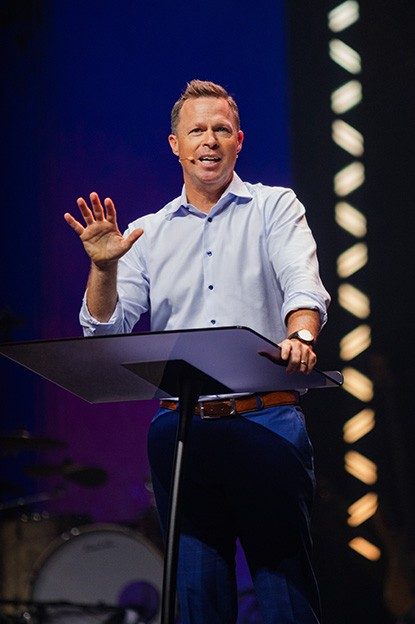
David Robbins, Cru’s newest president, shares the vision of Cru to help the church fufill the Great Commission.

We both came away from our time refreshed and reinvigorated for a new season of ministry. My overall impression of the conference was that it felt like a reaffirmation of Cru’s original calling – to help the church fulfill the Great Commission.

We live in a culture today that is very divided, with a lot of noise politically and even within the church. For us, it was good to hear from our leaders that our mission is the same as it has been since God called Bill and Vonette Bright to start Campus Crusade for Christ nearly 75 years ago.

We’re a missions organization that seeks to take the gospel to the world and build up multiplying disciples who will commit themselves to that endeavor.

Perhaps one of the most encouraging aspects of the conference for us was seeing the many spiritual generations of influence in our own lives.

Betty Hartley in between Dave & Jen. Two of her disciples had a major influence on Jen when she was a college student. Betty is 95 and still going strong, ministering to International students at Cal State Fullerton.

One of my staff heroes is Betty Hartley, who, along with her husband Bob (now with the Lord), became believers in their adult years and made the transition to full-time missionaries in their late 30’s.

They served as the Cru directors at Cal State Fullerton for many years. While there, Betty discipled two women who were later very influential in Jen’s life.

When Jen was a freshman at Fresno State, her Bible study leader was Kim Kirouac, a staff woman who had been greatly influenced by Betty when she was a student at Cal State Fullerton.

Later, Jen transferred to San Jose State University and was discipled by another Cru staff member, Marianne Elsheimer, who also had been a student at Cal State Fullerton under Betty’s tutelage.

At 95 years old, Betty still meets with students and ministers primarily to international students at Cal State Fullerton. What an incredible legacy!

Dave & Jen with Steph Wee, a former UC Davis student who joined Cru staff and worked for many years with our Epic ministry.

The first night we were in Milwaukee, we ran into Steven and Sam. Steven is the Cru director at Sac State and Sam, his wife, was a student in our ministry at UC Davis. Sam later sent us a text thanking us for our investment in her as a student at UC Davis. She said, “I’m the missionary, wife, mom and Christian that I am today because of you guys!” That is spiritual fuel for the journey ahead!

A few nights later, we ran into Tony and Steph Wee. Tony serves as a Vice President with Cru’s FamilyLife ministry. Steph was a student and intern with us at UC Davis and served for many years with Cru’s Epic ministry. Steph remarked to her kids that Jen’s influence was a critical factor in her joining Cru staff.

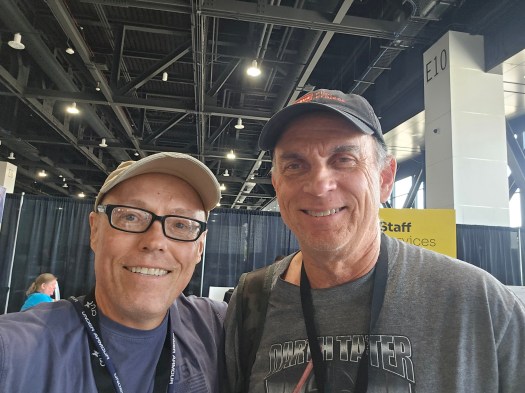
Dave with Bob Britton, who was Dave’s first discipler while on a summer missions project in 1987 at Lake Tahoe. Bob is still a missionary, serving with our Bridges International student ministry at Long Beach State and USC.

The next day, while heading to the main session, I noticed a familiar figure walking across the street. It was Bob Britton, a pivotal influence in my life during  the summer of 1987 in Lake Tahoe when I was just learning what it means to follow Jesus.

Later that day, while meandering through the conference coffee shop, I ran into Pav and Nalani who were on our Cru staff team when we were at UC Davis. For years, they have served as key support staff for all of our missionaries throughout the Middle East.

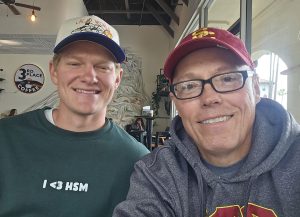
Dave, with Eric (Pav) & Nalani who was a student at UC Davis while Pav was on our staff team.

They spoke fondly of their time at UC Davis and how our influence in their lives was instrumental in helping them stay engaged in missions for the long-term.

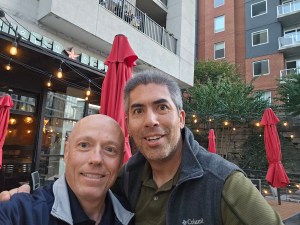
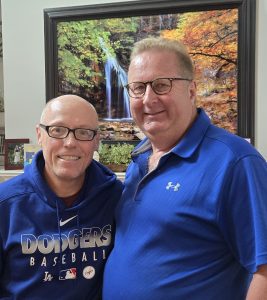
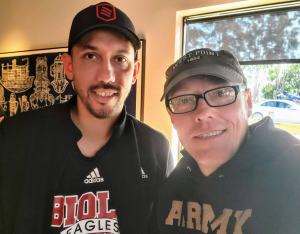
Time doesn’t permit me to talk about Bob Otten, Nick Castelluccio, Damon Barnes and countless others we encountered, who either influenced us or gave us the privilege of playing a small part in their faith journey.

Top photo: Bob Otten was a student on our summer team to Bishkek, Kyrgyzstan in 1992. Bob and his wife Becky later joined staff and served for many years as missionaries in Central Asia.
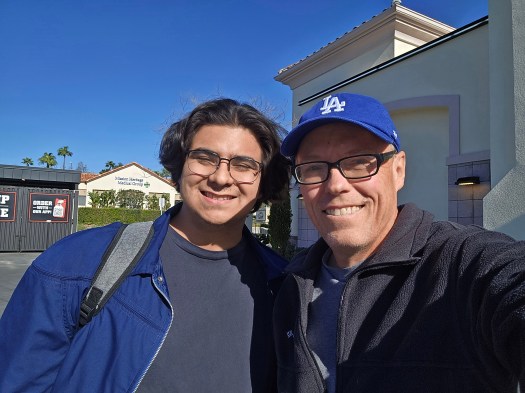
Middle Photo: Nick Castelluccio was a student in Dave’s Bible Study on the Ocean City summer project in 2000. Nick and his wife are on staff with Athletes in Action in Nashville, Tennessee.
Bottom Photo: Damon Barnes was Dave’s first Bible study leader at Cal Poly, Pomona when Dave first got involved with Cru in 1987. Damon and his wife Valerie serve on staff with the Jesus Film Project.

When I think of the many people who have influenced us to walk with Jesus and pursue His great mission to reach the world, I’m overwhelmed. That He has given us the privilege of influencing others in that same way is an amazing blessing.

Young Adults crave this same kind of personal involvement – someone who will come along side their faith journey with them.

We are so grateful for your partnership, which enables us to provide this critical ministry of personal discipleship and influence to Young Adults.

A “Golden” Opportunity

Helping out our Cru Military ministry at the FamilyLife Conference in Anaheim

Lately, we’ve been thinking a lot about marriage. In November, Jen and I attended a Weekend to Remember Marriage Conference hosted by FamilyLife. It was excellent. If you haven’t been to one, we highly recommend it.

In February, Jen and I helped out at a Weekend to Remember Conference in Anaheim. There were a number of military couples attending and our Cru Military ministry had a special booth and specific resources to help military families navigate the unique marital struggles they encounter.

In February, our church embarked on a 3 year plan that will lay the foundation for the next 45 years. One of the initiatives that is laid out as part of the “Dream Now” vision is strengthening families. A statistic that was shared is that 70% of all marriages in Orange County end in divorce.

We know all too well how the breakdown of the family has impacted the Young Adults of today. The landscape of families has encountered a seismic shift in the last 40-50 years.

An often quoted statistic about the spiritual influence men have with their family

When I was a kid, I didn’t know anyone whose parents were divorced. Today, divorce is so common that it’s almost strange to meet a Young Adult whose parents are still together.

All of this has created some unique challenges and opportunities when it comes to ministry.

Young Adults are less likely to have a strong extended family to rely on for support, whether it’s emotional or financial.

Because the nuclear family has been so fractured over the past 50 years, many Young Adults are longing for older adults who can provide mentoring and sage life advice that older family members have traditionally provided. I can’t tell you how often a Young Adult has mentioned to me or to Jen that they have nobody in their life who is older with whom they can discuss life issues.

For the last few years, I’ve been very involved in men’s ministry at our church (Jen is also very involved in the women’s ministry). I do some occasional teaching and I give leadership to a group of men who meet early on a weekly basis.

I’ve enjoyed applying all of the ministry training and experience I’ve accrued over the years to help older guys grow in their spiritual lives.

As I’ve connected with men over the years, I’ve realized that spiritually speaking, old guys have the same needs as young guys. Men want to make a difference and they want their lives to count. Men often want to take steps to grow spiritually but many times, they don’t know what to do beyond attending church, giving money and being involved in a small group.

Lately, we’ve been wondering if we can somehow “marry” our day job (Young Adults) with our part-time ministry to older adults.

Young Adults overwhelmingly indicate they want older people in their lives to function as mentors and even spiritual guides.

Older adults often communicate a strong desire to make an impact in others, particularly the younger generation.

Partnering with Cru Military at a Family Life Conference. Multiple ministries collaborating and intersecting.

What if we could help older Christians take steps to mentor and influence the young adults around them?

We’ve actually had this idea for a while but it’s been brought to the forefront more recently as God has provided numerous situations and personal examples that have made this need obvious and undeniable.

Our vision is not just to mentor Young Adults directly, though we are doing that. What we really want to do is to multiply our impact by equipping others, particularly older, wiser and more mature believers to take steps to pour into and impact Young adults. We believe that there is a golden opportunity for those who are entering their golden years!

Perhaps that sounds interesting. If so, let us know. We’d love to hear your thoughts and provide support and help for you to take meaningful steps that would enable you to make an impact in the lives of others!

Thank you for your continued prayers and partnership that enables us to minister to Young Adults…and Old Adults as well!

A Divine “Coincidence”

A few months ago, I approached one of the pastors at my church about meeting to discuss a personal matter. We had met many times before over lunch and coffee to talk about men’s ministry, which he helps to oversee, but since this was a personal issue, I suggested we meet at the church office.

When I arrived at the office, he escorted me upstairs and into a conference room, which I had never been in.

I made a remark about how I liked the glass plates on the wall that functioned as dry erase boards and even the conference table had the same glass plates with notes and ideas from a previous meeting scrawled on its surface.

In response, my pastor shared how, just prior to our meeting, he had been in that conference room brainstorming with a Young Adult about men’s discipleship within the Young Adult ministry.

My antenna immediately perked up. Did he say “Young Adult ministry?

If you’ve followed our ministry with Young Adults for the past 10 years, you probably know about the challenges we’ve experienced in ministering to this audience.


Young Adults are the largest population group in America, and yet, they are the least churched. There are a number of reasons why Young Adults are not active in church, some of which I’ve outlined in previous blog posts. To learn more, check out some of our prior newsletters and blog posts:


Young Adults are leaving the church in droves and most churches simply do not minister well to this demographic.

For the past several years, I’ve talked to a number of pastors at our church, wondering where the Young adults are at and whether Saddleback church has a ministry dedicated to this specific audience.

The response was always the same. The pastor was unaware of any specific Young Adult ministry, but maybe if I talked to “so-and-so”, they might know.

I learned more than I wanted to about the history of Young Adult ministry at Saddleback – how it had once been a thriving ministry but was not currently active. 

So when my pastor friend casually mentioned that he had just had a meeting with a Young adult about the Young adult ministry, I was naturally curious.

Before diving into the issue which I wanted to discuss, I asked him some questions about the meeting he had. He knows that I work with Cru and that our ministry focus is Young Adults so I asked him if he would connect me with the young man with whom he had just met. 

He agreed to reach out to the person and see if they would be willing to connect with me. He sent a quick text before we moved on to talking about my personal issue.

When our time was ending, he noticed that the Young adult had already texted him back and said that he would definitely be interested in meeting. So I got his contact information and I sent him an email later that afternoon.

A few days later, Logan got back with me and we arranged to meet up for breakfast.

Logan and I at a local eatery!

When we met, I asked Logan a few questions to get to know him better. I learned that he grew up really close to me and he had recently graduated from Cal Baptist University. 

I was curious where Logan went to high school. It turns out, he went to the same high school as our boys.

I asked him what year he graduated and I learned that he graduated the same year my boys graduated.

I told him I had twin boys who went to his high school and I wondered if he knew them.

That’s when the light bulb went off.

He said, “Wait! Your last name is Lowe? I know your boys. We were in the same Life group together in high school. I didn’t make that connection when you reached out to me.”

Logan is on staff with Saddleback, serving at the Brea campus. But he also helps to lead the fledgling Young Adult ministry that started up last year.

As I shared with Logan our vision for Young Adults and the resources we provide, particularly in helping Young Adults grow and mature in their leadership and their ability to become multiplying disciples, I could see his eyes light up.

I’m constantly amazed at how God works to orchestrate opportunities and open doors. In all the times I initiated with various pastors at our church to inquire about Young Adult ministry, it went nowhere. Then when I initiated to talk about something completely unrelated to Young adult ministry, the door suddenly and unexpectedly opened to connect with a key Young adult leader.

I’m not sure where this might lead but we’re excited about the potential of mentoring and coaching these young leaders who are working to create a community where Young Adults can thrive spiritually and live with purpose.

Our vision is not just to coach and mentor Young Adults, but to coach and mentor others, whether Young Adults or older adults, who can help to lead and mentor Young adults in church communities everywhere.

Is it Unbiblical to Teach That Salvation is About “Accepting Jesus”?

John 1

10But although the world was made through him, the world didn’t recognize him when he came. 11Even in his own land and among his own people, he was not accepted. 12But to all who believed him and accepted him, he gave the right to become children of God. 13They are reborn! This is not a physical birth resulting from human passion or plan—this rebirth comes from God. (John 1:10-13, NLT)


The Daily DAVEotional

I’ve been a Christian for a long time and ever since I can remember, I was told that becoming a Christian, or getting “saved” was simply a matter of “accepting” Jesus into your heart.

Not too long ago, I saw the above photo from one of my Facebook friends who regularly shows up in my feed. I respect Voddie Baucham as a teacher so I was curious about the context of the quote that seems to indicate that the idea of “accepting Jesus” is unbiblical.

Is it true that the New Testament nowhere mentions salvation being about “accepting Jesus”?

I think the short answer to that is NO.

John 1:12 is the most clear verse that would challenge that assertion as John states:

But to all who believed him and accepted him, he gave the right to become children of God. [emphasis added]

Now to be fair, my Scripture reference is from the New Living Translation (NLT) which is the only translation I’m aware of that uses the phrase “accepted him.” Most other translations, including the NIV, King James, NASB, ESV and others, all use the phrase “received him“. So I suppose it’s possible, if you exclude the NLT, that one could argue that the Bible doesn’t say anything about “accepting Jesus” when it comes to salvation.

In my mind, though, this could be considered theological nit-picking. It seems apparent to me that the words “accept” and “receive” are synonyms. So why make the argument that salvation has nothing to do with “accepting Jesus”?

Honestly, I could not find a link to the sermon in which Dr. Baucham made the quoted statement, so it’s hard to know exactly what he’s getting at or why he felt compelled to make the statement in the first place.

The problem sometimes with sound-bite quotes is that you don’t always get the context and so the quote can appear to be saying something entirely different than what the author was really intending to communicate.

I can say, however, that in my many years of ministry, this is not the first time I have heard someone make a statement like this. So I’ll address the statement as I’ve heard it shared from others, not necessarily from Dr. Baucham’s perspective, which, as I’ve stated, I was not able to clearly determine.

In my experience, the argument that salvation is not about just “accepting Jesus” is often made by those who are seeking to address the problem of spiritual mediocrity within the church.

An overwhelming number of people claim to be Christians and yet, as we look around at the landscape of our culture, it’s hard to imagine that there are really that many people who legitimately ARE Christians. In other words, the lifestyles of most people do not seem to indicate that most people are indeed Christians.

So what is the problem?

Some people would argue that a major problem is in our evangelistic message – that we are not calling people to repentance but instead, we’re peddling a soft message that requires little to no commitment. Note that Dr. Baucham’s quote appeals to the need to “repent and believe.”

The argument is that if we tell people that salvation is simply a matter of “accepting Jesus” into their life, we’re giving them the impression that being saved is merely a verbal transaction where, if we say the right words, and “ask Jesus into our hearts”, we can escape the punishment of hell and then go on our merry way doing whatever we were doing.

This kind of approach, the argument goes, lacks commitment and ultimately is not transformational. Instead of producing mature believers whose lives reflect Jesus, it produces worldly people who think of themselves as Christians simply because they said “the sinner’s prayer.”

The oft-suggested solution to this perceived problem is to refrain from telling people that salvation is about “accepting Jesus” and instead, communicate that it’s about a higher level of commitment that requires repentance.

As I see it, there are two problems with this solution.

The first problem is that the idea of “accepting Jesus” logically includes the idea of repentance.

Repentance literally means to turn and change direction. One cannot legitimately accept Jesus while maintaining the view that they can earn their salvation through their own good works.

Accepting Jesus is NOT just saying some prescribed prayer. It requires an attitude of humility that recognizes we fall short because of our sin and that Jesus is the ONLY one who can offer forgiveness through His shed blood on the cross.

Accepting Jesus, or receiving Christ, means that we accept the free gift of salvation that Jesus offers to all people. How do we do this? Ephesians 2:8-9 says that we do this by faith.

What that means is that I literally change direction (repentance). Instead of my former course where I trusted in my own good works to earn God’s favor, I now choose a new course, where I place my trust in Jesus alone to provide forgiveness and to save me from the penalty of my sins.

There’s a second problem with the solution of saying we should refrain from saying that salvation is about “accepting Jesus”. The second problem is that even if we were to stop talking about “accepting Jesus” and even if we were to convince everyone to use the different language of “repent and believe” in our evangelistic presentations, there is no reason to believe that the outcome would be any different than it already is.

The reason for this is because spiritual mediocrity in the church is largely a reflection of the hearts of people rather than the specific wording of the evangelistic messages that are being promoted.  Mark 4 tells us that there are 4 different soils that represent the different heart attitudes of people who hear the message of the gospel. (See my blog post: Which Soil Are You?)

Sharing a message of “Repent and Believe” to a person who has a hard heart, rocky heart or thorny heart is likely to yield the same result as sharing a message of “Accept Jesus”. Regardless of the specific verbiage of your message, the outcome will be the same, because it is already determined by the heart condition of the hearer.

Please note that I’m not saying that our evangelistic message and approach doesn’t matter. Our message should be biblically correct. However, the idea that one biblical approach  will produce better results than another, equally biblical approach is wishful thinking and places too much emphasis on the sower for the results.

There is no silver bullet message or approach that will guarantee the hearer will become a fruitful Christian.

In addition, since we know that spiritual mediocrity among professing believers has been a problem since the outset of the church, it stands to reason that it’s an issue of discipleship more than evangelism. The issue was addressed repeatedly in the New Testament and has been a source of controversy for 2000 years. We’re not likely to see a change in this phenomenon, though we should certainly do our best to disciple believers to maturity, just as the apostles did.

(See my blog post: Why Some Christians Never Grow)

The most important thing we can do when communicating with a non-Christian is to give a clear and understandable explanation of what Jesus is offering. (See my blog post: What Does it Look Like to Follow Jesus?)

I think it’s clear that linking salvation to the idea of “accepting Jesus” is not unbiblical, as long as we help the hearer understand that accepting Jesus involves repenting of our sins and believing in Jesus as our one and only Savior.

Reflection

What has been your understanding of the idea that people must “accept Jesus” in order to be saved? What are they accepting?

What do you think are the main reasons why some Christians don’t grow? How should we change our evangelistic approach to ensure greater fruitfulness among believers?

Do you agree with the statement by the author of this blog that mediocrity among professing Christians is more a result of discipleship than evangelism? What are your reasons for agreeing or disagreeing?

How can we disciple others to greater levels of maturity and fruitfulness? What steps can be taken? What resources do you think are needed?


Photo is a screenshot from a Facebook post at Voddie Baucham’s Facebook Page (https://www.facebook.com/photo/?fbid=10221114209364128&set=a.1532880861226)


The Nashville Redemption

It was the spring of 2014 and Jen and I were just entering a new phase of ministry. After 25 years with college students as our primary focus, we made a pivot to reach Millennials, the largest age group in our culture, but the least churched.

Our first time in Nashville (2014) included the Q conference. We only got half of the first day in before Jen ended up in the hospital. A highlight of that session was an interview with Carrie Underwood and her husband, NHL Hockey player Mike Fisher.

We flew to Nashville to spend some time with about a dozen other Cru staff members who were also committed to reaching this underserved audience. On the heels of our staff time, we were slated to attend the Q conference (led by Gabe Lyons – now rebranded as ThinQ Media) and we were looking forward to meeting with one of our former students from our time at the University of Arizona who had transplanted his family to the Nashville area.

On the first day of that conference, Jen experienced some chest pains that ultimately landed her at Vanderbilt hospital. 

I wrote about that experience in our April 2014 newsletter, which you can access here (bit.ly/LWDN0414).

We left Nashville feeling grateful that we had dodged a bullet. When we arrived at the hospital we didn’t know what was going on. We were relieved when the doctors told us that they thought Jen had walking pneumonia and gave her antibiotics to help clear up any infection. 

Cru Embark staff enjoying good BBQ in downtown Nashville

It turned out though that that diagnosis was wrong, and this was just the first phase of a medical journey we entered, and are still in. 

Thankfully, we know a lot more about Jen’s condition, vasculitis, which is currently in remission.

This last fall, I had the opportunity to return to Nashville for the first time since that ordeal. Jen was not able to make this trip due to a conflict with her class schedule.

Once again, a fledgling group of Cru staff met to discuss and dream about reaching the under-served audience that is Young Adults.

It was great being back in Nashville and experiencing a bit of the culture, including good BBQ and some great music from talented artists.

We were treated to a small intimate, unplugged acoustic set from American Idol season 8 winner, Kris Allen
Me with Kris Allen – American Idol Season 8 winner

We were surprised by one of our Cru staff who lives and ministers in Nashville and happens to live just around the corner from Kris Allen (of American Idol Fame) who did an acoustic set for us on our colleague’s back porch! That feels very Nashville-y!

Meeting up with my friend Mark, a former student from way back during our University of Arizona days. This meet-up was 10 years overdue!

As much as I enjoyed connecting with our staff and revisiting and renewing my vision for Young Adults, the highlight of my trip was my time after the conference. 

I decided to delay my return so that I might meet with my friend Mark, the former student we had to cancel on 10 years earlier.

In addition, another friend from our church in South Orange County had moved his family to Nashville 4 years ago and my trip provided an opportunity to connect with him as well.

I was able to connect with a friend (Rob) from our church in SoCal who moved his family to the Nashville area a few years ago

It was great to pray together and have extended time to connect on a deeper level and hear how God is moving and working in the lives of these two families. 

As I reflected back on my time in Nashville, I realized that the number of Cru staff who are reaching Young Adults is still rather small.

What really stood out to me though is that the make-up of the staff in attendance was different. I was the only person at these recent meetings who had been at the Nashville meeting 10 years ago. That is often the nature of ministry. People often come and go and move on to other opportunities and other callings. For us, at this time, Young Adults remains our calling.

We are grateful for your investment and commitment to us!


To read the pdf version of our newsletter, click here.

A Spiritual Milestone

50 years ago TODAY (June 9, 1974), I went forward in response to an altar call at the end of the Sunday morning service of Beaty Avenue Baptist Church in Whittier, California. After attending church for 6 months with my family, I responded to the pastor’s invitation for anyone to come forward if they wanted to respond to Jesus’ free gift of salvation.

As a kid, it was one of the scariest things I ever did, as I could feel all eyes staring at me as I made the trek out of the pew, into the outer aisle and toward the front of the church sanctuary. I slowly walked to the front while everyone was still  singing what was commonly known as “the hymn of invitation.”.

When I arrived at the front, I was greeted by an older gentleman who escorted me into a private room in the back where he shared this little gold booklet with me called “the Four Spiritual Laws.” Little did I know that years later, I would end up sharing that same booklet with thousands of people as a missionary.

I recognized that I was a sinner and that Jesus had died on a cross to pay the penalty that I deserved for sin. I invited Jesus to come into my life, forgive me for every wrong thing I ever did or ever would do and begin the spiritual journey for which I had been created – to KNOW Him.

That evening, at the Sunday evening service (yes, old time baptist churches often had Sunday evening services, as well as mid-week Wednesday night services), I was baptized, along with my two brothers.

I remember that day because it was the same weekend as my mother’s birthday, which was yesterday. She would be 84 years old if she were still alive.

We only attended that church for about a year before moving to another church. That old Beaty Avenue Baptist church building is still there, though it is home to a different church.

Here is a photo of myself from that time frame. I have very few photos of me growing up as most of my childhood photos were destroyed in a house fire in 2000. This photo was taken about a year before the events I describe above.

Photo taken at what used to be known as East Norwalk Little League off Shoemaker in Norwalk, CA. According to current Norwalk Little League website, this field is the Zimmerman Field that is part of current Norwalk Little League.

Also included is a Google street view photo of the church that used to be known as Beaty Avenue Baptist Church.

Google Street view of church building that at one time was Beaty Ave. Baptist Church in South Whitter, CA

I don’t remember the name of the person who shared with me in that back room, though somewhere in a box at my house, I have that very booklet with a phone number written on the back.

I’m grateful for the many people who played a role in me making a decision on that day, including my parents, Sunday school teachers, the pastor of that Beaty Avenue Baptist church and the gentleman who shared the gospel message with me in that private room.

Life changed on that day in June of 1974. Real life actually began on that day!

What Would You Do for a Klondike Bar….or a Coke?

January marked the 35th anniversary of me (Dave) being on staff with Cru. As I reflect back on the many years of ministry, I’m amazed at all God has done in the lives of the students, staff and Young Adults to whom we’ve ministered. What follows is the story of one student whose life was impacted at San Jose State University and the many ways he and his family continue to make an impact for the Lord today.


It was the fall of 1990 and we were on campus at San Jose State University for Registration Day, a day when students could change their classes, settle their schedules and get their books for the Fall Semester.

Our goal was to surface students who had a spiritual interest and since we really wanted to engage with freshmen, we set up a large banner that said “Freshmen, Stop Here!”

Over the years, the “Freshmen STOP Here” banner was effective in drawing new students to our table.

We offered ice cold Coca-Cola drinks in exchange for filling out a spiritual interest questionnaire.

One of the students who filled out a card was Dexter. I still remember his bright smile and friendly demeanor. I flagged his card to ensure that I wasted no time in getting back in touch with this potentially “hot” lead.

What I didn’t know was that Dexter wasn’t his real name and the phone number was not his home number. Being a Cru Staff “NEWB”, I wasn’t yet wise to all the tricks that students use to feign interest in order to get free stuff.

Not long afterwards, I called “Dexter” to set up an appointment to meet. Dexter had decided to put his work number down instead of his home number. And instead of using his real name, he gave a stage name that he had used as part of a dance group. He knew that if he got a call at work from someone asking for “Dexter”, he would know it was someone from this “Campus Crusade” group (as we were known back in those days) and he could avoid the call if he desired.

I was oblivious to all of this of course. I just called the number, which turned out to be an Office Club. I didn’t know any better so I asked for Dexter. Someone on the other end put me on hold while Dexter was paged.

Dexter was surprised to hear his stage name being paged. He thought the call would never go through because there were no “Dexters” who worked there. So why the person chose to page for Dexter in the first place remains a mystery. 

Dexter ended up answering the phone and amazingly, he agreed to meet with me.

When we met on campus, I learned that Dexter was a fairly new Christian. I also learned that he wasn’t a freshman. He was a sophomore who recently changed majors, so he was a “freshman” in his major. He stretched the truth on the questionnaire so that he could get a free Coke. We had a good laugh about that.

Maricar and Rauderick (Dexter) are actively planting churches, building disciples and reaching the lost around the world.

Dexter (whose real name is Rauderick) and I hit it off and began meeting regularly for discipleship and ministry training. He ended up becoming a leader in the Cru ministry at SJSU.

A few years later when Jen and I moved to Davis to start the Cru ministry there, Rauderick drove over from the Bay Area and brought us an overhead projector from his job at Office Club that we were able to use for our weekly meetings (yes, those were still the days when we used transparencies for worship music!)

Today, Rauderick is living in the South Bay Area with his wife Maricar and their 4 children, three of whom are in college. He works as a clinic director in San Francisco, providing mental health services and care for those who are most marginalized. But that’s just his day job.

For the past 23 years, Rauderick has been living out his passion for the gospel as a bi-vocational pastor, providing spiritual care and direction to those in his congregation.

Rauderick has a passion for making Jesus known. He and Maricar have been involved in numerous church plants and are active in world missions, training missionaries in the Middle East and pastors in Vietnam.

Raud and Maricar also have a heart for families. They love counseling and mentoring couples using HomeBuilders materials produced by Cru’s FamilyLife ministry.

For the past 35 years, we’ve sought to make disciples of all the nations, raising up leaders and laborers who could make an impact for Christ wherever the Lord might lead.

To me, Rauderick (aka Dexter) is an amazing example of a former disciple who exemplifies our vision: to raise up disciples who will walk with Jesus and become life-time laborers, impacting those around them for His kingdom purposes.

Please pray for Rauderick and Maricar as they lead their family and those under their care. And please continue to pray for us as we seek to raise up others in this younger generation who will become life-time laborers, just like Rauderick and Maricar!

The De Silva Family
Isabel (front), Gabrielle (middle left), Samuel (back left), Abigail (back middle), Maricar & Rauderick (back right)


Header photo by Mahbod Akhzami on Unsplash

Freshmen Stop Here photo by Dave Lowe

Other photos courtesy of Rauderick and Maricar De Silva

A Biblical Gospel Presentation in ONE Six-verse Passage

Titus 3

3Once we, too, were foolish and disobedient. We were misled by others and became slaves to many wicked desires and evil pleasures. Our lives were full of evil and envy. We hated others, and they hated us.

4But then God our Savior showed us his kindness and love. 5He saved us, not because of the good things we did, but because of his mercy. He washed away our sins and gave us a new life through the Holy Spirit. 6He generously poured out the Spirit upon us because of what Jesus Christ our Savior did. 7He declared us not guilty because of his great kindness. And now we know that we will inherit eternal life. 8These things I have told you are all true. I want you to insist on them so that everyone who trusts in God will be careful to do good deeds all the time. These things are good and beneficial for everyone. (Titus 3:3-8, NLT)


The Daily DAVEotional

Have you ever tried to share your faith with another person? What do you say? How do you go about it?

There are a number of great evangelism tools that have been created over the years to help Christians share the message of Christ to others. There’s the Roman’s Road, the Navigator’s “Bridge to Life” and of course, the old school “Four Spiritual Laws.”  (a tool I was trained in)

There are quite a number of newer resources as well, such as The Four Circles by James Chuong, or The Three Circles by Jimmy Scroggins, both of which emphasize sharing the message graphically over sharing a predominantly written narrative.

However, if you want ONE biblical passage from which you can share the gospel message, this passage from Titus 3 is a good choice. Just about every relevant point needed to share the gospel with another person is covered in these six verses. Here’s the summary of what Paul shares:

Our Problem – We were sinners

Many gospel presentations highlight our sinful condition, or in some cases, our brokenness. Paul too highlights our sinful state in verse 3:

Once we, too, were foolish and disobedient. We were misled by others and became slaves to many wicked desires and evil pleasures. Our lives were full of evil and envy. We hated others, and they hated us.

Notice the words and phrases Paul uses to describe us:

    • foolish and disobedeint
    • misled by others
    • slaves to many wicked desires and evil pleasures
    • lives that are full of evil and envy
    • hatred towards others

Paul could have just said we were sinful and alienated from God, but instead, he paints a robust picture of the depth and root of our alienation – it comes from our wicked desires and evil nature, which leads to disobedience and ultimately, enmity towards others. In other words, our rebellion is extensive. It doesn’t just affect our relationship with God; it affects our relationships with others as well!

God’s Solution – Jesus Saved Us

Paul spends 4 verses explaining that God saved us from our rebellious condition. These 4 verses are PACKED with information about the nature of God and what He’s done for us. He says:

4But then God our Savior showed us his kindness and love. 5He saved us, not because of the good things we did, but because of his mercy. He washed away our sins and gave us a new life through the Holy Spirit. 6He generously poured out the Spirit upon us because of what Jesus Christ our Savior did. 7He declared us not guilty because of his great kindness. And now we know that we will inherit eternal life.

First and foremost, salvation is rooted in the nature of God. Paul says that God showed us His kindness and love. Salvation is not based on our good works, but because of God’s mercy. Mercy is when something bad that we deserve is withheld. In this case, we deserve punishment, but because God is merciful, he saves us from judgment.

Second, Paul says that salvation involves forgiveness. Verse 5 says that our sins have been washed away, which is another way of saying that our sins have been paid for.

Salvation also involves new life through the Holy Spirit, who has been generously poured out on us.

Lastly, Paul says that salvation involves justification, which simply means that we are declared righteous, or “not guilty”. Because we are no longer under judgment for our sin, Paul says that we can KNOW that we will inherit eternal life.

Our Response

Verse 8 highlights our response. If we want to experience these benefits, Paul says we simply need to trust what Jesus has done for us.

These things I have told you are all true. I want you to insist on them so that everyone who trusts in God will be careful to do good deeds all the time. These things are good and beneficial for everyone.

Interestingly, Paul mentions trusting in God, not Jesus. But it’s clear from this passage (specifically verses 4 and 6) that Jesus IS God. I previously wrote about this in my blog post, “Further Evidence that Jesus is God.” Please read that post for a more detailed explanation of how we know that Jesus is God from this passage.

What I love about these 6 verses is that it hits all the main points you typically would want to share when presenting the gospel to another person:

    • We are sinful and alienated from God and others (verse 3)
    • We are slaves to our sinful desires – hence we cannot help ourselves (verse 3)
    • God is kind, loving and merciful (verses 4, 7)
    • Salvation is not based on our good works but based on God’s kindness, love and mercy (verse 5)
    • Our sins have been forgiven and we’ve been declared “not guilty” (verses 5, 7)
    • We’ve been given new life through the Holy Spirit (verse 5)
    • Salvation is based on what Jesus did for us (verse 6)
    • We can KNOW that we have eternal life (verse 7)

Of course there are shortcoming with using these 6 verses alone, just as almost any short evangelistic presentation is incomplete on its own. As much as these 6 verses outline the basic gospel message, we know that the fullest expression of the gospel includes the greater context of God’s original design, the nature and scope of the fall as well as God’s redemptive plan to restore His creation.

The Bible takes a full 66 books to outline the full redemptive narrative.

With that in mind, no five, ten or even thirty minute presentation can share everything that is written in the Bible regarding God’s redemptive plan. But these tools are useful in giving a person a basic framework for the Biblical story and introducing them to a relationship with God.

By highlighting these 6 verses in Titus, I don’t mean to imply that the evangelism tools mentioned at the outset are deficient or ineffective. All of them have actually proven to be helpful and beneficial to many Christians.

However, this passage from Titus is simply a different approach one might use. Instead of being based on a written or graphical presentation, it’s based on ONE six-verse BIBLICAL passage that can be easily shared with anyone.

Reflection

What has been your practice or habit in sharing the gospel with others? What tools or gospel outlines do you use? What do you like about that tool? 

What do you think are the relevant points that must be shared in any gospel presentation?

When you think of the main ideas that must be shared when presenting the gospel, which ones are covered by this passage in Titus? Which ones are missing?

What do you see as the main advantages of using this passage as a gospel presentation outline? What are some reasons why you might prefer not to use this passage?

Which of the statements that Paul uses to describe our condition (foolish, disobedient, slaves, etc.) resonate with you the most? Explain.


Photo by Jon Tyson on Unsplash

There’s an App for That!

Can you believe it’s been 17 years since the iPhone was introduced? Technically, the iPhone is not considered the first smart phone. That distinction belongs to a phone designed by IBM in 1992 called the Simon Personal Computer (SPC), which was released in 1994. It’s considered the first smart phone because it was the first phone to include apps.

However, it was really the iPhone that revolutionized cell phones as we know it. Flip phones and Blackberries, which were ubiquitous up until then, are but a memory now.

Back in 2008, when smart phones were still relatively new, Apple embarked on an ad campaign that was highly successful and no doubt aided in the early lead the iPhone had over competitors in the newly created smartphone market.

The theme of the ad campaign was: There’s an app for that! Commercials touted the abundance of apps that were available for the iPhone compared to other smart phone platforms. Just about anything you might need to do with your phone, there was an app available that could do it for you.

Here’s an example of one of those early iPhone commercials:

Recently, I had my own “There’s an app for that” moment.

I was meeting with my friend Mike, a guy I’ve been coaching over the last few years. I met Mike in a grocery store parking lot during the pandemic and we’ve been connecting ever since. You can read about that story here in our January 2021 Newsletter at Lowedown.com.

Mike has a passion for basketball and after spending some time as a high school coach Mike has been trying to make the leap into the difficult world of coaching at the collegiate level.

After volunteer coaching for several years at Azusa Pacific, Mike is now an assistant coach for Biola University.

Mike was recently hired as an assistant coach at Biola University, where he now has the opportunity to influence the young men on the team, not just in their basketball skills, but in their spiritual lives as well.

Mike and I were going over some new discipleship material I’ve been developing. The idea is to create a menu of lessons that anyone can use to help another person take concrete steps in their relationship with God. I’ve been going through the content with Mike to get his feedback and to see if this is the kind of material he might be able to use in his basketball ministry.

After we finished the content, Mike told me, “I wish I could translate this into Japanese.” Mike has a significant ministry to Japanese kids and teens both here and in Japan, through the many youth basketball camps he hosts.

He shared how he thought the content we were going over could be super helpful but he wouldn’t be able to share it with a Japanese student because he doesn’t know Japanese well enough to translate the content himself. It launched us into a conversation about how even here in Southern California, there is often a need for material to be available in multiple languages besides English.

The GodTools app is available at the App Store for iOS devices and the Google Play store for Android devices.

Though my content is currently in English only, our conversation made me think about the GodTools app that Cru has created for evangelistic and spiritual conversations. 

I had assumed that Mike probably was familiar with the app and probably had it on his phone, but when I mentioned it, I found out that he not only doesn’t have the app, but he was only vaguely familiar with it.

I pulled up the app on my phone and showed him how he could have access to a number of different gospel presentations as well as a presentation on the ministry of the Holy Spirit….all at his fingertips. 

To demonstrate, I opened up the Four Spiritual Laws presentation and began to scroll through the pages.

The GodTools app can be shared in 90 different languages and the Parallel feature allows you to toggle between multiple languages at once. You can even share your screen with the person you’re sharing with.

One of the best things about the app though is not just having a gospel tract on you at all times, but the fact that you can share the presentations in any one of 90 languages. And there’s also an option to toggle the screen between 2 languages (English and Japanese for example). 

Mike was excited to learn there was an app at his disposal that would allow him to share a number of tools with his Japanese friends in their native tongue and he didn’t have to spend the money to hire a professional to translate it.

It turns out that if you want to share your faith with others, there’s an app for that. And if you need to share it in a foreign language, there’s an app for that as well!

If you haven’t downloaded the GodTools app yourself, consider adding it to the other Bible apps on your phone. Go to GodToolsapp.com for more information on the features of the app and for suggestions on how to use it in your conversations. 

Please pray for Mike as he continues to establish himself as a collegiate coach and pray for us as we seek to continue helping Young Professionals multiply their lives into others.

A Recent “Weekend to Remember”

Last month, Jen and I attended a “Weekend to Remember” Getaway Conference sponsored by FamilyLife, which is a ministry of Cru. 

We’ve found this weekend conference to be a great way to reflect on and invest in our marriage. It really is one of the best resources our ministry offers. 

We’ve attended this conference a few times over our 30 years of marriage but it actually had been over 15 years since our last conference, so it seemed like a good time for a refresher. And being in LaJolla was not a bad selling point!

But we had a secondary reason for attending this particular conference. 

Of all the Weekend to Remember Conferences FamilyLife puts on each year, a select few are labeled as “Military Friendly”. What that means is that military couples who attend are given additional opportunities to connect and are provided with additional resources to help navigate the unique challenges that military families experience.

We were able to greet military couples when they arrived, give them a goodie bag and alert them to the lounge and a special breakout session just for them.

Families are extremely important to God. In the Old Testament, God is portrayed as a Father and the Nation of Israel are His people.

The New Testament continues the theme by showing that when people of any race or ethnicity put their faith in Jesus and His death, they are adopted into God’s family as His sons and daughters.

The family unit is an important building block culture. Study after study demonstrates that many of the problems we are experiencing in our culture – the rise in crime, exponential drug use, failing education system, etc. – find their roots in the breakdown of the traditional family. There is no doubt that healthy families result in healthier communities.

Keeping families together is hard enough these days. But military families experience additional challenges that civilian families don’t. From frequent moves to long-term deployments, military families have an added layer of complexity that must be navigated and considered. 

We had tons of FREE resources available for military families to help them navigate the specific pressures that come with military service.

Our goal at this conference was simply to be available to military couples and provide resources that might help them in their current situation.

Over 25 military couples attended the conference. We were able to greet couples when they checked in and then alert them to a special lounge we had prepared for their own use during the conference.

In addition, we had a special breakout session for military couples where we were able to highlight resources and opportunities Cru Military provides for Military families beyond the weekend getaway.

It was nice for us to experience a short getaway given all that we’ve experienced this Fall in our own family. It was also nice to be able to meet some military couples who were in attendance, hear their stories and provide encouragement and resources to help them lead their families well while serving our country. 

If you’ve never attended a Weekend to Remember Getaway, we highly recommend it. Even if you have done one before, it’s never a bad idea to invest in your marriage. 

Reach out to us if you’re interested and we would be glad to give you more information!