Political Divisions Within Church

1 Corinthians 1

10Now, dear brothers and sisters, I appeal to you by the authority of the Lord Jesus Christ to stop arguing among yourselves. Let there be real harmony so there won’t be divisions in the church. I plead with you to be of one mind, united in thought and purpose. 11For some members of Chloe’s household have told me about your arguments, dear brothers and sisters. 12Some of you are saying, “I am a follower of Paul.” Others are saying, “I follow Apollos,” or “I follow Peter,” or “I follow only Christ.” 13Can Christ be divided into pieces?

Was I, Paul, crucified for you? Were any of you baptized in the name of Paul? 14I thank God that I did not baptize any of you except Crispus and Gaius, 15for now no one can say they were baptized in my name. 16(Oh yes, I also baptized the household of Stephanas. I don’t remember baptizing anyone else.) 17For Christ didn’t send me to baptize, but to preach the Good News—and not with clever speeches and high-sounding ideas, for fear that the cross of Christ would lose its power. (1 Corinthians 1:10-17, NLT)


The Daily DAVEotional

If you haven’t noticed, there is a lot of political division in our country these days. And this political division has seeped into the church.

Perhaps it’s always been there. But with the advent of social media, it’s definitely more pervasive and widespread.

The first letter from Paul to the Corinthians was written in part to address the problem of divisions in the church. I wrote my thoughts on this passage a few years ago in my blog post “Name Dropping in the Early Church“. Members of the church in Corinth were aligning themselves with different church leaders, which was causing conflicts and divisions in the church.

Certainly, there is no problem with following certain pastors and religious leaders. The problem comes when we elevate those figures to celebrity status and begin to idolize them or place them on a pedestal, where they may take precedence over even Jesus himself.

As I re-read this passage recently, it occurred to me that perhaps the biggest source of division within the church today is political divisions. People within the church are aligning themselves with certain political figures and ideologies, which is causing major divisions within the global church.

These last 8-10 years in the United States have been a breeding ground for the enemy to sow hatred, divisiveness and discord among Jesus’ followers.

It’s become apparent that for many who call themselves Christ followers, their political party and candidate of choice is more important than Jesus himself. This heightened commitment to politicians and political parties  is driving their behaviors and greatly influencing their views of others and even their understanding of what it means to be a Christian.

It’s been amazing to me to see people who claim to be followers of Jesus, belittling others, bullying others and berating others who don’t share their love and devotion for a particular candidate or political party.

For example, I’ve seen people on various social media platforms who have made the statement, “I don’t see how you can be a Christian and vote for                                . ” I’ve also seen “Christians” claim that God hates candidate “X” while other “Christians” have rebutted that God actually hates candidate “Y”.

Ironically, Christians on both sides, in defending their preferred candidate and ideology, are appealing to the need to “love” people, all while demonstrating hate towards those who disagree with them.

Let me be clear. It is not unbiblical to have a preferred candidate or a preferred political party. But when we place those candidates and parties above Jesus himself, and when we’re incapable of basic civility towards those with whom we disagree, we’ve unwittingly made an idol out of our political identity.

Paul, in this passage, has some words of wisdom for us. Was Donald Trump crucified for you? Were any of you baptized in the name of Joe Biden or Kamala Harris? Christ did not send us to promote the Democratic or the Republican party platforms BUT TO PREACH THE GOSPEL.

It’s apparent that we all have different ideas about how to solve the problems that we face as a nation and as a culture. While it’s ok to promote our views, as Christians, NOTHING should take precedence over Jesus and the gospel message. To do so could become idol worship or worse, the promotion of a false gospel.

Reflection

What steps do you think Christians can take to ensure that they don’t promote politics over Jesus?

Do you think it’s possible to be a Christian and also be heavily involved in politics?

What would you say to someone who says that a certain political party is the only party a “true” Christian could support?

How do you reconcile the different political views with the gospel message? What do you think is the proper way to integrate our political views with the gospel message?


Photo by cottonbro studio: https://www.pexels.com/photo/two-people-standing-face-to-face-10350693/

The Last Supper and the Human Condition

Last month, Jen and I took a break from our daily routine and traveled to Italy to visit our son Joshua, who is an Army officer stationed there.

It was a great to visit him and see what his world is like. It was also fun to get a taste (literally) of Italy, though we only saw a small portion of the country.

Enjoying lunch in a Vicenza cafe with our son Joshua

In addition to spending a day in Venice and a few days in Florence, where we saw Michelangelo’s famous statue of David, Jen and I also took a day trip to Milan, where we experienced a very informative walking tour through parts of the city that included seeing the Duomo di Milano (Milan Cathedral) as well as the famous DaVinci masterpiece “The Last Supper”. 

I have to admit that the Last Supper was not exactly what I expected. It looked a little different than all the photos you see. It turns out that there’s a reason for that.

Venice was exactly how I imagined it from watching movies like “The Italian Job”
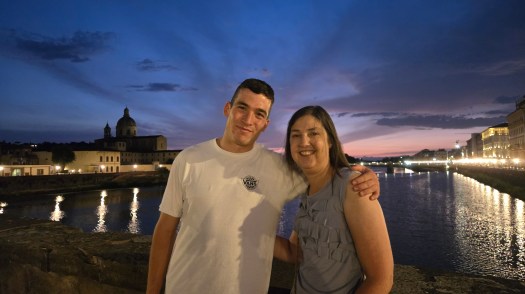
Joshua and Jen at dusk in Florence on a bridge overlooking the Arno river
Jen and Dave pose with the Duomo di Milano (Milan Cathedral) in the background

Our guide explained that when DaVinci was commissioned to make the painting, he decided against the tried and true traditional Fresco style of painting, which creates a permanent image because the painting is all done in wet plaster.

The downside of this technique is that you have to paint very quickly before the plaster dries. DaVinci wanted to take his time and create a painting with more intricate detail than the fresco technique would allow, so he developed a completely new technique that allowed him to take his time.

Michaelangelos famous statue of “David” is located in Florence

The result was an undisputed masterpiece. However, it became more clear, over time, that DaVinci’s novel new technique was flawed, as parts of the painting literally began to flake away from the wall.

To fix this problem, other painters were often called in to fill in the gaps and “restore” those portions to match copies that demonstrated the original image.

Fast forward hundreds of years and the image on the wall has been painted over dozens of times. The original image is actually lost as many of the finer details, such as facial expressions, don’t look exactly as Leonardo had painted them.

In 1977, it was decided that the painting would go through a restoration process whereby all the extra layers of paint would be removed so that the image that remained would be only what Leonardo had painted. It was risky because they weren’t sure if ANYTHING would be left when they removed all the layers.

Fortunately, there was still plenty of Leonardo’s original image still intact when all of the extraneous layers were removed. At that point, what was left underwent an extensive 25 year restoration process to ensure that the image would not experience further decay. In fact, our guide told us that Leonardo’s masterpiece should remain intact for another 500 years!
What remains is still amazing but it is not exactly the original. There are parts that have faded or flaked away. We have a good idea of what the original looked like based on copies that were created when it was more complete.

I think the Last Supper illustrates the human condition. The Bible tells us that we are God’s masterpiece, but it also says that we’re broken because of sin. 

Just as the Last Supper was in a constant state of decay, so too are we. Without outside intervention, the Last Supper was doomed to decay into, at best, a muted reflection of the original masterpiece and at worst, nothingness!

The Last Supper by Leonardo DaVinci

The same is true with us. Without God’s intervention, we have no hope of reflecting the true masterpiece that God says we are. And even in this life, the best we can hope for is a muted, partial reflection of God’s artistry. 

The Last Supper will never be restored to the original image that Leonardo painted. But we, as believers, have the hope and assurance that one day, we will experience the final restoration of our bodies and our souls. Sin will be eradicated and we will no longer experience death or decay!

THAT is good news and it’s amazing!

Thank you for your partnership with us, which allows us to help others realize that we are all “masterpieces” in need of restoration!

Arrivederci!

Jen and I loved hanging out with our son Joshua in Italy, where he is serving as an officer in the U.S. Army.

Haters Gonna Hate, Hate, Hate

John 15

18“When the world hates you, remember it hated me before it hated you. 19The world would love you if you belonged to it, but you don’t. I chose you to come out of the world, and so it hates you. 20Do you remember what I told you? ‘A servant is not greater than the master.’ Since they persecuted me, naturally they will persecute you. And if they had listened to me, they would listen to you! 21The people of the world will hate you because you belong to me, for they don’t know God who sent me. 22They would not be guilty if I had not come and spoken to them. But now they have no excuse for their sin. 23Anyone who hates me hates my Father, too. 24If I hadn’t done such miraculous signs among them that no one else could do, they would not be counted guilty. But as it is, they saw all that I did and yet hated both of us—me and my Father. 25This has fulfilled what the Scriptures said: ‘They hated me without cause.’ 26“But I will send you the Counselor—the Spirit of truth. He will come to you from the Father and will tell you all about me. 27And you must also tell others about me because you have been with me from the beginning.

(John 15:18-27, NLT)


The Daily DAVEotional

Have you noticed that there is a lot of hate in our culture today. A LOT.

What I find interesting is that our culture seems to have redefined what the word hate even means. If you disagree with someone, you are quickly labeled a “hater.”

This is very problematic for Christians because we believe that Jesus has given us moral guidelines to live by and to promote as good for our society at large.

But many of the moral guidelines Christians hold to are not accepted by our culture. So what is the response? Christians are labeled as haters.

There are lots of names that can be found in the hate bucket. Racist, Sexist, Misogynist. Homophobic. Transphobic. Judgmental. Hypocritical.

There is no doubt that there are those who identify as Christians who are racist, or sexist or judgmental, or any number of other labels. ALL have sinned. ALL do sin. We should be honest about that and appeal to Jesus to not only forgive but transform.

Still, no matter what you say or do, some are going to hate you. This should not surprise us as Jesus Himself warned that this would be the case.

And yet, I find that many Christians cannot stomach the fact that the world hates them. So what is the response? For many, the response is accommodation. I see quite a number of Christians, churches and denominations who are changing their theology, their moral stances and in some cases, their entire worldview – all so that they won’t be hated by others.

And while the culture has redefined what hate is, I think many believers have redefined what love is. In a desperate attempt to not be seen as any of the “hate” words listed above, I see long-standing, biblical beliefs and moral principles being accommodated and compromised, in the name of “love”. The thinking for many is that if others hate you, then you must not be “loving.”

Nothing could be further from the truth. Loving people has nothing to do with getting them to like you. This passage is a proof text for that. Jesus was and is the most loving person who ever lived and yet He was hated so much that He was crucified by His haters. His love for them was not enough to get them to “like” Him.

In this passage, Jesus implores His followers to recognize this same principle. Some people are so hard-hearted toward God that anyone who represents Him or reflects His moral guidance is a target for personal wrath and ire. We cannot avoid this. We simply must endure it.

Fortunately, Jesus sends us the Counselor, the Spirit of TRUTH, who gives us the courage to tell others about Jesus and empowers us with the strength to endure the hatred that may be directed toward us.

Reflection

As Christians, we are commanded to love others. What do you think that looks like? How do you love people who hate you and what you stand for?

When Jesus says that the world will hate His followers, what do you think that means?

How do you think Christians should respond to hate they experience from the world? 

Do you think it’s possible for Christians to be liked by the world? Why or why not? 

Jesus says that we are to tell others about Him. What exactly about Jesus do you think we are to communicate? What do you think are the best ways to communicate about Jesus to others?


Photo by Andre Hunter on Unsplash

One Word to Define Christianity

If you had to pick one word that best characterizes Christianity, what would it be?

I’m sure an overwhelming number of people would say “Love”.

Eleven times in the New Testament we’re exhorted to “Love one Another”
Photo by Jon Tyson on Unsplash

This is a great answer. After all, Jesus said the greatest commandment is to LOVE the Lord your God with all your heart, soul, mind and strength (Mark 12:30). He also said we should LOVE our neighbor as ourselves (Mark 12:31).

In John 13:35, Jesus said, “Your LOVE for one another will prove to the world that you are my disciples.” To Jesus, love was the pre-eminent characteristic of those who would follow Him.

Eleven other times, the New Testament encourages us to “love one another”, “serve one another in love” or some close variant of this admonition.

And of course, if you’ve ever been to a wedding, you’ve probably heard 1 Corinthians 13 read, in which Paul expounds on the characteristics of love and declares it to be the greatest of the enduring qualities.

I’d like to make the case, however, for a word that might rival the word “love” as a word that epitomizes Christianity.

In today’s culture, love has been totally distorted, and to be honest, secularism has co-opted the idea of love and adopted it as its own virtue.

Forgiveness isn’t easy, but it one of the characteristics that sets Christianity apart from other religions and philosophies.
Photo by Felix Koutchinski on Unsplash

So if you think of love as serving others, well, lots of non-Christians promote the idea of service. Or if you think of love as caring for those in need, or speaking up for those who are marginalized, there are many non-Christian groups that do that as well.

The word I’d like to promote that could rival to the word “Love” as a defining descriptor for Christianity is the word “Forgiveness”.

The other day, I was reading in 2 Timothy 3, starting in verse 1, where Paul says:

1 You should also know this, Timothy, that in the last days there will be very difficult times. 2 For people will love only themselves and their money. They will be boastful and proud, scoffing at God, disobedient to their parents, and ungrateful. They will consider nothing sacred. 3 They will be unloving and unforgiving; they will slander others and have no self-control; they will be cruel and have no interest in what is good. 4 They will betray their friends, be reckless, be puffed up with pride, and love pleasure rather than God. (2 Timothy 3:1-4, NLT)

When I read that passage, I first noticed how Paul coupled the idea of love and forgiveness together. He said in verse 3, “they will be unloving AND unforgiving.”

Secondly, I was reminded of a tweet I had read the day before. It was from a woman who is an opinion writer for the New York Times (@ebruenig). She tweeted:

“there’s just something unsustainable about an environment that demands constant atonement but actively disdains the very idea of forgiveness”

Cancel culture is an environment where people try to shut down, ruin, or “cancel” those who have been deemed to have committed offenses that are not acceptable in today’s culture.
Photo by Marco Bianchetti on Unsplash

I was struck by that statement because I thought it cogently described our current “cancel” culture. If you don’t know what “cancel culture” is, it’s an attitude within our culture that seeks vindication and retribution on anybody and everybody for any transgression that is uncovered, no longer how long ago, that might go against current accepted standards of behavior or current accepted views.

Here’s an example of how this works. Let’s say you tweeted a coarse joke 10 years ago that was somewhat acceptable then but is considered out of bounds now. Somebody might dig that tweet up today and weaponize it by using it to “cancel” you, publicly shaming you to the point that your reputation and often your career are irreparably damaged.

I came across this statement from Alan Jacobs, a Christian who is a professor at Baylor University:

“When a society rejects the Christian account of who we are, it doesn’t become less moralistic but far more so, because it retains an inchoate sense of justice but has no means of offering and receiving forgiveness. The great moral crisis of our time is not, as many of my fellow Christians believe, sexual licentiousness, but rather vindictiveness. Social media serve as crack for moralists: there’s no high like the high you get from punishing malefactors. But like every addiction, this one suffers from the inexorable law of diminishing returns. The mania for punishment will therefore get worse before it gets better.”  (https://blog.ayjay.org/vengeance/)

What this says to me is that in our current culture love may be indistinguishable and unidentifiable to others. Of course we should love people, but our loving actions towards others may not set us apart from the culture as much as we might like to believe.

On the other hand, forgiveness, in this culture, stands out because our culture neither teaches forgiveness, nor promotes it.

Forgiveness is hard. It takes an extreme act of love to forgive others and to seek their ultimate good instead of seeking vengeance or vindictiveness.

In Matthew 5, Jesus says:

43 “You have heard that the law of Moses says, ‘Love your neighbor’ and hate your enemy. 44 But I say, love your enemies! Pray for those who persecute you! 45 In that way, you will be acting as true children of your Father in heaven. For he gives his sunlight to both the evil and the good, and he sends rain on the just and on the unjust, too. 46 If you love only those who love you, what good is that? Even corrupt tax collectors do that much. 47 If you are kind only to your friends, how are you different from anyone else? Even pagans do that. 48 But you are to be perfect, even as your Father in heaven is perfect. (Matthew 5:43-48, NLT)

I believe that what sets Christianity apart from other religions and philosophies is our ability to love others, even those who disagree with us and even those who persecute us. And I think a primary way we can demonstrate that kind of love in this current culture is in our ability to forgive others who offend us, while everyone around us is seeking retribution and vengeance.

What are your thoughts?

What do you think makes it hard to forgive others who don’t share our views or values?

How can we cultivate a heart that is willing to forgive?

Is Healthier Social Media Possible?

Last week, I was scrolling through my Facebook feed and came across a post from a friend who was announcing they were taking a break from Facebook mainly because of all the misinformation, politicizing and negative interactions.

Many people are taking a break or Sabbath from social media because of the negative interactions and anxiety it causes
Photo by Thought Catalog on Unsplash

I feel ya! Going on social media these days can feel like entering the gladiator ring. You never know what political viewpoint is going to be thrown at you or who is going to challenge your ideology or what news article is going to pop up in your feed.

You innocently start off with a desire to see “What’s up?” with some of your friends and before you know it you’re engaged in a heated debate with a person you never met about some political policy on which you disagree. It’s easy to get worked up and riled up.

One of my favorite authors, John Ortberg, describes his book The Life You’ve Always Wanted as “Spiritual Disciplines for Dummies”, and says that the purpose of spiritual disciplines is really to train ourselves to love God and love others more.

Ortberg suggests that sleep could be a spiritual discipline, reasoning that If lack of sleep causes you to be grumpy and irritable, then a good night’s sleep could help us become more loving people! Photo by Daniele Levis Pelusi on Unsplash

In one of the chapters, Ortberg makes the case that for some people, the most important discipline they could practice is getting a good night’s sleep. His reasoning is that if being sleep deprived makes you moody and grumpy, then the best thing you can do to love God and others is to ensure you are well rested.

Maybe Ortberg is on to something! Given the polarizing nature of social media these days, it’s easy to see why so many people are deciding to take a break from it. The sad part about it though is that in this season where we’re sheltering at home and not physically able to connect with others, we could use the benefits of social media now more than ever. Is healthier social media even possible?

A friend of mine thinks so. Mike was a student I discipled years ago during my early days with Cru at San Jose State. Years later we’re still in touch and Mike and his family are living in Kansas City. After working as a graphic designer for most of his career, Mike has teamed up with a couple of believers who not only think that healthier social media is possible, they’ve created an app that aims to prove it.

Mike DeVincenzi is one of the developers of The Jump, a new app that seeks to provide a healthier social media ecosystem. Go to: thejump.com for more info. Photo courtesy of thejump.com

The Jump is an app that markets itself as “Healthier Social Media” with a mission of “bringing together authentic community, robust tools and a positive culture to create a better ecosystem.”

How are they doing that?

You can learn more at thejump.com but here are a few benefits:

For one, there are no ads, so you won’t be endlessly bombarded with posts urging you to buy an item that you happened to search for online last week.

Second, there are no algorithms. Tech giants like Facebook and Twitter use sophisticated algorithms to push content to you that THEY think you want, instead of just letting you determine what you want to see for yourself.

Additionally, in our high tech world, privacy is always a concern. Who has my data and what are they doing with it? The developers of The Jump are just as concerned about privacy as you are and pledge not to sell your data to third parties.

Last year I spent some time using The Jump app with my boys Cross Country team and was really impressed with how it functions. It seems to work especially well for teams and groups.

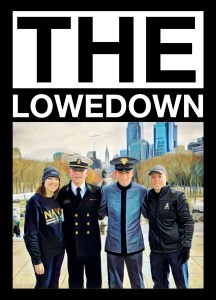
Check Out My Jump “The Lowedown” by clicking the image or the following link:
https://plm4.app.link/XH0QcDNap5

Personally, I love the idea of social media enabling me to stay connected with the people who are important to me, but much of the current social media culture is toxic and polarizing. The Jump may just be the alternative we’ve all been looking for.

I’ve created a Jump (group) on the app for those who want to stay connected to us and our ministry (Group icon is shown at left).

I invite you to try it out by texting 54293 to (913) 828-0100. You’ll receive a personal invitation to download the app and join our Jump.

In these crazy, uncertain times, now more than ever, we need a way to stay connected to encourage and support one another. Please let us know, in whatever fashion works for you (text, e-mail, snail-mail, The Jump, or whatever), how you’re doing and how we can pray for you!

We are so grateful for you and we pray that the Lord is protecting you and meeting you in the midst of this global crisis!

Adapting to New Realities

Jacob (Navy) and Joshua (Army) look on as their former team-mate races to the finish line of the 800m race!

One week ago, with my twins home for spring break, we went to a track meet where I took photos while my boys connected with former coaches and teammates. Everything seemed normal and life was good. We were making the most of our few days together as a family before the twins were scheduled to report back to their respective academies.

Within 24 hours, everything changed.

EVERYTHING!

It was announced that Tom Hanks and his wife Rita Wilson had tested positive for the Coronavirus. At the same time, a member of the Utah Jazz tested positive and the NBA immediately suspended their season. Things escalated exponentially from there.

The next day, Jacob and Joshua were both informed that they were to delay their returns for 2 weeks and that online instruction would ensue shortly. Restaurants began closing and other large events were canceled or postponed. Disneyland closed for only the 4th time in its history. By the end of the week, all major sports leagues had been suspended, most schools had closed, weekend church services were either canceled or moved online and many people were told to begin working from home.

New terms such as “flattening the curve” and “social distancing” have become a normal part of our vernacular while crowded grocery stores and empty shelves have become commonplace. Who would have thought a few weeks ago that toilet paper would be more sought after than gold?

Long lines and empty shelves are the norm now at most grocery stores

What we’re experiencing is unprecedented….at least in my lifetime. How should we respond?

As you know, Jen has been experiencing her own health issues with her vasculitis flaring up recently. She’s been hospitalized, is back on Prednisone and has undergone two different infusions of Rituxan, a drug which is designed to suppress her immune system as a measure of stabilizing the auto-immune flare that is currently afflicting her.

A few weeks ago, Jen spent the day at UCLA, receiving a five hour infusion of Rituxan, a drug that is part of her ongoing treatment in combating her vasculitis flare.

While she’s not bed-ridden and she’s able to carry on most work responsibilities, she’s at increased risk for infections. As a result, we’re trying to be extra cautious and vigilant, but also doing our best not to panic.

From a ministry perspective, we’re still working and actively seeking to minister to Young Professionals. While many of our upcoming work trips have been canceled and events postponed, we’re still able to coach Young Professionals virtually. In fact, we already office out of our home and have been doing more and more of our coaching in a virtual environment anyway, so these latest measures have not been a major disruption to us.

One benefit of having the boys home is the dog gets more attention…but yeah, he’s already a spoiled pup!

Perhaps the biggest change for us is the fact that our boys are home and we are all sharing the same space and needing to get online for virtual classes or online meetings. Our boys are attending class as normal but everything is on East Coast time so they are having to get up at 4:30 a.m. in order to attend their first period classes.

Food consumption has also gone up, which means there are more trips to the grocery store, and more empty shelves and hunting for food and supplies to keep these guys from going hungry!

Though the nation is in crisis, we are trying to rest in the peace that Jesus is in control and we are His.

We would appreciate your prayers, though, mainly to stay healthy and for Jen’s vasculitis flare to become stable so she can begin to taper off of some of the drugs that have such negative effects. Pray too that we would find new and creative ways to minister to people during this time.

We know this crisis is affecting many of you in very real and perhaps devastating ways. We would love to pray for you. Please let us know how we can intercede on your behalf!

Living and Ministering in Digital Babylon

Based on recent Barna research, Faith For Exiles is the latest book by David Kinnaman.

As I read the words on the very first page, I was hooked. David Kinnaman, in his latest book, Faith For Exiles, was describing what it was like to drop his oldest daughter off at college, with all of the emotions that you would expect. Having just dropped our twins off at schools that are 3000 miles away, I could relate to Kinnaman’s fears and anxieties concerning the question of how your child will fare spiritually in this new and secular environment without our guidance. Is their faith strong enough? Have we built the right character into them? Did we do a good job of preparing them spiritually for what lies ahead?

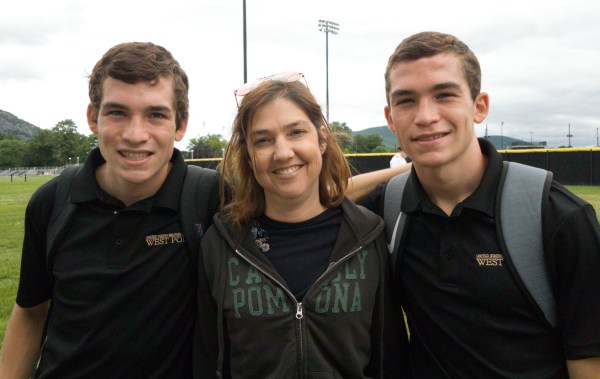
TOP LEFT: Jacob (left) waits in line to get on a bus to enter summer training for the Naval Academy
TOP RIGHT: Joshua waits in line to enter summer training for West Point
BOTTOM: Sign at West Point directing new students where to go

Kinnaman’s 2011 book, You Lost Me, argued that the church has a dropout problem. Research at the time showed that 59% of Young Adults who claimed a faith upbringing had left the church. New research shows the problem has gotten worse, with 64% of Young Adults abandoning the faith of their youth.     

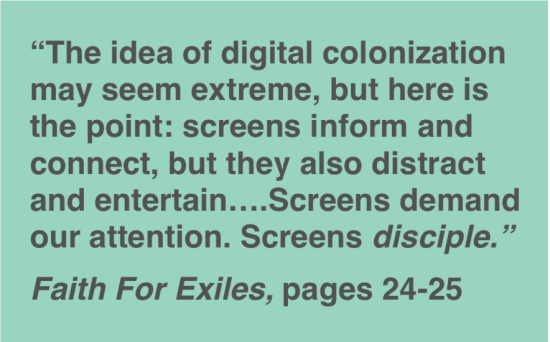
What accounts for such a mass exodus? Kinnaman, and his co-author Mark Matlock, argue that our culture is “especially and insidiously faith repellant.” The biggest culprit, they contend, is our smart devices, which have created a digital culture that actually works against us. As a result, believers are swimming upstream, fighting to maintain their values and their faith beliefs in a culture that is becoming increasingly opposed and in some cases hostile to these values and beliefs.

Click on the image to watch this short video from thebibleproject.com, which explains what exile is and how the theme of “exile” is woven throughout the Bible

The Old Testament highlights God’s promise that if His people followed Him and worshiped Him alone, they would prosper. But He warned them that if they were disobedient, He would bring judgment in the form of invading armies who would conquer them and take them into captivity. Much of the Old Testament is story after story of the nation of Israel forsaking God to pursue false gods. God continually sends prophets to warn them of impending doom but His message inevitably falls on deaf ears.

Click on the image to watch this short video from thebibleproject.com, which highlights what it was supposed to look like for the Israelites who were living in exile in Babylon and what it means for us as believers “living in exile.”

God finally hands his people over to the Babylonians, who take the Israelites into exile, where they live for 70 years in a foreign land, amidst a foreign culture that serves foreign gods and does not share their religious and cultural values. In fact, one of the goals of taking a conquered people into captivity was the systematic dismantling and eradication of their culture and the assimilation and adoption of the invading empire’s culture and values.

Imagine what it was like to be a Jew living in Babylon. How hard would it be to resist adopting the culture in which you’re thoroughly steeped, while trying to keep your own faith and religious views alive?

Young Adults spend an enormous time on their phones and the content is not always helpful to to maintaining a vibrant faith. Photo by KAL VISUALS on Unsplash

We haven’t been taken into captivity and we’re not living in a foreign land, as the Israelites did, but the authors make the case that the internet age in which we’re living has created what they refer to as “Digital Babylon.” A sobering graphic shows that the average 15-23 year old spends nearly 2800 hours in a typical year engaging with media on their phone. For the average 15-23 year old who is not a Christian, only 153 of those 2800 hours contain ANY kind of spiritual or biblical content. The Christian Young Adult fares only slightly better, with 291 hours of biblical content to offset the nearly 2800 hours of input they’re getting.

Our “smart” devices have created a digital environment that is slowly indoctrinating us to views and values that are contrary to our faith. This is what it means to live in “Digital Babylon”.

It’s not all bad news though. There is a segment of Young Adults, identified as “resilient disciples” who are thriving spiritually even in this current cultural context. The book is really about the practices of this group that enable them to maintain a vibrant faith. It turns out that we’ve already identified many of these practices as critical to thriving spiritually and as a result, we’ve already implemented many of these practices in our own ministry to Young Adults.

Our prayer is that our influence would increase and the Lord would show us new ways and avenues to impact Young Adults, who are seeking to live as resilient disciples in “Digital Babylon.”

We greatly appreciate your partnership and your prayers as we strive to this end!

The Power of a New Year’s Resolution

Photo by Crazy nana on Unsplash

There are two kinds of people in the world: those who make New Year’s resolutions and those who don’t.

It’s not hard to figure out why some people hate New Year’s resolutions. Many people hate the idea of New Year’s resolutions because they’ve made them over and over again, only to fail miserably over and over again. Nobody likes the feeling of failure.

We resolve to lose weight and we actually gain weight. We resolve to get a handle on our finances and yet we go deeper into debt. We resolve to read more and watch TV less  and yet we find ourselves binge watching the latest Netflix series during our free time (when we should probably be exercising)!

Photo by Jamie Matociños on Unsplash

Have you ever wondered why so many New Year’s resolutions fail? It’s because for most of us, we try to change our outward behavior without changing the inner person. We fail to address the core issues that cause us to do the things that we say we don’t want to do but we end up doing anyway.

Photo from Pexels.com

In The Godfather III, there is a scene where Michael Corleone (played by Al Pacino), feeling remorseful for his sinful life, is at the Vatican City talking to a priest. The priest picks up a stone from the fountain next to him and says, “do you see this stone? It has been surrounded by water from this fountain for many years. But the water has never penetrated the inside.” He then smacks the stone onto the pavement and it breaks in two. “You see? The inside is completely dry. This is like Christianity. People have been surrounded by Christianity for thousands of years and yet it does not penetrate their hearts.”

Forty-five years ago, my parents made a New Year’s resolution that greatly impacted me. Though they had both grown up going to church, we were not a church-going family. My parents, after much reflection, resolved to recommit themselves to the Lord and begin taking their family to church on Sundays.

As an eight-year old boy, I suddenly found myself in church on Sundays instead of sleeping in or messing around the neighborhood. It was not my preference, but as the weeks and months went by, I learned about my sinfulness and my need for forgiveness. I also learned about the payment Jesus made on the cross for my sin. I learned that I could receive forgiveness and enter into a relationship with God simply by putting my faith in Jesus and His death for me. My life was changed because of a New Year’s resolution.

If only I could get someone to take me on a walk!

What are the things you are hoping to change as you enter this New Year? What are your resolutions? They are probably similar to mine. I’d like to exercise more and read more. I should probably walk my dog more. I’d like to be more kind and compassionate and less impatient with others.

More than anything, my hope for this year is that Christ would penetrate my heart more deeply and that I would experience greater internal transformation as a result. I don’t want to just try to act better but my hope is that by Christ’s strength and power, I might be better – that I might become one who more accurately reflects Christ’s character to the world around me.

We are so grateful for you, our friends and ministry partners, whose encouragement motivates us to continue to pursue Jesus and the spiritual transformation that only he can offer.

Let us know what your resolutions are for this year and how we can pray for you to experience transformation in 2019!

Happy New Year!

The Anchor of Hope

For the last year and half, Jen and I have been volunteering as coaches at an Orange County High School. Once a week, a group of students spend an hour with us going through a curriculum that teaches life skills and principles designed to help students experience greater success in pursuing their goals and ambitions.

Pedro was a student in Dave’s coaching group this last spring

To be honest, these groups are a real challenge. Many of these students are unmotivated and have been hardened by the circumstances of life.

Some have had close friends killed as a result of gang violence. Others have relatives who have been in and out of jail. Some have witnessed shootings. For many, there is a feeling of hopelessness.

Dictionary.com defines hope as “the feeling that what is wanted can be had or that events will turn out for the best.” But what do you do when events don’t turn out the way you wanted or life delivers unexpected hardships?

Our twins are in the middle of their senior year and they’ve been thinking and dreaming about life after high school. Their hope is to attend a military academy and they’ve been working diligently for the last several years to put themselves in a position to achieve that goal. But obtaining an appointment to any of the service academies is incredibly competitive. It might not work out the way they’ve planned.

Joshua (left) and Jacob experienced a week at West Point over the summer and are hoping to gain acceptance to one of the service academies as their college choice.

There is a tremendous amount of hopelessness in our culture these days, especially among Millennials. Many are discouraged by the political system and by how polarized we seem to be on many issues. Others are discouraged by the high cost of education and the amount of indebtedness they’ve incurred. For some, the job market is not as promising as they had hoped and the American dream seems elusive.

The Bible has a lot to say about hope. The author of Hebrews says that “we have this hope as an anchor for the soul, firm and secure.” The hope being spoken of is that God cannot lie, and therefore we can trust in His promises. The author says that Jesus is our High Priest who has gone into the inner sanctuary to make atonement for our sin, and as a result, we can run to God and take refuge.

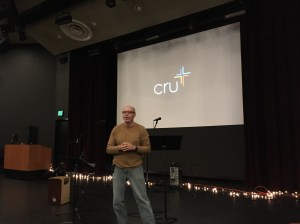
Dave speaks to the UCLA Cru students at their weekly meeting

In other words, we can know God and we can come into His presence. He will not deny us no matter what we’ve done or we might be feeling about ourselves.

Jesus is the only one who can be an anchor of hope for our souls. Everything else will either let us down or is ultimately fleeting. We cannot put our hope in our job or in the political system or the college we want to attend. None of those things can provide ultimate meaning and purpose for our lives. Only Jesus can do that.

Thanks for your partnership with us in helping Young Professionals find meaning and purpose in Jesus, the hope of glory!

Feeling Disconnected in an Interconnected World

(10:00 p.m. on a School Night)

“Is the internet down? I can’t get online!”

“I’m not sure. Try refreshing  your browser.”

“I did that. I still can’t get online.”

“Have you tried rebooting your computer? Let me know if that fixes the problem.”

The internet has put endless amounts of information at our fingertips, but for most people, has complicated the process of developing deep, meaningful relationships.

(Minutes later)

“I rebooted my computer and I still can’t get online. I think there’s something wrong with the network.”

“Alright (sigh), let me check. Why do you need to get online anyway? It’s late!”

“I’m working on a class assignment and need to access my document in the cloud.”

“Is it urgent? Is it due tomorrow? Does it have to be done tonight?”

“No. But I have 3 tests and another major assignment due this week and if I don’t work ahead now, I’m going to get slammed later in the week. That’s why I need to get online.”

(Yelling from another room): “I just rebooted the modem. Did that work?”

“No. I still can’t connect to the network.”

“Arrrggghhhhhh!!!!!” (shaking fist in the air)

Perhaps you can relate to this scenario (which happened in our home a few weeks ago). We’ve become so integrated with the internet via our computers, tablets and phones that when the network goes down, we’re not sure how to function. Panic can set in when we try easy troubleshooting tactics and still can’t fix the issue.

AT&T had a whole ad campaign a few years ago connected to this theme. Their ads showed humorous responses a family had after being disconnected from the internet at home for 4 minutes, 6 minutes, 9 minutes and so forth. The ads always concluded by saying, “Keep Calm, your internet is on.” AT&T then touted their 99% reliability rating in providing consistent and uninterrupted internet service to their customers. (See YouTube video at: https://youtu.be/zYys_Jg9xz4 )

The internet is an amazing tool that has allowed people to be instantly connected to information. Whatever you want or need, it’s all there at the click of a button.

As helpful as this information may be, it can make meaningful relational connection more difficult.

The internet has enabled us to have access to seemingly endless information about our friends. We see what they’re doing on Facebook. We see their photos on Instagram. We know what they’re thinking by the tweets they post. And yet ironically, we feel even more disconnected!

Almost universally, as we meet with Millennials, they tell us of their desire to have deeper relational connections and the challenges they face in experiencing those kinds of relationships in today’s digital culture. Sadly, for many Young Professionals, the struggle to find meaningful community extends to their church.

I sat across a table recently with a Young Professional who told me very directly of his frustration to find real community within his church. He’d been in several Bible Studies that didn’t last and after attending church regularly for several years, he found that his closest friends were all outside of the church. He’s been struggling lately to understand the purpose and relevance of church in his life, which has given birth to a seed of disillusionment.

Unfortunately, we’ve found that this is not an isolated occurrence with this generation of Young Professionals.

Our challenge is to help Young Professionals connect with Jesus, who is the only legitimate source of life, and to learn to form deep, meaningful relationships with others in our current cultural environment. We’re trying a number of things to help foster meaningful connections.

Jen’s lunch-time book club has created meaningful conversations related to the topic of faith and work.

Jen has incorporated a work-lunch book study to bring Young Professional women together around a certain topic that helps create meaningful conversations and deepen relationships.

We’ve also created Leadership Development groups to bring Young Professionals together in a cohort-like environment to process life with other Young Adults and talk about core faith issues that are relevant in today’s cultural and professional environment.

We’re seeing signs of success but we’ve learned that building effective community always takes work and it always takes time. That’s a challenge because in today’s internet environment, it’s often easier to entertain ourselves with digital alternatives than to invest the time and work necessary to create the kind of real connections that our souls really crave and need.

Please pray with us as we seek to find effective ways of helping Young Professionals connect with others. And please pray for us as well, as we need those same kinds of life-giving relationships in our own lives.

Thanks for journeying with us!