Filling a God-Shaped Hole

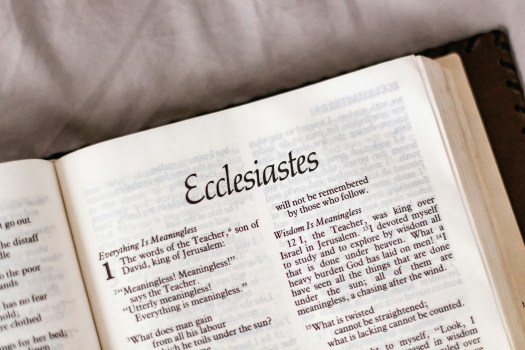
Ecclesiastes 2

1I said to myself, “Come now, let’s give pleasure a try. Let’s look for the ‘good things’ in life.” But I found that this, too, was meaningless. 2“It is silly to be laughing all the time,” I said. “What good does it do to seek only pleasure?” 3After much thought, I decided to cheer myself with wine. While still seeking wisdom, I clutched at foolishness. In this way, I hoped to experience the only happiness most people find during their brief life in this world.

4I also tried to find meaning by building huge homes for myself and by planting beautiful vineyards. 5I made gardens and parks, filling them with all kinds of fruit trees. 6I built reservoirs to collect the water to irrigate my many flourishing groves. 7I bought slaves, both men and women, and others were born into my household. I also owned great herds and flocks, more than any of the kings who lived in Jerusalem before me. 8I collected great sums of silver and gold, the treasure of many kings and provinces. I hired wonderful singers, both men and women, and had many beautiful concubines. I had everything a man could desire!

9So I became greater than any of the kings who ruled in Jerusalem before me. And with it all, I remained clear-eyed so that I could evaluate all these things. 10Anything I wanted, I took. I did not restrain myself from any joy. I even found great pleasure in hard work, an additional reward for all my labors. 11But as I looked at everything I had worked so hard to accomplish, it was all so meaningless. It was like chasing the wind. There was nothing really worthwhile anywhere.

12So I decided to compare wisdom and folly, and anyone else would come to the same conclusions I did. 13Wisdom is of more value than foolishness, just as light is better than darkness. 14For the wise person sees, while the fool is blind. Yet I saw that wise and foolish people share the same fate. 15Both of them die. Just as the fool will die, so will I. So of what value is all my wisdom? Then I said to myself, “This is all so meaningless!” 16For the wise person and the fool both die, and in the days to come, both will be forgotten.

17So now I hate life because everything done here under the sun is so irrational. Everything is meaningless, like chasing the wind. 18I am disgusted that I must leave the fruits of my hard work to others. 19And who can tell whether my successors will be wise or foolish? And yet they will control everything I have gained by my skill and hard work. How meaningless!

20So I turned in despair from hard work. It was not the answer to my search for satisfaction in this life. 21For though I do my work with wisdom, knowledge, and skill, I must leave everything I gain to people who haven’t worked to earn it. This is not only foolish but highly unfair. 22So what do people get for all their hard work? 23Their days of labor are filled with pain and grief; even at night they cannot rest. It is all utterly meaningless.

24So I decided there is nothing better than to enjoy food and drink and to find satisfaction in work. Then I realized that this pleasure is from the hand of God. 25For who can eat or enjoy anything apart from him? 26God gives wisdom, knowledge, and joy to those who please him. But if a sinner becomes wealthy, God takes the wealth away and gives it to those who please him. Even this, however, is meaningless, like chasing the wind. (Ecclesiastes 2:1-26, NLT)


The Daily DAVEotional

Blaise Pascal, the famous 17th century French mathematician and inventor, is often credited with saying,

​There is a God-shaped vacuum in the heart of every man which cannot be filled by any created thing, but only by God, the Creator, made known through Jesus Christ.

Interestingly, Pascal never actually said this exact quote, though he did express the sentiment when he said,

“What else does this craving, and this helplessness, proclaim but that there was once in man a true happiness, of which all that now remains is the empty print and trace? This he tries in vain to fill with everything around him, seeking in things that are not there the help he cannot find in those that are, though none can help, since this infinite abyss can be filled only with an infinite and immutable object; in other words by God himself”

As it turns out, this sentiment from Pascal, which has been shortened into the pithy quote that we all see today, was probably derived from Solomon, who explored the nature of meaning and fulfillment in this second chapter of Ecclesiastes.

So what exactly does Solomon say?

It’s important to understand the context on which Ecclesiastes 2 rests. In chapter 1, Solomon is trying to derive meaning and purpose to our existence. His initial position, based on observations and lived experience, is that life is meaningless.

It’s a sad existence indeed if there is absolutely no purpose or meaning in life. Yet that is what Solomon initially concludes.

In this chapter of Ecclesiastes, we’re subjected to a bit of Solomon’s ontological journey.

The first thing he says is that he tried to find meaning and fulfillment in pleasure, or what we call hedonism. But physical pleasure provides no lasting satisfaction. The exhilarating rush that pleasure brings quickly fades, leaving one grasping for the next opportunity to experience that physical and emotional high.

Solomon then turns his attention to the pursuit of materialism. Perhaps acquiring lots of stuff, overseeing grand construction projects or building tremendous wealth could ascribe meaning and value to life. But Solomon found that lacking as well. The allure that extreme wealth promises is never quite  achieved. John Rockefeller, who was the richest person to ever live, was once asked, “how much is enough?” His response was “just a little bit more.” He apparently did not subscribe to Solomon’s conclusion that extreme wealth does not ultimately satisfy.

Perhaps fame and taking pride in one’s work could provide the kind of satisfaction that pleasure and materialism couldn’t. But Solomon ultimately realized the utter futility of that pursuit. Fame is fleeting and whatever work we may accomplish is forgotten as quickly as we are when we die.

Solomon reasoned that hard work and wealth are ultimately meaningless because we all die. What good are those things after you die? Someone else will take possession of and oversee all that we’ve worked to produce. That hardly seems fair. You work your tail off to produce wealth and build an empire only to leave it to someone else who did nothing to earn or produce what you’ve left?

None of this makes sense on the surface. What is the point?

Solomon gives a glimpse into the ultimate purpose in verses 24-25, when he says,

24So I decided there is nothing better than to enjoy food and drink and to find satisfaction in work. Then I realized that this pleasure is from the hand of God. 25For who can eat or enjoy anything apart from him?

Is pleasure, wealth, fame and work all meaningless? Apart from God, the answer is yes. But with God, all of these things are meaningful because they are gifts from God, the ultimate gift-giver!

So we’re back to our opening line that is often attributed to Pascal. There is something inside each person that is searching and striving for meaning and purpose. Man, in his fallenness, seeks to satiate this inner desire with all kinds of things – pleasure, power, wealth and fame. But none of these things bring true satisfaction or fulfillment. That’s because God is the only one who can ultimately fulfill our basic human need for meaning and purpose. It’s part of His design.

Apart from God there is no ultimate meaning and purpose. As Christian philosopher and apologist Frank Turek says, we are just “moist robots” who appear one day and then one day we’re gone.

If that is the case, then Solomon’s initial assessment is true – life is indeed meaningless. But with God, life not only has purpose and meaning but work, pleasure and wealth all make sense.


Did you enjoy this post? I’d love to hear your thoughts! Feel free to like, leave a comment below, and share it with your friends or on social media if you found it helpful or interesting. Your support keeps the conversation going!


Reflection

What do you turn to in order to experience purpose and meaning in life?

Which of the following do you struggle with the most: the pursuit of pleasure, wealth, power or fame?

What do you think are the reasons you or people in general pursue other things to satisfy their inner needs rather than pursuing God Himself?

In what ways can you turn to God as your source of true satisfaction and fulfillment?


Photo by Sincerely Media on Unsplash

Does Proverbs 8 Prove that Jesus is a Created Being?

Proverbs 8

1Listen as wisdom calls out! Hear as understanding raises her voice! 2She stands on the hilltop and at the crossroads. 3At the entrance to the city, at the city gates, she cries aloud, 4“I call to you, to all of you! I am raising my voice to all people. 5How naive you are! Let me give you common sense. O foolish ones, let me give you understanding. 6Listen to me! For I have excellent things to tell you. Everything I say is right, 7for I speak the truth and hate every kind of deception. 8My advice is wholesome and good. There is nothing crooked or twisted in it. 9My words are plain to anyone with understanding, clear to those who want to learn.

10“Choose my instruction rather than silver, and knowledge over pure gold. 11For wisdom is far more valuable than rubies. Nothing you desire can be compared with it.

12“I, Wisdom, live together with good judgment. I know where to discover knowledge and discernment. 13All who fear the LORD will hate evil. That is why I hate pride, arrogance, corruption, and perverted speech. 14Good advice and success belong to me. Insight and strength are mine. 15Because of me, kings reign, and rulers make just laws. 16Rulers lead with my help, and nobles make righteous judgments.

17“I love all who love me. Those who search for me will surely find me. 18Unending riches, honor, wealth, and justice are mine to distribute. 19My gifts are better than the purest gold, my wages better than sterling silver! 20I walk in righteousness, in paths of justice. 21Those who love me inherit wealth, for I fill their treasuries.

22“The LORD formed me from the beginning, before he created anything else. 23I was appointed in ages past, at the very first, before the earth began. 24I was born before the oceans were created, before the springs bubbled forth their waters. 25Before the mountains and the hills were formed, I was born—26before he had made the earth and fields and the first handfuls of soil.

27“I was there when he established the heavens, when he drew the horizon on the oceans. 28I was there when he set the clouds above, when he established the deep fountains of the earth. 29I was there when he set the limits of the seas, so they would not spread beyond their boundaries. And when he marked off the earth’s foundations, 30I was the architect at his side. I was his constant delight, rejoicing always in his presence. 31And how happy I was with what he created—his wide world and all the human family!

32“And so, my children, listen to me, for happy are all who follow my ways. 33Listen to my counsel and be wise. Don’t ignore it.

34“Happy are those who listen to me, watching for me daily at my gates, waiting for me outside my home! 35For whoever finds me finds life and wins approval from the LORD. 36But those who miss me have injured themselves. All who hate me love death.” (Proverbs 8:1-36, NLT)


The Daily DAVEotional

When I was a high school senior, I took AP English. At one point we were studying poetry and we read a famous poem by Robert Frost, entitled, “The Road Not Taken”The poem starts with the line:

Two roads diverged in a yellow wood,

and ends with the oft-quoted phrase:

Two roads diverged in a wood, and I—
I took the one less traveled by,
And that has made all the difference.


Our teacher asked the class what we thought the poem was about. A few people in the class who had a somewhat religious background, including myself, thought the poem was a metaphor for heaven and hell. After all, if you’re going to talk about two roads that diverge, you cannot get any more divergent than heaven and hell.

I remember our teacher graciously telling us that we were overthinking the poem. There was nothing in the poem that mentioned heaven or hell and the context of the poem was not about eternal destiny. There was really nothing about the poem that would indicate that it was religious in nature.

To my surprise, I learned that the plain meaning was usually the correct meaning, unless there was some compelling reason to believe that the writer was speaking metaphorically or allegorically.

In our case, the poem was simply about two different choices, both of which were appealing in their own way. Which one should I choose? How do you choose? The author is simply writing about the conflict that arises when we have to choose between two paths. That’s it.

What can happen though is that some people will naturally want to import their own views and perspectives into the poem. In my case, being a person who went to church and Sunday school and who had heard a lot about the two different life choices of heaven and hell, I saw “two paths” and immediately concluded “heaven and hell” without really thinking about whether that was what the author was really writing about.

The Jehovah’s Witnesses make a similar error in their understanding and explanation of Proverbs 8.

If you’ve ever had a discussion with a Jehovah’s Witness, you likely know that they do not believe that Jesus is God. Instead, they teach that Jesus is a created being. They believe that Jesus is God’s first created being, which makes him extra special, but in the end, he’s still a created being like you and me.

The Jehovah’s Witnesses theological viewpoints on Jesus are rooted in an ancient heresy known as Arianism. I wrote about their views in my blog post “A Modern Day Version of an Ancient Heresy” in which I discuss their views of the opening verses of John’s gospel.

When talking to a Jehovah’s Witness regarding their view that Jesus was a created being, they have a number of biblical “proof-texts” to support their theological stance. One of those passages is Proverbs 8.

According to the Jehovah’s Witness, Proverbs 8 provides ironclad evidence that the Bible teaches that Jesus is NOT God.

Verses 22-31, in particular, demonstrate that Jesus is created. The Jehovah’s Witness argument is that Jesus is speaking about how he was formed “before he created anything else.” Jesus was there at God’s side when He created everything.

To the Jehovah’s Witness, this fits perfectly with their view that Jesus was the first created “thing” and then God created everything else through Jesus.

There is only one problem with this reasoning – the subject of this passage is wisdom not Jesus.

The Jehovah’s Witnesses, in their haste to project their theological view of Jesus into any text that might have words or phrases that trigger their theological bias, have erred in much the same way I, and others in my high school English class, so quickly attributed a wrong context to Robert Frost’s famous poem.

Solomon, the author of Proverbs, is using a literary device known as personification to explain and highlight the importance of wisdom.

There is nothing in the context to suggest that Wisdom is really Jesus. Actually, when you really look at this passage, you realize that the text cannot be referring to Jesus. Here are a couple of reasons why:

First, wisdom in this passage is identified as a female, whereas Jesus is male.

Secondly, if wisdom is an actual person, then “good judgment” must also be a person because wisdom lives with good judgment according to verse 12. If wisdom is really Jesus, then who is this “good judgment” character?

Lastly, if you know anything about the broader context of Proverbs, it is a collection of sayings and instruction regarding wise living. This is made clear at the very outset of the book:

The purpose of these proverbs is to teach people wisdom and discipline, and to help them understand wise sayings. 3Through these proverbs, people will receive instruction in discipline, good conduct, and doing what is right, just, and fair. 4These proverbs will make the simpleminded clever. They will give knowledge and purpose to young people. (Proverbs 1:1-4, NLT – emphasis added)

Additionally, in this particular section of the book, Wisdom is personified as a female instructor. Proverbs 9 continues with this personified motif as Wisdom is contrasted with Folly, both of whom are given female personalities.

So if this passage isn’t speaking about Jesus, what is the point being made?

The point of this passage is summarized at the end, in verses 32-36, which state:

32“And so, my children, listen to me, for happy are all who follow my ways. 33Listen to my counsel and be wise. Don’t ignore it.

34“Happy are those who listen to me, watching for me daily at my gates, waiting for me outside my home! 35For whoever finds me finds life and wins approval from the LORD. 36But those who miss me have injured themselves. All who hate me love death.”

In short, the reader is encouraged to “listen to my counsel and be wise.”

In the end, the Jehovah’s Witnesses commit an error we call eisegesis, which occurs when one imports their own viewpoint or bias into the interpretation of the text. Good Bible interpretation will instead interpret the passage based on the plain meaning and the context while resisting the urge to make the passage say what the reader wants or hopes that it will say.


Did you enjoy this post? I’d love to hear your thoughts! Feel free to like, leave a comment below, and share it with your friends or on social media if you found it helpful or interesting. Your support keeps the conversation going!


Reflection

The error of eisegesis, where one interprets a text in such a way that it fits with their pre-conceived views, is not just a problem with Jehovah’s Witnesses. People everywhere commit this error. What are some views you have that you are more apt to try to find the text to support? In other words, what are some ways you have, or are tempted to commit this error of eisegesis?

Why do you think the Jehovah’s Witnesses are so committed to their view that Jesus is a created being?

What are some of the benefits of wisdom according to this passage?

What do you think are some good Bible study habits and techniques that will help you to interpret passages correctly, without importing your personal views into the interpretation of the passage?


Photo by James Wheeler: https://www.pexels.com/photo/photo-of-pathway-surrounded-by-fir-trees-1578750/


Communication Advice from the Bible

Proverbs 18

2Fools have no interest in understanding; they only want to air their own opinions.

6Fools get into constant quarrels; they are asking for a beating.

7The mouths of fools are their ruin; their lips get them into trouble.

13What a shame, what folly, to give advice before listening to the facts!

(Proverbs 18:2, 6, 7, 13, NLT)


The Daily DAVEotional

Several years ago my wife and I took a weekend communication course that had been recommended to us by some friends. The content was really good and we quickly realized how helpful the tools and concepts presented would be for healthy marital communication as well as conflict resolution situations.

The course and content was presented by PhD level communication experts who had spent countless hours researching what makes good, effective communication.

One of the first principles that was presented as important for good communication was to seek to understand BEFORE being understood. That seemed like really good advice.

The presenter then proceeded to share how “scripture” confirmed what the research had discovered.

If you think about it, it’s actually the other way around. Proverbs 18:2 was written thousands of years ago and the research actually confirms what Proverbs has been trying to teach us – that it’s better to understand before you try to be understood. In fact, the scripture calls people who don’t practice this principle “fools”.

The Bible actually has a lot to say about communication. I’ve written here about how James warns us against “Weaponizing our Words“.

The book of Proverbs has a lot to say on the subject as well and Proverbs 18, in particular, is a treasure trove of wisdom on good communication. I wrote here about how our words can be emotionally damaging to others.

Proverbs is a book of wisdom and in many of the chapters there is a contrast between wise living and foolish living. In this chapter, a number of verses cite the foolishness of talking too much.

The fool doesn’t listen but only talks. In a tense or heated conversation, this can lead to quarrels and arguments as the foolish person fails to listen but only seeks to get their point across. In a normal, less tense conversation it can simply lead to someone acting like a know-it-all and giving unsolicited and unwarranted advice instead of listening and understanding the other person’s story and situation.

My guess is you know someone like the fool that is described in these Proverbs 18 verses. If you don’t know someone like that, as the old saying goes, perhaps YOU are that person.

The wise person listens and seeks to understand BEFORE trying to get his or her point across. Research shows that this leads to healthier communication and better relationships. But the Bible knew this all along.

Imagine that!

Reflection

When have you been in a situation where someone gave you advice before listening to really understand your situation? How did that make you feel? What was the outcome of that encounter?

Why do you think people are so anxious to be understood (trying to get their point across) before understanding the other person?

What do you think would be required to “seek to understand before being understood”? What skills and attitudes would need to be present in order to “understand before being understood”?

Based on the principles in these verses, how would you rate your communication patterns on a scale of 1-10? What reasons did you rate yourself the way you did? What steps can you take to improve your rating?


Photo by Timur Weber: https://www.pexels.com/photo/a-couple-talking-while-arguing-8560383/

Biblical Investing Advice

Ecclesiastes 11

2Divide your gifts among many, for you do not know what risks might lie ahead. (Ecclesiastes 11:2, NLT)


The Daily DAVEotional

The Bible has a lot to say about money and wealth. Despite what many people in our culture think today, the Bible doesn’t condemn wealth or making money. Actually, Jesus himself encourages the wise steward  to multiply the resources entrusted to him/her by God and to seek to make a profit. I’ve written a number of blog posts on the subject of whether wealth is immoral. You can read my previous posts here, here and here.  Additionally, I wrote about God’s stance towards the rich here.

Though the Bible encourages people to make a profit and to multiply their financial resources, it doesn’t give a lot of guidance on how exactly we’re supposed to do that. When it comes to investing, the Bible has little to say that will yield any specific steps or strategies to guide us.

There is one verse however, that gives some financial wisdom on the topic of investing, and it’s found in Ecclesiastes 11:2.

In this verse, Solomon tells us to divide our “gifts” among many in order to hedge against risk.

What’s he talking about?

I like the way the NIV states this verse. It says it this way:

2Give portions to seven, yes to eight, for you do not know what disaster may come upon the land. (Ecclesiastes 11:2, NIV)

In this verse, Solomon is encouraging the reader to divide his investments into 7 or 8 different portions. Essentially, he’s encouraging the reader to diversify their assets in order to hedge against a potential disaster.

I found a blog post by Alice A. Anacioco to be especially helpful. She explains this passage this way:

You may be surprised to read King Solomon offering financial counsel as he nears the end of Ecclesiastes. But accordingly, Solomon was deeply involved in international trades with merchants. And just like today, one of the main trade commodities was grain.

The merchants of Solomon’s day would load their grains on ships and send them off. But instead of loading all of their grains in just one ship, he tells his merchants to put them in several ships and send them out in a diversified way so that if one of the ships should sink, he would not lose everything.

The main advice the Bible gives when it comes to investing is to diversify your investments. The idea is to spread your money out among different types of assets so that if one type of asset is negatively impacted by an economic event, the other assets may be unaffected and as a result, the entire portfolio will not be completely devastated.

Be careful though. Many people assume they are following this advice because they have placed their investment money into mutual funds. Many financial advisors will advise their clients to diversify their stock portfolio among many different stocks so that if one company performs badly, the positive performances of the other stocks may shield the portfolio from being completely torpedoed.

Mutual funds provide some level of inherent diversity because a mutual fund is already a portfolio of many stocks. Hence, if one company within the fund goes down, other companies may go up and thus the value of the fund may go up as well despite the poor performance of one or a few companies.

But being invested in a number of stocks or even mutual funds does not mean you are diversified. To truly be diversified and hedged against disastrous economic events, one needs to have their funds invested in different asset classes altogether.

Think about it. Stocks and mutual funds are part of the same asset class. When the market crashed in 2000 due to the dotcom bubble bursting, many people who had all their money in the stock market had their entire portfolio decimated. Again, in 2008 when the market crashed as a result of the real estate bubble bursting, many who were “diversified” because they owned many different stocks or mutual funds took major hits to their bottom line.

I have heard and seen too many stories of people who had their entire nest egg cut in half or worse by one of these two market events. And for those who were in retirement when it happened, the results have been disastrous. There simply is no time to rebound from these market crashes when you’re already taking disbursements during retirement.

Solomon’s advice is basically “don’t put all your eggs in one basket”. So if you really want to diversify, don’t have all your money in stocks and mutual funds. Invest in other assets as well (such as real estate, precious metals, commodities, etc.) That way, if the stock market crashes, as it inevitably will do, only a portion of your entire portfolio will be affected. And who knows, even while the market is crashing, perhaps the other assets will be unaffected or even increase. You may find that you are gaining overall instead of losing it all.

Reflection

What is or has been your investing strategy?

What steps have you taken or are you taking to diversify your financial portfolio?

Besides stocks and mutual funds, what are some other asset classes you could invest in to begin to create a truly diversified portfolio?


Photo by Precondo CA on Unsplash


Can Golf Nourish Your Soul?

Proverbs 11

17Your own soul is nourished when you are kind, but you destroy yourself when you are cruel. (Proverbs 11:17, NLT)


The Daily DAVEotional

It’s summer time so of course for thousands of kids, that means summer camp. When my kids were in high school, we were alerted to all kinds of “camps” that we could pay money to send our kids to – soccer camps, baseball camps, basketball camps and even music camps. Some are even hosted by famous athletes and celebrities.

It’s interesting that these experiences are often called “camps” because there’s very little “camping” that happens. I think a better term for these week-long adventures is “clinic”. The purpose of these “clinics” is to hone skills and become better at whatever the craft is.

The truth is that any professional athlete, whether it’s a golfer, basketball player, baseball player or just about any other sport, spends hours upon hours doing drills. A golfer will take thousands of practice swings in order to perfect his or her technique.

A basketball player will dribble a ball up and down the court, switching hands and navigating through cones, just to perfect command of the ball.

Kobe Bryant was noted for his work ethic, shooting hundreds of balls every day in order to perfect his jump shot.

The purpose of training is to create muscle memory and develop habits so that when you’re in a game or in a live situation, you don’t have to think twice about how to act or what to do. Your body automatically taps into the hours of practice and you simply repeat what you’ve done thousands of times.

In this single proverb, we see a biblical example of what the scriptures refer to as “training in righteousness.”

What is training in righteousness?

Training in righteousness is a process by which you train yourself to do the right thing and thus live righteously, even when circumstances are against you.

Just as a golfer doesn’t perfect his swing without hours of practice swings, we don’t live righteously unless we train ourselves to make righteous choices.

According to this proverb, our soul is actually nourished when we act kindly. You might say that when we make a righteous choice, like acting kindly, it feeds our soul. But when we make an unrighteous choice, like acting with cruelty, it starves our soul.

If we make right choices over and over, we train our soul to live righteously. It becomes a habit and our lives will begin to bear fruits of righteousness, which will become evident to others.

However, if we make unrighteous choices over and over, we train our soul to live unrighteously. Living sinful lives will become second nature to us and our lives will bear unrighteous fruit.

So remember this the next time you are conflicted about how to act in a certain situation or how to respond to another person – by responding with kindness, you are feeding your soul and training yourself to live righteously. But by responding unkindly or acting cruelly, you will have the opposite effect – you will actually be training yourself to live unrighteously.

Reflection

What are some examples in your own life, whether sports, or music or some other discipline, where you have practiced drills in order to increase your skill level and your performance?

Can you think of any situations where a person can experience growth and development without undergoing some kind of training routine?

What are some ideas you have for cultivating your own soul and training yourself to live righteously?

What are some things that might be helpful to eliminate in your life that are actually starving your soul and making it harder to train yourself in righteousness?


Photo by Courtney Cook on Unsplash

Biblical Advice: Don’t Feed the Trolls!

Proverbs 26

4When arguing with fools, don’t answer their foolish arguments, or you will become as foolish as they are.

5When arguing with fools, be sure to answer their foolish arguments, or they will become wise in their own estimation.

(Proverbs 26:4-5, NLT)


The Daily DAVEotional

Not long ago, as I was reading through Proverbs, I encountered these two verses, right next to each other, which seemingly contradict each other.

Verse 4 states that we SHOULDN’T respond to a fool’s arguments while the very next verse says that we SHOULD respond. Which is it? Should we respond or shouldn’t we? How are we to reconcile these two statements?

When evaluating these two statements, you’ll notice that the first half of each statement is essentially the same, “when arguing with fools….”

The difference is in the back half of each statement, with each verse giving a different intended outcome. So, when arguing with fools, there are two desired outcomes. First, we don’t want to become as foolish as they are. Secondly, we want to ensure that the fool doesn’t become wise in their own estimation.

So while these two verses seem contradictory at first glance, you can see that the two intended outcomes are not mutually exclusive. Therefore, as long as you are satisfying the two different intended outcomes, the two statements are not contradictory.

Exactly how can we approach our engagements with others so that these two outcomes are achieved?

First of all, we should realize that it’s not necessary to respond to every foolish argument. In internet circles (forums, threads, tweets, posts, etc.) it is very common to encounter people who are engaged in what’s known as “trolling”.

An internet troll is someone who purposefully makes inflammatory or rude comments in order to evoke an emotional response or in order to hijack a conversation. Most people who engage in this type of behavior do so for their own personal amusement.

When we encounter this kind of foolish behavior, it’s tempting to respond in kind. But that would violate the outcome of verse 4. We don’t want to engage with a person in such a way that we “become as foolish as they are.”

Furthermore, when we engage people like this, we’re simply feeding their own amusement. Though it might feel good initially to respond with a zinger or some kind of disparaging remark, it actually serves as fuel and encouragement for the other person to continue their foolish behavior. Hence the phrase “don’t feed the trolls.”

So if you’re too emotionally involved in the conversation, or you’ve been triggered by something that the person said or the way in which they said it, then the advice of Proverbs is to NOT engage with the fool. In this case, it’s better to simply not respond.

However, if you’re able to respond in a respectful way and not act as foolishly as the other person, it may be prudent to expose the person’s immature behavior or the foolishness of their argument so that they don’t walk away thinking how wise they are.

Recently, I’ve encountered some examples of these principles in action as I manage an online forum where just about anyone can post.

In a recent thread, people were posting on the topic of evil. An article had been posted on the subject of why do bad things happen and many folks were posting their comments on the content of the article.

Whenever you are talking about a theological topic like the existence of God or the problem of evil, it is not uncommon for people who consider themselves atheists to engage in the discussion. While some are interested in genuine dialog, a number of people like to engage in trolling kinds of behavior with posts that are agitating, mocking and generally rude to people of faith.

One person posted on the thread a lot of inflammatory remarks aimed at God along with some incendiary language mocking Christians and people of faith.

After some deliberation I decided to respond to this person who, quite frankly, was coming off as arrogant and condescending. I shared how ironic it was that we were discussing the existence of evil and he was the only one, through his disrespectful language and mocking tone, who was engaged in behavior that most people would consider to be evil. I pointed out that while he was ridiculing those who believed in God and rolling his eyes at the biblical understanding of evil, he had not made an alternate case for why evil exists or how to deal with it.

I invited him to continue to engage but in a civil, adult way and I gave him some specific questions to answer if he wanted to show the superiority of his position.

To his credit, he did respond with a much less combative tone, though he never did answer the questions that were posed.

I think this was an example of responding to a fool so they don’t “become wise in their own estimation.”

So the bottom line is that these two verses are not contradictory but represent two different approaches to dealing with someone’s foolish arguments and behavior.

Our approach will be dictated by the outcome we are trying to achieve. If we’re trying to avoid the trap of engaging in the same kind of foolish tactics the other person is engaging in, then our approach will be to NOT engage. However, if our goal is for the other person’s foolishness to be exposed so they don’t become so full of themselves, then our strategy will be to respond.

Knowing the difference of when to pursue which outcome requires wisdom, which is why we need the Lord’s perspective, even in our personal and online interactions!

Reflection

When have you been tempted or even succumbed to foolish behavior in your in-person or online interactions? What do you think is the reason so many people engage in these uncivil and unproductive arguments?

What are some ways you can respectfully engage with people are who are fools to point out the folly of their position or tactics?

How would you rate your current in-person and online interactions? How well are you applying and abiding by these two proverbs?

Of the two approaches, which one would you say you need to grow in or develop more – do you need to practice NOT engaging because you’re too triggered or emotionally involved? Or do you need to develop in the art of engaging the fool to expose their tactics and behavior?


Original Photo by Donald Giannatti on Unsplash
Edited photo by Dave Lowe

Keep Your Mouth Shut!

Proverbs 21

If you keep your mouth shut, you will stay out of trouble. (Proverbs 21:23, NLT)


The Daily DAVEotional

Have you ever been told to “shut up”? Have you ever told someone to “shut up”?

Generally speaking we think of the command to “shut up” as rude, while the more muted request to “be quiet” is more courteous.

Usually, I think of the directive to “shut up” as being more demanding and authoritarian, often blurted, or even yelled at someone with whom I’m arguing or debating.

Would it surprise you to know that the Bible actually advises us to “keep our mouths shut”?

Think about all the ways our words can get us into trouble. We can consciously or unconsciously lie about something, or stretch the truth. We can offend people, purposefully, or inadvertently. We can say truthful things but with the wrong tone. We can joke or make fun of people. We can criticize, judge, or mock others.

However, if we keep our mouths shut, there is hardly any way a person can bring a charge against us. Keeping our mouths shut can keep us out of trouble.

Sometimes, saying nothing can be the wisest course of action.

Reflection

What are some ways your mouth can get you into trouble?

When is a time when you said something you regretted…when you wished you had kept your mouth shut?

What are some things that would help you to implement this advice?


Photo by Jackson Simmer on Unsplash

A Wise Person Thinks About Death?

Ecclesiastes 7

A good reputation is more valuable than the most expensive perfume. In the same way, the day you die is better than the day you are born. It is better to spend your time at funerals than at festivals. For you are going to die, and you should think about it while there is still time. Sorrow is better than laughter, for sadness has a refining influence on us. A wise person thinks much about death, while the fool thinks only about having a good time now.  – Ecclesiastes 7:1-4 (NLT)


The Daily DAVEotional

At first glance, this passage seems kind of morbid. How in the world is it better to spend time at funerals than festivals? Who in their right mind likes going to funerals? With all that’s going on in the world, why would I want to intentionally think about death?

At closer inspection, this passage has profound wisdom that is especially appropriate as we begin a new year.

The author might have communicated his point in a different way, by inviting you to ask yourself this question: when you get to the end of your life, what do you want to be true of you? Or to put it another way, how do you want to be eulogized by others?

The fool only thinks about the here and now (verse 4) and what kind of fun they can have (festivals). But the wise person thinks about what kind of person they want to become (their reputation) and what will be said about them by others when they die.

As we embark on another year, it’s only natural to think about the things you want to accomplish in the coming year. Perhaps you want to lose weight and get healthy. Or maybe you want to advance in your profession or develop yourself educationally.

It’s ok to set material and professional goals but don’t neglect your character and your reputation. The wise person realizes that this is the most important area to think about and reflect on.

What steps can you take this year to move toward becoming the kind of person you want to ultimately be known as? What resources do you need to help you get there?

If you’re a Young Adult, contact us about coaching and other resources that can help you grow and develop in all areas of your life.

Here’s to a Happy and blessed New Year!

Reflection

What do you hope will be said about you by others at your memorial service?

What needs to change now for you to become the kind of person you want to be remembered as when you die?

What do you think are the reasons people tend to think about the here and now instead of the long-term?

What are some of the reasons it’s more difficult to set and focus on character goals versus material and professional goals?


Photo by Pavel Danilyuk: https://www.pexels.com/photo/people-sitting-on-the-bench-7317734/