
What do you think happens after we die?
Most people believe in an afterlife, such as the Christian concept of heaven. But, assuming heaven exists, how does one get there?
In my thousands of conversations with people, I’ve found that people overwhelmingly believe that if they were to die, they would make it into heaven. However, when asked the question,
What is God’s criteria for deciding who makes it into heaven?
Most people I’ve conversed with don’t know.
To me, that’s a bit like studying for a final exam without having any idea what is going to be on the exam.
Read this article “How Do You Prepare for God’s Final Exam” for a fuller explanation of this idea.
The Bible tells us that God’s plan from the beginning was that we would know Him and experience life in His presence. Man freely interacted with God and it was good.
Genesis 1:29-31 gives a picture of God’s initial creation:
27So God created man in his own image,
in the image of God he created him;
male and female he created them.
28God blessed them and said to them, “Be fruitful and increase in number; fill the earth and subdue it. Rule over the fish of the sea and the birds of the air and over every living creature that moves on the ground.”
29Then God said, “I give you every seed-bearing plant on the face of the whole earth and every tree that has fruit with seed in it. They will be yours for food. 30And to all the beasts of the earth and all the birds of the air and all the creatures that move on the ground—everything that has the breath of life in it—I give every green plant for food.” And it was so.
31God saw all that he had made, and it was very good.
POINT 1: GOD’S PLAN
GOD LOVES YOU AND CREATED YOU FOR A PURPOSE
God’s Love
The Bible is clear that one of God’s attributes is love.
1 John 4:8-9 says:
Whoever does not love does not know God, because God is love. This is how God showed his love among us: He sent his one and only Son into the world that we might live through him.
God demonstrated His love by sending His Son Jesus into the world to ultimately die on our behalf.
God’s Purpose
In John 10:10 (NLT), Jesus gives a glimpse into his purpose. He said:
The thief’s purpose is to steal and kill and destroy. My purpose is to give life in all its fullness.
Jesus came so that we might experience life in all its fullness – that we would begin to fulfill the purpose for which we’ve been created, which is to know Him and experience His presence in our lives.
REFLECT
What do you think it means to experience life in all its fulness? What would that look like?
“Fullness of Life” Expanded
Here’s another way to think about it. When Jesus says that His purpose is to give “life” in all its fulness, He’s talking about giving eternal life.
In John 17:3 (NIV), Jesus said this:
Now this is eternal life: that they may know you, the only true God, and Jesus Christ, whom you have sent.
Jesus defines eternal life as knowing God – experiencing a relationship with Him. Therefore, when Jesus says His purpose to give life in all its fullness, what He’s saying is that He has come to offer people a relationship with Him (life) and He wants people to experience that relationship to the fullest extent possible.
REFLECT
Why do you think people are not experiencing life in all its fullness? What keeps them from knowing God?
POINT 2: OUR PROBLEM
WE’VE REBELLED AGAINST GOD AND ARE THEREFORE SEPARATED FROM HIM. AS A RESULT, WE CANNOT EXPERIENCE HIS PURPOSE FOR OUR LIVES, WHICH IS TO KNOW HIM.
The Fall – the Original Rebellion
According the Bible, God’s good creation was distorted when man disobeyed God and was exiled from God’s presence. Genesis 3 tells the story of the fall of mankind (Read Genesis 3).
Adam and Eve freely interacted with God, who had given them free reign over the entire garden. They took care of it and they were given every seed-bearing plant for their food. However, there was one tree they were forbidden from eating – the fruit from the tree of the knowledge of good and evil.
Adam and Eve were deceived by the serpent (Satan) to eat this forbidden fruit. Because of their disobedience, God banished them from the garden.
Have you ever wondered why God forbade Adam and Eve from eating from that one particular tree? Was it random? Or was there a reason why that specific tree was off limits. Read this article (Why Did God Forbid this One Fruit?) to understand why this particular tree was off limits.
The rest of the Bible is the story of God’s plan to restore man’s relationship with Him and to reverse the curse that was inflicted upon creation as a result of this original sin.
The Results of Sin
It’s at this point that one might argue that we should not be punished for Adam and Eve’s rebellion. But the Bible is clear that EVERYONE has sinned against God.
Romans 3:23 says:
For all have sinned; all fall short of God’s glorious standard. (NLT) [Emphasis added]
But I’m a Good Person
In my experience, I’ve found that most people tend to think of themselves as “good”.
In our society goodness and badness are relative terms that are used in comparison to other people. I’ve found that most people consider themselves to be good because they compare themselves to others who, in their mind, have done more egregious and heinous acts. But comparing ourselves to other people is using the wrong standard of comparison.
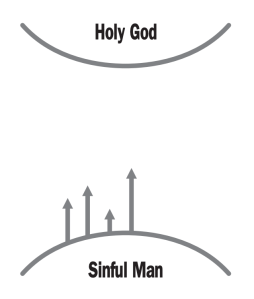 The Bible says that only God is truly good. What this means is that God’s standard for goodness is perfect holiness and by this standard, He is the only one who is truly good.
Notice the diagram to the right. God is holy and man is sinful and there’s a great chasm that separates man from God. The arrows illustrate that man continually tries to reach God through various efforts, such as religion, good works, etc. But all of these efforts ultimately fall short because God is perfectly holy, and there is no amount of good works that will enable man to achieve God’s standard of perfection.
Here is a short article (What is Your Definition of Good?) that explains how God defines “good”.
REFLECT
How does your definition of goodness compare or contrast with what the Bible says about goodness?
What is Sin?
The word “sin” is one of those churchy, religious words that many people associate with behaviors that others don’t approve of but we think is no big deal. For example, you may see nothing wrong with drinking while some “uptight, religious people” think drinking is a “sin”.
REFLECT
How do you define sin? What do you think sin is?
Sin Explained

Sin not just a list of immoral or socially unacceptable behaviors. When Romans 3:23 says that “all have sinned”, the Greek word for sin is actually an archery term.
In a competition, the archer would shoot the arrow and the goal was to hit the bullseye on the target. If the archer missed the bullseye, even if it was only by a fraction of an inch, it was considered an imperfect mark, which was called a sin.
So when the Bible says we’ve all sinned, it means that no matter how hard you’ve tried and no matter how good you think you are, you (and all people) have missed the mark of God’s standard, which is perfect holiness.
That raises the bar quite a bit doesn’t it?
Things are complicated by the fact that God is not only perfectly holy, but He’s perfectly just, and as a result, He must punish sin. He cannot just overlook it or ignore it. Sin is a violation of the very nature and character of God and His goodness, so sin must be punished.
According to Romans 6:23, the punishment, or penalty for sin is DEATH!
For the wages of sin is death, but the free gift of God is eternal life through Christ Jesus our Lord.
You might be thinking, “well we’re all going to die so what does it matter?”
Death here refers to being separated from God. So, the result of sin, or the punishment for sin is that we will experience a separation from God, FOR ETERNITY! This is literally what hell is – the complete absence of God and everything good.
POINT 3: GOD’S PROVISION
JESUS CHRIST PROVIDES THE ONLY SOLUTION TO MAN’S SIN.
Through Jesus, the barriers that kept us from experiencing God’s purpose have been removed – we now have access to God and can know Him.
If everyone has sinned and God, in His justice, must punish sin, then it seems as if there is no solution to our problem. We are all seemingly doomed to punishment!
But God, in His goodness, creates a solution that only He can provide. The solution is in His son Jesus.
Christ Died for Us
Romans 5:8 says,
But God showed his great love for us by sending Christ to die for us while we were still sinners.
REFLECT
If God can forgive sin, why couldn’t he just declare it to be forgiven?
Why do you think Jesus had to die to pay for sin?
Why did Jesus Have to Die?
Why do you think Jesus had to die in order to pay for sin?
Jesus had to die to pay for sin because God’s justice demands that the only valid payment for sin is death.
For the wages of sin is death…Romans 6:23
Jesus died in our place, thus paying the penalty that God’s justice demanded (death) but doing it in a way that allows humankind to avoid the penalty.
The reason that Jesus could do this is because He is God. As God, He has the very righteousness that God requires for those who wish to come into His presence. Through Jesus’ death, we can be forgiven for our sins and not only avoid the penalty for sin, but experience a relationship with God!
Colossians 1:13, 14 says,
For he has rescued us from the one who rules in the kingdom of darkness, and he has brought us into the Kingdom of his dear Son. God has purchased our freedom with his blood and has forgiven all our sins.
Christ Rose from the Dead
Not only did Jesus die for us, but the Bible says that He rose from the dead.
1 Corinthians 15:3-6 states:
For what I received I passed on to you as of first importance: that Christ died for our sins according to the Scriptures, that he was buried, that he was raised on the third day according to the Scriptures, and that he appeared to Peter, and then to the Twelve. After that, he appeared to more than five hundred of the brothers at the same time,
REFLECT
If Jesus had never risen from the dead, would it make any difference?
What do you think is the significance of the resurrection?
Read this article, He is Risen….Why Does it Matter? to understand the significance of the resurrection to the Christian message.

Jesus is the Only Way to God
In John 14: 6, Jesus says:
“I am the way and the truth and the life. No one comes to the Father except through me.”
Notice that He doesn’t say, “I’m one of the ways, I’m one of the truths, I’m one of the lives. There are lots of ways to get to the Father, but I’m a pretty good way, so check me out, I’m cool!”
NO!
He says, “I am the way, the truth, and the life; no one comes to the Father, but through Me.”
He could say this because He is the only one who has made a valid payment for sin. Hence, only Jesus can take away our sin.
The image above demonstrates that God realized that man could not bridge the gap that separated them because of man’s sin. The distance is too wide. If you think about it, God is infinitely holy so the gap between His holiness and man’s is an INFINITE gap!
Because we could not bridge the gap ourselves, God bridged the gap for us. He sent His son Jesus, who is INFINITELY holy and righteous. Jesus’ death bridges the gap and creates a path for people to come into God’s presence and experience a relationship with Him.
POINT 4: OUR RESPONSE
We each must receive the free gift that Jesus offers – His death as payment for our sins. Only then can we experience His purpose, which is to KNOW Him.
Knowing this information doesn’t make a person a Christian. Even if you agree with everything that has been outlined so far, it doesn’t mean you are a Christian.
What makes a person a Christian is when they respond to the invitation of Jesus to accept Him and His death as a free gift that pays for your sin and provides complete forgiveness.
John 1:12 (NLT) says,
But to all who believed him and accepted him, he gave the right to become children of God.
If you want to become a Christian (a child of God), then you must believe in Jesus and accept Him.
REFLECT
What do you think it means to accept Jesus?
We Receive Christ Through Faith
Ephesians 2:8, 9 (NIV) says,
For it is by grace you have been saved, through faith—and this not from yourselves, it is the gift of God— not by works, so that no one can boast.
Accepting Him simply means you accept the free gift that He offers of being saved by His death on the cross. It means that you acknowledge that His death alone can pay for sin and you put your trust in His death to provide forgiveness instead of trusting in your own good works to earn favor with God.
We Receive Christ by Personal Invitation
In Revelation 3:20, Jesus gives this invitation:
Here I am! I stand at the door and knock. If anyone hears my voice and opens the door, I will come in and eat with him, and he with me.
REFLECT
What do you think the door represents in this verse?
How do you think a person opens the door?
Opening the Door
The door represents your heart (your will). Jesus is inviting you to open yourself up and let Him in. The way you do that is simply by putting your trust in Jesus and His death to save you instead of trusting in your own perceived goodness to “earn” your way into heaven.
KEY QUESTIONS:
Have you ever opened the door of your life and let Jesus in to begin a relationship with Him?
If so, when was that? What were the circumstances that led you to make that decision?
If not, do you want to open the door of your life to Jesus and begin a relationship with Him?

Opening the Door 2
The key to opening the door is to decide to put your trust in Jesus instead of trusting yourself. One way you can express your faith to God is simply telling Him that you want to accept His free gift and you want Jesus to come into your life. We call this prayer. Take a minute right now to express your faith and desire for Jesus to come into your life by repeating the following prayer:
Lord Jesus, I need you. I acknowledge that I am a sinner and there is no way I can earn my way into heaven. I want to trust in Jesus and His death to pay the penalty for my sins and provide forgiveness. I open the door of my life now and I invite Jesus to come in so that I might begin a relationship with Him and know Him. Amen.
Things to Remember…
God’s criteria for who makes it into heaven is not how good you are but whether you have the Son (Jesus).
And this is the testimony: God has given us eternal life, and this life is in his Son. He who has the Son has life; he who does not have the Son of God does not have life. (1 John 5:11-12, NIV)
You can KNOW you have eternal life, if you have the Son.
Jesus defined eternal life as knowing Him (John 17:3). Hence, you can have eternal life if you have the Son – if you have a relationship with Him.
You can have the Son (Jesus), simply by accepting Him and the free gift that He offers – His death on the cross as a payment for all of your sins.
Jesus gives an invitation to everyone. He is standing at the door of each person’s heart. He’s knocking. He wants to come into your life and begin a relationship.
But we have to open the door.
Opening the door is a matter of choosing to put our trust in Jesus instead of trusting in our own goodness. It means that we acknowledge that we have sinned and we cannot earn our way to God. We recognize that Jesus ALONE can pay for sin and we accept the free gift of His death as a payment for our sins.
When we make that decision to open the door to Jesus, we experience complete forgiveness of sin and Jesus enters our life, establishing a relationship with us.
Once we have the Son (Jesus), we have the life, which is defined by Jesus as knowing Him.
QUESTIONS FOR REFLECTION
1. Did you open the door an invite Jesus into your life?
2. Where is Jesus right now in relation to you?
3. After a person receives Christ, what do you think a person has to do in order to keep Jesus in their life? What do you think is required?
4. What questions do you have about the Christian faith?
WHAT NOW?
If you prayed that prayer to invite Jesus into your life, the Bible says that you are a new creation. You are now a child of God!
You can request some free resources and next steps by going to our Prayer Page, giving us your name and writing in the box, “I received Christ and would like to know how to begin growing in my new faith.”
We will respond to you with some resources and help to take some next steps.

 The Lowedown