11To illustrate the point further, Jesus told them this story: “A man had two sons. 12The younger son told his father, ‘I want my share of your estate now, instead of waiting until you die.’ So his father agreed to divide his wealth between his sons.
13“A few days later this younger son packed all his belongings and took a trip to a distant land, and there he wasted all his money on wild living. 14About the time his money ran out, a great famine swept over the land, and he began to starve. 15He persuaded a local farmer to hire him to feed his pigs. 16The boy became so hungry that even the pods he was feeding the pigs looked good to him. But no one gave him anything.
17“When he finally came to his senses, he said to himself, ‘At home even the hired men have food enough to spare, and here I am, dying of hunger! 18I will go home to my father and say, “Father, I have sinned against both heaven and you, 19and I am no longer worthy of being called your son. Please take me on as a hired man.”’
20“So he returned home to his father. And while he was still a long distance away, his father saw him coming. Filled with love and compassion, he ran to his son, embraced him, and kissed him. 21His son said to him, ‘Father, I have sinned against both heaven and you, and I am no longer worthy of being called your son.
22“But his father said to the servants, ‘Quick! Bring the finest robe in the house and put it on him. Get a ring for his finger, and sandals for his feet. 23And kill the calf we have been fattening in the pen. We must celebrate with a feast, 24for this son of mine was dead and has now returned to life. He was lost, but now he is found.’ So the party began. (Luke 15:11-24, NLT)
The Daily DAVEotional
Imagine you are the son (or daughter) of a very wealthy man. You have no job and you still live under his roof.
Now imagine you go to your father and you say, “You know what old man? I wish you were dead, and I wish I could cash out my inheritance right now and blow this popsicle stand.”
This is not too far off from the scenario that Jesus paints in the story of the “lost son”, more commonly referred to as the “prodigal son.”
The son in the story doesn’t use the words I’ve chosen but the effect is pretty much the same, for in the Jewish culture, it was the ultimate slap in the face to ask your father for your inheritance while he was still living. It was more than a slap in the face actually. It was the ultimate sign of disrespect, akin to giving the father the finger.
Now if you happened to be living the imagined scenario I painted at the outset, what kind of response might you expect from your father after telling him you wished he was dad and you wanted your money…NOW?
Amazingly, in the story Jesus tells, the father willingly complies. He doesn’t demonstrate anger or resentment or any kind of vindictiveness, all emotions I imagine I’d express if I were the father in this scenario.
So the son gets his wish. And what does he do?
He goes to a distant land and wastes ALL the money on wild living (i.e. partying and prostitutes). In some ways, the story mutes the degree of nastiness in which the son treats his father and exploits his wealth. But make no mistake, the son is the most extreme example of a rebel that you can fathom.
When you have no job and your sole purpose is to experience hedonism to its fullest extent, eventually you run out of money to support that crazy lifestyle. And that’s exactly what happened here too. The son had no money, no plan and no prospects. He was desperate.
He finally gets a job feeding slop to pigs. Take note of this detail. He was feeding PIGS.
Pigs were unclean animals to Jews, which is just one more detail revealing how far off the son had strayed.
It’s at this point that the story turns. The key passage in this whole story comes in verses 17-19, which says:
17“When he finally came to his senses, he said to himself, ‘At home even the hired men have food enough to spare, and here I am, dying of hunger! 18I will go home to my father and say, “Father, I have sinned against both heaven and you, 19and I am no longer worthy of being called your son. Please take me on as a hired man.”’
The son “came to his senses”. This is a biblical picture of repentance. The son came face to face with reality. He had hit rock bottom and he was finally willing to humble himself and admit the stupidity of his decisions that led to his current situation. In short, he finally took responsibility for his actions.
But he didn’t stop there. He humbled himself and was willing to admit his sin to his father. So he swallowed his pride and returned home to face his father.
Imagine if you were the son in that situation. How difficult would it be to face your father and admit you were wrong? Personally, I think a typical father would be angry and I’d expect their response to follow suit. I’d expect to be berated and “made an example of”. I’m certain I’d need to learn my lesson and take my medicine. Essentially, I’d expect to experience some kind of penalty and punishment.
But that’s not what happens in this case. The text says that when the son was still a long way off, the father SAW HIM COMING. That means the father had to be watching and waiting for the son to return.
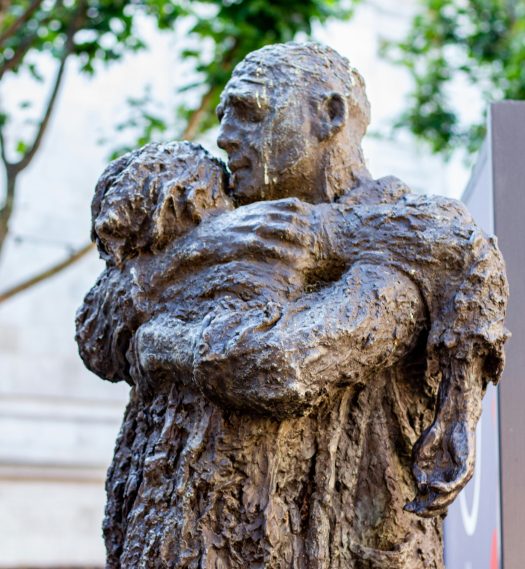
The father doesn’t react the way we would expect because he’s like no earthly father any of us have ever experienced. The father doesn’t berate his son. He doesn’t say “I told you so”. He doesn’t require any groveling or penance. He just embraces the son and welcomes him back into the family, with full rights and privileges restored.
The story highlights the incredible love and patience God the Father has for His children.
God is not a dictator. He allows us to choose our own path. He doesn’t restrict our choices but he also doesn’t shield us from the consequences of those choices. He patiently waits for us to return. And if and when we do return, He welcomes us back with a lavish love that is beyond any kind of earthly love we could experience.
On the flip side, the son is an example of the most egregious offenses one could commit. And yet, the Father extends His love and immediately forgives and restores the son. It’s incredible.
This tells me a couple of things. First, there is nothing I can do that God won’t forgive. NOTHING. I only need to come to my senses (repent), humble myself and admit my sin, just as the son in the story did.
God doesn’t require us to grovel or do penance to receive His love and forgiveness. He freely gives it to those who come to Him with a humble heart of surrender. His love is infinite and He freely and unconditionally lavishes it on those who come to Him.
Now imagine experiencing the love of THAT Father!
Did you enjoy this post? I’d love to hear your thoughts! Feel free to like, leave a comment below, and share it with your friends or on social media if you found it helpful or interesting. Your support keeps the conversation going!
Reflection
What was your relationship like with your earthly father?
If you had done something wrong that you know he would be offended by, what would it have been like for you to think about approaching Him? What kind of reaction might you expect?
When you think of God, what words come to mind? How would you describe God to someone else?
When you find yourself sinning and “straying” from God’s plan, how easy is it for you to “come to your senses”? What keeps you from coming to your senses and returning to God?
What amazes you most about this story?
Photo by IP Withers on Unsplash – Charlie Mackesy’s Return of the Prodigal Son statue outside HTB Church London
1Who has believed our message and to whom has the arm of the LORD been revealed?
2He grew up before him like a tender shoot, and like a root out of dry ground. He had no beauty or majesty to attract us to him, nothing in his appearance that we should desire him.
3He was despised and rejected by men, a man of sorrows, and familiar with suffering. Like one from whom men hide their faces he was despised, and we esteemed him not.
4Surely he took up our infirmities and carried our sorrows, yet we considered him stricken by God, smitten by him, and afflicted.
5But he was pierced for our transgressions, he was crushed for our iniquities; the punishment that brought us peace was upon him, and by his wounds we are healed.
6We all, like sheep, have gone astray, each of us has turned to his own way; and the LORD has laid on him the iniquity of us all.
7He was oppressed and afflicted, yet he did not open his mouth; he was led like a lamb to the slaughter, and as a sheep before her shearers is silent, so he did not open his mouth.
8By oppression and judgment he was taken away. And who can speak of his descendants? For he was cut off from the land of the living; for the transgression of my people he was stricken.
9He was assigned a grave with the wicked, and with the rich in his death, though he had done no violence, nor was any deceit in his mouth.
10Yet it was the LORD’s will to crush him and cause him to suffer, and though the LORD makes his life a guilt offering, he will see his offspring and prolong his days, and the will of the LORD will prosper in his hand.
11After the suffering of his soul, he will see the light and be satisfied; by his knowledge my righteous servant will justify many, and he will bear their iniquities.
12Therefore I will give him a portion among the great, and he will divide the spoils with the strong, because he poured out his life unto death, and was numbered with the transgressors. For he bore the sin of many, and made intercession for the transgressors. (Isaiah 53:1-12, NIV)
The Daily DAVEotional
I saw a post on X.com recently where an influential user listed what he considered the most significant in human history.
Who would you put at the top of that list?
Regardless of your religious views, I think it’s hard to argue against Jesus being the most important figure in all of human history. Incidentally, this user listed Genghis Khan first. Jesus was second on his list.
Jesus and his teachings have literally changed the world. And yet, the Jewish people, his own people, largely reject him. Why is that?
If you happened to be an Israelite living in first century Palestine, you eagerly expected and longed for the Messiah.
The nation of Israel was hundreds of years past its glory days, when it was an independent and respected nation. Now, it was merely one of the many provinces that were subject to Roman rule.
The prophets had foretold of a Messiah, who would one day come and deliver his people and restore the nation to its former glory. At least that was the hope.
Unfortunately, the biblical version of the Messiah did not match the expectations of most Jewish people, who were hoping for a political and military leader who would drive out the Romans, just as the many judges had driven out their oppressors in the early years of their nation’s formation.
This passage in Isaiah 53 gives a much different picture and description of the Messiah compared to the peoples’ expectations.
According to Isaiah, the coming Messiah would not be a person who would stand out. There was nothing physical about the Messiah that would draw people to him. He would be decidedly “normal”.
While the people were expecting a William Wallace type military hero to rally the troops and drive out their Gentile occupiers, this passage shows that the Messiah’s mission would be much different.
Yes, the Messiah would deliver his people; he just wouldn’t deliver them from the enemy they were thinking he would.
Verse 6 lays out the issue – we ALL have gone astray. As a result, the purpose of the Messiah would be to take the iniquity of people upon Himself.
Verse 10 is key because it explicitly states that the Messiah would be a guilt offering. Every Israelite knew that they had to make regular offerings at the temple in order to make atonement for sin. This verse indicates that it’s the Messiah himself whose life would be a guilt offering for the people.
There are a number of verses in this passage that explicitly point to Jesus.
Verse 5 provides one of the clearest references to Jesus’ brutal execution when it says that he was “pierced” for our transgressions. In John’s description of Jesus’ death, we learn that the Roman soldiers were eager to hasten the death of their victims because of the impending Sabbath (see John 19:31-34). It was common to break the legs of those being crucified, rendering it impossible for them to push themselves up to expand their lungs and breathe. Hence, the breaking of the legs brought a swift end to the slow tortures of crucifixion as the victim would immediately die of asphyxiation.
In the case of Jesus. the centurion realized that Jesus was already dead so there was no need to break his legs. Instead, he decided to take his spear and pierce Jesus’ side.
Verse 9 indicates that the Messiah would be assigned a grave for the wicked and the rich. In Jesus’ case, his body was set to be dumped in a pit with other common criminals. But instead, a rich person, Joseph of Arimathea, petitioned Pilate for the body of Jesus, whom he buried in a tomb that he had recently purchased.
Other prophecies in this passage are also fulfilled by Jesus. Verse 7 indicates that the Messiah would be silent when confronted by his accusers. All of the gospel accounts indicate that Jesus, when pressed by Pilate and the authorities, did not defend himself, but chose to willingly give himself up in order to go to the cross to be crucified.
To this day, the Jewish people largely reject Jesus as their Messiah, despite the fact that he fulfills all of the prophecies about the coming Messiah. In fact, there are a number of prophecies concerning the Messiah that only Jesus could have fulfilled.
If you don’t understand the mission of the Messiah, you will reject him.
The Jewish people reject Jesus as their Messiah because he doesn’t fit their hope and expectation of what the Messiah’s purpose would be. Instead of delivering his people from their political oppressors and restoring the glory of their nation, the Messiah’s purpose was first and foremost, to deliver people from the penalty of sin.
Non-Jews reject Jesus simply because they fail to see their need for a Savior. In this case, you may see Jesus as a significant figure in human history, but not as significant as someone like Genghis Khan who wielded tremendous political and military power to conquer the entire known world.
We would all do well to heed the words of Isaiah 53:6:
6We all, like sheep, have gone astray, each of us has turned to his own way; and the LORD has laid on him the iniquity of us all.
Did you enjoy this post? I’d love to hear your thoughts! Feel free to like, leave a comment below, and share it with your friends or on social media if you found it helpful or interesting. Your support keeps the conversation going!
Reflection
What is your understanding of the purpose of the Messiah?
In what ways do you see Jesus matching the description that prophets like Isaiah gave of the coming Messiah?
Who do you know that rejects Jesus as their Messiah and Savior? What are their reasons for rejecting Jesus ?
Why do you think Jewish people, by and large, still reject Jesus, despite clear passages like Isaiah 53 that show Jesus to be a “Suffering Servant” instead of a military conqueror?
1My little children, I am writing these things to you so that you may not sin. And if anyone sins, we have an Advocate with the Father, Jesus Christ the righteous; 2and He Himself is the propitiation for our sins; and not for ours only, but also for those of the whole world.
(1 John 2:1-2, NASB)
The Daily DAVEotional
In the first chapter of John’s first epistle, he shared a number of important principles regarding sin and experiencing fellowship with God. I wrote about that in my blog post, “Walking in the Light Simplified”.
Immediately following that passage, John says that our aim as believers should be to avoid sinning. But we also know that in our fallen humanity, we will inevitably still sin. In the first chapter, he outlined the importance of confessing our sin in order to maintain fellowship with God.
In this section, John stresses the fact that when we do sin (and we WILL sin) we have an Advocate in the person of Jesus Christ.
The picture here is of a defense attorney who pleads our case before the judge, the Father.
Jesus is uniquely qualified to be our advocate because He alone is the propitiation for the sins of the whole world.
What exactly does that mean?
If you’re unfamiliar with the word “propitiation”, it may be because the NIV and NLT, two of the most popular translations used today, don’t include this word in their translation of this passage. Instead, these versions translate the passage to say that Jesus is “the atoning sacrifice for our sins.”
It’s certainly true that Jesus is the atoning sacrifice for the sins of the world, but there’s an element of truth that John is communicating that is missed as a result of omitting the word “propitiation” from the translation.
The word “propitiation” means to appease wrath. The idea is that God is so just and holy, that sin is an infinite offense against God’s character. God’s righteous anger demands that sin be punished.
When it says that Jesus is the propitiation for sin, what it means is that Jesus, through His death on the cross, satisfied the payment that was required for sin. Hence, God’s wrath is appeased or satisfied.
Jesus is more than an atoning sacrifice for sins. He is the propitiation for sin. His death not only atones for sin, but it turns away God’s wrath so that no more punishment is required.
The Greek word for propitiation is “hilasterion” which is the same word for the Old Testament Hebrew word “mercy seat”.
The mercy seat was the cover of the Ark of the Covenant and was the place where the yearly blood sacrifice was made by the high priest. This sacrifice occurred only once a year in the Holy of Holies. On either side of the lid (or mercy seat) were two cherubim (angelic beings). They were facing each other and looked down at the lid.
Inside the ark were placed three significant artifacts: manna, representing the Jewish people’s rejection of God’s provision; Aaron’s rod, which represented man’s rejection of God’s leadership; and the broken pieces of the Ten Commandments, representing man’s rejection of God’s holiness.
When the cherub of Righteousness looked down on the symbols in the ark, it saw all the evidences of man’s rejection of God. When the cherub of Justice looked down, it saw that man was no longer like God’s righteousness and pronounced the death penalty on man. But on the Day of Atonement, the cherub of Justice looked down at the blood sacrifice covering on the lid and said, “I’m satisfied because the death penalty has been paid.” Similarly, Righteousness looked down and was no longer offended because the evidence of man’s sin was covered up and could not be seen.
Jesus’ death on the cross transforms the judgment seat, representing the judgment and punishment we deserve, into a mercy seat, representing the fact that His shed blood through His death on the cross, provides a covering for our sin. Atonement is made, once and for all, and therefore, there is no longer any punishment reserved for those who have placed their trust in Jesus.
Did you enjoy this post? I’d love to hear your thoughts! Feel free to like, leave a comment below, and share it with your friends or on social media if you found it helpful or interesting. Your support keeps the conversation going!
Reflection
What difference does it make to know that Jesus’ death and shed blood has appeased God’s wrath towards your sin?
What is your view and understanding of the holiness of God? Does it seem appropriate to you that God, in His infinite justice, must punish sin? Why or why not?
Is the lid of the ark of the covenant a judgment seat or a mercy seat for you? What is keeping you from putting your full trust in Jesus to cover your sins so that you experience God’s mercy instead of justice?
Photo of Ark of Covenant provided from the following website under Creative Commons License 4.0
Most people believe in an afterlife, such as the Christian concept of heaven. But, assuming heaven exists, how does one get there?
In my thousands of conversations with people, I’ve found that people overwhelmingly believe that if they were to die, they would make it into heaven. However, when asked the question,
What is God’s criteria for deciding who makes it into heaven?
Most people I’ve conversed with don’t know.
To me, that’s a bit like studying for a final exam without having any idea what is going to be on the exam.
The Bible tells us that God’s plan from the beginning was that we would know Him and experience life in His presence. Man freely interacted with God and it was good.
Genesis 1:29-31 gives a picture of God’s initial creation:
27So God created man in his own image,
in the image of God he created him;
male and female he created them. 28God blessed them and said to them, “Be fruitful and increase in number; fill the earth and subdue it. Rule over the fish of the sea and the birds of the air and over every living creature that moves on the ground.” 29Then God said, “I give you every seed-bearing plant on the face of the whole earth and every tree that has fruit with seed in it. They will be yours for food. 30And to all the beasts of the earth and all the birds of the air and all the creatures that move on the ground—everything that has the breath of life in it—I give every green plant for food.” And it was so. 31God saw all that he had made, and it was very good.
POINT 1: GOD’S PLAN
GOD LOVES YOU AND CREATED YOU FOR A PURPOSE
God’s Love
The Bible is clear that one of God’s attributes is love.
1 John 4:8-9 says:
Whoever does not love does not know God, because God is love. This is how God showed his love among us: He sent his one and only Son into the world that we might live through him.
God demonstrated His love by sending His Son Jesus into the world to ultimately die on our behalf.
God’s Purpose
In John 10:10 (NLT), Jesus gives a glimpse into his purpose. He said:
The thief’s purpose is to steal and kill and destroy. My purpose is to give life in all its fullness.
Jesus came so that we might experience life in all its fullness – that we would begin to fulfill the purpose for which we’ve been created, which is to know Him and experience His presence in our lives.
REFLECT What do you think it means to experience life in all its fulness? What would that look like?
“Fullness of Life” Expanded
Here’s another way to think about it. When Jesus says that His purpose is to give “life” in all its fulness, He’s talking about giving eternal life.
In John 17:3 (NIV), Jesus said this:
Now this is eternal life: that they may know you, the only true God, and Jesus Christ, whom you have sent.
Jesus defines eternal life as knowing God – experiencing a relationship with Him. Therefore, when Jesus says His purpose to give life in all its fullness, what He’s saying is that He has come to offer people a relationship with Him (life) and He wants people to experience that relationship to the fullest extent possible.
REFLECT Why do you think people are not experiencing life in all its fullness? What keeps them from knowing God?
POINT 2: OUR PROBLEM
WE’VE REBELLED AGAINST GOD AND ARE THEREFORE SEPARATED FROM HIM. AS A RESULT, WE CANNOT EXPERIENCE HIS PURPOSE FOR OUR LIVES, WHICH IS TO KNOW HIM.
The Fall – the Original Rebellion
According the Bible, God’s good creation was distorted when man disobeyed God and was exiled from God’s presence. Genesis 3 tells the story of the fall of mankind (Read Genesis 3).
Adam and Eve freely interacted with God, who had given them free reign over the entire garden. They took care of it and they were given every seed-bearing plant for their food. However, there was one tree they were forbidden from eating – the fruit from the tree of the knowledge of good and evil.
Adam and Eve were deceived by the serpent (Satan) to eat this forbidden fruit. Because of their disobedience, God banished them from the garden.
Have you ever wondered why God forbade Adam and Eve from eating from that one particular tree? Was it random? Or was there a reason why that specific tree was off limits. Read this article (Why Did God Forbid this One Fruit?) to understand why this particular tree was off limits.
The rest of the Bible is the story of God’s plan to restore man’s relationship with Him and to reverse the curse that was inflicted upon creation as a result of this original sin.
The Results of Sin
It’s at this point that one might argue that we should not be punished for Adam and Eve’s rebellion. But the Bible is clear that EVERYONE has sinned against God.
Romans 3:23 says:
For all have sinned; all fall short of God’s glorious standard. (NLT) [Emphasis added]
But I’m a Good Person
In my experience, I’ve found that most people tend to think of themselves as “good”.
In our society goodness and badness are relative terms that are used in comparison to other people. I’ve found that most people consider themselves to be good because they compare themselves to others who, in their mind, have done more egregious and heinous acts. But comparing ourselves to other people is using the wrong standard of comparison.
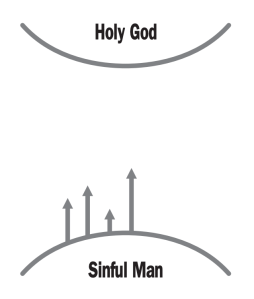
The Bible says that only God is truly good. What this means is that God’s standard for goodness is perfect holiness and by this standard, He is the only one who is truly good.
Notice the diagram to the right. God is holy and man is sinful and there’s a great chasm that separates man from God. The arrows illustrate that man continually tries to reach God through various efforts, such as religion, good works, etc. But all of these efforts ultimately fall short because God is perfectly holy, and there is no amount of good works that will enable man to achieve God’s standard of perfection.
REFLECT How does your definition of goodness compare or contrast with what the Bible says about goodness?
What is Sin?
The word “sin” is one of those churchy, religious words that many people associate with behaviors that others don’t approve of but we think is no big deal. For example, you may see nothing wrong with drinking while some “uptight, religious people” think drinking is a “sin”.
REFLECT How do you define sin? What do you think sin is?
Sin not just a list of immoral or socially unacceptable behaviors. When Romans 3:23 says that “all have sinned”, the Greek word for sin is actually an archery term.
In a competition, the archer would shoot the arrow and the goal was to hit the bullseye on the target. If the archer missed the bullseye, even if it was only by a fraction of an inch, it was considered an imperfect mark, which was called a sin.
So when the Bible says we’ve all sinned, it means that no matter how hard you’ve tried and no matter how good you think you are, you (and all people) have missed the mark of God’s standard, which is perfect holiness.
That raises the bar quite a bit doesn’t it?
Things are complicated by the fact that God is not only perfectly holy, but He’s perfectly just, and as a result, He must punish sin. He cannot just overlook it or ignore it. Sin is a violation of the very nature and character of God and His goodness, so sin must be punished.
According to Romans 6:23, the punishment, or penalty for sin is DEATH!
For the wages of sin is death, but the free gift of God is eternal life through Christ Jesus our Lord.
You might be thinking, “well we’re all going to die so what does it matter?”
Death here refers to being separated from God. So, the result of sin, or the punishment for sin is that we will experience a separation from God, FOR ETERNITY! This is literally what hell is – the complete absence of God and everything good.
POINT 3: GOD’S PROVISION
JESUS CHRIST PROVIDES THE ONLY SOLUTION TO MAN’S SIN. Through Jesus, the barriers that kept us from experiencing God’s purpose have been removed – we now have access to God and can know Him.
If everyone has sinned and God, in His justice, must punish sin, then it seems as if there is no solution to our problem. We are all seemingly doomed to punishment!
But God, in His goodness, creates a solution that only He can provide. The solution is in His son Jesus.
Christ Died for Us
Romans 5:8 says,
But God showed his great love for us by sending Christ to die for us while we were still sinners.
REFLECT If God can forgive sin, why couldn’t he just declare it to be forgiven? Why do you think Jesus had to die to pay for sin?
Why did Jesus Have to Die?
Why do you think Jesus had to die in order to pay for sin?
Jesus had to die to pay for sin because God’s justice demands that the only valid payment for sin is death.
For the wages of sin is death…Romans 6:23
Jesus died in our place, thus paying the penalty that God’s justice demanded (death) but doing it in a way that allows humankind to avoid the penalty.
The reason that Jesus could do this is because He is God. As God, He has the very righteousness that God requires for those who wish to come into His presence. Through Jesus’ death, we can be forgiven for our sins and not only avoid the penalty for sin, but experience a relationship with God!
Colossians 1:13, 14 says,
For he has rescued us from the one who rules in the kingdom of darkness, and he has brought us into the Kingdom of his dear Son. God has purchased our freedom with his blood and has forgiven all our sins.
Christ Rose from the Dead
Not only did Jesus die for us, but the Bible says that He rose from the dead.
1 Corinthians 15:3-6 states:
For what I received I passed on to you as of first importance: that Christ died for our sins according to the Scriptures, that he was buried, that he was raised on the third day according to the Scriptures, and that he appeared to Peter, and then to the Twelve. After that, he appeared to more than five hundred of the brothers at the same time,
REFLECT If Jesus had never risen from the dead, would it make any difference? What do you think is the significance of the resurrection?
Read this article, He is Risen….Why Does it Matter? to understand the significance of the resurrection to the Christian message.
Jesus is the Only Way to God
In John 14: 6, Jesus says:
“I am the way and the truth and the life. No one comes to the Father except through me.”
Notice that He doesn’t say, “I’m one of the ways, I’m one of the truths, I’m one of the lives. There are lots of ways to get to the Father, but I’m a pretty good way, so check me out, I’m cool!”
NO!
He says, “I am the way, the truth, and the life; no one comes to the Father, but through Me.”
He could say this because He is the only one who has made a valid payment for sin. Hence, only Jesus can take away our sin.
The image above demonstrates that God realized that man could not bridge the gap that separated them because of man’s sin. The distance is too wide. If you think about it, God is infinitely holy so the gap between His holiness and man’s is an INFINITE gap!
Because we could not bridge the gap ourselves, God bridged the gap for us. He sent His son Jesus, who is INFINITELY holy and righteous. Jesus’ death bridges the gap and creates a path for people to come into God’s presence and experience a relationship with Him.
POINT 4: OUR RESPONSE
We each must receive the free gift that Jesus offers – His death as payment for our sins. Only then can we experience His purpose, which is to KNOW Him.
Knowing this information doesn’t make a person a Christian. Even if you agree with everything that has been outlined so far, it doesn’t mean you are a Christian.
What makes a person a Christian is when they respond to the invitation of Jesus to accept Him and His death as a free gift that pays for your sin and provides complete forgiveness.
John 1:12 (NLT) says,
But to all who believed him and accepted him, he gave the right to become children of God.
If you want to become a Christian (a child of God), then you must believe in Jesus and accept Him.
REFLECT What do you think it means to accept Jesus?
We Receive Christ Through Faith
Ephesians 2:8, 9 (NIV) says,
For it is by grace you have been saved, through faith—and this not from yourselves, it is the gift of God— not by works, so that no one can boast.
Accepting Him simply means you accept the free gift that He offers of being saved by His death on the cross. It means that you acknowledge that His death alone can pay for sin and you put your trust in His death to provide forgiveness instead of trusting in your own good works to earn favor with God.
We Receive Christ by Personal Invitation
In Revelation 3:20, Jesus gives this invitation:
Here I am! I stand at the door and knock. If anyone hears my voice and opens the door, I will come in and eat with him, and he with me.
REFLECT What do you think the door represents in this verse? How do you think a person opens the door?
Opening the Door
The door represents your heart (your will). Jesus is inviting you to open yourself up and let Him in. The way you do that is simply by putting your trust in Jesus and His death to save you instead of trusting in your own perceived goodness to “earn” your way into heaven.
KEY QUESTIONS:
Have you ever opened the door of your life and let Jesus in to begin a relationship with Him?
If so, when was that? What were the circumstances that led you to make that decision?
If not, do you want to open the door of your life to Jesus and begin a relationship with Him?
The key to opening the door is to decide to put your trust in Jesus instead of trusting yourself. One way you can express your faith to God is simply telling Him that you want to accept His free gift and you want Jesus to come into your life. We call this prayer. Take a minute right now to express your faith and desire for Jesus to come into your life by repeating the following prayer:
Lord Jesus, I need you. I acknowledge that I am a sinner and there is no way I can earn my way into heaven. I want to trust in Jesus and His death to pay the penalty for my sins and provide forgiveness. I open the door of my life now and I invite Jesus to come in so that I might begin a relationship with Him and know Him. Amen.
Things to Remember…
God’s criteria for who makes it into heaven is not how good you are but whether you have the Son (Jesus).
And this is the testimony: God has given us eternal life, and this life is in his Son. He who has the Son has life; he who does not have the Son of God does not have life. (1 John 5:11-12, NIV)
You can KNOW you have eternal life, if you have the Son.
Jesus defined eternal life as knowing Him (John 17:3). Hence, you can have eternal life if you have the Son – if you have a relationship with Him.
You can have the Son (Jesus), simply by accepting Him and the free gift that He offers – His death on the cross as a payment for all of your sins.
Jesus gives an invitation to everyone. He is standing at the door of each person’s heart. He’s knocking. He wants to come into your life and begin a relationship.
But we have to open the door.
Opening the door is a matter of choosing to put our trust in Jesus instead of trusting in our own goodness. It means that we acknowledge that we have sinned and we cannot earn our way to God. We recognize that Jesus ALONE can pay for sin and we accept the free gift of His death as a payment for our sins.
When we make that decision to open the door to Jesus, we experience complete forgiveness of sin and Jesus enters our life, establishing a relationship with us.
Once we have the Son (Jesus), we have the life, which is defined by Jesus as knowing Him.
QUESTIONS FOR REFLECTION
1. Did you open the door an invite Jesus into your life?
2. Where is Jesus right now in relation to you?
3. After a person receives Christ, what do you think a person has to do in order to keep Jesus in their life? What do you think is required?
4. What questions do you have about the Christian faith?
WHAT NOW?
If you prayed that prayer to invite Jesus into your life, the Bible says that you are a new creation. You are now a child of God!
You can request some free resources and next steps by going to our Prayer Page, giving us your name and writing in the box, “I received Christ and would like to know how to begin growing in my new faith.”
We will respond to you with some resources and help to take some next steps.
1“I am the true vine, and my Father is the gardener. 2He cuts off every branch in me that bears no fruit, while every branch that does bear fruit he prunes so that it will be even more fruitful. 3You are already clean because of the word I have spoken to you. 4Remain in me, and I will remain in you. No branch can bear fruit by itself; it must remain in the vine. Neither can you bear fruit unless you remain in me.
5“I am the vine; you are the branches. If a man remains in me and I in him, he will bear much fruit; apart from me you can do nothing. 6If anyone does not remain in me, he is like a branch that is thrown away and withers; such branches are picked up, thrown into the fire and burned. 7If you remain in me and my words remain in you, ask whatever you wish, and it will be given you. 8This is to my Father’s glory, that you bear much fruit, showing yourselves to be my disciples. (John 15:1-8, NIV)
The Daily DAVEotional
Have you ever wondered what the Christian life is all about? For many people, living as a Christian has been reduced to a series of religious activities, such as attending church, being in a bible study and serving in various ministry capacities.
While these activities aren’t bad, Jesus is clear that the goal of the Christian life is to “bear much fruit, showing yourselves to be my disciples.”
So how exactly does one “bear fruit”? HINT – it doesn’t happen because of our religious activities.
In John 15, Jesus gives a picture of fruitfulness by describing the relationship between a vine and its branches.
Being in a more agrarian society, Jesus’ audience likely would have understood the analogy in greater depth than we might, given that most of us probably didn’t grow up on a farm and may never have had much experience with vines or vineyards.
Nevertheless, it’s not a complicated concept to understand. Similar to a tree trunk, which gets its nourishment from a well-developed root system and then delivers it to the branches, a vine is the source of nourishment for the branches that are connected to it.
The key to bearing fruit for a branch is staying connected to the vine. If a branch is disconnected from the vine somehow, it will not produce fruit. Jesus emphasizes this point with the phrase “remain in me”, which he repeats six times in these eight verses.
What does Jesus mean when He says to “remain in me”?
The greek word used here is the word “meno”, the primary meaning of which is to stay in a given place, state or relation. Other words that help define the word “meno” are abide, continue, dwell, endure, be present, remain, and stand.
To remain in Jesus means we are to stay relationally present with Him. That word “dwell” evokes an image of Jesus being present with me in my living room, in my car when I’m driving, at my work place, when I’m out and about, when I’m hanging out with the guys or when I’m alone with no one around me to see what I’m doing. In short, I’m aware of Jesus’ presence in my life wherever I’m at and whatever I’m doing.
You don’t have to be a viticulturalist to know that the natural outcome of a branch that is connected to a vine is fruit. If there is no fruit, you know there is a problem somewhere. The same is true in our spiritual lives. If there is no fruit in your spiritual life, there is a problem.
So what are the problems that might result in a lack of fruit?
Verse 2 says that He “cuts off” branches that don’t produce fruit, while He “prunes” some branches that do bear fruit so that they will be more fruitful.
The Greek word that is translated as “cuts off” in the NIV, and “takes away” in the NASB is the Greek word “airo” which literally means “to lift up”.
In a vineyard, some branches would end up on the ground and would not have access to sunlight. These branches would grow but they wouldn’t produce grapes. Jesus is saying that branches that were lying on the ground would be “lifted up” so that they would have access to sunlight and thus would be able to bear fruit.
It’s easy to think we’re connected to Jesus because our lives are filled with religious activities, but remaining with Jesus means that I understand that He is the onlysource of spiritual life. He is the true vine.
As part of our fallen nature, we all try to fill the needs and cravings in our life in inauthentic ways, whether it’s work, hobbies, money, entertainment, sex or whatever. None of these avenues can truly satisfy us. Only Jesus can provide TRUE spiritual life and nourishment that satisfies and fulfills.
So if you’re not bearing fruit, perhaps it’s because you’re not depending on Jesus alone as your true source of spiritual nourishment and fulfillment. Jesus wants to lift you up out of the dirt and bring you into the light of His word and His truth so that you can begin to bear fruit.
Another possible reason we may be experiencing a lack of fruit is that we need to be “pruned”. Jesus says that He (God the Father) prunes every branch that does bear fruit so that it will bear more fruit.
The word that is translated “prune” is the greek word “kathairo” which means “to cleanse, to prune.” Vinedressers would routinely clean and wash the branches on the vine to rid them of pests that might destroy the leaves and interrupt the fruit-bearing process.
If you’re lacking fruit in your life, perhaps you need Jesus to cleanse you. In other words, maybe there is a sin issue that is keeping you from being fully dependent on Jesus and as a result, is negatively impacting your ability to bear fruit in your life.
Are you starting to get the picture? Jesus wants us to bear fruit, just as a branch connected to a vine would produce fruit.
But we are unable to produce fruit on our own. Only Jesus can produce fruit. We bear fruit if we simply stay connected to Him in a dependent relationship.
If we are lacking fruit, it is likely because we are depending on something apart from Jesus to provide fulfillment in our lives.
Did you enjoy this post? I’d love to hear your thoughts! Feel free to like, leave a comment below, and share it with your friends or on social media if you found it helpful or interesting. Your support keeps the conversation going!
Reflection
What are some of the inauthentic ways you seek to fulfill the needs and cravings in your life?
Describe a time when you realized that you were not producing fruit? What was happening in your life? What caused you to realize that you were not fruitful?
What are some practical ways you can seek to remain in Jesus? How do you demonstrate your dependence on Him?
What do you think spiritual fruit is? How do you define it? What does it look like in your life to produce “fruit”?
What are the religious activities you are regularly involved in? In what ways are these activities helping you grow in your dependence on Jesus? How can you avoid falling into the trap of thinking that these religious activities alone will produce “fruit” in your life?
1In the year King Uzziah died, I saw the Lord. He was sitting on a lofty throne, and the train of his robe filled the Temple. 2Hovering around him were mighty seraphim, each with six wings. With two wings they covered their faces, with two they covered their feet, and with the remaining two they flew. 3In a great chorus they sang, “Holy, holy, holy is the LORD Almighty! The whole earth is filled with his glory!” 4The glorious singing shook the Temple to its foundations, and the entire sanctuary was filled with smoke.
5Then I said, “My destruction is sealed, for I am a sinful man and a member of a sinful race. Yet I have seen the King, the LORD Almighty!”
6Then one of the seraphim flew over to the altar, and he picked up a burning coal with a pair of tongs. 7He touched my lips with it and said, “See, this coal has touched your lips. Now your guilt is removed, and your sins are forgiven.”
8Then I heard the Lord asking, “Whom should I send as a messenger to my people? Who will go for us?”
And I said, “Lord, I’ll go! Send me.”
(Isaiah 6:1-8, NLT)
The Daily DAVEotional
Have you noticed that sin is not talked about that much anymore? It’s almost like it’s a dirty word – too offensive to mention to those outside of a church setting.
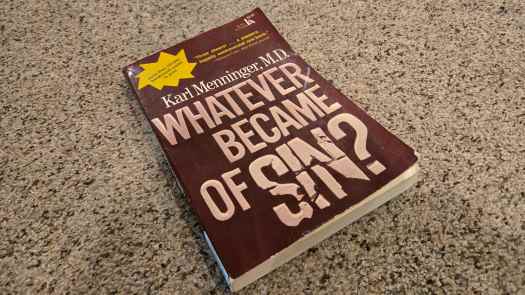
In 1973, Psychologist Karl Menninger published an important work, “Whatever Became of Sin?” in which he reflected on the diminishing concept of sin in our modern culture. His thesis was that the concept of sin as immoral behavior was being replaced by medical and psychological labels that reduced moral responsibility.
Though Menninger draws upon Christian as well as other religious traditions to support his thesis, his book is not a biblical exposition on the subject. Still, his thoughts on this issue, which were printed over 50 years ago, now seem prophetic in nature.
So whatever became of sin? Why has the concept diminished in our culture and what are the reasons for its demise?
The 6th chapter of Isaiah provides an answer for us. This chapter marks a pivotal moment in the life and calling of the prophet. In this chapter, Isaiah has a vision of the Lord in all of His splendor and glory.
The opening verse gives us a time stamp to date the events that follow. Uzziah had been the king of Israel for 52 years, a full life-time for many of his subjects. While Uzziah was one of the better kings of Judah early on, things did not end well for him. Toward the end of his reign, he stubbornly tried to enter the temple and perform rites that were reserved only for the priests, and as a result, he contracted leprosy and was forced to finish out his days in exile.
At Uzziah’s death, with no king to rule, Isaiah goes to the temple and experiences a vision of the true king, the Lord God Himself. Isaiah catches a rare glimpse of God as He really is, a picture of His absolute holiness.
What’s interesting about this encounter is the text says that when Isaiah sees the Lord in His holiness, he cries out, “my destruction is sealed, for I am a sinful man and a member of a sinful race.”
Some translations use the word “ruined” or “undone” to describe Isaiah’s emotional response.
Isaiah, when confronted with the perfect righteousness of God almighty, is brought to his knees as he recognizes his own sinfulness in light of holy God.
One of the reasons sin is not talked about much these days is because we don’t talk about God’s holiness so much these days. These two concepts are intertwined and interdependent – we don’t see sin so much if we don’t see God as holy and righteous.
Over the last 50 years or more, our culture has done all that it can to soften God’s divine attributes to make Him more palatable to our own personal preferences. In short, we’ve made God less like God and more like us.
For the atheist, dismissing God altogether means that there is no objective anchor or standard by which actions can be judged or labeled as “sin”.
“Who are you to tell me that my behaviors are wrong?” is a common refrain.
In many Christian circles, especially among progressives, God is not so much eliminated as much as He’s recreated or reimagined in a way that better fits the person’s lifestyle choices and behaviors.
One of the ways we often see this is in the elevation of the kind-hearted, compassionate New Testament version of God that we see in Jesus while dismissing or diminishing the “judgmental, ego-maniacal” Old Testament picture of God that seems too harsh and exacting. Some may go so far as to claim that the Bible describes two completely different Gods. I wrote recently about this in my blog post, “Is the Old Testament God a Bloodthirsty, Genocidal Psychopath?”
In light of the stark differences between the Old Testament perception of God and the New Testament portrayal of God in the person of Jesus, one inevitably chooses the deity that is more preferable and less restrictive to their own life choices.
The problem with this approach, as I outlined in my blog post, “Can You Make the Bible an Idol?”is it essentially results in a form of idol worship, where my image of God is created according to my personal choices and inclincations instead of forming a picture of God that represents the fullness of how He has been revealed to us through His holy word.
If we want to talk about sin and the need for a savior, we must highlight God’s absolute holiness and righteousness. If a person doesn’t see God as infinitely holy, they’re more likely to overlook or dismiss their sinfulness as mere character flaws or innocent mistakes. If sin is not seen as an egregious offense against God’s very nature, there is less likelihood of coming to the realization that we are utterly lost and in need of a divine savior.
So whatever became of sin? It fell out of favor, just as God’s holiness has.
Did you enjoy this post? I’d love to hear your thoughts! Feel free to like, leave a comment below, and share it with your friends or on social media if you found it helpful or interesting. Your support keeps the conversation going!
Reflection
Describe a time when you encountered the power and presence of God in your life as Isaiah did. In other words, when have you had an “Isaiah” moment with God? What was that like emotionally?
What is your concept of sin? How would you define it? In what ways have you seen our culture minimize sin and personal responsibility?
In what ways have you created an image of God that is not fully reflective of how God has revealed Himself in both the Old and New Testaments?
How can. you ensure that your view of God is not just a personal image that you created to suit your own preferences?
23For all have sinned; all fall short of God’s glorious standard.
(Romans 3:23, NLT)
The Daily DAVEotional
Back in the day there was a popular song by Linda Ronstadt with a chorus that said, “you’re no good, you’re no good, you’re no good, baby, you’re no good”! (see Ronstadt YouTube video here)
It’s doubtful that Ronstadt (or whoever actually wrote the song) had Romans 3 in mind when they penned the words, but this chorus is actually the sentiment of Paul’s message in Romans 3.
Paul has spent the first 2 chapters of Romans outlining how the pagan, the moral person and even the religious person are all sinful and therefore under God’s judgment.
In this chapter, Paul finalizes his argument that all people are no good. It’s doubtful that he could bust out the lyrics as soulfully as Ronstadt but Paul’s message is essentially, “you’re no good, you’re no good, you’re no good….baby you’re no good.”
Perhaps you disagree with this assessment. After all, a lot of people think that people are basically good. And many would argue that at least SOME people are good. So how can Paul say ALL people are NO GOOD?
It all comes down to how you define good. We (people) tend to define good in relative standards that make us look good and feel good about ourselves.
For example, if Hitler is the standard of bad, then I feel good about myself because I’m reasonably confident that I’m a better person than Hitler.
And that’s the problem. Everybody is using a different standard of goodness and each person’s standard tends to be derived in such a way that they themselves end up on the good end of the spectrum.
Is this not blatantly obvious? How many people would actually say they are no good? Very few, in my experience. Even the most hardened criminal is likely to point to someone whom they believe to be a worse person than they are as their comparison for measuring and evaluating goodness.
But God’s standard of goodness is different than ours. God doesn’t use Hitler or Stalin or any other authoritarian tyrant as the standard for what is good. God uses HIMSELF as the standard of goodness.
With God as the standard of goodness, we can see that being good requires us to be as good as God is, which is impossible. This is why Paul says in verse 23 that “all fall short of God’s glorious standard” and it explains how Paul can say that ALL are NO GOOD!
Reflection
What has been your standard for measuring goodness?
How does your definition of goodness compare or contrast with what the Bible says about goodness?
1You may be saying, “What terrible people you have been talking about!” But you are just as bad, and you have no excuse! When you say they are wicked and should be punished, you are condemning yourself, for you do these very same things. 2And we know that God, in his justice, will punish anyone who does such things. 3Do you think that God will judge and condemn others for doing them and not judge you when you do them, too? 4Don’t you realize how kind, tolerant, and patient God is with you? Or don’t you care? Can’t you see how kind he has been in giving you time to turn from your sin?
5But no, you won’t listen. So you are storing up terrible punishment for yourself because of your stubbornness in refusing to turn from your sin. For there is going to come a day of judgment when God, the just judge of all the world, 6will judge all people according to what they have done. 7He will give eternal life to those who persist in doing what is good, seeking after the glory and honor and immortality that God offers. 8But he will pour out his anger and wrath on those who live for themselves, who refuse to obey the truth and practice evil deeds. 9There will be trouble and calamity for everyone who keeps on sinning—for the Jew first and also for the Gentile. 10But there will be glory and honor and peace from God for all who do good—for the Jew first and also for the Gentile. 11For God does not show favoritism.
12God will punish the Gentiles when they sin, even though they never had God’s written law. And he will punish the Jews when they sin, for they do have the law. 13For it is not merely knowing the law that brings God’s approval. Those who obey the law will be declared right in God’s sight. 14Even when Gentiles, who do not have God’s written law, instinctively follow what the law says, they show that in their hearts they know right from wrong. 15They demonstrate that God’s law is written within them, for their own consciences either accuse them or tell them they are doing what is right. 16The day will surely come when God, by Jesus Christ, will judge everyone’s secret life. This is my message. (Romans 2:1-16, NLT)
The Daily DAVEotional
One of the biggest criticisms against Christianity is its exclusive claims. Christianity claims that it is only through Jesus Christ and His atoning sacrifice that people can be reconciled to God and experience eternity in heaven.
The response many people have is “what about those who’ve never heard of Jesus?”
The people making this claim almost certainly HAVE heard of Jesus, so the question is almost always a smokescreen. In other words, the people asking this question aren’t typically concerned with the distant jungle tribes who have had no contact with modern civilization and hence would not have ever had the opportunity to know about Jesus.
This question usually comes from a person who is using it as a way to defend their worldview and life choices. If it can be demonstrated that the Christian message and method of salvation is faulty, then one can dismiss it and effectively ignore it.
So what about the person who has never heard of Jesus? Does this argument negate the Christian message of salvation through Christ alone?
On its surface, it doesn’t seem fair that someone who has never been exposed to the person of Jesus and the sacrifice He’s made on our behalf would be penalized at the Pearly gates for not having responded to an invitation that they were completely unaware of.
And yet, Paul, in these first few chapters of Romans, addresses this very issue. In Romans 1, Paul says that people are without excuse because God’s presence and power are plainly visible through general revelation that is available to everyone just by looking at creation. I wrote about this in a blog post entitled “Where Did that Ball Come From?” , where I outline the lengths that people go to dismiss God and attempt to eliminate Him from their lives.
Paul continues his argument that people are without excuse regarding the existence of God here in Romans 2.
In this chapter, Paul says that nobody is without excuse because EVERYONE sins.
But how do we know we sin?
Paul says that Jews know they are sinning because they have the Law which is a moral code given to them by God Himself through Moses. Whenever these moral guidelines are violated, it is sin, and according to God’s justice, it deserves to be punished.
But what about Gentiles? They never had the Law.
Notice that this is the exact same argument that was posed at the outset – what about those who have never heard of Jesus (or had the law)?
It’s true that Gentiles were not given the Law. Paul stipulates to this. There is no argument regarding this fact.
But Paul continues in verses 14 and 15, saying
Even when Gentiles, who do not have God’s written law, instinctively follow what the law says, they show that in their hearts they know right from wrong. 15They demonstrate that God’s law is written within them, for their own consciences either accuse them or tell them they are doing what is right.
Everyone has a conscience which tells us, generally speaking, that some things are right and other things are wrong. Paul’s argument is that a person’s conscience functions as a written code. Have you ever violated your own standards? Of course you have. Everyone has done things that they KNEW to be wrong. Hence, even if you didn’t have the Law that the Israelites did, if you’ve ever violated your own standards of what you thought was right and wrong, then you have sinned.
EVEN IF YOUR STANDARDS OF RIGHT AND WRONG ARE DIFFERENT FROM WHAT THE LAW SAYS.
This last statement is crucial because it demonstrates that no matter what your moral values are, if you are incapable of upholding them 100% of the time (and nobody is) it demonstrates that you are a sinner. You are broken and you are in need of help.
The message of the Bible is that no one is without excuse. All have sinned. And all are in need of a savior.
Those who recognize this problem in their own lives can appeal to God to save them. God will either lead them to Jesus or, by His grace, He will apply the sacrifice of Jesus to those who appeal to Him by faith, even if they weren’t aware of Jesus’ sacrifice specifically.
But God is under no obligation to reveal more truth about Jesus to those who have rejected the truth about God that has already been revealed.
Reflection
Have you ever done something that violated your conscience? What was the situation? What feelings and emotions did it produce? How did you respond?
Do you think it’s fair that the only way a person can be saved is through Jesus? How would you respond to someone who asks you what happens to the people who’ve never heard of Jesus?
What thoughts and feelings do you experience from Paul’s statement that “The day will surely come when God, by Jesus Christ, will judge everyone’s secret life.”?
Paul says, “there is going to come a day of judgment when God, the just judge of all the world, will judge all people according to what they have done.” How do you reconcile God’s judgment with His divine attribute of love? Do you think it is a contradiction that God is love but also exercises judgment and punishment on people? Why or why not?
21“Not all people who sound religious are really godly. They may refer to me as ‘Lord,’ but they still won’t enter the Kingdom of Heaven. The decisive issue is whether they obey my Father in heaven. 22On judgment day many will tell me, ‘Lord, Lord, we prophesied in your name and cast out demons in your name and performed many miracles in your name.’ 23But I will reply, ‘I never knew you. Go away; the things you did were unauthorized.’ (Matthew 7:21-23, NLT)
The Daily DAVEotional
Matthew 7 is part of a larger discourse known as the Sermon on the Mount, which begins in Matthew chapter 5.
In this section of scripture, Jesus gives many well-known teachings related to the theme of righteous living.
In this particular passage, Jesus highlights a key characteristic of those who claim to be His followers. “The decisive issue”, Jesus says, “is whether they obey my Father in heaven.”
Think about it. Many people today claim to be Christians and devout followers of Christ. Yet Jesus explicitly says that there will be many people who called Him ‘Lord’ who will not enter the Kingdom of Heaven. How is this possible? Don’t people simply have to confess Jesus is Lord and then they’re saved from the punishment of hell?
Yes, and no.
Yes it’s true that we cannot be saved unless we put our trust in Jesus. But Jesus is saying that just because someone makes the claim that Jesus is Lord doesn’t mean that He really IS their Lord.
If Jesus is your Lord then that means He is your master. And if Jesus is your master then that means you are His slave, or as Paul puts it, His bondservant. If Jesus is the master and I am the slave, then that implies that what He says goes. Jesus makes the rules and He is the ruler. We are subservient to Him AND His rules.
Yet according to Jesus, many people who call Jesus Lord are not really obeying the Father. They have a duplicitous nature, claiming that Jesus is Lord, but not fully obeying Jesus and the Father.
The critical issue in following Jesus is obedience. Unfortunately, many people who go to church and act religious are not truly following. In today’s culture, it is quite common for people to claim to be Christians but not do what Jesus says. There may be no area more apparent with this issue than the sexual arena.
You might be thinking, “well nobody is perfect! How can we possibly be expected to live up to some idealistic standard?”
We’re not meant or expected to live up to some ideal. We will sin. That’s not really the issue. Jesus has paid for sin and we can experience ongoing forgiveness by bringing our sin to the cross and confessing it. See my blog post “Walking in the Light Simplified.”
“if we claim we have not sinned, we make Him out to be a liar and His word has no place in our lives.”
The problem is when we change the rules so that we don’t agree that what we’re doing is sinful. In this scenario, we don’t confess our sins to Jesus because we no longer believe these actions or attitudes are sinful.
This is what I refer to as “Salad Bar Religion”, which I wrote about here. Salad Bar religion occurs when we pick and choose the things we want to obey while discarding the things we don’t want to obey.
Jesus’ words may seem harsh to some but He’s crystal clear on this: we are not authorized to change His rules and guidelines for what constitutes righteous living. Those who do change His rules in order to suit their own personal preferences may find themselves in the unenviable position of being rejected by Jesus when the time comes to give an account of our life and our choices.
Did you enjoy this post? I’d love to hear your thoughts! Feel free to like, leave a comment below, and share it with your friends or on social media if you found it helpful or interesting. Your support keeps the conversation going!
Reflection
In what areas of Scripture do you find it most difficult to obey? What are some of the “rules” that you are most tempted to neglect, ignore or change?
What is your response to the thought that Jesus may reject entrance to the Kingdom of heaven to some people who have claimed to be Christians in this life?
If obedience is the decisive issue, how do you account for the fact that all of us as Christians still disobey God at times? How would you explain to someone who argues that you are being legalistic by setting up an impossible standard that cannot be met?
What steps can you take to ensure that you are not a follower with a duplicitous nature, claiming to follow Jesus verbally but internally, following your own preferred rules of living?
5This is the message we have heard from him and declare to you: God is light; in him there is no darkness at all. 6If we claim to have fellowship with him yet walk in the darkness, we lie and do not live by the truth. 7But if we walk in the light, as he is in the light, we have fellowship with one another, and the blood of Jesus, his Son, purifies us from all sin.
8If we claim to be without sin, we deceive ourselves and the truth is not in us. 9If we confess our sins, he is faithful and just and will forgive us our sins and purify us from all unrighteousness. 10If we claim we have not sinned, we make him out to be a liar and his word has no place in our lives.
(1 John 1:5-10, NIV)
The Daily DAVEotional
The letter of 1 John contains the familiar light/darkness motif that John is known for in his gospel, in which the word “light” shows up 24 times.
John uses the idea of light to depict moral purity and absolute righteousness, whereas darkness refers to sin or unrighteousness.
In this passage, John declares that “God is light and in Him there is no darkness at all”, signifying that God is completely righteous and without sin.
John then proceeds to give some qualifications for how we, as believers, can experience fellowship with God. Here are some of the highlights:
Verse 6 says that we cannot experience fellowship with God if we are walking in the darkness. But what does that mean? Well, if darkness refers to sin and unrighteousness, then walking in the darkness must mean that we are walking in unrighteousness.
Verse 7 says that if we walk in the light then we WILL experience fellowship with one another and our sin will be purified by the blood of Jesus.
In verse 8, John tells us that anyone who claims to be without sin is deceiving themselves.
In verse 9, John tells us that if we confess our sins, God is faithful and just and will forgive us our sins and purify us from all sin.
Finally, verse 10 tells us that anyone who claims that they haven’t sinned is making God out to be a liar!
So what do these verses really tell us? It seems that if we want to experience fellowship with God then we cannot walk in unrighteousness, which one might conclude means that we cannot sin.
Yet verses 8 and 10 tell us that anyone who claims to be without sin is deceiving themselves and calling God a liar.
So if fellowship with God requires sinlessness, we are in trouble, because sinlessness is an impossible standard and John himself has said that we can’t claim to be without sin without deceiving ourselves and making God out to be a liar.
So what is really going on here?
To answer this question, I want to appeal to a mathematical law known as syllogism.
The law of syllogism demonstrates the relationship between multiple statements.
For example, if “a” leads to “b” and “b” leads to “c”, then it logically follows that “a” leads to “c”.
Stay with me here because this isn’t as complicated as it may appear. Here is how this relates to this passage. Look particularly at verses 7 & 9.
In verse 7, John says that (A) “walking in the light” leads to “fellowship with God” and (C) “our sin being purified by the blood of Jesus.”
In verse 9, John says that (B) “confessing our sin” leads to “God forgiving our sins” and (C) “purifying us from all unrighteousness.”
Notice that in both verse 7 and verse 9 there are two different actions (A & B) that both lead to the same result: being purified of our sin/unrighteousness. Here it is in simplified form:
(A) “walking in the light” leads to (C) “our sin being purified by the blood of Jesus.”
(B) “confessing our sin” leads to (C) “being purified from all unrighteousness.”
What does this tell us? It tells us that there is a relationship between “walking in the light” and “confessing our sins” since both lead to “our sin/unrighteousness being purified.”
So, do you want to experience fellowship with God? John says you have to walk in the light. But what does that mean? Fortunately, the law of syllogism helps us by showing us how John defined what it means to walk in the light. It means that we are in the habit of confessing our sins and experiencing God’s forgiveness.
Walking in the light does not require some kind of sinless perfection, as John has established that everyone sins and so we can’t say that we haven’t sinned.
Walking in the darkness means that when I do sin, I fail to confess it. As a result, I begin to live in rebellion towards God and I cease to experience daily forgiveness for my sins and shortcomings. The result of this is a lack of growth, as I wrote in my recent blog post “Why Some Christians Never Grow“.
Walking in the light simply means that when I do sin, I submit myself to God’s authority and I confess my sin. Confession involves agreeing with God regarding His moral standards. It also involves repentance, which is a posture of humility and openness to God that causes me to turn from my sin and back toward God.
The benefits of this simple habit of confession are enormous. We experience daily cleansing from our sins and we continue to experience fellowship with God and with other believers!
Reflection
What has been your understanding of the concept of “walking in the light”? How would you have described it to another person?
How important has the habit of confession been in your own spiritual journey? What makes it hard for you to confess your sins regularly?
What do you think are the connections between lack of confession and walking in unrighteousness? What are some of the reasons or factors that make it tempting for you and other believers to walk in the darkness instead of walking in the light?
John says in verse 6 that some people claim to have fellowship with God but they’re actually walking in the darkness. What do you think characterizes the lifestyle of this person? What does it look like to walk in darkness but claim to be in fellowship with God?



 The Bible says that only God is truly good. What this means is that God’s standard for goodness is perfect holiness and by this standard, He is the only one who is truly good.






 The Lowedown