Sarah’s Oil – Movie Review

Sarah’s Oil – a Kingdom Story Movie
My Rating: 5 of 5 stars

Last night, my wife and I attended a pre-screening for a new movie, Sarah’s Oil, that will release in theaters on November 7th.

The movie is inspired by the true life story of Sarah Rector, a young African-American girl living in rural Oklahoma in the early 1900s, who received a grant of 160 acres of land as a reparation payment because her ancestors had been enslaved by a local native tribe.

Because most of the people who received such land grants could not afford the yearly property tax fee, they sold their land to avoid losing it outright.

Sarah believed that her land had oil on it so instead of selling and making a small profit, which certainly would have been a lot of money to her family at the time, she was determined to keep her land and realize its full potential.

The movie centers around the struggle to keep her land from a greedy and unscrupulous oil company that threatens her at every turn. But it’s more than just a story of good vs. evil. The story explores themes of racism, justice, greed, forgiveness and perseverance.

The plot is engaging and the acting is professional. It has moments of tension, heartache and suspense, as well as the occasional comedic relief line.

This movie is the latest entry by Kingdom Story, a faith-based production company that’s responsible for movies like, “I Can Only Imagine”, “American Underdog” and “Jesus Revolution”.

Zachary Levi, who has appeared in a number of Kingdom Story movies, is excellent as B.B. “Bert” Smith, Sarah’s wildcat business partner who helps her in her quest to find oil on her land, while Naya Desir-Johnson gives a standout performance as the young Sarah Rector.

I thoroughly enjoyed this film and would highly recommend it to moviegoers. This movie is inspiring. You’ll laugh, cry, shake your fist and cheer at different points in the movie.

Ultimately, this movie feels like a throwback to the way movies used to be made. A lot of what gets churned out in Hollywood these days feels like recycled, uninspired junk, but this movie is clean, well-produced and is rich with positive moral themes. It’s a movie you can take your kids to see and have a meaningful discussion about afterwards.

I’m not a movie critic per se and I don’t write a lot of movie reviews. But this is a movie that I can heartily endorse and I encourage all to see this movie when it hits the theaters.

You may know that movies can have a short life-span in the theaters, based on how well they do initially. This is a movie, and Kingdom Story is a company, that deserves your support. Kingdom Story continues to produce high quality, faith and family-oriented films that not only entertain, but inspire.


Watch the trailer for Sarah’s Oil:

Watch “The Story Behind Sarah’s Oil”:

Watch an interview with John Shepherd, producer of Sarah’s Oil:

https://www.godtube.com/watch/?v=E11E11NU


What is Your One Word for 2024?

Acts 22

1“Brothers and esteemed fathers,” Paul said, “listen to me as I offer my defense.” 2When they heard him speaking in their own language, [Greek in Aramaic.] the silence was even greater. 3“I am a Jew, born in Tarsus, a city in Cilicia, and I was brought up and educated here in Jerusalem under Gamaliel. At his feet I learned to follow our Jewish laws and customs very carefully. I became very zealous to honor God in everything I did, just as all of you are today. 4And I persecuted the followers of the Way, hounding some to death, binding and delivering both men and women to prison. 5The high priest and the whole council of leaders can testify that this is so. For I received letters from them to our Jewish brothers in Damascus, authorizing me to bring the Christians from there to Jerusalem, in chains, to be punished.

6“As I was on the road, nearing Damascus, about noon a very bright light from heaven suddenly shone around me. 7I fell to the ground and heard a voice saying to me, ‘Saul, Saul, why are you persecuting me?’

8“‘Who are you, sir?’ I asked. And he replied, ‘I am Jesus of Nazareth, the one you are persecuting.’ 9The people with me saw the light but didn’t hear the voice.

10“I said, ‘What shall I do, Lord?’ And the Lord told me, ‘Get up and go into Damascus, and there you will be told all that you are to do.’

11“I was blinded by the intense light and had to be led into Damascus by my companions. 12A man named Ananias lived there. He was a godly man in his devotion to the law, and he was well thought of by all the Jews of Damascus. 13He came to me and stood beside me and said, ‘Brother Saul, receive your sight.’ And that very hour I could see him!

14“Then he told me, ‘The God of our ancestors has chosen you to know his will and to see the Righteous One and hear him speak. 15You are to take his message everywhere, telling the whole world what you have seen and heard. 16And now, why delay? Get up and be baptized, and have your sins washed away, calling on the name of the Lord.’

17“One day after I returned to Jerusalem, I was praying in the Temple, and I fell into a trance. 18I saw a vision of Jesus saying to me, ‘Hurry! Leave Jerusalem, for the people here won’t believe you when you give them your testimony about me.’

19“‘But Lord,’ I argued, ‘they certainly know that I imprisoned and beat those in every synagogue who believed on you. 20And when your witness Stephen was killed, I was standing there agreeing. I kept the coats they laid aside as they stoned him.’

21“But the Lord said to me, ‘Leave Jerusalem, for I will send you far away to the Gentiles!’”

22The crowd listened until Paul came to that word; then with one voice they shouted, “Away with such a fellow! Kill him! He isn’t fit to live!” 23They yelled, threw off their coats, and tossed handfuls of dust into the air.

(Acts 22:1-22, NLT)


The Daily DAVEotional

Have you heard about this “One Word for your New Year” idea that has gained popularity in recent years?

The idea is to pick one word that you want to be the theme for the upcoming year. For example, you might choose “healthy” if you want to lose weight, develop better eating habits, or get in shape. Or you might choose the word “simplify” if you want to declutter or downsize your current living situation.

Whatever the word, the thought is that this one word could help to give focus and discipline to your lifestyle choices for the year, which hopefully result in some positive outcomes.

Some people swear by it, but I’m not so sure its effect is any different than just making a traditional New Year’s resolution. Still, I think any tool or resource that motivates a person to make consistently positive life choices is a good thing. (Click here to see a blog post that explains the concept in more detail)

In this chapter of Acts though, we encounter a slightly different take on the ONE word effect.

Paul has just been falsely arrested by his Jewish compatriots for defiling the Temple. Before he’s hauled off to face the Jewish high council, Paul makes a public defense to the crowd, in which he shares about his personal encounter with Jesus, who has selected him to be His missionary agent to the GENTILES.

Everything seems to be going well, until Paul reaches that ONE WORD – GENTILE!

Paul is talking to a Jewish audience, which is mostly attentive, listening to him explain his previous life as a traveling henchman for the Jewish High Council before experiencing a divine encounter with the risen Jesus on the road to Damascus. When Paul reveals to the crowd that part of God’s master plan is to send Paul to GENTILES so that they too can be saved, his audience loses it, instantly turning into a violent mob.

Can you imagine a group of people becoming uncontrollably triggered over the utterance of just one word? It seems preposterous.

Except that this kind of response is so commonplace today that we hardly notice it anymore. People are triggered by all kinds of words, including racial and political descriptors. Politically, many people on the right are triggered by words and phrases that describe people on the left.

Likewise, many people on the left are triggered by words and ideas that represent people on the right.

In our current cultural environment, outrage and anger isn’t limited to different political beliefs but extends to racial divisions as well.

The truth is that many people in Paul’s day were racist, including many Jews. And people today are no better. Despite what you may have been told or led to believe, we still live in a country full of bigots and racists. That’s because we live in a country full of PEOPLE. And people are all still just as sinful today as they were in the New Testament times.

But haven’t we progressed as a society? I don’t think so. Yes, our laws have eliminated the most egregious and obvious racist and discriminatory acts, which is obviously a good thing. But racism and bigotry as a heart condition certainly persist and that is clearly evident from the events of the last few years. It turns out that the Bible once again is true – making laws to legislate behavior doesn’t actually change people’s hearts. Only Jesus can do that.

So the challenge I’m giving myself and invite you to as well is to pick ONE WORD for 2024. But rather than picking a word that might define a theme for your year, pick the one word that is most likely to send you over the top in anger or frustration. Ask yourself what is it about that word that sets you off so much? Then invite the Holy Spirit to empower you to love any person or group who might be characterized by that word. After all, Jesus died for them just as He died for you. And “those people” have infinite value in the eyes of God, just as you and I do.

Reflection

What do you think are some reasons why people get so upset when they encounter certain words, phrases or ideas?

What is your “Gentile” word – the one word that provokes the most frustration and anger?

What do you think are the reasons this word provokes you so much?

What steps can you take to allow the Holy Spirit to initiate a heart change in you regarding your attitude toward people who may be categorized by your “one word”?


Photo by Dave Lowe

Was Jesus A Racist Who Needed to Repent?

Mark 7

24Then Jesus left Galilee and went north to the region of Tyre. He tried to keep it secret that he was there, but he couldn’t. As usual, the news of his arrival spread fast. 25Right away a woman came to him whose little girl was possessed by an evil spirit. She had heard about Jesus, and now she came and fell at his feet. 26She begged him to release her child from the demon’s control.

Since she was a Gentile, born in Syrian Phoenicia, 27Jesus told her, “First I should help my own family, the Jews. It isn’t right to take food from the children and throw it to the dogs.”

28She replied, “That’s true, Lord, but even the dogs under the table are given some crumbs from the children’s plates.”

29“Good answer!” he said. “And because you have answered so well, I have healed your daughter.” 30And when she arrived home, her little girl was lying quietly in bed, and the demon was gone. (Mark 7:24-30, NLT)


The Daily DAVEotional

A few weeks ago I saw a Tik Tok video that was making the rounds on Twitter. It was posted by a Pastor from the San Diego area in which he said that Jesus was a racist because he used a racial slur when he called the Syrophoenician woman in this passage a DOG!

This pastor went on to say that the woman didn’t back down, but “spoke truth to power” and when she confronted Jesus with his racism, Jesus not only changed his mind, but “Jesus repents of his racism and extends healing to this woman’s daughter.”

That’s not all. This pastor said that he loves this story because it’s a reminder that “Jesus is human. He had prejudices and biases and when confronted with it he was willing to do his work.”

Are the claims being made by this pastor true? Did Jesus demonstrate racism and prejudice by calling the woman a dog? Is the point of this story to show us that Jesus is a human who had human flaws and prejudices like every human being does? Was this story told to be an example to us on how to repent when we are confronted with truth?

The short answer to all of these questions is an emphatic NO!

None of these “observations” and conclusions demonstrate the real point of the story.

Well then, what IS the point of the story?

If you know anything about the book of Mark, you know that most of the stories and accounts demonstrate Jesus’ teaching and miracles that He performed while in the presence of His disciples. Everything Jesus does is for the sake of the men who are following Him and learning from Him. Jesus is demonstrating to them WHO He is and what His ultimate mission is. At the mid-point of Mark, Jesus asks the all-important question of His disciples: Who do you say that I am? I wrote about that passage and their response to that question here.

Based on what you know about the Jewish mindset of that time, including the disciples, what do you think was their view of non-Jews?

The prevailing mindset of Jewish people, from the religious leaders to Jesus’ own disciples was that non-Jews were unclean. They were “dogs”. In fact, merely being in their presence could make one unclean.

We see this Jewish nationalism throughout the New Testament. In fact, Peter needs a vision from the Lord himself in Acts 10 to finally realize that Gentiles are not unclean and that salvation is not reserved only for the Jew.

In addition, a council was convened in Acts 15 to address this very issue: do Gentiles need to become culturally Jewish in order to be saved? I wrote about that Council and the context surrounding it here.

So why does Jesus compare this woman to a dog?

Jesus is using an illustration to explain to the woman that the priority of His ministry and His message regarding the kingdom of God was FIRST to his own family, the Jewish people. He is not saying that Gentiles can never receive the message, He’s merely saying that He’s not prepared to share His message and ministry to Gentiles YET.

In this illustration, Jesus uses the Greek word “kunarion” which means “pet dog”. The Greek word that was usually used to describe an unclean dog was the word “kuon” which meant “wild dog.”

Most Jews viewed Gentiles as “wild dogs”, unclean animals that were not worthy of salvation and were excluded from the promises and blessings of God.

Jesus, however, gives an illustration in which Gentiles are compared not to wild dogs but to the family pet. He does this to show his disciples that their view of Gentiles and their worthiness to experience the blessings of God is wrong. They are not unclean, mangy animals roaming the streets, pilfering through the garbage. They are a part of the family and they are loved.

Regarding the other observations made by this pastor, it’s clear that his conclusions are an example of importing current cultural views and concepts into the biblical narrative while ignoring observations that might contradict his views.

This pastor paints a picture of a bold woman standing up to a misogynistic, bigoted Jesus, but the text paints a much different picture. The text states that she heard about Jesus and came and knelt before Him. The picture the pastor paints could not be more opposite of what the text actually says.

Secondly, the woman says nothing in response to Jesus that would indicate she is confronting Him or rebuking Him. Instead, her response shows that she understands the ministry priority Jesus has shared and yet she requests consideration from Him anyways.

Jesus is impressed with her response and her resolve and in Matthew’s version of this same story, Jesus speaks of her “great faith” (see Matthew 15:28).

This pastor completely overlooks the faith of the woman and Jesus’ praise of her response and opts instead for an explanation based more on his current cultural views than the plain theological meaning of the text.

Phrases like “speak truth to power” and “Jesus did his work” are rather recent phrases that represent a progressive ideology and  agenda. There is nothing in the passage or the context that suggests that the woman “confronted” Jesus regarding racism or that she spoke “truth to power”.

Neither is there any indication that Jesus changed his mind or repented of some egregious sin.

Furthermore, this pastor’s views are an example of false teaching regarding the nature and work of Jesus. I wrote about the importance of one’s view of Jesus here, when evaluating an early church heresy that John wrote about in the letter of 1 John.

Think about the implications of what this pastor is saying.

First, how could the woman speak truth to power when Jesus himself IS the truth (John 14:6)?

Secondly, Jesus is God in human flesh. He lived a sinless life and and His death pays the penalty for the sins of the world.

If Jesus used a racial slur and thus sinned, how could He secure salvation for the sins of mankind? Even if He repented, as this pastor suggests, Jesus would not be qualified to pay for the sins of humanity if He Himself was a sinner. His sin would disqualify Him from being the Savior of the world.

So the point of this story is NOT that Jesus is racist just like we probably are and He gives us an example of how to “do the work” and “repent” when confronted with truth.

The point of this story is to demonstrate that Jesus’ ministry and message was to go to the Jews FIRST but that Gentiles were also a part of God’s plan. Jesus did this in a way that explained His priority to the woman, revealed to His disciples that their prejudicial view of Gentiles did not line up with God’s heart, or His kingdom purposes, and praised the woman’s response as being one of “great faith”!

One final reminder I would make is the importance of “doing the work” of understanding what God’s word says in its context instead of taking the word of someone who calls themself a pastor but is merely importing their own modern day bias and preconception into the biblical narrative.

As John revealed in the 1 John 4 devotional, there are many people promoting false views of Jesus. John labeled those preachers as “false prophets” and those who promote false views of Jesus today should be labeled the same way.

Reflection

If someone were to use this story to make a claim that Jesus was racist, how would you respond? What parts of the text would you use to demonstrate that Jesus was not racist?

What specific parts of the text prove that the woman was NOT rebuking Jesus?

What specific parts of the text demonstrate that Jesus in no way repented of some kind of wrong-doing?

One of the lessons of this text is the “great faith” of the woman. In what ways did she demonstrate faith? In what ways can we emulate that kind of faith? 

What is a current issue you are dealing with in which you need Jesus to intervene? What are some ways you can demonstrate faith toward God in your circumstances?


 

Photo by Julia Volk from Pexels

Jackie Robinson Day!

When I was a kid, the most exciting sound to me was the sound of the ice cream truck rolling down the street with its iconic tune blaring from the bull-horn speaker on the top of the truck.

Whenever we heard that sound we’d rush into the house and scrape together any spare quarters we could find. If we didn’t have any saved up, we’d run and ask mom for some spare change.

But while other kids were buying ice cream sandwiches, drumsticks or the red, white and blue bomb pops, I was buying packs of baseball cards.

I can’t say exactly when or why I started purchasing them but I can tell you I loved opening that wax paper to reveal the chalky flat stick of bubble gum. I would quickly scan through all the cards in the pack to see what treasures I had scored. If the pack contained a Dodgers player, I was elated, and if it contained a Dodgers player who was not yet checked off on my team checklist, it was even better.

1972 was the first year that I really started collecting cards and 1975 was the first year I collected enough cards that I actually completed a set. I continued collecting cards through the 70’s and into the 80’s.

One year as a teenager, I was in Kansas visiting my relatives and my uncle pulled out a scrapbook that he wanted to show me. My eyes bulged as he opened the pages and I saw page after page of baseball memorabilia, including many older baseball cards from the 50’s. Cards from the 50’s were a novelty to me as they represented the league before league expansion in the early 60’s and division play of the late 60’s. For some reason, the names on those cards seemed even more legendary than the iconic names of my youth.

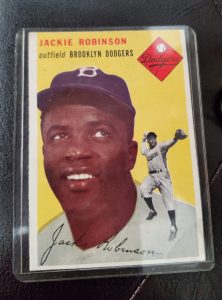
My uncle turned the page and there it was, a 1954 Topps Jackie Robinson card. Picture Ralphie at the beginning of “A Christmas Story”, with eyes mesmerized and mouth agape at the items in the department store window display as the adult Ralphie says:

Higbees’ corner window was traditionally a high-water mark of the pre-Christmas season. First nighters, packed earmuff to earmuff, jostled in wonderment before a golden tinkling display of mechanized, electronic joooyyyy.

In that moment, I was Ralphie, spellbound as I saw the iconic Jackie Robinson card on full display.

The scrapbook wasn’t that big and it didn’t have a ton of cards. It was the product of my uncle’s childhood hobby, created when he was not much younger than I was at that moment.

A few years later I received an unexpected package in the mail. I didn’t remember ordering anything and this was well before the internet and online purchasing became a thing. I could see that it was from my uncle but I had no idea what it was.

I opened the package and there it was, the scrapbook that once belonged to my uncle. There was a note which I’m sad to say I’ve misplaced. I don’t remember exactly what the note said but knowing my uncle, he expressed that because of my love for baseball and baseball cards, he wanted me to have the cards he had collected as a kid.

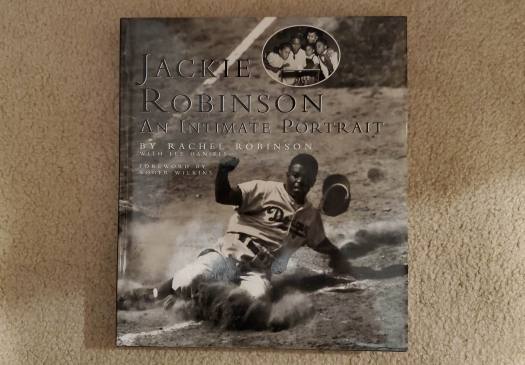
Today marks the annual Jackie Robinson day in Major League Baseball. It’s a day to honor the man who broke the color barrier in the big leagues. I’m sad to say that as a kid, I knew next to nothing about what Jackie endured to open the door for black players to show their talents and skills in the MLB. I admired Jackie and other Dodger greats like Roy Campanella and Don Newcombe because they were some of the greatest to ever play the game. I admire them even more now because of the environment they lived in and the character and resolve they displayed in the face of unbelievable and unimaginable adversity.

Every player wears #42 on Jackie Robinson day and there are no names on the jerseys. The great Mariano Rivera was the last player to don the number 42 as his normal jersey number. No player will ever wear that number as his everyday number as the number 42 has been retired from every major league team.

As I write this, the Dodgers are playing the Colorado Rockies at Dodgers Stadium in one of the final remaining games of this annual day of remembrance. The Dodgers are leading the Rockies 3-2. I think it would be appropriate if the Dodgers were to score one more run and win the game 4-2!