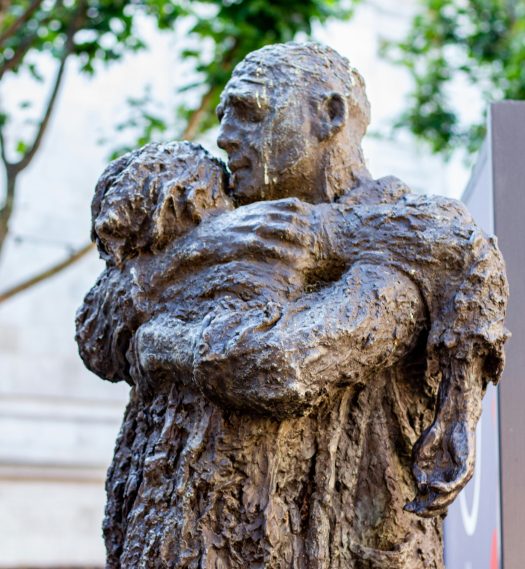
Revisiting the Story of the Prodigal Son

Luke 15

11To illustrate the point further, Jesus told them this story: “A man had two sons. 12The younger son told his father, ‘I want my share of your estate now, instead of waiting until you die.’ So his father agreed to divide his wealth between his sons.

13“A few days later this younger son packed all his belongings and took a trip to a distant land, and there he wasted all his money on wild living. 14About the time his money ran out, a great famine swept over the land, and he began to starve. 15He persuaded a local farmer to hire him to feed his pigs. 16The boy became so hungry that even the pods he was feeding the pigs looked good to him. But no one gave him anything.

17“When he finally came to his senses, he said to himself, ‘At home even the hired men have food enough to spare, and here I am, dying of hunger! 18I will go home to my father and say, “Father, I have sinned against both heaven and you, 19and I am no longer worthy of being called your son. Please take me on as a hired man.”’

20“So he returned home to his father. And while he was still a long distance away, his father saw him coming. Filled with love and compassion, he ran to his son, embraced him, and kissed him. 21His son said to him, ‘Father, I have sinned against both heaven and you, and I am no longer worthy of being called your son.

22“But his father said to the servants, ‘Quick! Bring the finest robe in the house and put it on him. Get a ring for his finger, and sandals for his feet. 23And kill the calf we have been fattening in the pen. We must celebrate with a feast, 24for this son of mine was dead and has now returned to life. He was lost, but now he is found.’ So the party began. (Luke 15:11-24, NLT)


The Daily DAVEotional

Imagine you are the son (or daughter) of a very wealthy man. You have no job and you still live under his roof.

Now imagine you go to your father and you say, “You know what old man? I wish you were dead, and I wish I could cash out my inheritance right now and blow this popsicle stand.”

This is not too far off from the scenario that Jesus paints in the story of the “lost son”, more commonly referred to as the “prodigal son.”

The son in the story doesn’t use the words I’ve chosen but the effect is pretty much the same, for in the Jewish culture, it was the ultimate slap in the face to ask your father for your inheritance while he was still living. It was more than a slap in the face actually. It was the ultimate sign of disrespect, akin to giving the father the finger.

Now if you happened to be living the imagined scenario I painted at the outset, what kind of response might you expect from your father after telling him you wished he was dad and you wanted your money…NOW?

Amazingly, in the story Jesus tells, the father willingly complies. He doesn’t demonstrate anger or resentment or any kind of vindictiveness, all emotions I imagine I’d express if I were the father in this scenario.

So the son gets his wish. And what does he do?

He goes to a distant land and wastes ALL the money on wild living (i.e. partying and prostitutes). In some ways, the story mutes the degree of nastiness in which the son treats his father and exploits his wealth. But make no mistake, the son is the most extreme example of a rebel that you can fathom.

When you have no job and your sole purpose is to experience hedonism to its fullest extent, eventually you run out of money to support that crazy lifestyle. And that’s exactly what happened here too. The son had no money, no plan and no prospects. He was desperate.

He finally gets a job feeding slop to pigs. Take note of this detail. He was feeding PIGS.

Pigs were unclean animals to Jews, which is just one more detail revealing how far off the son had strayed.

It’s at this point that the story turns. The key passage in this whole story comes in verses 17-19, which says:

17“When he finally came to his senses, he said to himself, ‘At home even the hired men have food enough to spare, and here I am, dying of hunger! 18I will go home to my father and say, “Father, I have sinned against both heaven and you, 19and I am no longer worthy of being called your son. Please take me on as a hired man.”’

The son “came to his senses”. This is a biblical picture of repentance. The son came face to face with reality. He had hit rock bottom and he was finally willing to humble himself and admit the stupidity of his decisions that led to his current situation. In short, he finally took responsibility for his actions.

But he didn’t stop there. He humbled himself and was willing to admit his sin to his father. So he swallowed his pride and returned home to face his father.

Imagine if you were the son in that situation. How difficult would it be to face your father and admit you were wrong? Personally, I think a typical father would be angry and I’d expect their response to follow suit. I’d expect to be berated and “made an example of”. I’m certain I’d need to learn my lesson and take my medicine. Essentially, I’d expect to experience some kind of penalty and punishment.

But that’s not what happens in this case. The text says that when the son was still a long way off, the father SAW HIM COMING. That means the father had to be watching and waiting for the son to return.

The father doesn’t react the way we would expect because he’s like no earthly father any of us have ever experienced. The father doesn’t berate his son. He doesn’t say “I told you so”. He doesn’t require any groveling or penance. He just embraces the son and welcomes him back into the family, with full rights and privileges restored.

The story highlights the incredible love and patience God the Father has for His children.

God is not a dictator. He allows us to choose our own path. He doesn’t restrict our choices but he also doesn’t shield us from the consequences of those choices. He patiently waits for us to return. And if and when we do return, He welcomes us back with a lavish love that is beyond any kind of earthly love we could experience.

On the flip side, the son is an example of the most egregious offenses one could commit. And yet, the Father extends His love and immediately forgives and restores the son. It’s incredible.

This tells me a couple of things. First, there is nothing I can do that God won’t forgive. NOTHING. I only need to come to my senses (repent), humble myself and admit my sin, just as the son in the story did.

God doesn’t require us to grovel or do penance to receive His love and forgiveness. He freely gives it to those who come to Him with a humble heart of surrender. His love is infinite and He freely and unconditionally lavishes it on those who come to Him.

Now imagine experiencing the love of THAT Father!


Did you enjoy this post? I’d love to hear your thoughts! Feel free to like, leave a comment below, and share it with your friends or on social media if you found it helpful or interesting. Your support keeps the conversation going!


Reflection

What was your relationship like with your earthly father?

If you had done something wrong that you know he would be offended by, what would it have been like for you to think about approaching Him? What kind of reaction might you expect?

When you think of God, what words come to mind? How would you describe God to someone else?

When you find yourself sinning and “straying” from God’s plan, how easy is it for you to “come to your senses”? What keeps you from coming to your senses and returning to God?

What amazes you most about this story?


Photo by IP Withers on Unsplash – Charlie Mackesy’s Return of the Prodigal Son statue outside HTB Church London

Judgment Seat or Mercy Seat?

1 John 2

1My little children, I am writing these things to you so that you may not sin. And if anyone sins, we have an Advocate with the Father, Jesus Christ the righteous; 2and He Himself is the propitiation for our sins; and not for ours only, but also for those of the whole world.

(1 John 2:1-2, NASB)


The Daily DAVEotional

In the first chapter of John’s first epistle, he shared a number of important principles regarding sin and experiencing fellowship with God. I wrote about that in my blog post, “Walking in the Light Simplified”.

Immediately following that passage, John says that our aim as believers should be to avoid sinning. But we also know that in our fallen humanity, we will inevitably still sin. In the first chapter, he outlined the importance of confessing our sin in order to maintain fellowship with God.

In this section, John stresses the fact that when we do sin (and we WILL sin) we have an Advocate in the person of Jesus Christ.

The picture here is of a defense attorney who pleads our case before the judge, the Father.

Jesus is uniquely qualified to be our advocate because He alone is the propitiation for the sins of the whole world.

What exactly does that mean?

If you’re unfamiliar with the word “propitiation”, it may be because the NIV and NLT, two of the most popular translations used today, don’t include this word in their translation of this passage. Instead, these versions translate the passage to say that Jesus is “the atoning sacrifice for our sins.”

It’s certainly true that Jesus is the atoning sacrifice for the sins of the world, but there’s an element of truth that John is communicating that is missed as a result of omitting the word “propitiation” from the translation.

The word “propitiation” means to appease wrath. The idea is that God is so just and holy, that sin is an infinite offense against God’s character. God’s righteous anger demands that sin be punished.

When it says that Jesus is the propitiation for sin, what it means is that Jesus, through His death on the cross, satisfied the payment that was required for sin. Hence, God’s wrath is appeased or satisfied.

Jesus is more than an atoning sacrifice for sins. He is the propitiation for sin. His death not only atones for sin, but it turns away God’s wrath so that no more punishment is required.

The Greek word for propitiation is “hilasterion” which is the same word for the Old Testament Hebrew word “mercy seat”.

The mercy seat was the cover of the Ark of the Covenant and was the place where the yearly blood sacrifice was made by the high priest. This sacrifice occurred only once a year in the Holy of Holies. On either side of the lid (or mercy seat) were two cherubim (angelic beings). They were facing each other and looked down at the lid.

Inside the ark were placed three significant artifacts: manna, representing the Jewish people’s rejection of God’s provision; Aaron’s rod, which represented man’s rejection of God’s leadership; and the broken pieces of the Ten Commandments, representing man’s rejection of God’s holiness.

When the cherub of Righteousness looked down on the symbols in the ark, it saw all the evidences of man’s rejection of God. When the cherub of Justice looked down, it saw that man was no longer like God’s righteousness and pronounced the death penalty on man. But on the Day of Atonement, the cherub of Justice looked down at the blood sacrifice covering on the lid and said, “I’m satisfied because the death penalty has been paid.” Similarly, Righteousness looked down and was no longer offended because the evidence of man’s sin was covered up and could not be seen.

Jesus’ death on the cross transforms the judgment seat, representing the judgment and punishment we deserve, into a mercy seat, representing the fact that His shed blood through His death on the cross, provides a covering for our sin. Atonement is made, once and for all, and therefore, there is no longer any punishment reserved for those who have placed their trust in Jesus.


Did you enjoy this post? I’d love to hear your thoughts! Feel free to like, leave a comment below, and share it with your friends or on social media if you found it helpful or interesting. Your support keeps the conversation going!


Reflection

What difference does it make to know that Jesus’ death and shed blood has appeased God’s wrath towards your sin?

What is your view and understanding of the holiness of God? Does it seem appropriate to you that God, in His infinite justice, must punish sin? Why or why not?

Is the lid of the ark of the covenant a judgment seat or a mercy seat for you? What is keeping you from putting your full trust in Jesus to cover your sins so that you experience God’s mercy instead of justice?


Photo of Ark of Covenant provided from the following website under Creative Commons License 4.0

https://skfb.ly/6TpDB

Job’s Case of Cognitive Dissonance

Job 9

1Then Job spoke again:

2“Yes, I know this is all true in principle. But how can a person be declared innocent in the eyes of God? 3If someone wanted to take God to court, would it be possible to answer him even once in a thousand times? 4For God is so wise and so mighty. Who has ever challenged him successfully?

5“Without warning, he moves the mountains, overturning them in his anger. 6He shakes the earth from its place, and its foundations tremble. 7If he commands it, the sun won’t rise and the stars won’t shine. 8He alone has spread out the heavens and marches on the waves of the sea. 9He made all the stars—the Bear, Orion, the Pleiades, and the constellations of the southern sky. 10His great works are too marvelous to understand. He performs miracles without number.

11Yet when he comes near, I cannot see him. When he moves on, I do not see him go. 12If he sends death to snatch someone away, who can stop him? Who dares to ask him, ‘What are you doing?’ 13And God does not restrain his anger. The mightiest forces against him are crushed beneath his feet.

14“And who am I, that I should try to answer God or even reason with him? 15Even if I were innocent, I would have no defense. I could only plead for mercy. 16And even if I summoned him and he responded, he would never listen to me. 17For he attacks me without reason, and he multiplies my wounds without cause. 18He will not let me catch my breath, but fills me instead with bitter sorrows. 19As for strength, he has it. As for justice, who can challenge him? 20Though I am innocent, my own mouth would pronounce me guilty. Though I am blameless, it would prove me wicked.

21“I am innocent, but it makes no difference to me—I despise my life. 22Innocent or wicked, it is all the same to him. That is why I say, ‘He destroys both the blameless and the wicked.’ 23He laughs when a plague suddenly kills the innocent. 24The whole earth is in the hands of the wicked, and God blinds the eyes of the judges and lets them be unfair. If not he, then who? (Job 9:1-24, NLT)


The Daily DAVEotional

In Job 9, Job responds to the discourse of Bildad in Job 8, in which Bildad promoted what we know as prosperity theology. You can read more about Bildad’s distorted views of God’s justice in a previous post here, but the summary is that Bildad believes that any tragedy or hardship can be assumed to be a punishment from God for some sin or wickedness. Since Job was experiencing hardship, Bildad was encouraging Job to stop the innocence act and come clean with his sin.

It’s interesting that Job doesn’t dispute Bildad’s theological framework. In fact, he starts his response with, “I know this is all true in principle” as a prelude to then declaring his innocence.

Job understands certain truths about God – that He is mighty and He is the creator of everything. Job also understands that God is in control and sovereign over creation.

But Job also gets some things wrong about God – questioning His character, saying that God “attacks for no reason, and he multiplies my wounds without cause.” (verse 17)

He paints a picture of a powerful God who doesn’t care. He says in Job 9.23 that “God laughs when a plague suddenly kills the innocent.”

His situation has given him a distorted view of God’s love and justice.

He believes that God finds him guilty even when he’s innocent (vs. 20).

Job assumes that everything he is experiencing is a punishment and because he is a righteous person, he concludes that God must punish for sport.

This is what happens when we go through trials or when things happen that either we don’t understand or that contradict our own reason – we end up distorting and skewing our own view of God.

This is what’s known as cognitive dissonance. When our understanding of a situation doesn’t match the reality, we create a narrative or a way of understanding that explains why the outcome doesn’t match my understanding, which I hold to be true.

Job firmly believes that his understanding of God is true (similar to what Bildad has asserted). Yet Job maintains his innocence, which makes his circumstances hard to understand.

Job has two choices. He can adjust his understanding of God in order to give coherent meaning to the tragic events he’s experiencing or he can create a narrative that would explain his circumstances while allowing him to maintain his initial view.

Job chooses the second option, which is the option of cognitive dissonance. In this option, Job holds fast to his wrong understanding of God’s justice, which means he is able to comprehend his innocence only by creating a distorted view of God, a demented being who “laughs when a plague suddenly kills the innocent.”

Reflection

What is your reaction when things happen that you don’t understand? 

Cognitive dissonance occurs when we hold certain views tightly without allowing for the possibility that our views may be wrong. What are some views or opinions that you might need to re-evaluate in order to avoid the danger of cognitive dissonance?

What are some ways a person can avoid the trap of cognitive dissonance?


Photo by Pixabay on Pexels.com