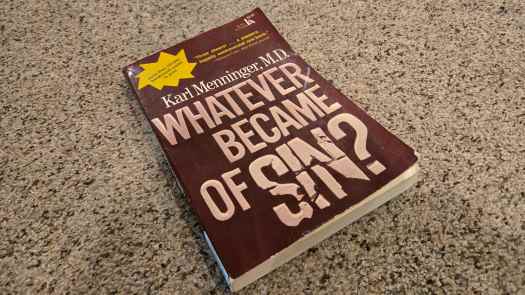
Whatever Became of Sin?

Isaiah 6

1In the year King Uzziah died, I saw the Lord. He was sitting on a lofty throne, and the train of his robe filled the Temple. 2Hovering around him were mighty seraphim, each with six wings. With two wings they covered their faces, with two they covered their feet, and with the remaining two they flew. 3In a great chorus they sang, “Holy, holy, holy is the LORD Almighty! The whole earth is filled with his glory!” 4The glorious singing shook the Temple to its foundations, and the entire sanctuary was filled with smoke.

5Then I said, “My destruction is sealed, for I am a sinful man and a member of a sinful race. Yet I have seen the King, the LORD Almighty!”

6Then one of the seraphim flew over to the altar, and he picked up a burning coal with a pair of tongs. 7He touched my lips with it and said, “See, this coal has touched your lips. Now your guilt is removed, and your sins are forgiven.”

8Then I heard the Lord asking, “Whom should I send as a messenger to my people? Who will go for us?”

And I said, “Lord, I’ll go! Send me.”

(Isaiah 6:1-8, NLT)


The Daily DAVEotional

Have you noticed that sin is not talked about that much anymore? It’s almost like it’s a dirty word – too offensive to mention to those outside of a church setting.

In 1973, Psychologist Karl Menninger published an important work, “Whatever Became of Sin?” in which he reflected on the diminishing concept of sin in our modern culture. His thesis was that the concept of sin as immoral behavior was being replaced by medical and psychological labels that reduced moral responsibility.

Though Menninger draws upon Christian as well as other religious traditions to support his thesis, his book is not a biblical exposition on the subject. Still, his thoughts on this issue, which were printed over 50 years ago, now seem prophetic in nature.

So whatever became of sin? Why has the concept diminished in our culture and what are the reasons for its demise?

The 6th chapter of Isaiah provides an answer for us. This chapter marks a pivotal moment in the life and calling of the prophet. In this chapter, Isaiah has a vision of the Lord in all of His splendor and glory.

The opening verse gives us a time stamp to date the events that follow. Uzziah had been the king of Israel for 52 years, a full life-time for many of his subjects. While Uzziah was one of the better kings of Judah early on, things did not end well for him. Toward the end of his reign, he stubbornly tried to enter the temple and perform rites that were reserved only for the priests, and as a result, he contracted leprosy and was forced to finish out his days in exile.

At Uzziah’s death, with no king to rule, Isaiah goes to the temple and experiences a vision of the true king, the Lord God Himself. Isaiah catches a rare glimpse of God as He really is, a picture of His absolute holiness.

What’s interesting about this encounter is the text says that when Isaiah sees the Lord in His holiness, he cries out, “my destruction is sealed, for I am a sinful man and a member of a sinful race.”

Some translations use the word “ruined” or “undone” to describe Isaiah’s emotional response.

Isaiah, when confronted with the perfect righteousness of God almighty, is brought to his knees as he recognizes his own sinfulness in light of holy God.

One of the reasons sin is not talked about much these days is because we don’t talk about God’s holiness so much these days. These two concepts are intertwined and interdependent – we don’t see sin so much if we don’t see God as holy and righteous.

Over the last 50 years or more, our culture has done all that it can to soften God’s divine attributes to make Him more palatable to our own personal preferences. In short, we’ve made God less like God and more like us.

For the atheist, dismissing God altogether means that there is no objective anchor or standard by which actions can be judged or labeled as “sin”.

“Who are you to tell me that my behaviors are wrong?” is a common refrain.

In many Christian circles, especially among progressives, God is not so much eliminated as much as He’s recreated or reimagined in a way that better fits the person’s lifestyle choices and behaviors.

One of the ways we often see this is in the elevation of the kind-hearted, compassionate New Testament version of God that we see in Jesus while dismissing or diminishing the “judgmental, ego-maniacal” Old Testament picture of God that seems too harsh and exacting. Some may go so far as to claim that the Bible describes two completely different Gods. I wrote recently about this in my blog post, “Is the Old Testament God a Bloodthirsty, Genocidal Psychopath?”

In light of the stark differences between the Old Testament perception of God and the New Testament portrayal of God in the person of Jesus, one inevitably chooses the deity that is more preferable and less restrictive to their own life choices.

The problem with this approach, as I outlined in my blog post, “Can You Make the Bible an Idol?”  is it essentially results in a form of idol worship, where my image of God is created according to my personal choices and inclincations instead of forming a picture of God that represents the fullness of how He has been revealed to us through His holy word.

If we want to talk about sin and the need for a savior, we must highlight God’s absolute holiness and righteousness. If a person doesn’t see God as infinitely holy, they’re more likely to overlook or dismiss their sinfulness as mere character flaws or innocent mistakes. If sin is not seen as an egregious offense against God’s very nature, there is less likelihood of coming to the realization that we are utterly lost and in need of a divine savior.

So whatever became of sin? It fell out of favor, just as God’s holiness has.


Did you enjoy this post? I’d love to hear your thoughts! Feel free to like, leave a comment below, and share it with your friends or on social media if you found it helpful or interesting. Your support keeps the conversation going!


Reflection

Describe  a time when you encountered the power and presence of God in your life as Isaiah did. In other words, when have you had an “Isaiah” moment with God? What was that like emotionally? 

What is your concept of sin? How would you define it? In what ways have you seen our culture minimize sin and personal responsibility?

In what ways have you created an image of God that is not fully reflective of how God has revealed Himself in both the Old and New Testaments?

How can. you ensure that your view of God is not just a personal image that you created to suit your own preferences?


Photo by Dave Lowe


Can You Make the Bible an Idol?

Psalm 119

16I delight in your decrees; I will not neglect your word.

20My soul is consumed with longing for your laws at all times.

24Your statutes are my delight; they are my counselors.

40How I long for your precepts! Preserve my life in your righteousness.

43Do not snatch the word of truth from my mouth, for I have put my hope in your laws.

47for I delight in your commands because I love them.

48I lift up my hands to your commands, which I love, and I meditate on your decrees.

70Their hearts are callous and unfeeling, but I delight in your law.

72The law from your mouth is more precious to me than thousands of pieces of silver and gold.

77Let your compassion come to me that I may live, for your law is my delight.

92If your law had not been my delight, I would have perished in my affliction.

97Oh, how I love your law! I meditate on it all day long.

103How sweet are your words to my taste, sweeter than honey to my mouth!

111Your statutes are my heritage forever; they are the joy of my heart.

113I hate double-minded men, but I love your law.

119All the wicked of the earth you discard like dross; therefore I love your statutes.

120My flesh trembles in fear of you; I stand in awe of your laws.

127Because I love your commands more than gold, more than pure gold,

129Your statutes are wonderful; therefore I obey them.

140Your promises have been thoroughly tested, and your servant loves them.

143Trouble and distress have come upon me, but your commands are my delight.

159See how I love your precepts; preserve my life, O LORD, according to your love.

163I hate and abhor falsehood but I love your law.

165Great peace have they who love your law, and nothing can make them stumble.

167I obey your statutes, for I love them greatly.

174I long for your salvation, O LORD, and your law is my delight.

(Psalm 119 – selected verses, NLT)

NOTE: Psalm 119 is the longest chapter in the entire Bible. I’ve included selected verses that reflect the content of this blog post


The Daily DAVEotional

A while back, I read a social media post from a person with a sizable following in which he exhorted people, “Don’t make the Bible an idol.”

My first thought was, “what does that even mean?”

Is it possible to make the Bible an idol? What would that even look like?

I immediately thought about this Psalm (119), which is the longest chapter in the entire Bible and is an extended discourse on the wonders and virtues of God’s word. I’ve written about this Psalm before in my post “The Endless Virtues of God’s Word.”

It’s well worth your time to read the entire Psalm but due to the sheer length of the text, I’ve only included selected verses that highlight the devotion, awe and love that the psalmist has for God’s word.

If ever someone might be accused of worshiping God’s Word and making it an idol, it would be the author of Psalm 119. Notice some of the language he uses to express his feelings about God’s laws, statutes and precepts.

Words like delight, love, long, hope, consumed, sweet, joy, precious and awe are all used to describe how the psalmist feels about God’s laws.

There is clearly a reverence and respect and a deep LOVE for God’s word. But does that equate to idol worship?

To answer that question, we need to understand what idol worship is.

I wrote in a previous blog post, “A Discourse on the Foolishness of Idols” that an idol can be thought of as a substitutionary object of trust. Instead of trusting in God as your deliverer, your provider, your protector, your source of life, your savior, etc, you transfer that trust to something or someone else.

But you can also think of an idol as anything that takes priority or precedence in your heart over God.

So how about this Psalmist? Is he guilty of idol worship? Is it possible to elevate the Bible to a position over God in our lives?

I suppose that if I were to worship the physical book of the Bible as if it were a deity itself, I could be accused of idol worship. But I don’t think that is what’s happening with the psalmist.

The word of the Lord – his law, precepts, ordinances and statutes – are all merely an extension of God Himself. They are not God, but they are a revelation of the character of the true God.

When the psalmist says he loves God’s law, and he delights in His word, he’s making a statement about God’s character. He’s acknowledging that God’s word is a source of revelation about God’s nature and in it, God has provided wisdom and instruction for righteous living.

God’s word tells us who He is and how we’re to live. The psalmist simply acknowledges these facts. Moreover, he’s speaking directly to God when he makes these statements. Therefore, the praise and adoration is directed toward God and not some inanimate scroll.

Think of it this way – let’s say you read a book that you really loved. Then one day you meet the author at a book signing. While you’re at the table, you go on and on about how much you loved the book. You share that the character development, plot lines and context were all relatable and engrossing. Do you think the author will be offended because you praised his/her work and not the author directly? No, the book is an extension of them and it is obvious to all that your praise is directed toward the author.

That is exactly what is happening in this psalm. The psalmist is simply recognizing that God’s laws and statutes are righteous and life-giving.

So why would this online social media influencer bark out that we should not make the Bible an idol? Why is this even a concern?

My desire to answer this question led me down an online rabbit hole. This particular influencer, and others who also warn that we should not make the Bible an idol, belongs to a strain of religious faith that is known as Progressive Christianity.

Progressive Christianity uses the word “Christianity” but it is hardly Christian. While they utilize the same language and reference the same characters as traditional Christianity, they redefine the meaning of words, concepts and even characters in order to suit their own theological preferences.

Progressive Christians occupy a broad spectrum of beliefs but there are some things that tend to be common among most who identify themselves as being a part of this camp.

Perhaps the hallmark value of Progressive Christianity is their view that God is always evolving. Hence, there is an emphasis on searching and questioning, while those claiming to know truth may be labeled as unenlightened or immature.

Progressive Christianity tends to be very ecumenical, embracing all faith religions and ideologies as equally valid and helpful. Loving others means you shouldn’t offend others by telling them that their beliefs might be wrong. Hence, Jesus has been recast from His role as exclusive Savior of the world to that of a moral teacher whose example we’re to follow.

Standing in contrast to Progressive Christianity is Orthodox Christianity, which teaches that God can be known because He has revealed Himself to us through His word and through the person of Jesus.

In addition, orthodox Christianity teaches that God is NOT evolving. He has laid out for us in His word what His standards are for living and because God doesn’t change, the standards and statutes set forth in His word apply to us today.

Perhaps you are starting to see the problem. If God doesn’t change, then that means His moral code and His rules for righteous living are not optional and must be obeyed today.

The Progressive Christian attempts to get around this by doubling down on the assertion that God IS evolving while adding the caveat that the Bible is not written by God.

Their claim is that the Bible we have is simply a record of writings by fallible men; they are NOT God’s spoken words. While the Bible may be helpful and inspiring, it is only a tool that you may choose to use; it is NOT authoritative for our lives. If the Bible lacks authority, then it logically follows that I don’t have to abide by all of its restrictive and antiquated rules and regulations.

This is where the rubber meets the road. For the evangelical (orthodox) believer, the Bible is authoritative, for it reveals God’s very nature to us and it contains His laws, statutes, precepts and ordinances for righteous living. This is what the psalmist was extolling in Psalm 119.

The Progressive Christian denies that God is the author of Scripture and so for anyone who believes in the authority of Scripture, they are told by the Progressive Christian, “Don’t make the Bible an idol.”

So you see that this whole argument is based on a completely different foundational view of God’s nature and how he reveals Himself to mankind. The Progressive Christian denies that the Bible is an authoritative tome that accurately reflects God’s nature and provides rules and guidance for living. To them, there are many other ways God may communicate to us apart from the Bible, including other faith traditions.

This denigration of the authority of Scripture allows the Progressive Christian to decide for himself which of the statutes in the Bible are valid for today and which ones aren’t. Conveniently, this allows the Progressive Christian to formulate a view of God that matches their preferences and proclivities exactly, which, strangely, is exactly the definition of forming an idol.

Amazingly, we’ve come full circle. The Progressive Christian tells us not to make the Bible an idol because doing so limits God and restricts our view of Him to how He is portrayed in Scripture.

Meanwhile, the Progressive Christian untethers themselves from the shackles of Biblical revelation of God as an immutable template for representing who God is, opting instead for the freedom to develop an image of God that is highly influenced by their own experiences and preferences.

Ironically, that sounds like idol worship to me.


To learn more about Progressive Christianity and what they believe, watch this 12 minute video from apologist Alisa Childers


Reflection

What is your view of the Bible? Do you see it as God’s word or a collection of writings written by fallible men?

What is the source of your information about God? How can you know if your view of God is accurate to who God really is rather than just an image you developed about Him that suits your preferences?

Do you think that the commands of the Bible are valid for people today or are they optional? What are the reasons for your position?

What has been your experience with Progressive Christianity? Do you think Progressive Christianity is compatible with traditional, orthodox Christianity? Why or why not?

Why do you think people opt for a Progressive version of Christianity instead of traditional, orthodox Christianity? What do you think are some of the main reasons and driving forces?


Photo by Pixabay on Pexels.com