What Does it Mean that Jesus is the Firstborn? (Part 2)

Colossians 1

15He is the image of the invisible God, the firstborn over all creation. 16For by him all things were created: things in heaven and on earth, visible and invisible, whether thrones or powers or rulers or authorities; all things were created by him and for him. 17He is before all things, and in him all things hold together. 18And he is the head of the body, the church; he is the beginning and the firstborn from among the dead, so that in everything he might have the supremacy. 19For God was pleased to have all his fullness dwell in him, 20and through him to reconcile to himself all things, whether things on earth or things in heaven, by making peace through his blood, shed on the cross. (Colossians 1:15-20, NIV)


The Daily DAVEotional

About a year ago, I posted my thoughts on this very passage, explaining the meaning of the term “firstborn” and why it doesn’t teach that Jesus is a created being, as the Jehovah’s Witnesses argue.

I don’t want to rehash all of my points from that post so if you haven’t read it, I encourage you to read the original post, “What Does it Mean that Jesus is the Firstborn?” to get up to speed on the debate between the traditional Christian understanding of Jesus and the Arian view that Jehovah’s Witnesses hold.

My purpose in this post is to provide a response to some of the arguments levied by Jehovah’s Witnesses who argue against my interpretation of this passage.

In my initial post, I made the claim that the primary meaning of “firstborn” in Colossians 1:15 and 18 is “preeminence”. I reasoned that this makes the most sense since Paul uses “firstborn” in conjunction with two different terms, “creation” and “death”, neither of which have anything to do with a parent. Therefore, it seems most natural that Paul is using the term to demonstrate Jesus’ supremacy (pre-eminence) over creation and death.

In recent weeks, I’ve encountered a number of committed Jehovah’s Witnesses online who disagree with my interpretation and have offered up their own explanations for this passage.

The standard Jehovah’s Witness talking point as it relates to the meaning of “firstborn” in Colossians 1 is that the term means something like “first in line.”

The argument is that the term “firstborn” most often refers to the first offspring of a particular person. Therefore, the word should be interpreted in a similar manner when it’s used in a verse that is not referencing offspring.

If you agree with the Jehovah’s Witness logic, then the interpretation of Colossians 1 yields the following:

Jesus is the firstborn of creation, which means that he was the first one to be created by Jehovah.

Jesus is the firstborn from among the dead, which means he’s the first one to overcome death.

To some, particularly Jehovah’s Witnesses and others who hold to an Arian view of Christ, the debate is over. In their mind, the logic is irrefutable.

But is it?

Sound Bible study methods dictate that we investigate their claims. Is their understanding of the word the standard interpretation?

Let’s see.


Click here to see a A Comprehensive List of Blog Posts Based on Bible Passage Reference


I did a Bible search and found that the word “firstborn” shows up in 111 Bible verses, all but 9 of which are found in the Old Testament. In some verses, the word “firstborn” appears multiple times. Hence, the term is used more than 120 times throughout the Bible.

I’ve catalogued every verse where the term shows up, so you can see for yourself. You can access this list of verses in my blog post “Bible References to the Term “Firstborn”“.

The Jehovah’s Witnesses are right in this respect – a majority of the references to the term “firstborn” do actually refer to the first one born to a particular person. However, it is rather obvious from the context of all of those passages that this is the meaning.

Take Genesis 10:15 for example, which is the very first occurrence of the term. The verse says,

Canaan became the father of Sidon, his firstborn.

In a majority of the occurrences of the term “firstborn”, it’s used in this same manner where the term is by itself, but referencing a parent. Occasionally, the term is referenced to another living creature as in Exodus 11:5 which states that God was going to kill the firstborn of Pharaoh as well as the firstborn of all cattle.

It’s clear in these situations that the term does mean “first offspring” primarily because the verse gives the name of the parent and the son or daughter.

But how is the word understood when it is not used in conjunction with a living being (man or animal)? Is it understood in the same way?

Typically not.

One of the first occurrences where firstborn is used in a non-traditional way is Exodus 4:22, which says,

“Then you shall say to Pharaoh, ‘Thus says the LORD, “Israel is My son, My firstborn23“So I said to you, ‘Let My son go that he may serve Me’; but you have refused to let him go. Behold, I will kill your son, your firstborn.”’”

Notice that the term shows up twice. In the second instance it’s used in the same way we typically see the word being used, in reference to the first offspring of a person. In this case, it’s referring to the first offspring of Pharaoh.

But in the first instance of the term “firstborn”, it is not used in the typical fashion.

According to Jehovah’s Witness’ argumentation, the word should have the same meaning even when it’s used in a non-traditional way.

It turns out that the first instance of “firstborn” in this passage CANNOT mean what the Jehovah’s Witnesses attribute to the term. God specifically states that Israel, the nation, is his firstborn. If we understand “firstborn” to be “first in line”, in what sense is Israel the “first in line”?

Israel was not the first nation to be created. And God doesn’t “birth” nations anyway, so the word cannot mean “first offspring”.

It’s clear by the context that the first occurrence of “firstborn” in this verse is to be understood as Israel having a favored status. God selected Israel for a distinct and unique purpose – to be a nation through which all the other nations would be blessed and come to know the one true God.

In this case, the meaning of “preeminent” is clearly the correct understanding.

Genesis 48 provides an insightful story that helps us understand the significance of the firstborn.

In this passage, Joseph brings his sons Manasseh and Ephraim to Jacob in order to receive a blessing before Jacob passes.

Jacob is old and his vision is failing. As he reaches out to bless Joseph’s sons, he crosses his arms so that his right hand is on Ephraim instead of Manasseh who is the first offspring of Joseph and therefore the firstborn.

Genesis 48:14 says,

But Israel stretched out his right hand and laid it on the head of Ephraim, who was the younger, and his left hand on Manasseh’s head, crossing his hands, although Manasseh was the firstborn.

In Genesis 48:18, Joseph tries to correct his father, saying,

“Not so, my father, for this one is the firstborn. Place your right hand on his head.”

Jacob tells Joseph that he is aware of the situation and he knows what he is doing. He tells Joseph that Ephraim, though he is the younger, will have a higher position over his brother. He will be the firstborn, the favored son.

Just a few verses later, in the next chapter, Jacob is giving his final words to each of his sons. Here is what he says to Reuben, his first son, in Genesis 49:3-4,

“Reuben, you are my firstborn; My might and the beginning of my strength, Preeminent in dignity and preeminent in power. 4“Uncontrolled as water, you shall not have preeminence, Because you went up to your father’s bed; Then you defiled it —he went up to my couch.

Jacob not only defines the term “firstborn” for us but expounds on its significance. The firstborn IS the might of the father AND the beginning of the father’s strength. The firstborn is PREEMINENT.

Jacob tells Reuben that he is the firstborn in terms of offspring. But he would NOT be firstborn in terms of preeminence.

These passages, which show up early in the biblical narrative, demonstrate clearly that the idea of “preeminence” was nearly synonymous with the term “firstborn”.

Though Manasseh was Joseph’s first offspring, it turns out that he was not considered the “firstborn” in terms of stature and rank. In Jeremiah 31:9, God  confirms that “Ephraim is my firstborn.”

In 1 Chronicles 2:13, we read that,

Jesse became the father of Eliab his firstborn, then Abinadab the second, Shimea the third,

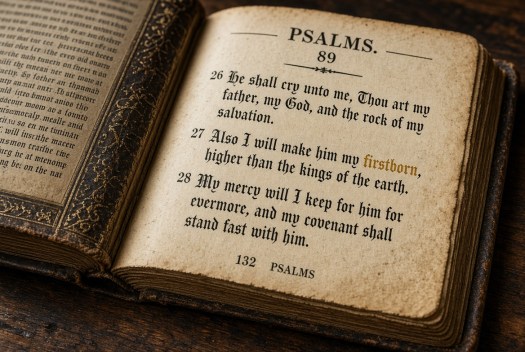
In verse 14, we learn that David was the seventh and last son born to Jesse. Yet, in Psalm 89:27, God says about David,

“I also shall make him My firstborn,
The highest of the kings of the earth.

David was not the first offspring of Jesse, but God made David His firstborn.

What does that mean?

It cannot mean that David was “first in line” because David was neither the first offspring of Jesse nor was he the first king of Israel.

What it means is that David was made by God to assume the highest rank among rulers. David was made firstborn – he was made to be preeminent.

The context dictates the meaning and sense of the word and so far, when the word is used in a way that doesn’t mean “first offspring”, it carries the meaning of “preeminence.”

There’s an interesting passage in Job that uses the term firstborn. It’s found in Job 18:13, which says:

“His skin is devoured by disease,
The firstborn of death devours his limbs.

This occurrence is informative because it uses the term “firstborn” with the prepositional phrase “of….” that doesn’t have a person or animal following. Whenever we see a person or animal (cattle, herd) follow, as in “firstborn of Jacob” or “firstborn of cattle”, the term always refers to the first offspring.

But in this case, the “firstborn of” phrase is not followed by a person or animal.

Does the standard Jehovah’s Witness meaning of “first in line” follow?

Not really.

Death is inanimate. It’s not a living organism that gives birth as humans and mammals do.

So what is this verse saying?

This verse is part of a larger discourse by Bildad in which he’s communicating his ideology that the wicked eventually get the punishment they deserve. He’s using this argumentation to try to prove that the reason Job has experienced so much trauma and suffering is because Job’s sin has finally caught up to him.

In describing the punishment the wicked will endure, Bildad claims that the skin of the wicked gets devoured by disease AND the “firstborn of death” devours his limbs. It’s obvious that Bildad is making reference to Job’s physical ailments as a proof of Job’s supposed secret sin.

But what is meant by “firstborn of death”?

Note that this term is very similar to how Paul uses “firstborn” in Colossians 1:18.

If “firstborn” means “first in line” in these kinds of cases, what exactly does that mean?

The context will not allow that interpretation because if you assume that meaning, you end up with a garbled mess of a sentence that is completely incoherent.

It’s clear in this context that death is afflicting its victim. There is no sense in which the term “firstborn of death” includes the meaning “first in line”. Death does not birth anything and does not produce a literal offspring.

But death CAN rule. Death CAN overwhelm. That is the sense that is being conveyed here. There is no meaningful or coherent sense in which “first in line” as a meaning applies to the term “firstborn” here.

There’s another uncommon use of the term “firstborn” in Isaiah that does not follow the typical examples that are littered throughout the Old Testament.

Isaiah 14:30 in the ESV says,

And the firstborn of the poor will graze,
And the needy lie down in safety;
but I will kill your root with famine,
and your remnant it will slay.

Here is another example of the word “firstborn” being used in connection with something that is a non-person and a non-animal, negating the traditional meaning of “first offspring.”

What exactly, then is the “firstborn of the poor” and does the definition of “first in line” fit here given the context?

This verse is part of a prophecy that the Lord is giving to Philistia. God warns that Philistia will experience complete devastation and that only “the firstborn of the poor will graze.”

What exactly does that mean?

One thing it doesn’t mean is “first in line”. If we apply the meaning of “highest rank” or “supreme” then it means that those who are the MOST poor will graze (be fed). In other words, it’s going to be bad, and only the most poor, or the poorest of the poor will survive.

It appears that in pretty much every case where the term “firstborn” is used in a way that doesn’t include the parent with the first offspring, the term means “preeminent.”

As mentioned at the outset, there are only 9 verses in the New Testament that use the term “firstborn”.

There are two verses in Luke 2 that use the term, and in both cases, the term “firstborn” is used to refer to Jesus as Mary’s first offspring.

In Hebrews 11:28, the term “firstborn” is referencing the Egyptian plague when the angel of death passed over the Israelites and all of the firstborn of the Israelites were shielded from the plague.

That leaves 6 more verses that use the term “firstborn” including the two in Colossians. None of these other verses use the term in the normal sense where it obviously refers to the first offspring of a certain person.

I’ll examine each of the non-Colossians verses before coming back to Colossians and then summarizing what this tells us.

Romans 8:29 says,

For those whom He foreknew, He also predestined to become conformed to the image of His Son, so that He would be the firstborn among many brethren;

What is this verse saying?

It’s saying that those who become children of God are predestined to be conformed to the image of Jesus. That is, believers ultimately are going to be LIKE him. We won’t just be declared righteous, we will BE righteous because in the end, our sin nature will finally be eradicated.

This is the sense that we will fully be Christ’s brethren. Though we will be LIKE him, we will not be equal to him. Jesus will be the firstborn among all these brethren, which simply means, he will be preeminent. He will be supreme.

So this verse, as applied to Jesus, does not state that he is the first of Jehovah’s creation. It’s stating that he will have a preeminent position among all of the brethren.

This interpretation makes complete sense if we understand that Jesus is a son by nature but we are sons (and daughters) by adoption.

Hebrews 1:6 says,

And when He again brings the firstborn into the world, He says,
“AND LET ALL THE ANGELS OF GOD WORSHIP HIM.”

The term “firstborn” in this verse clearly refers to Jesus, but does it mean that he was the first offspring?

That is a doubtful interpretation for reasons that have already been enumerated. Jesus was not born. Therefore, the more logical understanding of this term as applied to Jesus is “preeminent one”.

This makes sense given the context of Hebrews 1. This passage, starting in verse 5 and ending with verse 13, is demonstrating that Jesus is superior to, or better than the angels.

So when the firstborn, the preeminent one, comes into the world, God says “let all the angels worship Him.” It logically follows that the angels are commanded to worship Jesus because he is preeminent over them.

Now two things should be said about this. First of all, it’s clear from Scripture that only God is to be worshipped. So what does it say about Jesus that God instructs the angels to worship Him?

Secondly, the Jehovah’s Witnesses believe that Jesus is actually the archangel Michael. They believe that Michael is the highest of angels and that God the Father (Jehovah to the Jehovah’s Witnesses) gave Michael the task of coming into the world to redeem humanity. Michael took on a human nature and changed his name for some reason. When his mission was complete, Jesus returned to heaven and assumed his prior identity as Michael the archangel.

So according to the Jehovah’s Witnesses, a powerful angel came to earth, took on a human body and God the Father instructed all the other angels to WORSHIP him.

This doesn’t sound like an angel or even someone who is god-like, as Jehovah’s Witnesses will say. This sounds like someone who possesses the divine nature. In fact, this is exactly what Hebrews 1:3 -4 teaches, that Jesus is the EXACT representation of God’s nature AND he is BETTER than the angels. How can he be better than the angels if he himself IS an angel?

Hebrews 12:23 says,

to the general assembly and church of the firstborn who are enrolled in heaven, and to God, the Judge of all, and to the spirits of the righteous made perfect,

There is some debate about what the term “church of the firstborn” refers to but we know it does NOT refer to Jesus. It clearly refers to a group of people in heaven. It’s also clear that the idea of “first offspring” is not in view here.

I think the most likely understanding of “firstborn” in this verse is either “favored status” or “inheritance.” Remember that the firstborn son had a favored status and received a double portion of the inheritance. So both of these ideas are already inherent in the term.

In this sense, the phrase “church of the firstborn” likely refers to those who have received the inheritance. In other words, it’s referring to those who, because they have placed their faith in Jesus and belong to him, receive exclusive spiritual blessings that are not available to those who are not in the church.

This view makes more sense than anything resembling “first in line”.

Revelation 1:5 says,

and from Jesus Christ, the faithful witness, the firstborn of the dead, and the ruler of the kings of the earth. To Him who loves us and released us from our sins by His blood—

This is the last occurrence of the term “firstborn” in the Bible and it’s the one occurrence that most resembles the usage of Colossians, especially Colossians 1:18.

So what does this mean?

Jehovah’s Witnesses will likely argue for the interpretation that they hold for Colossians 1:18, namely that this means that Jesus is the first to overcome death, that Jesus is “first in line”.

But given the context, noting that John follows this phrase by saying that Jesus is the RULER of the kings of the earth, it makes more sense that John is using the term to communicate that Jesus is the one who is preeminent over death. In other words, Jesus rules over death, just as he rules over the kings of earth.

It bears repeating that Jesus was not born. So what would be the purpose of using the term “firstborn” if it does not apply to Jesus as it applied to Reuben, Manasseh and the dozens of other references that referred to the first offspring of some person?

In other words, the term firstborn, in a majority of cases, was used to identify the first offspring of a person in order to distinguish that person from other siblings who were not first. But since Jesus has no spiritual “siblings”, there is no need to use the term “firstborn” to distinguish him from rival siblings.

Clearly, John is pointing to Jesus’ special status. To conclude otherwise is to stretch or twist the context of these passages and phrases to unnatural and incoherent meanings.

Now let’s circle back to the Colossians verses that use the term “firstborn”.

What we’ve seen in every use of the term “firstborn” is that it most often refers to “first offspring”. But it never means “first offspring” when the term “firstborn” is used in conjunction with  a non-person or non-mammal. In those cases, some form of preeminence, rule or supremacy is meant.

One thing that is clear is that there are no verses where the term firstborn means “first in line”. Yes, it means “first offspring” when speaking of a person or animal that bears offspring in the natural way. However, when “firstborn” is coupled with a non-person, the idea of “first in line” is never in view.

Yet that is exactly what the Jehovah’s Witnesses contend that it means in these two verses in Colossians. They argue that Colossians 1:15 means that Jesus was first in line to be created and Colossians 1:18 means that Jesus was first in line to be raised from the dead.

Their argument is that this understanding is demanded because it is the normal meaning when you see the term.

But, as we’ve seen, it’s only normal when the term is used to refer to “first offspring”. There is no instance where it carries that meaning apart from the term “firstborn” being connected with a living person or an animal such as “cattle” or “herd”.

When the term “firstborn” is used apart from a living person or animal, it always has the meaning of preeminence, supremacy or highest rank.

This rendering makes the most sense in Colossians, especially when you look at the context and realize that Paul is seeking to demonstrate that “in everything Christ might have supremacy.” 

If Paul’s argument is designed to show that Christ will have supremacy in everything (verse 18), then it makes sense that he is going to support that argument by showing that Jesus has supremacy over creation and over death.

So why do Jehovah’s Witnesses still insist that “firstborn”, when attributed to Jesus, means “first in line” when it’s never used that way in any other example?

The answer is that they have manufactured this definition as a way to maintain their theological view that Jesus is a created being.

Jehovah’s Witnesses demonstrate the most egregious form of the Bible study error known as eisegesis, which means to “read into the text.”

In simple terms, the Jehovah’s Witnesses do not approach the text in order to inform their theology. Instead, they add phrases to the text and change the normal meaning of words in order to conform the text to their theology.

It’s clear that, as it relates to Jesus, Paul is using the term “firstborn” in the sense of “preeminence”. This is how the word is used in cases that clearly don’t refer to “first offspring.”

Additionally, the context supports the idea of “preeminence” as the meaning of firstborn.

Paul states that Jesus is the “firstborn of creation” which means Jesus is preeminent over creation.

In the verses that follow, Paul states that Jesus is the creator of all things. So Jesus is preeminent over creation because he is the creator.

The Jehovah’s Witnesses have to manufacture a meaning of firstborn to mean something like “first in line” in order to convince you that Paul is trying to tell you that Jesus is the first created being of Jehovah.

Yet if Paul was trying to communicate that Jesus was “first-created”, he would have used the Greek word “protoktisis” which literally means “first-created.”

That Paul didn’t use that word speaks volumes.

The Jehovah’s Witnesses then have to add the word “other” to the text four times in order to change the meaning of the text to show that Jesus is not really the creator as the original Greek text indicates.

The Jehovah’s Witnesses are like the person who tells a small lie to promote a false narrative but are then forced to create bigger lies in order to maintain the fabricated story.

They first had to offer up a definition for “firstborn” that is literally not used in any of the more than 100 occurrences of the term.

Then, to keep their narrative alive that Jesus is a created being, they have to add the word “other” to the passage four times. Their explanations and justifications for their interpretive choices get increasingly more complicated and logically convoluted in their effort to maintain their theological view.

The most direct, plain and understandable meaning of this passage is that Jesus is preeminent over creation because he is the creator. Additionally, Jesus is preeminent over death because he conquered death. All of this demonstrates that Jesus will come to have first place (i.e. preeminence) in everything!

No extra words and no uncommon and unnatural definitions are required to arrive at this understanding.

So we are back to my original premise in my first blog post, which is that the word “firstborn” does not mean what the Jehovah’s Witnesses think it means.

Jehovah’s Witnesses would do well to heed the advice of Inigo Montoya, who famously said,


Did you enjoy this post? I’d love to hear your thoughts! Feel free to like, leave a comment below, and share it with your friends or on social media if you found it helpful or interesting. Your support keeps the conversation going!


Reflection

Do you agree with the Jehovah’s Witnesses’ interpretation of Colossians 1;15 and Colossians 1:18 that the term “firstborn” should be understood as “first in line”? If so, how do you interpret the other passages that use “firstborn” in a context that doesn’t refer to “first offspring”?

Have you ever told a small lie that escalated into much bigger fabrications? What is the motivation for lying in the first place? What are the reasons a person might continue to promote a falsehood?

What are some examples you can think of where a person is so committed to their narrative that they resort to convoluted logic and distorted definitions in an attempt to justify their narrative?

If the term “firstborn” means “first in line” in Colossians, as Jehovah’s Witnesses assert, what exactly is the meaning of the phrase “firstborn from among the dead”? How does the idea of “first in line” apply to Jesus’ death?


Photo is a screenshot from the movie “The Princess Bride”
Bible References to the Term “Firstborn”


This is a complete list of all Bible verses that contain the word “firstborn”. This list is provided for convenience to those who want to do a word study to determine the meaning and the usage of the word “firstborn”, particularly so you can accurately interpret the meaning of “firstborn” as it relates to Jesus in Colossians 1:15 and Colossians 1:18.

The Jehovah’s Witnesses insist that the meaning of the word “firstborn” in those verses is the normal standard meaning of one born first. Or to put it another way, they claim the word means something like “first in line” or “first in chronology.”

To determine whether their interpretation is correct or even a valid option, it is helpful to see how the word is used throughout Scripture. Specifically, we want to see if the word is ever used with the meaning they attribute in Colossians. If the word is used in other parts of Scripture in the way they define it in Colossians then it lends more credibility to their interpretation.


All references are in the New American Standard Bible, unless otherwise noted

Old Testament

Genesis

  1. Genesis 10:15 – Canaan became the father of Sidon, his firstborn

  2. Genesis 19:31 – Then the firstborn said to the younger, “Our father is old, and there is not a man on earth to come in to us after the manner of the earth.

Lot’s daughter, the firstborn, hatched a plan with her younger sister to get their father to impregnate them in order to ensure that they would have offspring


  1. Genesis 19:33 – So they made their father drink wine that night, and the firstborn went in and lay with her father;

  2. Genesis 19:34 – On the following day, the firstborn said to the younger, “Behold, I lay last night with my father;

  3. Genesis 19:37 – The firstborn bore a son, and called his name Moab

Lot’s oldest bore a son who became the father of the Moabites. The younger daughter bore a son who became the father of the Ammonites.


  1. Genesis 22:20-21 – “Behold, Milcah also has borne children to your brother Nahor: 21Uz his firstborn and Buz his brother

Uz was Abraham’s nephew, the firstborn of Abraham’s brother Nahor


  1. Genesis 25:13 – and these are the names of the sons of Ishmael, by their names, in the order of their birth: Nebaioth, the firstborn of Ishmael, and Kedar and Adbeel and Mibsam

  2. Genesis 27:19 – Jacob said to his father, “I am Esau your firstborn; I have done as you told me. Get up, please, sit and eat of my game, that you may bless me.”

Jacob was deceiving Isaac, pretending to be Esau, the firstborn son


  1. Genesis 27:32 – Isaac his father said to him, “Who are you?” And he said, “I am your son, your firstborn, Esau.”

  2. Genesis 29:26 – But Laban said, “It is not the practice in our place to marry off the younger before the firstborn.

Leah was the firstborn. She was older than Rachel so the custom was that she should be married off first


  1. Genesis 35:23 – the sons of Leah: Reuben, Jacob’s firstborn, then Simeon and Levi and Judah and Issachar and Zebulun;

  2. Genesis 36:15 – The sons of Eliphaz, the firstborn of Esau, are chief Teman, chief Omar, chief Zepho, chief Kenaz

  3. Genesis 38:6 – Now Judah took a wife for Er his firstborn, and her name was Tamar.

  4. Genesis 38:7 – But Er, Judah’s firstborn, was evil in the sight of the LORD, so the LORD took his life.

  5. Genesis 41:51 – Joseph named the firstborn Manasseh,

  6. Genesis 43:33 – Now they were seated before him, the firstborn according to his birthright and the youngest according to his youth, and the men looked at one another in astonishment.

Joseph had seated his brothers according to their birth order. Joseph’s brothers were amazed, as they still were unaware that it was Joseph


  1. Genesis 46:8 – Now these are the names of the sons of Israel, Jacob and his sons, who went to Egypt: Reuben, Jacob’s firstborn.

  2. Genesis 48:14 – But Israel stretched out his right hand and laid it on the head of Ephraim, who was the younger, and his left hand on Manasseh’s head, crossing his hands, although Manasseh was the firstborn.

Jacob intentionally gave Ephraim the blessing of the firstborn even though he was NOT the firstborn


  1. Genesis 48:18 – Joseph said to his father, “Not so, my father, for this one is the firstborn. Place your right hand on his head.”

Joseph tried to correct his father to give the favored blessing to Manasseh, who held that status as the firstborn. In the next verse, Genesis 48:19, Jacob tells Joseph that he realizes Manasseh is the firstborn, yet he knows what he’s doing, so Ephraim received the blessing of the firstborn.


  1. Genesis 49:3-4 – “Reuben, you are my firstborn; My might and the beginning of my strength, Preeminent in dignity and preeminent in power. 4“Uncontrolled as water, you shall not have preeminence, Because you went up to your father’s bed; Then you defiled it —he went up to my couch.

A critical passage in which the definition of “firstborn” is provided by Jacob as he tells Reuben that even though he’s the firstborn, he would not experience the preeminence that is due the firstborn


Exodus

  1. Exodus 4:22 – “Then you shall say to Pharaoh, ‘Thus says the LORD, “Israel is My son, My firstborn. 23“So I said to you, ‘Let My son go that he may serve Me’; but you have refused to let him go. Behold, I will kill your son, your firstborn.”’”

A critical passage in which the term “firstborn” appears twice. The first time, it refers to the nation of Israel. Obviously, the meaning of this first occurrence is NOT that Israel was born first, for Israel was not born in the same sense that people are. They were chosen. It must be stated that Israel was NOT created first. They were NOT the first nation to appear. They were “firstborn” in the sense that they were “preeminent” – they had a special status and unique favor by God as the nation through which God’s blessings would extend to the world.

NOTE that the second occurrence of “firstborn” in this verse is the typical usage – it refers to the literal firstborn son of Pharaoh.


  1. Exodus 4:23 – “So I said to you, ‘Let My son go that he may serve Me’; but you have refused to let him go. Behold, I will kill your son, your firstborn.”’”

  2. Exodus 6:14 – These are the heads of their fathers’ households. The sons of Reuben, Israel’s firstborn: Hanoch and Pallu, Hezron and Carmi; these are the families of Reuben.

  3. Exodus 11:5 – and all the firstborn in the land of Egypt shall die, from the firstborn of the Pharaoh who sits on his throne, even to the firstborn of the slave girl who is behind the millstones; all the firstborn of the cattle as well.

Four occurrences of the term “firstborn”. Notice the first occurrence generally refers to all the firstborn, whether people or animals. The following occurrences serve to clarify or provide more specifics. The second occurrence refers to Pharaoh’s firstborn. The third and fourth occurrences are interesting because this is the first time we see the word “firstborn” used with a prepositional phrase “of….” That does not include the name of the father. We’ve seen “Reuben, firstborn of Jacob” but this is “firstborn of the slave girl” and “firstborn of the cattle”. So we deduce that this refers to the literal first person born of slave girls or cattle. Note though that these are living beings who bear offspring in natural ways. They BIRTH their offspring. Hence, their first offspring can naturally be referred to as “firstborn”. This is noted because the word “firstborn” is not used in this way in Colossians 1.


  1. Exodus 12:12 – ‘For I will go through the land of Egypt on that night, and will strike down all the firstborn in the land of Egypt, both man and beast; and against all the gods of Egypt I will execute judgments—I am the LORD.

  2. Exodus 12:29 – Now it came about at midnight that the LORD struck all the firstborn in the land of Egypt, from the firstborn of Pharaoh who sat on his throne to the firstborn of the captive who was in the dungeon, and all the firstborn of cattle.

  3. Exodus 13:2 – “Sanctify to Me every firstborn, the first offspring of every womb among the sons of Israel, both of man and beast; it belongs to Me.”

After the Passover, God issues a decree that the firstborn of people and cattle should be consecrated to the Lord


  1. Exodus 13:12 (ESV) – you shall set apart to the LORD all that first opens the womb. All the firstborn of your animals that are males shall be the LORD’s.

  2. Exodus 13:13 (ESV) – Every firstborn of a donkey you shall redeem with a lamb, or if you will not redeem it you shall break its neck. Every firstborn of man among your sons you shall redeem.

Another example of the word “firstborn” being used with the phrase “of”. In this case “of man” makes it clear that it’s speaking of the first offspring of all men


  1. Exodus 13:15 – ‘It came about, when Pharaoh was stubborn about letting us go, that the LORD killed every firstborn in the land of Egypt, both the firstborn of man and the firstborn of beast. Therefore, I sacrifice to the LORD the males, the first offspring of every womb, but every firstborn of my sons I redeem.’

  2. Exodus 22:29 – “You shall not delay the offering from your harvest and your vintage. The firstborn of your sons you shall give to Me.

  3. Exodus 34:19 (ESV) – All that open the womb are mine, all your male livestock, the firstborn of cow and sheep.

  4. Exodus 34:20 (ESV) – The firstborn of a donkey you shall redeem with a lamb, or if you will not redeem it you shall break its neck. All the firstborn of your sons you shall redeem. And none shall appear before me empty-handed.

Leviticus

  1. Leviticus 27:26 – However, a firstborn among animals, which as a firstborn belongs to the LORD, no man may consecrate it; whether ox or sheep, it is the LORD’s.

Numbers

  1. Numbers 1:20 – Now the sons of Reuben, Israel’s firstborn, their genealogical registration by their families, by their fathers’ households, according to the number of names, head by head, every male from twenty years old and upward, whoever was able to go out to war,

  2. Numbers 3:2 – These then are the names of the sons of Aaron: Nadab the firstborn, and Abihu, Eleazar and Ithamar.

  3. Numbers 3:12 – “Now, behold, I have taken the Levites from among the sons of Israel instead of every firstborn, the first issue of the womb among the sons of Israel. So the Levites shall be Mine.

  4. Numbers 3:13 – “For all the firstborn are Mine; on the day that I struck down all the firstborn in the land of Egypt, I sanctified to Myself all the firstborn in Israel, from man to beast. They shall be Mine; I am the LORD.”

  5. Numbers 3:40 – Then the LORD said to Moses, “Number every firstborn male of the sons of Israel from a month old and upward, and make a list of their names.

  6. Numbers 3:41 – “You shall take the Levites for Me, I am the LORD, instead of all the firstborn among the sons of Israel, and the cattle of the Levites instead of all the firstborn among the cattle of the sons of Israel.”

  7. Numbers 3:42 – So Moses numbered all the firstborn among the sons of Israel, just as the LORD had commanded him

  8. Numbers 3:43 – and all the firstborn males by the number of names from a month old and upward, for their numbered men were 22,273.

  9. Numbers 3:45 – “Take the Levites instead of all the firstborn among the sons of Israel and the cattle of the Levites. And the Levites shall be Mine; I am the LORD.

  10. Numbers 3:46 – “For the ransom of the 273 of the firstborn of the sons of Israel who are in excess beyond the Levites,

  11. Numbers 8:16 – for they are wholly given to Me from among the sons of Israel. I have taken them for Myself instead of every first issue of the womb, the firstborn of all the sons of Israel.

  12. Numbers 8:17 – “For every firstborn among the sons of Israel is Mine, among the men and among the animals; on the day that I struck down all the firstborn in the land of Egypt I sanctified them for Myself.

  13. Numbers 8:18 – “But I have taken the Levites instead of every firstborn among the sons of Israel.

  14. Numbers 18:15 – “Every first issue of the womb of all flesh, whether man or animal, which they offer to the LORD, shall be yours; nevertheless the firstborn of man you shall surely redeem, and the firstborn of unclean animals you shall redeem.

NOTE the use of firstborn of man, and of animals. These are living creatures that bear offspring through live birth. Hence, firstborn here refers to their FIRST offspring.


  1. Numbers 18:17 – “But the firstborn of an ox or the firstborn of a sheep or the firstborn of a goat, you shall not redeem; they are holy. You shall sprinkle their blood on the altar and shall offer up their fat in smoke as an offering by fire, for a soothing aroma to the LORD.

  2. Numbers 26:5 – Reuben, Israel’s firstborn, the sons of Reuben: of Hanoch, the family of the Hanochites; of Pallu, the family of the Palluites;

Here, Israel refers to Jacob. Reuben was Israel’s (Jacob’s) first born son.


  1. Numbers 33:4 – while the Egyptians were burying all their firstborn whom the LORD had struck down among them. The LORD had also executed judgments on their gods.

Deuteronomy

  1. Deuteronomy 12:6 – “There you shall bring your burnt offerings, your sacrifices, your tithes, the contribution of your hand, your votive offerings, your freewill offerings, and the firstborn of your herd and of your flock.

Herds and flocks are living creatures whose offspring enter via live birth. Hence, the firstborn of herds and flocks refers to the first offspring.


  1. Deuteronomy 12:17 – “You are not allowed to eat within your gates the tithe of your grain or new wine or oil, or the firstborn of your herd or flock, or any of your votive offerings which you vow, or your freewill offerings, or the contribution of your hand.

  2. Deuteronomy 14:23 – “You shall eat in the presence of the LORD your God, at the place where He chooses to establish His name, the tithe of your grain, your new wine, your oil, and the firstborn of your herd and your flock, so that you may learn to fear the LORD your God always.

  3. Deuteronomy 15:19 – “You shall consecrate to the LORD your God all the firstborn males that are born of your herd and of your flock; you shall not work with the firstborn of your herd, nor shear the firstborn of your flock.

  4. Deuteronomy 21:15 – “If a man has two wives, the one loved and the other unloved, and both the loved and the unloved have borne him sons, if the firstborn son belongs to the unloved,

  5. Deuteronomy 21:16 – then it shall be in the day he wills what he has to his sons, he cannot make the son of the loved the firstborn before the son of the unloved, who is the firstborn.

  6. Deuteronomy 21:17 – “But he shall acknowledge the firstborn, the son of the unloved, by giving him a double portion of all that he has, for he is the beginning of his strength; to him belongs the right of the firstborn.

  7. Deuteronomy 25:6 – “It shall be that the firstborn whom she bears shall assume the name of his dead brother, so that his name will not be blotted out from Israel.

  8. Deuteronomy 33:17

“As the firstborn of his ox, majesty is his,

And his horns are the horns of the wild ox;

With them he will push the peoples,

All at once, to the ends of the earth.

And those are the ten thousands of Ephraim,

And those are the thousands of Manasseh.”

This is a prophecy related to Joseph (see Deuteronomy 33:13. Joseph represented Israel’s firstborn ox. Literally, Joseph was Jacob’s strength. His double blessing was represented by Ephraim and Manasseh


Joshua

  1. Joshua 6:26 – Then Joshua made them take an oath at that time, saying, “Cursed before the LORD is the man who rises up and builds this city Jericho; with the loss of his firstborn he shall lay its foundation, and with the loss of his youngest son he shall set up its gates.”

This was a curse…the person who rebuilt Jericho would lose their firstborn. This curse was fulfilled in 1 Kings 16:34


  1. Joshua 17:1 – Now this was the lot for the tribe of Manasseh, for he was the firstborn of Joseph. To Machir the firstborn of Manasseh, the father of Gilead, were allotted Gilead and Bashan, because he was a man of war.

Manasseh was LITERALLY the first one born to Joseph. So yes, he was firstborn in the sense that he was born first. But he was NOT firstborn in the sense of preeminence and favor. That was reserved for Ephraim (see Jeremiah 31:9).


Judges

  1. Judges 8:20 – So he said to Jether his firstborn, “Rise, kill them.” But the youth did not draw his sword, for he was afraid, because he was still a youth.

1 Samuel

  1. 1 Samuel 8:2 – Now the name of his firstborn was Joel, and the name of his second, Abijah; they were judging in Beersheba.

  2. 1 Samuel 14:49 – Now the sons of Saul were Jonathan and Ishvi and Malchi-shua; and the names of his two daughters were these: the name of the firstborn Merab and the name of the younger Michal.

  3. 1 Samuel 17:13 – The three older sons of Jesse had gone after Saul to the battle. And the names of his three sons who went to the battle were Eliab the firstborn, and the second to him Abinadab, and the third Shammah.

The next verse, 1 Samuel 17:14 says that David was the YOUNGEST. Yet Psalm 89:27 says David was the “firstborn”


2 Samuel

  1. 2 Samuel 3:2 – Sons were born to David at Hebron: his firstborn was Amnon, by Ahinoam the Jezreelitess;

1 Kings

  1. 1 Kings 16:34 – In his days Hiel the Bethelite built Jericho; he laid its foundations with the loss of Abiram his firstborn, and set up its gates with the loss of his youngest son Segub, according to the word of the LORD, which He spoke by Joshua the son of Nun.

1 Chronicles

  1. 1 Chronicles 1:13 – Canaan became the father of Sidon, his firstborn, Heth, 14and the Jebusites, the Amorites, the Girgashites, 15the Hivites, the Arkites, the Sinites, 16the Arvadites, the Zemarites and the Hamathites.

Canaan’s firstborn was Sidon, father of the Sidonians. Canaan also fathered, Heth and the various other nations listed. All came from Canaan.


  1. 1 Chronicles 1:29 – These are their genealogies: the firstborn of Ishmael was Nebaioth, then Kedar, Adbeel, Mibsam,

Note that Ishmael was literally the first one born to Isaac but he was NOT the firstborn. Isaac was the firstborn.


  1. 1 Chronicles 2:3 – The sons of Judah were Er, Onan and Shelah; these three were born to him by Bath-shua the Canaanitess. And Er, Judah’s firstborn, was wicked in the sight of the LORD, so He put him to death.

  2. 1 Chronicles 2:13 – and Jesse became the father of Eliab his firstborn, then Abinadab the second, Shimea the third,

The next verse continues and demonstrates that David was the SEVENTH born to Jesse


  1. 1 Chronicles 2:25 – Now the sons of Jerahmeel the firstborn of Hezron were Ram the firstborn, then Bunah, Oren, Ozem and


  2. 1 Chronicles 2:27 – The sons of Ram, the firstborn of Jerahmeel, were Maaz, Jamin and Eker.

  3. 1 Chronicles 2:42 – Now the sons of Caleb, the brother of Jerahmeel, were Mesha his firstborn, who was the father of Ziph; and his son was Mareshah, the father of Hebron.

  4. 1 Chronicles 2:50 – The sons of Hur, the firstborn of Ephrathah, were Shobal the father of Kiriath-jearim,

  5. 1 Chronicles 3:1 – Now these were the sons of David who were born to him in Hebron: the firstborn was Amnon, by Ahinoam the Jezreelitess; the second was Daniel, by Abigail the Carmelitess;

  6. 1 Chronicles 3:15 – The sons of Josiah were Johanan the firstborn, and the second was Jehoiakim, the third Zedekiah, the fourth Shallum.

  7. 1 Chronicles 4:4 – Penuel was the father of Gedor, and Ezer the father of Hushah. These were the sons of Hur, the firstborn of Ephrathah, the father of Bethlehem.

  8. 1 Chronicles 5:1 – Now the sons of Reuben the firstborn of Israel (for he was the firstborn, but because he defiled his father’s bed, his birthright was given to the sons of Joseph the son of Israel; so that he is not enrolled in the genealogy according to the birthright.

  9. 1 Chronicles 5:3 – the sons of Reuben the firstborn of Israel were Hanoch and Pallu, Hezron and Carmi.

  10. 1 Chronicles 6:28 – The sons of Samuel were Joel the firstborn, and Abijah the second.

  11. 1 Chronicles 8:1 – And Benjamin became the father of Bela his firstborn, Ashbel the second, Aharah the third,

  12. 1 Chronicles 8:30 – and his firstborn son was Abdon, then Zur, Kish, Baal, Nadab,

  13. 1 Chronicles 8:39 – he sons of Eshek his brother were Ulam his firstborn, Jeush the second and Eliphelet the third.

  14. 1 Chronicles 9:5 – From the Shilonites were Asaiah the firstborn and his sons.

  15. 1 Chronicles 9:31 – Mattithiah, one of the Levites, who was the firstborn of Shallum the Korahite, had the responsibility over the things which were baked in pans.

  16. 1 Chronicles 9:35-37 – In Gibeon Jeiel the father of Gibeon lived, and his wife’s name was Maacah, 36and his firstborn son was Abdon, then Zur, Kish, Baal, Ner, Nadab, 37Gedor, Ahio, Zechariah and Mikloth.

  17. 1 Chronicles 26:10 – Meshelemiah had sons: Zechariah the firstborn, Jediael the second, Zebadiah the third, Jathniel the fourth,

 2 Chronicles

  1. 2 Chronicles 21:3 – Their father [Jehoshaphat] gave them many gifts of silver, gold and precious things, with fortified cities in Judah, but he gave the kingdom to Jehoram because he was the firstborn.

Nehemiah

  1. Nehemiah 10:36 – and bring to the house of our God the firstborn of our sons and of our cattle, and the firstborn of our herds and our flocks as it is written in the law, for the priests who are ministering in the house of our God.

Job

  1. Job 18:13

“His skin is devoured by disease,

The firstborn of death devours his limbs.


An interesting use of the word “firstborn”. This is part of a larger discourse by Bildad pontificating on the fate of the wicked. Bildad postulates that the wicked ultimate get trapped and they get theirs. He is thus inferring that the reason Job has experienced such calamity is because his wickedness (sin) has finally caught up.

But note the use of the term “firstborn”. It is very similar to Colossians 1:18 in which Paul refers to Jesus as the firstborn from the dead.

Are we to believe that the use of “firstborn” in this case means “first in line”? Clearly, this verse in Job firstborn of death refers to the author of death. Literally, “death devours his limbs”.

Death does not birth anything and does not have a literal first offspring. But death CAN rule. Death can overwhelm. That is the sense that is being conveyed here.


Psalms

  1. Psalms 78:51

And smote all the firstborn in Egypt,

The first issue of their virility in the tents of Ham.


  1. Psalms 89:27

“I also shall make him My firstborn,

The highest of the kings of the earth.

This Psalm is speaking about David, who was NOT the firstborn son of Jesse. David was the SEVENTH son, literally the last son of Jesse.

But God elevated him to the position of preeminence. Hence, David was the firstborn.


  1. Psalms 105:36

He also struck down all the firstborn in their land,

The first fruits of all their vigor.


  1. Psalms 135:8

He smote the firstborn of Egypt,

Both of man and beast.


  1. Psalms 136:10

To Him who smote the Egyptians in their firstborn,

For His lovingkindness is everlasting,


Isaiah

  1. Isaiah 14:30 (ESV)

And the firstborn of the poor will graze,

And the needy lie down in safety;

but I will kill your root with famine,

and your remnant it will slay.

Another interesting use of “firstborn” where it is used in a phrase that does not include a person or animal. Therefore, the “firstborn” CANNOT refer to first offspring.

So what does it mean to be “firstborn of the poor”

The Jehovah’s Witnesses want to twist and stretch the meaning of firstborn in Colossians to mean  something like “first in line” or “first one to experience”. They have to create this meaning in order to make its usage with respect to Jesus fit their theological understanding of his nature, namely that he is NOT God, but is a created being.

So if that is the meaning of the word “firstborn” in that case, then that same meaning and usage should fit here, in a similar usage. Does it work?

Hardly.

What exactly would this mean if its saying the first to be poor? Or how could the Philistines (those to whom this prophecy is directed be the first ones to experience being poor?

The meaning of the word cannot mean what Jehovah’s Witnesses contend. If it did, you would end up with a garbled, incoherent mess.

But if firstborn is taken to mean preeminence or rank, then this verse is saying that those who are supremely poor will be fed. Or another way of thinking about it is “those who are the MOST poor”. This is why the NIV doesn’t even translate the word “firstborn.” It simply says “the poorest of the poor.” The NASB, which is one of the most literal translations doesn’t even use the word “firstborn” for this verse. This verse will not show up in a search of the NASB1995 (though it will in 2020 version). The NASB1995 translates this “those who are most helpless will eat.”


Jeremiah

  1. Jeremiah 31:9

“With weeping they will come,

And by supplication I will lead them;

I will make them walk by streams of waters,

On a straight path in which they will not stumble;

For I am a father to Israel,

And Ephraim is My firstborn.”

An important verse in this discussion. We’ve already seen that Manasseh was Joseph’s first offspring. (See Genesis 48:14 and Genesis 48:18)

Yet even though Manasseh was the firstborn in terms of being the first offspring, Ephraim was the “firstborn” in terms of preeminence.

It’s clear that preeminence is MORE important than birth order. True, the first offspring normally held the preeminent position, but not always.

Hence, when spoken of Christ, who had NO spiritual brothers to share the inheritance, is it more likely that the term “firstborn” is being used to let us know that he was the first in a line of children, or is it more likely that it is being used to let us know that he is preeminent?

I think the answer is obvious. Since he has NO sibling rivals to compete for the birthright, there is no need to inform us that he is the “first offspring”.


Ezekiel

  1. Ezekiel 20:26 – and I pronounced them unclean because of their gifts, in that they caused all their firstborn to pass through the fire so that I might make them desolate, in order that they might know that I am the LORD.’”

The Israelites had offered their firstborn children as sacrifices to pagan idols


Micah

  1. Micah 6:7 –

Does the LORD take delight in thousands of rams,

In ten thousand rivers of oil?

Shall I present my firstborn for my rebellious acts,

The fruit of my body for the sin of my soul?


This verse is akin to the modern day saying, “what do I have to do? Give you my firstborn?”


Zechariah

  1. Zechariah 12:10 – “I will pour out on the house of David and on the inhabitants of Jerusalem, the Spirit of grace and of supplication, so that they will look on Me whom they have pierced; and they will mourn for Him, as one mourns for an only son, and they will weep bitterly over Him like the bitter weeping over a firstborn.

New Testament


Luke

  1. Luke 2:7 – And she gave birth to her firstborn son; and she wrapped Him in cloths, and laid Him in a manger, because there was no room for them in the inn.

Yes, Jesus WAS the firstborn son of Mary. He was literally the first of her offspring

  1. Luke 2:23 – (as it is written in the Law of the Lord, “EVERY firstborn MALE THAT OPENS THE WOMB SHALL BE CALLED HOLY TO THE LORD”),

Romans

  1. Romans 8:29 – For those whom He foreknew, He also predestined to become conformed to the image of His Son, so that He would be the firstborn among many brethren;

What is this verse saying?

It’s saying that those who become children of God are predestined to be conformed to the image of Jesus. That is, we are going to be LIKE him. We will be sinless and holy and righteous in reality. We won’t just be declared righteous, we will BE righteous because in the end, our sin nature will finally be eradicated.

This is the sense that we will fully be Christ’s brethren. But he is the firstborn among all these brethren. Which simply means, he is preeminent. He is supreme.

So this verse, as applied to Jesus does not state that he is the first of Jehovah’s creation. It’s stating that he will have a preeminent position among all the brethren.

This makes sense if we understand that Jesus is a son by nature but we are sons (and daughters) by adoption.


Colossians

  1. Colossians 1:15 – He is the image of the invisible God, the firstborn of all creation.

This is one of the passages in dispute with Jehovah’s Witnesses. They contend that this verse means that Jesus is the first one created by Jehovah. So firstborn here means something like “first in line” or “first one to experience…”

But as we’ve seen, there is no other verse where this is the meaning of “firstborn”, even in verses of similar construction. It cannot mean that Jesus is literally the first offspring of creation for creation cannot have offspring.

Jehovah’s Witnesses claim that the use of firstborn here should carry the normal meaning that is seen in the majority of verses in Scripture. But we’ve seen that the normal usage applies to the first child of normal parents who bore that child through natural child birthing. But this cannot describe Jesus because even if you believe that he was created, he certainly was not birthed in the same way that people are. Jesus did not have a spiritual mother who “bore” him.

Additionally, Jesus has no spiritual siblings. Therefore, there is no need to distinguish him from rival siblings in terms of the firstborn status.

First born does NOT mean first-created. There is a different word that specifically communicates that, and Paul did not use that word to describe Jesus.

Therefore, the logical understanding of the term “firstborn” in this verse is preeminence or rule. The idea is that Jesus reigns over creation. Why? Because he is creator, as the verses that follow teach.


  1. Colossians 1:18 – He is also head of the body, the church; and He is the beginning, the firstborn from the dead, so that He Himself will come to have first place in everything.

The second verse in this passage that uses the term “firstborn”. How do the Jehovah’s Witnesses explain this occurrence?

They pull out their made up meaning of “first in line”. Remember there has been no other occurrence of the term “firstborn” in the more than 100 instances where the idea is anything similar to “first in line.”

Their understanding of this verse is that Jesus was “first in line” to come “from the dead”.

This is faulty for a number of reasons. First of all, Jesus was not the first to die and he was NOT the first to be resurrected.

The response from Jehovah’s Witnesses is that Jesus was the first to be raised to immortality. But this doesn’t make sense within the Jehovah’s Witnesses’ framework, for they do not even believe that Jesus was raised with a physical body. They believe that Jesus was raised from the dead (so was Lazarus) and Jesus now has returned to his pre-incarnate state of being the archangel, Michael. So Jesus is still alive. But so is Moses and Elijah. They appeared with Jesus at the transfiguration.

The Jehovah’s Witnesses’ view here that Jesus was the first to overcome death doesn’t make sense, especially given the statement that follows from Paul, “so that He Himself will come to have first place in everything.”

The meaning of preeminence for the word “firstborn” makes complete sense in this verse, as well as the prior verse and it fits perfectly with the context, including the statement that follows.

Jesus is preeminent over creation, he RULES over creation because he’s the creator. Jesus is preeminent over death, he RULES over death because he CONQUERED death. As a result, He himself will have first place in everything.” Jesus will have supremacy.

See the post “What Does it Mean that Jesus is the Firstborn?”


Hebrews

  1. Hebrews 1:6

And when He again brings the firstborn into the world, He says,

“AND LET ALL THE ANGELS OF GOD WORSHIP HIM.”


This verse is interesting because firstborn clearly refers to Jesus, but does it mean that he was the first offspring?

That is a doubtful interpretation for reasons that have already been enumerated. Jesus was not born. The more logical understanding of this term as applied to Jesus is “preeminent one”.

This makes sense given the context. This passage starting in verse 5 and ending with verse 13 is designed to demonstrate that Jesus is superior (better than) the angels.

So when the firstborn, the preeminent one comes into the world, God says “let all the angels worship Him.”

Now two things should be said about this. First of all, only God should be worshipped. So what does it say about Jesus that God instructs the angels to worship Him?

Secondly, the Jehovah’s Witnesses believe that Jesus is actually the archangel Michael. They believe that he is the highest of angels and God the Father (Jehovah to the Jehovah’s Witnesses) tasked Michael with the task of coming into the world to redeem humanity. Michael took on a human nature and changed his name, for some reason. When his task was complete, he returned to heaven and assumed his prior identity.

So you have an angel coming to earth, taking on a human nature and God the Father is instructing all the other angels to WORSHIP him. This does not sound like an angel or even someone who is god-like, as Jehovah’s Witnesses will say. This sounds like someone who possesses the divine nature. Indeed, this is what Hebrews says in Hebrews 1:3 and 4. Jesus is the EXACT representation of God’s nature AND he is BETTER than the angels. How can he be better than the angels if he himself is an angel?


  1. Hebrews 11:28 – By faith he kept the Passover and the sprinkling of the blood, so that he who destroyed the firstborn would not touch them.

This verse is talking about Moses. Moses was faithful to follow the Passover instructions so that the angel of death would not touch the firstborn children of Israel.


  1. Hebrews 12:23 – to the general assembly and church of the firstborn who are enrolled in heaven, and to God, the Judge of all, and to the spirits of the righteous made perfect,

There is some debate about what the term “church of the firstborn” refers to but we know it does NOT refer to Jesus. It’s referring to a group of people in heaven. It’s also clear that the idea of “first offspring” is not in view here. It cannot mean that because it’s talking about people who are in heaven with the Lord so it doesn’t make sense that it’s referring to people who are born first.


Revelation

  1. Revelation 1:5 – and from Jesus Christ, the faithful witness, the firstborn of the dead, and the ruler of the kings of the earth. To Him who loves us and released us from our sins by His blood—

This is the last occurrence of the term “firstborn” and it is the one occurrence that most resembles the usage of Colossians, especially Colossians 1:18.

So what does this mean?

Jehovah’s Witnesses will argue for the interpretation that they hold for Colossians 1:18, namely that this means that Jesus is the first to overcome death, that Jesus is “first in line”.

But given the context, that John follows this phrase by saying that Jesus is the RULER of the kings of the earth, it makes more sense that John is using the term to communicate that Jesus is the one who is preeminent over death. Jesus rules over death, just as he rules over the kings of earth.

A reminder that Jesus was not born. So what would be the purpose of using the term “firstborn” if it does not apply to Jesus as it applied to Reuben, Manasseh and the hundred other references that referred to the first offspring of some person?

Clearly, John is pointing to Jesus’ special status. To conclude otherwise is to stretch or twist the context of these passages and phrases to unnatural and incoherent meanings.


Image created by Grok

How Does Isaiah 44 Demonstrate that Jesus is God?

If you’re wondering why there is an image of a pretzel with a side of mustard for a blog post related to Isaiah 44, read to the end of the post to find out

Isaiah 44

24The LORD, your Redeemer and Creator, says: “I am the LORD, who made all things. I alone stretched out the heavens. By myself I made the earth and everything in it. (Isaiah 44:24, NLT)


The Daily DAVEotional

The lion’s share of verses in Isaiah 44 deal with the foolishness of idols, which I wrote about in my blog post “A Discourse on the Foolishness of Idols”.

However, at the end of Isaiah 44, the prophecy shifts as God gives His people hope regarding the future restoration of the holy city of Jerusalem, which has been decimated due to the fact that many of its inhabitants have been exiled to Babylon. It’s this later passage that I want to focus on in this post, specifically, the first verse in that section.

You’re probably asking, “how exactly does Isaiah 44 demonstrate that Jesus is God, especially since Jesus isn’t mentioned at all in the passage?”

That’s a good question. To answer that question, we must first look at a New Testament passage from Colossians 1.

Speaking of Jesus, Paul, in Colossians 1:16-17, says:

16For by him all things were created: things in heaven and on earth, visible and invisible, whether thrones or powers or rulers or authorities; all things were created by him and for him. 17He is before all things, and in him all things hold together. (NIV)

The clear teaching of these verses is unmistakeable. Jesus is the creator of ALL things. As such, He CANNOT himself be a created thing. In addition, He is BEFORE all things, which means He existed before all things. That means He is eternal. Lastly, He holds all things together, which means He is all-powerful.

By every possible measure, these two verses unequivocally teach that Jesus is God, for He possesses attributes that only God possesses (eternality, omnipotence) and He performs acts that only God could perform, namely creating ALL things.

What’s interesting though is how this same passage is interpreted by the Jehovah’s Witnesses. The Jehovah’s Witnesses do not use any of the standard Christian Bible translations that you’re probably familiar with. Instead, they have their own translation, The New World Translation (NWT), which renders Colossians 1:16-17 this way:

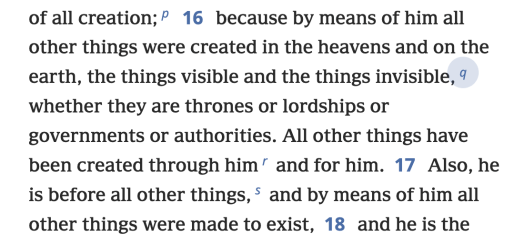
16  because by means of him all other things were created in the heavens and on the earth, the things visible and the things invisible, whether they are thrones or lordships or governments or authorities. All other things have been created through him and for him.  17  Also, he is before all other things, and by means of him all other things were made to exist,  (NWT)

Do you notice the differences between these two translations?

The Jehovah’s Witnesses’ New World Translation inserts the word “other” into the text four times despite the fact that the word “other” is nowhere in the original Greek text. So why is this word inserted four times into the text when it’s not in the original Greek text?


Click here to see a A Comprehensive List of Blog Posts Based on Bible Passage Reference


It’s obvious that the Jehovah’s Witnesses add the word “other” multiple times in order to dilute the clear meaning of the original Greek text, which is that Jesus is the creator of ALL things.

Not only do the Jehovah’s Witnesses unjustifiably add the word “other” to the text, but they do so deceptively.

It’s customary in Bible translations to put any added word in brackets if isn’t in the original Greek text. When the reader sees a word in brackets, it’s a cue that the word is not original to the text but has been added by the translators for some reason, usually for readability.

The online version of the Jehovah’s Witnesses New World Translation. Note that Colossians 1:16-17 does not have brackets around the four occurrences of the word “other” despite the fact that the word “other” appears nowhere in the original Greek text.

It is highly unusual that a translator would add a word to the translation that isn’t in the original Greek and NOT put it in brackets, especially when the addition of the word completely changes the meaning of the text. One can only conclude that the Jehovah’s Witnesses omit the brackets in order to deceive the average person, who will naturally assume that the Jehovah’s Witnesses version of the text accurately reflects what the original Greek text says.

The obvious teaching from Colossians 1:16-17 is uncomfortable to Jehovah’s Witnesses who are so committed to their doctrine that Jesus is a created being that they MUST add the word “other” in order to make the passage fit their doctrinal bias.

Now I’m certain that after I post this online, I’ll encounter many Jehovah’s Witnesses who will attempt to educate me on why it’s ok and even necessary for their translators to add the word “other” to this passage.

Their argument is that the Greek word “panta” can be translated “all other” in some contexts in order to make the reading more “smooth”.  They will undoubtedly point to Luke 13:2 as an example where “panta” is translated as “all other Galileans” instead of just “all Galileans”.

While it’s true that panta can be translated as “all other” in some contexts, it’s not true that it can be translated “all other” whenever the word occurs. The general rule is that the addition of the word “other” is acceptable if it makes the verse more readable BUT DOES NOT CHANGE THE MEANING OF THE VERSE.

The Jehovah’s Witnesses violate this rule by adding the word “other” four times to Colossians 1:16-17 because that is the only way to make those two verses align with their teaching that Jesus is a created being.

So what does any of this have to do with Isaiah 44:24, which is supposed to be the subject of this devotional blog post?

I’m glad you asked.

Let’s assume for one moment that grammatically, the Jehovah’s Witnesses addition of the word “other” four times is linguistically allowed. It’s not, since the word appears nowhere in the original Greek text, but let’s just play along for the sake of argument.

The Jehovah’s Witnesses theological position is that Jehovah created Jesus and THEN Jesus created everything else (all other things).

But Isaiah 44:24 directly refutes this position, as Jehovah says:

I am the LORD, who made all things. I alone stretched out the heavens. By myself I made the earth and everything in it.

Did you catch that?

Jehovah says that he acted ALONE and created ALL THINGS by HIMSELF. He made the earth and EVERYTHING in it.

This directly refutes the Jehovah’s Witnesses doctrinal teaching that Jesus was first created and then created all “other” things.

The Jehovah’s Witnesses teaching is therefore logically false. In order to accept their teaching, one must ignore certain scriptures altogether while directly altering other verses in an effort to bring them into alignment with their prescribed viewpoint.

Nowhere in Scripture does it say that Jesus is created and then Jesus created all “other” things. This view is communicated only in the Jehovah’s Witnesses own translation (the NWT) which conveniently changes key verses in order to force them to agree with their heretical christological view.

Colossians 1:16-17 clearly teaches that all things were created by Jesus, which means he himself cannot be created. Adding the word “other” becomes problematic for Jehovah’s Witnesses as it means they must either deny the clear teaching of Isaiah 44:24 or try to explain it using some other kind of pretzel logic.

The problem for Jehovah’s Witnesses is that they have created so many doctrinal pretzels with their edited translation that their isn’t enough theological mustard available in the world to help us choke down what they’re serving.


Did you enjoy this post? I’d love to hear your thoughts! Feel free to like, leave a comment below, and share it with your friends or on social media if you found it helpful or interesting. Your support keeps the conversation going!


Reflection

If Jesus created all “other” things, how is it possible that Jehovah alone created all things by himself?

How do you explain the fact that all major Bible translations omit the word “other” from Colossians 1:16-17 but the Jehovah’s Witnesses add the word four times?

If Jesus is indeed the creator of all things, and is indeed before all things, what does that imply about his nature?

If Jesus is a created being, as the Jehovah’s Witnesses claim, how does Jesus secure salvation for humankind? In other words, how is it possible that a being who is not eternal and who is not infinitely holy can secure forgiveness and redemption for mankind?


Photo Created with Grok

How Can Other “Christians” be Enemies?

Ezra 4

1The enemies of Judah and Benjamin heard that the exiles were rebuilding a Temple to the LORD, the God of Israel. 2So they approached Zerubbabel and the other leaders and said, “Let us build with you, for we worship your God just as you do. We have sacrificed to him ever since King Esarhaddon of Assyria brought us here.”

3But Zerubbabel, Jeshua, and the other leaders of Israel replied, “You may have no part in this work, for we have nothing in common. We alone will build the Temple for the LORD, the God of Israel, just as King Cyrus of Persia commanded us.”

4Then the local residents tried to discourage and frighten the people of Judah to keep them from their work. 5They bribed agents to work against them and to frustrate their aims. This went on during the entire reign of King Cyrus of Persia and lasted until King Darius of Persia took the throne. (Ezra 4:1-5, NLT)


The Daily DAVEotional

This passage in Ezra 4 describes an interesting scenario. Some locals who claim to worship the same God as the Israelites do come to the leaders in charge of rebuilding the temple and offer to help. Yet the first verse describes them as “enemies” of Judah and Benjamin.

What in the world is going on?

Can’t we all just get along?

For the sake of unity and harmony, shouldn’t we agree to partner with those who claim allegiance to the same God we do?

On the surface, it makes logical sense to affirm those who invoke the name of Jesus or who claim that they worship the same God we do.

The problem though is that invoking the name of Jesus or saying that we affirm the same God doesn’t mean that our beliefs are in alignment. In fact, it’s possible, even likely, that they aren’t.

In this passage, we learn that the Jewish exiles were in the process of rebuilding the Temple.

To understand what is really happening, let’s take a moment to review how the Israelites got to this particular moment in time.

The Israelites had been warned by God over and over again that disobedience to Him and continued idolatry would incur severe consequences in the form of being conquered by rival nations.

God made due on His promise as the Israelites, the Northern Kingdom, were conquered and subdued by the Assyrians in 722 B.C. Likewise, Judah, the Southern Kingdom, was conquered and exiled by the Babylonians in 586 BC.

What happened when a nation like Israel was conquered was a systematic process of acculturation. Large numbers of the conquered nations’ citizens were typically transported to the conqueror’s country, where they were dispersed and expected to assimilate into the dominant culture of the conquering nation. In this case, large numbers of Jews were transported to Assyria, where they became exiles living in a foreign land.

At the same time, citizens of the conquering nation were encouraged to relocate into the land of the conquered nation, thus bringing that culture into the new province of the conquering nation. In this scenario, Assyrian citizens were relocated to Israel, where they brought their customs and their religious beliefs.

The net result was the slow erasure of the conquered nation’s culture in favor of the conquering nation’s culture.

So when Israelite exiles were finally allowed to return to their homeland, they find it populated with Assyrians who had moved there to occupy the land. These Assyrians were not worshipers of Yahweh, at least not exclusively.

So when Ezra references, “the enemies of Judah and Benjamin”, he’s talking about these Assyrian transplants who have been living in the land but who are not native to the area, and who do not reflect Jewish culture.

But don’t these Assyrians worship Yahweh now? After all, don’t they “worship your God just as you do”?

This is the claim, right? They claim that they worship Yahweh and that they also sacrifice to Him. Doesn’t that make them fellow God-fearers? What would be the harm then in partnering with them to rebuild the temple? Shouldn’t we work with those who share our interests?

Notice that in the first verse, these Assyrians are described as “enemies of Judah and Benjamin”.

Here’s the important point: just because someone says they worship the same God as you doesn’t mean that their views are in alignment with yours. Additionally, it doesn’t mean that their intentions and their ultimate allegiance is the same as yours.

This is extremely relevant in our own culture, where the label “Christian” gets thrown around so much that it’s almost cliche.

Just because someone says they are a Christian doesn’t mean that their understanding of what it means to be a Christian is biblical. Furthermore, just because a person says they believe, or “respect” Jesus, doesn’t mean that their view of Jesus is biblical and in alignment with what the Christian church has traditionally believed and taught.

We are seeing this play out first hand in Texas, where a young congressman, James Talarico, is running for U.S. Senate. Talarico claims to be a Christian but when you evaluate his theological positions, it’s clear that his version of Christianity is progressive, not orthodox.

What that means is that even though he identifies as Christian, and he says that he follows the teachings of Jesus, it’s clear that his understanding of Christianity and Jesus is not in alignment with traditional, biblical teachings.

Talarico has made a number of statements that demonstrate that his version of Christianity is actually not Christian at all. Foremost is his belief that Jesus is not the only way to salvation and that other religions are equally valid representations of God.

I don’t mean to pick on Talarico. He is just a prominent example of a growing strain of Christianity that is not actually Christian. This ideology has hijacked the name and terms of Christianity to promote its own evil, anti-biblical views in an effort to mainstream them within the culture.

Progressive Christianity is just one example of an ideology that uses the names and terms of Christianity in ways that aren’t actually Christian.

So when someone says they are a Christian, or they say that they like Jesus or even that they follow Jesus, that doesn’t automatically mean they believe what the Bible teaches on these matters. It could simply mean that they have adopted the culture’s views of Jesus and Christianity.

We would be wise to explore their views further before aligning ourselves with those who are actually opposed to the work of God. We might find, just as Ezra did, that when it comes to the work of God, “we have nothing in common.”


Did you enjoy this post? I’d love to hear your thoughts! Feel free to like, leave a comment below, and share it with your friends or on social media if you found it helpful or interesting. Your support keeps the conversation going!


Reflection

What clues from this passage affirm the fact that these Assyrians truly were “enemies of Judah and Benjamin”?

If these Assyrians living in Jerusalem truly did worship and sacrifice to Yahweh, why do you think they would try to frustrate the building of the Temple?

What are some examples in your own experience where someone claims to have the same views and values as you regarding Jesus, the Bible and Christianity, but it becomes clear from their actions that they are actually “enemies of God.”

Are there any circumstances where we as Christians might align ourselves and partner with those who are not Christians? What guidelines or principles might help you determine when and when not to partner with those who don’t share your faith?


“Image by Grok / xAI”

Why Do Jews Reject Jesus as Their Messiah?

Isaiah 53

1Who has believed our message and to whom has the arm of the LORD been revealed?

2He grew up before him like a tender shoot, and like a root out of dry ground. He had no beauty or majesty to attract us to him, nothing in his appearance that we should desire him.

3He was despised and rejected by men, a man of sorrows, and familiar with suffering. Like one from whom men hide their faces he was despised, and we esteemed him not.

4Surely he took up our infirmities and carried our sorrows, yet we considered him stricken by God, smitten by him, and afflicted.

5But he was pierced for our transgressions, he was crushed for our iniquities; the punishment that brought us peace was upon him, and by his wounds we are healed.

6We all, like sheep, have gone astray, each of us has turned to his own way; and the LORD has laid on him the iniquity of us all.

7He was oppressed and afflicted, yet he did not open his mouth; he was led like a lamb to the slaughter, and as a sheep before her shearers is silent, so he did not open his mouth.

8By oppression and judgment he was taken away. And who can speak of his descendants? For he was cut off from the land of the living; for the transgression of my people he was stricken.

9He was assigned a grave with the wicked, and with the rich in his death, though he had done no violence, nor was any deceit in his mouth.

10Yet it was the LORD’s will to crush him and cause him to suffer, and though the LORD makes his life a guilt offering, he will see his offspring and prolong his days, and the will of the LORD will prosper in his hand.

11After the suffering of his soul, he will see the light and be satisfied; by his knowledge my righteous servant will justify many, and he will bear their iniquities.

12Therefore I will give him a portion among the great, and he will divide the spoils with the strong, because he poured out his life unto death, and was numbered with the transgressors. For he bore the sin of many, and made intercession for the transgressors. (Isaiah 53:1-12, NIV)


The Daily DAVEotional

I saw a post on X.com recently where an influential user listed what he considered the most significant in human history.

Who would you put at the top of that list?

Regardless of your religious views, I think it’s hard to argue against Jesus being the most important figure in all of human history. Incidentally, this user listed Genghis Khan first. Jesus was second on his list.

Jesus and his teachings have literally changed the world. And yet, the Jewish people, his own people, largely reject him. Why is that?

If you happened to be an Israelite living in first century Palestine, you eagerly expected and longed for the Messiah.

The nation of Israel was hundreds of years past its glory days, when it was an independent and respected nation. Now, it was merely one of the many provinces that were subject to Roman rule.

The prophets had foretold of a Messiah, who would one day come and deliver his people and restore the nation to its former glory. At least that was the hope.

Unfortunately, the biblical version of the Messiah did not match the expectations of most Jewish people, who were hoping for a political and military leader who would drive out the Romans, just as the many judges had driven out their oppressors in the early years of their nation’s formation.

This passage in Isaiah 53 gives a much different picture and description of the Messiah compared to the peoples’ expectations.

According to Isaiah, the coming Messiah would not be a person who would stand out. There was nothing physical about the Messiah that would draw people to him. He would be decidedly “normal”.

While the people were expecting a William Wallace type military hero to rally the troops and drive out their Gentile occupiers, this passage shows that the Messiah’s mission would be much different.

Yes, the Messiah would deliver his people; he just wouldn’t deliver them from the enemy they were thinking he would.

Verse 6 lays out the issue – we ALL have gone astray. As a result, the purpose of the Messiah would be to take the iniquity of people upon Himself.

Verse 10 is key because it explicitly states that the Messiah would be a guilt offering. Every Israelite knew that they had to make regular offerings at the temple in order to make atonement for sin. This verse indicates that it’s the Messiah himself whose life would be a guilt offering for the people.

There are a number of verses in this passage that explicitly point to Jesus.

Verse 5 provides one of the clearest references to Jesus’ brutal execution when it says that he was “pierced” for our transgressions. In John’s description of Jesus’ death, we learn that the Roman soldiers were eager to hasten the death of their victims because of the impending Sabbath (see John 19:31-34). It was common to break the legs of those being crucified, rendering it impossible for them to push themselves up to expand their lungs and breathe. Hence, the breaking of the legs brought a swift end to the slow tortures of crucifixion as the victim would immediately die of asphyxiation.

In the case of Jesus. the centurion realized that Jesus was already dead so there was no need to break his legs. Instead, he decided to take his spear and pierce Jesus’ side.

Verse 9 indicates that the Messiah would be assigned a grave for the wicked and the rich. In Jesus’ case, his body was set to be dumped in a pit with other common criminals. But instead, a rich person, Joseph of Arimathea, petitioned Pilate for the body of Jesus, whom he buried in a tomb that he had recently purchased.

Other prophecies in this passage are also fulfilled by Jesus. Verse 7 indicates that the Messiah would be silent when confronted by his accusers. All of the gospel accounts indicate that Jesus, when pressed by Pilate and the authorities, did not defend himself, but chose to willingly give himself up in order to go to the cross to be crucified.

To this day, the Jewish people largely reject Jesus as their Messiah, despite the fact that he fulfills all of the prophecies about the coming Messiah. In fact, there are a number of prophecies concerning the Messiah that only Jesus could have fulfilled.

If you don’t understand the mission of the Messiah, you will reject him.

The Jewish people reject Jesus as their Messiah because he doesn’t fit their hope and expectation of what the Messiah’s purpose would be. Instead of delivering his people from their political oppressors and restoring the glory of their nation, the Messiah’s purpose was first and foremost, to deliver people from the penalty of sin.

Non-Jews reject Jesus simply because they fail to see their need for a Savior. In this case, you may see Jesus as a significant figure in human history, but not as significant as someone like Genghis Khan who wielded tremendous political and military power to conquer the entire known world.

We would all do well to heed the words of Isaiah 53:6:

6We all, like sheep, have gone astray, each of us has turned to his own way; and the LORD has laid on him the iniquity of us all.


Did you enjoy this post? I’d love to hear your thoughts! Feel free to like, leave a comment below, and share it with your friends or on social media if you found it helpful or interesting. Your support keeps the conversation going!


Reflection

What is your understanding of the purpose of the Messiah?

In what ways do you see Jesus matching the description that prophets like Isaiah gave of the coming Messiah?

Who do you know that rejects Jesus as their Messiah and Savior? What are their reasons for rejecting Jesus ?

Why do you think Jewish people, by and large, still reject Jesus, despite clear passages like Isaiah 53 that show Jesus to be a “Suffering Servant” instead of a military conqueror?


Photo by MBVisign: https://www.pexels.com/photo/genghis-khan-statue-in-close-up-photography-6466768/

Fact-Checking and Misinformation in the New Testament

Acts 17

10That very night the believers sent Paul and Silas to Berea. When they arrived there, they went to the synagogue. 11And the people of Berea were more open-minded than those in Thessalonica, and they listened eagerly to Paul’s message. They searched the Scriptures day after day to check up on Paul and Silas, to see if they were really teaching the truth. 12As a result, many Jews believed, as did some of the prominent Greek women and many men. (Acts 17:10-12, NLT)


The Daily DAVEotional

The advent of social media has completely changed the landscape of how information is disseminated to the masses. Prior to social media, people relied primarily on what is now known as “legacy media” – national broadcast news networks and major metropolitan newspapers.

But now with social media, anyone and everyone can be a journalist, investigative reporter, podcaster or blogger. Competing ideas and opinions abound, making it increasingly more difficult to separate fact from fiction.

With such an affluence of free-flowing information, two terms have been introduced into the mainstream cultural vernacular in recent years – misinformation and disinformation. These terms have primarily been used by politicians and pundits on both sides of the aisle to label the speech and narratives of their opponents as false. Alarmingly, our own government has cited “misinformation” as a basis for seeking to censor the speech and thus limit the reach of those whose ideas and beliefs are not aligned with the official position of the party in power.

This effort to limit speech has been evident in the last few political cycles through an increased effort to put pressure on social media platforms to limit and even censor speech that is deemed as “misinformation”.

But who exactly determines what is misinformation?

Social media outlets have employed “fact-checkers” to determine what information is accurate and what should be labeled as “misinformation”.

A fact-checker is someone who evaluates the truthfulness of a statement and then renders a judgment. These fact-checkers are expected to be neutral but the problem, as we’ve seen, is that they’re rarely unbiased. Who then fact-checks the fact-checkers?

In this segment of Acts 17, the Bereans are commended for their ability to fact-check the information that was being promoted.

Paul was a missionary who traveled throughout Asia Minor proclaiming the message of Christ and planting churches among those who believed his message.

But just like today, there was no shortage of ideological grifters and religious charlatans traveling from village to village looking for a market to sell their ideological snake oil.

With so many traveling religious preachers, how does one determine who, if anyone, is telling the truth?

The Bereans were commended because they “fact-checked” Paul’s message by “searching the Scriptures” to determine it’s veracity.

“The Scriptures” in this case refers to the Old Testament. The Bereans listened intently at Paul’s message and “day after day” they checked the message and compared it to what they already knew was true – the Old Testament Scriptures.

Fact-checking is a good thing, as long as the facts are being checked honestly against an objective, truthful standard. As we’ve seen recently, people are often biased, meaning they are rarely objective and often will stretch the truth, or in some cases, even deny the truth in order to fit their own biases.

But God’s word is both objective and true because it is the very word of God, who is by definition, truth.

So if you really want to check your facts, be sure they are not misaligned with what the Scriptures say. If they are, you can be certain that your facts are indeed “misinformation”.


Did you enjoy this post? I’d love to hear your thoughts! Feel free to like, leave a comment below, and share it with your friends or on social media if you found it helpful or interesting. Your support keeps the conversation going!


Reflection

What are some beliefs and ideas that you may tend to hold more because of your own personal  bias than the fact that it is true?

What is the standard that you use to determine if a religious statement is true or not?

What examples have you seen in your own experience of fact-checkers who were too biased to be trusted?

How do you think it’s possible that two different people can evaluate the same “facts” and arrive at completely different conclusions?

How can you ensure that you are not being misled and falling for misinformation when it comes to some of the ideological narratives that are being promoted in our culture?


Photo by Samuel Regan-Asante on Unsplash

Whatever Became of Sin?

Isaiah 6

1In the year King Uzziah died, I saw the Lord. He was sitting on a lofty throne, and the train of his robe filled the Temple. 2Hovering around him were mighty seraphim, each with six wings. With two wings they covered their faces, with two they covered their feet, and with the remaining two they flew. 3In a great chorus they sang, “Holy, holy, holy is the LORD Almighty! The whole earth is filled with his glory!” 4The glorious singing shook the Temple to its foundations, and the entire sanctuary was filled with smoke.

5Then I said, “My destruction is sealed, for I am a sinful man and a member of a sinful race. Yet I have seen the King, the LORD Almighty!”

6Then one of the seraphim flew over to the altar, and he picked up a burning coal with a pair of tongs. 7He touched my lips with it and said, “See, this coal has touched your lips. Now your guilt is removed, and your sins are forgiven.”

8Then I heard the Lord asking, “Whom should I send as a messenger to my people? Who will go for us?”

And I said, “Lord, I’ll go! Send me.”

(Isaiah 6:1-8, NLT)


The Daily DAVEotional

Have you noticed that sin is not talked about that much anymore? It’s almost like it’s a dirty word – too offensive to mention to those outside of a church setting.

In 1973, Psychologist Karl Menninger published an important work, “Whatever Became of Sin?” in which he reflected on the diminishing concept of sin in our modern culture. His thesis was that the concept of sin as immoral behavior was being replaced by medical and psychological labels that reduced moral responsibility.

Though Menninger draws upon Christian as well as other religious traditions to support his thesis, his book is not a biblical exposition on the subject. Still, his thoughts on this issue, which were printed over 50 years ago, now seem prophetic in nature.

So whatever became of sin? Why has the concept diminished in our culture and what are the reasons for its demise?

The 6th chapter of Isaiah provides an answer for us. This chapter marks a pivotal moment in the life and calling of the prophet. In this chapter, Isaiah has a vision of the Lord in all of His splendor and glory.

The opening verse gives us a time stamp to date the events that follow. Uzziah had been the king of Israel for 52 years, a full life-time for many of his subjects. While Uzziah was one of the better kings of Judah early on, things did not end well for him. Toward the end of his reign, he stubbornly tried to enter the temple and perform rites that were reserved only for the priests, and as a result, he contracted leprosy and was forced to finish out his days in exile.

At Uzziah’s death, with no king to rule, Isaiah goes to the temple and experiences a vision of the true king, the Lord God Himself. Isaiah catches a rare glimpse of God as He really is, a picture of His absolute holiness.

What’s interesting about this encounter is the text says that when Isaiah sees the Lord in His holiness, he cries out, “my destruction is sealed, for I am a sinful man and a member of a sinful race.”

Some translations use the word “ruined” or “undone” to describe Isaiah’s emotional response.

Isaiah, when confronted with the perfect righteousness of God almighty, is brought to his knees as he recognizes his own sinfulness in light of holy God.

One of the reasons sin is not talked about much these days is because we don’t talk about God’s holiness so much these days. These two concepts are intertwined and interdependent – we don’t see sin so much if we don’t see God as holy and righteous.

Over the last 50 years or more, our culture has done all that it can to soften God’s divine attributes to make Him more palatable to our own personal preferences. In short, we’ve made God less like God and more like us.

For the atheist, dismissing God altogether means that there is no objective anchor or standard by which actions can be judged or labeled as “sin”.

“Who are you to tell me that my behaviors are wrong?” is a common refrain.

In many Christian circles, especially among progressives, God is not so much eliminated as much as He’s recreated or reimagined in a way that better fits the person’s lifestyle choices and behaviors.

One of the ways we often see this is in the elevation of the kind-hearted, compassionate New Testament version of God that we see in Jesus while dismissing or diminishing the “judgmental, ego-maniacal” Old Testament picture of God that seems too harsh and exacting. Some may go so far as to claim that the Bible describes two completely different Gods. I wrote recently about this in my blog post, “Is the Old Testament God a Bloodthirsty, Genocidal Psychopath?”

In light of the stark differences between the Old Testament perception of God and the New Testament portrayal of God in the person of Jesus, one inevitably chooses the deity that is more preferable and less restrictive to their own life choices.

The problem with this approach, as I outlined in my blog post, “Can You Make the Bible an Idol?”  is it essentially results in a form of idol worship, where my image of God is created according to my personal choices and inclincations instead of forming a picture of God that represents the fullness of how He has been revealed to us through His holy word.

If we want to talk about sin and the need for a savior, we must highlight God’s absolute holiness and righteousness. If a person doesn’t see God as infinitely holy, they’re more likely to overlook or dismiss their sinfulness as mere character flaws or innocent mistakes. If sin is not seen as an egregious offense against God’s very nature, there is less likelihood of coming to the realization that we are utterly lost and in need of a divine savior.

So whatever became of sin? It fell out of favor, just as God’s holiness has.


Did you enjoy this post? I’d love to hear your thoughts! Feel free to like, leave a comment below, and share it with your friends or on social media if you found it helpful or interesting. Your support keeps the conversation going!


Reflection

Describe  a time when you encountered the power and presence of God in your life as Isaiah did. In other words, when have you had an “Isaiah” moment with God? What was that like emotionally? 

What is your concept of sin? How would you define it? In what ways have you seen our culture minimize sin and personal responsibility?

In what ways have you created an image of God that is not fully reflective of how God has revealed Himself in both the Old and New Testaments?

How can. you ensure that your view of God is not just a personal image that you created to suit your own preferences?


Photo by Dave Lowe


Was it Genocide or Punishment?

Deuteronomy 18

9“When you arrive in the land the LORD your God is giving you, be very careful not to imitate the detestable customs of the nations living there. 10For example, never sacrifice your son or daughter as a burnt offering. And do not let your people practice fortune-telling or sorcery, or allow them to interpret omens, or engage in witchcraft, 11or cast spells, or function as mediums or psychics, or call forth the spirits of the dead. 12Anyone who does these things is an object of horror and disgust to the LORD. It is because the other nations have done these things that the LORD your God will drive them out ahead of you. 13You must be blameless before the LORD your God. 14The people you are about to displace consult with sorcerers and fortune-tellers, but the LORD your God forbids you to do such things. (Deuteronomy 18:9-14, NLT)


The Daily DAVEotional

I heard a speaker once ask the question, “if you were put on trial for being a Christian, would there be enough evidence to convict you?”

The idea behind the question is that a lot of people who claim to be Christians don’t live like it.

I think there’s a similar question being asked within our culture about the God of the Old Testament. Is there enough evidence to prove He is God? I think the real question people are asking is, “does the God of the Old Testament measure up to my idea of God?”

For many, the answer is no, mostly because people cannot reconcile their view that God is all-loving with the commands in the Old Testament for the Israelites to wipe out the people dwelling in the land of Canaan.

I wrote about this topic recently in my post “Is the Old Testament God a Bloodthirsty, Genocidal Psychopath?” in which I argue that one of the main reasons people have difficulty with the God of the Old Testament is that they have a faulty or incomplete view of His nature. Sure God is loving. But that is not His only attribute. He’s also holy and righteous and just and infinitely good (to name just a few).

As a result, His command for the Israelites to expel the Canaanites from the land was not genocide, but divine punishment.

This passage in Deuteronomy is one of many that gives just a glimpse into the reprehensible atrocities and “detestable customs” of the Canaanites.

To say the Canaanites were wicked would be an understatement. But of course, that also depends on your definition and understanding of what is “wicked”. And that is part of the problem. Wickedness in our culture is so pervasive that we have a hard time indicting the Canaanites without indicting ourselves too.

The Canaanites not only practiced human sacrifice, with children no less, but they also engaged in sorcery, witchcraft and fortune-telling. Many of these practices have been so mainstreamed within our culture that we look at Canaanite culture as normal and innocent. Hence, we see God as the bad guy.

Sexually, the Canaanites practiced every sort of perversion you can imagine, including incest, bestiality, rape, and of course, homosexuality. But again, in a culture where anything goes sexually, our response is “what’s the big deal?”

This is the point Clay Jones makes in his well-researched article, “We Don’t Hate Sin So We Don’t Understand What Happened to the Canaanites” which can be found at his website: ClayJones.net. Jones utilizes extra-biblical texts from the ancient world to dive deeper into the Canaanites’ pagan practices. What he finds is much more disturbing than even the biblical texts portray.

Scripture is clear. God’s command to the Israelites to drive out the Canaanites from the land was not a whimsical command given to appease some genocidal proclivities. The Canaanites were wicked and their customs so depraved that justice was required. The Israelites were simply God’s tool for meting out that justice.

But make no mistake, God warned the Israelites that they too would be subject to the same just punishment as the Canaanites if they followed their customs.

This passage thus served not as a justification for God’s impending justice but a prophetic warning.

Reflection

What is. your view of God? How would you describe God’s character?

How would you define wickedness? 

In what ways do you see our current culture mirroring or following some of the ancient Canaanite practices which God says were detestable?

How do you explain God’s command for the Israelites to expel the Canaanites to those who question His character? 


Photo by KATRIN BOLOVTSOVA: https://www.pexels.com/photo/brown-wooden-gavel-on-brown-wooden-table-6077326/

Biblical Warning: Round 2

Hebrews 3

1And so, dear brothers and sisters who belong to God and are bound for heaven, think about this Jesus whom we declare to be God’s Messenger and High Priest. 2For he was faithful to God, who appointed him, just as Moses served faithfully and was entrusted with God’s entire house. 3But Jesus deserves far more glory than Moses, just as a person who builds a fine house deserves more praise than the house itself. 4For every house has a builder, but God is the one who made everything.

5Moses was certainly faithful in God’s house, but only as a servant. His work was an illustration of the truths God would reveal later. 6But Christ, the faithful Son, was in charge of the entire household. And we are God’s household, if we keep up our courage and remain confident in our hope in Christ. 7That is why the Holy Spirit says,

“Today you must listen to his voice.

8Don’t harden your hearts against him as Israel did when they rebelled, when they tested God’s patience in the wilderness.

9There your ancestors tried my patience, even though they saw my miracles for forty years.

10So I was angry with them, and I said, ‘Their hearts always turn away from me. They refuse to do what I tell them.’

11So in my anger I made a vow: ‘They will never enter my place of rest.’”

12Be careful then, dear brothers and sisters. Make sure that your own hearts are not evil and unbelieving, turning you away from the living God. 13You must warn each other every day, as long as it is called “today,” so that none of you will be deceived by sin and hardened against God. 14For if we are faithful to the end, trusting God just as firmly as when we first believed, we will share in all that belongs to Christ. 15But never forget the warning:

“Today you must listen to his voice. Don’t harden your hearts against him as Israel did when they rebelled.”

16And who were those people who rebelled against God, even though they heard his voice? Weren’t they the ones Moses led out of Egypt? 17And who made God angry for forty years? Wasn’t it the people who sinned, whose bodies fell in the wilderness? 18And to whom was God speaking when he vowed that they would never enter his place of rest? He was speaking to those who disobeyed him. 19So we see that they were not allowed to enter his rest because of their unbelief. (Hebrews 3:1-19, NLT)


The Daily DAVEotional

A few days ago, I wrote my thoughts about a warning that was included in Psalm 95. You can read my thoughts here.

Just two days later, I came to this passage in Hebrews 3, in which the author quotes the very text I had read from Psalm 95 and highlights the same warning that I mentioned a few days ago.

Coincidence?

Actually, these kinds of random biblical cross-references happen more often than you might think when you’re following the Grant Horner Bible reading plan.

So what is happening in this passage and why is the author referencing Psalm 95 to issue this warning?

The theme of the letter to the Hebrews could be labeled as “Jesus is Better than…”

The audience, as the name of the letter implies, is Hebrew Christians. These believers were in danger of reverting back to their Jewish rituals and customs as a means of appeasing God and gaining His favor.

So the author erects an outline, detailing in point by point fashion that Jesus is better than everything associated with the Old Testament religious system.

In chapter 1, the author demonstrates that Jesus is better than the angels, and now in this chapter, the author takes on the greatest icon within the Jewish religious system, Moses himself.

The author states that Jesus is better than Moses in the same way a builder of a house is better than the house.

The author then develops their argument by stating that Moses was faithful in God’s house but only as a servant. Jesus, on the other hand, is in charge of the household because he is a son, not a servant. I wrote about the implications of slaves/servants as opposed to sons here, in a blog post which referenced a passage from Galatians.

The point is that in the household of God, Moses was a servant. Yes, he was important and he played a key role and he was faithful in his duties. But Jesus is a SON in the household and therefore deserves more glory because as a son, He is the heir to the household. He is the owner!

The author then says that we (people) ARE God’s household. Our choice is that we can follow Moses who is a servant in God’s household, or we can follow Jesus, who is a son in God’s household. Which person makes more sense to follow?

It’s at this point that the author references the warnings from Psalm 95.

The warning can be paraphrased as follows:

    • We must listen to God’s voice today
    • Don’t harden your hearts as the Israelites did when they rebelled (see the Psalm 95 blog post here to read about the incident in which the Israelites rebelled against God)
    • The consequence for their rebellion was that they were not allowed to enter into God’s rest – they were not allowed to enter the promised land.

Starting in verse 12, the author of Hebrews begins to unpack the warning of Psalm 95 a bit more, demonstrating the implications of how the warning applies to his readers.

Remember, the recipients of this letter were being tempted to forsake Jesus as the object of their faith and trust for salvation and revert back to the Old Testament legal system, with its many rules and regulations as a means of achieving a righteous standing before God.

The author then elaborates on the warning, saying:

    • Make sure your hearts are not evil and unbelieving
    • This results in turning away from God
    • You must warn each other so that you won’t be deceived by sin and hardened against God
    • This hardening results in a lack of trust in God (unbelief)
    • Unbelief is characterized by disobedience

So the pattern is as follows: sin, hardening (lack of openness to God), distrust, disobedience.

When this pattern fully develops into disobedience, we will no longer experience the benefits of God’s rest. All of the benefits Jesus wants us to experience now as His beloved children and followers will fail to materialize.

How do we avoid the hardening, distrust, disobedience cycle?

It starts with listening to His voice, a command the author reiterates again in verse 15.  When we listen to His voice, we learn who He is and we learn to trust Him. We also learn what He wants from us and we learn how to follow Him.

When we don’t listen to His voice, it means that we’re listening to another voice, whether it’s our own or that of the culture or someone else. At that point, we’re no longer following God but we’re following ourselves.

How then do we listen to God’s voice?

It’s possible God may audibly speak to you but I would say that is not typical. The primary way in which God speaks to us today is through His word, the Scriptures. If you want to listen to God’s voice, to know Him and understand what He expects, then read the Scriptures. It’s through God’s word that we understand what is sin and what isn’t. It’s through His word that we understand who He is and who He isn’t.

If we fail to appeal to God’s word as our means of listening to His voice, it is quite likely we will be deceived by sin. We will begin to follow our own ideas about what we think is right and wrong. We may even attribute our new moral values to God Himself. Indeed, it’s quite common today for people to reject certain moral standards from the bible and replace them with more updated, contemporary values that speak to today’s cultural norms.

It is also common for these same people to claim to be God worshipers and Christ-followers. But if they are creating their own morality while rejecting what God explicitly says, they are in effect, creating their own version of God. This is the modern day equivalent of idol worship. I wrote about this in a previous post here.

This is deception, which leads to a hardening of the heart, which is characterized by not listening to God. This results in unbelief which is characterized by disobedience.

This cycle is alluring and it’s easy to fall into, which is why the author exhorts the audience to “warn each other every day”.

We are ALL susceptible to deceiving ourselves and falling into this religious trap.

Hence, the author says again in verse 15, “Never forget the warning”!

Reflection

In what ways are you tempted to harden your heart towards God?

What are some examples in today’s culture where you see people forsaking biblical moral values and substituting them for something that seems to fit our current culture better?

The author says that those who reject God because of their unbelief will not enter God’s rest? What do you think that means? What would it look like to not enter God’s rest?

What are some ways you could heed the author’s warning and ensure that you are listening to His voice today?

What can you do to ensure that you don’t harden your heart towards God?


Photo by Matthew T Rader on Unsplash