Colossians 1
15He is the image of the invisible God, the firstborn over all creation. 16For by him all things were created: things in heaven and on earth, visible and invisible, whether thrones or powers or rulers or authorities; all things were created by him and for him. 17He is before all things, and in him all things hold together. 18And he is the head of the body, the church; he is the beginning and the firstborn from among the dead, so that in everything he might have the supremacy. 19For God was pleased to have all his fullness dwell in him, 20and through him to reconcile to himself all things, whether things on earth or things in heaven, by making peace through his blood, shed on the cross. (Colossians 1:15-20, NIV)
The Daily DAVEotional
About a year ago, I posted my thoughts on this very passage, explaining the meaning of the term “firstborn” and why it doesn’t teach that Jesus is a created being, as the Jehovah’s Witnesses argue.
I don’t want to rehash all of my points from that post so if you haven’t read it, I encourage you to read the original post, “What Does it Mean that Jesus is the Firstborn?” to get up to speed on the debate between the traditional Christian understanding of Jesus and the Arian view that Jehovah’s Witnesses hold.
My purpose in this post is to provide a response to some of the arguments levied by Jehovah’s Witnesses who argue against my interpretation of this passage.
In my initial post, I made the claim that the primary meaning of “firstborn” in Colossians 1:15 and 18 is “preeminence”. I reasoned that this makes the most sense since Paul uses “firstborn” in conjunction with two different terms, “creation” and “death”, neither of which have anything to do with a parent. Therefore, it seems most natural that Paul is using the term to demonstrate Jesus’ supremacy (pre-eminence) over creation and death.
In recent weeks, I’ve encountered a number of committed Jehovah’s Witnesses online who disagree with my interpretation and have offered up their own explanations for this passage.
The standard Jehovah’s Witness talking point as it relates to the meaning of “firstborn” in Colossians 1 is that the term means something like “first in line.”
The argument is that the term “firstborn” most often refers to the first offspring of a particular person. Therefore, the word should be interpreted in a similar manner when it’s used in a verse that is not referencing offspring.
If you agree with the Jehovah’s Witness logic, then the interpretation of Colossians 1 yields the following:
Jesus is the firstborn of creation, which means that he was the first one to be created by Jehovah.
Jesus is the firstborn from among the dead, which means he’s the first one to overcome death.
To some, particularly Jehovah’s Witnesses and others who hold to an Arian view of Christ, the debate is over. In their mind, the logic is irrefutable.
But is it?
Sound Bible study methods dictate that we investigate their claims. Is their understanding of the word the standard interpretation?
Let’s see.
Click here to see a A Comprehensive List of Blog Posts Based on Bible Passage Reference
I did a Bible search and found that the word “firstborn” shows up in 111 Bible verses, all but 9 of which are found in the Old Testament. In some verses, the word “firstborn” appears multiple times. Hence, the term is used more than 120 times throughout the Bible.
I’ve catalogued every verse where the term shows up, so you can see for yourself. You can access this list of verses in my blog post “Bible References to the Term “Firstborn”“.
The Jehovah’s Witnesses are right in this respect – a majority of the references to the term “firstborn” do actually refer to the first one born to a particular person. However, it is rather obvious from the context of all of those passages that this is the meaning.
Take Genesis 10:15 for example, which is the very first occurrence of the term. The verse says,
Canaan became the father of Sidon, his firstborn.
In a majority of the occurrences of the term “firstborn”, it’s used in this same manner where the term is by itself, but referencing a parent. Occasionally, the term is referenced to another living creature as in Exodus 11:5 which states that God was going to kill the firstborn of Pharaoh as well as the firstborn of all cattle.
It’s clear in these situations that the term does mean “first offspring” primarily because the verse gives the name of the parent and the son or daughter.
But how is the word understood when it is not used in conjunction with a living being (man or animal)? Is it understood in the same way?
Typically not.
One of the first occurrences where firstborn is used in a non-traditional way is Exodus 4:22, which says,
“Then you shall say to Pharaoh, ‘Thus says the LORD, “Israel is My son, My firstborn. 23“So I said to you, ‘Let My son go that he may serve Me’; but you have refused to let him go. Behold, I will kill your son, your firstborn.”’”
Notice that the term shows up twice. In the second instance it’s used in the same way we typically see the word being used, in reference to the first offspring of a person. In this case, it’s referring to the first offspring of Pharaoh.
But in the first instance of the term “firstborn”, it is not used in the typical fashion.
According to Jehovah’s Witness’ argumentation, the word should have the same meaning even when it’s used in a non-traditional way.
It turns out that the first instance of “firstborn” in this passage CANNOT mean what the Jehovah’s Witnesses attribute to the term. God specifically states that Israel, the nation, is his firstborn. If we understand “firstborn” to be “first in line”, in what sense is Israel the “first in line”?
Israel was not the first nation to be created. And God doesn’t “birth” nations anyway, so the word cannot mean “first offspring”.
It’s clear by the context that the first occurrence of “firstborn” in this verse is to be understood as Israel having a favored status. God selected Israel for a distinct and unique purpose – to be a nation through which all the other nations would be blessed and come to know the one true God.
In this case, the meaning of “preeminent” is clearly the correct understanding.
Genesis 48 provides an insightful story that helps us understand the significance of the firstborn.
In this passage, Joseph brings his sons Manasseh and Ephraim to Jacob in order to receive a blessing before Jacob passes.
Jacob is old and his vision is failing. As he reaches out to bless Joseph’s sons, he crosses his arms so that his right hand is on Ephraim instead of Manasseh who is the first offspring of Joseph and therefore the firstborn.
Genesis 48:14 says,
But Israel stretched out his right hand and laid it on the head of Ephraim, who was the younger, and his left hand on Manasseh’s head, crossing his hands, although Manasseh was the firstborn.
In Genesis 48:18, Joseph tries to correct his father, saying,
“Not so, my father, for this one is the firstborn. Place your right hand on his head.”
Jacob tells Joseph that he is aware of the situation and he knows what he is doing. He tells Joseph that Ephraim, though he is the younger, will have a higher position over his brother. He will be the firstborn, the favored son.
Just a few verses later, in the next chapter, Jacob is giving his final words to each of his sons. Here is what he says to Reuben, his first son, in Genesis 49:3-4,
“Reuben, you are my firstborn; My might and the beginning of my strength, Preeminent in dignity and preeminent in power. 4“Uncontrolled as water, you shall not have preeminence, Because you went up to your father’s bed; Then you defiled it —he went up to my couch.
Jacob not only defines the term “firstborn” for us but expounds on its significance. The firstborn IS the might of the father AND the beginning of the father’s strength. The firstborn is PREEMINENT.
Jacob tells Reuben that he is the firstborn in terms of offspring. But he would NOT be firstborn in terms of preeminence.
These passages, which show up early in the biblical narrative, demonstrate clearly that the idea of “preeminence” was nearly synonymous with the term “firstborn”.
Though Manasseh was Joseph’s first offspring, it turns out that he was not considered the “firstborn” in terms of stature and rank. In Jeremiah 31:9, God confirms that “Ephraim is my firstborn.”
In 1 Chronicles 2:13, we read that,
Jesse became the father of Eliab his firstborn, then Abinadab the second, Shimea the third,
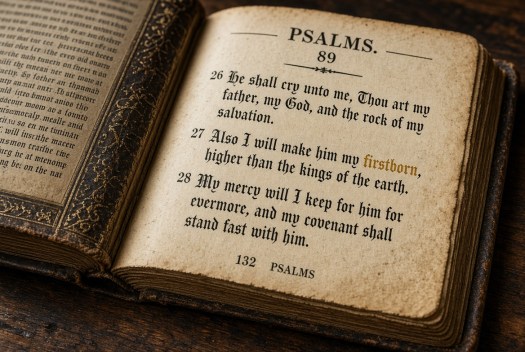
In verse 14, we learn that David was the eighth and last son born to Jesse. Yet, in Psalm 89:27, God says about David,
“I also shall make him My firstborn,
The highest of the kings of the earth.
David was not the first offspring of Jesse, but God made David His firstborn.
What does that mean?
It cannot mean that David was “first in line” because David was neither the first offspring of Jesse nor was he the first king of Israel.
What it means is that David was made by God to assume the highest rank among rulers. David was made firstborn – he was made to be preeminent.
The context dictates the meaning and sense of the word and so far, when the word is used in a way that doesn’t mean “first offspring”, it carries the meaning of “preeminence.”
There’s an interesting passage in Job that uses the term firstborn. It’s found in Job 18:13, which says:
“His skin is devoured by disease,
The firstborn of death devours his limbs.
This occurrence is informative because it uses the term “firstborn” with the prepositional phrase “of….” that doesn’t have a person or animal following. Whenever we see a person or animal (cattle, herd) follow, as in “firstborn of Jacob” or “firstborn of cattle”, the term always refers to the first offspring.
But in this case, the “firstborn of” phrase is not followed by a person or animal.
Does the standard Jehovah’s Witness meaning of “first in line” follow?
Not really.
Death is inanimate. It’s not a living organism that gives birth as humans and mammals do.
So what is this verse saying?
This verse is part of a larger discourse by Bildad in which he’s communicating his ideology that the wicked eventually get the punishment they deserve. He’s using this argumentation to try to prove that the reason Job has experienced so much trauma and suffering is because Job’s sin has finally caught up to him.
In describing the punishment the wicked will endure, Bildad claims that the skin of the wicked gets devoured by disease AND the “firstborn of death” devours his limbs. It’s obvious that Bildad is making reference to Job’s physical ailments as a proof of Job’s supposed secret sin.
But what is meant by “firstborn of death”?
Note that this term is very similar to how Paul uses “firstborn” in Colossians 1:18.
If “firstborn” means “first in line” in these kinds of cases, what exactly does that mean?
The context will not allow that interpretation because if you assume that meaning, you end up with a garbled mess of a sentence that is completely incoherent.
It’s clear in this context that death is afflicting its victim. There is no sense in which the term “firstborn of death” includes the meaning “first in line”. Death does not birth anything and does not produce a literal offspring.
But death CAN rule. Death CAN overwhelm. That is the sense that is being conveyed here. There is no meaningful or coherent sense in which “first in line” as a meaning applies to the term “firstborn” here.
There’s another uncommon use of the term “firstborn” in Isaiah that does not follow the typical examples that are littered throughout the Old Testament.
Isaiah 14:30 in the ESV says,
And the firstborn of the poor will graze,
And the needy lie down in safety;
but I will kill your root with famine,
and your remnant it will slay.
Here is another example of the word “firstborn” being used in connection with something that is a non-person and a non-animal, negating the traditional meaning of “first offspring.”
What exactly, then is the “firstborn of the poor” and does the definition of “first in line” fit here given the context?
This verse is part of a prophecy that the Lord is giving to Philistia. God warns that Philistia will experience complete devastation and that only “the firstborn of the poor will graze.”
What exactly does that mean?
One thing it doesn’t mean is “first in line”. If we apply the meaning of “highest rank” or “supreme” then it means that those who are the MOST poor will graze (be fed). In other words, it’s going to be bad, and only the most poor, or the poorest of the poor will survive.
It appears that in pretty much every case where the term “firstborn” is used in a way that doesn’t include the parent with the first offspring, the term means “preeminent.”
As mentioned at the outset, there are only 9 verses in the New Testament that use the term “firstborn”.
There are two verses in Luke 2 that use the term, and in both cases, the term “firstborn” is used to refer to Jesus as Mary’s first offspring.
In Hebrews 11:28, the term “firstborn” is referencing the Egyptian plague when the angel of death passed over the Israelites and all of the firstborn of the Israelites were shielded from the plague.
That leaves 6 more verses that use the term “firstborn” including the two in Colossians. None of these other verses use the term in the normal sense where it obviously refers to the first offspring of a certain person.
I’ll examine each of the non-Colossians verses before coming back to Colossians and then summarizing what this tells us.
Romans 8:29 says,
For those whom He foreknew, He also predestined to become conformed to the image of His Son, so that He would be the firstborn among many brethren;
What is this verse saying?
It’s saying that those who become children of God are predestined to be conformed to the image of Jesus. That is, believers ultimately are going to be LIKE him. We won’t just be declared righteous, we will BE righteous because in the end, our sin nature will finally be eradicated.
This is the sense that we will fully be Christ’s brethren. Though we will be LIKE him, we will not be equal to him. Jesus will be the firstborn among all these brethren, which simply means, he will be preeminent. He will be supreme.
So this verse, as applied to Jesus, does not state that he is the first of Jehovah’s creation. It’s stating that he will have a preeminent position among all of the brethren.
This interpretation makes complete sense if we understand that Jesus is a son by nature but we are sons (and daughters) by adoption.
Hebrews 1:6 says,
And when He again brings the firstborn into the world, He says,
“AND LET ALL THE ANGELS OF GOD WORSHIP HIM.”
The term “firstborn” in this verse clearly refers to Jesus, but does it mean that he was the first offspring?
That is a doubtful interpretation for reasons that have already been enumerated. Jesus was not born. Therefore, the more logical understanding of this term as applied to Jesus is “preeminent one”.
This makes sense given the context of Hebrews 1. This passage, starting in verse 5 and ending with verse 13, is demonstrating that Jesus is superior to, or better than the angels.
So when the firstborn, the preeminent one, comes into the world, God says “let all the angels worship Him.” It logically follows that the angels are commanded to worship Jesus because he is preeminent over them.
Now two things should be said about this. First of all, it’s clear from Scripture that only God is to be worshipped. So what does it say about Jesus that God instructs the angels to worship Him?
Secondly, the Jehovah’s Witnesses believe that Jesus is actually the archangel Michael. They believe that Michael is the highest of angels and that God the Father (Jehovah to the Jehovah’s Witnesses) gave Michael the task of coming into the world to redeem humanity. Michael took on a human nature and changed his name for some reason. When his mission was complete, Jesus returned to heaven and assumed his prior identity as Michael the archangel.
So according to the Jehovah’s Witnesses, a powerful angel came to earth, took on a human body and God the Father instructed all the other angels to WORSHIP him.
This doesn’t sound like an angel or even someone who is god-like, as Jehovah’s Witnesses will say. This sounds like someone who possesses the divine nature. In fact, this is exactly what Hebrews 1:3 -4 teaches, that Jesus is the EXACT representation of God’s nature AND he is BETTER than the angels. How can he be better than the angels if he himself IS an angel?
Hebrews 12:23 says,
to the general assembly and church of the firstborn who are enrolled in heaven, and to God, the Judge of all, and to the spirits of the righteous made perfect,
There is some debate about what the term “church of the firstborn” refers to but we know it does NOT refer to Jesus. It clearly refers to a group of people in heaven. It’s also clear that the idea of “first offspring” is not in view here.
I think the most likely understanding of “firstborn” in this verse is either “favored status” or “inheritance.” Remember that the firstborn son had a favored status and received a double portion of the inheritance. So both of these ideas are already inherent in the term.
In this sense, the phrase “church of the firstborn” likely refers to those who have received the inheritance. In other words, it’s referring to those who, because they have placed their faith in Jesus and belong to him, receive exclusive spiritual blessings that are not available to those who are not in the church.
This view makes more sense than anything resembling “first in line”.
Revelation 1:5 says,
and from Jesus Christ, the faithful witness, the firstborn of the dead, and the ruler of the kings of the earth. To Him who loves us and released us from our sins by His blood—
This is the last occurrence of the term “firstborn” in the Bible and it’s the one occurrence that most resembles the usage of Colossians, especially Colossians 1:18.
So what does this mean?
Jehovah’s Witnesses will likely argue for the interpretation that they hold for Colossians 1:18, namely that this means that Jesus is the first to overcome death, that Jesus is “first in line”.
But given the context, noting that John follows this phrase by saying that Jesus is the RULER of the kings of the earth, it makes more sense that John is using the term to communicate that Jesus is the one who is preeminent over death. In other words, Jesus rules over death, just as he rules over the kings of earth.
It bears repeating that Jesus was not born. So what would be the purpose of using the term “firstborn” if it does not apply to Jesus as it applied to Reuben, Manasseh and the dozens of other references that referred to the first offspring of some person?
In other words, the term firstborn, in a majority of cases, was used to identify the first offspring of a person in order to distinguish that person from other siblings who were not first. But since Jesus has no spiritual “siblings”, there is no need to use the term “firstborn” to distinguish him from rival siblings.
Clearly, John is pointing to Jesus’ special status. To conclude otherwise is to stretch or twist the context of these passages and phrases to unnatural and incoherent meanings.
Now let’s circle back to the Colossians verses that use the term “firstborn”.
What we’ve seen in every use of the term “firstborn” is that it most often refers to “first offspring”. But it never means “first offspring” when the term “firstborn” is used in conjunction with a non-person or non-mammal. In those cases, some form of preeminence, rule or supremacy is meant.
One thing that is clear is that there are no verses where the term firstborn means “first in line”. Yes, it means “first offspring” when speaking of a person or animal that bears offspring in the natural way. However, when “firstborn” is coupled with a non-person, the idea of “first in line” is never in view.
Yet that is exactly what the Jehovah’s Witnesses contend that it means in these two verses in Colossians. They argue that Colossians 1:15 means that Jesus was first in line to be created and Colossians 1:18 means that Jesus was first in line to be raised from the dead.
Their argument is that this understanding is demanded because it is the normal meaning when you see the term.
But, as we’ve seen, it’s only normal when the term is used to refer to “first offspring”. There is no instance where it carries that meaning apart from the term “firstborn” being connected with a living person or an animal such as “cattle” or “herd”.
When the term “firstborn” is used apart from a living person or animal, it always has the meaning of preeminence, supremacy or highest rank.
This rendering makes the most sense in Colossians, especially when you look at the context and realize that Paul is seeking to demonstrate that “in everything Christ might have supremacy.”
If Paul’s argument is designed to show that Christ will have supremacy in everything (verse 18), then it makes sense that he is going to support that argument by showing that Jesus has supremacy over creation and over death.
So why do Jehovah’s Witnesses still insist that “firstborn”, when attributed to Jesus, means “first in line” when it’s never used that way in any other example?
The answer is that they have manufactured this definition as a way to maintain their theological view that Jesus is a created being.
Jehovah’s Witnesses demonstrate the most egregious form of the Bible study error known as eisegesis, which means to “read into the text.”
In simple terms, the Jehovah’s Witnesses do not approach the text in order to inform their theology. Instead, they add phrases to the text and change the normal meaning of words in order to conform the text to their theology.
It’s clear that, as it relates to Jesus, Paul is using the term “firstborn” in the sense of “preeminence”. This is how the word is used in cases that clearly don’t refer to “first offspring.”
Additionally, the context supports the idea of “preeminence” as the meaning of firstborn.
Paul states that Jesus is the “firstborn of creation” which means Jesus is preeminent over creation.
In the verses that follow, Paul states that Jesus is the creator of all things. So Jesus is preeminent over creation because he is the creator.
The Jehovah’s Witnesses have to manufacture a meaning of firstborn to mean something like “first in line” in order to convince you that Paul is trying to tell you that Jesus is the first created being of Jehovah.
Yet if Paul was trying to communicate that Jesus was “first-created”, he would have used the Greek word “protoktisis” which literally means “first-created.”
That Paul didn’t use that word speaks volumes.
The Jehovah’s Witnesses then have to add the word “other” to the text four times in order to change the meaning of the text to show that Jesus is not really the creator as the original Greek text indicates.
The Jehovah’s Witnesses are like the person who tells a small lie to promote a false narrative but are then forced to create bigger lies in order to maintain the fabricated story.
They first had to offer up a definition for “firstborn” that is literally not used in any of the more than 100 occurrences of the term.
Then, to keep their narrative alive that Jesus is a created being, they have to add the word “other” to the passage four times. Their explanations and justifications for their interpretive choices get increasingly more complicated and logically convoluted in their effort to maintain their theological view.
The most direct, plain and understandable meaning of this passage is that Jesus is preeminent over creation because he is the creator. Additionally, Jesus is preeminent over death because he conquered death. All of this demonstrates that Jesus will come to have first place (i.e. preeminence) in everything!
No extra words and no uncommon and unnatural definitions are required to arrive at this understanding.
So we are back to my original premise in my first blog post, which is that the word “firstborn” does not mean what the Jehovah’s Witnesses think it means.
Jehovah’s Witnesses would do well to heed the advice of Inigo Montoya, who famously said,
Did you enjoy this post? I’d love to hear your thoughts! Feel free to like, leave a comment below, and share it with your friends or on social media if you found it helpful or interesting. Your support keeps the conversation going!
Reflection
Do you agree with the Jehovah’s Witnesses’ interpretation of Colossians 1;15 and Colossians 1:18 that the term “firstborn” should be understood as “first in line”? If so, how do you interpret the other passages that use “firstborn” in a context that doesn’t refer to “first offspring”?
Have you ever told a small lie that escalated into much bigger fabrications? What is the motivation for lying in the first place? What are the reasons a person might continue to promote a falsehood?
What are some examples you can think of where a person is so committed to their narrative that they resort to convoluted logic and distorted definitions in an attempt to justify their narrative?
If the term “firstborn” means “first in line” in Colossians, as Jehovah’s Witnesses assert, what exactly is the meaning of the phrase “firstborn from among the dead”? How does the idea of “first in line” apply to Jesus’ death?
Photo is a screenshot from the movie “The Princess Bride”