
The Story of the “Other” Son

Luke 15

25“Meanwhile, the older son was in the fields working. When he returned home, he heard music and dancing in the house, 26and he asked one of the servants what was going on. 27‘Your brother is back,’ he was told, ‘and your father has killed the calf we were fattening and has prepared a great feast. We are celebrating because of his safe return.’

28“The older brother was angry and wouldn’t go in. His father came out and begged him, 29but he replied, ‘All these years I’ve worked hard for you and never once refused to do a single thing you told me to. And in all that time you never gave me even one young goat for a feast with my friends. 30Yet when this son of yours comes back after squandering your money on prostitutes, you celebrate by killing the finest calf we have.’

31“His father said to him, ‘Look, dear son, you and I are very close, and everything I have is yours. 32We had to celebrate this happy day. For your brother was dead and has come back to life! He was lost, but now he is found!’” (Luke 15:25-32, NLT)


The Daily DAVEotional

In a previous post, Revisiting the Story of the Prodigal Son, I shared what the story of the Prodigal Son reveals to us about God, particularly the depth of His love.

In that story, the younger son commits the most egregious act of disrespect imaginable. The father does not stop him, but simply allows him to follow his own path. The father also does not shield his son from the consequences of his misguided choices.

The younger son pursues a life of hedonism, squandering all of his father’s money and wasting his life. But the text says that “he came to his senses”, which means that he repented.

He returned to his father fully expecting to be admonished and punished. Instead, he’s greeted with joy and a loving embrace. He was immediately reconciled and fully restored positionally in the family.

The point of the story is to demonstrate the incredible depth of God’s love and compassion for us. There is nothing we can do that would be so bad that God would not run to us with open arms if we were simply to “come to our senses” and return to Him.

But there’s more to this story, and that’s what this post is about. The younger son was the rebel, the black sheep of the family. But there’s another son, the older son. The loyal and dutiful son.

While the younger son completely disrespected his father and blew his father’s wealth on wild living, the older son stayed home, submissively serving his father as cultural etiquette required.

So what’s the problem? It seems like the older son is the example we’re supposed to follow.

Not exactly.

Have you ever wondered why this part of the story is included? If Jesus simply wanted to illustrate the depth of God’s love, why not just end the story after the younger son returns and is accepted back into the fold by the father?

Jesus clearly had more to say about who He is AND who we are and there’s a reason why Jesus gives us this insight into the older son.

You see, the younger son was the rebel, the wild child. A select group of people will read this story and see themselves as the younger son. But not everyone identifies as a black sheep within their family. Hence Jesus gives us another son in the story, one who is NOT a black sheep at all.

The older son is not lifted up in this story as someone we should emulate because he actually suffers the SAME problem as the younger son. Both sons are disconnected from their father – they just express it in different ways.

While the younger son is brash and disrespectful, the older son is reserved and compliant, But the older son clearly did not demonstrate love and appreciation for his father. That becomes quite evident as soon as the younger son returns home.

Notice the older son’s reaction. The text says he’s angry. I imagine the older son as the type who always does what he’s told but doesn’t express much emotion, until something triggering occurs that causes him to erupt.

That’s the scenario here. The older son isn’t happy the younger son returned, nor is he happy that his father is joyful at his brother’s return. He’s upset at the whole thing, jealous really, that his brother is getting so much favorable treatment.

What’s telling about the older son is what he valued. He’s upset that he never got to have a party with his friends, but his younger brother, the black sheep, is being celebrated for bad behavior.

Have you ever experienced that?

You work your tail off but don’t get the results you want. Meanwhile, some knucklehead you know screws around and seems to break all the rules, and they somehow get rewarded despite their indiscretions.

It doesn’t seem fair does it?

But that’s exactly what Jesus is trying to highlight. The older son stayed with the father, which really is its own reward. The older son missed it completely. The father is the treasure, but the older son was hoping for some other material treasure instead.

The older son suffers from a lack of perspective. The father tells him, “look you and I are very close, and everything I have is yours.”

The father is reminding his son that he has an inheritance.

The older son was not looking toward his future inheritance. Instead, he was coveting some present material reward.

So there you have it. There’s a younger son who is the screw up and there’s the older son who is privately jealous and envious. Both take their relationship with their father for granted. Instead of enjoying the relationship with their loving father, each seeks contentment and pleasure through material means. The younger son is overt in his desire to “live it up” while the older son is more indirect in his thirst for worldly satisfaction.

Which of the sons are you?


Did you enjoy this post? I’d love to hear your thoughts! Feel free to like, leave a comment below, and share it with your friends or on social media if you found it helpful or interesting. Your support keeps the conversation going!


Reflection

When is a time in your life when you rebelled against God and went your own way? What prompted you to wander away?

What keeps you from “coming to your senses” when you find yourself disconnected from God?

Which son do you resonate with more – the younger son or the older son? What are some reasons for your choice?

God is the treasure in this story, though neither son really saw their relationship with their father as something to cherish. How would you rate your own relationship with God? How much do you see God as a treasure? 

In what ways can you cultivate a relationship with God that is not centered on duty? How do you think you can develop your heart and passion to see God as a treasure, instead of viewing Him as someone who can help you in some material way?


Photo by Muhmed Alaa El-Bank on Unsplash
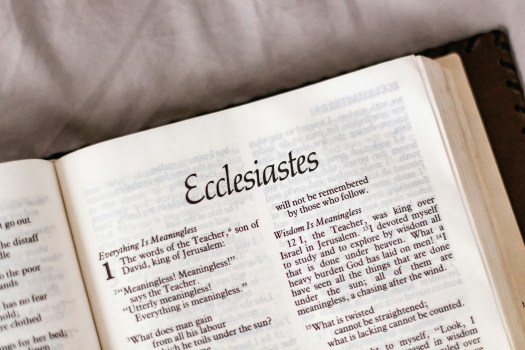
Filling a God-Shaped Hole

Ecclesiastes 2

1I said to myself, “Come now, let’s give pleasure a try. Let’s look for the ‘good things’ in life.” But I found that this, too, was meaningless. 2“It is silly to be laughing all the time,” I said. “What good does it do to seek only pleasure?” 3After much thought, I decided to cheer myself with wine. While still seeking wisdom, I clutched at foolishness. In this way, I hoped to experience the only happiness most people find during their brief life in this world.

4I also tried to find meaning by building huge homes for myself and by planting beautiful vineyards. 5I made gardens and parks, filling them with all kinds of fruit trees. 6I built reservoirs to collect the water to irrigate my many flourishing groves. 7I bought slaves, both men and women, and others were born into my household. I also owned great herds and flocks, more than any of the kings who lived in Jerusalem before me. 8I collected great sums of silver and gold, the treasure of many kings and provinces. I hired wonderful singers, both men and women, and had many beautiful concubines. I had everything a man could desire!

9So I became greater than any of the kings who ruled in Jerusalem before me. And with it all, I remained clear-eyed so that I could evaluate all these things. 10Anything I wanted, I took. I did not restrain myself from any joy. I even found great pleasure in hard work, an additional reward for all my labors. 11But as I looked at everything I had worked so hard to accomplish, it was all so meaningless. It was like chasing the wind. There was nothing really worthwhile anywhere.

12So I decided to compare wisdom and folly, and anyone else would come to the same conclusions I did. 13Wisdom is of more value than foolishness, just as light is better than darkness. 14For the wise person sees, while the fool is blind. Yet I saw that wise and foolish people share the same fate. 15Both of them die. Just as the fool will die, so will I. So of what value is all my wisdom? Then I said to myself, “This is all so meaningless!” 16For the wise person and the fool both die, and in the days to come, both will be forgotten.

17So now I hate life because everything done here under the sun is so irrational. Everything is meaningless, like chasing the wind. 18I am disgusted that I must leave the fruits of my hard work to others. 19And who can tell whether my successors will be wise or foolish? And yet they will control everything I have gained by my skill and hard work. How meaningless!

20So I turned in despair from hard work. It was not the answer to my search for satisfaction in this life. 21For though I do my work with wisdom, knowledge, and skill, I must leave everything I gain to people who haven’t worked to earn it. This is not only foolish but highly unfair. 22So what do people get for all their hard work? 23Their days of labor are filled with pain and grief; even at night they cannot rest. It is all utterly meaningless.

24So I decided there is nothing better than to enjoy food and drink and to find satisfaction in work. Then I realized that this pleasure is from the hand of God. 25For who can eat or enjoy anything apart from him? 26God gives wisdom, knowledge, and joy to those who please him. But if a sinner becomes wealthy, God takes the wealth away and gives it to those who please him. Even this, however, is meaningless, like chasing the wind. (Ecclesiastes 2:1-26, NLT)


The Daily DAVEotional

Blaise Pascal, the famous 17th century French mathematician and inventor, is often credited with saying,

​There is a God-shaped vacuum in the heart of every man which cannot be filled by any created thing, but only by God, the Creator, made known through Jesus Christ.

Interestingly, Pascal never actually said this exact quote, though he did express the sentiment when he said,

“What else does this craving, and this helplessness, proclaim but that there was once in man a true happiness, of which all that now remains is the empty print and trace? This he tries in vain to fill with everything around him, seeking in things that are not there the help he cannot find in those that are, though none can help, since this infinite abyss can be filled only with an infinite and immutable object; in other words by God himself”

As it turns out, this sentiment from Pascal, which has been shortened into the pithy quote that we all see today, was probably derived from Solomon, who explored the nature of meaning and fulfillment in this second chapter of Ecclesiastes.

So what exactly does Solomon say?

It’s important to understand the context on which Ecclesiastes 2 rests. In chapter 1, Solomon is trying to derive meaning and purpose to our existence. His initial position, based on observations and lived experience, is that life is meaningless.

It’s a sad existence indeed if there is absolutely no purpose or meaning in life. Yet that is what Solomon initially concludes.

In this chapter of Ecclesiastes, we’re subjected to a bit of Solomon’s ontological journey.

The first thing he says is that he tried to find meaning and fulfillment in pleasure, or what we call hedonism. But physical pleasure provides no lasting satisfaction. The exhilarating rush that pleasure brings quickly fades, leaving one grasping for the next opportunity to experience that physical and emotional high.

Solomon then turns his attention to the pursuit of materialism. Perhaps acquiring lots of stuff, overseeing grand construction projects or building tremendous wealth could ascribe meaning and value to life. But Solomon found that lacking as well. The allure that extreme wealth promises is never quite  achieved. John Rockefeller, who was the richest person to ever live, was once asked, “how much is enough?” His response was “just a little bit more.” He apparently did not subscribe to Solomon’s conclusion that extreme wealth does not ultimately satisfy.

Perhaps fame and taking pride in one’s work could provide the kind of satisfaction that pleasure and materialism couldn’t. But Solomon ultimately realized the utter futility of that pursuit. Fame is fleeting and whatever work we may accomplish is forgotten as quickly as we are when we die.

Solomon reasoned that hard work and wealth are ultimately meaningless because we all die. What good are those things after you die? Someone else will take possession of and oversee all that we’ve worked to produce. That hardly seems fair. You work your tail off to produce wealth and build an empire only to leave it to someone else who did nothing to earn or produce what you’ve left?

None of this makes sense on the surface. What is the point?

Solomon gives a glimpse into the ultimate purpose in verses 24-25, when he says,

24So I decided there is nothing better than to enjoy food and drink and to find satisfaction in work. Then I realized that this pleasure is from the hand of God. 25For who can eat or enjoy anything apart from him?

Is pleasure, wealth, fame and work all meaningless? Apart from God, the answer is yes. But with God, all of these things are meaningful because they are gifts from God, the ultimate gift-giver!

So we’re back to our opening line that is often attributed to Pascal. There is something inside each person that is searching and striving for meaning and purpose. Man, in his fallenness, seeks to satiate this inner desire with all kinds of things – pleasure, power, wealth and fame. But none of these things bring true satisfaction or fulfillment. That’s because God is the only one who can ultimately fulfill our basic human need for meaning and purpose. It’s part of His design.

Apart from God there is no ultimate meaning and purpose. As Christian philosopher and apologist Frank Turek says, we are just “moist robots” who appear one day and then one day we’re gone.

If that is the case, then Solomon’s initial assessment is true – life is indeed meaningless. But with God, life not only has purpose and meaning but work, pleasure and wealth all make sense.


Did you enjoy this post? I’d love to hear your thoughts! Feel free to like, leave a comment below, and share it with your friends or on social media if you found it helpful or interesting. Your support keeps the conversation going!


Reflection

What do you turn to in order to experience purpose and meaning in life?

Which of the following do you struggle with the most: the pursuit of pleasure, wealth, power or fame?

What do you think are the reasons you or people in general pursue other things to satisfy their inner needs rather than pursuing God Himself?

In what ways can you turn to God as your source of true satisfaction and fulfillment?


Photo by Sincerely Media on Unsplash

He Who Dies with the Most Toys Wins!

Matthew 6

19“Don’t store up treasures here on earth, where they can be eaten by moths and get rusty, and where thieves break in and steal. 20Store your treasures in heaven, where they will never become moth-eaten or rusty and where they will be safe from thieves. 21Wherever your treasure is, there your heart and thoughts will also be.

22“Your eye is a lamp for your body. A pure eye lets sunshine into your soul. 23But an evil eye shuts out the light and plunges you into darkness. If the light you think you have is really darkness, how deep that darkness will be!

24“No one can serve two masters. For you will hate one and love the other, or be devoted to one and despise the other. You cannot serve both God and money. (Matthew 6:19-24, NLT)


The Daily DAVEotional

What does Jesus think about money and wealth?

Many insist that Jesus condemned wealth. Numerous passages are cited as proof that Jesus was a wealth buster. This passage is among them.

The argument that this passage condemns wealth goes something like this:

    • Jesus clearly teaches that we are NOT to store up treasures (i.e. money/possessions) on earth because those things have no eternal value. Instead, we should focus our efforts on storing up treasures in heaven.
    • Furthermore, Jesus warned that wherever our treasure is our heart will be also. So if we are storing up treasures on earth, then our heart will be focused on earthly things, whereas if our treasures are stored in heaven, then our heart will be focused on heavenly, or spiritual things.
    • Hence, Jesus clearly is teaching against earthly wealth.

I’ve written many blog posts on this issue, arguing that the Bible does not condemn wealth or the rich. This includes Jesus. Some of the more pertinent “wealth-condemning” passages are addressed here (Luke 12),  here (1 Timothy 6), and here (Ecclesiastes 5).

As is the case in those other passages, this passage, though using money (or treasures) as a context, is actually addressing a deeper issue.

This passage is addressing the issue of what we invest in. The question being posed is how exactly will we orient our lives?

On the one hand, we can orient our lives to pursue material possessions. This attitude is known as materialism.

Materialism is an ideology or an attitude that elevates material possessions above all else. Similar to being greedy, a person who is materialistic attempts to accumulate as many material goods as possible, seeking security, pleasure and even status through the things they own.

If you’re a person who lived through the 1980’s, you may remember a popular bumper sticker from that decade that read:

“He who dies with the most toys wins!”

This bumper sticker accurately and succinctly summarizes the main premise of materialism, that somehow, the main goal in life is to accumulate things, as if we’re all playing a giant game of Monopoly.

Jesus warns against this approach. When he talks about “storing up treasures on earth” I can’t help but think of someone who owns every new gadget and gizmo and even enjoys flaunting his innumerable toys to others.

In ancient times, one of the ways people flaunted their wealth and promoted their status was through their clothing. People didn’t have luxury cars they could drive around to show off their status, and they didn’t have the plethora of clothing options that we have today. But it was possible to have expensive clothes (see Matthew 11:8).

Jesus is saying that expensive clothes can be eaten by moths and rust can destroy fancy jewelry. Furthermore, any treasured item can be stolen. Of what value is it then?

The alternative to an ideology of materialism is to be kingdom-minded. Jesus urges His listeners to store up for themselves “treasures in heaven”. What exactly does that mean?

Jesus is talking about investing our time, our money, our very lives into things that will not be destroyed….EVER.

There are only 3 things that will last forever: God, His Word, and people. Therefore, it makes sense to invest our time and our treasure (money) into things that will have eternal impact – things that will make an eternal difference.

So Jesus is not saying wealth is bad and he’s certainly not condemning people who are rich. What he is condemning is materialism – the attitude that by hoarding material possessions, I will somehow experience purpose, meaning and fulfillment in life.

Jesus says that “where your treasure is, there your heart and thoughts will also be.” He also says that we cannot serve two masters. We cannot serve both God and money.

It turns out that materialism is self-defeating. If you make it your focus to accumulate things, then those things will ultimately become your focus. Essentially, it will become an idol in your life, squeezing God out of His rightful place at the center of your life.

So we have a choice. We can live by the bumper sticker adage that “He who dies with the most toys wins”, reveling in our many possessions while flaunting our status to others. Or we can recognize the futility of that approach, and choose to follow the suggestion of Jesus by serving God and living in such a way that our lives impact others for eternity.

Jesus reminds us that our earthly possessions don’t last and therefore are of no value to us in the next life.

As the rival 1980’s bumper sticker retorted,

“He who dies with the most toys still dies.”

Reflection

How would you respond to someone who says that Jesus is against money and wealth? 

Based on this passage, what do you think is the purpose or value of owning things?

Jesus is speaking against materialism, the idea that material possessions will bring meaning, security and even success. Do you think materialism is something that only wealthy people struggle with? Explain.

What do you think are some practical steps a person can take to avoid materialism?

What are some of the ways our culture promotes materialism? 

What are some practical ways a person can “store up treasures in heaven”?


Photo by Dave Lowe