There’s an App for That!

Can you believe it’s been 17 years since the iPhone was introduced? Technically, the iPhone is not considered the first smart phone. That distinction belongs to a phone designed by IBM in 1992 called the Simon Personal Computer (SPC), which was released in 1994. It’s considered the first smart phone because it was the first phone to include apps.

However, it was really the iPhone that revolutionized cell phones as we know it. Flip phones and Blackberries, which were ubiquitous up until then, are but a memory now.

Back in 2008, when smart phones were still relatively new, Apple embarked on an ad campaign that was highly successful and no doubt aided in the early lead the iPhone had over competitors in the newly created smartphone market.

The theme of the ad campaign was: There’s an app for that! Commercials touted the abundance of apps that were available for the iPhone compared to other smart phone platforms. Just about anything you might need to do with your phone, there was an app available that could do it for you.

Here’s an example of one of those early iPhone commercials:

Recently, I had my own “There’s an app for that” moment.

I was meeting with my friend Mike, a guy I’ve been coaching over the last few years. I met Mike in a grocery store parking lot during the pandemic and we’ve been connecting ever since. You can read about that story here in our January 2021 Newsletter at Lowedown.com.

Mike has a passion for basketball and after spending some time as a high school coach Mike has been trying to make the leap into the difficult world of coaching at the collegiate level.
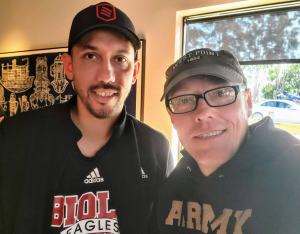
After volunteer coaching for several years at Azusa Pacific, Mike is now an assistant coach for Biola University.

Mike was recently hired as an assistant coach at Biola University, where he now has the opportunity to influence the young men on the team, not just in their basketball skills, but in their spiritual lives as well.

Mike and I were going over some new discipleship material I’ve been developing. The idea is to create a menu of lessons that anyone can use to help another person take concrete steps in their relationship with God. I’ve been going through the content with Mike to get his feedback and to see if this is the kind of material he might be able to use in his basketball ministry.

After we finished the content, Mike told me, “I wish I could translate this into Japanese.” Mike has a significant ministry to Japanese kids and teens both here and in Japan, through the many youth basketball camps he hosts.

He shared how he thought the content we were going over could be super helpful but he wouldn’t be able to share it with a Japanese student because he doesn’t know Japanese well enough to translate the content himself. It launched us into a conversation about how even here in Southern California, there is often a need for material to be available in multiple languages besides English.

The GodTools app is available at the App Store for iOS devices and the Google Play store for Android devices.

Though my content is currently in English only, our conversation made me think about the GodTools app that Cru has created for evangelistic and spiritual conversations. 

I had assumed that Mike probably was familiar with the app and probably had it on his phone, but when I mentioned it, I found out that he not only doesn’t have the app, but he was only vaguely familiar with it.

I pulled up the app on my phone and showed him how he could have access to a number of different gospel presentations as well as a presentation on the ministry of the Holy Spirit….all at his fingertips. 

To demonstrate, I opened up the Four Spiritual Laws presentation and began to scroll through the pages.

The GodTools app can be shared in 90 different languages and the Parallel feature allows you to toggle between multiple languages at once. You can even share your screen with the person you’re sharing with.

One of the best things about the app though is not just having a gospel tract on you at all times, but the fact that you can share the presentations in any one of 90 languages. And there’s also an option to toggle the screen between 2 languages (English and Japanese for example). 

Mike was excited to learn there was an app at his disposal that would allow him to share a number of tools with his Japanese friends in their native tongue and he didn’t have to spend the money to hire a professional to translate it.

It turns out that if you want to share your faith with others, there’s an app for that. And if you need to share it in a foreign language, there’s an app for that as well!

If you haven’t downloaded the GodTools app yourself, consider adding it to the other Bible apps on your phone. Go to GodToolsapp.com for more information on the features of the app and for suggestions on how to use it in your conversations. 

Please pray for Mike as he continues to establish himself as a collegiate coach and pray for us as we seek to continue helping Young Professionals multiply their lives into others.

Choose Wisely!

Deuteronomy 30

11“This command I am giving you today is not too difficult for you to understand or perform. 12It is not up in heaven, so distant that you must ask, ‘Who will go to heaven and bring it down so we can hear and obey it?’ 13It is not beyond the sea, so far away that you must ask, ‘Who will cross the sea to bring it to us so we can hear and obey it?’ 14The message is very close at hand; it is on your lips and in your heart so that you can obey it.

15“Now listen! Today I am giving you a choice between prosperity and disaster, between life and death. 16I have commanded you today to love the LORD your God and to keep his commands, laws, and regulations by walking in his ways. If you do this, you will live and become a great nation, and the LORD your God will bless you and the land you are about to enter and occupy. 17But if your heart turns away and you refuse to listen, and if you are drawn away to serve and worship other gods, 18then I warn you now that you will certainly be destroyed. You will not live a long, good life in the land you are crossing the Jordan to occupy.

19“Today I have given you the choice between life and death, between blessings and curses. I call on heaven and earth to witness the choice you make. Oh, that you would choose life, that you and your descendants might live! 20Choose to love the LORD your God and to obey him and commit yourself to him, for he is your life. Then you will live long in the land the LORD swore to give your ancestors Abraham, Isaac, and Jacob.” (Deuteronomy 30:11-20, NLT)


The Daily DAVEotional

There are dozens of burger chains among an endless sea of fast food choices in America. The job of marketing is to convince you why you should frequent one establishment over the others.

A successful marketing campaign will have you singing a jingle or repeating a slogan unconsciously.

Back in the 70’s it was McDonald’s “Two all beef patties, special sauce, lettuce, cheese, pickles, onions on a sesame seed bun” jingle vs. Burger King’s “hold the pickles, hold the lettuce, special orders don’t upset us, all we ask is that you let us serve it your way” chorus.

These two fast food giants were the undisputed big dogs of the fast food world.

Wendy’s burst on the scene in the 1980’s with its famous “Where’s the beef?” commercial and is currently the 3rd largest burger chain.

Today, the McDonald’s slogan is “I’m loving it.”

I can’t even tell you what Burger King’s slogan is as they seem to be going through somewhat of an identity crisis.

Wendy’s current marketing strategy is to position itself as the “better” choice, from hot and crispy fries that are better than McDonalds to burgers made from beef that is fresh, not frozen. The ad campaign encourages patrons to “Choose wisely, choose Wendy’s”.

It all comes down to how you choose.

This is the idea in this section of the book of Deuteronomy. Make your choice and choose wisely.

The book of Deuteronomy is really a message given by Moses to the Israelites just before entering the promised land. The word actually means “Second Law”. Moses had already given the law to the Israelites in Exodus but most of those people had died off because of their disobedience in Numbers 13-14. Hence, this is the “second” giving of the law.

After 40 years of wandering in the desert a new generation was finally about to experience God’s promise to enter the promised land on the other side of the Jordan river. Moses is reminding them of the covenant that God had established with His people, along with His promise that if they would follow Him whole-heartedly and obey His commands, they would not only live, but they would prosper.

Disobedience, on the other hand, would bring about disaster and curses, including certain destruction from their enemies.

The choice for the Israelites was simple: choose life and prosperity over death and destruction.

Choosing life means loving God with your whole heart, keeping His commands and walking in His ways.

Choosing death means turning away from God, refusing to listen to Him and being drawn away to serve and worship other gods (including oneself).

Clearly life is better than death and prosperity is better than destruction.

Though we are now living under the New Covenant, the basic choice is still the same. We can choose life or death. We can choose prosperity or we can choose destruction. We can choose to love God and follow Him or we can choose to follow our own selfish path.

Like the Wendy’s ad campaign says, there is a better option…..choose wisely!

Reflection

When have you been faced with a tough choice in your life? How did you choose? What factors went into your decision?

What makes choosing God so difficult for people in today’s culture? 

What do you think it means to choose life? What would that look like?

What do you think “destruction” looks like for those who choose not to love God? 

What steps can you take to continue to choose life over death?


Photo by Batu Gezer on Unsplash