
Mark 5
1So they arrived at the other side of the lake, in the land of the Gerasenes. 2Just as Jesus was climbing from the boat, a man possessed by an evil spirit ran out from a cemetery to meet him. 3This man lived among the tombs and could not be restrained, even with a chain. 4Whenever he was put into chains and shackles—as he often was—he snapped the chains from his wrists and smashed the shackles. No one was strong enough to control him. 5All day long and throughout the night, he would wander among the tombs and in the hills, screaming and hitting himself with stones. 6When Jesus was still some distance away, the man saw him. He ran to meet Jesus and fell down before him. 7He gave a terrible scream, shrieking, “Why are you bothering me, Jesus, Son of the Most High God? For God’s sake, don’t torture me!” 8For Jesus had already said to the spirit, “Come out of the man, you evil spirit.”
9Then Jesus asked, “What is your name?”
And the spirit replied, “Legion, because there are many of us here inside this man.” 10Then the spirits begged him again and again not to send them to some distant place. 11There happened to be a large herd of pigs feeding on the hillside nearby. 12“Send us into those pigs,” the evil spirits begged. 13Jesus gave them permission. So the evil spirits came out of the man and entered the pigs, and the entire herd of two thousand pigs plunged down the steep hillside into the lake, where they drowned. 14The herdsmen fled to the nearby city and the surrounding countryside, spreading the news as they ran. Everyone rushed out to see for themselves. 15A crowd soon gathered around Jesus, but they were frightened when they saw the man who had been demon possessed, for he was sitting there fully clothed and perfectly sane. 16Those who had seen what happened to the man and to the pigs told everyone about it, 17and the crowd began pleading with Jesus to go away and leave them alone. (Mark 5:1-17, NLT)
The Daily DAVEotional
Once again, we see Jesus demonstrating His omnipotence to the masses and to his disciples. Jesus’ many miracles were meant to demonstrate His power and authority over the natural world (calming a storm), the physical world (healing sickness), the spiritual world (casting out demons) and even death itself (bringing back someone who had died).
When reading this passage, one might conclude that the point of the passage is to simply show, once again, Jesus’ authority over the spiritual realm. While this is true, I think there’s another, often overlooked aspect to this passage. It’s found in verse 11, which says,
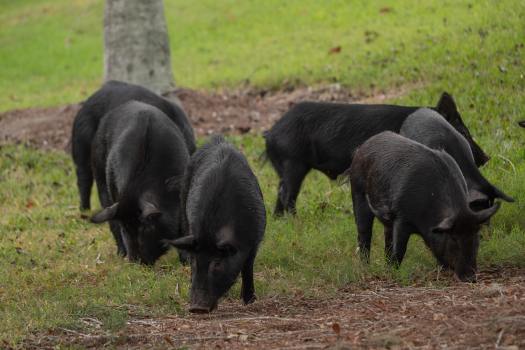
“there happened to be a large herd of pigs feeding on the hillside nearby.”
Now if you know anything about Jewish laws and regulations, you know that pigs were considered unclean animals. Jews were not allowed to eat pigs; they weren’t even allowed to touch them.
So what are pigs doing in the story?
Though not explicitly stated, it seems obvious that Jesus is ministering in an area that isn’t Jewish; hence the presence of pigs.
Jesus crossed over into another culture. He went to a place that would have been uncomfortable to Jews and he healed a man who likely was not Jewish. Now this isn’t explicitly stated, but it’s inferred from the text. Because of the clear presence of pigs, we know that Jesus and his disciples were in a Gentile area. We can therefore infer that the man whom Jesus healed also was likely Gentile.
What I find interesting about this story is that Jesus clearly indicated through ministry encounters like this one (and others) that he was concerned about all peoples, not just Jews. And yet the disciples did not immediately comprehend this aspect of the gospel message, as indicated by Peter’s need for a direct vision from God in Acts 10 to help him understand that Gentiles are not to be thought of as unclean and unworthy of salvation.
If these 12 men, who were actually with Jesus, could be slow to understand basic truths about the Lord and His plans and purposes, I wonder how much of my thinking may actually be wrong or incomplete.
This is not an invitation to question all of our beliefs, particularly those that are solidly grounded in Scripture. However, we all have some beliefs that may not be as grounded in Scripture as we think. Perhaps they are rooted more in our own church, cultural or even family traditions. The invitation, I think, is to keep learning, knowing that I have biases and blind spots and that in my finiteness, I struggle to know God completely as He is. Therefore, there is always room to grow in my understanding and comprehension of God and His nature.
I’m also challenged by the notion that Jesus went to places that were uncomfortable and considered off limits by the culture of his time.
I’m not apt to move too far out of my comfort zone and I’m not always motivated to move toward those who are different. But Jesus’ actions in this passage clearly demonstrate his love and commitment for those who don’t fit my cultural norms and preferences.
Reflection
When is a time you were challenged in your understanding about God – his nature and His purposes? What was it that challenged these beliefs?
How can you ensure that the things you believe about God and salvation are rooted in truth and not just some traditional or cultural view that you’re holding on to?
What steps can you take to move out of your comfort zone as Jesus did in this passage?
Photo by David Cashbaugh on Unsplash
 The Lowedown