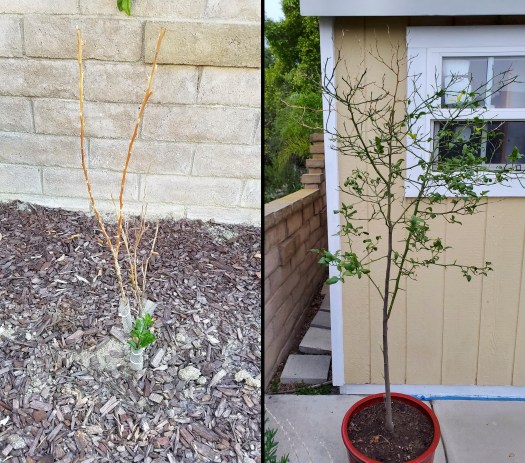
Why Does My Fruit Tree Have no Fruit?

Luke 13

6Then Jesus used this illustration: “A man planted a fig tree in his garden and came again and again to see if there was any fruit on it, but he was always disappointed. 7Finally, he said to his gardener, ‘I’ve waited three years, and there hasn’t been a single fig! Cut it down. It’s taking up space we can use for something else.’

8“The gardener answered, ‘Give it one more chance. Leave it another year, and I’ll give it special attention and plenty of fertilizer. 9If we get figs next year, fine. If not, you can cut it down.’” (Luke 13:6-9, NLT)


The Daily DAVEotional

(This blog post was initially titled “A Tree with No Fruit!”)

In the first house we owned we had a tangerine tree in the back yard. It was awesome. There’s nothing like fresh squeezed tangerine juice.

When we moved to our current location, I dreamed of having a tangerine tree so we could have fresh squeezed juice just about whenever we wanted.

It took a couple of years to clear some of the bushes and get the back yard exactly the way we wanted but we finally bought a dwarf tangerine tree and planted it in the corner.

The first year there was no fruit, but I figured it was still growing. The next year, it looked like it was ready to start producing as I could see a couple of tiny tangerines beginning to grow.

And then we got a puppy.

If you know anything about puppies, they like to chew things and one of the things our dog chewed on was that tangerine tree. (For more on doggie destructiveness, read my post: Life Lessons From Our Dog).  I put some mesh wiring around the base of the tree to keep the dog from destroying the tree but I wasn’t sure if it was too little too late.

Lo and behold, the tree was saved and it began to grow back (see photo on top left). But it’s been almost five years since then and we still haven’t seen one piece of fruit.

This passage from Luke reminds me of my tangerine tree. I’m about ready to toss it out and get another tree, perhaps one that is more fully developed – one that I know will yield me the fruit that I’m so often craving.

Henry Cloud appeals to this passage to illustrate what he refers to as “The Growth Model.”

When you’re thinking about growth and development, Dr. Cloud says there are three ingredients that are necessary: grace, truth and time.

In this example, the tree is not producing fruit. That is the reality. The owner wants to chop it down and put something else in its place, something that will produce fruit.

The gardener urges the owner to give the tree “one more chance”. The gardener wants to intentionally apply these 3 necessary ingredients for growth to see if the tree will respond and begin to produce fruit.

The time is the extra year. What is the truth in this scenario? The truth is the special attention gardener promises to give the tree.

But what is the grace?

We often think of grace as unmerited favor – the free gift of salvation that is given to us by Jesus through His sacrificial death on the cross.

In this illustration, the grace is the fertilizer. It’s the ingredient the tree cannot provide for itself that comes from an outside source.

Like that tree, we also need grace, truth and time in order to grow and develop. Truth is reality. It’s the realization that we have an issue or problem we need to work through.

Grace is the ingredient that you cannot provide for yourself. It may come in the form of support or motivation or help from someone else.

If we have appropriate levels of grace and truth in our lives applied over time, we can experience growth. We will be like the tangerine tree, producing sweet fruit that is evident and enjoyed by many!

NOTE: For a real life example of how grace and truth helps promote growth and change, read my post from December 15 on “Discipleship and Change Through Coaching.”

Reflection

Which of the three elements do you need in your life to experience growth in an area where you may have struggled to see improvement?

What are some areas of your life where you’ve struggled to experience real change?

How can you apply the principles from this passage to help you see progress?


Photos by Dave Lowe


What Does it Look Like to Follow Jesus?

Luke 9

57As they were walking along someone said to Jesus, “I will follow you no matter where you go.”

58But Jesus replied, “Foxes have dens to live in, and birds have nests, but I, the Son of Man, have no home of my own, not even a place to lay my head.”

59He said to another person, “Come, be my disciple.”

The man agreed, but he said, “Lord, first let me return home and bury my father.”

60Jesus replied, “Let those who are spiritually dead care for their own dead. Your duty is to go and preach the coming of the Kingdom of God.”

61Another said, “Yes, Lord, I will follow you, but first let me say good-bye to my family.”

62But Jesus told him, “Anyone who puts a hand to the plow and then looks back is not fit for the Kingdom of God.” (Luke 9:57-62, NLT)


The Daily DAVEotional

At the end of Luke chapter 9, someone tells Jesus he will follow Him wherever He goes. Jesus then lays out some requirements for truly following Him.

The first thing he says, in verse 58, is that “Foxes have dens to live in, and birds have nests, but I, the Son of Man, have no home of my own, not even a place to lay my head.”

What’s he saying? Jesus is saying that following Him may be uncomfortable and will require sacrifice. Are you willing to give up a life of comfort and ease in order to follow me?

Another person responded to Jesus’s call to discipleship by saying he wanted to first go home and bury his father. Jesus responds, in verse 60, saying “Let those who are spiritually dead care for their own dead. Your duty is to go and preach the coming of the Kingdom of God.”

Is Jesus against family responsibilities?

No. It’s unlikely the person’s father was already dead for if he was, the man would not likely have been there in the first place to interact with Jesus. What the man was really saying is that he would follow Jesus at a later date, when life circumstances are different. Jesus responds by saying that following Him means making Him a priority over everything else, including family.

Finally, a third person says he will follow Jesus but only after saying goodbye to his family.

Jesus responds by saying, “Anyone who puts a hand to the plow and then looks back is not fit for the Kingdom of God.”

Again, Jesus is not against families. He’s merely pointing out that following Him means enduring to the end.

If you think about it, following Jesus is like a marriage.

What does this have to do with marriage?

Well, if you’ve ever been to a wedding ceremony, it’s traditional for the officiant to lead the bride and groom in an exchange of vows. Usually, the official will ask each participant if they will commit themselves to the other person and stay committed through a variety of life’s conditions, including:

    • For richer for poorer (sacrifice)
    • In sickness and in health (priority)
    • ’til death do us part (endurance)

Notice that these conditions are the same conditions that Jesus set forth as necessary to be His follower. If you want to follow Jesus, it will take sacrifice; He must be your priority and you must endure to the end.

If you think about it, Jesus is asking us to marry Him. Not literally, of course. But to be a follower of Jesus carries that same level of commitment, dedication and intentionality.

Reflection

What do you think about the idea that when Jesus invites you to follow Him, it’s like He’s asking you to marry Him?

Which of the three conditions Jesus lays out for following Him do you struggle with the most?

What would keep you from committing yourself to Jesus in the way He invites His true followers?


Photo by Sandy Millar on Unsplash