
The Story of the “Other” Son

Luke 15

25“Meanwhile, the older son was in the fields working. When he returned home, he heard music and dancing in the house, 26and he asked one of the servants what was going on. 27‘Your brother is back,’ he was told, ‘and your father has killed the calf we were fattening and has prepared a great feast. We are celebrating because of his safe return.’

28“The older brother was angry and wouldn’t go in. His father came out and begged him, 29but he replied, ‘All these years I’ve worked hard for you and never once refused to do a single thing you told me to. And in all that time you never gave me even one young goat for a feast with my friends. 30Yet when this son of yours comes back after squandering your money on prostitutes, you celebrate by killing the finest calf we have.’

31“His father said to him, ‘Look, dear son, you and I are very close, and everything I have is yours. 32We had to celebrate this happy day. For your brother was dead and has come back to life! He was lost, but now he is found!’” (Luke 15:25-32, NLT)


The Daily DAVEotional

In a previous post, Revisiting the Story of the Prodigal Son, I shared what the story of the Prodigal Son reveals to us about God, particularly the depth of His love.

In that story, the younger son commits the most egregious act of disrespect imaginable. The father does not stop him, but simply allows him to follow his own path. The father also does not shield his son from the consequences of his misguided choices.

The younger son pursues a life of hedonism, squandering all of his father’s money and wasting his life. But the text says that “he came to his senses”, which means that he repented.

He returned to his father fully expecting to be admonished and punished. Instead, he’s greeted with joy and a loving embrace. He was immediately reconciled and fully restored positionally in the family.

The point of the story is to demonstrate the incredible depth of God’s love and compassion for us. There is nothing we can do that would be so bad that God would not run to us with open arms if we were simply to “come to our senses” and return to Him.

But there’s more to this story, and that’s what this post is about. The younger son was the rebel, the black sheep of the family. But there’s another son, the older son. The loyal and dutiful son.

While the younger son completely disrespected his father and blew his father’s wealth on wild living, the older son stayed home, submissively serving his father as cultural etiquette required.

So what’s the problem? It seems like the older son is the example we’re supposed to follow.

Not exactly.

Have you ever wondered why this part of the story is included? If Jesus simply wanted to illustrate the depth of God’s love, why not just end the story after the younger son returns and is accepted back into the fold by the father?

Jesus clearly had more to say about who He is AND who we are and there’s a reason why Jesus gives us this insight into the older son.

You see, the younger son was the rebel, the wild child. A select group of people will read this story and see themselves as the younger son. But not everyone identifies as a black sheep within their family. Hence Jesus gives us another son in the story, one who is NOT a black sheep at all.

The older son is not lifted up in this story as someone we should emulate because he actually suffers the SAME problem as the younger son. Both sons are disconnected from their father – they just express it in different ways.

While the younger son is brash and disrespectful, the older son is reserved and compliant, But the older son clearly did not demonstrate love and appreciation for his father. That becomes quite evident as soon as the younger son returns home.

Notice the older son’s reaction. The text says he’s angry. I imagine the older son as the type who always does what he’s told but doesn’t express much emotion, until something triggering occurs that causes him to erupt.

That’s the scenario here. The older son isn’t happy the younger son returned, nor is he happy that his father is joyful at his brother’s return. He’s upset at the whole thing, jealous really, that his brother is getting so much favorable treatment.

What’s telling about the older son is what he valued. He’s upset that he never got to have a party with his friends, but his younger brother, the black sheep, is being celebrated for bad behavior.

Have you ever experienced that?

You work your tail off but don’t get the results you want. Meanwhile, some knucklehead you know screws around and seems to break all the rules, and they somehow get rewarded despite their indiscretions.

It doesn’t seem fair does it?

But that’s exactly what Jesus is trying to highlight. The older son stayed with the father, which really is its own reward. The older son missed it completely. The father is the treasure, but the older son was hoping for some other material treasure instead.

The older son suffers from a lack of perspective. The father tells him, “look you and I are very close, and everything I have is yours.”

The father is reminding his son that he has an inheritance.

The older son was not looking toward his future inheritance. Instead, he was coveting some present material reward.

So there you have it. There’s a younger son who is the screw up and there’s the older son who is privately jealous and envious. Both take their relationship with their father for granted. Instead of enjoying the relationship with their loving father, each seeks contentment and pleasure through material means. The younger son is overt in his desire to “live it up” while the older son is more indirect in his thirst for worldly satisfaction.

Which of the sons are you?


Did you enjoy this post? I’d love to hear your thoughts! Feel free to like, leave a comment below, and share it with your friends or on social media if you found it helpful or interesting. Your support keeps the conversation going!


Reflection

When is a time in your life when you rebelled against God and went your own way? What prompted you to wander away?

What keeps you from “coming to your senses” when you find yourself disconnected from God?

Which son do you resonate with more – the younger son or the older son? What are some reasons for your choice?

God is the treasure in this story, though neither son really saw their relationship with their father as something to cherish. How would you rate your own relationship with God? How much do you see God as a treasure? 

In what ways can you cultivate a relationship with God that is not centered on duty? How do you think you can develop your heart and passion to see God as a treasure, instead of viewing Him as someone who can help you in some material way?


Photo by Muhmed Alaa El-Bank on Unsplash
Revisiting the Story of the Prodigal Son

Luke 15

11To illustrate the point further, Jesus told them this story: “A man had two sons. 12The younger son told his father, ‘I want my share of your estate now, instead of waiting until you die.’ So his father agreed to divide his wealth between his sons.

13“A few days later this younger son packed all his belongings and took a trip to a distant land, and there he wasted all his money on wild living. 14About the time his money ran out, a great famine swept over the land, and he began to starve. 15He persuaded a local farmer to hire him to feed his pigs. 16The boy became so hungry that even the pods he was feeding the pigs looked good to him. But no one gave him anything.

17“When he finally came to his senses, he said to himself, ‘At home even the hired men have food enough to spare, and here I am, dying of hunger! 18I will go home to my father and say, “Father, I have sinned against both heaven and you, 19and I am no longer worthy of being called your son. Please take me on as a hired man.”’

20“So he returned home to his father. And while he was still a long distance away, his father saw him coming. Filled with love and compassion, he ran to his son, embraced him, and kissed him. 21His son said to him, ‘Father, I have sinned against both heaven and you, and I am no longer worthy of being called your son.

22“But his father said to the servants, ‘Quick! Bring the finest robe in the house and put it on him. Get a ring for his finger, and sandals for his feet. 23And kill the calf we have been fattening in the pen. We must celebrate with a feast, 24for this son of mine was dead and has now returned to life. He was lost, but now he is found.’ So the party began. (Luke 15:11-24, NLT)


The Daily DAVEotional

Imagine you are the son (or daughter) of a very wealthy man. You have no job and you still live under his roof.

Now imagine you go to your father and you say, “You know what old man? I wish you were dead, and I wish I could cash out my inheritance right now and blow this popsicle stand.”

This is not too far off from the scenario that Jesus paints in the story of the “lost son”, more commonly referred to as the “prodigal son.”

The son in the story doesn’t use the words I’ve chosen but the effect is pretty much the same, for in the Jewish culture, it was the ultimate slap in the face to ask your father for your inheritance while he was still living. It was more than a slap in the face actually. It was the ultimate sign of disrespect, akin to giving the father the finger.

Now if you happened to be living the imagined scenario I painted at the outset, what kind of response might you expect from your father after telling him you wished he was dad and you wanted your money…NOW?

Amazingly, in the story Jesus tells, the father willingly complies. He doesn’t demonstrate anger or resentment or any kind of vindictiveness, all emotions I imagine I’d express if I were the father in this scenario.

So the son gets his wish. And what does he do?

He goes to a distant land and wastes ALL the money on wild living (i.e. partying and prostitutes). In some ways, the story mutes the degree of nastiness in which the son treats his father and exploits his wealth. But make no mistake, the son is the most extreme example of a rebel that you can fathom.

When you have no job and your sole purpose is to experience hedonism to its fullest extent, eventually you run out of money to support that crazy lifestyle. And that’s exactly what happened here too. The son had no money, no plan and no prospects. He was desperate.

He finally gets a job feeding slop to pigs. Take note of this detail. He was feeding PIGS.

Pigs were unclean animals to Jews, which is just one more detail revealing how far off the son had strayed.

It’s at this point that the story turns. The key passage in this whole story comes in verses 17-19, which says:

17“When he finally came to his senses, he said to himself, ‘At home even the hired men have food enough to spare, and here I am, dying of hunger! 18I will go home to my father and say, “Father, I have sinned against both heaven and you, 19and I am no longer worthy of being called your son. Please take me on as a hired man.”’

The son “came to his senses”. This is a biblical picture of repentance. The son came face to face with reality. He had hit rock bottom and he was finally willing to humble himself and admit the stupidity of his decisions that led to his current situation. In short, he finally took responsibility for his actions.

But he didn’t stop there. He humbled himself and was willing to admit his sin to his father. So he swallowed his pride and returned home to face his father.

Imagine if you were the son in that situation. How difficult would it be to face your father and admit you were wrong? Personally, I think a typical father would be angry and I’d expect their response to follow suit. I’d expect to be berated and “made an example of”. I’m certain I’d need to learn my lesson and take my medicine. Essentially, I’d expect to experience some kind of penalty and punishment.

But that’s not what happens in this case. The text says that when the son was still a long way off, the father SAW HIM COMING. That means the father had to be watching and waiting for the son to return.

The father doesn’t react the way we would expect because he’s like no earthly father any of us have ever experienced. The father doesn’t berate his son. He doesn’t say “I told you so”. He doesn’t require any groveling or penance. He just embraces the son and welcomes him back into the family, with full rights and privileges restored.

The story highlights the incredible love and patience God the Father has for His children.

God is not a dictator. He allows us to choose our own path. He doesn’t restrict our choices but he also doesn’t shield us from the consequences of those choices. He patiently waits for us to return. And if and when we do return, He welcomes us back with a lavish love that is beyond any kind of earthly love we could experience.

On the flip side, the son is an example of the most egregious offenses one could commit. And yet, the Father extends His love and immediately forgives and restores the son. It’s incredible.

This tells me a couple of things. First, there is nothing I can do that God won’t forgive. NOTHING. I only need to come to my senses (repent), humble myself and admit my sin, just as the son in the story did.

God doesn’t require us to grovel or do penance to receive His love and forgiveness. He freely gives it to those who come to Him with a humble heart of surrender. His love is infinite and He freely and unconditionally lavishes it on those who come to Him.

Now imagine experiencing the love of THAT Father!


Did you enjoy this post? I’d love to hear your thoughts! Feel free to like, leave a comment below, and share it with your friends or on social media if you found it helpful or interesting. Your support keeps the conversation going!


Reflection

What was your relationship like with your earthly father?

If you had done something wrong that you know he would be offended by, what would it have been like for you to think about approaching Him? What kind of reaction might you expect?

When you think of God, what words come to mind? How would you describe God to someone else?

When you find yourself sinning and “straying” from God’s plan, how easy is it for you to “come to your senses”? What keeps you from coming to your senses and returning to God?

What amazes you most about this story?


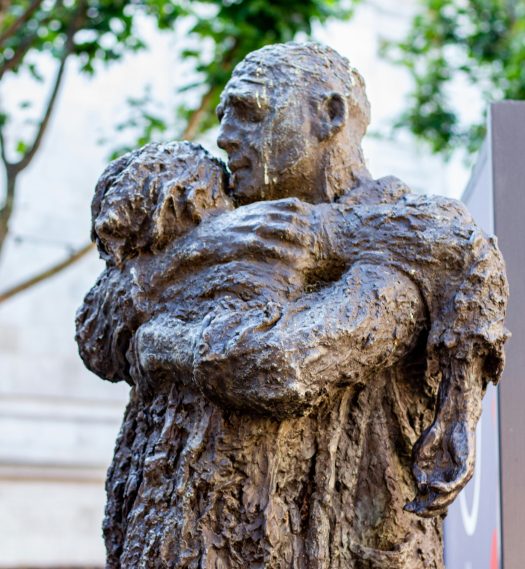
Photo by IP Withers on Unsplash – Charlie Mackesy’s Return of the Prodigal Son statue outside HTB Church London

Developing the Habit of Daily Bible Reading

It’s the beginning of the New Year so naturally, many people are thinking about New Year’s resolutions.

Typical resolutions for people include: losing weight, paying down debt,  finishing a degree or improving a job situation.

In the spiritual realm, a very common New Year’s resolution is to read through the Bible in a year.

Over the years, I’ve made this resolution countless times and mostly failed, though I was able to read through the entire Bible once or twice.

As Christians, reading through the Bible in its entirety is a noble goal. Many do it because it seems like an enormous accomplishment, like running a marathon once or hiking Yosemite’s half-dome summit.

But for the Christian, the goal really shouldn’t be to say that we’ve read through the Bible, as if it’s some bucket list item that we can boast about.

The goal is to gain a greater understanding of God’s word so that it impacts us and transforms us at a heart level.

With that in mind, I think a better resolution is to develop consistency in reading God’s Word. The goal is to develop a habit of taking in God’s word; to see it as essential and necessary for your spiritual life as food is daily for your physical life.

To develop a habit, a daily reading program is a must.

If this is all new to you, a few tips might be helpful.

Don’t worry about reading the Bible through chronologically. You can do that if you want but the Bible is not a novel. It’s a collection of books. So it’s not necessary to read through in order.

Shoot for being consistent instead of racing to finish. The goal is not to “finish” per se, because even if and when you do read through the entire Bible, you will still want to keep reading. It is NOT like a novel that you put back on the shelf once you’ve read the final page.

Allot an appropriate amount of time to help you be consistent. Many people start off with 45 minutes to an hour but cannot sustain that and then quickly give up. It’s like a person who’s out of shape and starts running for fitness. They immediately run 5 miles and kill themselves. Start off with a manageable routine that you can repeat consistently.

Recognize that there is a difference between reading and studying the Bible. You want to develop a habit of “reading” consistently, preferably every day. Reading doesn’t mean you have to understand everything you read. You can create longer study periods at other times in order to dive deeper into various sections of God’s word.

Recognize that the Bible is a collection of different types of literature. Some of it is historical narrative, some of it is poetic prayers and wisdom and some of it is direct teaching and instruction. Based on your personality, you will likely find some parts of the Bible easy and enjoyable to read while other sections (the types you don’t normally gravitate toward) you will find more laborious. Start with the types of literature that you would more easily gravitate toward, and then mix in the types that aren’t as easy. Starting off with books that are interesting will help you create momentum which will enable you to begin developing consistency.

Consider following a Daily Devotional program on the YouVersion Bible app. This is a popular app that is free and available for Smartphones in both iOS and Android versions. Not only does this app give you digital access to many different Bible translations, but there are literally thousands of different devotional programs that you can select to follow. The app will enable you follow each day’s content (a mixture of Bible reading often with some brief commentary) until you finish the program. When you finish, you can find another topic or series that interests you.

You may be saying to yourself, “this is all helpful, but I still don’t have any idea where to start.”

That’s a common issue. Here are some ideas to help you know where to begin:

Read through one of the gospels (Matthew, Mark, Luke and John). These books are narratives that each tell the story of the life of Jesus from the perspective of that author. There are similarities and differences between each account as each author reported on those parts of the life of Jesus that were important for the purpose they were writing. Pick one gospel and reach through it. You can read one chapter a day and it will take you 5-10 minutes, maybe even less. Reading through one of the gospel accounts will help you get familiar with the life and teachings of Jesus, who is the Bible’s central character.

Read through the book of Genesis, the first book of the Bible. Genesis is foundational for helping you to understand the context for the whole theme of the Bible. In it, you learn about creation, the Fall of man and then the story of the formation of the nation of Israel, God’s chosen people through whom the promised Messiah would come. Again, read one chapter a day. That should take no more than 5-10 minutes and will take you 50 days as there are 50 chapters.

If you like poetry, read through the Psalms. The Psalms are independent poems and praises that were written by different people to express their thoughts and emotions to God regarding the things they were experiencing. You can read one per day. Some are very short and there’s a few (like Psalm 119) that are extra long. If a Psalm is more than 30 or 40 verses, you might consider breaking it up into multiple days.

Read through the book of Proverbs. This book is what is called Wisdom literature. It’s a collection of sayings that are designed to give instruction and impart wisdom. There are 31 chapters in this book. One strategy is to read whatever Proverb corresponds to the day of the month. Hence, in a month that has 31 days, you will read through the entire book.

Read through the book of Acts, one chapter at a time. The book of Acts is another narrative book that tells the story of the foundation and growth of the early church, just after Jesus’ death, resurrection and ascension. It is filled with stories that demonstrate God’s design for His message of redemption to be taken to the ends of the earth.

Read through some of Paul’s letters. Romans, Galatians, Ephesians, Philippians and Colossians are good starting places. These letters are not narrative but are instructions that Paul is sharing with various New Testament churches. Reading these letters will help you to begin to learn important doctrinal truths about God and your relationship with Him.

Building a habit of daily Bible reading is one of the best practices you can develop if you want to grow and mature as a Christian. God’s Word is our source of life; it’s an instruction manual that teaches us what is right and what is wrong and directs us in how we are to live our lives in connection with God. (For more thoughts on the benefits of reading God’s Word, read my post “Training in Righteousness – Part 2”)

One last suggestion that you may find helpful. Consider signing up for my blog posts where you will get alerted each time a new post is made. Many of my posts are part of what I call the Daily DAVEotional. It’s not exactly daily, but each post has a passage from my own daily reading, along with my commentary on what it means. I end each post with some reflection questions to help you process and apply what you’ve read. Each post will take between 5 and 10 minutes to read, depending on how fast you read and how long you take to reflect on the questions at the end.

Wherever you’re at in your knowledge and understanding of God’s Word, I hope this is a year that you are able to begin to build a habit of daily Bible reading. This one habit practiced over time, can be instrumental in your own spiritual growth and transformation in the months and years to come!

How about you? What has been your experience with New Years’ resolutions and reading through the Bible?

What have you found helpful in your own life for developing consistency in daily Bible reading?

Share your thoughts and comments below!


Photo by Joel Muniz on Unsplash

Is it Immoral to Be Wealthy?

Luke 12

13Then someone called from the crowd, “Teacher, please tell my brother to divide our father’s estate with me.”

14Jesus replied, “Friend, who made me a judge over you to decide such things as that?” 15Then he said, “Beware! Don’t be greedy for what you don’t have. Real life is not measured by how much we own.”

16And he gave an illustration: “A rich man had a fertile farm that produced fine crops. 17In fact, his barns were full to overflowing.18So he said, ‘I know! I’ll tear down my barns and build bigger ones. Then I’ll have room enough to store everything. 19And I’ll sit back and say to myself, My friend, you have enough stored away for years to come. Now take it easy! Eat, drink, and be merry!’

20“But God said to him, ‘You fool! You will die this very night. Then who will get it all?’

21“Yes, a person is a fool to store up earthly wealth but not have a rich relationship with God.” (Luke 12:13-21, NLT)


The Daily DAVEotional

A few weeks ago I saw the following tweet from Dave Ramsey who quoted and then commented on a statement from Larry Burkett.

If you don’t know who Dave Ramsey is, he’s well known for teaching thousands, if not millions of people biblical principles for managing money, getting out of debt and building wealth.

Larry Burkett was Dave Ramsey before Dave Ramsey.  Burkett, founder of Crown Ministries, was one of the main voices teaching biblical money-management principles from the 1970’s through the 1990’s before his passing in 2003. Personally, I remember reading a number of Larry Burkett books in the early 1990’s that helped me get out of debt, stay out of debt and begin to save money that would become foundational for my future marriage and family.

Why do I bring this up? What’s the big deal about this tweet?

Actually, I only saw Dave Ramsey’s tweet because of a response to his tweet that showed up on my timeline.

In the response, the tweeter made the comment that he’s heard too many sermons that try to explain away passages like this by saying that it’s not wealth that is being condemned but it’s the motivation for that wealth that Jesus is condemning.

The problem, according to the tweeter, is that these Bible passages, like the one we’re looking at today, don’t talk about “attitude” but only mention the bigger barns and the tremendous wealth.

The implication is that Jesus was condemning great wealth and that building bigger barns is immoral. After all, that is what is stated in the story.

The responder had a follow-up tweet in which he stated that the challenge he was bringing up isn’t just a challenge for Ramsey but it’s a challenge for himself as well, because as a middle class American, he’s wealthy by global standards. Therefore, he is just like the fool who is building bigger barns.

Is this tweeter on to something? Is it true that Jesus was condemning great wealth?  Is it also true that if you are a middle class American, you too are a fool because you have great wealth by global standards? In short, Is it immoral to have wealth?

If Jesus is condemning wealth then he would be instituting a radical shift in understanding regarding what was taught and understood from the Bible regarding wealth.

Consider the following facts:

    • Abraham, the patriarch of the Jewish people. was quite wealthy, as were his sons Isaac and Jacob. It is clear that God blessed them and their wealth was God-ordained.
    • David too was wealthy, as was his son Solomon. In fact, God provided tremendous wealth for Solomon because he asked God for wisdom to guide his people instead of asking for wealth. God gave him what he asked for (wisdom) and threw in what he didn’t ask for (wealth) as a bonus.
    • Job was tremendously wealthy. In fact, the scriptures say he was the wealthiest man in the area. After he lost everything, God restored his wealth and gave him even more. Job is consistently described as righteous, despite his wealth, which is never condemned.

How do we reconcile the tremendous wealth of these great bible characters with this “new understanding” that Jesus is supposedly condemning great wealth?

A basic tenet of Bible study is that scripture interprets scripture. What that means, simply, is that our understanding of a passage must align with what is taught in other passages. Otherwise, we end up with the Bible contradicting itself, which would be quite problematic.

Given the fact that wealth in the Old Testament wasn’t condemned as immoral and that there are numerous examples of God Himself providing and blessing people with great wealth, it should be clear that Jesus must not be condemning wealth outright.

So what’s Jesus saying? What’s the point of His story.

If we take a closer look at the passage, it’s clear from the outset what the point of the story is. Jesus tells us plainly in verse 15 when he says:

“Beware! Don’t be greedy for what you don’t have. Real life is not measured by how much we own.”

What Jesus is condemning is greed, which is clearly sin. Jesus’ example uses a rich man who decides to tear down his barns and build bigger barns because otherwise, he would not be able to store all the crops that his fields are producing. Because Jesus’ example involved a “rich” man, one might conclude that Jesus must be against the rich. But that’s not the case.

Jesus defines what is foolish in verse 21 when He says:

“a person is a fool to store up earthly wealth but not have a rich relationship with God.”

What makes a person a fool is being greedy, which leads to an attitude of always wanting and needing more. This is why the rich man felt the need to build bigger barns.

It’s also clear from this passage that another aspect of being a fool is NOT having a rich relationship with God.

What’s the bottom line?

The bottom line is that people are foolish when they are not content with what they have. Greed is not just a problem for people with money. Anyone can be greedy. Conversely, just because a person has wealth doesn’t mean they are greedy.

Greed is sinful because we seek to gain satisfaction and significance from material possessions instead of from our relationship with God. This is what Jesus is condemning.

We need to be very careful not to assume or project our motives onto others, particularly those who are wealthy. It’s become fashionable lately to malign those who have great wealth and condemn them as greedy.

The problem is that we cannot really know the inner motives of those who have an abundance of material resources. They “may” be greedy or they may not be.

The irony is that when we assume that those who have much are greedy and when we call for them to be stripped of what they have so that it can be redistributed to others who don’t have as much, it actually demonstrates our own envy and sinful desires.

Wealth is not immoral. Greed is. Wealth is just a tool that can be used for good by those who are generous or it can be used for evil by those who are greedy.

Lastly, God Himself owns everything. He’s the wealthiest person in existence. The fact that He owns everything does not make Him selfish or greedy or immoral. He is none of those things. Instead, He’s extremely generous.

As believers, we should not be consumed with those who have more than us. We should be content with what we have and if we are blessed by God with much, we should be generous, just as God is.

Reflection

What has been your attitude towards people who are wealthy? What about people who have extreme wealth, such as billionaires? What has been your attitude towards their wealth?

What are some examples in your own life when you’ve been envious of others? What are some examples of greed in your own life?  How can you combat these attitudes and cultivate an attitude of generosity?

Do you agree with the tweeter or this author regarding how God views wealth? How does your view align with what the rest of Scripture teaches about wealth?

Why do you think so many people nowadays are attacking those who are rich and seeking to redistribute their wealth to others? What do you think are the reasons and motivations? 


Photo by Pixabay from Pexels


What Can We Learn from the Temptations of Jesus?

Luke 4

1Then Jesus, full of the Holy Spirit, left the Jordan River. He was led by the Spirit to go out into the wilderness, 2where the Devil tempted him for forty days. He ate nothing all that time and was very hungry.

3Then the Devil said to him, “If you are the Son of God, change this stone into a loaf of bread.”

4But Jesus told him, “No! The Scriptures say, ‘People need more than bread for their life.’ ”

5Then the Devil took him up and revealed to him all the kingdoms of the world in a moment of time. 6The Devil told him, “I will give you the glory of these kingdoms and authority over them—because they are mine to give to anyone I please. 7I will give it all to you if you will bow down and worship me.”

8Jesus replied, “The Scriptures say,

‘You must worship the Lord your God; serve only him.’ ”

9Then the Devil took him to Jerusalem, to the highest point of the Temple, and said, “If you are the Son of God, jump off! 10For the Scriptures say,

‘He orders his angels to protect and guard you.

11And they will hold you with their hands to keep you from striking your foot on a stone.’ ”

12Jesus responded, “The Scriptures also say, ‘Do not test the Lord your God.’ ”

13When the Devil had finished tempting Jesus, he left him until the next opportunity came. (Luke 4:1-14, NLT)

Hebrews 4

14That is why we have a great High Priest who has gone to heaven, Jesus the Son of God. Let us cling to him and never stop trusting him. 15This High Priest of ours understands our weaknesses, for he faced all of the same temptations we do, yet he did not sin. 16So let us come boldly to the throne of our gracious God. There we will receive his mercy, and we will find grace to help us when we need it. (Hebrews 4:14-16, NLT)


The Daily DAVEotional

A few days ago, in my daily bible reading, I came across both Luke 4 and Hebrews 4. Both of these chapters have portions related to the temptations Jesus experienced from Satan in the wilderness.

What exactly was the purpose of the temptations Jesus experienced in the desert and how can we learn from His example?


NOTE: Many of my thoughts concerning the temptations Jesus faced come from a talk that Dr. Bill Lawrence, a former professor at Dallas Theological Seminary, gave to a group of Cru staff at a conference in March, 2011.


Sin has been described as our attempt to meet legitimate needs in illegitimate ways. In other words, we all have basic human needs that need to be met but we sin when we attempt to meet those needs in ways that are outside of the boundaries that God has set for us to meet those needs.

Dr. Lawrence, in his talk on the temptations Jesus faced, described the 3 temptations this way:

Every one of the temptations is related to what God wants you to do but not the way God wants you to do it. We are tempted to do God’s will but man’s way.

So how exactly are these three temptations an attempt to do God’s will but in man’s way?

In the first temptation, Jesus experiences the temptation to meet His own needs – to rely on himself instead of on God.

Clearly Jesus needed to eat. We all need food and sustenance to survive. But Satan was inviting Jesus to rely on His own resources instead of relying on the Father. Jesus recognized Satan’s tactic and quoted Deuteronomy 8:3, which states that people need more than bread for life, we need the Lord Himself in order to really live.

The second temptation, according to Lawrence, is the temptation to Self-Advancement. Jesus knew that it was the Father’s will that He would rule over the nations. Satan offered Jesus a shortcut to that outcome. But at what cost?

Jesus would have had to bow to Satan, who is NOT God.

Sometimes, because of our impatience, we can seek to get to a godly outcome via an ungodly process. In our haste to get what we want, we can cut corners and do things our way instead of God’s way.

In the third temptation, Jesus faces the temptation to make an impact. Remember that this desert encounter with Satan occurs at the very beginning of Jesus’ earthly ministry. He’s a relative unknown. By throwing Himself down from the highest point and saving Himself, He would have instantly been seen as a divine being by the crowds.

Lawrence says that this is the temptation to self-assertion – to be successful.

There’s no doubt that had Jesus followed Satan’s plan, He would have gained an instant following. People would have recognized His power and divinity. But humility is more messianic than self-assertion and so Jesus rejects Satan’s offer for immediate fame and popularity.

These temptations are illustrative of the kinds of temptations we all face as human beings. We too face the temptation to meet our own needs instead of trusting God. We too face the temptation to do things our own way in order to get an outcome that we justify as “godly”. We too can act without humility, seeking to advance our own name instead of advancing God’s name.

In the Hebrews passage, we’re told the reason why Jesus experienced these temptations. Jesus experienced the temptations He did so that He could identify with our weaknesses and offer help to us in our time of need.

Jesus is our High Priest, which means He works as a mediator between us and the Father. Jesus is the perfect mediator because He knows from first-hand experience what it is like to be tempted with the kinds of things we are all tempted with.

The writer of Hebrews says that Jesus experienced, “all of the same temptations we do, yet he did not sin.”

Jesus knows what we’re going through. He doesn’t just know on a cognitive level. He knows on an emotional level because He has endured the kinds of temptations we’ve endured, and yet, He did not sin.

This last part, He did not sin, is important because it means that Jesus is divine and therefore can relate to the Father, who shares in His divinity, while at the same time, He can relate to us because He lived a life where He experienced all of the same struggles, hardships, and yes, TEMPTATIONS, that we have experienced.

As a result of these two truths, the author of Hebrews tells us that we can have confidence to come boldly before God’s throne. Because of Jesus, God will extend mercy to us and offer grace to us when we need it most!

Reflection

Which of the three temptations outlined in Luke 4 do you struggle with the most and why?

In what ways have you seen the statement “sin is meeting legitimate needs in illegitimate ways” to be true in your own life?

What do you learn from Jesus’ encounter that you can apply to your own life in terms of resisting temptation?

The author of Hebrews states that Jesus is our High Priest and that He’s experienced temptation just as we have, and yet did not sin! This gives us confidence to boldly approach God’s throne. What does it look like for you to boldly approach God’s throne? What are some practical ways you have done that in your own devotional life with God?

NOTE: For more on this topic, check out this online article from Dr. Lawrence regarding Ten Temptations of a Leader”  


Photo by Glenn Carstens-Peters on Unsplash

Fake News and Cancel Culture in the New Testament

Luke 23

1Then the entire council took Jesus over to Pilate, the Roman governor. 2They began at once to state their case: “This man has been leading our people to ruin by telling them not to pay their taxes to the Roman government and by claiming he is the Messiah, a king.”

3So Pilate asked him, “Are you the King of the Jews?”

Jesus replied, “Yes, it is as you say.”

4Pilate turned to the leading priests and to the crowd and said, “I find nothing wrong with this man!”

5Then they became desperate. “But he is causing riots everywhere he goes, all over Judea, from Galilee to Jerusalem!”

. . . . .

13Then Pilate called together the leading priests and other religious leaders, along with the people, 14and he announced his verdict. “You brought this man to me, accusing him of leading a revolt. I have examined him thoroughly on this point in your presence and find him innocent. 15Herod came to the same conclusion and sent him back to us. Nothing this man has done calls for the death penalty. 16So I will have him flogged, but then I will release him.”

18Then a mighty roar rose from the crowd, and with one voice they shouted, “Kill him, and release Barabbas to us!” 19(Barabbas was in prison for murder and for taking part in an insurrection in Jerusalem against the government.) 20Pilate argued with them, because he wanted to release Jesus. 21But they shouted, “Crucify him! Crucify him!” (Luke 23:1-5; 13-21, NLT)

Acts 24

1Five days later Ananias, the high priest, arrived with some of the Jewish leaders and the lawyer Tertullus, to press charges against Paul.  2When Paul was called in, Tertullus laid charges against Paul in the following address to the governor:

“Your Excellency, you have given peace to us Jews and have enacted reforms for us. 3And for all of this we are very grateful to you. 4But lest I bore you, kindly give me your attention for only a moment as I briefly outline our case against this man. 5For we have found him to be a troublemaker, a man who is constantly inciting the Jews throughout the world to riots and rebellions against the Roman government. He is a ringleader of the sect known as the Nazarenes. 6Moreover he was trying to defile the Temple when we arrested him. 7but Lysias, the commander of the garrison, came and took him violently away from us, commanding his accusers to come before you.8You can find out the truth of our accusations by examining him yourself.”  9Then the other Jews chimed in, declaring that everything Tertullus said was true. (Acts 24:1-9, NLT)


The Daily DAVEotional

One of the advantages of the Grant Horner Bible reading system is that you begin to see how biblical events relate to each other. This is because each day, the reader reads one chapter from 10 different sections of Scripture. Since each section has a unique number of chapters, the number of days it will take the reader to read through each section is different, creating a unique “playlist” of chapters to read each day.

A few days ago, in consecutive days, I read Luke 23 and then Acts 24. I was amazed to see two different scenarios that played out in almost identical fashion.

In the Luke chapter, Jesus is arrested and appears before the Jewish Council, who then take Him before the Roman authorities to plead their case and seek punishment.

The Council leaders create a false narrative in order to see Jesus prosecuted to the fullest. What was Jesus’s crime? Jesus was accused of telling people not to pay their taxes. However, we know this is false. It’s a New Testament version of “fake news.”

In Luke 20:20, the Jewish leaders had sent “secret agents”, who pretended to be honest men, but were really trying to entrap Jesus. They had asked Jesus specifically if it was right to pay taxes to the Roman government. Jesus sees through their deception and tells them to grab a Roman coin.

“Who’s image is on the coin”, Jesus asked.

They replied, “Caesar’s”.

Jesus responds by telling them, “give to Caesar what is belongs to him and everything that belongs to God should be given to God.”

Now here we are, four chapters later and the story is that Jesus tells people not to pay their taxes. In verse 5, the Council’s desperation unfolds as they claim, without evidence, that Jesus is causing riots everywhere he goes.

Later, Pilate declares Jesus innocent of the charge of revolt, mostly because there’s no evidence whatsoever to support the charge. But that no longer matters because by this time, a mob of people have joined in to promote the false accusations, insisting that Jesus be crucified. Pilate, in an act of cowardice and weak leadership, gives in to the mob and allows Jesus, a man he knows to be innocent, to be crucified.

In the Acts story, the names are changed but the scenario unfolds in almost exactly the same way.

Paul is the accused now instead of Jesus. What is Paul accused of? Inciting riots wherever he goes. 

Do you see a pattern here?

After Paul is accused of being a troublemaker and inciting riots, other people chimed in, agreeing that it was true (verse 9).

So, the formula for using a fake narrative to get your enemy canceled seems to be:

    1. Find some powerful or influential people to accuse your enemy of something egregious, even if it’s not true.
    2. Get other people to repeat and vocalize the false narrative, creating a viral effect.
    3. Take the charge to someone who has the power to exact punishment.
    4. Use the power of the mob’s outrage to have your enemy canceled.

A few things I noticed in these two passages:

First, the people leading the charge against the accused are the same, the Jewish leaders. Though they may not be the exact same leaders in both cases, it’s interesting to note that this group of people, who should be the harbingers of truth and justice, ultimately wield their power for their own political purposes.

Secondly, while Jesus doesn’t answer His accusers, Paul speaks out and defends himself (we see this more clearly in the later verses of Acts 24, which were not included in this post for the sake of brevity).

Third, the outcome was slightly different in each case. In the case of Jesus, He is condemned to death mostly because of Pilate’s unwillingness to stand up to the people and do what he knows is right.

Paul’s situation dragged on, not because Felix was standing up to the mob, but because he was greedy and was hoping Paul would pay his way out of his predicament. He also wanted to gain favor with the Jews so he kept Paul’s case open for two years.

The last thing I notice, is that despite the injustice of it all, God uses both situations to fulfill His purposes.  Jesus’s injustice sends Him to the cross where He secures the salvation of the entire human race, while Paul, because of his situation, is able to take the gospel to Rome. Hundreds, if not thousands came to Christ even while Paul was in chains.

Reflection

When have you experienced an injustice that you didn’t understand? How did God use that situation to accomplish greater purposes in you and around you?

What do you think is the appropriate response if you’re being falsely accused? Should you keep quiet, much like Jesus did, or do you think it’s ok to defend yourself as Paul did?

What safety measures can you take to ensure that you don’t unwittingly become part of a mob that unjustly seeks to cancel others?


Photo by Joshua Miranda from Pexels

Are You or Aren’t You?

Luke 22

66At daybreak all the leaders of the people assembled, including the leading priests and the teachers of religious law. Jesus was led before this high council, 67and they said, “Tell us if you are the Messiah.”

But he replied, “If I tell you, you won’t believe me. 68And if I ask you a question, you won’t answer. 69But the time is soon coming when I, the Son of Man, will be sitting at God’s right hand in the place of power.”

70They all shouted, “Then you claim you are the Son of God?”

And he replied, “You are right in saying that I am.”

71“What need do we have for other witnesses?” they shouted. “We ourselves heard him say it.” (Luke 22:66-71, NLT)


The Daily DAVEotional

Have you ever heard people say that Jesus never claimed to be God? It’s a popular view among non-Christian religions and skeptics alike.

There’s just one problem….Jesus clearly DID claim to be God. There are a number of verses and situations that demonstrate this but this passage in Luke is a clear example.

Jesus has been arrested and at his trial, He’s asked directly if He is the Messiah. Jesus, in his typical fashion, doesn’t answer the question directly. It’s this tactic that often gives people the impression that Jesus never claimed deity. The theory is that Jesus is so cryptic and elusive in his responses that he could not be God, as Christians claim. If Jesus really WAS God, then surely he would have been more direct.

Instead of giving a direct answer, Jesus gives a reference to Him being seen sitting at the right hand of God.

The reaction of the Jewish leaders tells you all you need to know about what Jesus was really saying.

The text says they shouted, “Then you claim you are the Son of God?”

The Jewish leaders understood that Jesus’s reference to sitting at the right hand of God was a direct reference to deity. They recognized that Jesus was claiming a special relationship with God that was putting Him on par with God, hence, the claim to deity.

In response to Jesus’s reference and subsequent admission to being the Messiah, the Jewish leaders recognized that they now didn’t need witnesses in order to convict Jesus of blasphemy. They had all the evidence they needed straight from Jesus’s own lips. Jesus was not only claiming to be the Messiah, but was also asserting deity and the Jewish leaders now had the necessary motive and reason to crucify Him.

You can reject Jesus’s claim to deity as perhaps being false, but you cannot say that Jesus never made the claim. For if he didn’t make the claim, the Jewish leaders would not have had a basis to crucify Him.

Reflection

What has been your view of Jesus? Do you see Jesus as a great teacher, or do you recognize Him as God incarnate?

Why do you think Jesus did not always respond directly to the questions people were asking Him? 

Why do you think the Jewish leaders were so set on arresting and killing Jesus instead of embracing Him as the long-awaited Messiah?


Photo by Tingey Injury Law Firm on Unsplash

That Feeling of Panic

Luke 15

8“Or suppose a woman has ten valuable silver coins and loses one. Won’t she light a lamp and look in every corner of the house and sweep every nook and cranny until she finds it?9And when she finds it, she will call in her friends and neighbors to rejoice with her because she has found her lost coin. 10In the same way, there is joy in the presence of God’s angels when even one sinner repents.” (Luke 15:8-10, NLT)


The Daily DAVEotional

A few years ago, I had to take my car in for a recall issue. On my way to the dealer I stopped off at a county e-waste facility to drop off a number of used electronic items for recycling.

When I arrived at the e-waste facility, the guy working asked me to stay in the car and he would retrieve the items out of the trunk. I didn’t think anything about it, until I arrived 20 minutes later at the car dealer.

As the service technician grabbed my keys to pull the car into the service bay, I went to the trunk to grab my backpack and computer so I could do some work in the waiting area while my car was being serviced. But I quickly noticed that my computer was not there.

The computer had been in a zipped sleeve next to my backpack. But it was gone. It was at that moment that panic set in as I realized the e-waste worker had grabbed my laptop with all the other electronic waste items.

It was Defcon red in my mind as I thought about losing my computer, which would have been expensive to replace, not to mention all the data that I would have lost forever.

I called my wife who dropped everything to come and get me. That took 15 minutes. I was clenching my fists and my stomach was turning inside out as we drove back to the e-waste center as fast as we could. That took another 20 minutes.

When I arrived back at the e-waste center it had been over an hour since my computer had been accidentally mistaken as e-waste.

I explained my situation to the worker and he asked me to wait a moment while he went to look and see if the computer was still there.

A few moments later, I saw him walk toward me with the computer, still in its zipped sleeve, in hand.

The sense of relief and elation that I had not lost my computer with all of its contents was almost too much to handle. I was so happy and overjoyed that it took quite a while for all the nervous energy to dissipate.

In this passage from Luke, Jesus tells a story about a woman who loses some valuable coins. She goes through the whole house, turning everything inside out and upside down until she finally finds the item of value. She’s elated that the item she thought was lost has now been found.

Jesus uses this illustration to give the listener a slight glimpse into the heart of God. When people turn to Him and put their trust in Him, beginning a relationship with Him and becoming a part of His family, He is elated.

I often think of God as being somewhat stoic and devoid of emotion. But that’s not the case at all. God’s love for you (and me) is immeasurable. And so when someone decides to turn to Him and become a part of His family, He is euphoric. That which was lost (separated from Him) is now found and there is joy in heaven as a result!

Side note: the e-waste worker, upon handing my laptop back to me, told me that if we had arrived any later, my computer would likely be gone as a truck was scheduled to arrive any minute to haul everything away!

Reflection

When have you lost something valuable or important (keys, wallet, money)?

What did it feel like as you searched earnestly for the item?

What feelings did you experience when you found the item (if you did find it)?

How do you tend to think about God and His emotional response to you choosing Him? 


Photo by Markus Spiske on Unsplash

Why Does My Fruit Tree Have no Fruit?

Luke 13

6Then Jesus used this illustration: “A man planted a fig tree in his garden and came again and again to see if there was any fruit on it, but he was always disappointed. 7Finally, he said to his gardener, ‘I’ve waited three years, and there hasn’t been a single fig! Cut it down. It’s taking up space we can use for something else.’

8“The gardener answered, ‘Give it one more chance. Leave it another year, and I’ll give it special attention and plenty of fertilizer. 9If we get figs next year, fine. If not, you can cut it down.’” (Luke 13:6-9, NLT)


The Daily DAVEotional

(This blog post was initially titled “A Tree with No Fruit!”)

In the first house we owned we had a tangerine tree in the back yard. It was awesome. There’s nothing like fresh squeezed tangerine juice.

When we moved to our current location, I dreamed of having a tangerine tree so we could have fresh squeezed juice just about whenever we wanted.

It took a couple of years to clear some of the bushes and get the back yard exactly the way we wanted but we finally bought a dwarf tangerine tree and planted it in the corner.

The first year there was no fruit, but I figured it was still growing. The next year, it looked like it was ready to start producing as I could see a couple of tiny tangerines beginning to grow.

And then we got a puppy.

If you know anything about puppies, they like to chew things and one of the things our dog chewed on was that tangerine tree. (For more on doggie destructiveness, read my post: Life Lessons From Our Dog).  I put some mesh wiring around the base of the tree to keep the dog from destroying the tree but I wasn’t sure if it was too little too late.

Lo and behold, the tree was saved and it began to grow back (see photo on top left). But it’s been almost five years since then and we still haven’t seen one piece of fruit.

This passage from Luke reminds me of my tangerine tree. I’m about ready to toss it out and get another tree, perhaps one that is more fully developed – one that I know will yield me the fruit that I’m so often craving.

Henry Cloud appeals to this passage to illustrate what he refers to as “The Growth Model.”

When you’re thinking about growth and development, Dr. Cloud says there are three ingredients that are necessary: grace, truth and time.

In this example, the tree is not producing fruit. That is the reality. The owner wants to chop it down and put something else in its place, something that will produce fruit.

The gardener urges the owner to give the tree “one more chance”. The gardener wants to intentionally apply these 3 necessary ingredients for growth to see if the tree will respond and begin to produce fruit.

The time is the extra year. What is the truth in this scenario? The truth is the special attention gardener promises to give the tree.

But what is the grace?

We often think of grace as unmerited favor – the free gift of salvation that is given to us by Jesus through His sacrificial death on the cross.

In this illustration, the grace is the fertilizer. It’s the ingredient the tree cannot provide for itself that comes from an outside source.

Like that tree, we also need grace, truth and time in order to grow and develop. Truth is reality. It’s the realization that we have an issue or problem we need to work through.

Grace is the ingredient that you cannot provide for yourself. It may come in the form of support or motivation or help from someone else.

If we have appropriate levels of grace and truth in our lives applied over time, we can experience growth. We will be like the tangerine tree, producing sweet fruit that is evident and enjoyed by many!

NOTE: For a real life example of how grace and truth helps promote growth and change, read my post from December 15 on “Discipleship and Change Through Coaching.”

Reflection

Which of the three elements do you need in your life to experience growth in an area where you may have struggled to see improvement?

What are some areas of your life where you’ve struggled to experience real change?

How can you apply the principles from this passage to help you see progress?


Photos by Dave Lowe


What Does it Look Like to Follow Jesus?

Luke 9

57As they were walking along someone said to Jesus, “I will follow you no matter where you go.”

58But Jesus replied, “Foxes have dens to live in, and birds have nests, but I, the Son of Man, have no home of my own, not even a place to lay my head.”

59He said to another person, “Come, be my disciple.”

The man agreed, but he said, “Lord, first let me return home and bury my father.”

60Jesus replied, “Let those who are spiritually dead care for their own dead. Your duty is to go and preach the coming of the Kingdom of God.”

61Another said, “Yes, Lord, I will follow you, but first let me say good-bye to my family.”

62But Jesus told him, “Anyone who puts a hand to the plow and then looks back is not fit for the Kingdom of God.” (Luke 9:57-62, NLT)


The Daily DAVEotional

At the end of Luke chapter 9, someone tells Jesus he will follow Him wherever He goes. Jesus then lays out some requirements for truly following Him.

The first thing he says, in verse 58, is that “Foxes have dens to live in, and birds have nests, but I, the Son of Man, have no home of my own, not even a place to lay my head.”

What’s he saying? Jesus is saying that following Him may be uncomfortable and will require sacrifice. Are you willing to give up a life of comfort and ease in order to follow me?

Another person responded to Jesus’s call to discipleship by saying he wanted to first go home and bury his father. Jesus responds, in verse 60, saying “Let those who are spiritually dead care for their own dead. Your duty is to go and preach the coming of the Kingdom of God.”

Is Jesus against family responsibilities?

No. It’s unlikely the person’s father was already dead for if he was, the man would not likely have been there in the first place to interact with Jesus. What the man was really saying is that he would follow Jesus at a later date, when life circumstances are different. Jesus responds by saying that following Him means making Him a priority over everything else, including family.

Finally, a third person says he will follow Jesus but only after saying goodbye to his family.

Jesus responds by saying, “Anyone who puts a hand to the plow and then looks back is not fit for the Kingdom of God.”

Again, Jesus is not against families. He’s merely pointing out that following Him means enduring to the end.

If you think about it, following Jesus is like a marriage.

What does this have to do with marriage?

Well, if you’ve ever been to a wedding ceremony, it’s traditional for the officiant to lead the bride and groom in an exchange of vows. Usually, the official will ask each participant if they will commit themselves to the other person and stay committed through a variety of life’s conditions, including:

    • For richer for poorer (sacrifice)
    • In sickness and in health (priority)
    • ’til death do us part (endurance)

Notice that these conditions are the same conditions that Jesus set forth as necessary to be His follower. If you want to follow Jesus, it will take sacrifice; He must be your priority and you must endure to the end.

If you think about it, Jesus is asking us to marry Him. Not literally, of course. But to be a follower of Jesus carries that same level of commitment, dedication and intentionality.

Reflection

What do you think about the idea that when Jesus invites you to follow Him, it’s like He’s asking you to marry Him?

Which of the three conditions Jesus lays out for following Him do you struggle with the most?

What would keep you from committing yourself to Jesus in the way He invites His true followers?


Photo by Sandy Millar on Unsplash