“You’ve Heard it Said….”

Matthew 5

43“You have heard that the law of Moses says, ‘Love your neighbor’ and hate your enemy. 44But I say, love your enemies! Pray for those who persecute you! 45In that way, you will be acting as true children of your Father in heaven. For he gives his sunlight to both the evil and the good, and he sends rain on the just and on the unjust, too. 46If you love only those who love you, what good is that? Even corrupt tax collectors do that much. 47If you are kind only to your friends, how are you different from anyone else? Even pagans do that. 48But you are to be perfect, even as your Father in heaven is perfect. (Matthew 5:43-48, NLT)


The Daily DAVEotional

There goes Jesus again raising the bar on ethical behavior for everyone and creating impossible standards to live by!

In Matthew 5, commonly referred to as the “Sermon on the Mount”, Jesus gives a series of statements related to his views on the Old Testament Law. The Law, which included over 600 commandments was already impossible to adhere to perfectly (though the Pharisees thought they could), and yet Jesus, with a series of “you’ve heard it said….but I say” statements elevates the demands of the law to an even higher standard.

Jesus’ comments conclude with this section on love. Jesus states that the Old Testament Law commanded you to love your neighbor and hate your enemy. This makes perfect sense to most people. Why would we love those who are our enemies? People who oppose us, especially those who seek to do harm are not going to get my love, they’re going to experience my wrath. “You mess with the bull, you’re gonna get the horns!”

This of course is how our culture views the topic of love. We love those who are friendly to us. We love those who are generous towards us. We love those who serve us and help us to achieve our personal desires. We LOVE those who agree with us and affirm our positions on everything from religion to politics to pop culture.

Oh wait! That person I loved just said something I disagree with. I no longer love that person. I loathe that person. I hate that person. I REALLY HATE that person. I hate that person so much I’m going to get other people to hate that person.

The difference between our love and Jesus’ love is conditions. We put conditions on our love (I’ll love you if….or….I’ll love you as long as you….).

Jesus doesn’t put conditions on his love. He loves you even if you are not friendly to him. He loves you even if you disagree with him or even if you HATE him. He loves you unconditionally.

It’s not surprising then that Jesus calls his followers to love this same way. He tells us to love our enemies because he demonstrates love even to those who don’t acknowledge or follow him. He demonstrates love even to those who say that they HATE Him!

What is the proof God shows love to His enemies? The proof is that He gives sunlight and brings rain to everyone, not just those who are in His fan club.

Now if you’re saying to yourself, “Wait a minute. That’s impossible! Nobody could live up to that standard.”

Congratulations. You understand the point. God’s standard is perfection. It’s HIS level of righteousness we must possess and display.

When we come to the realization that we have to be as perfect as He is, then we can stop pretending that we are “good” and we can start trusting Jesus to provide a way for us to be forgiven and cleansed from our sin.

Oh yeah, and even though Jesus’ standard for love is not achievable, He still expects us to love our enemies. Think about that the next time you prepare to enter into the social media arena!

Reflection

What kinds of things tend to anger you about other people?

What are some things you’ve experienced from others that make it more difficult to love them?

Think of a person in your life that is hard to love for whatever reason. What are some tangible things you could do today to demonstrate love toward them.

What are some practical steps you could implement to begin developing love towards those to whom you’ve previously been opposed?


Photo by Jude Beck on Unsplash

One Word to Define Christianity

If you had to pick one word that best characterizes Christianity, what would it be?

I’m sure an overwhelming number of people would say “Love”.

Eleven times in the New Testament we’re exhorted to “Love one Another”
Photo by Jon Tyson on Unsplash

This is a great answer. After all, Jesus said the greatest commandment is to LOVE the Lord your God with all your heart, soul, mind and strength (Mark 12:30). He also said we should LOVE our neighbor as ourselves (Mark 12:31).

In John 13:35, Jesus said, “Your LOVE for one another will prove to the world that you are my disciples.” To Jesus, love was the pre-eminent characteristic of those who would follow Him.

Eleven other times, the New Testament encourages us to “love one another”, “serve one another in love” or some close variant of this admonition.

And of course, if you’ve ever been to a wedding, you’ve probably heard 1 Corinthians 13 read, in which Paul expounds on the characteristics of love and declares it to be the greatest of the enduring qualities.

I’d like to make the case, however, for a word that might rival the word “love” as a word that epitomizes Christianity.

In today’s culture, love has been totally distorted, and to be honest, secularism has co-opted the idea of love and adopted it as its own virtue.

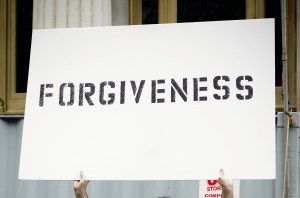
Forgiveness isn’t easy, but it one of the characteristics that sets Christianity apart from other religions and philosophies.
Photo by Felix Koutchinski on Unsplash

So if you think of love as serving others, well, lots of non-Christians promote the idea of service. Or if you think of love as caring for those in need, or speaking up for those who are marginalized, there are many non-Christian groups that do that as well.

The word I’d like to promote that could rival to the word “Love” as a defining descriptor for Christianity is the word “Forgiveness”.

The other day, I was reading in 2 Timothy 3, starting in verse 1, where Paul says:

1 You should also know this, Timothy, that in the last days there will be very difficult times. 2 For people will love only themselves and their money. They will be boastful and proud, scoffing at God, disobedient to their parents, and ungrateful. They will consider nothing sacred. 3 They will be unloving and unforgiving; they will slander others and have no self-control; they will be cruel and have no interest in what is good. 4 They will betray their friends, be reckless, be puffed up with pride, and love pleasure rather than God. (2 Timothy 3:1-4, NLT)

When I read that passage, I first noticed how Paul coupled the idea of love and forgiveness together. He said in verse 3, “they will be unloving AND unforgiving.”

Secondly, I was reminded of a tweet I had read the day before. It was from a woman who is an opinion writer for the New York Times (@ebruenig). She tweeted:

“there’s just something unsustainable about an environment that demands constant atonement but actively disdains the very idea of forgiveness”

Cancel culture is an environment where people try to shut down, ruin, or “cancel” those who have been deemed to have committed offenses that are not acceptable in today’s culture.
Photo by Marco Bianchetti on Unsplash

I was struck by that statement because I thought it cogently described our current “cancel” culture. If you don’t know what “cancel culture” is, it’s an attitude within our culture that seeks vindication and retribution on anybody and everybody for any transgression that is uncovered, no longer how long ago, that might go against current accepted standards of behavior or current accepted views.

Here’s an example of how this works. Let’s say you tweeted a coarse joke 10 years ago that was somewhat acceptable then but is considered out of bounds now. Somebody might dig that tweet up today and weaponize it by using it to “cancel” you, publicly shaming you to the point that your reputation and often your career are irreparably damaged.

I came across this statement from Alan Jacobs, a Christian who is a professor at Baylor University:

“When a society rejects the Christian account of who we are, it doesn’t become less moralistic but far more so, because it retains an inchoate sense of justice but has no means of offering and receiving forgiveness. The great moral crisis of our time is not, as many of my fellow Christians believe, sexual licentiousness, but rather vindictiveness. Social media serve as crack for moralists: there’s no high like the high you get from punishing malefactors. But like every addiction, this one suffers from the inexorable law of diminishing returns. The mania for punishment will therefore get worse before it gets better.”  (https://blog.ayjay.org/vengeance/)

What this says to me is that in our current culture love may be indistinguishable and unidentifiable to others. Of course we should love people, but our loving actions towards others may not set us apart from the culture as much as we might like to believe.

On the other hand, forgiveness, in this culture, stands out because our culture neither teaches forgiveness, nor promotes it.

Forgiveness is hard. It takes an extreme act of love to forgive others and to seek their ultimate good instead of seeking vengeance or vindictiveness.

In Matthew 5, Jesus says:

43 “You have heard that the law of Moses says, ‘Love your neighbor’ and hate your enemy. 44 But I say, love your enemies! Pray for those who persecute you! 45 In that way, you will be acting as true children of your Father in heaven. For he gives his sunlight to both the evil and the good, and he sends rain on the just and on the unjust, too. 46 If you love only those who love you, what good is that? Even corrupt tax collectors do that much. 47 If you are kind only to your friends, how are you different from anyone else? Even pagans do that. 48 But you are to be perfect, even as your Father in heaven is perfect. (Matthew 5:43-48, NLT)

I believe that what sets Christianity apart from other religions and philosophies is our ability to love others, even those who disagree with us and even those who persecute us. And I think a primary way we can demonstrate that kind of love in this current culture is in our ability to forgive others who offend us, while everyone around us is seeking retribution and vengeance.

What are your thoughts?

What do you think makes it hard to forgive others who don’t share our views or values?

How can we cultivate a heart that is willing to forgive?