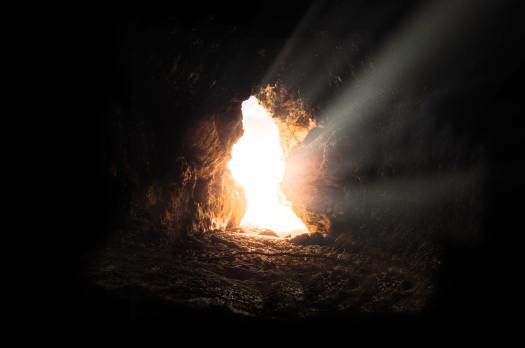
The Significance of the Torn Veil

Mark 15

33At the sixth hour darkness came over the whole land until the ninth hour. 34And at the ninth hour Jesus cried out in a loud voice, “Eloi, Eloi, lama sabachthani?”—which means, “My God, my God, why have you forsaken me?”

35When some of those standing near heard this, they said, “Listen, he’s calling Elijah.”

36One man ran, filled a sponge with wine vinegar, put it on a stick, and offered it to Jesus to drink. “Now leave him alone. Let’s see if Elijah comes to take him down,” he said.

37With a loud cry, Jesus breathed his last.

38The curtain of the temple was torn in two from top to bottom. 39And when the centurion, who stood there in front of Jesus, heard his cry and saw how he died, he said, “Surely this man was the Son of God!”

40Some women were watching from a distance. Among them were Mary Magdalene, Mary the mother of James the younger and of Joses, and Salome. 41In Galilee these women had followed him and cared for his needs. Many other women who had come up with him to Jerusalem were also there. (Mark 15:33-41, NIV)


The Daily DAVEotional

Mark 15 documents the climactic struggle of Jesus on the cross. Jesus shouts out something in Hebrew and those who are watching assume that He’s appealing to Elijah to save Him.

Jesus breathes His last breath before succumbing to the brutal effects of crucifixion, a torturous method of execution that is designed to slowly suffocate its victims.

And then comes verse 38. It’s so easy to gloss over because before this verse you have people standing around wondering if Jesus is appealing to Elijah and then immediately after this verse the focus shifts back to a centurion who had witnessed Jesus’s ordeal and who concludes that, “surely this man was the Son of God!”

So what’s the deal with verse 38? It seems so out of place to mention that the veil in the temple was torn in two right in the midst of describing Jesus’s death on the cross. It’s almost like the subliminal message that briefly interrupts the flow of the video you’re watching. If you’re not paying attention, you hardly notice it.

Yet this verse is extremely significant. If you’re familiar with the importance of the temple to Jewish religious life, the significance of this verse is probably evident. But if you’re not familiar with the role the temple played in the lives of the Israelites, let me give you some information that may shed new light on this passage.

The temple was THE center of religious life for the Israelites because it represented the very dwelling place of God. The temple was where Jews brought their sacrifices as an act of worship to God.

Inside the temple was a section called the Holy Place, which was separated by another room called the Holy of Holies. The Holy of Holies contained only one item, the Ark of the Covenant. The Holy of Holies was a room that could only be entered once per year, on Yom Kippur, by the high priest, who would enter the room and sprinkle the blood of an unblemished sacrifice on the mercy seat of the Ark of the Covenant in order to atone for the sins of the people.

The Holy of Holies was separated by a large thick veil, a curtain that created a barrier between the Holy Place and the Holy of Holies. The significance of this veil cannot be underscored. It represented the idea that God is holy and man is not and therefore, God is not accessible to man because of his sin.

Yet immediately upon Jesus’s death on the cross, this tiny, easy to overlook verse says that this veil was torn in two, giving access to the very presence of God. The text specifically says the veil was torn from top to bottom, which is no accident. The symbolism is clear – the veil was torn by God Himself, giving access to His presence that was previously unavailable.

The heart of the gospel message is this: Jesus died on a cross, atoning for the sins of the world and giving sinful humanity access to Holy God. We no longer need to make yearly sacrifices because of the sacrifice Jesus has already made on our behalf.

We have two possible responses. We can respond like the centurion, who recognized Jesus is the Son of God, or we can respond like the religious leaders, who took the torn veil, sewed it up and reattached it, thus ignoring the sacrifice that Jesus had made.

Reflection

What is your response to the death of Jesus and the tearing of the veil? Are you more like the centurion, who recognized Jesus as the Son of God? Or are you more like the Jewish religious leaders who preferred to dismiss Jesus’s sacrifice in favor of their former way of life?

What are the veils (barriers) that you put up in your life that keep you from entering into the presence of God? 

For more details about the layout of the temple click here.


Photo by Nikola Bikar on Unsplash
The Most Important Question to Ask Yourself

Mark 10

27Jesus and his disciples left Galilee and went up to the villages of Caesarea Philippi. As they were walking along, he asked them, “Who do people say I am?”

28“Well,” they replied, “some say John the Baptist, some say Elijah, and others say you are one of the other prophets.”

29Then Jesus asked, “Who do you say I am?”

Peter replied, “You are the Messiah.” 30But Jesus warned them not to tell anyone about him. (Mark 8:27-30, NLT)


The Daily DAVEotional

For the first half of the book of Mark, Jesus is revealing to His disciples WHO he is. He’s exposed his disciples to his teachings and many miracles, in which he demonstrates His power over nature, the physical realm and the spiritual realm. In Mark 8:27, Jesus asks the important question, “Who do people say I am?”

He follows up with an even more crucially important question: “Who do YOU say I am?”

When we’re engaging with others who don’t consider themselves followers of Jesus, it’s critically important that we help them come to a Biblical understanding of WHO Jesus is.

In Mark 8:28, Peter says that the main responses people often have about Jesus are “John the Baptist or Elijah, or one of the other prophets.”

People today have a lot of similar ideas about who Jesus is. Some say He’s a good teacher. Some, like Muslims, say He’s a prophet. Still others say He’s a great moral example to follow.

These do not hit the mark. Peter gives the proper response regarding who Jesus is….He is the Messiah (or “the Christ”).

The most important question you can ask yourself (or others)?

Who is Jesus?

As we engage with others regarding the Christian faith, we have to help people come to this understanding of Jesus’s identity. He is not merely a prophet. He is not just a good person or some moral example to follow.

He is God. He is the promised Messiah (the promised deliverer)!


For more information on the Biblical evidence for Jesus’ deity, see my short article “Is Jesus God?”


Did you enjoy this post? I’d love to hear your thoughts! Feel free to like, leave a comment below, and share it with your friends or on social media if you found it helpful or interesting. Your support keeps the conversation going!


Reflection

Who do you think Jesus is? Is He a good teacher? A revolutionary? A great moral example? What title or phrase would you use to describe Jesus to others?

What led you to the conclusion for how you view Jesus?

What do you think it means when Peter calls Jesus the Messiah? What does this say about Jesus?

How can you help others see Jesus’ true identity? 


Photo by Gift Habeshaw on Unsplash

What Makes Good Friday “Good”?

When you think of the full Easter story, it seems the good part is on Sunday, when Jesus is resurrected.

Have you ever wondered why Christians refer to the Friday before Easter as Good Friday? I never quite understood that myself growing up as a kid even though I went to church and heard the Easter story every year.

Think about the Easter story as a movie. The good part is at the end, when Jesus comes out of the tomb, resurrected! It seems to me that Friday is bad, at least if you’re looking at Jesus as a hero figure. On Friday, He’s dead. How is that good?

To answer that, I want to first ask a different question. Why did Jesus have to die? To put it another way, what was the purpose of Jesus’s death?

It’s an honest question, really. If Jesus is God, as he claimed, why couldn’t He just declare sins to be forgiven?

I’ve posed this question to many people over the years as I’ve engaged in conversations about Jesus and some people respond that Jesus’s death is an example to us.

I suppose that could be true, but how exactly is it an example?

Perhaps Jesus’s death was simply a demonstration of his love
Photo by Neal E. Johnson on Unsplash

Well, you might respond by pointing to the verse where Jesus says, “Greater love has no one than this, that he lay down his life for his friends.” (John 15:13, NIV)

Yes, it’s true that Jesus’s death does demonstrate the depth of His love for us. But what does that do for us?

Some people have responded to that question (Why did Jesus have to die?) by saying that Jesus’s death was a sacrifice.

Agreed. But what does it mean that His death was a sacrifice? In what way was it a sacrifice?

The simple answer to “Why did Jesus have to die?” is that God’s justice required it.

Romans 6:23 says that “the wages of sin is death.” Since the penalty of sin is death, the only way Jesus could pay for our sin was to die. He couldn’t just declare sin to be paid for because death is required.

I often share this illustration with people when talking about the importance of Jesus’s death on the cross….

In New Testament times people who owed a debt were often thrown into debtors prison until they could pay their debt or until their sentence was complete
Photo by Ashim D’Silva on Unsplash

In New Testament times, when a person committed a crime, the authorities would throw the offender in the dungeon until he made restitution or until his sentence was completed.

On the door of his cell they would list the crimes that he had committed. When he had completed his sentence or paid for his crime, they took the list and wrote ‘tetelestai’ across it, which in greek means “it is finished”, or “paid in full”.

The person would then use this document as a receipt that those specific crimes had been paid for. He could not be accused of those crimes again.

We are separated from God because of the debt that we owe as a result of our sin. The debt we owe for our sin must be paid for.

Now think about the Easter story again. Jesus is arrested, tried and crucified. The last words Jesus uttered before dying were, “it is finished” (tetelestai).

Here’s what Paul said to the Colossians about the importance of Jesus’s death:

He forgave us all our sins, having canceled the written code, with its regulations,  that was against us and that stood opposed to us; he took it away, nailing it to the cross. (Colossians 2:13-14)

Why did Jesus have to die?
Photo by Jon Tyson on Unsplash

The picture here is that Jesus had a written list of all of your sins and all of my sins and He nailed that list of all of our iniquities to the cross. Just before He died, He uttered “it is finished”, meaning that sin had been “paid in full”.

It’s as if Jesus, in his last dying breath was taking a big rubber stamp to that list and stamping it “PAID” so that we would know that sin was paid for and therefore forgiveness could be granted.

So when you think of the full Easter story, it doesn’t appear that Friday is good. It seems rather bad, if you are looking from the perspective of Jesus as the hero.

But if you realize what Jesus meant to accomplish – the redemption of mankind, the forgiveness of sins – through that lens, it’s clear that Good Friday is indeed good. Actually, it’s rather GREAT for us! Sin is paid for. We are forgiven!

Good Friday is indeed GOOD! And, that’s not even the end of the story….