11To illustrate the point further, Jesus told them this story: “A man had two sons. 12The younger son told his father, ‘I want my share of your estate now, instead of waiting until you die.’ So his father agreed to divide his wealth between his sons.
13“A few days later this younger son packed all his belongings and took a trip to a distant land, and there he wasted all his money on wild living. 14About the time his money ran out, a great famine swept over the land, and he began to starve. 15He persuaded a local farmer to hire him to feed his pigs. 16The boy became so hungry that even the pods he was feeding the pigs looked good to him. But no one gave him anything.
17“When he finally came to his senses, he said to himself, ‘At home even the hired men have food enough to spare, and here I am, dying of hunger! 18I will go home to my father and say, “Father, I have sinned against both heaven and you, 19and I am no longer worthy of being called your son. Please take me on as a hired man.”’
20“So he returned home to his father. And while he was still a long distance away, his father saw him coming. Filled with love and compassion, he ran to his son, embraced him, and kissed him. 21His son said to him, ‘Father, I have sinned against both heaven and you, and I am no longer worthy of being called your son.
22“But his father said to the servants, ‘Quick! Bring the finest robe in the house and put it on him. Get a ring for his finger, and sandals for his feet. 23And kill the calf we have been fattening in the pen. We must celebrate with a feast, 24for this son of mine was dead and has now returned to life. He was lost, but now he is found.’ So the party began. (Luke 15:11-24, NLT)
The Daily DAVEotional
Imagine you are the son (or daughter) of a very wealthy man. You have no job and you still live under his roof.
Now imagine you go to your father and you say, “You know what old man? I wish you were dead, and I wish I could cash out my inheritance right now and blow this popsicle stand.”
This is not too far off from the scenario that Jesus paints in the story of the “lost son”, more commonly referred to as the “prodigal son.”
The son in the story doesn’t use the words I’ve chosen but the effect is pretty much the same, for in the Jewish culture, it was the ultimate slap in the face to ask your father for your inheritance while he was still living. It was more than a slap in the face actually. It was the ultimate sign of disrespect, akin to giving the father the finger.
Now if you happened to be living the imagined scenario I painted at the outset, what kind of response might you expect from your father after telling him you wished he was dad and you wanted your money…NOW?
Amazingly, in the story Jesus tells, the father willingly complies. He doesn’t demonstrate anger or resentment or any kind of vindictiveness, all emotions I imagine I’d express if I were the father in this scenario.
So the son gets his wish. And what does he do?
He goes to a distant land and wastes ALL the money on wild living (i.e. partying and prostitutes). In some ways, the story mutes the degree of nastiness in which the son treats his father and exploits his wealth. But make no mistake, the son is the most extreme example of a rebel that you can fathom.
When you have no job and your sole purpose is to experience hedonism to its fullest extent, eventually you run out of money to support that crazy lifestyle. And that’s exactly what happened here too. The son had no money, no plan and no prospects. He was desperate.
He finally gets a job feeding slop to pigs. Take note of this detail. He was feeding PIGS.
Pigs were unclean animals to Jews, which is just one more detail revealing how far off the son had strayed.
It’s at this point that the story turns. The key passage in this whole story comes in verses 17-19, which says:
17“When he finally came to his senses, he said to himself, ‘At home even the hired men have food enough to spare, and here I am, dying of hunger! 18I will go home to my father and say, “Father, I have sinned against both heaven and you, 19and I am no longer worthy of being called your son. Please take me on as a hired man.”’
The son “came to his senses”. This is a biblical picture of repentance. The son came face to face with reality. He had hit rock bottom and he was finally willing to humble himself and admit the stupidity of his decisions that led to his current situation. In short, he finally took responsibility for his actions.
But he didn’t stop there. He humbled himself and was willing to admit his sin to his father. So he swallowed his pride and returned home to face his father.
Imagine if you were the son in that situation. How difficult would it be to face your father and admit you were wrong? Personally, I think a typical father would be angry and I’d expect their response to follow suit. I’d expect to be berated and “made an example of”. I’m certain I’d need to learn my lesson and take my medicine. Essentially, I’d expect to experience some kind of penalty and punishment.
But that’s not what happens in this case. The text says that when the son was still a long way off, the father SAW HIM COMING. That means the father had to be watching and waiting for the son to return.
The father doesn’t react the way we would expect because he’s like no earthly father any of us have ever experienced. The father doesn’t berate his son. He doesn’t say “I told you so”. He doesn’t require any groveling or penance. He just embraces the son and welcomes him back into the family, with full rights and privileges restored.
The story highlights the incredible love and patience God the Father has for His children.
God is not a dictator. He allows us to choose our own path. He doesn’t restrict our choices but he also doesn’t shield us from the consequences of those choices. He patiently waits for us to return. And if and when we do return, He welcomes us back with a lavish love that is beyond any kind of earthly love we could experience.
On the flip side, the son is an example of the most egregious offenses one could commit. And yet, the Father extends His love and immediately forgives and restores the son. It’s incredible.
This tells me a couple of things. First, there is nothing I can do that God won’t forgive. NOTHING. I only need to come to my senses (repent), humble myself and admit my sin, just as the son in the story did.
God doesn’t require us to grovel or do penance to receive His love and forgiveness. He freely gives it to those who come to Him with a humble heart of surrender. His love is infinite and He freely and unconditionally lavishes it on those who come to Him.
Now imagine experiencing the love of THAT Father!
Did you enjoy this post? I’d love to hear your thoughts! Feel free to like, leave a comment below, and share it with your friends or on social media if you found it helpful or interesting. Your support keeps the conversation going!
Reflection
What was your relationship like with your earthly father?
If you had done something wrong that you know he would be offended by, what would it have been like for you to think about approaching Him? What kind of reaction might you expect?
When you think of God, what words come to mind? How would you describe God to someone else?
When you find yourself sinning and “straying” from God’s plan, how easy is it for you to “come to your senses”? What keeps you from coming to your senses and returning to God?
What amazes you most about this story?
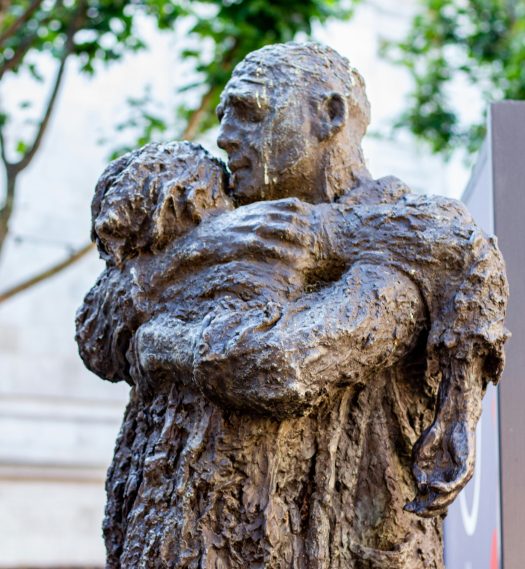
Photo by IP Withers on Unsplash – Charlie Mackesy’s Return of the Prodigal Son statue outside HTB Church London
Most people believe in an afterlife, such as the Christian concept of heaven. But, assuming heaven exists, how does one get there?
In my thousands of conversations with people, I’ve found that people overwhelmingly believe that if they were to die, they would make it into heaven. However, when asked the question,
What is God’s criteria for deciding who makes it into heaven?
most people I’ve conversed with don’t know.
To me, that’s a bit like studying for a final exam without having any idea what is going to be on the exam.
The Bible tells us that God’s plan from the beginning was that we would know Him and experience life in His presence. Man freely interacted with God and it was good.
Genesis 1:29-31 gives a picture of God’s initial creation:
27So God created man in his own image,
in the image of God he created him;
male and female he created them. 28God blessed them and said to them, “Be fruitful and increase in number; fill the earth and subdue it. Rule over the fish of the sea and the birds of the air and over every living creature that moves on the ground.” 29Then God said, “I give you every seed-bearing plant on the face of the whole earth and every tree that has fruit with seed in it. They will be yours for food. 30And to all the beasts of the earth and all the birds of the air and all the creatures that move on the ground—everything that has the breath of life in it—I give every green plant for food.” And it was so. 31God saw all that he had made, and it was very good.
POINT 1: GOD’S PLAN
GOD LOVES YOU AND CREATED YOU FOR A PURPOSE
God’s Love
The Bible is clear that one of God’s attributes is love.
1 John 4:8-9 says:
Whoever does not love does not know God, because God is love. This is how God showed his love among us: He sent his one and only Son into the world that we might live through him.
God demonstrated His love by sending His Son Jesus into the world to ultimately die on our behalf.
God’s Purpose
In John 10:10 (NLT), Jesus gives a glimpse into his purpose. He said:
The thief’s purpose is to steal and kill and destroy. My purpose is to give life in all its fullness.
Jesus came so that we might experience life in all its fullness – that we would begin to fulfill the purpose for which we’ve been created, which is to know Him and experience His presence in our lives.
REFLECT What do you think it means to experience life in all its fulness? What would that look like?
“Fullness of Life” Expanded
Here’s another way to think about it. When Jesus says that His purpose is to give “life” in all its fulness, He’s talking about giving eternal life.
In John 17:3 (NIV), Jesus said this:
Now this is eternal life: that they may know you, the only true God, and Jesus Christ, whom you have sent.
Jesus defines eternal life as knowing God – experiencing a relationship with Him. Therefore, when Jesus says His purpose to give life in all its fullness, what He’s saying is that He has come to offer people a relationship with Him (life) and He wants people to experience that relationship to the fullest extent possible.
REFLECT Why do you think people are not experiencing life in all its fullness? What keeps them from knowing God?
POINT 2: OUR PROBLEM
WE’VE REBELLED AGAINST GOD AND ARE THEREFORE SEPARATED FROM HIM. AS A RESULT, WE CANNOT EXPERIENCE HIS PURPOSE FOR OUR LIVES, WHICH IS TO KNOW HIM.
The Fall – the Original Rebellion
According the Bible, God’s good creation was distorted when man disobeyed God and was exiled from God’s presence. Genesis 3 tells the story of the fall of mankind (Read Genesis 3).
Adam and Eve freely interacted with God, who had given them free reign over the entire garden. They took care of it and they were given every seed-bearing plant for their food. However, there was one tree they were forbidden from eating – the fruit from the tree of the knowledge of good and evil.
Adam and Eve were deceived by the serpent (Satan) to eat this forbidden fruit. Because of their disobedience, God banished them from the garden.
Have you ever wondered why God forbade Adam and Eve from eating from that one particular tree? Was it random? Or was there a reason why that specific tree was off limits. Read this article (Why Did God Forbid this One Fruit?) to understand why this particular tree was off limits.
The rest of the Bible is the story of God’s plan to restore man’s relationship with Him and to reverse the curse that was inflicted upon creation as a result of this original sin.
The Results of Sin
It’s at this point that one might argue that we should not be punished for Adam and Eve’s rebellion. But the Bible is clear that EVERYONE has sinned against God.
Romans 3:23 says:
For all have sinned; all fall short of God’s glorious standard. (NLT) [Emphasis added]
But I’m a Good Person
In my experience, I’ve found that most people tend to think of themselves as “good”.
In our society goodness and badness are relative terms that are used in comparison to other people. I’ve found that most people consider themselves to be good because they compare themselves to others who, in their mind, have done more egregious and heinous acts. But comparing ourselves to other people is using the wrong standard of comparison.
The Bible says that only God is truly good. What this means is that God’s standard for goodness is perfect holiness and by this standard, He is the only one who is truly good.

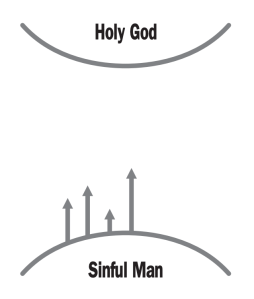
Notice the diagram to the right. God is holy and man is sinful and there’s a great chasm that separates man from God. The arrows illustrate that man continually tries to reach God through various efforts, such as religion, good works, etc. But all of these efforts ultimately fall short because God is perfectly holy, and there is no amount of good works that will enable man to achieve God’s standard of perfection.
REFLECT How does your definition of goodness compare or contrast with what the Bible says about goodness?
What is Sin?
The word “sin” is one of those churchy, religious words that many people associate with behaviors that others don’t approve of but we think is no big deal. For example, you may see nothing wrong with drinking while some “uptight, religious people” think drinking is a “sin”.
REFLECT How do you define sin? What do you think sin is?
Sin not just a list of immoral or socially unacceptable behaviors. When Romans 3:23 says that “all have sinned”, the Greek word for sin is actually an archery term.
In a competition, the archer would shoot the arrow and the goal was to hit the bullseye on the target. If the archer missed the bullseye, even if it was only by a fraction of an inch, it was considered an imperfect mark, which was called a sin.
So when the Bible says we’ve all sinned, it means that no matter how hard you’ve tried and no matter how good you think you are, you (and all people) have missed the mark of God’s standard, which is perfect holiness.
That raises the bar quite a bit doesn’t it?
Things are complicated by the fact that God is not only perfectly holy, but He’s perfectly just, and as a result, He must punish sin. He cannot just overlook it or ignore it. Sin is a violation of the very nature and character of God and His goodness, so sin must be punished.
According to Romans 6:23, the punishment, or penalty for sin is DEATH!
For the wages of sin is death, but the free gift of God is eternal life through Christ Jesus our Lord.
You might be thinking, “well we’re all going to die so what does it matter?”
Death here refers to being separated from God. So, the result of sin, or the punishment for sin is that we will experience a separation from God, FOR ETERNITY! This is literally what hell is – the complete absence of God and everything good.
POINT 3: GOD’S PROVISION
JESUS CHRIST PROVIDES THE ONLY SOLUTION TO MAN’S SIN. Through Jesus, the barriers that kept us from experiencing God’s purpose have been removed – we now have access to God and can know Him.
If everyone has sinned and God, in His justice, must punish sin, then it seems as if there is no solution to our problem. We are all seemingly doomed to punishment!
But God, in His goodness, creates a solution that only He can provide. The solution is in His son Jesus.
Christ Died for Us
Romans 5:8 says,
But God showed his great love for us by sending Christ to die for us while we were still sinners.
REFLECT If God can forgive sin, why couldn’t he just declare it to be forgiven? Why do you think Jesus had to die to pay for sin?
Why did Jesus Have to Die?
Why do you think Jesus had to die in order to pay for sin?
Jesus had to die to pay for sin because God’s justice demands that the only valid payment for sin is death.
For the wages of sin is death…Romans 6:23
Jesus died in our place, thus paying the penalty that God’s justice demanded (death) but doing it in a way that allows humankind to avoid the penalty.
The reason that Jesus could do this is because He is God. As God, He has the very righteousness that God requires for those who wish to come into His presence. Through Jesus’ death, we can be forgiven for our sins and not only avoid the penalty for sin, but experience a relationship with God!
Colossians 1:13, 14 says,
For he has rescued us from the one who rules in the kingdom of darkness, and he has brought us into the Kingdom of his dear Son. God has purchased our freedom with his blood and has forgiven all our sins.
Christ Rose from the Dead
Not only did Jesus die for us, but the Bible says that He rose from the dead.
1 Corinthians 15:3-6 states:
For what I received I passed on to you as of first importance: that Christ died for our sins according to the Scriptures, that he was buried, that he was raised on the third day according to the Scriptures, and that he appeared to Peter, and then to the Twelve. After that, he appeared to more than five hundred of the brothers at the same time,
REFLECT If Jesus had never risen from the dead, would it make any difference? What do you think is the significance of the resurrection?
Read this article, He is Risen….Why Does it Matter? to understand the significance of the resurrection to the Christian message.
Jesus is the Only Way to God
In John 14: 6, Jesus says:
“I am the way and the truth and the life. No one comes to the Father except through me.”
Notice that He doesn’t say, “I’m one of the ways, I’m one of the truths, I’m one of the lives. There are lots of ways to get to the Father, but I’m a pretty good way, so check me out, I’m cool!”
NO!
He says, “I am the way, the truth, and the life; no one comes to the Father, but through Me.”
He could say this because He is the only one who has made a valid payment for sin. Hence, only Jesus can take away our sin.
The image above demonstrates that God realized that man could not bridge the gap that separated them because of man’s sin. The distance is too wide. If you think about it, God is infinitely holy so the gap between His holiness and man’s is an INFINITE gap!
Because we could not bridge the gap ourselves, God bridged the gap for us. He sent His son Jesus, who is INFINITELY holy and righteous. Jesus’ death bridges the gap and creates a path for people to come into God’s presence and experience a relationship with Him.
POINT 4: OUR RESPONSE
We each must receive the free gift that Jesus offers – His death as payment for our sins. Only then can we experience His purpose, which is to KNOW Him.
Knowing this information doesn’t make a person a Christian. Even if you agree with everything that has been outlined so far, it doesn’t mean you are a Christian.
What makes a person a Christian is when they respond to the invitation of Jesus to accept Him and His death as a free gift that pays for your sin and provides complete forgiveness.
John 1:12 (NLT) says,
But to all who believed him and accepted him, he gave the right to become children of God.
If you want to become a Christian (a child of God), then you must believe in Jesus and accept Him.
REFLECT What do you think it means to accept Jesus?
We Receive Christ Through Faith
Ephesians 2:8, 9 (NIV) says,
For it is by grace you have been saved, through faith—and this not from yourselves, it is the gift of God— not by works, so that no one can boast.
Accepting Him simply means you accept the free gift that He offers of being saved by His death on the cross. It means that you acknowledge that His death alone can pay for sin and you put your trust in His death to provide forgiveness instead of trusting in your own good works to earn favor with God.
We Receive Christ by Personal Invitation
In Revelation 3:20, Jesus gives this invitation:
Here I am! I stand at the door and knock. If anyone hears my voice and opens the door, I will come in and eat with him, and he with me.
REFLECT What do you think the door represents in this verse? How do you think a person opens the door?
Opening the Door
The door represents your heart (your will). Jesus is inviting you to open yourself up and let Him in. The way you do that is simply by putting your trust in Jesus and His death to save you instead of trusting in your own perceived goodness to “earn” your way into heaven.
KEY QUESTIONS:
Have you ever opened the door of your life and let Jesus in to begin a relationship with Him?
If so, when was that? What were the circumstances that led you to make that decision?
If not, do you want to open the door of your life to Jesus and begin a relationship with Him?
The key to opening the door is to decide to put your trust in Jesus instead of trusting yourself. One way you can express your faith to God is simply telling Him that you want to accept His free gift and you want Jesus to come into your life. We call this prayer. Take a minute right now to express your faith and desire for Jesus to come into your life by repeating the following prayer:
Lord Jesus, I need you. I acknowledge that I am a sinner and there is no way I can earn my way into heaven. I want to trust in Jesus and His death to pay the penalty for my sins and provide forgiveness. I open the door of my life now and I invite Jesus to come in so that I might begin a relationship with Him and know Him. Amen.
Things to Remember…
God’s criteria for who makes it into heaven is not how good you are but whether you have the Son (Jesus).
And this is the testimony: God has given us eternal life, and this life is in his Son. He who has the Son has life; he who does not have the Son of God does not have life. (1 John 5:11-12, NIV)
You can KNOW you have eternal life, if you have the Son.
Jesus defined eternal life as knowing Him (John 17:3). Hence, you can have eternal life if you have the Son – if you have a relationship with Him.
You can have the Son (Jesus), simply by accepting Him and the free gift that He offers – His death on the cross as a payment for all of your sins.
Jesus gives an invitation to everyone. He is standing at the door of each person’s heart. He’s knocking. He wants to come into your life and begin a relationship.
But we have to open the door.
Opening the door is a matter of choosing to put our trust in Jesus instead of trusting in our own goodness. It means that we acknowledge that we have sinned and we cannot earn our way to God. We recognize that Jesus ALONE can pay for sin and we accept the free gift of His death as a payment for our sins.
When we make that decision to open the door to Jesus, we experience complete forgiveness of sin and Jesus enters our life, establishing a relationship with us.
Once we have the Son (Jesus), we have the life, which is defined by Jesus as knowing Him.
QUESTIONS FOR REFLECTION
1. Did you open the door an invite Jesus into your life?
2. Where is Jesus right now in relation to you?
3. After a person receives Christ, what do you think a person has to do in order to keep Jesus in their life? What do you think is required?
4. What questions do you have about the Christian faith?
WHAT NOW?
If you prayed that prayer to invite Jesus into your life, the Bible says that you are a new creation. You are now a child of God!
You can request some free resources and next steps by going to our Prayer Page, giving us your name and writing in the box, “I received Christ and would like to know how to begin growing in my new faith.”
We will respond to you with some resources and help to take some next steps.
1Listen as wisdom calls out! Hear as understanding raises her voice! 2She stands on the hilltop and at the crossroads. 3At the entrance to the city, at the city gates, she cries aloud, 4“I call to you, to all of you! I am raising my voice to all people. 5How naive you are! Let me give you common sense. O foolish ones, let me give you understanding. 6Listen to me! For I have excellent things to tell you. Everything I say is right, 7for I speak the truth and hate every kind of deception. 8My advice is wholesome and good. There is nothing crooked or twisted in it. 9My words are plain to anyone with understanding, clear to those who want to learn.
10“Choose my instruction rather than silver, and knowledge over pure gold. 11For wisdom is far more valuable than rubies. Nothing you desire can be compared with it.
12“I, Wisdom, live together with good judgment. I know where to discover knowledge and discernment. 13All who fear the LORD will hate evil. That is why I hate pride, arrogance, corruption, and perverted speech. 14Good advice and success belong to me. Insight and strength are mine. 15Because of me, kings reign, and rulers make just laws. 16Rulers lead with my help, and nobles make righteous judgments.
17“I love all who love me. Those who search for me will surely find me. 18Unending riches, honor, wealth, and justice are mine to distribute. 19My gifts are better than the purest gold, my wages better than sterling silver! 20I walk in righteousness, in paths of justice. 21Those who love me inherit wealth, for I fill their treasuries.
22“The LORD formed me from the beginning, before he created anything else. 23I was appointed in ages past, at the very first, before the earth began. 24I was born before the oceans were created, before the springs bubbled forth their waters. 25Before the mountains and the hills were formed, I was born—26before he had made the earth and fields and the first handfuls of soil.
27“I was there when he established the heavens, when he drew the horizon on the oceans. 28I was there when he set the clouds above, when he established the deep fountains of the earth. 29I was there when he set the limits of the seas, so they would not spread beyond their boundaries. And when he marked off the earth’s foundations, 30I was the architect at his side. I was his constant delight, rejoicing always in his presence. 31And how happy I was with what he created—his wide world and all the human family!
32“And so, my children, listen to me, for happy are all who follow my ways. 33Listen to my counsel and be wise. Don’t ignore it.
34“Happy are those who listen to me, watching for me daily at my gates, waiting for me outside my home! 35For whoever finds me finds life and wins approval from the LORD. 36But those who miss me have injured themselves. All who hate me love death.” (Proverbs 8:1-36, NLT)
The Daily DAVEotional
When I was a high school senior, I took AP English. At one point we were studying poetry and we read a famous poem by Robert Frost, entitled, “The Road Not Taken”. The poem starts with the line:
Two roads diverged in a yellow wood,
and ends with the oft-quoted phrase:
Two roads diverged in a wood, and I—
I took the one less traveled by,
And that has made all the difference.
Our teacher asked the class what we thought the poem was about. A few people in the class who had a somewhat religious background, including myself, thought the poem was a metaphor for heaven and hell. After all, if you’re going to talk about two roads that diverge, you cannot get any more divergent than heaven and hell.
I remember our teacher graciously telling us that we were overthinking the poem. There was nothing in the poem that mentioned heaven or hell and the context of the poem was not about eternal destiny. There was really nothing about the poem that would indicate that it was religious in nature.
To my surprise, I learned that the plain meaning was usually the correct meaning, unless there was some compelling reason to believe that the writer was speaking metaphorically or allegorically.
In our case, the poem was simply about two different choices, both of which were appealing in their own way. Which one should I choose? How do you choose? The author is simply writing about the conflict that arises when we have to choose between two paths. That’s it.
What can happen though is that some people will naturally want to import their own views and perspectives into the poem. In my case, being a person who went to church and Sunday school and who had heard a lot about the two different life choices of heaven and hell, I saw “two paths” and immediately concluded “heaven and hell” without really thinking about whether that was what the author was really writing about.
The Jehovah’s Witnesses make a similar error in their understanding and explanation of Proverbs 8.
If you’ve ever had a discussion with a Jehovah’s Witness, you likely know that they do not believe that Jesus is God. Instead, they teach that Jesus is a created being. They believe that Jesus is God’s first created being, which makes him extra special, but in the end, he’s still a created being like you and me.
The Jehovah’s Witnesses theological viewpoints on Jesus are rooted in an ancient heresy known as Arianism. I wrote about their views in my blog post “A Modern Day Version of an Ancient Heresy” in which I discuss their views of the opening verses of John’s gospel.
When talking to a Jehovah’s Witness regarding their view that Jesus was a created being, they have a number of biblical “proof-texts” to support their theological stance. One of those passages is Proverbs 8.
According to the Jehovah’s Witness, Proverbs 8 provides ironclad evidence that the Bible teaches that Jesus is NOT God.
Verses 22-31, in particular, demonstrate that Jesus is created. The Jehovah’s Witness argument is that Jesus is speaking about how he was formed “before he created anything else.” Jesus was there at God’s side when He created everything.
To the Jehovah’s Witness, this fits perfectly with their view that Jesus was the first created “thing” and then God created everything else through Jesus.
There is only one problem with this reasoning – the subject of this passage is wisdom not Jesus.
The Jehovah’s Witnesses, in their haste to project their theological view of Jesus into any text that might have words or phrases that trigger their theological bias, have erred in much the same way I, and others in my high school English class, so quickly attributed a wrong context to Robert Frost’s famous poem.
Solomon, the author of Proverbs, is using a literary device known as personification to explain and highlight the importance of wisdom.
There is nothing in the context to suggest that Wisdom is really Jesus. Actually, when you really look at this passage, you realize that the text cannot be referring to Jesus. Here are a couple of reasons why:
First, wisdom in this passage is identified as a female, whereas Jesus is male.
Secondly, if wisdom is an actual person, then “good judgment” must also be a person because wisdom lives with good judgment according to verse 12. If wisdom is really Jesus, then who is this “good judgment” character?
Lastly, if you know anything about the broader context of Proverbs, it is a collection of sayings and instruction regarding wise living. This is made clear at the very outset of the book:
The purpose of these proverbs is to teach people wisdom and discipline, and to help them understand wise sayings. 3Through these proverbs, people will receive instruction in discipline, good conduct, and doing what is right, just, and fair. 4These proverbs will make the simpleminded clever. They will give knowledge and purpose to young people. (Proverbs 1:1-4, NLT – emphasis added)
Additionally, in this particular section of the book, Wisdom is personified as a female instructor. Proverbs 9 continues with this personified motif as Wisdom is contrasted with Folly, both of whom are given female personalities.
So if this passage isn’t speaking about Jesus, what is the point being made?
The point of this passage is summarized at the end, in verses 32-36, which state:
32“And so, my children, listen to me, for happy are all who follow my ways. 33Listen to my counsel and be wise. Don’t ignore it.
34“Happy are those who listen to me, watching for me daily at my gates, waiting for me outside my home! 35For whoever finds me finds life and wins approval from the LORD. 36But those who miss me have injured themselves. All who hate me love death.”
In short, the reader is encouraged to “listen to my counsel and be wise.”
In the end, the Jehovah’s Witnesses commit an error we call eisegesis, which occurs when one imports their own viewpoint or bias into the interpretation of the text. Good Bible interpretation will instead interpret the passage based on the plain meaning and the context while resisting the urge to make the passage say what the reader wants or hopes that it will say.
Did you enjoy this post? I’d love to hear your thoughts! Feel free to like, leave a comment below, and share it with your friends or on social media if you found it helpful or interesting. Your support keeps the conversation going!
Reflection
The error of eisegesis, where one interprets a text in such a way that it fits with their pre-conceived views, is not just a problem with Jehovah’s Witnesses. People everywhere commit this error. What are some views you have that you are more apt to try to find the text to support? In other words, what are some ways you have, or are tempted to commit this error of eisegesis?
Why do you think the Jehovah’s Witnesses are so committed to their view that Jesus is a created being?
What are some of the benefits of wisdom according to this passage?
What do you think are some good Bible study habits and techniques that will help you to interpret passages correctly, without importing your personal views into the interpretation of the passage?
1“I am the true vine, and my Father is the gardener. 2He cuts off every branch in me that bears no fruit, while every branch that does bear fruit he prunes so that it will be even more fruitful. 3You are already clean because of the word I have spoken to you. 4Remain in me, and I will remain in you. No branch can bear fruit by itself; it must remain in the vine. Neither can you bear fruit unless you remain in me.
5“I am the vine; you are the branches. If a man remains in me and I in him, he will bear much fruit; apart from me you can do nothing. 6If anyone does not remain in me, he is like a branch that is thrown away and withers; such branches are picked up, thrown into the fire and burned. 7If you remain in me and my words remain in you, ask whatever you wish, and it will be given you. 8This is to my Father’s glory, that you bear much fruit, showing yourselves to be my disciples. (John 15:1-8, NIV)
The Daily DAVEotional
Have you ever wondered what the Christian life is all about? For many people, living as a Christian has been reduced to a series of religious activities, such as attending church, being in a bible study and serving in various ministry capacities.
While these activities aren’t bad, Jesus is clear that the goal of the Christian life is to “bear much fruit, showing yourselves to be my disciples.”
So how exactly does one “bear fruit”? HINT – it doesn’t happen because of our religious activities.
In John 15, Jesus gives a picture of fruitfulness by describing the relationship between a vine and its branches.
Being in a more agrarian society, Jesus’ audience likely would have understood the analogy in greater depth than we might, given that most of us probably didn’t grow up on a farm and may never have had much experience with vines or vineyards.
Nevertheless, it’s not a complicated concept to understand. Similar to a tree trunk, which gets its nourishment from a well-developed root system and then delivers it to the branches, a vine is the source of nourishment for the branches that are connected to it.
The key to bearing fruit for a branch is staying connected to the vine. If a branch is disconnected from the vine somehow, it will not produce fruit. Jesus emphasizes this point with the phrase “remain in me”, which he repeats six times in these eight verses.
What does Jesus mean when He says to “remain in me”?
The greek word used here is the word “meno”, the primary meaning of which is to stay in a given place, state or relation. Other words that help define the word “meno” are abide, continue, dwell, endure, be present, remain, and stand.
To remain in Jesus means we are to stay relationally present with Him. That word “dwell” evokes an image of Jesus being present with me in my living room, in my car when I’m driving, at my work place, when I’m out and about, when I’m hanging out with the guys or when I’m alone with no one around me to see what I’m doing. In short, I’m aware of Jesus’ presence in my life wherever I’m at and whatever I’m doing.
You don’t have to be a viticulturalist to know that the natural outcome of a branch that is connected to a vine is fruit. If there is no fruit, you know there is a problem somewhere. The same is true in our spiritual lives. If there is no fruit in your spiritual life, there is a problem.
So what are the problems that might result in a lack of fruit?
Verse 2 says that He “cuts off” branches that don’t produce fruit, while He “prunes” some branches that do bear fruit so that they will be more fruitful.
The Greek word that is translated as “cuts off” in the NIV, and “takes away” in the NASB is the Greek word “airo” which literally means “to lift up”.
In a vineyard, some branches would end up on the ground and would not have access to sunlight. These branches would grow but they wouldn’t produce grapes. Jesus is saying that branches that were lying on the ground would be “lifted up” so that they would have access to sunlight and thus would be able to bear fruit.
It’s easy to think we’re connected to Jesus because our lives are filled with religious activities, but remaining with Jesus means that I understand that He is the onlysource of spiritual life. He is the true vine.
As part of our fallen nature, we all try to fill the needs and cravings in our life in inauthentic ways, whether it’s work, hobbies, money, entertainment, sex or whatever. None of these avenues can truly satisfy us. Only Jesus can provide TRUE spiritual life and nourishment that satisfies and fulfills.
So if you’re not bearing fruit, perhaps it’s because you’re not depending on Jesus alone as your true source of spiritual nourishment and fulfillment. Jesus wants to lift you up out of the dirt and bring you into the light of His word and His truth so that you can begin to bear fruit.
Another possible reason we may be experiencing a lack of fruit is that we need to be “pruned”. Jesus says that He (God the Father) prunes every branch that does bear fruit so that it will bear more fruit.
The word that is translated “prune” is the greek word “kathairo” which means “to cleanse, to prune.” Vinedressers would routinely clean and wash the branches on the vine to rid them of pests that might destroy the leaves and interrupt the fruit-bearing process.
If you’re lacking fruit in your life, perhaps you need Jesus to cleanse you. In other words, maybe there is a sin issue that is keeping you from being fully dependent on Jesus and as a result, is negatively impacting your ability to bear fruit in your life.
Are you starting to get the picture? Jesus wants us to bear fruit, just as a branch connected to a vine would produce fruit.
But we are unable to produce fruit on our own. Only Jesus can produce fruit. We bear fruit if we simply stay connected to Him in a dependent relationship.
If we are lacking fruit, it is likely because we are depending on something apart from Jesus to provide fulfillment in our lives.
Did you enjoy this post? I’d love to hear your thoughts! Feel free to like, leave a comment below, and share it with your friends or on social media if you found it helpful or interesting. Your support keeps the conversation going!
Reflection
What are some of the inauthentic ways you seek to fulfill the needs and cravings in your life?
Describe a time when you realized that you were not producing fruit? What was happening in your life? What caused you to realize that you were not fruitful?
What are some practical ways you can seek to remain in Jesus? How do you demonstrate your dependence on Him?
What do you think spiritual fruit is? How do you define it? What does it look like in your life to produce “fruit”?
What are the religious activities you are regularly involved in? In what ways are these activities helping you grow in your dependence on Jesus? How can you avoid falling into the trap of thinking that these religious activities alone will produce “fruit” in your life?
16I delight in your decrees; I will not neglect your word.
20My soul is consumed with longing for your laws at all times.
24Your statutes are my delight; they are my counselors.
40How I long for your precepts! Preserve my life in your righteousness.
43Do not snatch the word of truth from my mouth, for I have put my hope in your laws.
47for I delight in your commands because I love them.
48I lift up my hands to your commands, which I love, and I meditate on your decrees.
70Their hearts are callous and unfeeling, but I delight in your law.
72The law from your mouth is more precious to me than thousands of pieces of silver and gold.
77Let your compassion come to me that I may live, for your law is my delight.
92If your law had not been my delight, I would have perished in my affliction.
97Oh, how I love your law! I meditate on it all day long.
103How sweet are your words to my taste, sweeter than honey to my mouth!
111Your statutes are my heritage forever; they are the joy of my heart.
113I hate double-minded men, but I love your law.
119All the wicked of the earth you discard like dross; therefore I love your statutes.
120My flesh trembles in fear of you; I stand in awe of your laws.
127Because I love your commands more than gold, more than pure gold,
129Your statutes are wonderful; therefore I obey them.
140Your promises have been thoroughly tested, and your servant loves them.
143Trouble and distress have come upon me, but your commands are my delight.
159See how I love your precepts; preserve my life, O LORD, according to your love.
163I hate and abhor falsehood but I love your law.
165Great peace have they who love your law, and nothing can make them stumble.
167I obey your statutes, for I love them greatly.
174I long for your salvation, O LORD, and your law is my delight.
(Psalm 119 – selected verses, NLT)
NOTE: Psalm 119 is the longest chapter in the entire Bible. I’ve included selected verses that reflect the content of this blog post
The Daily DAVEotional
A while back, I read a social media post from a person with a sizable following in which he exhorted people, “Don’t make the Bible an idol.”
My first thought was, “what does that even mean?”
Is it possible to make the Bible an idol? What would that even look like?
I immediately thought about this Psalm (119), which is the longest chapter in the entire Bible and is an extended discourse on the wonders and virtues of God’s word. I’ve written about this Psalm before in my post “The Endless Virtues of God’s Word.”
It’s well worth your time to read the entire Psalm but due to the sheer length of the text, I’ve only included selected verses that highlight the devotion, awe and love that the psalmist has for God’s word.
If ever someone might be accused of worshiping God’s Word and making it an idol, it would be the author of Psalm 119. Notice some of the language he uses to express his feelings about God’s laws, statutes and precepts.
Words like delight, love, long, hope, consumed, sweet, joy, precious and awe are all used to describe how the psalmist feels about God’s laws.
There is clearly a reverence and respect and a deep LOVE for God’s word. But does that equate to idol worship?
To answer that question, we need to understand what idol worship is.
I wrote in a previous blog post, “A Discourse on the Foolishness of Idols” that an idol can be thought of as a substitutionary object of trust. Instead of trusting in God as your deliverer, your provider, your protector, your source of life, your savior, etc, you transfer that trust to something or someone else.
But you can also think of an idol as anything that takes priority or precedence in your heart over God.
So how about this Psalmist? Is he guilty of idol worship? Is it possible to elevate the Bible to a position over God in our lives?
I suppose that if I were to worship the physical book of the Bible as if it were a deity itself, I could be accused of idol worship. But I don’t think that is what’s happening with the psalmist.
The word of the Lord – his law, precepts, ordinances and statutes – are all merely an extension of God Himself. They are not God, but they are a revelation of the character of the true God.
When the psalmist says he loves God’s law, and he delights in His word, he’s making a statement about God’s character. He’s acknowledging that God’s word is a source of revelation about God’s nature and in it, God has provided wisdom and instruction for righteous living.
God’s word tells us who He is and how we’re to live. The psalmist simply acknowledges these facts. Moreover, he’s speaking directly to God when he makes these statements. Therefore, the praise and adoration is directed toward God and not some inanimate scroll.
Think of it this way – let’s say you read a book that you really loved. Then one day you meet the author at a book signing. While you’re at the table, you go on and on about how much you loved the book. You share that the character development, plot lines and context were all relatable and engrossing. Do you think the author will be offended because you praised his/her work and not the author directly? No, the book is an extension of them and it is obvious to all that your praise is directed toward the author.
That is exactly what is happening in this psalm. The psalmist is simply recognizing that God’s laws and statutes are righteous and life-giving.
So why would this online social media influencer bark out that we should not make the Bible an idol? Why is this even a concern?
My desire to answer this question led me down an online rabbit hole. This particular influencer, and others who also warn that we should not make the Bible an idol, belongs to a strain of religious faith that is known as Progressive Christianity.
Progressive Christianity uses the word “Christianity” but it is hardly Christian. While they utilize the same language and reference the same characters as traditional Christianity, they redefine the meaning of words, concepts and even characters in order to suit their own theological preferences.
Progressive Christians occupy a broad spectrum of beliefs but there are some things that tend to be common among most who identify themselves as being a part of this camp.
Perhaps the hallmark value of Progressive Christianity is their view that God is always evolving. Hence, there is an emphasis on searching and questioning, while those claiming to know truth may be labeled as unenlightened or immature.
Progressive Christianity tends to be very ecumenical, embracing all faith religions and ideologies as equally valid and helpful. Loving others means you shouldn’t offend others by telling them that their beliefs might be wrong. Hence, Jesus has been recast from His role as exclusive Savior of the world to that of a moral teacher whose example we’re to follow.
Standing in contrast to Progressive Christianity is Orthodox Christianity, which teaches that God can be known because He has revealed Himself to us through His word and through the person of Jesus.
In addition, orthodox Christianity teaches that God is NOT evolving. He has laid out for us in His word what His standards are for living and because God doesn’t change, the standards and statutes set forth in His word apply to us today.
Perhaps you are starting to see the problem. If God doesn’t change, then that means His moral code and His rules for righteous living are not optional and must be obeyed today.
The Progressive Christian attempts to get around this by doubling down on the assertion that God IS evolving while adding the caveat that the Bible is not written by God.
Their claim is that the Bible we have is simply a record of writings by fallible men; they are NOT God’s spoken words. While the Bible may be helpful and inspiring, it is only a tool that you may choose to use; it is NOT authoritative for our lives. If the Bible lacks authority, then it logically follows that I don’t have to abide by all of its restrictive and antiquated rules and regulations.
This is where the rubber meets the road. For the evangelical (orthodox) believer, the Bible is authoritative, for it reveals God’s very nature to us and it contains His laws, statutes, precepts and ordinances for righteous living. This is what the psalmist was extolling in Psalm 119.
The Progressive Christian denies that God is the author of Scripture and so for anyone who believes in the authority of Scripture, they are told by the Progressive Christian, “Don’t make the Bible an idol.”
So you see that this whole argument is based on a completely different foundational view of God’s nature and how he reveals Himself to mankind. The Progressive Christian denies that the Bible is an authoritative tome that accurately reflects God’s nature and provides rules and guidance for living. To them, there are many other ways God may communicate to us apart from the Bible, including other faith traditions.
This denigration of the authority of Scripture allows the Progressive Christian to decide for himself which of the statutes in the Bible are valid for today and which ones aren’t. Conveniently, this allows the Progressive Christian to formulate a view of God that matches their preferences and proclivities exactly, which, strangely, is exactly the definition of forming an idol.
Amazingly, we’ve come full circle. The Progressive Christian tells us not to make the Bible an idol because doing so limits God and restricts our view of Him to how He is portrayed in Scripture.
Meanwhile, the Progressive Christian untethers themselves from the shackles of Biblical revelation of God as an immutable template for representing who God is, opting instead for the freedom to develop an image of God that is highly influenced by their own experiences and preferences.
Ironically, that sounds like idol worship to me.
To learn more about Progressive Christianity and what they believe, watch this 12 minute video from apologist Alisa Childers
Reflection
What is your view of the Bible? Do you see it as God’s word or a collection of writings written by fallible men?
What is the source of your information about God? How can you know if your view of God is accurate to who God really is rather than just an image you developed about Him that suits your preferences?
Do you think that the commands of the Bible are valid for people today or are they optional? What are the reasons for your position?
What has been your experience with Progressive Christianity? Do you think Progressive Christianity is compatible with traditional, orthodox Christianity? Why or why not?
Why do you think people opt for a Progressive version of Christianity instead of traditional, orthodox Christianity? What do you think are some of the main reasons and driving forces?
1“Don’t be troubled. You trust God, now trust in me. 2There are many rooms in my Father’s home, and I am going to prepare a place for you. If this were not so, I would tell you plainly. 3When everything is ready, I will come and get you, so that you will always be with me where I am. 4And you know where I am going and how to get there.”
5“No, we don’t know, Lord,” Thomas said. “We haven’t any idea where you are going, so how can we know the way?”
6Jesus told him, “I am the way, the truth, and the life. No one can come to the Father except through me.”
(John 14:1-6, NLT)
The Daily DAVEotional
What is truth?
I think the best way of defining truth is “that which corresponds to reality.”
We live in a time and culture where many people are not too concerned with truth, especially as it relates to religious beliefs.
The predominant view regarding religion today is that of pluralism, the idea that there is no ONE right view or true religion. Most people think that whatever works best for you is good for you. If you think about it, this totally fits our postmodern culture.
Postmodernism is a reaction or a rejection to the philosophy of modernism, which is also known as naturalism. While naturalism emphasized logic and repeated observation and experience to arrive at truth (seen most notably in modern science and the scientific method), postmodernism emphasizes one’s own experience as the basis for truth.
Hence, for most people, there is not ONE truth, but there can be many truths, because truth is whatever your experience tells you it is.
Enter Jesus in John 14. Jesus is interacting with his disciples shortly before he is arrested and crucified. In preparing his disciples for what they will soon encounter with his death, resurrection and ascension, he tells them that he’s going to prepare a place for them. He also tells them that they know the way to get to where he’s going.
The disciples are confused. “We don’t know where you’re going….so how could we know how to get there?”
In typical fashion, the disciples are perplexed because Jesus is talking about a spiritual reality while the disciples are thinking only about the physical reality they’re currently in.
Jesus’ response to his disciples is profound and has far-reaching implications. He says:
“I am the way, the truth, and the life. No one can come to the Father except through me.”
Jesus uses three separate terms to describe himself:
I am the way – Jesus defines himself as THE way, not “a” way. In our diverse world of religious pluralism, Jesus does not describe himself as one alternative path among many. Jesus is not an option that suits some people while Buddha, Mohammad or Confucius might be more preferable for others. Jesus is not a preference. Jesus is THE option.
I am the truth – Jesus says that he is THE truth. If truth is that which corresponds to reality, then Jesus is saying that he is the ultimate reality. His life and His words accurately depict what is real. What this means is that Jesus’ words are not mere suggestions to consider. Instead, they are the basis of reality for everyone, not just those people who prefer Jesus over some other religious leader or humanistic ideology.
I am the life – Jesus also describes himself as THE LIFE. Jesus is not just a way to experience a better life as if he is a self-help guru. He is the source of all life itself. John says this about Jesus in the introductory words of his gospel:
He created everything there is. Nothing exists that he didn’t make. 4Life itself was in him, and this life gives light to everyone. (John 1:3-4, NLT)
Perhaps you have heard the analogy that getting to God is like a trek to the top of a mountain. While God is at the top, there are many routes that one might traverse in order to get to the top and reach God.
This analogy adequately illustrates what many believe today. God is whatever or however you might define him and your path to getting to him is whatever path you might choose to take.
Jesus stands in stark contrast to this way of thinking. God is not whatever or whomever you might want him to be. Making God out to be whoever you might prefer him to be is what the Bible calls idol worship and it’s an egregious sin. Israel’s engagement in idol worship is a main theme in the Old Testament and was the primary reason for their punishment and exile at the hands of foregien powers. (See my blog posts “Are You an Idol Worshiper” and “A Discourse on the Foolishness of Idols”).
Jesus says that if you want to get to God the Father, you MUST go through Him. Contrary to what our modern day religious pluralism says, Jesus IS the only way. Jesus can make that claim because He’s the only one who has made a valid payment for sin. No other religious leader or ideology even offers a solution to the problem of sin before a holy God. Jesus is the only one who does, and therefore, His claims are exclusive.
Christianity does not fit well in today’s religious pluralistic culture because it makes exclusive claims about God and salvation. Jesus himself claimed to be the ONLY way to God and this view was supported by his disciples and the New Testament writings (see my blog post “Is Christianity an Exclusive Religion?“)
We live in a pluralistic society and as a result, we’re tolerant of others and their views and beliefs. However, tolerance is not truth. Tolerance says that we respect the rights of others to hold views and beliefs that are different than ours. It doesn’t mean that we agree that their views are right. Truth is that which corresponds to reality. Jesus is truth. His words are truth. He is the only one who has paid the price for sin and therefore, He indeed is the only way to get to God.
Reflection
How would you define truth?
What is your response to those who say all religions are basically the same? How would you go about distinguishing Christianity from other religions and ideologies?
How do you respond to those who object to Christianity’s exclusive claims?
Do you think that Christianity is intolerant because it teaches that there is only ONE way to reach God? Why or why not? How do you define tolerance?
34Israel failed to destroy the nations in the land,
as the LORD had told them to.
35Instead, they mingled among the pagans
and adopted their evil customs.
36They worshiped their idols,
and this led to their downfall.
37They even sacrificed their sons
and their daughters to the demons.
38They shed innocent blood,
the blood of their sons and daughters.
By sacrificing them to the idols of Canaan,
they polluted the land with murder.
39They defiled themselves by their evil deeds,
and their love of idols was adultery in the LORD’s sight.
40That is why the LORD’s anger burned against his people,
and he abhorred his own special possession.
41He handed them over to pagan nations,
and those who hated them ruled over them.
42Their enemies crushed them
and brought them under their cruel power.
43Again and again he delivered them,
but they continued to rebel against him,
and they were finally destroyed by their sin.
44Even so, he pitied them in their distress
and listened to their cries.
45He remembered his covenant with them
and relented because of his unfailing love.
46He even caused their captors
to treat them with kindness.
47O LORD our God, save us!
Gather us back from among the nations,
so we can thank your holy name
and rejoice and praise you.
48Blessed be the LORD, the God of Israel,
from everlasting to everlasting!
Let all the people say, “Amen!”
Praise the LORD!
(Psalm 106:34-48, NLT)
The Daily DAVEotional
Have you ever heard someone question the morality of God as He is portrayed in the Old Testament?
Perhaps you (or someone you know) have wondered if the Bible is actually describing two different gods, since God as He is depicted in the Old Testament seems so different than how He is portrayed in the New Testament in the person of Jesus.
Some might go so far as to deny the God of the Old Testament, using words like “blood-thirsty”, “genocidal” and even “psychopathic” to describe His behavior.
In a previous blog post entitled “Is the God of the Old Testament Petty“, I wrote about how some people view the Old Testament God as petty or jealous.
The bottom line is that many people simply cannot reconcile the actions of God in the Old Testament with the teachings of Jesus in the New Testament. How is it possible, the reasoning goes, that Jesus could teach about the need to love others while the God of the Old Testament routinely wipes out whole cultures and whimsically punishes people for no apparent reason? That doesn’t seem very loving. Ergo, many simply dismiss the Old Testament entirely since it paints a picture of God that is inconsistent with their view and understanding of who they think God is or should be.
The primary reason that people cannot reconcile the God of the Old Testament with the God of the New Testament (Jesus) is because they have created a caricature of each that is based on limited information and a false understanding of God’s nature.
These caricatures often set up the Old Testament God as being a bloodthirsty God of vengeance while depicting Jesus as mild-mannered and universally accepting of all peoples. It’s no wonder people are confused. Both versions and understandings of God are wrong and incomplete.
Regarding the God of the Old Testament, here are a few things people don’t often recognize:
First, God expelled the people who inhabited the land that Israel occupied because they were extremely wicked. This Psalm passage says that they even sacrificed their sons and daughters to the idols of Canaan. The land was desecrated and they defiled themselves.
Should God not bring punishment on the wicked?
The Israelites ultimately adopted the same wicked practices of the people they displaced, and despite God’s numerous warnings, their lack of repentance led to the same fate – punishment.
The second thing people don’t realize about the Old Testament is that the events portrayed extend out over a span of thousands of years. Yes, there is judgment, but it is not the constant rampage that people have depicted, as if God is out of control and in a continual fit of rage.
The Old Testament God is actually quite patient and reserved, if you think about the time frame related to the events. Over, and over and over and over again, God warns his people about impending judgment and punishment that will come as a result of their sin and wickedness. He provides many, many, many opportunities over years and years and years for them to humble themselves and repent. And yet, he doesn’t just talk a big talk. He delivers on his promised retribution.
The perception of Jesus, however, is that he doesn’t exhibit any of the out-of-control jealousy and rage that the Old Testament God does. Jesus is seemingly patient and kind, without a mean bone in his body. Jesus is often seen as someone who exhibits the pacifism of Ghandi, the esoteric teachings and pithy proverbs of Buddha and the generous giving spirit of Santa Claus, all at once.
But this caricature of Jesus is also false and incomplete.
Jesus affirmed the teachings of the Old Testament as being the authoritative words of God (see John 5:39, Matthew 5:17 and Luke 24:44-46). Additionally, Jesus quoted from the Old Testament and referenced many of the stories as if they were real. There is no indication that Jesus disputed any of the stories, writings or teachings of the Old Testament. If Jesus is so different than the God of the Old Testament, in terms of their nature and purpose, wouldn’t we expect Jesus to note that? Shouldn’t we expect that Jesus would point out the flaws in the Old Testament version of God and demonstrate where and how He is superior? He doesn’t.
In addition, the idea that Jesus is a kind, grandfatherly figure who never utters a harsh word is also false. Jesus had many harsh words, particularly for the religious elites of the day. Jesus demonstrated kindness and gentleness to those who were humble and those who were in despair, but for those who were arrogant and thought of themselves as sinless, Jesus often took a different tone – one of rebuke.
Jesus came to the earth to offer humanity the opportunity to partake in the kingdom of God, which required Him to go to the cross and secure payment for the sins of the world. It is clear that Jesus’ first advent was not as judge, but as a prophet and priest.
However, Jesus himself acknowledged and taught that He would come again, but this time, He would be coming as a conquering king, bringing judgment to the world. This is most clear in his extended discourse on the future in Matthew 24 and Matthew 25, but also in Revelation 19:11-21, which depicts Jesus on a white horse with the armies of heaven behind him as he defeats his enemies.
Jesus is in perfect alignment with God as He is portrayed in the Old Testament. He claimed to be sent from the Father and He also affirmed their unity of purpose.
Much more could be said to demonstrate this but that is beyond the scope of this limited blog post.
Suffice it to say, the idea that the God of the Old Testament is a vile, evil, rageaholic, while Jesus is Mr. Rogers on steroids is a false caricature that is based on limited information and personal preferences rather than an accurate reading and understanding of the Biblical texts.
Reflection
How would you respond to someone who says the God of the Old Testament is a different god than Jesus?
How have you reconciled in your heart and mind the differences in the Old Testament depiction of God and the New Testament portrayal of Jesus?
In what ways do you think your views and understanding of God might be deficient or incomplete?
What steps do you think you and others can take to reconcile the supposed differences between the God of the Old Testament and the person of Jesus?
23For all have sinned; all fall short of God’s glorious standard.
(Romans 3:23, NLT)
The Daily DAVEotional
Back in the day there was a popular song by Linda Ronstadt with a chorus that said, “you’re no good, you’re no good, you’re no good, baby, you’re no good”! (see Ronstadt YouTube video here)
It’s doubtful that Ronstadt (or whoever actually wrote the song) had Romans 3 in mind when they penned the words, but this chorus is actually the sentiment of Paul’s message in Romans 3.
Paul has spent the first 2 chapters of Romans outlining how the pagan, the moral person and even the religious person are all sinful and therefore under God’s judgment.
In this chapter, Paul finalizes his argument that all people are no good. It’s doubtful that he could bust out the lyrics as soulfully as Ronstadt but Paul’s message is essentially, “you’re no good, you’re no good, you’re no good….baby you’re no good.”
Perhaps you disagree with this assessment. After all, a lot of people think that people are basically good. And many would argue that at least SOME people are good. So how can Paul say ALL people are NO GOOD?
It all comes down to how you define good. We (people) tend to define good in relative standards that make us look good and feel good about ourselves.
For example, if Hitler is the standard of bad, then I feel good about myself because I’m reasonably confident that I’m a better person than Hitler.
And that’s the problem. Everybody is using a different standard of goodness and each person’s standard tends to be derived in such a way that they themselves end up on the good end of the spectrum.
Is this not blatantly obvious? How many people would actually say they are no good? Very few, in my experience. Even the most hardened criminal is likely to point to someone whom they believe to be a worse person than they are as their comparison for measuring and evaluating goodness.
But God’s standard of goodness is different than ours. God doesn’t use Hitler or Stalin or any other authoritarian tyrant as the standard for what is good. God uses HIMSELF as the standard of goodness.
With God as the standard of goodness, we can see that being good requires us to be as good as God is, which is impossible. This is why Paul says in verse 23 that “all fall short of God’s glorious standard” and it explains how Paul can say that ALL are NO GOOD!
Reflection
What has been your standard for measuring goodness?
How does your definition of goodness compare or contrast with what the Bible says about goodness?
1But very early on Sunday morning the women came to the tomb, taking the spices they had prepared. 2They found that the stone covering the entrance had been rolled aside. 3So they went in, but they couldn’t find the body of the Lord Jesus. 4They were puzzled, trying to think what could have happened to it. Suddenly, two men appeared to them, clothed in dazzling robes. 5The women were terrified and bowed low before them. Then the men asked, “Why are you looking in a tomb for someone who is alive? 6He isn’t here! He has risen from the dead! Don’t you remember what he told you back in Galilee, 7that the Son of Man must be betrayed into the hands of sinful men and be crucified, and that he would rise again the third day?”
8Then they remembered that he had said this. 9So they rushed back to tell his eleven disciples—and everyone else—what had happened. 10The women who went to the tomb were Mary Magdalene, Joanna, Mary the mother of James, and several others. They told the apostles what had happened, 11but the story sounded like nonsense, so they didn’t believe it. 12However, Peter ran to the tomb to look. Stooping, he peered in and saw the empty linen wrappings; then he went home again, wondering what had happened. (Luke 24:1-12, NLT)
The Daily DAVEotional
In this last chapter of the gospel of Luke, the good doctor gives his account of the empty tomb.
It’s fascinating to consider some of the details of his account, which yields several interesting (at least to me) observations.
First of all, this chapter stands as a powerful defense against the argument that the resurrection is a fabricated event. For if the resurrection never happened, but you were determined to concoct a story for the purpose of gaining some kind of power and influence over others, you would never construct the story in such a way that the first people to discover the empty tomb were women.
The truth is that women in that culture did not have the same power, authority or voice to create the kind of instant credibility that would have been necessary to get people to believe your false narrative.
In other words, the most probable reason that Luke shares the details he does, in which a group of women are the first ones on the scene to discover the empty tomb, and in which these same women are the ones to deliver the message of Jesus’ resurrection to the eleven disciples, is because that is exactly how the events happened.
Secondly, the angel’s response to the women leads to an interesting conclusion about the role women played in the ministry of Jesus.
If you’re like me, you tend to think of Jesus roaming around teaching, preaching, healing and performing miracles among the masses, all with a small band of 12 men at his side.
The reality is that Jesus had a lot more than 12 men who followed him. More than that, the group of Jesus-followers was not exclusively men. The angel’s response confirms this. The angel questions the women:
“Why are you looking in a tomb for someone who is alive? 6He isn’t here! He has risen from the dead! Don’t you remember what he told you back in Galilee, 7that the Son of Man must be betrayed into the hands of sinful men and be crucified, and that he would rise again the third day?” (Luke 24:6, 7)
Did you catch that?
The angel reminds them of something Jesus had taught regarding his arrest, crucifixion and resurrection. Clearly, the women cannot be reminded of something UNLESS they were there when it was originally taught.
This just underscores an often overlooked detail of Jesus’ ministry and the make-up of his cast of followers. They weren’t all men! There were most assuredly women, some of whom are mentioned in this encounter with the angel at the empty tomb. In fact, not only were there a number of women among Jesus’ followers, but according to Luke 8:1-3, many of these women were supporting Jesus and his disciples through their own resources.
It’s easy for some to dismiss the validity and authority of Scripture because of a dissatisfaction with how women in the Ancient Near East culture were portrayed. However, there is no denying that Jesus substantially elevated the role and prominence of women relative to the culture of the time. Not only were women among some of His most devoted followers but it is women, not men, who initially discover the empty tomb and announce the resurrected Jesus to the rest of His followers.
Reflection
How would you go about defending the resurrection to someone who disputed it?
What do you think is the reason why women were the first ones to discover the empty tomb?
What are some of the issues in the Bible that challenge your belief that it is God-inspired?
What difference does it make to you to know that women were part of Jesus’ followers and were exposed to his teaching, healing and miracles, just as the 12 disciples were? In what ways does this change or impact your understanding of Jesus and the role women play in ministry?
1It was now two days before the Passover celebration and the Festival of Unleavened Bread. The leading priests and the teachers of religious law were still looking for an opportunity to capture Jesus secretly and put him to death. 2“But not during the Passover,” they agreed, “or there will be a riot.”
3Meanwhile, Jesus was in Bethany at the home of Simon, a man who had leprosy. During supper, a woman came in with a beautiful jar of expensive perfume. She broke the seal and poured the perfume over his head. 4Some of those at the table were indignant. “Why was this expensive perfume wasted?” they asked. 5“She could have sold it for a small fortune and given the money to the poor!” And they scolded her harshly.
6But Jesus replied, “Leave her alone. Why berate her for doing such a good thing to me? 7You will always have the poor among you, and you can help them whenever you want to. But I will not be here with you much longer. 8She has done what she could and has anointed my body for burial ahead of time. 9I assure you, wherever the Good News is preached throughout the world, this woman’s deed will be talked about in her memory.” (Mark 14:1-9, NLT)
The Daily DAVEotional
Have you heard of this idea known as virtue signaling? While the phrase may be fairly recent, the concept is as old as man.
Virtue signaling is when a person makes a comment or does something in public to try to make themselves appear virtuous when the truth often is the exact opposite of the claim they are trying to make.
Virtue signaling has become especially popular with the rise of social media, which has given people a wider platform to broadcast their “virtuous character.”
It’s not uncommon for those who “virtue signal” to draw attention to themselves by pointing to the supposed lack of virtue in others.
This is the situation in Mark 14.
In this passage, a woman comes to Jesus with a very expensive jar of perfume and she proceeds to pour the jar over Jesus’ head.
The value of the perfume was about 300 denarii. ONE denarius was equivalent to a typical day’s wage, which means that this one jar of perfume was worth almost an entire year’s worth of wages.
The text says that there were those who were there to witness this act who were INDIGNANT.
To be indignant is to be extremely angry or annoyed because of some perceived unjust or unfair treatment.
From this passage, we don’t know who these people are that were indignant but John 12:4-6 gives us additional insight into the context:
4But Judas Iscariot, one of his disciples—the one who would betray him—said, 5“That perfume was worth a small fortune.It should have been sold and the money given to the poor.” 6Not that he cared for the poor—he was a thief who was in charge of the disciples’ funds, and he often took some for his own use.
So here we have it – Judas is upset that this expensive jar of perfume is being poured out over Jesus’ head. He chastises the woman for being wasteful and having wrong priorities. He claims that this expensive perfume should have been sold so that the poor could be taken care of. Essentially, he’s accusing this woman of not caring about the poor. In his mind, why else would someone waste a whole year’s worth of money on something as unnecessary as a jar of perfume?
The reality is that Judas didn’t care about the poor; he just wanted others to think that he did. What better way to draw attention to his “care” for the poor than to scold a woman who had the means to give a significant sum to the poor but didn’t?
The text indicates that Judas’s real motive was himself. As the treasurer, he often helped himself to some of the money. Judas saw this extravagant act by this woman as a missed opportunity for himself.
It’s not likely that many people read this passage and identify with Judas. After all, John tells us that Judas had an ulterior motive – he was a thief. And we also know that Judas betrayed Jesus. For most of us, we don’t think of ourselves as anything like Judas.
But I think that most of us are more like Judas than we would care to admit.
Be honest. How do you react when you hear of someone spending what would cost you a year’s worth of work on something as unnecessary and trivial as a bottle of perfume?
In my experience, I see more people responding like Judas.
For some reason, we tend to have this idea that our standards are normal and reasonable while those who are living beyond our standards must be greedy or gluttonous. We attribute sinful motives to those who don’t think and act exactly as we might in a given situation.
This is true of Judas. He sees this expensive perfume as being needless and wasteful and he assumes that by pointing this out to the group he will be praised and honored. But he doesn’t get the response that he expects.
Instead of vilifying the woman and praising Judas, Jesus honors the woman and rebukes Judas.
Apparently, what Judas sees as needless and wasteful, Jesus sees as having an honorable and good purpose.
I think there are two lessons here from this passage.
First, I should be careful not to assign sinful or dubious motives to those whose lifestyle is more “expensive” than mine. It’s possible that the items that I think are wasteful and unnecessary can actually have an honorable purpose and be used in such a way that God is honored and glorified.
Secondly, I should be careful not to castigate others whom I know next to nothing about. Just because a person has more money than I do and might spend some of it on things I never would doesn’t mean they can’t care about things that are important to God’s heart. After all, nobody cares more about the poor than Jesus does and He has no problem with this woman taking an expensive jar of perfume and using it for His benefit.
Ironically, we don’t demonstrate ourselves to be virtuous if we have to disparage others to prove how much better we are than them. While it’s always easy to point the finger at others, we should be more concerned with caring for and cultivating our own heart toward God than pointing out all the flaws we perceive in others, especially when our primary intent is to make ourselves look good to others.
Reflection
What is your reaction and response to people whose lifestyle is more extravagant than yours? Have you ever found yourself questioning the things they own and value as wasteful and needless?
When is a time when you questioned another person’s “virtue” because they bought or owned something that you saw as unnecessary or needless? When have you responded like Judas to another person’s choice?
What is your reaction to the fact that Jesus honors and praises the woman who uses a whole bottle of perfume, that cost a year’s worth of wages, on Him?
How do you reconcile the fact that God loves and cares for the poor more than you or I could and yet He says, “you will always have the poor among you.”?
What steps are you taking to cultivate your own heart to ensure you are become a true person of virtue? How do you think a person would go about becoming more virtuous?