Why Do Jews Reject Jesus as Their Messiah?

Isaiah 53

1Who has believed our message and to whom has the arm of the LORD been revealed?

2He grew up before him like a tender shoot, and like a root out of dry ground. He had no beauty or majesty to attract us to him, nothing in his appearance that we should desire him.

3He was despised and rejected by men, a man of sorrows, and familiar with suffering. Like one from whom men hide their faces he was despised, and we esteemed him not.

4Surely he took up our infirmities and carried our sorrows, yet we considered him stricken by God, smitten by him, and afflicted.

5But he was pierced for our transgressions, he was crushed for our iniquities; the punishment that brought us peace was upon him, and by his wounds we are healed.

6We all, like sheep, have gone astray, each of us has turned to his own way; and the LORD has laid on him the iniquity of us all.

7He was oppressed and afflicted, yet he did not open his mouth; he was led like a lamb to the slaughter, and as a sheep before her shearers is silent, so he did not open his mouth.

8By oppression and judgment he was taken away. And who can speak of his descendants? For he was cut off from the land of the living; for the transgression of my people he was stricken.

9He was assigned a grave with the wicked, and with the rich in his death, though he had done no violence, nor was any deceit in his mouth.

10Yet it was the LORD’s will to crush him and cause him to suffer, and though the LORD makes his life a guilt offering, he will see his offspring and prolong his days, and the will of the LORD will prosper in his hand.

11After the suffering of his soul, he will see the light and be satisfied; by his knowledge my righteous servant will justify many, and he will bear their iniquities.

12Therefore I will give him a portion among the great, and he will divide the spoils with the strong, because he poured out his life unto death, and was numbered with the transgressors. For he bore the sin of many, and made intercession for the transgressors. (Isaiah 53:1-12, NIV)


The Daily DAVEotional

I saw a post on X.com recently where an influential user listed what he considered the most significant in human history.

Who would you put at the top of that list?

Regardless of your religious views, I think it’s hard to argue against Jesus being the most important figure in all of human history. Incidentally, this user listed Genghis Khan first. Jesus was second on his list.

Jesus and his teachings have literally changed the world. And yet, the Jewish people, his own people, largely reject him. Why is that?

If you happened to be an Israelite living in first century Palestine, you eagerly expected and longed for the Messiah.

The nation of Israel was hundreds of years past its glory days, when it was an independent and respected nation. Now, it was merely one of the many provinces that were subject to Roman rule.

The prophets had foretold of a Messiah, who would one day come and deliver his people and restore the nation to its former glory. At least that was the hope.

Unfortunately, the biblical version of the Messiah did not match the expectations of most Jewish people, who were hoping for a political and military leader who would drive out the Romans, just as the many judges had driven out their oppressors in the early years of their nation’s formation.

This passage in Isaiah 53 gives a much different picture and description of the Messiah compared to the peoples’ expectations.

According to Isaiah, the coming Messiah would not be a person who would stand out. There was nothing physical about the Messiah that would draw people to him. He would be decidedly “normal”.

While the people were expecting a William Wallace type military hero to rally the troops and drive out their Gentile occupiers, this passage shows that the Messiah’s mission would be much different.

Yes, the Messiah would deliver his people; he just wouldn’t deliver them from the enemy they were thinking he would.

Verse 6 lays out the issue – we ALL have gone astray. As a result, the purpose of the Messiah would be to take the iniquity of people upon Himself.

Verse 10 is key because it explicitly states that the Messiah would be a guilt offering. Every Israelite knew that they had to make regular offerings at the temple in order to make atonement for sin. This verse indicates that it’s the Messiah himself whose life would be a guilt offering for the people.

There are a number of verses in this passage that explicitly point to Jesus.

Verse 5 provides one of the clearest references to Jesus’ brutal execution when it says that he was “pierced” for our transgressions. In John’s description of Jesus’ death, we learn that the Roman soldiers were eager to hasten the death of their victims because of the impending Sabbath (see John 19:31-34). It was common to break the legs of those being crucified, rendering it impossible for them to push themselves up to expand their lungs and breathe. Hence, the breaking of the legs brought a swift end to the slow tortures of crucifixion as the victim would immediately die of asphyxiation.

In the case of Jesus. the centurion realized that Jesus was already dead so there was no need to break his legs. Instead, he decided to take his spear and pierce Jesus’ side.

Verse 9 indicates that the Messiah would be assigned a grave for the wicked and the rich. In Jesus’ case, his body was set to be dumped in a pit with other common criminals. But instead, a rich person, Joseph of Arimathea, petitioned Pilate for the body of Jesus, whom he buried in a tomb that he had recently purchased.

Other prophecies in this passage are also fulfilled by Jesus. Verse 7 indicates that the Messiah would be silent when confronted by his accusers. All of the gospel accounts indicate that Jesus, when pressed by Pilate and the authorities, did not defend himself, but chose to willingly give himself up in order to go to the cross to be crucified.

To this day, the Jewish people largely reject Jesus as their Messiah, despite the fact that he fulfills all of the prophecies about the coming Messiah. In fact, there are a number of prophecies concerning the Messiah that only Jesus could have fulfilled.

If you don’t understand the mission of the Messiah, you will reject him.

The Jewish people reject Jesus as their Messiah because he doesn’t fit their hope and expectation of what the Messiah’s purpose would be. Instead of delivering his people from their political oppressors and restoring the glory of their nation, the Messiah’s purpose was first and foremost, to deliver people from the penalty of sin.

Non-Jews reject Jesus simply because they fail to see their need for a Savior. In this case, you may see Jesus as a significant figure in human history, but not as significant as someone like Genghis Khan who wielded tremendous political and military power to conquer the entire known world.

We would all do well to heed the words of Isaiah 53:6:

6We all, like sheep, have gone astray, each of us has turned to his own way; and the LORD has laid on him the iniquity of us all.


Did you enjoy this post? I’d love to hear your thoughts! Feel free to like, leave a comment below, and share it with your friends or on social media if you found it helpful or interesting. Your support keeps the conversation going!


Reflection

What is your understanding of the purpose of the Messiah?

In what ways do you see Jesus matching the description that prophets like Isaiah gave of the coming Messiah?

Who do you know that rejects Jesus as their Messiah and Savior? What are their reasons for rejecting Jesus ?

Why do you think Jewish people, by and large, still reject Jesus, despite clear passages like Isaiah 53 that show Jesus to be a “Suffering Servant” instead of a military conqueror?


Photo by MBVisign: https://www.pexels.com/photo/genghis-khan-statue-in-close-up-photography-6466768/
Whatever Became of Sin?

Isaiah 6

1In the year King Uzziah died, I saw the Lord. He was sitting on a lofty throne, and the train of his robe filled the Temple. 2Hovering around him were mighty seraphim, each with six wings. With two wings they covered their faces, with two they covered their feet, and with the remaining two they flew. 3In a great chorus they sang, “Holy, holy, holy is the LORD Almighty! The whole earth is filled with his glory!” 4The glorious singing shook the Temple to its foundations, and the entire sanctuary was filled with smoke.

5Then I said, “My destruction is sealed, for I am a sinful man and a member of a sinful race. Yet I have seen the King, the LORD Almighty!”

6Then one of the seraphim flew over to the altar, and he picked up a burning coal with a pair of tongs. 7He touched my lips with it and said, “See, this coal has touched your lips. Now your guilt is removed, and your sins are forgiven.”

8Then I heard the Lord asking, “Whom should I send as a messenger to my people? Who will go for us?”

And I said, “Lord, I’ll go! Send me.”

(Isaiah 6:1-8, NLT)


The Daily DAVEotional

Have you noticed that sin is not talked about that much anymore? It’s almost like it’s a dirty word – too offensive to mention to those outside of a church setting.

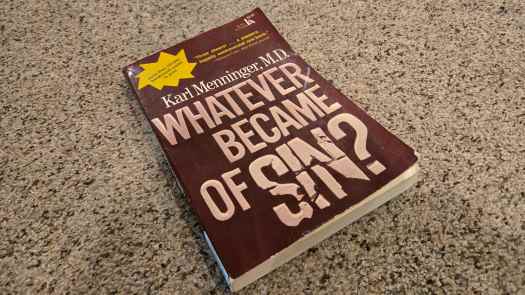
In 1973, Psychologist Karl Menninger published an important work, “Whatever Became of Sin?” in which he reflected on the diminishing concept of sin in our modern culture. His thesis was that the concept of sin as immoral behavior was being replaced by medical and psychological labels that reduced moral responsibility.

Though Menninger draws upon Christian as well as other religious traditions to support his thesis, his book is not a biblical exposition on the subject. Still, his thoughts on this issue, which were printed over 50 years ago, now seem prophetic in nature.

So whatever became of sin? Why has the concept diminished in our culture and what are the reasons for its demise?

The 6th chapter of Isaiah provides an answer for us. This chapter marks a pivotal moment in the life and calling of the prophet. In this chapter, Isaiah has a vision of the Lord in all of His splendor and glory.

The opening verse gives us a time stamp to date the events that follow. Uzziah had been the king of Israel for 52 years, a full life-time for many of his subjects. While Uzziah was one of the better kings of Judah early on, things did not end well for him. Toward the end of his reign, he stubbornly tried to enter the temple and perform rites that were reserved only for the priests, and as a result, he contracted leprosy and was forced to finish out his days in exile.

At Uzziah’s death, with no king to rule, Isaiah goes to the temple and experiences a vision of the true king, the Lord God Himself. Isaiah catches a rare glimpse of God as He really is, a picture of His absolute holiness.

What’s interesting about this encounter is the text says that when Isaiah sees the Lord in His holiness, he cries out, “my destruction is sealed, for I am a sinful man and a member of a sinful race.”

Some translations use the word “ruined” or “undone” to describe Isaiah’s emotional response.

Isaiah, when confronted with the perfect righteousness of God almighty, is brought to his knees as he recognizes his own sinfulness in light of holy God.

One of the reasons sin is not talked about much these days is because we don’t talk about God’s holiness so much these days. These two concepts are intertwined and interdependent – we don’t see sin so much if we don’t see God as holy and righteous.

Over the last 50 years or more, our culture has done all that it can to soften God’s divine attributes to make Him more palatable to our own personal preferences. In short, we’ve made God less like God and more like us.

For the atheist, dismissing God altogether means that there is no objective anchor or standard by which actions can be judged or labeled as “sin”.

“Who are you to tell me that my behaviors are wrong?” is a common refrain.

In many Christian circles, especially among progressives, God is not so much eliminated as much as He’s recreated or reimagined in a way that better fits the person’s lifestyle choices and behaviors.

One of the ways we often see this is in the elevation of the kind-hearted, compassionate New Testament version of God that we see in Jesus while dismissing or diminishing the “judgmental, ego-maniacal” Old Testament picture of God that seems too harsh and exacting. Some may go so far as to claim that the Bible describes two completely different Gods. I wrote recently about this in my blog post, “Is the Old Testament God a Bloodthirsty, Genocidal Psychopath?”

In light of the stark differences between the Old Testament perception of God and the New Testament portrayal of God in the person of Jesus, one inevitably chooses the deity that is more preferable and less restrictive to their own life choices.

The problem with this approach, as I outlined in my blog post, “Can You Make the Bible an Idol?”  is it essentially results in a form of idol worship, where my image of God is created according to my personal choices and inclincations instead of forming a picture of God that represents the fullness of how He has been revealed to us through His holy word.

If we want to talk about sin and the need for a savior, we must highlight God’s absolute holiness and righteousness. If a person doesn’t see God as infinitely holy, they’re more likely to overlook or dismiss their sinfulness as mere character flaws or innocent mistakes. If sin is not seen as an egregious offense against God’s very nature, there is less likelihood of coming to the realization that we are utterly lost and in need of a divine savior.

So whatever became of sin? It fell out of favor, just as God’s holiness has.


Did you enjoy this post? I’d love to hear your thoughts! Feel free to like, leave a comment below, and share it with your friends or on social media if you found it helpful or interesting. Your support keeps the conversation going!


Reflection

Describe  a time when you encountered the power and presence of God in your life as Isaiah did. In other words, when have you had an “Isaiah” moment with God? What was that like emotionally? 

What is your concept of sin? How would you define it? In what ways have you seen our culture minimize sin and personal responsibility?

In what ways have you created an image of God that is not fully reflective of how God has revealed Himself in both the Old and New Testaments?

How can. you ensure that your view of God is not just a personal image that you created to suit your own preferences?


Photo by Dave Lowe


A Discourse on the Foolishness of Idols

Isaiah 44

9How foolish are those who manufacture idols to be their gods. These highly valued objects are really worthless. They themselves are witnesses that this is so, for their idols neither see nor know. No wonder those who worship them are put to shame. 10Who but a fool would make his own god—an idol that cannot help him one bit! 11All who worship idols will stand before the LORD in shame, along with all these craftsmen—mere humans—who claim they can make a god. Together they will stand in terror and shame.

12The blacksmith stands at his forge to make a sharp tool, pounding and shaping it with all his might. His work makes him hungry and thirsty, weak and faint. 13Then the wood-carver measures and marks out a block of wood, takes the tool, and carves the figure of a man. Now he has a wonderful idol that cannot even move from where it is placed! 14He cuts down cedars; he selects the cypress and the oak; he plants the cedar in the forest to be nourished by the rain. 15And after his care, he uses part of the wood to make a fire to warm himself and bake his bread. Then—yes, it’s true—he takes the rest of it and makes himself a god for people to worship! He makes an idol and bows down and praises it! 16He burns part of the tree to roast his meat and to keep himself warm. 17Then he takes what’s left and makes his god: a carved idol! He falls down in front of it, worshiping and praying to it. “Rescue me!” he says. “You are my god!”

18Such stupidity and ignorance! Their eyes are closed, and they cannot see. Their minds are shut, and they cannot think. 19The person who made the idol never stops to reflect, “Why, it’s just a block of wood! I burned half of it for heat and used it to bake my bread and roast my meat. How can the rest of it be a god? Should I bow down to worship a chunk of wood?” 20The poor, deluded fool feeds on ashes. He is trusting something that can give him no help at all. Yet he cannot bring himself to ask, “Is this thing, this idol that I’m holding in my hand, a lie?”


The Daily DAVEotional

In this chapter of Isaiah, the prophet goes to considerable lengths to explain the process and foolishness of fashioning an idol out of wood and then worshiping it as your god.

Who in their right mind would take a block of wood, using some of it to heat their home and cook their food while fashioning an idol out of the remaining portion, which they then worship as their god? It makes ZERO sense. Isaiah goes so far as to call it “stupidity and ignorance!”

Why would people do this?

For starters, the people living in the Ancient Near East did not have the same technological and informational understanding that we do today. It was quite common to believe in a regional deity as a supernatural being who had to be appeased or worshiped in order to gain favor and blessings that would make life livable.

For example, if there was drought, the people would appeal to the regional deity to bring rain. If crops were failing, the regional deity would be appeased in order to bring a favorable crop.

The god you worshiped and to whom you appealed was largely a function of where you lived, as it was a commonly held belief that there were many deities, each of whom ruled over a particular territory.

The fact that the Israelites continually forsook the Lord in order to worship Baal was because Baal was the god of the Canaanites, the people who occupied the land when the Israelites arrived on the scene. Though God had instructed the Israelites to remove the Canaanites from the land, the Jews never fully expelled the Canaanite religious belief system, which became a constant thorn in their side.

Today, there are still cultures that worship regional deities but most of the modern world sees this as foolishness, just as Isaiah has described. But that doesn’t mean that the modern world doesn’t still worship idols. We do. We are just much more sophisticated in how we do it.

What really is an idol anyway, and why is it wrong to worship an idol?

An idol could be defined as an object of substitutionary trust.

Think of the 10 commandments. The first commandment, which is found in Exodus 20:3 is “Do not worship any other gods besides me”. But before the Lord shares the first commandment, He prefaces it by saying, “I am the Lord your God who rescued you from slavery in Egypt.”

At the core of this commandment is a recognition of who provides for you and who sustains your very life. It’s a remembrance and acknowledgement of all that God has done for you, including deliverance from slavery.

When the Israelites worshiped idols, they were essentially saying that God was NOT the one who rescued them; God is NOT the one who sustains them: God is NOT the one who delivers them or protects them or cares for them.

We do the same thing – we just attribute our trust to things other than carved wooden idols.

If an idol is an object of substitutionary trust, what are people today most likely to put their trust in instead of God?

Themselves!

The most common idol that people trust for their success, deliverance and provision is themselves. Many people have become their own gods. They alone determine their destiny. They alone can provide for themselves and their family. They alone are the masters of their own fate. They alone determine what they believe to be right and wrong.

In our modern culture, we no longer take a block of wood and use some of it for heating while fashioning a portion into an idol that we then worship. Instead, we simply reject God as the ultimate standard of right and wrong, while denying God’s involvement in our lives, His sovereignty in the world and His right to receive worship as the one who created us.

In short, we magnify and glorify ourselves and others, who serve as our means of trust to provide for us, deliver us, protect us, and bless us! It may not be as obvious as creating our god from a block of wood, but nonetheless, it’s just as foolish!

Reflection

What do you think of the author’s definition of an idol as a substitutionary object of trust? Do you agree with it? Why or why not?

What are the things that you are most likely to trust to provide for you, care for you and deliver you in place of God?

What can you do to ensure that God has His rightful place in your life and that you worship Him and Him alone? What steps can you take; what practices can you implement?


Photo by Nathan Lemon on Unsplash

The Whip of God’s Anger!

Isaiah 10

5“Destruction is certain for Assyria, the whip of my anger. Its military power is a club in my hand. 6Assyria will enslave my people, who are a godless nation. It will plunder them, trampling them like dirt beneath its feet. 7But the king of Assyria will not know that it is I who sent him. He will merely think he is attacking my people as part of his plan to conquer the world. 8He will say, ‘Each of my princes will soon be a king, ruling a conquered land. 9We will destroy Calno just as we did Carchemish. Hamath will fall before us as Arpad did. And we will destroy Samaria just as we did Damascus. 10Yes, we have finished off many a kingdom whose gods were far greater than those in Jerusalem and Samaria. 11So when we have defeated Samaria and her gods, we will destroy Jerusalem with hers.’”

12After the Lord has used the king of Assyria to accomplish his purposes in Jerusalem, he will turn against the king of Assyria and punish him—for he is proud and arrogant. 13He boasts, “By my own power and wisdom I have won these wars. By my own strength I have captured many lands, destroyed their kings, and carried off their treasures. 14By my greatness I have robbed their nests of riches and gathered up kingdoms as a farmer gathers eggs. No one can even flap a wing against me or utter a peep of protest.”

15Can the ax boast greater power than the person who uses it? Is the saw greater than the person who saws? Can a whip strike unless a hand is moving it? Can a cane walk by itself?

16Listen now, king of Assyria! Because of all your evil boasting, the Lord, the LORD Almighty, will send a plague among your proud troops, and a flaming fire will ignite your glory. 17The LORD, the Light of Israel and the Holy One, will be a flaming fire that will destroy them. In a single night he will burn those thorns and briers, the Assyrians. 18Assyria’s vast army is like a glorious forest, yet it will be destroyed. The LORD will completely destroy Assyria’s warriors, and they will waste away like sick people in a plague. 19Only a few from all that mighty army will survive—so few that a child could count them! (Isaiah 10:5-19, NLT)


Assyria is an ancient nation that at one time was THE biggest, baddest empire around.

As is typical of big, bad empires, they conquered other nations, took captives, plundered and slaughtered people and generally enforced their will wherever they went.

In this chapter of Isaiah, God describes the Assyrians as “the whip of my anger.” Its mighty military power is described by God as “a club in my hand.”

God explains that He is going to use the Assyrians as His tool to punish the Israelites, His people who have continually forsaken Him, despite many warnings about the consequences of abandoning the Lord for other gods.

After the Lord has used the Assyrians to accomplish His purposes, He explains that He will then punish the Assyrians.

Why would He punish the Assyrians if they were simply God’s tool to accomplish His plan of destruction against Israel?

Verses 12-15 give the answer. The reason Assyria will be punished is because of pride and arrogance. The Assyrian king won’t acknowledge that He is subordinate to God and that the Lord was simply using Him as His vessel of discipline. Instead, the Assyrian king will embrace the belief that everything he’s accomplished is because of his superior nature over those whom he’s subjugated.

The king of Assyria will essentially make himself out to be a god as he mentions all the gods he has conquered from the various lands he now controls.

God reminds the listener that Assyria is no different than an ax, a saw or a cane. They are all just instruments that are completely useless unless there is an active agent to employ the tool for its purpose.

Assyria, at one time, WAS the big bad empire bullying all the surrounding nations of the Ancient Near East. WAS! Somewhere between 612 and 605 BC, Assyria was destroyed. They were overtaken by the next big, bad empire – the Babylonians, but not before God fulfilled His promise of using the Assyrians to discipline and punish His people who had forsaken Him.

Reflection

Under what circumstances are you tempted to take credit for actions and outcomes that are ultimately orchestrated by God?

The Assyrians were supplanted by the Babylonians, who were supplanted by the Persians, who were supplanted by the Greeks, who were supplanted by the Romans, etc. Why do you suppose empires come and go? What conditions do you think would be necessary for an empire to last?

What do you think is the difference between pride/arrogance/boasting and confidence and self-assurance? How can you ensure that you’re confident in yourself without being boastful or proud?


Photo by Jamil Kabar on Unsplash

Who Knows?

Isaiah 8

11The LORD has said to me in the strongest terms: “Do not think like everyone else does. 12Do not be afraid that some plan conceived behind closed doors will be the end of you. 13Do not fear anything except the LORD Almighty. He alone is the Holy One. If you fear him, you need fear nothing else. 14He will keep you safe. But to Israel and Judah he will be a stone that causes people to stumble and a rock that makes them fall. And for the people of Jerusalem he will be a trap that entangles them. 15Many of them will stumble and fall, never to rise again. Many will be captured.”

16I will write down all these things as a testimony of what the LORD will do. I will entrust it to my disciples, who will pass it down to future generations. 17I will wait for the LORD to help us, though he has turned away from the people of Israel. My only hope is in him. 18I and the children the LORD has given me have names that reveal the plans the LORD Almighty has for his people. 19So why are you trying to find out the future by consulting mediums and psychics? Do not listen to their whisperings and mutterings. Can the living find out the future from the dead? Why not ask your God?

20“Check their predictions against my testimony,” says the LORD. “If their predictions are different from mine, it is because there is no light or truth in them. 21My people will be led away as captives, weary and hungry. And because they are hungry, they will rage and shake their fists at heaven and curse their king and their God. 22Wherever they look, there will be trouble and anguish and dark despair. They will be thrown out into the darkness.” (Isaiah 8:11-22, NLT)


The Daily DAVEotional

We are obsessed with the future. It seems like half of the movies and TV shows being released these days depict some sort of dystopian future.

Doomsday prophets seem to fill the airwaves and the media platforms with predictions of the earth’s and mankind’s demise.

My e-mail inbox is flooded with people who want me to pay them for financial advice because they claim to be better than others at predicting the future of the stock market or the technology sector, or the energy industry, or the….well, you get the picture.

The truth is that we are not that great at predicting the future. It’s interesting to watch older movies that are set in a future that is equivalent to our modern day. It’s never close to being right.

Sure, we can plan for the future and we can take all the relevant information at our disposal and make educated guesses about what we think will happen, but there are just too many variables for anyone to be able to make accurate predictions about the future with any degree of consistency.

This is why God, via the prophet Isaiah, asks the question in verse 19:

So why are you trying to find out the future by consulting mediums and psychics?

God is the only person who can tell the future, and that’s because He’s sovereign over everything, including time.

If you’re comparing track records, nobody even comes close as He’s 100% accurate.

Some of our obsession with the future is due to fear. We’re afraid of what might happen to us, to our loved ones and to our community. If this is you, listen again to these words from the prophet Isaiah to the people of God:

Do not be afraid that some plan conceived behind closed doors will be the end of you. Do not fear anything except the LORD Almighty. He alone is the Holy One. If you fear him, you need fear nothing else. He will keep you safe… (Isaiah 8:12-14a, NLT)

Reflection

When have you been tempted to rely on a psychic or medium for advice or information?

When you think of the future, what fears do you have?

What are some practical tips or ideas that will enable you to connect with the Lord and trust Him for your future?


Photo by Dave Lowe