What is the Rapture?

1 Thessalonians 4

13And now, brothers and sisters, I want you to know what will happen to the Christians who have died so you will not be full of sorrow like people who have no hope. 14For since we believe that Jesus died and was raised to life again, we also believe that when Jesus comes, God will bring back with Jesus all the Christians who have died.

15I can tell you this directly from the Lord: We who are still living when the Lord returns will not rise to meet him ahead of those who are in their graves. 16For the Lord himself will come down from heaven with a commanding shout, with the call of the archangel, and with the trumpet call of God. First, all the Christians who have died will rise from their graves. 17Then, together with them, we who are still alive and remain on the earth will be caught up in the clouds to meet the Lord in the air and remain with him forever. 18So comfort and encourage each other with these words. (1 Thessalonians 4:13-18, NLT)


The Daily DAVEotional

You may have heard Christians talk about “the Rapture” and asked yourself, “what is that?”

The rapture is a biblical end times event that was popularized in the mid-to-late 20th century through books such as Hal Lindsey’s “Late Great Planet Earth” and the “Left Behind” book series from authors Tim LaHaye and Jerry Jenkins.

While most evangelical Christians embrace the doctrine of Jesus’ second coming, that Jesus will appear at the end of time to judge the world, eradicate evil and reign over creation forever, not all Christians hold to the doctrine known as “the rapture”, which is considered an event that is separate from and preceding to the second coming of Christ.

For those who do hold to a “rapture” as a distinct event from the second coming, this passage in 1 Thessalonians is a primary passage in support of their view.

In this passage, Paul is seeking to console the Thessalonians who are grieved that many of their loved ones have passed. Paul is correcting a misunderstanding these young believers had concerning what happens to believers after they have passed.


Click here to see a A Comprehensive List of Blog Posts Based on Bible Passage Reference


The Thessalonians apparently had mistakenly believed that because their loved ones were in the grave, they would miss out on “the rapture”.

What exactly is the rapture?

“The rapture” is a doctrine that says Jesus will appear unexpectedly to take believers from this earth so that they might be with Him for eternity.

The word rapture comes from the Latin word “rapturo” which comes from verse 17 where Paul says that when Jesus returns, believers will be “caught up” with Christ in the clouds and will remain with Him forever. The Latin word for “caught up” is rapturo.

So the rapture is that moment when believers will be “caught up” with Jesus upon His return.

Paul tells these Thessalonian believers that those who have already died and are in the grave will be raised up first to meet Jesus and then those who are alive will be “caught up” with them.

So the order of events, according to this passage from Paul, is as follows:

    • Jesus will come back at some point. The exact timing of His return is not known so believers are exhorted to always be ready and to not be caught off guard
    • When Jesus returns, all those who have died will be resurrected and will meet Jesus in the clouds
    • Those believers who are alive on earth when Jesus returns will also meet Jesus in the clouds AFTER those who have already died are raised

As has already been mentioned, not all Christians agree that what Paul is describing in this passage is a separate, distinct event from the second coming of Christ. There are valid arguments for each view – that the rapture is a separate event that precedes the second coming of Jesus, and that the rapture is simply a different description of the second coming of Christ.

Regardless of the view one might take, we know for certain from this passage that Jesus WILL come back. When he does, those who have already died WILL be raised from the dead and WILL meet Jesus. Additionally, those who are alive when Jesus returns WILL also meet Jesus.

Paul says that this teaching is designed to give us hope, knowing that we, as believers, have a purpose and a destiny beyond this life. If there is no resurrection and no hope for life beyond our earthly physical existence, then, as Paul says in 1 Corinthians 15, “we are to be pitied more than all men.” (See my blog post “Will Christians Really Experience a Bodily Resurrection?“)


Did you enjoy this post? I’d love to hear your thoughts! Feel free to like, leave a comment below, and share it with your friends or on social media if you found it helpful or interesting. Your support keeps the conversation going!


Reflection

What do you think happens to people after they die? What has been. your belief about the afterlife?

Have you heard of the rapture? What have you been taught about the events leading up to the “end times”?

Do you think it matters what a person believes about the end times? Why do you think it’s important that we, as Christians, understand what the Bible teaches about the end times?

If the rapture really is an event that is distinct from and preceding to the second coming of Jesus, how does that change how you think about the Christian life and live out the Christian life?


Photo by Mahmoud Yahyaoui: https://www.pexels.com/photo/dramatic-sunlight-through-fluffy-clouds-29286046/

Don’t Put Confidence in Powerful People!

Psalm 146

1Praise the LORD! Praise the LORD, I tell myself.

2I will praise the LORD as long as I live. I will sing praises to my God even with my dying breath.

3Don’t put your confidence in powerful people; there is no help for you there.

4When their breathing stops, they return to the earth, and in a moment all their plans come to an end.

5But happy are those who have the God of Israel as their helper, whose hope is in the LORD their God.

6He is the one who made heaven and earth, the sea, and everything in them. He is the one who keeps every promise forever,

7who gives justice to the oppressed and food to the hungry. The LORD frees the prisoners.

8The LORD opens the eyes of the blind. The LORD lifts the burdens of those bent beneath their loads.The LORD loves the righteous.

9The LORD protects the foreigners among us. He cares for the orphans and widows, but he frustrates the plans of the wicked.

10The LORD will reign forever. O Jerusalem, your God is King in every generation! Praise the LORD! (Psalm 146:1-10, NLT)


The Daily DAVEotional

We live in perhaps one of the most polarized times in the history of our country. Wherever you may align yourself on the political spectrum, it’s easy to think that all of the problems in our country could be solved if everyone agreed with our views and our solutions.

By extension, we can be fooled into thinking that if people who align with our political persuasions can come to power, things would be much better.

The truth is, as the psalmist says in verse 3, the people who are in positions of authority really have no power to effect lasting change. Why? They are mortal. Being mortal doesn’t just mean that they are subject to death but it also means they are susceptible to all of the vices that mortals are susceptible to – greed, power, corruption, and pursuing their own self-interests.

This is not to say that people cannot effect change or that we shouldn’t give careful thought to who we vote for public office. There is no doubt that the right people can make a huge difference in our communities.

But we shouldn’t put our confidence in them because ultimately, they cannot help. Only the Lord can. Only the Lord ALWAYS keeps his promises. He is righteous and just and he is concerned for the orphan, the widow, the poor and oppressed.

In addition, only the Lord can meet our deepest spiritual needs. And because He is the eternal King, we can ALWAYS depend on Him. Political parties are always changing, which means that the perspectives, approaches and solutions to the issues of the day are constantly shifting as well. But God is eternal. He never changes and He doesn’t change His opinion or His approach.

Thus, the psalmist can say, “He is King in every generation!”

Amen!

Reflection

In what ways can you tend to trust in politicians and people of power to effect change?

What are some examples from your own experience where you have seen people or politicians whom you had trusted, let you down?

While still being politically active and responsible, how can you ensure that your ultimate trust is in the Lord and not people?


Photo by Cameron Smith on Unsplash


Hope and The Shawshank Redemption

Here’s a simple litmus test to tell if a movie deserves to be in your Top 10 list of favorites.

Imagine you’re channel surfing and you see a movie playing that you have to watch, even though you’ve seen it dozens of times before. That movie, which you find yourself tuning into any time you see it on the TV is likely one of your favorites.

I have several movies that fit that category for me, including Braveheart, Tommy Boy and The Shawshank Redemption.

“The Shawshank Redemption” is one of those movies I find myself watching any time I see it playing on broadcast TV.

Recently, Pastor Rick Warren gave a sermon on “Experiencing Hope During Difficult Times.” I was reminded of The Shawshank Redemption, since one of the main themes in that movie is “hope”.

The Shawshank Redemption is based on a short story by Steven King (yes, that Steven King), but it’s not a horror movie. It’s a movie about prison. Some have dubbed it the greatest prison movie of all time.

The story centers around Andy Dufresne (played by Tim Robbins) who is wrongly convicted of double murder and sent to the notorious Shawshank prison to serve back to back life sentences.

Dufresne quickly befriends Ellis “Red” Redding, played by Morgan Freeman, a murderer who has already served 20 years of a life sentence, and though he sees the error of his foolish teenage act, nevertheless, sees no hope of ever being paroled.

There’s a critical scene about midway through the movie. Andy receives an unexpected shipment of books and vinyl records for the prison library and decides to blare music from an opera record to the entire prison population via the prison loudspeaker system.

This infuriates the warden, who punishes Andy with two weeks in “the hole” – solitary confinement in a room with no light source.

When Andy emerges from confinement his inmate friends are amazed to see him so upbeat after such a harsh punishment.

“Easiest time I ever did” is Andy’s response. “I had Mr. Mozart to keep me company.”

Fear Can Hold You Prisoner.
Hope Can Set You Free.

Andy’s prison-mates are understandably confused. Andy explains that Mozart is inside…in his mind and in his soul and then he declares, “there are places internally that they can’t touch.”

Andy’s friend Red asks, “What are you talking about?”

“Hope”, Andy replies.

Red gets a stern look on his face and says, “Listen here friend. Let me tell you something about hope. Hope is a dangerous thing. Hope can drive a man insane. It’s got no use on the inside. You better get used to that idea.”

Pastor Rick, in his sermon, stated that we can have hope because we know that the situation we’re in is temporary….it will pass. He encouraged us to focus on that which is eternal instead of things that are temporary.

This is certainly good advice, but sometimes hard to implement. It’s difficult to focus on “eternal” things when there are so many immediate needs staring at you in the face, and often screaming for your attention.

We personally know people who have lost their jobs, are struggling financially, have lost their housing, have lost loved ones, are scrambling to figure out childcare and schooling options for the fall, are dealing with major health concerns with limited access to doctors, and many more issues that are magnified and amplified in this current Covid environment.

How exactly do we experience hope when there is so much pain and struggle in our lives?

I think Andy Dufresne provides a clue. Hope is something internal, rather than external.

Hebrews 6:19, speaking of Jesus, says,

“We have this hope as an anchor for the soul, firm and secure.” (emphasis mine)

The context of this passage is that Jesus is our High Priest. Through His death, He provided atonement for sinful humanity, making it possible for us to experience a relationship with Him.

For the Christian, Jesus is our anchor. He alone provides hope and meaning because He alone can provide ultimate fulfillment and purpose in life.

Where is your hope anchored?
Photo by Ron Smith on Unsplash

But what about all of the tremendous struggles we are facing? They seem overwhelming!

As we navigate life’s current realities, I realize how important the body of Christ is. We need others who can come alongside us when we’re struggling and offer real, tangible, material help, while reminding us of God’s goodness and pointing us to the hope that only Jesus can provide.

At the end of The Shawshank Redemption, Andy writes these fitting words to Red – “Remember Red, hope is a good thing, maybe the best of things. And no good thing ever dies.”

How are you doing in this current crisis? Are you more like Red – tired, disillusioned and lacking hope?

Or are you more like Andy, with a hope anchored to an internal, immovable source (Jesus).

Whatever your situation, let us know how we can pray for you! (Just click the Prayer tab at the top of the page)

Personally, we are grateful to our family and many friends who have been a source of encouragement and hope to us through the many struggles and trials we’ve faced over the past few months and years. You have helped us to continue to keep our hope anchored in Jesus!

The Anchor of Hope

For the last year and half, Jen and I have been volunteering as coaches at an Orange County High School. Once a week, a group of students spend an hour with us going through a curriculum that teaches life skills and principles designed to help students experience greater success in pursuing their goals and ambitions.

Pedro was a student in Dave’s coaching group this last spring

To be honest, these groups are a real challenge. Many of these students are unmotivated and have been hardened by the circumstances of life.

Some have had close friends killed as a result of gang violence. Others have relatives who have been in and out of jail. Some have witnessed shootings. For many, there is a feeling of hopelessness.

Dictionary.com defines hope as “the feeling that what is wanted can be had or that events will turn out for the best.” But what do you do when events don’t turn out the way you wanted or life delivers unexpected hardships?

Our twins are in the middle of their senior year and they’ve been thinking and dreaming about life after high school. Their hope is to attend a military academy and they’ve been working diligently for the last several years to put themselves in a position to achieve that goal. But obtaining an appointment to any of the service academies is incredibly competitive. It might not work out the way they’ve planned.

Joshua (left) and Jacob experienced a week at West Point over the summer and are hoping to gain acceptance to one of the service academies as their college choice.

There is a tremendous amount of hopelessness in our culture these days, especially among Millennials. Many are discouraged by the political system and by how polarized we seem to be on many issues. Others are discouraged by the high cost of education and the amount of indebtedness they’ve incurred. For some, the job market is not as promising as they had hoped and the American dream seems elusive.

The Bible has a lot to say about hope. The author of Hebrews says that “we have this hope as an anchor for the soul, firm and secure.” The hope being spoken of is that God cannot lie, and therefore we can trust in His promises. The author says that Jesus is our High Priest who has gone into the inner sanctuary to make atonement for our sin, and as a result, we can run to God and take refuge.

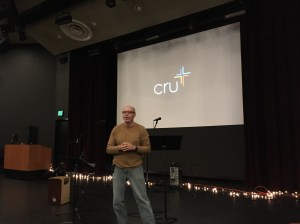
Dave speaks to the UCLA Cru students at their weekly meeting

In other words, we can know God and we can come into His presence. He will not deny us no matter what we’ve done or we might be feeling about ourselves.

Jesus is the only one who can be an anchor of hope for our souls. Everything else will either let us down or is ultimately fleeting. We cannot put our hope in our job or in the political system or the college we want to attend. None of those things can provide ultimate meaning and purpose for our lives. Only Jesus can do that.

Thanks for your partnership with us in helping Young Professionals find meaning and purpose in Jesus, the hope of glory!