FOUR POINTS TO UNDERSTAND HOW TO EXPERIENCE ETERNAL LIFE

What do you think happens after we die?

Most people believe in an afterlife, such as the Christian concept of heaven. But, assuming heaven exists, how does one get there?

In my thousands of conversations with people, I’ve found that people overwhelmingly believe that if they were to die, they would make it into heaven. However, when asked the question,

What is God’s criteria for deciding who makes it into heaven?

most people I’ve conversed with don’t know.

To me, that’s a bit like studying for a final exam without having any idea what is going to be on the exam.


Read this article “How Do You Prepare for God’s Final Exam” for a fuller explanation of this idea.


The Bible tells us that God’s plan from the beginning was that we would know Him and experience life in His presence. Man freely interacted with God and it was good.

Genesis 1:29-31 gives a picture of God’s initial creation:

27So God created man in his own image,
in the image of God he created him;
male and female he created them.
28God blessed them and said to them, “Be fruitful and increase in number; fill the earth and subdue it. Rule over the fish of the sea and the birds of the air and over every living creature that moves on the ground.”
29Then God said, “I give you every seed-bearing plant on the face of the whole earth and every tree that has fruit with seed in it. They will be yours for food. 30And to all the beasts of the earth and all the birds of the air and all the creatures that move on the ground—everything that has the breath of life in it—I give every green plant for food.” And it was so.
31God saw all that he had made, and it was very good.


POINT 1: GOD’S PLAN

GOD LOVES YOU AND CREATED YOU FOR A PURPOSE

God’s Love

The Bible is clear that one of God’s attributes is love.

1 John 4:8-9 says:

Whoever does not love does not know God, because God is love. This is how God showed his love among us: He sent his one and only Son into the world that we might live through him.

God demonstrated His love by sending His Son Jesus into the world to ultimately die on our behalf.

God’s Purpose

In John 10:10 (NLT), Jesus gives a glimpse into his purpose. He said:

The thief’s purpose is to steal and kill and destroy. My purpose is to give life in all its fullness.

Jesus came so that we might experience life in all its fullness – that we would begin to fulfill the purpose for which we’ve been created, which is to know Him and experience His presence in our lives.


REFLECT
What do you think it means to experience life in all its fulness? What would that look like?


“Fullness of Life” Expanded

Here’s another way to think about it. When Jesus says that His purpose is to give “life” in all its fulness, He’s talking about giving eternal life.

In John 17:3 (NIV), Jesus said this:

Now this is eternal life: that they may know you, the only true God, and Jesus Christ, whom you have sent.

Jesus defines eternal life as knowing God – experiencing a relationship with Him. Therefore, when Jesus says His purpose to give life in all its fullness, what He’s saying is that He has come to offer people a relationship with Him (life) and He wants people to experience that relationship to the fullest extent possible.


REFLECT
Why do you think people are not experiencing life in all its fullness? What keeps them from knowing God?


POINT 2: OUR PROBLEM

WE’VE REBELLED AGAINST GOD AND ARE THEREFORE SEPARATED FROM HIM. AS A RESULT, WE CANNOT EXPERIENCE HIS PURPOSE FOR OUR LIVES, WHICH IS TO KNOW HIM.

The Fall – the Original Rebellion

According the Bible, God’s good creation was distorted when man disobeyed God and was exiled from God’s presence. Genesis 3 tells the story of the fall of mankind (Read Genesis 3).

Adam and Eve freely interacted with God, who had given them free reign over the entire garden. They took care of it and they were given every seed-bearing plant for their food. However, there was one tree they were forbidden from eating – the fruit from the tree of the knowledge of good and evil.

Adam and Eve were deceived by the serpent (Satan) to eat this forbidden fruit. Because of their disobedience, God banished them from the garden.


Have you ever wondered why God forbade Adam and Eve from eating from that one particular tree? Was it random? Or was there a reason why that specific tree was off limits. Read this article (Why Did God Forbid this One Fruit?) to understand why this particular tree was off limits.


The rest of the Bible is the story of God’s plan to restore man’s relationship with Him and to reverse the curse that was inflicted upon creation as a result of this original sin.

The Results of Sin

It’s at this point that one might argue that we should not be punished for Adam and Eve’s rebellion. But the Bible is clear that EVERYONE has sinned against God.

Romans 3:23 says:

For all have sinned; all fall short of God’s glorious standard. (NLT) [Emphasis added]

But I’m a Good Person

In my experience, I’ve found that most people tend to think of themselves as “good”.

In our society goodness and badness are relative terms that are used in comparison to other people. I’ve found that most people consider themselves to be good because they compare themselves to others who, in their mind, have done more egregious and heinous acts. But comparing ourselves to other people is using the wrong standard of comparison.
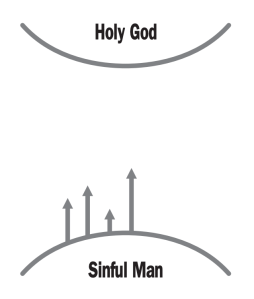
The Bible says that only God is truly good. What this means is that God’s standard for goodness is perfect holiness and by this standard, He is the only one who is truly good.

Notice the diagram to the right. God is holy and man is sinful and there’s a great chasm that separates man from God. The arrows illustrate that man continually tries to reach God through various efforts, such as religion, good works, etc. But all of these efforts ultimately fall short because God is perfectly holy, and there is no amount of good works that will enable man to achieve God’s standard of perfection.

Here is a short article (What is Your Definition of Good?) that explains how God defines “good”.


REFLECT
How does your definition of goodness compare or contrast with what the Bible says about goodness?


What is Sin?

The word “sin” is one of those churchy, religious words that many people associate with behaviors that others don’t approve of but we think is no big deal. For example, you may see nothing wrong with drinking while some “uptight, religious people” think drinking is a “sin”.


REFLECT
How do you define sin? What do you think sin is?


Sin Explained

Photo by Annie Spratt on Unsplash

Sin not just a list of immoral or socially unacceptable behaviors. When Romans 3:23 says that “all have sinned”, the Greek word for sin is actually an archery term.

In a competition, the archer would shoot the arrow and the goal was to hit the bullseye on the target. If the archer missed the bullseye, even if it was only by a fraction of an inch, it was considered an imperfect mark, which was called a sin.

So when the Bible says we’ve all sinned, it means that no matter how hard you’ve tried and no matter how good you think you are, you (and all people) have missed the mark of God’s standard, which is perfect holiness.

That raises the bar quite a bit doesn’t it?

Things are complicated by the fact that God is not only perfectly holy, but He’s perfectly just, and as a result, He must punish sin. He cannot just overlook it or ignore it. Sin is a violation of the very nature and character of God and His goodness, so sin must be punished.

According to Romans 6:23, the punishment, or penalty for sin is DEATH!

For the wages of sin is death, but the free gift of God is eternal life through Christ Jesus our Lord.

You might be thinking, “well we’re all going to die so what does it matter?”

Death here refers to being separated from God. So, the result of sin, or the punishment for sin is that we will experience a separation from God, FOR ETERNITY! This is literally what hell is – the complete absence of God and everything good.


POINT 3: GOD’S PROVISION

JESUS CHRIST PROVIDES THE ONLY SOLUTION TO MAN’S SIN.
Through Jesus, the barriers that kept us from experiencing God’s purpose have been removed – we now have access to God and can know Him.

If everyone has sinned and God, in His justice, must punish sin, then it seems as if there is no solution to our problem. We are all seemingly doomed to punishment!

But God, in His goodness, creates a solution that only He can provide. The solution is in His son Jesus.

Christ Died for Us

Romans 5:8 says,

But God showed his great love for us by sending Christ to die for us while we were still sinners.


REFLECT
If God can forgive sin, why couldn’t he just declare it to be forgiven?
Why do you think Jesus had to die to pay for sin?


Why did Jesus Have to Die?

Why do you think Jesus had to die in order to pay for sin?

Jesus had to die to pay for sin because God’s justice demands that the only valid payment for sin is death.

For the wages of sin is death…Romans 6:23

Jesus died in our place, thus paying the penalty that God’s justice demanded (death) but doing it in a way that allows humankind to avoid the penalty.

The reason that Jesus could do this is because He is God. As God, He has the very righteousness that God requires for those who wish to come into His presence. Through Jesus’ death, we can be forgiven for our sins and not only avoid the penalty for sin, but experience a relationship with God!

Colossians 1:13, 14 says,

For he has rescued us from the one who rules in the kingdom of darkness, and he has brought us into the Kingdom of his dear Son. God has purchased our freedom with his blood and has forgiven all our sins.

Christ Rose from the Dead

Not only did Jesus die for us, but the Bible says that He rose from the dead.

1 Corinthians 15:3-6 states:

For what I received I passed on to you as of first importance: that Christ died for our sins according to the Scriptures, that he was buried, that he was raised on the third day according to the Scriptures, and that he appeared to Peter, and then to the Twelve. After that, he appeared to more than five hundred of the brothers at the same time,


REFLECT
If Jesus had never risen from the dead, would it make any difference?
What do you think is the significance of the resurrection?


Read this article, He is Risen….Why Does it Matter? to understand the significance of the resurrection to the Christian message.


Jesus is the Only Way to God

In John 14: 6, Jesus says:

“I am the way and the truth and the life. No one comes to the Father except through me.”

Notice that He doesn’t say, “I’m one of the ways, I’m one of the truths, I’m one of the lives. There are lots of ways to get to the Father, but I’m a pretty good way, so check me out, I’m cool!”

NO!

He says, “I am the way, the truth, and the life; no one comes to the Father, but through Me.”

He could say this because He is the only one who has made a valid payment for sin. Hence, only Jesus can take away our sin.

The image above demonstrates that God realized that man could not bridge the gap that separated them because of man’s sin. The distance is too wide. If you think about it, God is infinitely holy so the gap between His holiness and man’s is an INFINITE gap!

Because we could not bridge the gap ourselves, God bridged the gap for us. He sent His son Jesus, who is INFINITELY holy and righteous. Jesus’ death bridges the gap and creates a path for people to come into God’s presence and experience a relationship with Him.


POINT 4: OUR RESPONSE

We each must receive the free gift that Jesus offers – His death as payment for our sins. Only then can we experience His purpose, which is to KNOW Him.

Knowing this information doesn’t make a person a Christian. Even if you agree with everything that has been outlined so far, it doesn’t mean you are a Christian.

What makes a person a Christian is when they respond to the invitation of Jesus to accept Him and His death as a free gift that pays for your sin and provides complete forgiveness.

John 1:12 (NLT) says,

But to all who believed him and accepted him, he gave the right to become children of God.

If you want to become a Christian (a child of God), then you must believe in Jesus and accept Him.


REFLECT
What do you think it means to accept Jesus?


We Receive Christ Through Faith

Ephesians 2:8, 9 (NIV) says,

For it is by grace you have been saved, through faith—and this not from yourselves, it is the gift of God— not by works, so that no one can boast.

Accepting Him simply means you accept the free gift that He offers of being saved by His death on the cross. It means that you acknowledge that His death alone can pay for sin and you put your trust in His death to provide forgiveness instead of trusting in your own good works to earn favor with God.

We Receive Christ by Personal Invitation

In Revelation 3:20, Jesus gives this invitation:

Here I am! I stand at the door and knock. If anyone hears my voice and opens the door, I will come in and eat with him, and he with me.


REFLECT
What do you think the door represents in this verse?
How do you think a person opens the door?


Opening the Door

The door represents your heart (your will). Jesus is inviting you to open yourself up and let Him in. The way you do that is simply by putting your trust in Jesus and His death to save you instead of trusting in your own perceived goodness to “earn” your way into heaven.


KEY QUESTIONS:

Have you ever opened the door of your life and let Jesus in to begin a relationship with Him?

If so, when was that? What were the circumstances that led you to make that decision?

If not, do you want to open the door of your life to Jesus and begin a relationship with Him?

 

Photo by Jan Tinneberg on Unsplash

Opening the Door 2

The key to opening the door is to decide to put your trust in Jesus instead of trusting yourself. One way you can express your faith to God is simply telling Him that you want to accept His free gift and you want Jesus to come into your life. We call this prayer. Take a minute right now to express your faith and desire for Jesus to come into your life by repeating the following prayer:

Lord Jesus, I need you. I acknowledge that I am a sinner and there is no way I can earn my way into heaven. I want to trust in Jesus and His death to pay the penalty for my sins and provide forgiveness. I open the door of my life now and I invite Jesus to come in so that I might begin a relationship with Him and know Him. Amen.


Things to Remember…

God’s criteria for who makes it into heaven is not how good you are but whether you have the Son (Jesus).

And this is the testimony: God has given us eternal life, and this life is in his Son. He who has the Son has life; he who does not have the Son of God does not have life. (1 John 5:11-12, NIV)

You can KNOW you have eternal life, if you have the Son.

Jesus defined eternal life as knowing Him (John 17:3). Hence, you can have eternal life if you have the Son – if you have a relationship with Him.

You can have the Son (Jesus), simply by accepting Him and the free gift that He offers – His death on the cross as a payment for all of your sins.

Jesus gives an invitation to everyone. He is standing at the door of each person’s heart. He’s knocking. He wants to come into your life and begin a relationship.

But we have to open the door.

Opening the door is a matter of choosing to put our trust in Jesus instead of trusting in our own goodness. It means that we acknowledge that we have sinned and we cannot earn our way to God. We recognize that Jesus ALONE can pay for sin and we accept the free gift of His death as a payment for our sins.

When we make that decision to open the door to Jesus, we experience complete forgiveness of sin and Jesus enters our life, establishing a relationship with us.

Once we have the Son (Jesus), we have the life, which is defined by Jesus as knowing Him.


QUESTIONS FOR REFLECTION

1.    Did you open the door an invite Jesus into your life?

2.    Where is Jesus right now in relation to you?

3.    After a person receives Christ, what do you think a person has to do in order to keep Jesus in their life? What do you think is required?

4.    What questions do you have about the Christian faith?


WHAT NOW?

If you prayed that prayer to invite Jesus into your life, the Bible says that you are a new creation. You are now a child of God!

You can request some free resources and next steps by going to our Prayer Page, giving us your name and writing in the box, “I received Christ and would like to know how to begin growing in my new faith.”

We will respond to you with some resources and help to take some next steps.

Political Divisions Within Church

1 Corinthians 1

10Now, dear brothers and sisters, I appeal to you by the authority of the Lord Jesus Christ to stop arguing among yourselves. Let there be real harmony so there won’t be divisions in the church. I plead with you to be of one mind, united in thought and purpose. 11For some members of Chloe’s household have told me about your arguments, dear brothers and sisters. 12Some of you are saying, “I am a follower of Paul.” Others are saying, “I follow Apollos,” or “I follow Peter,” or “I follow only Christ.” 13Can Christ be divided into pieces?

Was I, Paul, crucified for you? Were any of you baptized in the name of Paul? 14I thank God that I did not baptize any of you except Crispus and Gaius, 15for now no one can say they were baptized in my name. 16(Oh yes, I also baptized the household of Stephanas. I don’t remember baptizing anyone else.) 17For Christ didn’t send me to baptize, but to preach the Good News—and not with clever speeches and high-sounding ideas, for fear that the cross of Christ would lose its power. (1 Corinthians 1:10-17, NLT)


The Daily DAVEotional

If you haven’t noticed, there is a lot of political division in our country these days. And this political division has seeped into the church.

Perhaps it’s always been there. But with the advent of social media, it’s definitely more pervasive and widespread.

The first letter from Paul to the Corinthians was written in part to address the problem of divisions in the church. I wrote my thoughts on this passage a few years ago in my blog post “Name Dropping in the Early Church“. Members of the church in Corinth were aligning themselves with different church leaders, which was causing conflicts and divisions in the church.

Certainly, there is no problem with following certain pastors and religious leaders. The problem comes when we elevate those figures to celebrity status and begin to idolize them or place them on a pedestal, where they may take precedence over even Jesus himself.

As I re-read this passage recently, it occurred to me that perhaps the biggest source of division within the church today is political divisions. People within the church are aligning themselves with certain political figures and ideologies, which is causing major divisions within the global church.

These last 8-10 years in the United States have been a breeding ground for the enemy to sow hatred, divisiveness and discord among Jesus’ followers.

It’s become apparent that for many who call themselves Christ followers, their political party and candidate of choice is more important than Jesus himself. This heightened commitment to politicians and political parties  is driving their behaviors and greatly influencing their views of others and even their understanding of what it means to be a Christian.

It’s been amazing to me to see people who claim to be followers of Jesus, belittling others, bullying others and berating others who don’t share their love and devotion for a particular candidate or political party.

For example, I’ve seen people on various social media platforms who have made the statement, “I don’t see how you can be a Christian and vote for                                . ” I’ve also seen “Christians” claim that God hates candidate “X” while other “Christians” have rebutted that God actually hates candidate “Y”.

Ironically, Christians on both sides, in defending their preferred candidate and ideology, are appealing to the need to “love” people, all while demonstrating hate towards those who disagree with them.

Let me be clear. It is not unbiblical to have a preferred candidate or a preferred political party. But when we place those candidates and parties above Jesus himself, and when we’re incapable of basic civility towards those with whom we disagree, we’ve unwittingly made an idol out of our political identity.

Paul, in this passage, has some words of wisdom for us. Was Donald Trump crucified for you? Were any of you baptized in the name of Joe Biden or Kamala Harris? Christ did not send us to promote the Democratic or the Republican party platforms BUT TO PREACH THE GOSPEL.

It’s apparent that we all have different ideas about how to solve the problems that we face as a nation and as a culture. While it’s ok to promote our views, as Christians, NOTHING should take precedence over Jesus and the gospel message. To do so could become idol worship or worse, the promotion of a false gospel.

Reflection

What steps do you think Christians can take to ensure that they don’t promote politics over Jesus?

Do you think it’s possible to be a Christian and also be heavily involved in politics?

What would you say to someone who says that a certain political party is the only party a “true” Christian could support?

How do you reconcile the different political views with the gospel message? What do you think is the proper way to integrate our political views with the gospel message?


Photo by cottonbro studio: https://www.pexels.com/photo/two-people-standing-face-to-face-10350693/

A Biblical Gospel Presentation in ONE Six-verse Passage

Titus 3

3Once we, too, were foolish and disobedient. We were misled by others and became slaves to many wicked desires and evil pleasures. Our lives were full of evil and envy. We hated others, and they hated us.

4But then God our Savior showed us his kindness and love. 5He saved us, not because of the good things we did, but because of his mercy. He washed away our sins and gave us a new life through the Holy Spirit. 6He generously poured out the Spirit upon us because of what Jesus Christ our Savior did. 7He declared us not guilty because of his great kindness. And now we know that we will inherit eternal life. 8These things I have told you are all true. I want you to insist on them so that everyone who trusts in God will be careful to do good deeds all the time. These things are good and beneficial for everyone. (Titus 3:3-8, NLT)


The Daily DAVEotional

Have you ever tried to share your faith with another person? What do you say? How do you go about it?

There are a number of great evangelism tools that have been created over the years to help Christians share the message of Christ to others. There’s the Roman’s Road, the Navigator’s “Bridge to Life” and of course, the old school “Four Spiritual Laws.”  (a tool I was trained in)

There are quite a number of newer resources as well, such as The Four Circles by James Chuong, or The Three Circles by Jimmy Scroggins, both of which emphasize sharing the message graphically over sharing a predominantly written narrative.

However, if you want ONE biblical passage from which you can share the gospel message, this passage from Titus 3 is a good choice. Just about every relevant point needed to share the gospel with another person is covered in these six verses. Here’s the summary of what Paul shares:

Our Problem – We were sinners

Many gospel presentations highlight our sinful condition, or in some cases, our brokenness. Paul too highlights our sinful state in verse 3:

Once we, too, were foolish and disobedient. We were misled by others and became slaves to many wicked desires and evil pleasures. Our lives were full of evil and envy. We hated others, and they hated us.

Notice the words and phrases Paul uses to describe us:

    • foolish and disobedeint
    • misled by others
    • slaves to many wicked desires and evil pleasures
    • lives that are full of evil and envy
    • hatred towards others

Paul could have just said we were sinful and alienated from God, but instead, he paints a robust picture of the depth and root of our alienation – it comes from our wicked desires and evil nature, which leads to disobedience and ultimately, enmity towards others. In other words, our rebellion is extensive. It doesn’t just affect our relationship with God; it affects our relationships with others as well!

God’s Solution – Jesus Saved Us

Paul spends 4 verses explaining that God saved us from our rebellious condition. These 4 verses are PACKED with information about the nature of God and what He’s done for us. He says:

4But then God our Savior showed us his kindness and love. 5He saved us, not because of the good things we did, but because of his mercy. He washed away our sins and gave us a new life through the Holy Spirit. 6He generously poured out the Spirit upon us because of what Jesus Christ our Savior did. 7He declared us not guilty because of his great kindness. And now we know that we will inherit eternal life.

First and foremost, salvation is rooted in the nature of God. Paul says that God showed us His kindness and love. Salvation is not based on our good works, but because of God’s mercy. Mercy is when something bad that we deserve is withheld. In this case, we deserve punishment, but because God is merciful, he saves us from judgment.

Second, Paul says that salvation involves forgiveness. Verse 5 says that our sins have been washed away, which is another way of saying that our sins have been paid for.

Salvation also involves new life through the Holy Spirit, who has been generously poured out on us.

Lastly, Paul says that salvation involves justification, which simply means that we are declared righteous, or “not guilty”. Because we are no longer under judgment for our sin, Paul says that we can KNOW that we will inherit eternal life.

Our Response

Verse 8 highlights our response. If we want to experience these benefits, Paul says we simply need to trust what Jesus has done for us.

These things I have told you are all true. I want you to insist on them so that everyone who trusts in God will be careful to do good deeds all the time. These things are good and beneficial for everyone.

Interestingly, Paul mentions trusting in God, not Jesus. But it’s clear from this passage (specifically verses 4 and 6) that Jesus IS God. I previously wrote about this in my blog post, “Further Evidence that Jesus is God.” Please read that post for a more detailed explanation of how we know that Jesus is God from this passage.

What I love about these 6 verses is that it hits all the main points you typically would want to share when presenting the gospel to another person:

    • We are sinful and alienated from God and others (verse 3)
    • We are slaves to our sinful desires – hence we cannot help ourselves (verse 3)
    • God is kind, loving and merciful (verses 4, 7)
    • Salvation is not based on our good works but based on God’s kindness, love and mercy (verse 5)
    • Our sins have been forgiven and we’ve been declared “not guilty” (verses 5, 7)
    • We’ve been given new life through the Holy Spirit (verse 5)
    • Salvation is based on what Jesus did for us (verse 6)
    • We can KNOW that we have eternal life (verse 7)

Of course there are shortcoming with using these 6 verses alone, just as almost any short evangelistic presentation is incomplete on its own. As much as these 6 verses outline the basic gospel message, we know that the fullest expression of the gospel includes the greater context of God’s original design, the nature and scope of the fall as well as God’s redemptive plan to restore His creation.

The Bible takes a full 66 books to outline the full redemptive narrative.

With that in mind, no five, ten or even thirty minute presentation can share everything that is written in the Bible regarding God’s redemptive plan. But these tools are useful in giving a person a basic framework for the Biblical story and introducing them to a relationship with God.

By highlighting these 6 verses in Titus, I don’t mean to imply that the evangelism tools mentioned at the outset are deficient or ineffective. All of them have actually proven to be helpful and beneficial to many Christians.

However, this passage from Titus is simply a different approach one might use. Instead of being based on a written or graphical presentation, it’s based on ONE six-verse BIBLICAL passage that can be easily shared with anyone.

Reflection

What has been your practice or habit in sharing the gospel with others? What tools or gospel outlines do you use? What do you like about that tool? 

What do you think are the relevant points that must be shared in any gospel presentation?

When you think of the main ideas that must be shared when presenting the gospel, which ones are covered by this passage in Titus? Which ones are missing?

What do you see as the main advantages of using this passage as a gospel presentation outline? What are some reasons why you might prefer not to use this passage?

Which of the statements that Paul uses to describe our condition (foolish, disobedient, slaves, etc.) resonate with you the most? Explain.


Photo by Jon Tyson on Unsplash

Making Jesus “Findable” to the World!

Did you know that one of the most frequented internet sites for people wanting to know more about God and Jesus is hosted by Cru?

Since 2002, more than 4 million people have indicated a decision to trust Jesus as a result of visiting one of our evangelistic sites.

Back in February I wrote about how Cru is reaching millions of people through our digital websites everystudent.com and everyperson.com. By utilizing strategic google advertising, literally millions of people from around the world are visiting our sites to learn what it means to trust Jesus for salvation and experience His peace through the adversities of life.

I got involved earlier this year in helping to monitor our Facebook page, which has seen increased interaction as we’ve begun to utilize more advertising on that platform to attract seekers to our site.

A few months ago, Marilyn Adamson, the director of our everystudent.com site sent out a quick e-mail update to let people know how effective the site has been in recent months. I thought you might be encouraged to hear some of the results.

In July, nearly 6 million people visited one of our sites with over 80,000 people indicating a decision for Christ. That’s nearly 2600 people every day making a commitment to Jesus!

Everystudent.com has been translated into more than 40 different languages, giving people from nearly every country in the world an opportunity to access the information on the site in their own language.

Marilyn says, “Many of these people are in India, UK, Egypt, South Africa, Pakistan, China, Australia…all over the world, actually. Some come via a VPN because they live in difficult countries, under threats to them. Yet, in private, God is leading them to EveryStudent.com, then to himself, and revealing himself to them as they grow.”

It’s exciting to see so many lives being changed and it’s especially encouraging to hear from those whose lives have been impacted.

People like Adarkwah, who says, “I appreciate what you are doing for me and am very grateful. I hope by the end of this lesson, I will be the one to tell people how wonderful God is.”

Nikitha says simply, “Thank you so much…my new life has begun.”

Anne wrote, “Thank you for sharing your sites. I read everything you send and more on your sites. Finding this has opened my understanding of faith, grace, etc. It’s amazing! I mean amazing!! I’ll never be able to thank you enough.”

Many of those whose lives have changed by coming to the site and hearing the truth about God and Jesus, are in turn, sharing with others and becoming multiplying disciples.

It’s amazing to me how God uses every avenue at his disposal to reach those who are earnestly seeking him.

The great news is that you can use the site to reach those in your community and sphere of influence as well. To find out how you can make Jesus findable to those around you by utilizing the resources of these websites, go to http://www.everystudent.info. There, you’ll find a wealth of resources that will help you to see the various ways you can actively and passively point people to the site.

Thank you for your prayers and partnership as we seek to make Jesus Findable to Young Adults and the world!

Have You Been Scammed?

Galatians 3

1Oh, foolish Galatians! What magician has cast an evil spell on you? For you used to see the meaning of Jesus Christ’s death as clearly as though I had shown you a signboard with a picture of Christ dying on the cross. 2Let me ask you this one question: Did you receive the Holy Spirit by keeping the law? Of course not, for the Holy Spirit came upon you only after you believed the message you heard about Christ. 3Have you lost your senses? After starting your Christian lives in the Spirit, why are you now trying to become perfect by your own human effort? 4You have suffered so much for the Good News. Surely it was not in vain, was it? Are you now going to just throw it all away?

5I ask you again, does God give you the Holy Spirit and work miracles among you because you obey the law of Moses? Of course not! It is because you believe the message you heard about Christ.

6In the same way, “Abraham believed God, so God declared him righteous because of his faith.”  7The real children of Abraham, then, are all those who put their faith in God.

8What’s more, the Scriptures looked forward to this time when God would accept the Gentiles, too, on the basis of their faith. God promised this good news to Abraham long ago when he said, “All nations will be blessed through you.” 9And so it is: All who put their faith in Christ share the same blessing Abraham received because of his faith.

10But those who depend on the law to make them right with God are under his curse, for the Scriptures say, “Cursed is everyone who does not observe and obey all these commands that are written in God’s Book of the Law.” 11Consequently, it is clear that no one can ever be right with God by trying to keep the law. For the Scriptures say, “It is through faith that a righteous person has life.” 12How different from this way of faith is the way of law, which says, “If you wish to find life by obeying the law, you must obey all of its commands.”  13But Christ has rescued us from the curse pronounced by the law. When he was hung on the cross, he took upon himself the curse for our wrongdoing. For it is written in the Scriptures, “Cursed is everyone who is hung on a tree.” 14Through the work of Christ Jesus, God has blessed the Gentiles with the same blessing he promised to Abraham, and we Christians receive the promised Holy Spirit through faith. (Galatians 3:1-14, NLT)


The Daily DAVEotional

The letter to the Galatians, like many New Testament letters, was written as a response to an issue that had cropped up within the early church. In this case, the church in Galatia had been infiltrated by false teachers who were teaching a “different” gospel. This “different” gospel is still being taught today and therefore, Paul’s words are particularly appropriate in our current culture.

The nature of the false teaching had to do with the law. The false teachers were labeled “Judaizers” because of their strict adherence to the Old Testament rules and rituals. These teachers were advocating that belief in the Jewish Messiah was just the first step in the process of salvation. It was necessary, according to these teachers, to continue to observe all of the Old Testament laws and rituals, including circumcision, after accepting Jesus as the Jewish Messiah.

The issue of what is necessary to be saved was quite controversial in the early church, especially when Gentiles (non-Jews) began responding to the gospel. Some within the church, particularly those who had been Pharisees before conversion, continued to advocate for strict adherence to Old Testament laws and rituals, which meant that Gentiles would have to adopt all Jewish cultural rites, including circumcision. But Paul and Barnabas disagreed and did not require new Gentile converts to become “Jewish” culturally in order to gain admittance into the church.

This issue became so contentious that the church convened a special session to discuss the matter. The details of this Jerusalem Council are recorded in Acts 15 and I wrote about it previously here.

Paul’s words to the Galatians are strong. He calls them “foolish” and asks them “what magician has cast an evil spell on you?” Most translations use the word “bewitched” to describe the response to this false teaching. The idea Paul is communicating is that they’ve been duped or scammed. One version uses the word “hypnotized”.

Why would Paul say they were “bewitched”? Exactly what was so bad about this teaching and how were they being “tricked”?

To answer that question, let’s first explain what Paul had taught and compare it with the false teaching the Galatians had begun to follow.

Paul’s gospel says that EVERYONE is a sinner and NOBODY is righteous enough to earn their way into God’s presence. Trying to follow all of the Old Testament laws is futile. It cannot be done because we are sinners and we are going to fall short. Therefore, any system that requires adherence to a religious code in order to gain favor with God is doomed to failure.

Jesus offers a different way and this is what makes it good news. According to verse 13, Jesus died in our place, paying for our sin so that we could escape the penalty the law required. We are thus saved, not by our own good works, but by Jesus’ shed blood on the cross.

The false teachers said that once a person places their faith in Jesus, they must maintain their right standing before God by the things they do, namely by following all of the commands of the law. Paul argues that if one has to follow the law to maintain their right standing before God then they are no longer trusting in Jesus alone to provide the righteousness that is needed to enter God’s presence.

Hence, if you are going to follow the law as a means of maintaining your salvation, then you must follow the law completely in order to secure it in the first place.

The differences between Paul’s gospel and the false teaching can be clearly seen in how each system views a person gaining the righteousness required to enter into God’s presence. Paul’s gospel says that Jesus gives us His own righteousness (which is perfectly holy) when we place our faith in Him. This righteousness cannot be lost because it is based on Jesus’ complete work of atonement on the cross.

The Judaizers taught that righteousness is maintained by our adherence to Jewish laws and rituals. Hence, the source of righteousness is the individual’s own good works and personal efforts.

Though these teachers acknowledged Jesus as the Messiah, their doctrine was really a back-door method for maintaining a works-based system of salvation.

We do the same thing today in our Christian circles. We invite people to accept Jesus by faith and then inevitably, we think, and even teach, that being a good Christian means following a set of rules. It’s not likely that circumcision is on our list of what makes a good Christian, but you probably can come up with your own list of “sins” to avoid and “activities” that are required, or “strongly encouraged” in order to maintain your Christian “witness.”

We teach people that salvation is a “free gift” but then subtly give the impression that staying saved is more like a privilege that can be forfeited if we don’t toe the line.

Paul calls this kind of gospel and this line of thinking foolish and those who fall into this trap as being bewitched.

It turns out that this theological trickery is the oldest scam in the book. And yet, people are still falling for it today.

Reflection

How do you think you can tell if someone has been bewitched? Or, to put it another way, how would you determine if a person was following a false, rules-based gospel instead of the true gospel that Paul preached?

What are some religious activities that you may be tempted to elevate to “required” status in order to evaluate a person’s eligibility for salvation?

What are some of the “sins” that Christians have used in the past as evidence of someone not being a “true” Christian?

Why do you think people of every generation and culture tend towards rules-based religious systems as a means of appeasing God and gaining His favor?


Photo by Tara Winstead from Pexels

Are You a Christian Who Smells?

2 Corinthians 2

12Well, when I came to the city of Troas to preach the Good News of Christ, the Lord gave me tremendous opportunities. 13But I couldn’t rest because my dear brother Titus hadn’t yet arrived with a report from you. So I said good-bye and went on to Macedonia to find him.

14But thanks be to God, who made us his captives and leads us along in Christ’s triumphal procession. Now wherever we go he uses us to tell others about the Lord and to spread the Good News like a sweet perfume. 15Our lives are a fragrance presented by Christ to God. But this fragrance is perceived differently by those being saved and by those perishing. 16To those who are perishing we are a fearful smell of death and doom. But to those who are being saved we are a life-giving perfume. And who is adequate for such a task as this? 17You see, we are not like those hucksters—and there are many of them—who preach just to make money. We preach God’s message with sincerity and with Christ’s authority. And we know that the God who sent us is watching us. (2 Corinthian 2:12-17, NLT)


The Daily DAVEotional

There’s a commercial that has been running lately on a local hit radio station I listen to.

A woman is upset that she can’t get a plumber to tell her over the phone how much they charge to unclog a drain.

Queue the sound of a harp, signifying the entrance of another person.

The woman says, “Wow, you smell good. Who are you?”

“I’m Mike Diamond, the smell-good plumber.” Diamond goes on to tell the potential customer that they will gladly come and unclog almost any drain for $99.

I’m aware of a stereotype about plumbers but it doesn’t involve how they smell. Nevertheless, the plumber in this radio spot is trying to set himself and his company apart from others in the industry by marketing themselves as plumbers who show up on time, are clean and smell good.

Paul, in this chapter of 2 Corinthians says that Christians have a smell. To some, our smell is fragrant but to others, our smell is rotten. What’s he talking about? What is going on in this passage?

Paul begins this section by comparing Christ’s conquest over death to a Roman triumphal procession. A Roman triumphal procession was a great honor that was only bestowed on generals who had accomplished great victories over a foreign enemy, usually resulting in the end of a conflict that involved great military spoils.


NOTE: For more information on the Roman triumphal process, check out this article on britannica.com


The procession was essentially a parade that consisted of political leaders in the front, followed by musicians and then sacrificial animals. Then came the spoils of war (the prisoners), followed by the general, and lastly, the general’s soldiers.

Throughout the procession, the burning of incense to the gods created a ubiquitous aroma that filled the air with a fragrance that added to the aura of the occasion.

When the procession reached its conclusion at the Temple of Jupiter, the prisoners were usually slain while thank offerings were made to Jupiter and the political and military leaders feasted.

Thus, if you were a prisoner in that procession, the aroma, though pleasant to the nostrils, was literally the smell of death. For the rest of the procession, and those cheering in the crowds, the smell signified victory.

Paul says that we as his followers have been taken captive by Christ and we are now a part of his procession. We are commissioned by Jesus to share the gospel with others. Paul says that this act of service is like a sweet perfume, an offering of worship made to God himself.

This fragrance is perceived by our fellow humans in two different ways. For those who respond to the message, the smell is life-giving, but to those who reject the message, the smell is one of death and doom.

Notice that we don’t determine whether the smell is a life-giving fragrance or the smell of doom to others. That is determined solely by the response of the listener.

Though we can’t control how others perceived our smell, we can control whether we smell or not. We can choose to not smell at all by ignoring God’s command to share the message, or we can choose to smell by sharing the message with others without regard to how they will perceive it.

We have an awesome opportunity to invite others to be a part of Jesus’ triumphal procession. The reality is that everyone is already a part of the procession. For those who don’t know Jesus, they are the prisoners who are on their way to certain death. However, If they respond to the gospel message, they can be freed from impending doom and join us as captives in the back of the procession, becoming a part of God’s mighty, victorious army!

Reflection

Paul says that when we share the good news with others, people will perceive it (smell it) in two different ways. But that presupposes that we are involved in sharing with others. What motivates you to “smell” (share the gospel) with others? What keeps you from smelling?

In your own experience, what was it about the message of Christ that made it “life-giving”?

In your opinion, what are some things we can do as Christians to make our “smell” more attractive to those we are trying to reach?


Photo by Lenka Sluneckova on Unsplash

You’re no good, you’re no good, you’re no good, baby, you’re no good!

Romans 3

21But now God has shown us a different way of being right in his sight—not by obeying the law but by the way promised in the Scriptures long ago. 22We are made right in God’s sight when we trust in Jesus Christ to take away our sins. And we all can be saved in this same way, no matter who we are or what we have done.

23For all have sinned; all fall short of God’s glorious standard. 24Yet now God in his gracious kindness declares us not guilty. He has done this through Christ Jesus, who has freed us by taking away our sins. 25For God sent Jesus to take the punishment for our sins and to satisfy God’s anger against us. We are made right with God when we believe that Jesus shed his blood, sacrificing his life for us. God was being entirely fair and just when he did not punish those who sinned in former times. 26And he is entirely fair and just in this present time when he declares sinners to be right in his sight because they believe in Jesus.

27Can we boast, then, that we have done anything to be accepted by God? No, because our acquittal is not based on our good deeds. It is based on our faith. 28So we are made right with God through faith and not by obeying the law. (Romans 3:21-28, NLT)


The Daily DAVEotional

Back in the day there was a popular song by Linda Ronstadt with a chorus that said, “you’re no good, you’re no good, you’re no good, baby, you’re no good”! (see Ronstadt YouTube video here)

It’s doubtful that Ronstadt (or whoever actually wrote the song) had Romans 3 in mind when they penned the words, but this chorus is actually the sentiment of Paul’s message in Romans 3.

Paul has spent the first 2 chapters of Romans outlining how the pagan, the moral person and even the religious person are all sinful and therefore under God’s judgment.

In this chapter, Paul finalizes his argument that all people are no good. It’s doubtful that he could bust out the lyrics as soulfully as Ronstadt but Paul’s message is essentially, “you’re no good, you’re no good, you’re no good….baby you’re no good.”

Perhaps you disagree with this assessment. After all, a lot of people think that people are basically good. And many would argue that at least SOME people are good. So how can Paul say ALL people are NO GOOD?

It all comes down to how you define good. We (people) tend to define good in relative standards that make us look good and feel good about ourselves.

For example, if Hitler is the standard of bad, then I feel good about myself because I’m reasonably confident that I’m a better person than Hitler.

And that’s the problem. Everybody is using a different standard of goodness and each person’s standard tends to be derived in such a way that they themselves end up on the good end of the spectrum.

Is this not blatantly obvious? How many people would actually say they are no good? Very few, in my experience. Even the most hardened criminal is likely to point to someone whom they believe to be a worse person than they are as their comparison for measuring and evaluating goodness.

But God’s standard of goodness is different than ours. God doesn’t use Hitler or Stalin or any other authoritarian tyrant as the standard for what is good. God uses HIMSELF as the standard of goodness.

With God as the standard of goodness, we can see that being good requires us to be as good as God is, which is impossible. This is why Paul says in verse 23 that “all fall short of God’s glorious standard” and it explains how Paul can say that ALL are NO GOOD!

That may seem like really bad news, and it is, but fortunately, that’s not the end of the story. There is good news, really good news actually.

Paul states that God has created a different way for us to be made right in his sight. Before Jesus, Jews tried to maintain a right standing before God by following the Law – the long list of legal requirements as outlined in the Torah – the first 5 books of the Old Testament. Adhering to all these religious requirements (over 600 of them) proved to be impossible for even the most devout God-follower. It simply highlighted the reality that we are sinful and incapable of fully following God’s rules consistently.

God ‘s better way involves us being made right with God when we trust in Jesus to take away our sins. When Jesus died on the cross, he actually was being punished for our sins and, according to verse 25, God’s righteous anger is satisfied as a result of Jesus’s death.

When it says that God’s anger is satisfied, it’s saying that God’s punishment has been poured out on Jesus instead of on us. So when we trust Jesus to pay for our sin, we receive a full pardon from God and there is no longer any punishment reserved for us.

However, we can still choose to reject Jesus and continue to follow the old pattern for achieving a right standard before God. We can choose to be evaluated by our works and our own ability to live up to God’s moral standards. In that scenario, we will be found guilty and we will experience punishment for our sins because we’ve rejected Jesus’s alternate method of paying for the penalty of our sins.

Or we can choose the better way…trust Jesus, receive a full pardon for all of our sin and experience a right standing with God that saves us from the punishment that we actually deserve!

Reflection

What is the standard you have been using for determining goodness? How close is your standard to the one Paul says that God is actually using?

What would you say to a person who claims to be a good person?

What would you say to someone who claims that it’s not fair that God would condemn anyone to an eternity in hell? What arguments would you make to demonstrate that it is fair and just?


Photo by Nick Gavrilov on Unsplash

The Beginning of the Gospel?

1The beginning of the gospel about Jesus Christ, the Son of God.  2It is written in Isaiah the prophet:

“I will send my messenger ahead of you, who will prepare your way”—

3“a voice of one calling in the desert, ‘Prepare the way for the Lord, make straight paths for him.’”

4And so John came, baptizing in the desert region and preaching a baptism of repentance for the forgiveness of sins.  5The whole Judean countryside and all the people of Jerusalem went out to him. Confessing their sins, they were baptized by him in the Jordan River.  6John wore clothing made of camel’s hair, with a leather belt around his waist, and he ate locusts and wild honey.  7And this was his message: “After me will come one more powerful than I, the thongs of whose sandals I am not worthy to stoop down and untie.  8I baptize you with water, but he will baptize you with the Holy Spirit.” (Mark 1:1-8, NLT)

The beginning of Mark is different than most of the other gospel books. The first words are “the beginning of the gospel about Jesus Christ.”

What I find interesting about this statement is that Mark starts off stating that the gospel is about Jesus Christ but then he immediately shifts to some Old Testament passage in Isaiah, followed by a description of John the Baptist, a fiery preacher who lived out in the desert, wore weird clothes and baptized people in the Jordan river.

If the gospel is about Jesus and Mark’s book is about the beginning of the gospel, why is it that we don’t see or hear anything about Jesus until halfway through the first chapter (verse 9)?

I think what Mark’s account demonstrates is that Jesus is the center of the gospel story but he’s not the whole story. The Isaiah passage along with the verses describing John the Baptist indicates that God is always working behind the scenes and preparing people for the arrival of Jesus.

The gospel is indeed about Jesus. He’s the central figure. Without Jesus, there is no good news. But even before Jesus shows up, God is working, paving the way and preparing people’s hearts for the arrival of the king!

Reflection

In what ways did God prepare you for the arrival of Jesus in your life? Who are the key people and what are the key situations that paved the way for you to recognize the king?

What are some ways you can be involved in being a gospel-paver for others?