
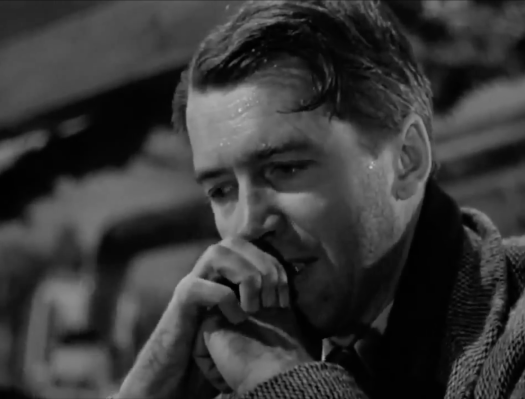
In the classic Christmas movie, “It’s a Wonderful Life”, George Bailey, played by Jimmy Stewart, is portrayed as a moral, selfless family man and a pillar of the community, who alone stands against the greedy and ruthless town banker, Henry Potter, a selfish opportunist who seeks to control the town of Bedford Falls through his wealth and financial might.
Through no fault of his own, George finds himself in a desperate financial situation. Though he’s portrayed as an upright man of moral character, he’s not a particularly religious person.
Yet, in a moment of absolute despair, George Bailey turns to God and utters this prayer: “Dear God…dear Father in heaven…I’m not a praying man but if you’re up there and you can hear me, show me the way. I’m at the end of my rope. Show me the way God.”
For many, this is exactly how they tend to think of prayer – as a desperate cry for help when all personal efforts have failed and every other conceivable avenue for addressing an issue has been exhausted. It’s a last-ditch effort to change an undesired situation by appealing to “the man upstairs”.
This view of prayer is rooted in a fundamental misconception and misunderstanding of the nature of God. This view sees God as all-powerful but distant. The God of “hail-Mary” prayers is not intimate and close; He’s impersonal and far away, too busy to be concerned with insignificant people and inconsequential matters.
But Christianity doesn’t view God as distant and impersonal. In fact, one of the major differences between Christianity and all other religions and philosophies is the idea that God is personal and He wants you to KNOW Him.
As John 1:14 states:
“And the Word became flesh and DWELT among us.”
And yet, even though Christianity sees God as intimate and personal, many Christians don’t pray regularly.
Renowned British Preacher Leonard Ravenhill penned it this way:
“The church has many organizers, but few agonizers;
many who pay, but few who pray;
many resters, but few wrestlers;
many who are enterprising, but few who are interceding.
People who are not praying and praying.
The secret of praying is praying in secret.
A worldly Christian will stop praying and a praying Christian will stop worldliness.
Tithes may build a church, but tears will give it life.
That is the difference between the modern church and the early church.
In the matter of effective praying, never have so many left so much to so few.”
As Christians, we recognize that prayer is an essential part of the Christian life; we know it’s “important”, yet we don’t pray. Why is that?
One reason, undoubtedly, is that we’re influenced by our culture to be self-reliant and self-sufficient, which probably explains why people turn to God only when they’re unable to handle their issues and problems on their own.
However, I think another reason why Christians don’t pray is that we don’t understand the many benefits of prayer.
What exactly are the benefits of prayer?
Prayer is Our Primary Means of Developing Intimacy with God.
First of all, prayer is the primary means by which we maintain our intimacy with God. James 4:8 says,
“Draw near to God and He will draw near to you.”
How, exactly, do we draw near to God? Through prayer. Prayer is an extremely personal exercise. When you pray, you’re communicating with the sovereign God of the Universe, who desires to spend time with you.
Prayer enables you to build intimacy with Jesus so that
“Christ may dwell in your heart through faith; and that you, being rooted and grounded in love, may be able to comprehend with all the saints what is the breadth and length and height and depth, and to know the love of Christ which surpasses knowledge, that you may be filled up to all the fullness of God.” (Ephesians 3:17-19)
Prayer is also the chief means by which we maintain our fellowship with God. For those times when we’ve done something we know isn’t right, or when we’ve moved away from that intimate relationship with God, prayer is how we get back on track. 1 John 1:9 says,
“If we confess our sins, He is faithful and righteous to forgive us our sins and to cleanse us from all unrighteousness.”
Prayer enables us to confess our sin and experience God’s forgiveness, resulting in continued fellowship with God.
Prayer Helps Us Overcome Temptation
A second benefit of prayer is that it helps us overcome temptation. Just before Jesus was arrested, he told his disciples in Mark 14 that they would all fall away because of Him. Peter’s response is probably one that I would be inclined to give. He emphatically says, “I won’t fall away. Even if everyone else abandons you, I won’t.”
Later, Jesus is in the Garden of Gethsemane praying. His disciples are all with Him, including Peter. They’re supposed to be keeping watch, but instead, they’re sleeping. In vs. 38 Jesus says:
“Keep watching and praying, that you may not come into temptation; the spirit is willing, but the flesh is weak.”
Jesus understood the dichotomy that exists between the sinful nature and the spiritual nature. When we pray, our focus is on God, whose power enables us to overcome sin. The disciples didn’t understand this. So instead of praying that they might not come into temptation and fall away, they slept. As a result of Christ’s arrest. v. 50 says:
“And they all left Him and fled.”
Prayer helps us overcome temptation. Even as you’re facing a temptation, getting your eyes off the temptation long enough to talk to God, can bring His help right when you need it.
Prayer Helps Us Determine God’s Will
A third benefit of prayer is that it helps us determine God’s will. In Luke chapter 6, Jesus spends all night praying to God about who He should choose to be His disciples. The next day, Jesus chose 12 men to be with Him. Jesus understood the benefit of prayer in helping to determine God’s will.
When you pray to God, you’re consulting someone who knows everything there is to know about your situation. Not only that, but He’s in complete control of your situation. Doesn’t it make sense to consult Him when you make decisions in your life?
When I was growing up, my dad was a private pilot, licensed to fly small aircraft, but only in visual flying conditions. On a cross country trip to visit some relatives in another state, we were following a two-lane highway below. From my view high above I could see the many cars and trucks traveling along the road below. In some cases, I noticed cars that were impeded by larger, slower-moving trucks in front of them. It occurred to me that if the drivers of these cars could see things from my perspective, it would be much easier for them to know when and where it would be safe to enter the lane of on-coming traffic to pass the trucks that were blocking their way.
God, of course, has a perspective that is even more expansive than my view was. He sees the complete picture of any situation we may be facing. His perfect knowledge is exactly what we need to guide our life. As we pray to God, and as we learn to listen to Him, we’ll find the direction we seek.
Prayer Allows Us to Intercede for Others
Still another benefit of prayer is that it allows us to intercede for others. Did you know that through prayer, we have the opportunity to impact the lives of others?
Jesus, in John 17, prayed for his disciples. Paul, likewise, in Ephesians 1:15-19 and Colossians 1:9-12 prayed for the young believers in those fledgling churches. We too can pray for others, and our prayers can have a powerful effect.
A story from World Christian Digest illustrates this point. Two missionaries in Malaysia had to go to the nearest town across some pretty rough country to collect some money which had come through for them at the bank there. It was a considerable distance away so they set off on foot early in the morning, hoping to return the same day.
They arrived at the town, collected the money and then set off again on their return trek, only to find that they were too tired and too far away to reach their station that night. So they set up camp on a hillside and, committing themselves to God, they fell asleep.
When morning came, they were surprised that they hadn’t been disturbed by bandits or wild animals. They went on their way without incident and arrived safely at their mission station later that day.
A few weeks later, a man came into the hospital for treatment. He stared at the missionary who attended him and said, “I’ve seen you before.”
“I don’t think we’ve met,” the missionary replied.
“No, I’m sure we have,” said the man. “You were camping on the hillside at such and such a place a few weeks back.”
“That’s right,” said the missionary. “How did you know? We didn’t see anyone.”
“I followed you with some others from the town. We had seen you in the bank and we knew you had money on you. We waited until dark to sneak up on you. We were intending to rob you, but we didn’t attack because of the soldiers.”
“Soldiers?” The missionary laughed. “There were no soldiers with us, my friend.”
The bandit was adamant. “There were – we counted them. There were sixteen of them, and they had swords too.”
The missionary humored the man and passed it off as a hallucination.
Sometime later, when he came home on furlough to England, the missionary was sharing the incident at a gathering in his home town. After the meeting, a man came up to him.
“What was the date that you camped on the hillside?”
Looking at his journal, the missionary said, “It was on such and such a night.”
The questioner also looked at his journal. “That night,” he said, “we had our weekly prayer meeting. Your name was brought forward by someone for prayer and,” he paused, “there were sixteen of us at the meeting.” [1]
Just like the 16 people who prayed for the missionaries, we too, through prayer, can enter into the spiritual battle and intercede on the behalf of others.
So why don’t Christians pray?
One reason is that we don’t see the many benefits of prayer. But there’s another reason why Christians often don’t pray.
The Power of Prayer
For many Christians, prayer is simply a mindless, rote activity. Many Christians don’t really believe that there is power in prayer.
It’s easy for us to be like the man who got lost deep in the woods while hiking alone. Later, in describing the experience, he shared about how frightened he was and how he had prayed to God to rescue him. “Did God answer your prayer?” someone asked. “Oh, no!” he replied. “Before God had a chance, a guide came along and showed me the path.” [2]
There’s an old story about some Christians who were upset that a tavern was being built in their small village. Up until then, the town had been dry. These concerned believers began an all-night prayer meeting, asking God to intervene.
As it happened, not long after, lightning struck the tavern building, and it burned to the ground. The owner brought a lawsuit against the church, claiming they were responsible. The Christians hired a lawyer, claiming that they weren’t responsible. The judge, in reviewing the case said, “No matter how this case comes out, one thing is clear. The tavern owner believes in prayer and the Christians do not.” [3]
Many of us don’t really believe that prayer makes a difference. Often, when God does meet our needs, we don’t attribute it to prayer, but instead to mere coincidence and circumstance.
The fact is, of course, that God is capable of handling any problem we could bring him. Creating planets isn’t much of a problem for him. Nothing is too difficult for God to handle – but He’s waiting for us to recognize his power and ask for his help. God DOES answer prayer.
Howard Hendricks, the long-time professor of theology at Dallas Theological Seminary, shares an amazing story of how God answered prayer. Shortly after Dallas Seminary was founded in 1924, it came to the point of bankruptcy. All the creditors were going to foreclose at noon on a certain day. That morning, the founders of the school met in the president’s office to pray that God would provide. One of the men in that prayer meeting was Harry Ironside. When it was his turn to pray, Dr. Ironside prayed in his characteristically refreshing manner: “Lord, we know that the cattle on a thousand hills are yours. Please sell some of them and send us the money.”
While they were still praying, a tall Texan came into the business office and said, “I just sold two carloads of cattle in Fort Worth. I’ve been trying to make a business deal go through and it won’t work, and I sense that God is compelling me to give this money to the Seminary. I don’t know if you need it or not, but here’s the check.”
A secretary took the check and, knowing something of the financial seriousness of the hour, went to the door of the prayer meeting and timidly tapped. When she finally got a response, Dr. Lewis Chafer took the check out of her hand; it was for the exact amount of the debt. When he looked at the signature, he recognized the name of the cattle rancher. Turning to Dr. Ironside, he said, “Harry, God sold the cattle!” [4]
God is the same yesterday, today, and forever. The same God who parted the Red Sea, the same God who caused the sun to stand still while Joshua and the Israelites routed their enemies, the same God who fed the 5000; this same God is able to handle all of your problems today. He is completely able. We simply need to go to Him in prayer.
Here are a few closing suggestions. Put prayer time into your schedule or you’ll never do it. Start small, but be consistent. Keep a journal of answered prayer. Your faith will increase as you see God answer your prayers, and as a result, you’ll be motivated to pray more.
[1] Naismith, Archibald. 2400 Outlines, Notes, Quotes and Anecdotes for Sermons. vol. 2 – Notes, Quotes and Anecdotes, Baker Book House, 1991. p. 182.
[2] Illustrations for Biblical Preaching. Edited by Michael P. Green, Baker Book House, 1991. p. 282.
[3] Illustrations for Biblical Preaching. Edited by Michael P. Green, Baker Book House, 1991. p. 275.
[4] Hendricks, Howard. “Selling Cattle.” Bible.Org, 20 Jul. 2009, bible.org/illustration/selling-cattle. Accessed 30 Aug. 2025 – (Dr. Howard Hendricks, Stories of the Heart, compiled by Alice Gray, Portland, Multnomah Press, 1996, p. 272)
Photo: Screenshot by Dave Lowe from the movie “It’s a Wonderful Life”


 The Lowedown