
Keys to Thriving

Psalm 1

1Oh, the joys of those who do not follow the advice of the wicked, or stand around with sinners, or join in with scoffers.

2But they delight in doing everything the LORD wants; day and night they think about his law.

3They are like trees planted along the riverbank, bearing fruit each season without fail. Their leaves never wither, and in all they do, they prosper.

4But this is not true of the wicked. They are like worthless chaff, scattered by the wind.

5They will be condemned at the time of judgment. Sinners will have no place among the godly.

6For the LORD watches over the path of the godly, but the path of the wicked leads to destruction. (Psalm 1:1-6, NLT)


The Daily DAVEotional

In the very first Psalm, the author paints a picture contrasting the life of those who follow the Lord with those who don’t.

The person who follows the Lord is depicted as a healthy tree that is firmly planted and has plenty of water. As a result, the tree thrives, producing fruit without fail, in every season, just as it is supposed to.

But those who don’t follow the Lord, termed “the wicked”, don’t thrive. Instead of producing fruit, they are like worthless dried leaves that wither in the wind.

What is it that determines whether someone is going to thrive or not?

According to the author, what allows some to thrive is that they “delight in doing everything the Lord wants.” The author expounds by saying, “day and night they think about his law.”

The person who thrives, spiritually speaking, does so because he commits himself to following God’s pattern for righteous living as outlined in God’s law.

You may be saying, “I thought Jesus died so that we would not have to follow the Law”, to which I would agree.

However, the fact that Jesus died does not mean we can do whatever we want. As I wrote in yesterday’s post, “The Decisive Issue in Following Christ”, when we come to Jesus to save us, we are not just saying a prayer that will allow us to escape some future punishment (hell). We are making a decision to make Jesus king in our lives, voluntarily submitting ourselves to His rules and His rule.

Jesus died so that the Law no longer condemns us and no longer punishes us. But God still outlines for us throughout the scriptures the way to righteous living. Those who want to prosper will follow the Lord’s guidelines for living. Those guidelines are not found by listening to the media, academia, celebrities or corporate America. God alone provides the way to a rich and abundant spiritual life.

Do you want to thrive? Do you want to be like a tree that is firmly planted, bearing fruit and flourishing?

According to Psalm 1, this happens only by knowing what God wants and actively and intentionally pursuing His ways.

Reflection

What kind of tree are you, spiritually speaking? Are you thriving? Why or why not?

The author says that those who prosper do so because they do everything God wants and they constantly think about God’s laws (God’s guidelines for righteous living). What evidence would you present to demonstrate that you know God’s ways and that you actively pursue them?

What factors might cause a tree that is thriving to begin to die and produce worthless dry leaves?

What are the things in your life and environment that make it harder for you to thrive spiritually and produce regular and consistent spiritual fruit?

 

Why Does My Fruit Tree Have no Fruit?

Luke 13

6Then Jesus used this illustration: “A man planted a fig tree in his garden and came again and again to see if there was any fruit on it, but he was always disappointed. 7Finally, he said to his gardener, ‘I’ve waited three years, and there hasn’t been a single fig! Cut it down. It’s taking up space we can use for something else.’

8“The gardener answered, ‘Give it one more chance. Leave it another year, and I’ll give it special attention and plenty of fertilizer. 9If we get figs next year, fine. If not, you can cut it down.’” (Luke 13:6-9, NLT)


The Daily DAVEotional

(This blog post was initially titled “A Tree with No Fruit!”)

In the first house we owned we had a tangerine tree in the back yard. It was awesome. There’s nothing like fresh squeezed tangerine juice.

When we moved to our current location, I dreamed of having a tangerine tree so we could have fresh squeezed juice just about whenever we wanted.

It took a couple of years to clear some of the bushes and get the back yard exactly the way we wanted but we finally bought a dwarf tangerine tree and planted it in the corner.

The first year there was no fruit, but I figured it was still growing. The next year, it looked like it was ready to start producing as I could see a couple of tiny tangerines beginning to grow.

And then we got a puppy.

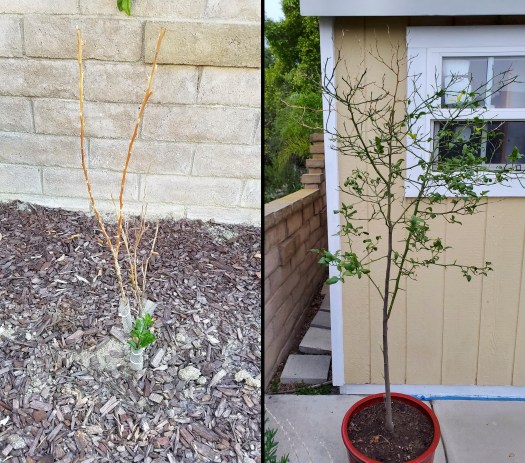
If you know anything about puppies, they like to chew things and one of the things our dog chewed on was that tangerine tree. (For more on doggie destructiveness, read my post: Life Lessons From Our Dog).  I put some mesh wiring around the base of the tree to keep the dog from destroying the tree but I wasn’t sure if it was too little too late.

Lo and behold, the tree was saved and it began to grow back (see photo on top left). But it’s been almost five years since then and we still haven’t seen one piece of fruit.

This passage from Luke reminds me of my tangerine tree. I’m about ready to toss it out and get another tree, perhaps one that is more fully developed – one that I know will yield me the fruit that I’m so often craving.

Henry Cloud appeals to this passage to illustrate what he refers to as “The Growth Model.”

When you’re thinking about growth and development, Dr. Cloud says there are three ingredients that are necessary: grace, truth and time.

In this example, the tree is not producing fruit. That is the reality. The owner wants to chop it down and put something else in its place, something that will produce fruit.

The gardener urges the owner to give the tree “one more chance”. The gardener wants to intentionally apply these 3 necessary ingredients for growth to see if the tree will respond and begin to produce fruit.

The time is the extra year. What is the truth in this scenario? The truth is the special attention gardener promises to give the tree.

But what is the grace?

We often think of grace as unmerited favor – the free gift of salvation that is given to us by Jesus through His sacrificial death on the cross.

In this illustration, the grace is the fertilizer. It’s the ingredient the tree cannot provide for itself that comes from an outside source.

Like that tree, we also need grace, truth and time in order to grow and develop. Truth is reality. It’s the realization that we have an issue or problem we need to work through.

Grace is the ingredient that you cannot provide for yourself. It may come in the form of support or motivation or help from someone else.

If we have appropriate levels of grace and truth in our lives applied over time, we can experience growth. We will be like the tangerine tree, producing sweet fruit that is evident and enjoyed by many!

NOTE: For a real life example of how grace and truth helps promote growth and change, read my post from December 15 on “Discipleship and Change Through Coaching.”

Reflection

Which of the three elements do you need in your life to experience growth in an area where you may have struggled to see improvement?

What are some areas of your life where you’ve struggled to experience real change?

How can you apply the principles from this passage to help you see progress?


Photos by Dave Lowe