
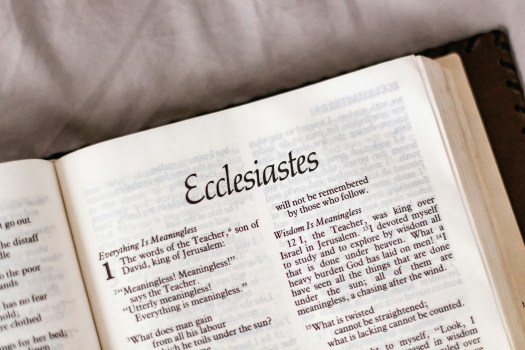
Ecclesiastes 2
1I said to myself, “Come now, let’s give pleasure a try. Let’s look for the ‘good things’ in life.” But I found that this, too, was meaningless. 2“It is silly to be laughing all the time,” I said. “What good does it do to seek only pleasure?” 3After much thought, I decided to cheer myself with wine. While still seeking wisdom, I clutched at foolishness. In this way, I hoped to experience the only happiness most people find during their brief life in this world.
4I also tried to find meaning by building huge homes for myself and by planting beautiful vineyards. 5I made gardens and parks, filling them with all kinds of fruit trees. 6I built reservoirs to collect the water to irrigate my many flourishing groves. 7I bought slaves, both men and women, and others were born into my household. I also owned great herds and flocks, more than any of the kings who lived in Jerusalem before me. 8I collected great sums of silver and gold, the treasure of many kings and provinces. I hired wonderful singers, both men and women, and had many beautiful concubines. I had everything a man could desire!
9So I became greater than any of the kings who ruled in Jerusalem before me. And with it all, I remained clear-eyed so that I could evaluate all these things. 10Anything I wanted, I took. I did not restrain myself from any joy. I even found great pleasure in hard work, an additional reward for all my labors. 11But as I looked at everything I had worked so hard to accomplish, it was all so meaningless. It was like chasing the wind. There was nothing really worthwhile anywhere.
12So I decided to compare wisdom and folly, and anyone else would come to the same conclusions I did. 13Wisdom is of more value than foolishness, just as light is better than darkness. 14For the wise person sees, while the fool is blind. Yet I saw that wise and foolish people share the same fate. 15Both of them die. Just as the fool will die, so will I. So of what value is all my wisdom? Then I said to myself, “This is all so meaningless!” 16For the wise person and the fool both die, and in the days to come, both will be forgotten.
17So now I hate life because everything done here under the sun is so irrational. Everything is meaningless, like chasing the wind. 18I am disgusted that I must leave the fruits of my hard work to others. 19And who can tell whether my successors will be wise or foolish? And yet they will control everything I have gained by my skill and hard work. How meaningless!
20So I turned in despair from hard work. It was not the answer to my search for satisfaction in this life. 21For though I do my work with wisdom, knowledge, and skill, I must leave everything I gain to people who haven’t worked to earn it. This is not only foolish but highly unfair. 22So what do people get for all their hard work? 23Their days of labor are filled with pain and grief; even at night they cannot rest. It is all utterly meaningless.
24So I decided there is nothing better than to enjoy food and drink and to find satisfaction in work. Then I realized that this pleasure is from the hand of God. 25For who can eat or enjoy anything apart from him? 26God gives wisdom, knowledge, and joy to those who please him. But if a sinner becomes wealthy, God takes the wealth away and gives it to those who please him. Even this, however, is meaningless, like chasing the wind. (Ecclesiastes 2:1-26, NLT)
The Daily DAVEotional
Blaise Pascal, the famous 17th century French mathematician and inventor, is often credited with saying,
There is a God-shaped vacuum in the heart of every man which cannot be filled by any created thing, but only by God, the Creator, made known through Jesus Christ.
Interestingly, Pascal never actually said this exact quote, though he did express the sentiment when he said,
“What else does this craving, and this helplessness, proclaim but that there was once in man a true happiness, of which all that now remains is the empty print and trace? This he tries in vain to fill with everything around him, seeking in things that are not there the help he cannot find in those that are, though none can help, since this infinite abyss can be filled only with an infinite and immutable object; in other words by God himself”
As it turns out, this sentiment from Pascal, which has been shortened into the pithy quote that we all see today, was probably derived from Solomon, who explored the nature of meaning and fulfillment in this second chapter of Ecclesiastes.
So what exactly does Solomon say?
It’s important to understand the context on which Ecclesiastes 2 rests. In chapter 1, Solomon is trying to derive meaning and purpose to our existence. His initial position, based on observations and lived experience, is that life is meaningless.
It’s a sad existence indeed if there is absolutely no purpose or meaning in life. Yet that is what Solomon initially concludes.
In this chapter of Ecclesiastes, we’re subjected to a bit of Solomon’s ontological journey.
The first thing he says is that he tried to find meaning and fulfillment in pleasure, or what we call hedonism. But physical pleasure provides no lasting satisfaction. The exhilarating rush that pleasure brings quickly fades, leaving one grasping for the next opportunity to experience that physical and emotional high.
Solomon then turns his attention to the pursuit of materialism. Perhaps acquiring lots of stuff, overseeing grand construction projects or building tremendous wealth could ascribe meaning and value to life. But Solomon found that lacking as well. The allure that extreme wealth promises is never quite achieved. John Rockefeller, who was the richest person to ever live, was once asked, “how much is enough?” His response was “just a little bit more.” He apparently did not subscribe to Solomon’s conclusion that extreme wealth does not ultimately satisfy.
Perhaps fame and taking pride in one’s work could provide the kind of satisfaction that pleasure and materialism couldn’t. But Solomon ultimately realized the utter futility of that pursuit. Fame is fleeting and whatever work we may accomplish is forgotten as quickly as we are when we die.
Solomon reasoned that hard work and wealth are ultimately meaningless because we all die. What good are those things after you die? Someone else will take possession of and oversee all that we’ve worked to produce. That hardly seems fair. You work your tail off to produce wealth and build an empire only to leave it to someone else who did nothing to earn or produce what you’ve left?
None of this makes sense on the surface. What is the point?
Solomon gives a glimpse into the ultimate purpose in verses 24-25, when he says,
24So I decided there is nothing better than to enjoy food and drink and to find satisfaction in work. Then I realized that this pleasure is from the hand of God. 25For who can eat or enjoy anything apart from him?
Is pleasure, wealth, fame and work all meaningless? Apart from God, the answer is yes. But with God, all of these things are meaningful because they are gifts from God, the ultimate gift-giver!
So we’re back to our opening line that is often attributed to Pascal. There is something inside each person that is searching and striving for meaning and purpose. Man, in his fallenness, seeks to satiate this inner desire with all kinds of things – pleasure, power, wealth and fame. But none of these things bring true satisfaction or fulfillment. That’s because God is the only one who can ultimately fulfill our basic human need for meaning and purpose. It’s part of His design.
Apart from God there is no ultimate meaning and purpose. As Christian philosopher and apologist Frank Turek says, we are just “moist robots” who appear one day and then one day we’re gone.
If that is the case, then Solomon’s initial assessment is true – life is indeed meaningless. But with God, life not only has purpose and meaning but work, pleasure and wealth all make sense.
Did you enjoy this post? I’d love to hear your thoughts! Feel free to like, leave a comment below, and share it with your friends or on social media if you found it helpful or interesting. Your support keeps the conversation going!
Reflection
What do you turn to in order to experience purpose and meaning in life?
Which of the following do you struggle with the most: the pursuit of pleasure, wealth, power or fame?
What do you think are the reasons you or people in general pursue other things to satisfy their inner needs rather than pursuing God Himself?
In what ways can you turn to God as your source of true satisfaction and fulfillment?
Photo by Sincerely Media on Unsplash

 The Lowedown