Wrestling Against Evil

Ephesians 6

10Finally, be strong in the Lord and in the strength of his might. 11Put on the whole armor of God, that you may be able to stand against the schemes of the devil. 12For we do not wrestle against flesh and blood, but against the rulers, against the authorities, against the cosmic powers over this present darkness, against the spiritual forces of evil in the heavenly places. 13Therefore take up the whole armor of God, that you may be able to withstand in the evil day, and having done all, to stand firm. 14Stand therefore, having fastened on the belt of truth, and having put on the breastplate of righteousness, 15and, as shoes for your feet, having put on the readiness given by the gospel of peace. 16In all circumstances take up the shield of faith, with which you can extinguish all the flaming darts of the evil one; 17and take the helmet of salvation, and the sword of the Spirit, which is the word of God, 18praying at all times in the Spirit, with all prayer and supplication. (Ephesians 6:10-18, ESV)


The Daily DAVEotional

Last week, on Wednesday, I took my car to my mechanic for service. When I picked it up later that day, my mechanic told me that Charlie Kirk had been shot and killed while speaking on a campus in Utah.

Honestly, I was shocked. What in the world is going on?

I think it’s been obvious for quite some time that our culture is divided. It might be tempting for one to explain these divisions as mere differences in political views and policy preferences.

But to me, the assassination of Charlie Kirk underscores the fact that what divides us aren’t trivial differences of opinion. No. The issues that divide us aren’t political, or even religious. What we’re experiencing is a spiritual battle.

There’s a spiritual component at play in our culture and it’s more intense than at any time I’ve ever experienced in my lifetime.

Paul talks about the nature of this battle here in this Ephesians 6:10-18 passage. I chose the ESV translation for a reason.

Most versions of this passage say that our “struggle” is not against flesh and blood. Some versions say our “battle” is not against flesh and blood. But the ESV, along with the King James version, uses the word “wrestle” . I like that rendering because when I was in high school, I was a wrestler. If you’re familiar with “wrestling” I think it will help you understand more fully the nature of the spiritual battle that Paul’s describing.

A lot of people are unfamiliar with real competitive wrestling. Their only concept of wrestling is what they see on TV with the WWE. But that’s not real wrestling. Mostly, that’s staged entertainment with a heavy dose of masculine bravado.

High school, collegiate and Olympic style wrestling is different from the staged spectacle that is marketed as entertainment.

Competitive wrestling is a grueling combat sport that combines strength, skill, stamina and strategy. The goal: each wrestler seeks to subjugate his opponent.

The word subjugate means to dominate or control.

Hence, the goal of wrestling is to control or dominate your opponent.

So when Paul says that we “wrestle” against the spiritual forces of EVIL, that means there are spiritual forces that are seeking to subjugate or control you….seeking to control how you think, how you act, even how you perceive ultimate reality.

These forces are evil, so these forces are intent on controlling you for EVIL.

Think about that for a moment. Spiritual forces are seeking to control you FOR EVIL.

We live in a culture that is obviously very divided. But unlike any other time in my lifetime, we are living in a moment where both sides of the political divide think the other side is evil. The Charlie Kirk assassination clearly illustrates this.

Charlie Kirk was murdered in cold blood while speaking to a crowd on a university campus. There can be no doubt and no debate that what happened to Charlie Kirk was a heinous act of EVIL.

And yet, in the days following this tragic event, many either cheered, excused or even rationalized this evil act by saying that Charlie Kirk was himself promoting evil.

My point here is not to get into the details of what Charlie thought, taught or believed. Nor am I going to discuss the killer’s personal views and motivations. There are plenty of people who have already done that.

My point is simply that you have an evil act on one side and on the other side,  you have people portraying the victim of that evil act as a person of evil.

Since each side is calling the other side “evil”, this tells me that what is happening is spiritual in nature. For how can both sides be evil? That makes no sense as Jesus himself said that “a house divided against itself cannot stand” (see Matthew 12:25).

It seems abundantly clear that a large number of people are completely deceived regarding their understanding of what is fundamentally good and what is inherently evil.

That’s the nature of the battle. It’s spiritual in nature and it’s a battle for control. Ultimately, it’s a battle regarding the nature of good and evil.


Did you enjoy this post? I’d love to hear your thoughts! Feel free to like, leave a comment below, and share it with your friends or on social media if you found it helpful or interesting. Your support keeps the conversation going!


Reflection

What are some examples you can cite that illustrate that we’re in a spiritual battle?

In what ways do you see spiritual forces seeking to control you or the culture?

What do you think are some of the schemes the devil employs in order to control people?

What practical steps can you take to “wrestle” against the spiritual forces of evil?


Photo by Chris Chow on Unsplash

Grace Anatomy

Ephesians 2

1As for you, you were dead in your transgressions and sins, 2in which you used to live when you followed the ways of this world and of the ruler of the kingdom of the air, the spirit who is now at work in those who are disobedient. 3All of us also lived among them at one time, gratifying the cravings of our sinful nature and following its desires and thoughts. Like the rest, we were by nature objects of wrath. 4But because of his great love for us, God, who is rich in mercy, 5made us alive with Christ even when we were dead in transgressions—it is by grace you have been saved. 6And God raised us up with Christ and seated us with him in the heavenly realms in Christ Jesus, 7in order that in the coming ages he might show the incomparable riches of his grace, expressed in his kindness to us in Christ Jesus. 8For it is by grace you have been saved, through faith—and this not from yourselves, it is the gift of God— 9not by works, so that no one can boast. 10For we are God’s workmanship, created in Christ Jesus to do good works, which God prepared in advance for us to do. (Ephesians 2:1-10, NIV)


The Daily DAVEotional

Ephesians 2 is one of my favorite passages. If I was creating a Mount Rushmore of favorite New Testament passages (an all-time top 4 list), this passage would definitely be in contention. It is rich with theological truths that are fundamental to understanding the depth of God’s love for us as well as the means and lengths He would go to save us.

A key word in these 10 verses is “grace”, which appears 3 times.

What do you think grace is? How would you define it?

I’ve asked that question to hundreds of people over the years as I’ve engaged in spiritual conversations.

The interesting thing about grace is that it’s a word that most people have heard hundreds of times but almost always have difficulty defining.

Some people, when they hear the word “grace”, think of a dinner time prayer, like Aunt Bethany in Christmas Vacation.

Others equate grace with beauty, like a graceful dancer, or an elegantly dressed celebrity.

To be sure, those are connotations that we may think of when we hear the word, but from a biblical standpoint, “grace” means none of those things.

The theological definition of grace is “unmerited favor” or “undeserved gift”.

I would often give this example of grace when talking to students, as it was a hypothetical, yet realistic situation they could imagine experiencing.

Imagine that you’re taking a class and it’s nearing the end of the semester. You have a big research paper due and it’s worth a hefty portion of your grade. You need to do well on this paper to pass the class.

The problem is that you are nowhere near being done. As the deadline nears, you approach the professor and ask for an extension.

Now would it be unfair if the professor were to decline your request? Would that be unjust?

No. The guidelines and deadlines were clearly communicated. You had ample opportunity to work on the paper and get it done. The professor would not be mean or unjust if he or she were to simply deny your request and tell you that any late papers would be severely penalized.

That is what the Bible calls justice – getting what you deserve. In this passage, what we deserve is God’s wrath. Paul says that we “followed the ways of the world”… “gratifying the craving of our sinful nature and following its desires and thoughts.” As a result, we were objects of God’s wrath, which simply means we were destined to be punished.

God would be perfectly just to give us what we deserve. That’s what justice is – getting what we deserve.

Your professor would also be just to say no to your request and give you exactly what you deserve.

But suppose your professor honors your request and decides to give you a one week extension with no late penalties – a “grace” period.

Your professor is not obligated to give you an extension but if he or she did, it would be an example of extending grace. Your professor is giving you something you don’t deserve – the gift of extra time. You didn’t earn an extension. You don’t deserve an extension. You receive the extension simply because your professor chooses to give it to you.

This is the situation with us and God. We don’t deserve to be saved. We did nothing to earn God’s favor. God is not obligated to save us, and yet, He chooses to extend grace to us. What that means is that we don’t get what we deserve, which is punishment. Instead, we get what we DON’T deserve – the gift of salvation.

Why would God choose to extend grace? Why would he not just punish us since that is what we deserve?

Verse 4 gives us the answer:

But because of his great love for us, God, who is rich in mercy, 5made us alive with Christ even when we were dead in transgressions—it is by grace you have been saved. 

God chooses to save us because of His great love for us and the depth of His mercy.

What is mercy?

Mercy is NOT getting something you deserve.


Doctrinal Dictionary

Justice – getting what you deserve (punishment)

Mercy – Not getting something we deserve (as in avoiding punishment)

Grace – Getting something we don’t deserve (as in favor or blessing)


We deserve punishment but because of God’s love for us, he takes pity on us and desires to make a way so that we don’t have to experience the punishment we deserve.

As a result, God extends grace by sending His son to die in our place so that God’s justice would be satisfied and we could avoid experiencing His wrath.

Verses 8 and 9 are often quoted, as they summarize the essence of the gospel message:

8For it is by grace you have been saved, through faith—and this not from yourselves, it is the gift of God— 9not by works, so that no one can boast.

God gives us a gift we don’t deserve – He saves us. This is grace: getting something we don’t deserve. We didn’t earn this gift. It is freely given by God. Hence, we cannot boast in our salvation because we did nothing to get it. Yet God did everything to give it.

Verse 10 is often neglected but is important to understanding God’s motive and the ultimate outcome He desires of our lives:

For we are God’s workmanship, created in Christ Jesus to do good works, which God prepared in advance for us to do.

Some Bible versions, like the NLT, translate this verse to say that “we are God’s masterpiece.”

Think about that for a minute. God saves us because we are a masterpiece in His eyes. His desire is that we would be transformed into a physical work of art and that our lives would be a living testament to the depth of His love, the richness of His mercy and the boundlessness of His grace!


Did you enjoy this post? I’d love to hear your thoughts! Feel free to like, leave a comment below, and share it with your friends or on social media if you found it helpful or interesting. Your support keeps the conversation going!


Reflection

What has been your definition of grace before reading this post? How did you tend to think of it and define it?

What are some examples of when you experienced grace from another person – a gift that you didn’t deserve?

How would you explain to someone else the difference between justice, mercy and grace?

God says that you are his masterpiece, created for good works in Christ Jesus. What do you think it would look like if you really understood and believed that God sees you as his masterpiece? How would it change your life and your view of yourself?

What are the barriers or roadblocks that make it difficult for you to see yourself as God’s masterpiece?


Photo above is an edited image of a photo by Zhifei Zhou on Unsplash

and another Photo by Helena Lopes on Unsplash

The Holy Spirit as a Deposit

Ephesians 1

13And you also were included in Christ when you heard the word of truth, the gospel of your salvation. Having believed, you were marked in him with a seal, the promised Holy Spirit, 14who is a deposit guaranteeing our inheritance until the redemption of those who are God’s possession—to the praise of his glory. (Ephesians 1:13, 14, NIV)


The Daily DAVEotional

What do you know about the Holy Spirit? To many Christians, the Holy Spirit remains a mystery. We know He’s important because He’s mentioned along with the Father and the Son as a member of the Holy Trinity. But for many Christians, that’s the extent of their knowledge and understanding of the Holy Spirit.

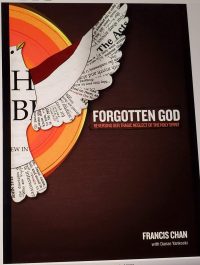
I mentioned in a previous post how Francis Chan referred to the Holy Spirit as the “Forgotten God”, which was the title of a book he wrote on the Holy Spirit.

The Holy Spirit’s role in the life of the believer is absolutely critical even though many Christians are blissfully unaware of who the Holy Spirit is or what role He plays in their lives.

So who IS the Holy Spirit and what is His role?

I wrote about the nature of the Holy Spirit in my blog post, “Is the Holy Spirit Like the Force in Star Wars?“, in which I demonstrated that the Holy Spirit is God.

I also wrote recently here about two verses in Ephesians that tell us ONE aspect of the Holy Spirit’s role in the life of those who follow Christ, namely that the Holy Spirit functions as a seal.

Closely related to His function as a seal, the Holy Spirit, according to Ephesians 1:14, functions as a deposit.

What exactly does Paul mean when he says that the Holy Spirit is a deposit?

To answer that question, I’ll ask you a different question.

Have you ever taken out a loan for a car or for a home?

If you have, it’s likely that you made a down payment or put down a deposit. Unless of course you paid cash in full for your purchase. If you did that, then Dave Ramsey would be very proud of you.

For most people, having enough cash on hand to buy a car might be possible, but it’s less likely that you are paying cash in full to buy a house. Especially in this market (have you seen the prices of homes lately?)

Anyhow, if you took out a loan for a house or a real nice car, you likely put down a deposit, or a down payment. Also if you’ve ever rented an apartment or a home, you likely put down a deposit to secure the lease.

The deposit has one function – skin in the game. The purpose of a deposit is for you to put a portion of your own hard-earned money into the loan. This gives the lender confidence that you are a responsible borrower and you are more likely to make the payments on the loan.

In the event that you as a borrower fail to make the payments on the loan, you forfeit your deposit. Most borrowers will not want to lose their deposit, especially if it represents a significant amount of money.

This verse says that the Holy Spirit functions like a deposit. The Holy Spirit is given to the believer as a down payment, guaranteeing that God will ultimately deliver on all future salvation promises.

When we make a down payment on a loan, we are promising the lender that we are “good for the balance”. We’re saying that we will make all the payments until the loan is fully paid.

However, even though we may have good intentions. a loan default is still possible. As humans, we don’t always keep our promises. But even though WE may not always fulfill our financial obligations, what are the chances that God will fail to keep His promises related to salvation? ZERO.  God cannot default on Himself. It is impossible for Him to be unfaithful.

So when the Bible says that the Holy Spirit is a deposit, it means that everything God has promised us related to our full and future redemption as believers WILL come to pass. You can take that to the bank!

Reflection

Have you ever made a down payment on a loan – for a house or car, or other item? If so, what was it?

Have you, or someone you know ever defaulted on a loan? What were the circumstances?

Have you ever been a renter and not received your full deposit back when you moved out? What were the reasons why you did not get all of your deposit back?

What do you think it means that the Holy Spirit is a deposit, guaranteeing our future redemption as believers?

What is the future redemption that the text speaks about? What exactly is the involved in the future redemption, which the Holy Spirit has secured for us as believer?


Photo by RDNE Stock project: https://www.pexels.com/photo/close-up-photo-of-an-agreement-on-a-paper-7841821/


The Holy Spirit as a Seal

Ephesians 1

13And you also were included in Christ when you heard the word of truth, the gospel of your salvation. Having believed, you were marked in him with a seal, the promised Holy Spirit, (Ephesians 1:13, NIV)

Ephesians 4

30And do not grieve the Holy Spirit of God, with whom you were sealed for the day of redemption. (Ephesians 4:30, NIV)


The Daily DAVEotional

In 2009, popular speaker and Christian author Francis Chan wrote and released his book “Forgotten God.” The book was an aptly titled treatise on the Holy Spirit, the often misunderstood and neglected third member of the Trinity.

Many Christians are confused about the role of the Holy Spirit. We understand God the Father. We imagine Moses talking to the Father as he encounters the burning bush. Or we think of the Old Testament prophets communicating with “The Father”.

We also understand Jesus because we read about Him in the gospels and the New Testament epistles. In our minds, we see the actions of Jesus and we hear His words as He teaches the crowds and interacts with His disciples.

But who is this Holy Spirit character? We know He’s a part of the Trinity but we often don’t know what He does or why He’s important.

I wrote about the nature of the Holy Spirit in my blog post “Is the Holy Spirit like the Force in Star Wars“, demonstrating that the Holy Spirit is God!

Beyond knowing that the Holy Spirit is a person and that He is God, what exactly is the role of the Holy Spirit in my life? What does He do? Does it even matter?

There’s a whole theology built around understanding the nature and the person of the Holy Spirit. It’s called Pneumatology, The Greek word “pneuma” (pronounced “nooma”) means “breath, wind, or spirit.” Hence, pneumatology is the study of the Holy Spirit.

To understand the Holy Spirit completely would take more time than just a brief blog post, but we do learn something specific about the role of the Holy Spirit in the life of believers from these two verses in Ephesians.

From these two verses, we learn that the Holy Spirit is a seal. What exactly does that mean?

A seal has many purposes.

For one, a seal was used to demonstrate ownership. In modern times, ranchers will brand their cattle and livestock with a branding iron, which is like a seal. This brand is a specific logo or emblem that represents that ranch and all livestock branded with that emblem are owned by that ranch.

Ephesians 1:13 says that we “were marked in Him with a seal, the promised Holy Spirit.” One role of The Holy Spirit then is to act as a seal, essentially imprinting a God-tattoo on our soul, demonstrating that we now belong to God.

A second purpose of the seal is to demonstrate authority.

In ancient times, a seal was used to identify an individual. The seal authenticated a person via an emblem or a device that could be used to make an impression in wax or clay.

Genesis 38 tells the story of Tamar who disguises herself as a prostitute in order to sleep with her father-in-law, Judah. When Judah asks her what he can give her as security while she waits for payment for services rendered, she replies,

“I want your identification seal, your cord, and the walking stick you are carrying.” So Judah gave these items to her. She then let him sleep with her, and she became pregnant. (Genesis 38:18, NLT)

In today’s culture, a seal is often used by official entities (like the government) to demonstrate the authority and authenticity of a document. As I look at my driver’s license, for example, it is embossed with the “Great Seal of the State of California”, which demonstrates that the identification is authentic and legal.

So the Holy Spirit is given to us as believers to authenticate our relationship with God. It is real. It is authentic. It is officially from God.

A third purpose of a seal is one of security. A seal was often used in official communication to ensure the security of the message. A document would be folded and a piece of wax or clay would be used to “seal” the fold. The seal of the person (often a signet ring) was used to press into the wax and create an official image that represented that person. If the seal was broken before reaching the recipient, the recipient would know that the communication was perhaps compromised.

According to Ephesians 4:30, the Holy Spirit “seals” the believer for the day of redemption. What that means is that the Holy Spirit is given to believers to secure all of the promised elements related to our future salvation.

Of course there’s a lot more to know and understand about the role the Holy Spirit plays in our lives as believers. But one important role is that He is a seal, which shows that we now belong to God, we are authentic members of His family and that all of God’s future promises related to salvation are secure.

Reflection

At the outset, it was suggested that the Holy Spirit is the often over-looked, misunderstood third member of the Trinity (the Forgotten God). What has been your understanding and experience with the Holy Spirit as a believer? Before reading this post, what has been your relationship with the Holy Spirit in your daily Christian life?

What are some examples in your own experience of a seal?

One purpose of the seal is to show ownership, like a brand on livestock. When you think about being “owned” by God, how does this affect you as a follower of Christ? What impact, either positive or negative, does this have on you as you seek to live out the Christian life?

Another purpose of a seal is security. What do you think it means that the Holy Spirit secures all of the promises related to our future salvation? What exactly is He securing? What difference does this make in how you live out your faith?


Photo by Anna Tarazevich: https://www.pexels.com/photo/close-up-photo-of-a-stamp-on-a-paper-5425648/

Under the Influence

Ephesians 5

15So be careful how you live, not as fools but as those who are wise. 16Make the most of every opportunity for doing good in these evil days. 17Don’t act thoughtlessly, but try to understand what the Lord wants you to do. 18Don’t be drunk with wine, because that will ruin your life. Instead, let the Holy Spirit fill and control you. 19Then you will sing psalms and hymns and spiritual songs among yourselves, making music to the Lord in your hearts. 20And you will always give thanks for everything to God the Father in the name of our Lord Jesus Christ. (Ephesians 5:15-20, NLT)


The Daily DAVEotional

In this section of Ephesians Paul is summarizing what He’s shared earlier in chapter 5 where he has given a number of examples and admonitions for what it means to follow God.

The summary of all the guidelines is to live wisely instead of foolishly.

What does it mean to live wisely and what does it look like to live foolishly?

Examples of wisdom and foolishness are replete throughout the Bible. The book of Proverbs contains a wealth of knowledge contrasting wisdom from foolishness. Additionally, Paul gives many exhortations and commands in his many New Testament letters, including what he’s shared earlier in chapter 5.

However, in this short segment, Paul summarizes wise and foolish living with 3 ideas:

First, people who live wisely make the most of their time. They don’t waste their time, but use their time for doing good.

Secondly, the wise person doesn’t act thoughtlessly but considers what the Lord’s will is. The implication here is that the wise person KNOWS the Lord and His word. Knowing God’s word is vital to understanding His will because it is the primary means by which we understand God’s character and His purposes.

Third, the wise person doesn’t get drunk but instead is filled with the Holy Spirit.

I think it’s interesting that Paul compares and contrasts being filled with the Spirit with being drunk. Why does he do this? How are these two things similar and how are they different?

Most states have strict laws about driving while drunk but if you get pulled over and charged, the official term is often “DUI”, which stands for driving under the influence.

When we drink too much, we are under the influence of alcohol and it affects us mentally, physically and emotionally. In short, we lose control of ourselves and often do things and act in ways that are totally out of character.

In the same way, to be filled with the Spirit is to be under the Spirit’s control. It means that I allow God’s Spirit to lead me and influence my decisions and my actions.

According to verse 18, the end result of being drunk is that it ruins our lives. Some translations say that being drunk leads to “dissipation”, which means “wasteful living.” The idea is that really nothing good comes from being drunk. It’s a waste of time and energy that leads to nothing good or productive.

The key question is: who is in control of my life? Is it me? If I’m in control, making my own decisions and living for myself, then I’m living foolishly and I’m apt to do foolish things, just as someone who is drunk.

However, if God’s Spirit is in control, then I’m living wisely, following His lead, doing good instead of evil and as a result, my life has purpose and direction.

Another way of looking at this is to ask the question: what influences you? We are all influenced by something. Whatever is influencing you is ultimately controlling you. Paul’s admonition is that the believer should be under the influence of the Holy Spirit. Being under the influence of anything else is foolish.

Reflection

How are you using your time? In what ways does your schedule reflect God’s priorities? Are there things in your schedule that are time wasters? 

What are some examples that come to mind that demonstrate how drunkenness can lead to ruined lives or wasteful living?

Paul contrasts being drunk with being filled with the Spirit. How can a person be controlled by God’s Spirit? What steps can one take to be under the influence of God’s Spirit?

If you were to create your own list of foolish living versus wise living, what items would be on each list? What is the source of items for each of your lists?

How can you know what God’s will is? What steps and actions can you take to understand God’s will and ensure that you’re following God’s will?


Photo by Vinicius “amnx” Amano on Unsplash


Rotten to the Core!

Ephesians 4

17With the Lord’s authority let me say this: Live no longer as the ungodly do, for they are hopelessly confused. 18Their closed minds are full of darkness; they are far away from the life of God because they have shut their minds and hardened their hearts against him. 19They don’t care anymore about right and wrong, and they have given themselves over to immoral ways. Their lives are filled with all kinds of impurity and greed.

20But that isn’t what you were taught when you learned about Christ. 21Since you have heard all about him and have learned the truth that is in Jesus, 22throw off your old evil nature and your former way of life, which is rotten through and through, full of lust and deception. 23Instead, there must be a spiritual renewal of your thoughts and attitudes. 24You must display a new nature because you are a new person, created in God’s likeness—righteous, holy, and true. (Ephesians 4:17-24, NLT)


The Daily DAVEotional

Chapter 4 of Ephesians is packed with theological truths that are vitally important for followers of Christ to understand.

Paul exhorts the Ephesians to live differently by contrasting the characteristics of the ungodly versus the characteristics of those who are in Jesus.

Paul describes the ungodly as darkened in their understanding because of their hardened hearts. A person with a hardened heart is someone who has made a decision of the will to live the way they want to and this shows up in their morals – they no longer care about right and wrong and their lives are filled with “all kinds of impurity and greed”.

Does this sound familiar?

But this shouldn’t be how the Christian lives. Paul admonishes us to throw off our old evil nature and former way of life which is rotten through and through. (vs 22). So according to Paul, you’re a rotten person! (I am too).

I love how the NIV states verse 22. It says:

22You were taught, with regard to your former way of life, to put off your old self, which is being corrupted by its deceitful desires; (Ephesians 4:22, NIV)

That phrase “being corrupted” is in the present tense, which indicates an action that is ongoing. What this means is that your sinful nature is not just sinful, but it’s continuing in its corruption – it’s getting worse!

How are we to combat a sin nature that’s actually getting worse?

Paul says there must be a spiritual renewal of your thoughts and attitudes. And since the old nature is continually being corrupted, our new nature must continually be renewed!

The Christian life, contrary to what some might believe, is not a one-time decision. Yes, our decision to accept Christ as our Savior brings us forgiveness and adoption and a myriad of other spiritual blessings. It’s the start of our new life in a relationship with Christ. But to follow Christ requires a constant renewal of our thoughts and attitudes. If we neglect to do this, our sin nature will take over, and since it is being corrupted, we are at risk of living more like the ungodly than the righteous.

Reflection

What areas of your life are you most likely to see as “being corrupted”?

What are some practical ways you can renew your thoughts and attitudes?

What is your reaction to the idea that the Christian life is not a “one-time” decision, but rather, it’s a daily, even moment-by-moment decision to reject ungodliness and pursue righteousness?


Photo by Anita Jankovic on Unsplash