
Ezra 4
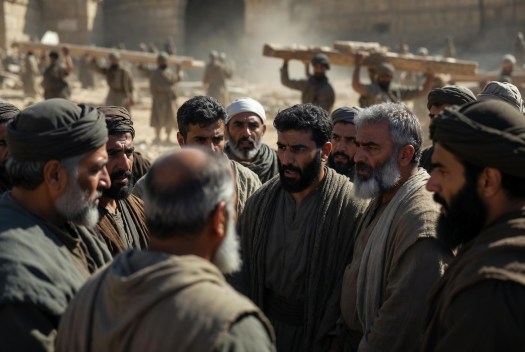
1The enemies of Judah and Benjamin heard that the exiles were rebuilding a Temple to the LORD, the God of Israel. 2So they approached Zerubbabel and the other leaders and said, “Let us build with you, for we worship your God just as you do. We have sacrificed to him ever since King Esarhaddon of Assyria brought us here.”
3But Zerubbabel, Jeshua, and the other leaders of Israel replied, “You may have no part in this work, for we have nothing in common. We alone will build the Temple for the LORD, the God of Israel, just as King Cyrus of Persia commanded us.”
4Then the local residents tried to discourage and frighten the people of Judah to keep them from their work. 5They bribed agents to work against them and to frustrate their aims. This went on during the entire reign of King Cyrus of Persia and lasted until King Darius of Persia took the throne. (Ezra 4:1-5, NLT)
The Daily DAVEotional
This passage in Ezra 4 describes an interesting scenario. Some locals who claim to worship the same God as the Israelites do come to the leaders in charge of rebuilding the temple and offer to help. Yet the first verse describes them as “enemies” of Judah and Benjamin.
What in the world is going on?
Can’t we all just get along?
For the sake of unity and harmony, shouldn’t we agree to partner with those who claim allegiance to the same God we do?
On the surface, it makes logical sense to affirm those who invoke the name of Jesus or who claim that they worship the same God we do.
The problem though is that invoking the name of Jesus or saying that we affirm the same God doesn’t mean that our beliefs are in alignment. In fact, it’s possible, even likely, that they aren’t.
In this passage, we learn that the Jewish exiles were in the process of rebuilding the Temple.
To understand what is really happening, let’s take a moment to review how the Israelites got to this particular moment in time.
The Israelites had been warned by God over and over again that disobedience to Him and continued idolatry would incur severe consequences in the form of being conquered by rival nations.
God made due on His promise as the Israelites, the Northern Kingdom, were conquered and subdued by the Assyrians in 722 B.C. Likewise, Judah, the Southern Kingdom, was conquered and exiled by the Babylonians in 586 BC.
What happened when a nation like Israel was conquered was a systematic process of acculturation. Large numbers of the conquered nations’ citizens were typically transported to the conqueror’s country, where they were dispersed and expected to assimilate into the dominant culture of the conquering nation. In this case, large numbers of Jews were transported to Assyria, where they became exiles living in a foreign land.
At the same time, citizens of the conquering nation were encouraged to relocate into the land of the conquered nation, thus bringing that culture into the new province of the conquering nation. In this scenario, Assyrian citizens were relocated to Israel, where they brought their customs and their religious beliefs.
The net result was the slow erasure of the conquered nation’s culture in favor of the conquering nation’s culture.
So when Israelite exiles were finally allowed to return to their homeland, they find it populated with Assyrians who had moved there to occupy the land. These Assyrians were not worshipers of Yahweh, at least not exclusively.
So when Ezra references, “the enemies of Judah and Benjamin”, he’s talking about these Assyrian transplants who have been living in the land but who are not native to the area, and who do not reflect Jewish culture.
But don’t these Assyrians worship Yahweh now? After all, don’t they “worship your God just as you do”?
This is the claim, right? They claim that they worship Yahweh and that they also sacrifice to Him. Doesn’t that make them fellow God-fearers? What would be the harm then in partnering with them to rebuild the temple? Shouldn’t we work with those who share our interests?
Notice that in the first verse, these Assyrians are described as “enemies of Judah and Benjamin”.
Here’s the important point: just because someone says they worship the same God as you doesn’t mean that their views are in alignment with yours. Additionally, it doesn’t mean that their intentions and their ultimate allegiance is the same as yours.
This is extremely relevant in our own culture, where the label “Christian” gets thrown around so much that it’s almost cliche.
Just because someone says they are a Christian doesn’t mean that their understanding of what it means to be a Christian is biblical. Furthermore, just because a person says they believe, or “respect” Jesus, doesn’t mean that their view of Jesus is biblical and in alignment with what the Christian church has traditionally believed and taught.
We are seeing this play out first hand in Texas, where a young congressman, James Talarico, is running for U.S. Senate. Talarico claims to be a Christian but when you evaluate his theological positions, it’s clear that his version of Christianity is progressive, not orthodox.
What that means is that even though he identifies as Christian, and he says that he follows the teachings of Jesus, it’s clear that his understanding of Christianity and Jesus is not in alignment with traditional, biblical teachings.
Talarico has made a number of statements that demonstrate that his version of Christianity is actually not Christian at all. Foremost is his belief that Jesus is not the only way to salvation and that other religions are equally valid representations of God.
I don’t mean to pick on Talarico. He is just a prominent example of a growing strain of Christianity that is not actually Christian. This ideology has hijacked the name and terms of Christianity to promote its own evil, anti-biblical views in an effort to mainstream them within the culture.
Progressive Christianity is just one example of an ideology that uses the names and terms of Christianity in ways that aren’t actually Christian.
So when someone says they are a Christian, or they say that they like Jesus or even that they follow Jesus, that doesn’t automatically mean they believe what the Bible teaches on these matters. It could simply mean that they have adopted the culture’s views of Jesus and Christianity.
We would be wise to explore their views further before aligning ourselves with those who are actually opposed to the work of God. We might find, just as Ezra did, that when it comes to the work of God, “we have nothing in common.”
Did you enjoy this post? I’d love to hear your thoughts! Feel free to like, leave a comment below, and share it with your friends or on social media if you found it helpful or interesting. Your support keeps the conversation going!
Reflection
What clues from this passage affirm the fact that these Assyrians truly were “enemies of Judah and Benjamin”?
If these Assyrians living in Jerusalem truly did worship and sacrifice to Yahweh, why do you think they would try to frustrate the building of the Temple?
What are some examples in your own experience where someone claims to have the same views and values as you regarding Jesus, the Bible and Christianity, but it becomes clear from their actions that they are actually “enemies of God.”
Are there any circumstances where we as Christians might align ourselves and partner with those who are not Christians? What guidelines or principles might help you determine when and when not to partner with those who don’t share your faith?


