Acts 2
37When the people heard this, they were cut to the heart and said to Peter and the other apostles, “Brothers, what shall we do?”
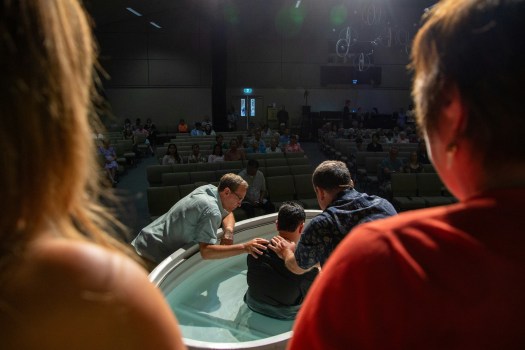
38Peter replied, “Repent and be baptized, every one of you, in the name of Jesus Christ for the forgiveness of your sins. And you will receive the gift of the Holy Spirit. 39The promise is for you and your children and for all who are far off—for all whom the Lord our God will call.”
40With many other words he warned them; and he pleaded with them, “Save yourselves from this corrupt generation.” 41Those who accepted his message were baptized, and about three thousand were added to their number that day.
(Acts 2:37-41, NIV)
The Daily DAVEotional
Over the last month or so, I’ve made a number of posts regarding baptism. The reason for this is that early in June of 2026, I had an online interaction with a Mormon who, in his attempt to argue for the legitimacy and necessity of the Mormon church, had made the claim that baptism was necessary for salvation. He posted a number of verse references as evidence for his position and I have been responding to the verses he mentioned as they turn up in my daily Bible reading.
Note: there are a number of mainline Christian denominations that also hold this view that baptism is essential for salvation, the most notable being the Church of Christ.
A few days ago, I read Acts 2, which includes what I would consider to be the cornerstone verse that is used by those who consider baptism to be essential for salvation (a doctrine known as “baptismal regeneration”).
The context for this passage is as follows:
In Acts 1, Jesus tells his disciples not to leave Jerusalem, but to wait, because in a few days they would all be baptized with the Holy Spirit. I expound on this passage more in my post “Is Baptism Necessary for Salvation?”
In Acts 2, on the day of Pentecost, the Holy Spirit descends upon the Jerusalem believers and the church is officially born.
The event causes a stir and a lot of locals are wondering what is happening as they can see the evidence of the Holy Spirit in the lives of these disciples. This provides an opportunity for Peter to preach the first gospel sermon to the many onlookers.
Our passage above picks up right at the conclusion of Peter’s sermon, which prompts a response from the audience, to which Peter gives the aforementioned Acts 2:38 directive.
On the surface, Acts 2:38 appears to indeed teach that baptism is necessary in order to be granted forgiveness for sins. However, it’s important to understand that this verse was originally written in Greek. The Greek word “for” in this verse is “eis“, which can have two different meanings.
The first meaning this word can have is “in order that”. The verse would then be understood to mean that we should each repent and be baptized “in order that” we could experience forgiveness.
The second and equally valid meaning for the word “eis” is “because of“. This changes the entire meaning of the verse. The verse then teaches that each of us should repent and be baptized “because” we have forgiveness of sins.
Click here to see a A Comprehensive List of Blog Posts Based on Bible Passage Reference
Those who believe that baptism is essential for salvation (including the Mormon church) arbitrarily select the first meaning for the word “for“. There is nothing in the original Greek grammar or syntax that indicates that is the correct meaning. Therefore, the second meaning is equally valid. In fact, there are many examples in the New Testament that demonstrate the second meaning of the word “eis“.
For example, in Matthew 3:11, John the Baptist says
I baptize you with water for repentance.
Does this mean that he is baptizing them so that they will repent, or because they had repented? It is obvious that the second meaning is the correct interpretation.
Another example from Matthew 12:41 says:
they repented at (eis) the preaching of Jonah.
Does this mean that they repented so that Jonah would preach, or because Jonah had preached? The answer is obviously because Jonah had preached.
How about a modern example?
We’ve all seen posters that say “Wanted for Murder!” Do these posters indicate that they are looking for the individual so that he (or she) will commit murder? Or is it better to say that they are looking for the individual on the poster because he (or she) has committed murder? Obviously, the second meaning is the understood interpretation.
In the examples we’ve seen, the interpretation seems pretty obvious and straightforward, but in Acts 2:38, the meaning of the word “for” is not as obvious. How then do we determine the real meaning? Which definition should we give it? Is it “so that” or “because”?
Rather than arbitrarily picking the meaning, as those who subscribe to baptismal regeneration do, good Bible study technique tells us that the meaning of a passage is always determined by the context. If the immediate context doesn’t help in determining the meaning of the verse, then the broader context should be used to make the determination.
In other words, if the meaning of the passage is unclear or in doubt, we should interpret its meaning in the light of passages that are clear and not in doubt.
With that in mind let’s analyze Acts 2:38. There is nothing in the immediate context of the verse that tells us which meaning we should ascribe to the word “for“. However, if we look at the broader context, we do get some help.
In Acts 3:19, Peter gives another invitation to salvation. In this invitation he says,
“Repent, then, and turn to God, so that your sins may be wiped out, that times of refreshing may come from the Lord”.
In this sermon, Peter makes no mention of baptism. Forgiveness of sins is dependent only on turning to God. If Peter does not require baptism for salvation in Acts 3:19, then he must not require it in Acts 2:38 either. Otherwise, we would have a contradiction of Scripture, which would be a clear indication of interpretive error.
In Acts 10, Peter is sharing with some Gentiles how a person is saved. In this sermon Peter says:
“that everyone who believes in him receives forgiveness of sins through his name.”
In Acts 13, Paul is preaching about Christ. He says in verses 38-39,
Therefore, my brothers, I want you to know that through Jesus the forgiveness of sins is proclaimed to you. Through him everyone who believes is justified from everything you could not be justified from by the law of Moses.
Also, in Acts 16, the Philippian jailer directly asks Paul,
Sirs, what must I do to be saved?
Paul and Silas replied,
Believe in the Lord Jesus, and you will be saved.
All of these verses demonstrate that baptism is not a requirement for salvation. If baptism were indeed required for salvation, as those who hold to baptismal regeneration attest, wouldn’t we expect it to be mentioned in each of these examples?
Therefore, this indicates that the better interpretation of Acts 2:38 is “Repent and be baptized because you have forgiveness of sins.”
A List of Relevant Posts Regarding Baptism
As I’ve demonstrated in many of my other blog posts on this topic (see links to posts above), this interpretation not only fits our understanding of the meaning of baptism, but it fits perfectly with other passages that speak to how a person is saved and when and how a person receives the Holy Spirit.
Did you enjoy this post? I’d love to hear your thoughts! Feel free to like, leave a comment below, and share it with your friends or on social media if you found it helpful or interesting. Your support keeps the conversation going!
Reflection
The word “for” is a preposition that can indicate causality (in order that) or result (because of). What are some examples you can think of where the word “for” is used in each way?
If the word “for” can have either meaning, why do you think some groups like the Mormons and the Church of Christ insist on their interpretation? What might be some possible motivations?
If you believe that this verse does indeed teach that baptism is necessary for salvation, how do you explain the omission of baptism as a necessary requirement for salvation in all of the other documented gospel sermons in the New Testament?
If baptism ISN’T necessary for salvation as the author of this blog suggests, then what is its purpose? Why do we see it practiced in the New Testament?
Photo by BBC Creative on Unsplash