Galatians 1
6I am shocked that you are turning away so soon from God, who in his love and mercy called you to share the eternal life he gives through Christ. You are already following a different way 7that pretends to be the Good News but is not the Good News at all. You are being fooled by those who twist and change the truth concerning Christ.
8Let God’s curse fall on anyone, including myself, who preaches any other message than the one we told you about. Even if an angel comes from heaven and preaches any other message, let him be forever cursed. 9I will say it again: If anyone preaches any other gospel than the one you welcomed, let God’s curse fall upon that person.
10Obviously, I’m not trying to be a people pleaser! No, I am trying to please God. If I were still trying to please people, I would not be Christ’s servant. (Galatians 1:6-10, NLT)
The Daily DAVEotional
If you haven’t noticed, Mormonism has been a huge topic on social media the last few days. The main topic of discussion and debate has been centered around the question of whether or not Mormons are Christians.
For context, the Department of Defense recently posted a memo regarding new abbreviated codes to identify the many different religious backgrounds that might be represented among the troops.
According to Secretary of War Pete Hegseth, the previous list of religious options was out of control, with over 200 different options. The goal was to simplify the number of codes and options, making it easier for chaplains to do their job of ministering to the troops.
The problem was that the new list had a number of different Christian denominations listed, such as “Christian-Baptist” and “Christian-Presbyterian” but the Mormon Church was not listed as Christian. Instead, it was listed simply as “Latter Day Saint.”
This set off a firestorm among many Mormon influencers and regular Mormon Joes who were offended that the U.S. government apparently didn’t consider Mormons to be Christian.
Chief among those speaking out online were Utah Senator Mike Lee (@basedMikeLee on X), who took every opportunity to post his thoughts and objections to this “egregious error” inflicted on Latter Day Saints.
This incident sparked a lot of online conversations about whether or not Mormons are Christians.
Mormons, of course, believe they ARE Christians, while evangelicals have argued that Mormons are NOT Christians because, despite the fact that Jesus Christ is in their name, they do not hold to the traditional Christian doctrinal views on Jesus, God, the Church, salvation, or the Scriptures.
The online discussion afforded many Mormons, including Senator Lee, the opportunity to inform and proselytize others regarding the Mormon faith.
In one of his posts, Senator Lee offered up what I’m calling the “Mormon challenge”:
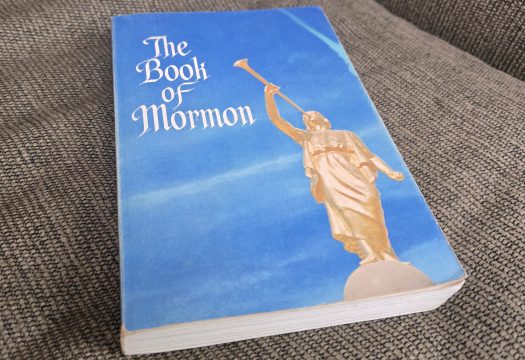
Read the Book of Mormon.
Cover to cover.
Pray about it, asking sincerely to know whether it’s true (the final chapter provides specific guidance on this point).
Then tell me whether Latter-day Saints believe in Jesus Christ.
Will you accept that challenge? pic.twitter.com/0pSDEmiMgT
— Mike Lee (@BasedMikeLee) June 7, 2026
This is the Mormon “trump” card so to speak. “Just read the Book of Mormon in it’s entirety”, they say, “and ask God humbly and with sincerity if it’s true.” This challenge is often offered as a gauntlet that is laid down for those who portend to be truth-seekers.
“What do you have to lose”, Mormons ask. The sentiment is, “Don’t be a chicken!”
Millions of Mormons attest that Mormonism is indeed true based on this challenge.
Should Christians accept this challenge?
The answer is a resounding NO.
There are two reasons why Christians should not take this challenge and neither of them have to do with being scared of the outcome.
The first reason you should not take this challenge is because it’s not falsifiable. The challenge is actually like the old “heads I win, tails you lose” proposition, which means that the challenge is designed to “prove” Mormonism is true regardless of the results of your humble and sincere prayer.
Think about it: if you pray and you say that you felt nothing or you didn’t get any firm and obvious confirmation from your prayer, the Mormon can just say that you were obviously not sincere enough, or humble enough or something similar.
Yet if you say that you DID feel something, that emotional response, regardless of how small or incomprehensible, is offered as proof that Mormonism is true.
In other words, the challenge simply appeals to an emotional response as evidence of veracity.
This leads to the second reason one should NOT take this challenge, which is that it’s unbiblical.
Nowhere in Scripture are people encouraged to evaluate truth claims by appealing to an emotional response.
Instead, we are exhorted to test a message against the clear revelation that has already been given by God.
Acts 17 is a good example of this. I have written about this passage in another blog post, “Fact-Checking and Misinformation in the New Testament” in which the Bereans were commended for testing Paul’s message against the Scriptures.
A second clear example of testing a message is in the Galatians passage listed above, in which Paul tells his audience that any “gospel” message that is not in alignment or in agreement with the gospel message he had already preached to them was to be rejected. Paul tells the Galatians that the person giving this false message is to be cursed.
We know exactly what the message was that Paul originally preached to the Galatians because he writes his letter to the Galatians to reinforce the original message and to correct their subsequent misunderstanding brought about by false teachers. The gospel message Paul preached was a message of justification by faith in Christ alone, apart from any works.
Since we already know that the Mormon message is different than Paul’s message on many different levels doctrinally, there is no need to “pray on it.” In fact, reading the Book of Mormon and praying on it could be considered disobedience to Paul’s admonition to outright reject so-called gospel messages that are different from what he taught the Galatians.
The debate about whether Mormons are Christian or not, while interesting, is in many ways irrelevant. The truth is that anyone can identify themselves as a Christian. Yet, it’s not as important what you call yourself as what you believe.
Mormons say they are Christians because they follow Jesus Christ. But so do Jehovah’s Witnesses, Catholics, Evangelical Christians, Liberal Christians and even Progressive Christians. Even Muslims will tell you that they respect and revere Jesus as a prophet.
All these groups, along with Latter Day Saints, have wildly different theological views on God, Jesus, salvation and the nature of the church, and yet, they all consider themselves “Christian”.
Are they Christian? The only way we can really know is to evaluate their beliefs in relation to what the Bible teaches.
With that in mind, I propose an alternate challenge to those who consider themselves Mormons…a challenge that is actually biblical. The challenge is to read the Bible cover to cover. Then compare the teachings of Mormonism with the teachings of the Bible, and specifically, compare the Mormon message with the gospel message taught by Jesus and the apostles in the New Testament.
Then tell me – does Mormonism line up with the already revealed and accepted teachings of Jesus and the apostles?
So Mike Lee (and other Mormons)….will you accept the challenge?
Did you enjoy this post? I’d love to hear your thoughts! Feel free to like, leave a comment below, and share it with your friends or on social media if you found it helpful or interesting. Your support keeps the conversation going!
Reflection
What is your definition of a Christian? According to the Bible and the gospel, how does one become a Christian?
What was the essence of the salvation message taught by Jesus and His disciples? What is the essence of the Mormon message regarding how a person is saved?
What is the traditional Christian teaching on the nature of Jesus? How do Mormons view the nature of Jesus? Are these two views the same? How do they differ?
Do you think it matters what a person believes about Jesus in order to be saved? Or is it simply enough to say you believe in Jesus?
photo by Dave Lowe