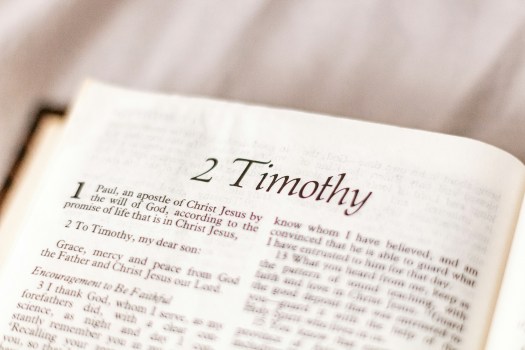
What Does it Mean That All Scripture is God-Breathed?

2 Timothy 3

14But as for you, continue in what you have learned and have become convinced of, because you know those from whom you learned it, 15and how from infancy you have known the holy Scriptures, which are able to make you wise for salvation through faith in Christ Jesus. 16All Scripture is God-breathed and is useful for teaching, rebuking, correcting and training in righteousness, 17so that the man of God may be thoroughly equipped for every good work.

(2 Timothy 3:14-17, NIV)


The Daily DAVEotional

A few months ago, I published a post entitled, “Can You Make the Bible an Idol?” which referenced Psalm 119.

The “inspiration” (you will see why this pun is intended) for that post was a series of online interactions I saw on X.com (formerly Twitter) in which a certain online influencer who identifies as a former evangelical was making the case that Christians should not make the Bible an idol.

The idea that one could make the Bible an idol seemed odd and confusing to me. I’d never heard anyone make such an admonition. I soon learned why as I fell further down an online rabbit hole exploring the theological views of Progressive Christianity.

Progressive Christians have a view and understanding of God that is in stark contrast to the traditional orthodox understanding. Whereas the traditional Christian view of God is that He’s immutable, which is to say He is unchanging, the progressive view of God is that He is evolving.

I explain the ramifications of this differing foundational belief in my previous post, but the summary is that if God is evolving then His standards are also evolving. And if God’s standards have evolved, then perhaps some of those behaviors that you were once told were “sinful” aren’t really sinful any longer.

The end result is that the Progressive ends up creating a God whose moral standards amazingly mimic their own lifestyle choices and preferences.

But how does the Progressive get around the clear teachings of Scripture that might restrict some of their life choices? To put it another way, how does the Progressive Christian deal with Biblical passages that seem to indicate that certain behaviors are wrong?

The simple answer is that the Progressive Christian doesn’t view the Bible as “God’s Word”. Hence, passages that seem to indicate certain actions as “sin” aren’t authoritative to them.

What? How can that be? Doesn’t the Bible clearly identify itself as “God’s Word”?

The argument made by Progressives is the same argument which is promoted by non-Christians, which is that the Bible wasn’t actually written by God but by fallible men.

And that leads us to our passage for today.

In this passage of 2 Timothy, Paul is exhorting Timothy to continue in what he has learned before. Timothy had grown up with an understanding of the Scriptures, which at that time was what we know as the Old Testament.

According to Paul, following these “Scriptures” would make Timothy wise unto salvation through faith in Jesus Christ.

Paul then follows with this oft-quoted verse:

All Scripture is God-breathed and is useful for teaching, rebuking, correcting and training in righteousness (2 Timothy 3:16)

This verse is often cited by Christians to demonstrate that the Bible is God’s Word and therefore authoritative for our lives.

According to this verse, the Bible (Scripture) has four main functions in our lives. I wrote about and explained these four functions in a previous post entitled “Training in Righteousness (Part 2).”

The question I want to focus on here is what does it mean when it says that “all Scripture is God-breathed?”

The greek word used here by Paul is theopneustos, which is a compilation of two separate words, theo = God and pneustos = breath.

This verse is the only place in Scripture where this particular word (theopneustos) is used. So what does it mean?

Most bible translations translate this verse as “all scripture is inspired by God…”

The idea is that God Himself has breathed His life into these words, making them inspired and useful for the purposes listed. Hence, the words are God’s words.

The response I have often seen online from Progressives is that the Bible was written by men, not by God. It is “inspired” only in the sense that it inspires people by bringing life to things that were lifeless.

This line of reasoning does not seem faithful to the text. Paul does not say that Scripture is inspiring, though that is almost certainly true as a by-product. What he says is that Scripture is inspired BY GOD. The difference in this wording may seem subtle and inconsequential but the difference in the resultant meanings is enormous.

In one view, the Progressive view, Scripture is the subject and it does the inspiring on the object, people who read it. This makes the Bible a book that is sort of like an ancient “Chicken Soup for Soul” to the reader. It’s a guidebook that one may utilize for navigating life’s journey, but it is certainly not the only tool one might consult.

In the other view, the traditional view, God is the subject who does the inspiring on the object, the Scriptures. Because God Himself has inspired the words, using various authors to communicate the message He desired and intended, it is indeed a guidebook for life and is useful for teaching, rebuking, correcting and training in righteousness.

The bottom line is that, according to Paul, the Scriptures are divinely inspired by God. This means that the words are God’s words; they are the words He intended the authors to write. For this reason, we refer to the Bible as “the Word of God”. Because the Bible is “the Word of God”, it’s not just an inspiring read, it’s authoritative. It alone contains the final word on the rule of life, including morality and our understanding of what is right and what is wrong.

The implications of this are massive. If the Bible is a book that is not written or authored by God, but is simply “inspiring” in some way, then I can pick and choose the parts that actually inspire me to feel good, and I can ignore the parts that I disagree with or that make me feel uncomfortable or “uninspired.”

But if the Bible is God’s Word and therefore authoritative, then I must relent to its position on all matters pertaining to faith and morality. According to Paul, as he made his charge to Timothy, when we acquiesce to God’s standards as outlined in the Scriptures, we’ll not only experience salvation through Jesus, but our lives will be transformed as we allow God’s Word to train us in righteous living, the fruit of which will be good works that glorify God.


Did you enjoy this post? I’d love to hear your thoughts! Feel free to like, leave a comment below, and share it with your friends or on social media if you found it helpful or interesting. Your support keeps the conversation going!


Reflection

What has been your position on the Bible? Do you believe it is God’s Word and therefore authoritative or is it something else? What are the reasons that support your position?

What are some of the things in the Bible that you struggle to agree with in terms of their moral implications? 

In what ways do you need to give the Scriptures authority in your life?

Paul’s charge to Timothy was to “continue what you have learned and become convinced of.” What can you do this week to “continue” your learning and conviction of the Scriptures?


Photo by Sincerely Media on Unsplash

Can You Make the Bible an Idol?

Psalm 119

16I delight in your decrees; I will not neglect your word.

20My soul is consumed with longing for your laws at all times.

24Your statutes are my delight; they are my counselors.

40How I long for your precepts! Preserve my life in your righteousness.

43Do not snatch the word of truth from my mouth, for I have put my hope in your laws.

47for I delight in your commands because I love them.

48I lift up my hands to your commands, which I love, and I meditate on your decrees.

70Their hearts are callous and unfeeling, but I delight in your law.

72The law from your mouth is more precious to me than thousands of pieces of silver and gold.

77Let your compassion come to me that I may live, for your law is my delight.

92If your law had not been my delight, I would have perished in my affliction.

97Oh, how I love your law! I meditate on it all day long.

103How sweet are your words to my taste, sweeter than honey to my mouth!

111Your statutes are my heritage forever; they are the joy of my heart.

113I hate double-minded men, but I love your law.

119All the wicked of the earth you discard like dross; therefore I love your statutes.

120My flesh trembles in fear of you; I stand in awe of your laws.

127Because I love your commands more than gold, more than pure gold,

129Your statutes are wonderful; therefore I obey them.

140Your promises have been thoroughly tested, and your servant loves them.

143Trouble and distress have come upon me, but your commands are my delight.

159See how I love your precepts; preserve my life, O LORD, according to your love.

163I hate and abhor falsehood but I love your law.

165Great peace have they who love your law, and nothing can make them stumble.

167I obey your statutes, for I love them greatly.

174I long for your salvation, O LORD, and your law is my delight.

(Psalm 119 – selected verses, NLT)

NOTE: Psalm 119 is the longest chapter in the entire Bible. I’ve included selected verses that reflect the content of this blog post


The Daily DAVEotional

A while back, I read a social media post from a person with a sizable following in which he exhorted people, “Don’t make the Bible an idol.”

My first thought was, “what does that even mean?”

Is it possible to make the Bible an idol? What would that even look like?

I immediately thought about this Psalm (119), which is the longest chapter in the entire Bible and is an extended discourse on the wonders and virtues of God’s word. I’ve written about this Psalm before in my post “The Endless Virtues of God’s Word.”

It’s well worth your time to read the entire Psalm but due to the sheer length of the text, I’ve only included selected verses that highlight the devotion, awe and love that the psalmist has for God’s word.

If ever someone might be accused of worshiping God’s Word and making it an idol, it would be the author of Psalm 119. Notice some of the language he uses to express his feelings about God’s laws, statutes and precepts.

Words like delight, love, long, hope, consumed, sweet, joy, precious and awe are all used to describe how the psalmist feels about God’s laws.

There is clearly a reverence and respect and a deep LOVE for God’s word. But does that equate to idol worship?

To answer that question, we need to understand what idol worship is.

I wrote in a previous blog post, “A Discourse on the Foolishness of Idols” that an idol can be thought of as a substitutionary object of trust. Instead of trusting in God as your deliverer, your provider, your protector, your source of life, your savior, etc, you transfer that trust to something or someone else.

But you can also think of an idol as anything that takes priority or precedence in your heart over God.

So how about this Psalmist? Is he guilty of idol worship? Is it possible to elevate the Bible to a position over God in our lives?

I suppose that if I were to worship the physical book of the Bible as if it were a deity itself, I could be accused of idol worship. But I don’t think that is what’s happening with the psalmist.

The word of the Lord – his law, precepts, ordinances and statutes – are all merely an extension of God Himself. They are not God, but they are a revelation of the character of the true God.

When the psalmist says he loves God’s law, and he delights in His word, he’s making a statement about God’s character. He’s acknowledging that God’s word is a source of revelation about God’s nature and in it, God has provided wisdom and instruction for righteous living.

God’s word tells us who He is and how we’re to live. The psalmist simply acknowledges these facts. Moreover, he’s speaking directly to God when he makes these statements. Therefore, the praise and adoration is directed toward God and not some inanimate scroll.

Think of it this way – let’s say you read a book that you really loved. Then one day you meet the author at a book signing. While you’re at the table, you go on and on about how much you loved the book. You share that the character development, plot lines and context were all relatable and engrossing. Do you think the author will be offended because you praised his/her work and not the author directly? No, the book is an extension of them and it is obvious to all that your praise is directed toward the author.

That is exactly what is happening in this psalm. The psalmist is simply recognizing that God’s laws and statutes are righteous and life-giving.

So why would this online social media influencer bark out that we should not make the Bible an idol? Why is this even a concern?

My desire to answer this question led me down an online rabbit hole. This particular influencer, and others who also warn that we should not make the Bible an idol, belongs to a strain of religious faith that is known as Progressive Christianity.

Progressive Christianity uses the word “Christianity” but it is hardly Christian. While they utilize the same language and reference the same characters as traditional Christianity, they redefine the meaning of words, concepts and even characters in order to suit their own theological preferences.

Progressive Christians occupy a broad spectrum of beliefs but there are some things that tend to be common among most who identify themselves as being a part of this camp.

Perhaps the hallmark value of Progressive Christianity is their view that God is always evolving. Hence, there is an emphasis on searching and questioning, while those claiming to know truth may be labeled as unenlightened or immature.

Progressive Christianity tends to be very ecumenical, embracing all faith religions and ideologies as equally valid and helpful. Loving others means you shouldn’t offend others by telling them that their beliefs might be wrong. Hence, Jesus has been recast from His role as exclusive Savior of the world to that of a moral teacher whose example we’re to follow.

Standing in contrast to Progressive Christianity is Orthodox Christianity, which teaches that God can be known because He has revealed Himself to us through His word and through the person of Jesus.

In addition, orthodox Christianity teaches that God is NOT evolving. He has laid out for us in His word what His standards are for living and because God doesn’t change, the standards and statutes set forth in His word apply to us today.

Perhaps you are starting to see the problem. If God doesn’t change, then that means His moral code and His rules for righteous living are not optional and must be obeyed today.

The Progressive Christian attempts to get around this by doubling down on the assertion that God IS evolving while adding the caveat that the Bible is not written by God.

Their claim is that the Bible we have is simply a record of writings by fallible men; they are NOT God’s spoken words. While the Bible may be helpful and inspiring, it is only a tool that you may choose to use; it is NOT authoritative for our lives. If the Bible lacks authority, then it logically follows that I don’t have to abide by all of its restrictive and antiquated rules and regulations.

This is where the rubber meets the road. For the evangelical (orthodox) believer, the Bible is authoritative, for it reveals God’s very nature to us and it contains His laws, statutes, precepts and ordinances for righteous living. This is what the psalmist was extolling in Psalm 119.

The Progressive Christian denies that God is the author of Scripture and so for anyone who believes in the authority of Scripture, they are told by the Progressive Christian, “Don’t make the Bible an idol.”

So you see that this whole argument is based on a completely different foundational view of God’s nature and how he reveals Himself to mankind. The Progressive Christian denies that the Bible is an authoritative tome that accurately reflects God’s nature and provides rules and guidance for living. To them, there are many other ways God may communicate to us apart from the Bible, including other faith traditions.

This denigration of the authority of Scripture allows the Progressive Christian to decide for himself which of the statutes in the Bible are valid for today and which ones aren’t. Conveniently, this allows the Progressive Christian to formulate a view of God that matches their preferences and proclivities exactly, which, strangely, is exactly the definition of forming an idol.

Amazingly, we’ve come full circle. The Progressive Christian tells us not to make the Bible an idol because doing so limits God and restricts our view of Him to how He is portrayed in Scripture.

Meanwhile, the Progressive Christian untethers themselves from the shackles of Biblical revelation of God as an immutable template for representing who God is, opting instead for the freedom to develop an image of God that is highly influenced by their own experiences and preferences.

Ironically, that sounds like idol worship to me.


To learn more about Progressive Christianity and what they believe, watch this 12 minute video from apologist Alisa Childers


Reflection

What is your view of the Bible? Do you see it as God’s word or a collection of writings written by fallible men?

What is the source of your information about God? How can you know if your view of God is accurate to who God really is rather than just an image you developed about Him that suits your preferences?

Do you think that the commands of the Bible are valid for people today or are they optional? What are the reasons for your position?

What has been your experience with Progressive Christianity? Do you think Progressive Christianity is compatible with traditional, orthodox Christianity? Why or why not?

Why do you think people opt for a Progressive version of Christianity instead of traditional, orthodox Christianity? What do you think are some of the main reasons and driving forces?


Photo by Pixabay on Pexels.com

A Trap Religious Leaders Can Fall Into

Matthew 21

33“Now listen to this story. A certain landowner planted a vineyard, built a wall around it, dug a pit for pressing out the grape juice, and built a lookout tower. Then he leased the vineyard to tenant farmers and moved to another country. 34At the time of the grape harvest he sent his servants to collect his share of the crop. 35But the farmers grabbed his servants, beat one, killed one, and stoned another. 36So the landowner sent a larger group of his servants to collect for him, but the results were the same.

37“Finally, the owner sent his son, thinking, ‘Surely they will respect my son.’

38“But when the farmers saw his son coming, they said to one another, ‘Here comes the heir to this estate. Come on, let’s kill him and get the estate for ourselves!’ 39So they grabbed him, took him out of the vineyard, and murdered him.

40“When the owner of the vineyard returns,” Jesus asked, “what do you think he will do to those farmers?”

41The religious leaders replied, “He will put the wicked men to a horrible death and lease the vineyard to others who will give him his share of the crop after each harvest.”

42Then Jesus asked them, “Didn’t you ever read this in the Scriptures?

‘The stone rejected by the builders has now become the cornerstone. This is the Lord’s doing, and it is marvelous to see.’

43What I mean is that the Kingdom of God will be taken away from you and given to a nation that will produce the proper fruit. 44Anyone who stumbles over that stone will be broken to pieces, and it will crush anyone on whom it falls. ”

45When the leading priests and Pharisees heard Jesus, they realized he was pointing at them—that they were the farmers in his story. 46They wanted to arrest him, but they were afraid to try because the crowds considered Jesus to be a prophet. (Matthew 21:33-46, NLT)


The Daily DAVEotional

Jesus often spoke in parables to teach spiritual truths. In this parable, the landowner is the Lord and the farmers are the Pharisees. The servants represent the Old Testament prophets whom God continually sent to warn His people, but who were constantly rejected.

In the story, the landowner finally sends his son, who represents Jesus.

In the parable, the farmers decide to kill the son because they don’t want to relinquish control and power. They don’t want to serve the owner and give him his portion of the proceeds. They want to BE the owner and keep all the proceeds for themselves.

Jesus explains the meaning of the parable in verse 43:

What I mean is that the Kingdom of God will be taken away from you and given to a nation that will produce the proper fruit.

The fruit Jesus is referring to is the nation of Israel’s acceptance of Him as the Messiah. Since the religious leaders were rejecting Jesus, and they used their power and influence over the people to keep the people from accepting Jesus as the Messiah, Jesus is warning them that their status as God’s special chosen people was in danger. Like the farmers in the story who were stewards of their master’s land, the Israelites were simply stewards of the message and revelation of the one true God. By rejecting Jesus, this stewardship would be taken away from them and given to another nation.

What is this other nation Jesus was referring to?

Jesus quotes Psalm 118:22-23 which was also referenced by Peter in 1 Peter 2:4-7, in which Peter says that Jesus is building a new temple made up of those who would follow Him. Thus this new nation is not a physical nation, as Israel was, but a spiritual nation with those who believe in Jesus as its citizens. I wrote about this new temple here.

Jesus was using this parable to show the Pharisees that they were rejecting the Son because they didn’t want to relinquish their religious control over the people. Verses 45-46 indicate that the religious leaders realized what Jesus was saying about them. However, instead of repenting, their inclination is to arrest him.

This parable was directed at the Pharisees and the nation of Israel and the punishment Jesus mentions cannot be duplicated for us today. So how then does this parable relate to us in our current culture? What can we learn from it?

Though we cannot reject Jesus in the same way, and thus we cannot experience the same penalty Jesus mentions, I think there are lessons we can learn from the way the Pharisees responded to God and the revelation He was giving them.

I think one potential lesson is that there is a dangerous trap for religious leaders, or anyone who is in a position of authority over others. The trap is to think so highly of yourself that you believe the people you are leading cannot get along without you. Instead of shepherding people to follow the Lord, we can become enamored with our own voice and our own self-importance and we can become consumed with gaining and maintaining a following for ourselves.

Being in authority and power over others, as the Jewish religious leaders were, can become so addictive and necessary to our own identity that we will do whatever is necessary to keep it. In the case of the Pharisees, they were willing to kill the Messiah himself to keep it.

We’re not in a position today to kill the Messiah to hold onto our power and authority, but we may still go to great lengths to keep our positions, including lying, deception, manipulation, intimidation, fear, bribery, harassment, etc.

Reflection

In the parable, God sends his messengers to convey truth but the messengers are constantly rejected. What are some of God’s messages (doctrinal truths or commands) that you find difficult to follow and are tempted to reject?

In the parable, the outcome of the nation of Israel rejecting the Son is their stewardship is taken away and given to another nation. What do you think will be the outcome for those who reject Jesus today? How will God treat the farmers of today who continually reject the messengers, including His son, whom God has sent?

What are some situations or relationships where you have found yourself wanting to maintain power and control when you know you should release it? 

Some people will go to great lengths to maintain power, authority, status or position? What do you think causes a person to adopt an “any means necessary” policy to maintain their power?


Photo by Alex Gorbi on Unsplash