What is Your Greatest Wish?

2 Chronicles 1

1Solomon, the son of King David, now took firm control of the kingdom, for the LORD his God was with him and made him very powerful. 2He called together all Israel—the generals and captains of the army, the judges, and all the political and clan leaders. 3Then Solomon led the entire assembly to the hill at Gibeon where God’s Tabernacle was located. This was the Tabernacle that Moses, the LORD’s servant, had constructed in the wilderness. 4David had already moved the Ark of God from Kiriath-jearim to the special tent he had prepared for it in Jerusalem. 5But the bronze altar made by Bezalel son of Uri and grandson of Hur was still at Gibeon in front of the Tabernacle of the LORD. So Solomon and the people gathered in front of it to consult the LORD. 6There in front of the Tabernacle, Solomon went up to the bronze altar in the LORD’s presence and sacrificed a thousand burnt offerings on it.

7That night God appeared to Solomon in a dream and said, “What do you want? Ask, and I will give it to you!”

8Solomon replied to God, “You have been so faithful and kind to my father, David, and now you have made me king in his place. 9Now, LORD God, please keep your promise to David my father, for you have made me king over a people as numerous as the dust of the earth! 10Give me wisdom and knowledge to rule them properly, for who is able to govern this great nation of yours?”

11God said to Solomon, “Because your greatest desire is to help your people, and you did not ask for personal wealth and honor or the death of your enemies or even a long life, but rather you asked for wisdom and knowledge to properly govern my people, 12I will certainly give you the wisdom and knowledge you requested. And I will also give you riches, wealth, and honor such as no other king has ever had before you or will ever have again!” 13Then Solomon returned to Jerusalem from the Tabernacle at the hill of Gibeon, and he reigned over Israel. (2 Chronicles 1:1-13, NLT)


The Daily DAVEotional

Imagine that you acquire an old lamp like the one from the movie Aladdin.

You rub the lamp and out pops a genie, who grants you one wish.

What would you wish for?

There’s an old Twilight Zone episode whose story follows this very premise.

A couple is barely making ends meet as the owners of a second-hand thrift shop. A woman comes in needing money, offering to sell an old wine bottle she found. Though financially strapped themselves, they buy the worthless bottle out of pity and compassion for the woman.

Wanting to recoup his money, the man attempts to clean up the bottle so he can put it on the shelf and sell it. While rubbing the bottle to clean it up, out pops a genie, who grants the couple four wishes.

The first wish is used to fix the broken glass of their main display case, thus proving the genie’s power and ability to grant wishes.

The couple decides to use their 2nd wish on money and they instantly have a million dollars in cash (valued in 1960). They promptly give thousands away to their friends and begin living the good life. But then the IRS shows up, demanding their cut. In the end, the couple has only $5 left of the million they had wished for.

The owner decides that maybe power would be a better thing to wish for, so he asks to be an all-powerful dictator who cannot be voted out of his position.

He’s instantly transformed into Hitler and it’s the final days of World War II. An officer enters the bunker where he’s hiding and offers him a vial of cyanide to commit suicide. At that moment, the shop-owner-turned-Hitler wishes for his old lifestyle back.

The man is instantly transformed back to his shop where things are pretty much exactly like they were before they met the genie, except their display cabinet glass is still intact from the first wish. A few moments later, while sweeping up in front of the display case, the broom handle accidentally hits the case and the glass breaks.

The moral of this episode is “be careful what you wish for” because what we think will bring meaning, purpose and fulfillment often has unforeseen consequences that bring trouble and pain.

It turns out that Solomon, the successor to King David, was faced with this exact scenario early in his reign.

God (not a genie) appears to Solomon in a dream and asks him “what do you want? Ask, and I will give it to you.”

Solomon isn’t given four wishes. He’s given only one wish. Having only one wish heightens the drama as it forces the person to choose from the array of things they desire. What you ultimately wish for is a reflection of your deepest desire and what is most important to you.

What would you have asked for?

If you’re like most people, you probably would have asked for riches, allowing you to quit working and ensuring that you would be financially set for life. Others might ask for fame, enabling them to be loved and adored by millions, feeding their egos and massaging their insecurities.

Still others would ask for long life or power, guaranteeing that their rule would be firmly established for many years.

But Solomon asks for none of these things.

Instead, Solomon asks God to give him wisdom so that he could rule the people under his authority properly, with fairness and justice.

God is so impressed with Solomon’s selfless request that he not only grants his wish. but he also gives him the things he didn’t ask for, namely, riches, power and fame.

Why would God give Solomon what he didn’t ask for?

God gave Solomon what he didn’t ask for because He knew he could be trusted to steward those resources for God’s purposes. Solomon could be trusted because his heart was inclined toward others and not himself.

In man’s mind, the most important commodities are money and power. We think that if we can acquire these things our lives will be better and things will go well for us.

But in God’s economy, wisdom is better than riches or fame. This truth is repeated and emphasized over and over by Solomon throughout Proverbs and Ecclesiastes.

Wisdom is not just knowing things. Wisdom is knowing how to apply and implement what you know in a way that is righteous and god-honoring.

Being wise doesn’t guarantee that you’ll become rich, powerful and famous, as Solomon did. But it does greatly improve your chances at a rich and meaningful lifestyle as your choices will follow God’s pattern instead of your own selfish desires. God’s pattern for living is more likely to bring ultimate satisfaction as you avoid the pitfalls that selfish and reckless behavior so often brings.

So what do you think? If you had one wish, what would you wish for?

If you said wisdom, then congratulations are in order. The good news is that you don’t have to wish for it. You can ask for wisdom and God will give it to you. In fact, He has already provided a master-class on wisdom in His word, the Bible.

He promises that if you study this book (the Bible), your life will be on the right path and you will experience His blessings.

If your one wish is for something else, like money, fame, power or an indestructible lifestyle, then be careful what you wish for as the things we think will bring ultimate meaning, purpose and fulfillment often come with unforeseen consequences, liabilities and obligations that lead to struggle and pain.


Did you enjoy this post? I’d love to hear your thoughts! Feel free to like, leave a comment below, and share it with your friends or on social media if you found it helpful or interesting. Your support keeps the conversation going!


Reflection

When growing up and faced with the prospect of three wishes (you can’t wish for more wishes) what were the things you typically wished for?

What do you think is the difference between wisdom and knowledge?

What are some reasons why wisdom would be preferable to have instead of wealth, or fame?

What are the ways you are seeking to become a wise person? How do you think a person acquires wisdom?


Photo by Vika Glitter: https://www.pexels.com/photo/woman-posing-in-arabic-clothing-with-genie-lamp-15499799/

Filling a God-Shaped Hole

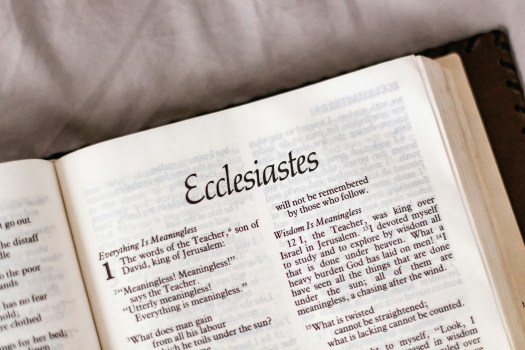
Ecclesiastes 2

1I said to myself, “Come now, let’s give pleasure a try. Let’s look for the ‘good things’ in life.” But I found that this, too, was meaningless. 2“It is silly to be laughing all the time,” I said. “What good does it do to seek only pleasure?” 3After much thought, I decided to cheer myself with wine. While still seeking wisdom, I clutched at foolishness. In this way, I hoped to experience the only happiness most people find during their brief life in this world.

4I also tried to find meaning by building huge homes for myself and by planting beautiful vineyards. 5I made gardens and parks, filling them with all kinds of fruit trees. 6I built reservoirs to collect the water to irrigate my many flourishing groves. 7I bought slaves, both men and women, and others were born into my household. I also owned great herds and flocks, more than any of the kings who lived in Jerusalem before me. 8I collected great sums of silver and gold, the treasure of many kings and provinces. I hired wonderful singers, both men and women, and had many beautiful concubines. I had everything a man could desire!

9So I became greater than any of the kings who ruled in Jerusalem before me. And with it all, I remained clear-eyed so that I could evaluate all these things. 10Anything I wanted, I took. I did not restrain myself from any joy. I even found great pleasure in hard work, an additional reward for all my labors. 11But as I looked at everything I had worked so hard to accomplish, it was all so meaningless. It was like chasing the wind. There was nothing really worthwhile anywhere.

12So I decided to compare wisdom and folly, and anyone else would come to the same conclusions I did. 13Wisdom is of more value than foolishness, just as light is better than darkness. 14For the wise person sees, while the fool is blind. Yet I saw that wise and foolish people share the same fate. 15Both of them die. Just as the fool will die, so will I. So of what value is all my wisdom? Then I said to myself, “This is all so meaningless!” 16For the wise person and the fool both die, and in the days to come, both will be forgotten.

17So now I hate life because everything done here under the sun is so irrational. Everything is meaningless, like chasing the wind. 18I am disgusted that I must leave the fruits of my hard work to others. 19And who can tell whether my successors will be wise or foolish? And yet they will control everything I have gained by my skill and hard work. How meaningless!

20So I turned in despair from hard work. It was not the answer to my search for satisfaction in this life. 21For though I do my work with wisdom, knowledge, and skill, I must leave everything I gain to people who haven’t worked to earn it. This is not only foolish but highly unfair. 22So what do people get for all their hard work? 23Their days of labor are filled with pain and grief; even at night they cannot rest. It is all utterly meaningless.

24So I decided there is nothing better than to enjoy food and drink and to find satisfaction in work. Then I realized that this pleasure is from the hand of God. 25For who can eat or enjoy anything apart from him? 26God gives wisdom, knowledge, and joy to those who please him. But if a sinner becomes wealthy, God takes the wealth away and gives it to those who please him. Even this, however, is meaningless, like chasing the wind. (Ecclesiastes 2:1-26, NLT)


The Daily DAVEotional

Blaise Pascal, the famous 17th century French mathematician and inventor, is often credited with saying,

​There is a God-shaped vacuum in the heart of every man which cannot be filled by any created thing, but only by God, the Creator, made known through Jesus Christ.

Interestingly, Pascal never actually said this exact quote, though he did express the sentiment when he said,

“What else does this craving, and this helplessness, proclaim but that there was once in man a true happiness, of which all that now remains is the empty print and trace? This he tries in vain to fill with everything around him, seeking in things that are not there the help he cannot find in those that are, though none can help, since this infinite abyss can be filled only with an infinite and immutable object; in other words by God himself”

As it turns out, this sentiment from Pascal, which has been shortened into the pithy quote that we all see today, was probably derived from Solomon, who explored the nature of meaning and fulfillment in this second chapter of Ecclesiastes.

So what exactly does Solomon say?

It’s important to understand the context on which Ecclesiastes 2 rests. In chapter 1, Solomon is trying to derive meaning and purpose to our existence. His initial position, based on observations and lived experience, is that life is meaningless.

It’s a sad existence indeed if there is absolutely no purpose or meaning in life. Yet that is what Solomon initially concludes.

In this chapter of Ecclesiastes, we’re subjected to a bit of Solomon’s ontological journey.

The first thing he says is that he tried to find meaning and fulfillment in pleasure, or what we call hedonism. But physical pleasure provides no lasting satisfaction. The exhilarating rush that pleasure brings quickly fades, leaving one grasping for the next opportunity to experience that physical and emotional high.

Solomon then turns his attention to the pursuit of materialism. Perhaps acquiring lots of stuff, overseeing grand construction projects or building tremendous wealth could ascribe meaning and value to life. But Solomon found that lacking as well. The allure that extreme wealth promises is never quite  achieved. John Rockefeller, who was the richest person to ever live, was once asked, “how much is enough?” His response was “just a little bit more.” He apparently did not subscribe to Solomon’s conclusion that extreme wealth does not ultimately satisfy.

Perhaps fame and taking pride in one’s work could provide the kind of satisfaction that pleasure and materialism couldn’t. But Solomon ultimately realized the utter futility of that pursuit. Fame is fleeting and whatever work we may accomplish is forgotten as quickly as we are when we die.

Solomon reasoned that hard work and wealth are ultimately meaningless because we all die. What good are those things after you die? Someone else will take possession of and oversee all that we’ve worked to produce. That hardly seems fair. You work your tail off to produce wealth and build an empire only to leave it to someone else who did nothing to earn or produce what you’ve left?

None of this makes sense on the surface. What is the point?

Solomon gives a glimpse into the ultimate purpose in verses 24-25, when he says,

24So I decided there is nothing better than to enjoy food and drink and to find satisfaction in work. Then I realized that this pleasure is from the hand of God. 25For who can eat or enjoy anything apart from him?

Is pleasure, wealth, fame and work all meaningless? Apart from God, the answer is yes. But with God, all of these things are meaningful because they are gifts from God, the ultimate gift-giver!

So we’re back to our opening line that is often attributed to Pascal. There is something inside each person that is searching and striving for meaning and purpose. Man, in his fallenness, seeks to satiate this inner desire with all kinds of things – pleasure, power, wealth and fame. But none of these things bring true satisfaction or fulfillment. That’s because God is the only one who can ultimately fulfill our basic human need for meaning and purpose. It’s part of His design.

Apart from God there is no ultimate meaning and purpose. As Christian philosopher and apologist Frank Turek says, we are just “moist robots” who appear one day and then one day we’re gone.

If that is the case, then Solomon’s initial assessment is true – life is indeed meaningless. But with God, life not only has purpose and meaning but work, pleasure and wealth all make sense.


Did you enjoy this post? I’d love to hear your thoughts! Feel free to like, leave a comment below, and share it with your friends or on social media if you found it helpful or interesting. Your support keeps the conversation going!


Reflection

What do you turn to in order to experience purpose and meaning in life?

Which of the following do you struggle with the most: the pursuit of pleasure, wealth, power or fame?

What do you think are the reasons you or people in general pursue other things to satisfy their inner needs rather than pursuing God Himself?

In what ways can you turn to God as your source of true satisfaction and fulfillment?


Photo by Sincerely Media on Unsplash

A Wise Person Thinks About Death?

Ecclesiastes 7

A good reputation is more valuable than the most expensive perfume. In the same way, the day you die is better than the day you are born. It is better to spend your time at funerals than at festivals. For you are going to die, and you should think about it while there is still time. Sorrow is better than laughter, for sadness has a refining influence on us. A wise person thinks much about death, while the fool thinks only about having a good time now.  – Ecclesiastes 7:1-4 (NLT)


The Daily DAVEotional

At first glance, this passage seems kind of morbid. How in the world is it better to spend time at funerals than festivals? Who in their right mind likes going to funerals? With all that’s going on in the world, why would I want to intentionally think about death?

At closer inspection, this passage has profound wisdom that is especially appropriate as we begin a new year.

The author might have communicated his point in a different way, by inviting you to ask yourself this question: when you get to the end of your life, what do you want to be true of you? Or to put it another way, how do you want to be eulogized by others?

The fool only thinks about the here and now (verse 4) and what kind of fun they can have (festivals). But the wise person thinks about what kind of person they want to become (their reputation) and what will be said about them by others when they die.

As we embark on another year, it’s only natural to think about the things you want to accomplish in the coming year. Perhaps you want to lose weight and get healthy. Or maybe you want to advance in your profession or develop yourself educationally.

It’s ok to set material and professional goals but don’t neglect your character and your reputation. The wise person realizes that this is the most important area to think about and reflect on.

What steps can you take this year to move toward becoming the kind of person you want to ultimately be known as? What resources do you need to help you get there?

If you’re a Young Adult, contact us about coaching and other resources that can help you grow and develop in all areas of your life.

Here’s to a Happy and blessed New Year!

Reflection

What do you hope will be said about you by others at your memorial service?

What needs to change now for you to become the kind of person you want to be remembered as when you die?

What do you think are the reasons people tend to think about the here and now instead of the long-term?

What are some of the reasons it’s more difficult to set and focus on character goals versus material and professional goals?


Photo by Pavel Danilyuk: https://www.pexels.com/photo/people-sitting-on-the-bench-7317734/