The Allure of Cheap Substitutes

Jeremiah 2

1The LORD gave me another message. He said, 2“Go and shout in Jerusalem’s streets: ‘This is what the LORD says: I remember how eager you were to please me as a young bride long ago, how you loved me and followed me even through the barren wilderness. 3In those days Israel was holy to the LORD, the first of my children. All who harmed my people were considered guilty, and disaster fell upon them. I, the LORD, have spoken!’”

4Listen to the word of the LORD, people of Jacob—all you families of Israel! 5This is what the LORD says: “What sin did your ancestors find in me that led them to stray so far? They worshiped foolish idols, only to become foolish themselves. 6They did not ask, ‘Where is the LORD who brought us safely out of Egypt and led us through the barren wilderness—a land of deserts and pits, of drought and death, where no one lives or even travels?’

7“And when I brought you into a fruitful land to enjoy its bounty and goodness, you defiled my land and corrupted the inheritance I had promised you. 8The priests did not ask, ‘Where is the LORD?’ The judges ignored me, the rulers turned against me, and the prophets spoke in the name of Baal, wasting their time on nonsense. 9Therefore, I will bring my case against you and will keep on accusing you, even against your children’s children in the years to come. I, the LORD, have spoken!

10“Go west to the land of Cyprus; go east to the land of Kedar. Think about what you see there. See if anyone has ever heard of anything as strange as this. 11Has any nation ever exchanged its gods for another god, even though its gods are nothing? Yet my people have exchanged their glorious God for worthless idols! 12The heavens are shocked at such a thing and shrink back in horror and dismay, says the LORD. 13For my people have done two evil things: They have forsaken me—the fountain of living water. And they have dug for themselves cracked cisterns that can hold no water at all! (Jeremiah 2:1-13, NLT)


The Daily DAVEotional

Jeremiah was a prophet of Judah who prophesied from about 627 B.C. to 587 B.C. He is known as the “weeping prophet” because he expressed deep sorrow in his writings over the sins of his people toward God.

You may remember that the Jewish nation was divided in two after Solomon’s reign. The northern kingdom, known as Israel in the Old Testament historical books, was conquered by the Assyrians in about 722 B.C. and many of it’s inhabitants were exiled.

The southern kingdom was known as Judah. This was the royal line of David and Solomon. The southern kingdom was invaded by Babylon in 605 BC at which time they became a vassal state, though the kings of Judah continued to resist Babylonian control. It was during this period that Jeremiah prophesied to the kings of Judah with a message that they should concede to Babylonian rule as their punishment for their continued sins of rebellion and rejection of God.

And just what did they do to sin against and reject God? Verse 11 demonstrates that the major sin was that they exchanged their allegiance to the one true God, the God who delivered them from the Egyptians and brought them into the promised land, for “worthless gods” who are “nothing.”

God’s people were guilty of idol worship. This was a recurring issue with God’s people that happened over, and over and over again. They were constantly forsaking God in order to worship idols in the form of regional gods of the people they had displaced as well as the gods of people who lived in proximity to them.

I’ve written many times about the problem of idol worship within the Israelite communities, including here, and here.

Jeremiah gives an illustration to demonstrate just how foolish the people of Judah had been. In verse 13, he states,

For my people have done two evil things: They have forsaken me—the fountain of living water. And they have dug for themselves cracked cisterns that can hold no water at all!

The climate in Israel was hot and arid and they depended on rainfall for drinking water and the development of their crops.

A cistern was used as a way of collecting water during the rainy season to use later when it was dry.

A cistern is not a well. It’s more like an underground storage tank. While there were different methods for constructing a cistern, a common cistern was a masonry cistern which allowed for more versatility in terms of the shape and size of the storage area.

Basically a large cavity or hole was unearthed and then quarried stones or bricks were used with mortar to create the structure – the walls and the floor. The structure was then sealed with plaster to prevent leaks.

So now that you know what a cistern is, let’s look at what the charge is against God’s people.

God says HIs people have rejected Him, the fountain of living water.

This right here is key. It’s easy to overlook the importance of water to the people in ancient Israel. Water represents life. You cannot live without water. You will die of thirst or of starvation if there is no water to drink and grow your crops.

In our modern society, we just go into the bathroom or kitchen and we turn on the faucet, and out comes the water – as much as we want. Most of us haven’t had to think at all about where our water will come from for that day.

But in the Ancient Near East, water was vital, and thinking about water was paramount. Water had to be retrieved on a daily basis for life’s needs – whether it was for drinking, cooking, cleaning or growing crops.

Retrieving water was not as easy as turning on a faucet and streaming water out of a hose into a bucket or cooking pot. One had to walk to wherever the well was located or wherever there was a cistern. Water had to painstakingly be lifted up out of the well or cistern. If you did happen to live near a river, you would have to walk to retrieve it and whatever you retrieved you’d have to carry back. The larger the bucket, the heavier the load. The smaller the bucket, the more times you had to visit the water source to retrieve the amount of water you needed.

To us, we can easily take water for granted. In that culture, nobody took water for granted. It was everything.

God says that He is like a fountain of living water. Since water is essential for life, God is saying that He is like a fountain of life. He is the one who sustains life.

Instead of coming to this source of pure living water, God’s people have chosen to retrieve their water from cisterns that are cracked. A cracked cistern not only would leak its water, which made for an unreliable source, but it would also allow earth sediment to leak in via the cracks so that whatever water remained would be dirty and impure.

This is what we tend to do as humans. On the one hand, there exists a fountain of pure water that never runs dry. On the other hand, there’s a cracked cistern that may have some water in it. It’s unreliable because it leaks. If there is water in it, it’s dirty and stagnant.

Now imagine you’re really thirsty. From which source do you choose to retrieve water to satisfy your thirst?

You’d think that we would choose the fountain of pure living water every time. But we don’t. We consistently choose cheap substitutes that we think will give us life but ultimately, doesn’t quench our thirst.

The Israelites were constantly worshiping false gods and idols that they created out of wood, stone and various metals. These idols could not save them, nor could they protect them, nor could they provide for them. Only God could do that.

We may not be carving idols out of wood, clay, stone and metal and then worshiping them. But we do make this same exchange that Jeremiah warns about. Anything in our life that we turn to in order to provide for us can be an idol.

What is it that you have exchanged for God in your life? What is it that you turn to in order to provide joy, happiness or contentment? Where do you go when you’re sad, anxious or lonely? If you don’t turn to God and trust Him for these things, it’s possible that you are settling for a cheap substitute that cannot quench your real thirst or satisfy your deepest need. Only God can do that.


Did you enjoy this post? I’d love to hear your thoughts! Feel free to like, leave a comment below, and share it with your friends or on social media if you found it helpful or interesting. Your support keeps the conversation going!


Reflection

How do you see people in today’s culture forsaking God? What does forsaking God look like today?

What are some typical things people today tend to turn to for fulfillment, joy and satisfaction in life?

What would you say is your deepest need? How can God help you meet that need?

How can you safeguard your life to ensure you don’t exchange God for some cheap substitute that cannot ultimately provide for your deepest needs?


Photo by Seval Torun on Unsplash

A Biblical Example of Virtue Signaling

Mark 14

1It was now two days before the Passover celebration and the Festival of Unleavened Bread. The leading priests and the teachers of religious law were still looking for an opportunity to capture Jesus secretly and put him to death. 2“But not during the Passover,” they agreed, “or there will be a riot.”

3Meanwhile, Jesus was in Bethany at the home of Simon, a man who had leprosy. During supper, a woman came in with a beautiful jar of expensive perfume. She broke the seal and poured the perfume over his head. 4Some of those at the table were indignant. “Why was this expensive perfume wasted?” they asked. 5“She could have sold it for a small fortune and given the money to the poor!” And they scolded her harshly.

6But Jesus replied, “Leave her alone. Why berate her for doing such a good thing to me? 7You will always have the poor among you, and you can help them whenever you want to. But I will not be here with you much longer. 8She has done what she could and has anointed my body for burial ahead of time. 9I assure you, wherever the Good News is preached throughout the world, this woman’s deed will be talked about in her memory.” (Mark 14:1-9, NLT)


The Daily DAVEotional

Have you heard of this idea known as virtue signaling? While the phrase may be fairly recent, the concept is as old as man.

Virtue signaling is when a person makes a comment or does something in public to try to make themselves appear virtuous when the truth often is the exact opposite of the claim they are trying to make.

Virtue signaling has become especially popular with the rise of social media, which has given people a wider platform to broadcast their “virtuous character.”

It’s not uncommon for those who “virtue signal” to draw attention to themselves by pointing to the supposed lack of virtue in others.

This is the situation in Mark 14.

In this passage, a woman comes to Jesus with a very expensive jar of perfume and she proceeds to pour the jar over Jesus’ head.

The value of the perfume was about 300 denarii. ONE denarius was equivalent to a typical day’s wage, which means that this one jar of perfume was worth almost an entire year’s worth of wages.

The text says that there were those who were there to witness this act who were INDIGNANT.

To be indignant is to be extremely angry or annoyed because of some perceived unjust or unfair treatment.

From this passage, we don’t know who these people are that were indignant but John 12:4-6 gives us additional insight into the context:

4But Judas Iscariot, one of his disciples—the one who would betray him—said, 5“That perfume was worth a small fortune. It should have been sold and the money given to the poor.” 6Not that he cared for the poor—he was a thief who was in charge of the disciples’ funds, and he often took some for his own use.

So here we have it – Judas is upset that this expensive jar of perfume is being poured out over Jesus’ head. He chastises the woman for being wasteful and having wrong priorities. He claims that this expensive perfume should have been sold so that the poor could be taken care of. Essentially, he’s accusing this woman of not caring about the poor. In his mind, why else would someone waste a whole year’s worth of money on something as unnecessary as a jar of perfume?

The reality is that Judas didn’t care about the poor; he just wanted others to think that he did. What better way to draw attention to his “care” for the poor than to scold a woman who had the means to give a significant sum to the poor but didn’t?

The text indicates that Judas’s real motive was himself. As the treasurer, he often helped himself to some of the money. Judas saw this extravagant act by this woman as a missed opportunity for himself.

It’s not likely that many people read this passage and identify with Judas. After all, John tells us that Judas had an ulterior motive – he was a thief. And we also know that Judas betrayed Jesus. For most of us, we don’t think of ourselves as anything like Judas.

But I think that most of us are more like Judas than we would care to admit.

Be honest. How do you react when you hear of someone spending what would cost you a year’s worth of work on something as unnecessary and trivial as a bottle of perfume?

In my experience, I see more people responding like Judas.

For some reason, we tend to have this idea that our standards are normal and reasonable while those who are living beyond our standards must be greedy or gluttonous. We attribute sinful motives to those who don’t think and act exactly as we might in a given situation.

This is true of Judas. He sees this expensive perfume as being needless and wasteful and he assumes that by pointing this out to the group he will be praised and honored. But he doesn’t get the response that he expects.

Instead of vilifying the woman and praising Judas, Jesus honors the woman and rebukes Judas.

Apparently, what Judas sees as needless and wasteful, Jesus sees as having an honorable and good purpose.

I think there are two lessons here from this passage.

First, I should be careful not to assign sinful or dubious motives to those whose lifestyle is more “expensive” than mine. It’s possible that the items that I think are wasteful and unnecessary can actually have an honorable purpose and be used in such a way that God is honored and glorified.

Secondly, I should be careful not to castigate others whom I know next to nothing about. Just because a person has more money than I do and might spend some of it on things I never would doesn’t mean they can’t care about things that are important to God’s heart. After all, nobody cares more about the poor than Jesus does and He has no problem with this woman taking an expensive jar of perfume and using it for His benefit.

Ironically, we don’t demonstrate ourselves to be virtuous if we have to disparage others to prove how much better we are than them. While it’s always easy to point the finger at others, we should be more concerned with caring for and cultivating our own heart toward God than pointing out all the flaws we perceive in others, especially when our primary intent is to make ourselves look good to others.

Reflection

What is your reaction and response to people whose lifestyle is more extravagant than yours? Have you ever found yourself questioning the things they own and value as wasteful and needless?

When is a time when you questioned another person’s “virtue” because they bought or owned something that you saw as unnecessary or needless? When have you responded like Judas to another person’s choice?

What is your reaction to the fact that Jesus honors and praises the woman who uses a whole bottle of perfume, that cost a year’s worth of wages, on Him?

How do you reconcile the fact that God loves and cares for the poor more than you or I could and yet He says, “you will always have the poor among you.”?

What steps are you taking to cultivate your own heart to ensure you are become a true person of virtue? How do you think a person would go about becoming more virtuous?


Photo by Rodolpho Zanardo: https://www.pexels.com/photo/photo-of-man-pointing-his-finger-1259327/

Communication Advice from the Bible

Proverbs 18

2Fools have no interest in understanding; they only want to air their own opinions.

6Fools get into constant quarrels; they are asking for a beating.

7The mouths of fools are their ruin; their lips get them into trouble.

13What a shame, what folly, to give advice before listening to the facts!

(Proverbs 18:2, 6, 7, 13, NLT)


The Daily DAVEotional

Several years ago my wife and I took a weekend communication course that had been recommended to us by some friends. The content was really good and we quickly realized how helpful the tools and concepts presented would be for healthy marital communication as well as conflict resolution situations.

The course and content was presented by PhD level communication experts who had spent countless hours researching what makes good, effective communication.

One of the first principles that was presented as important for good communication was to seek to understand BEFORE being understood. That seemed like really good advice.

The presenter then proceeded to share how “scripture” confirmed what the research had discovered.

If you think about it, it’s actually the other way around. Proverbs 18:2 was written thousands of years ago and the research actually confirms what Proverbs has been trying to teach us – that it’s better to understand before you try to be understood. In fact, the scripture calls people who don’t practice this principle “fools”.

The Bible actually has a lot to say about communication. I’ve written here about how James warns us against “Weaponizing our Words“.

The book of Proverbs has a lot to say on the subject as well and Proverbs 18, in particular, is a treasure trove of wisdom on good communication. I wrote here about how our words can be emotionally damaging to others.

Proverbs is a book of wisdom and in many of the chapters there is a contrast between wise living and foolish living. In this chapter, a number of verses cite the foolishness of talking too much.

The fool doesn’t listen but only talks. In a tense or heated conversation, this can lead to quarrels and arguments as the foolish person fails to listen but only seeks to get their point across. In a normal, less tense conversation it can simply lead to someone acting like a know-it-all and giving unsolicited and unwarranted advice instead of listening and understanding the other person’s story and situation.

My guess is you know someone like the fool that is described in these Proverbs 18 verses. If you don’t know someone like that, as the old saying goes, perhaps YOU are that person.

The wise person listens and seeks to understand BEFORE trying to get his or her point across. Research shows that this leads to healthier communication and better relationships. But the Bible knew this all along.

Imagine that!

Reflection

When have you been in a situation where someone gave you advice before listening to really understand your situation? How did that make you feel? What was the outcome of that encounter?

Why do you think people are so anxious to be understood (trying to get their point across) before understanding the other person?

What do you think would be required to “seek to understand before being understood”? What skills and attitudes would need to be present in order to “understand before being understood”?

Based on the principles in these verses, how would you rate your communication patterns on a scale of 1-10? What reasons did you rate yourself the way you did? What steps can you take to improve your rating?


Photo by Timur Weber: https://www.pexels.com/photo/a-couple-talking-while-arguing-8560383/

Does Jesus Really Give us the Strength to do ANYTHING?

Philippians 4

10How grateful I am, and how I praise the Lord that you are concerned about me again. I know you have always been concerned for me, but for a while you didn’t have the chance to help me. 11Not that I was ever in need, for I have learned how to get along happily whether I have much or little. 12I know how to live on almost nothing or with everything. I have learned the secret of living in every situation, whether it is with a full stomach or empty, with plenty or little. 13For I can do everything with the help of Christ who gives me the strength I need. 14But even so, you have done well to share with me in my present difficulty. (Phillippians 4:10-14, NLT)


The Daily DAVEotional

When my sons were in high school, they ran Cross Country and Track. I was at the school for all their meets taking photos for the team and as a result, I made a number of observations about the high schoolers of today compared to when I was in high school.

One thing that hasn’t changed since I was in high school is the letterman’s jacket. Donned with a myriad of patches and inscriptions, many of the athletes I observed proudly wore their jackets, even in scorching temperatures, as a testament to their many accomplishments.

Some jackets had the name of the athlete stitched on the back. Occasionally, I would see a jacket that had a Bible verse reference stitched on the jacket somewhere. One of the most popular verses I saw referenced was Philippians 4:13, in which Paul says:

I can do all things through Christ who strengthens me. (World English Bible)

For many athletes, Philippians 4:13 has become somewhat of a personalized mantra, a slogan repeated and memorized to help realize their athletic performance goals.

Is it true? Does Jesus really give us the strength to accomplish ANYTHING we might put our minds to? If I want to run faster, become stronger or perform better, can I invoke this biblical axiom to help me achieve my desired potential?

Unfortunately, this is not what Paul was talking about when he penned these words.

A few months ago, Christian apologist and author Clay Jones tweeted the following screenshot on X, creating some discussion and debate around the meaning and understanding of this very verse:

According to this post on X from Dustin Benge, Paul’s words have nothing to do with sports or fulfilling personal dreams. Instead, Paul was speaking about endurance in the midst of suffering.

This post created quite a bit of discussion amongst people who were confused about how and when we might invoke these words that Paul penned for our own circumstances.

Is it out of bounds to talk about how Christ gives one strength for a sporting event? Or is one only allowed to refer to the strength of Christ if and when we are sitting in a prison, as Paul was? Since most of us probably won’t ever find ourselves in the exact situation Paul was in, it seems a bit narrow to say that one can only refer to or appeal to the strength of Christ for that specific situation.

So what is Paul saying? What is the meaning of this verse and how does it apply to us today?

I think the point of the original tweeter (@DustinBenge) and the re-tweeter (@ClayBJones) is that this verse is often taken out of context and appropriated by people for their own selfish goals and ambitions. To understand and know how I might apply this verse for myself, I must understand the context in which Paul was speaking. Once I know the context and the general spiritual principle, I can then apply that general principle to my own situations where appropriate.

So what is the context and what is the principle?

We’ve already noted that Paul was in prison. The broader context of the letter to the Philippians is that Paul was expressing joy and thankfulness to the Philippian church for a financial gift that they had sent.

In this passage, Paul says that he knows the secret of living in every situation. Paul is talking about his need. He learned to deal with situations where he had nothing to eat as well as situations where he had plenty.

Paul had learned from experience that no matter what situation he faced, particularly regarding his physical circumstances, Christ was the one who was ultimately sustaining him. Essentially, Paul is talking about contentment and experiencing joy despite the circumstances.

The question for us then, is how does this verse apply to us? In what situations might we appropriate these words without taking the verse out of context?

First of all, it should be obvious that this verse is not an axiom that one might invoke to achieve some personal goal or achievement.

Instead, these words are an acknowledgement that ultimately, Jesus is the one who sustains us, physically as well as spiritually. Hence, any situation we might find ourselves in where we are struggling or perhaps doubting, we can acknowledge Jesus as our source of strength and life.

No, Jesus does not strengthen us with super-human abilities or capacities to accomplish any selfish endeavor one might imagine. But Jesus does provide strength to enable us to deal with our struggles, whether they’re physical, emotional or spiritual. Jesus sustains us when we are lonely, anxious, weary, fearful, insecure, hungry, thirsty, angry, etc. Jesus also provides strength to enable us to resist temptation and walk in humility.

And yes, those feelings of inadequacy, helplessness and all the others mentioned can occur while competing in a sporting event, or engaging in some other personal endeavor. Hence, Jesus sustains us and can provide strength in endeavors of all kinds.

Reflection

What has been your understanding of Paul’s words that “I can do all things through Christ who strengthens me”?

In what situations have you found yourself appealing to this verse? What kinds of situations might you feel compelled to acknowledge your need for Christ to strengthen you.

Do you agree with the original tweeter (Dustin Benge in the screenshot) who states that this verse has NOTHING to do with sports, personal dreams, being a champion, overcoming obstacles or building self-esteem? Why or why not?

What do you think it looks like for Christ to give you strength?


Photo by Dave Lowe


Weaponizing our Words


James 3

2We all stumble in many ways. If anyone is never at fault in what he says, he is a perfect man, able to keep his whole body in check.

3When we put bits into the mouths of horses to make them obey us, we can turn the whole animal. 4Or take ships as an example. Although they are so large and are driven by strong winds, they are steered by a very small rudder wherever the pilot wants to go. 5Likewise the tongue is a small part of the body, but it makes great boasts. Consider what a great forest is set on fire by a small spark. 6The tongue also is a fire, a world of evil among the parts of the body. It corrupts the whole person, sets the whole course of his life on fire, and is itself set on fire by hell.

7All kinds of animals, birds, reptiles and creatures of the sea are being tamed and have been tamed by man, 8but no man can tame the tongue. It is a restless evil, full of deadly poison.

9With the tongue we praise our Lord and Father, and with it we curse men, who have been made in God’s likeness. 10Out of the same mouth come praise and cursing. My brothers, this should not be. 11Can both fresh water and salt water flow from the same spring? 12My brothers, can a fig tree bear olives, or a grapevine bear figs? Neither can a salt spring produce fresh water. (James 3:2-12, NIV)


The Daily DAVEotional

Growing up, there was almost nothing more exciting than checking the daily mail. This was before the internet and personal computers. We had no email, no social media, no cell phones. The only way to communicate with someone was either a personal phone call (using our rotary phones) or via old-fashioned snail mail.

Junk mail wasn’t as prevalent back then so when something came that had your name on it, there was excitement – just like Ralphie in this clip from A Christmas Story.

One day when I was in junior high, I checked the mail after school, and low and behold, there was a letter with my name on it.

There it was….a small white envelope with my name handwritten right in the center! There was no return address so I wasn’t sure who it was from.

Immediately I began to ponder in my mind what was inside and who it was from. I speculated that the letter could be from a secret admirer, a girl no doubt, who wanted to express her affection for me.

However, when I opened the envelope, it wasn’t what I expected. There was no note of affection or admiration from a secret admirer. In fact, there was no letter at all. It was just a 3×5 index card with the following Bible verse written on it:

6The tongue also is a fire, a world of evil among the parts of the body. It corrupts the whole person, sets the whole course of his life on fire, and is itself set on fire by hell.

I was perplexed. What was the purpose of this note and why was it sent to me? And more importantly, WHO would send me a Bible verse on an index card? Why this particular verse?

I never did find out who sent me that card and to be honest, I didn’t reflect much on the meaning of the verse or what the anonymous sender was trying to say to me.

Growing up, I was always extremely small for my age. As a result, I was an easy target for bullying and intimidation. I quickly learned that in the school playground jungle, what one lacked in size and strength could be made up with words. I learned the art of using quick zingers and snappy comebacks to make fun of others and cut them down to size.

My verbal skills of sarcasm, put downs and quick wit became well-known, not only amongst my family and friends in my childhood years, but later with my co-workers and managers at work. I remember more than once a manager at the Target store I worked at in college telling me that I was a smart-a**.

What I think that anonymous note sender was trying to say, though I didn’t digest it until much later, is that I had a sharp tongue and my words could easily damage others. Of course I knew this intellectually. I had often been the recipient of teasing and verbal jabs. I wrote here in a previous blog post about how words have the power to heal or hurt.

In this passage, James is telling his audience that our tongues are an indication of our overall ability to control ourselves.

Our tongue may seem insignificant but it can have an enormous effect in how it is used. It can do tremendous damage. James notes three things about the tongue.

First, the tongue is small but it can do GREAT damage. Just as a small spark can result in a large fire, so even the smallest and seemingly innocuous of words spoken by our tongues can do enormous harm to others.

Secondly, James says that the tongue is evil and poisonous. When we use our tongue in the wrong way, we actually corrupt our entire body. This is because the tongue is the vehicle by which people share their thoughts. If their thoughts are evil, the tongue exposes the person to be corrupt and evil.

Thirdly, James points out that the tongue is inconsistent. It can be used for praising God on one hand and cursing those made in the image of God on the other hand.

James is noting that if we praise God on one hand and curse people made in the image of God in the next breath, there is a problem. Jesus taught that this inconsistency is the result of our evil heart.

Unfortunately, when we come to know Jesus, the evil in our heart is not completely eradicated. As a result, we may find ourselves still having trouble controlling our tongue. This is why James says that the tongue cannot be tamed.

So what are we to do? To gain control of our tongue we actually must yield control of our heart and will to the Holy Spirit who resides in us. It’s only by the power of God’s Spirit that we can experience transformation of our hearts resulting in a change in our behaviors.

For more information on how we can yield control of our lives to the Holy Spirit, see the following blog posts:

An Issue of Control – Romans 8

Under the Influence – Ephesians 5


Reflection

In what ways do you find yourself misusing your tongue (your words and language)?

Think of a time when you used your tongue (either spoken or written words) for good or when you were the recipient of someone else’s healing words? How did that feel? What did you experience?

Think of a time when you were harmed or hurt by the words of another (written or spoken)? What emotions did you feel?

What steps can you take to ensure that your tongue is used for godly purposes instead of for hurtful purposes?


Photo by Keira Burton: https://www.pexels.com/photo/diverse-multiracial-male-students-intimidating-ethnic-female-classmate-on-street-6147114/


Hidden Barriers to Experiencing Change

Jen and I had just parked the car and were heading over to the restaurant, where we were scheduled to meet long-time friends on the first day of our East Coast trip. I glanced at my phone and noticed a new text from our dog sitter. My heart beat instantly elevated as I read the text and learned that there was a water leak in our house.

A quick phone call and some remote sleuthing led me to determine that we likely had a slab leak. Why do these things always seem to happen when we’re out of town? This was the first day of our trip in which we were planning to see our sons at West Point during Parent weekend. I was now wondering if we would have to cut our trip short and head home.

Carpet damage extended beyond the hallway, into the neighboring living room as well as the downstairs bedroom.

The good news was that we had caught it early. Our dog sitter was able to get the water shut off and clean up the water, which was mostly contained in the laundry area and surrounding hallway. It seemed as if we had dodged a bullet and avoided a huge crisis.

However, when we returned from our trip, it quickly became apparent that the damage was more extensive than we had thought. The carpet stains revealed water had gone throughout the downstairs, not just in a small area in front of our laundry closet.

We called a restoration company and learned that there was moisture in a number of walls surrounding the affected areas.

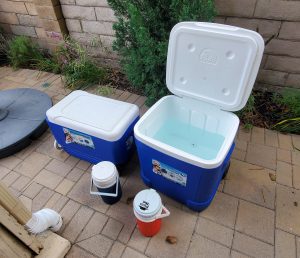
A system of water-filled coolers and thermoses allowed us to use our toilets for a few days.

Our hope was to get the walls dried up and then repipe our house. We figured we could live without running water for a few days so I devised a plan to fill a couple of large coolers with water from my neighbor’s hose. This water would be used to fill our toilet tanks so we could use them.

My plans were dashed as I learned that the restoration company wouldn’t be able to begin work immediately because our house is older and the walls needed to be tested first for lead and asbestos.

Our vinyl tile was “toxic” so it had to be treated by specially qualified professionals.

That took a few days and though our walls ultimately came back negative, the vinyl tile in the laundry area, which was damaged and needed to be removed, did come back positive for asbestos.

That meant we had to get a special abatement crew to remove the vinyl tile.

Two and a half weeks later, we are finally back in our home with actual running water. But there is still much that needs to happen to get back to normal. It will take weeks, if not months, for things to be fully restored.

Unfortunately, the process of repairing what’s broken & getting back to “normal” often takes longer than we hope or expect. The rebuilding process can uncover hidden issues that must be addressed. Sometimes, we even need experts to help us deal with the issues that may be toxic.

I’ve found that in my spiritual life, change is often like the repairs on my house. Spiritually, the things I struggle with are often caused by deeper, hidden issues that are ignored or not properly addressed.

Walls and ceilings had to be opened up throughout our home in order to “fix” the problem and repipe our house.

Real change often means opening up walls and getting inside before things can really be fixed. And sometimes, we can benefit greatly from the help of others who can help us deal with the highly sensitive and toxic issues in our lives that my be holding us back from experiencing the growth and change Jesus wants for us.

Thank you for your partnership with us and your encouragement to us as we navigate the slab leaks of our home and our spiritual lives.

Please pray for us as we deal with insurance, repairs and the costs related to this latest leak.

Discipleship and Change Through Coaching

Eric, with now wife Suemi, as a student at San Jose State University

I first met Eric thirty-one years ago. I was a brand-spanking new staff member with Cru at San Jose State University. It was a Friday night and we were hosting a Prayer night at the Crusade house where I lived with 12 other guys.

Eric opened the front door and walked in, looking for a friend who lived at the house. He felt like a deer caught in the headlights as he realized there was a prayer meeting happening. To avoid embarrassment, Eric played coy, acting as if he had intended to join.

Later that next week I met Eric on campus and we got into a deep spiritual conversation. Though Eric had a Christian background, he had never placed his faith in Christ, until that day.

Eric, taking time to reflect on God’s Word. As a new Christian, Eric spent the summer of 1990 on a Cru missions project in Santa Cruz getting vital discipleship training.

Over the next four years, Eric and I developed a close friendship as I helped him grow in his newfound faith. Since that time, we’ve stayed connected and remained friends, occasionally connecting as families as the opportunity has presented itself.

Earlier this year, I contacted Eric about coaching. I was looking to gain experience in implementing the training Jen and I had received last fall and I needed people to help me get started.

Unbeknownst to me, Eric had specifically prayed last fall that the Lord would give him wisdom and help him make progress in an area of his life that he’s struggled with for a long time – his health…specifically, his weight.

For years, Eric has tried to gain control of his weight, with very mixed results. There was a certain sense of urgency this time though as Eric’s doctor presented certain health related realities that were a direct result of his weight.

Can you relate? Is there an issue you’ve struggled with for as long as you can remember? It may not be weight or health-related but we all have areas in our lives that seem to hold us back.

Eric in 2002, attending a Sacramento area Cru Vision Dinner.

Eric and I officially began our coaching relationship right before Covid hit and the primary issue we’ve been tackling is Eric’s goal to lose 90 pounds.

If that sounds like a big goal, it is. Coaching isn’t a panacea. It’s not the silver bullet that solves all issues or problems. Primarily, it’s an avenue for self-discovery that empowers those who want to see growth and change make progress in areas that matter most to them.

For Eric, the journey has been long and hard. There have been many ups and downs. But with setbacks, coaching provides a structure for support that makes it a bit easier to keep going instead of throwing in the towel.

Eric has now lost 45 pounds and is half-way to his goal. He feels better, has more energy and is starting to see improvement in some of his weight-related health concerns.

Recently, I asked Eric about the spiritual connections he’s made through his weight loss journey.

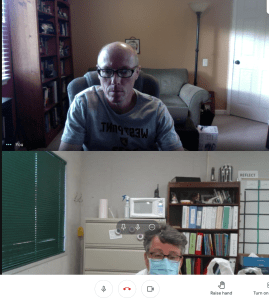
Eric and I using Google Meet for a virtual coaching call.

Eric said that he came to realize that losing weight was about more than just eating the right foods and exercising more, as important as those things are.

“There comes a point where you realize you can’t just will yourself to get the results you want to achieve. We lack discipline, focus and will power.” Eric went on to explain that we need help from others, whether that’s in the form of support and motivation or instruction and tools.

What Eric described to me is a picture of grace. Grace is applied when we can’t reach a standard we’ve set on our own and we need help to reach the goal.

Jesus is the ultimate grace-giver. He came to die for us, achieving the standard of righteousness required to experience a relationship with God that we couldn’t meet via our own efforts.

God answered Eric’s initial request from last fall by bringing others into his life to support him in his journey. I’ve been blessed to play a part in helping him hear the Lord’s voice through our coaching relationship.

How about you? What are the areas where you need the Lord to give you wisdom and grace to move forward to see significant life change? Who can you invite into your process to provide support and encouragement?

Coaching is an avenue that can help you gain greater awareness of your situation and provide support and encouragement to help you achieve goals that may have seemed out of reach.

Developing Resilience

What is resilience? Is it a skill? Is it an ingrained character quality?

A Picture of resilience – a lone tree somehow thrives in a harsh environment where plant life is sparse
Photo by Patrick Hendry on Unsplash

Marcus Buckingham, researcher and developer of the Gallup StrengthsFinder assessment addressed this question last month at the 2020 Global Leadership Summit, which Jen and I had the opportunity to attend virtually.

Buckingham and his team of researchers were interested in understanding this quality of resilience that some people seem to have, which gives them the ability to face incredible challenges without breaking or buckling.

Buckingham’s research determined that resilience isn’t a skill but a quality that can be developed. His talk focused on how to build resilience in others and in ourselves. Specifically, he shared 3 different ways we can build resilience in ourselves.

Resilient people have learned the importance of rest and recovery
Photo by Shane on Unsplash

First, Buckingham talked about a concept he called Agency, which simply refers to items we can control. One of the things we can control is the rhythms in our lives. Remember the morning and evening commute? As much as you might have hated that time in the car, it created an obvious separation between home life and work life. For many, that natural break is gone, disrupting the natural rhythm that existed.

The research on resilience, according to Buckingham, suggests that resilient people work hard and then take a break – they recognize the value of recovery. This sounds a lot like the idea of sabbath (rest), doesn’t it?

What are some ways you can create natural breaks in your schedule that would lead to rest, recovery and resilience?

Secondly, Buckingham elaborated on the idea of Compartmentalization, which means that different parts of our lives have different feelings and different outcomes. The most resilient people seem to understand that we have many different lanes in our lives and if we’re not doing well in one lane, there are other lanes. This doesn’t mean we deny the things that are going bad in that one area of life, but it’s a realization that there are other areas where I can see success and progress.

We all have different areas or lanes in our lives. If we’re struggling in one area, we can still succeed and see progress in other lanes.
Photo by Andrew McElroy on Unsplash

Dr. Henry Cloud, in his book Changes that Heal calls this the Good/Bad split, referring to our tendency to look at life as either “all good” if everything is going well, or “all bad” if something unexpected or undesirable happens.

The truth is, life is a mixture of good and bad. Resilient people are able to separate the good and bad and recognize that even when things happen that we wouldn’t prefer, there are often many other things that are going well which we can celebrate and for which we can be grateful.

What are the different lanes in your life where you’re seeing success? How can you leverage your experience in those areas to help you in the areas where you’re struggling?

According to Buckingham, the third way to develop resilience in ourselves is through our Strengths in Work. Resilient people have figured out how to utilize their strengths to derive meaning, purpose and joy from the circumstances they’re in.

Interestingly, Mayo Clinic research indicates that you don’t need to fill up your whole week with those invigorating activities in order to create resilience. If we can fill up just 20% of our schedules with the kinds of activities that bring life to our souls, we can develop resiliency that enables us to withstand the more difficult life circumstances which we may encounter.

What are the things that bring life to you? How can you inject a few of these joy-producing activities into your schedule to help build resilience?

Young Professionals face unique challenges, even apart from Covid, that makes resilience an important quality to develop. Many are struggling to find a supportive community while dealing with extreme financial issues and an uncertain job market.

We’re privileged to be able to help Young Professionals develop resiliency through coaching, Strengths assessments and awareness and Leadership Development.

If you’d like to learn more about resources and opportunities we provide to help people grow in their resilience, please contact us!