
Why Do Jews Reject Jesus as Their Messiah?

Isaiah 53

1Who has believed our message and to whom has the arm of the LORD been revealed?

2He grew up before him like a tender shoot, and like a root out of dry ground. He had no beauty or majesty to attract us to him, nothing in his appearance that we should desire him.

3He was despised and rejected by men, a man of sorrows, and familiar with suffering. Like one from whom men hide their faces he was despised, and we esteemed him not.

4Surely he took up our infirmities and carried our sorrows, yet we considered him stricken by God, smitten by him, and afflicted.

5But he was pierced for our transgressions, he was crushed for our iniquities; the punishment that brought us peace was upon him, and by his wounds we are healed.

6We all, like sheep, have gone astray, each of us has turned to his own way; and the LORD has laid on him the iniquity of us all.

7He was oppressed and afflicted, yet he did not open his mouth; he was led like a lamb to the slaughter, and as a sheep before her shearers is silent, so he did not open his mouth.

8By oppression and judgment he was taken away. And who can speak of his descendants? For he was cut off from the land of the living; for the transgression of my people he was stricken.

9He was assigned a grave with the wicked, and with the rich in his death, though he had done no violence, nor was any deceit in his mouth.

10Yet it was the LORD’s will to crush him and cause him to suffer, and though the LORD makes his life a guilt offering, he will see his offspring and prolong his days, and the will of the LORD will prosper in his hand.

11After the suffering of his soul, he will see the light and be satisfied; by his knowledge my righteous servant will justify many, and he will bear their iniquities.

12Therefore I will give him a portion among the great, and he will divide the spoils with the strong, because he poured out his life unto death, and was numbered with the transgressors. For he bore the sin of many, and made intercession for the transgressors. (Isaiah 53:1-12, NIV)


The Daily DAVEotional

I saw a post on X.com recently where an influential user listed what he considered the most significant in human history.

Who would you put at the top of that list?

Regardless of your religious views, I think it’s hard to argue against Jesus being the most important figure in all of human history. Incidentally, this user listed Genghis Khan first. Jesus was second on his list.

Jesus and his teachings have literally changed the world. And yet, the Jewish people, his own people, largely reject him. Why is that?

If you happened to be an Israelite living in first century Palestine, you eagerly expected and longed for the Messiah.

The nation of Israel was hundreds of years past its glory days, when it was an independent and respected nation. Now, it was merely one of the many provinces that were subject to Roman rule.

The prophets had foretold of a Messiah, who would one day come and deliver his people and restore the nation to its former glory. At least that was the hope.

Unfortunately, the biblical version of the Messiah did not match the expectations of most Jewish people, who were hoping for a political and military leader who would drive out the Romans, just as the many judges had driven out their oppressors in the early years of their nation’s formation.

This passage in Isaiah 53 gives a much different picture and description of the Messiah compared to the peoples’ expectations.

According to Isaiah, the coming Messiah would not be a person who would stand out. There was nothing physical about the Messiah that would draw people to him. He would be decidedly “normal”.

While the people were expecting a William Wallace type military hero to rally the troops and drive out their Gentile occupiers, this passage shows that the Messiah’s mission would be much different.

Yes, the Messiah would deliver his people; he just wouldn’t deliver them from the enemy they were thinking he would.

Verse 6 lays out the issue – we ALL have gone astray. As a result, the purpose of the Messiah would be to take the iniquity of people upon Himself.

Verse 10 is key because it explicitly states that the Messiah would be a guilt offering. Every Israelite knew that they had to make regular offerings at the temple in order to make atonement for sin. This verse indicates that it’s the Messiah himself whose life would be a guilt offering for the people.

There are a number of verses in this passage that explicitly point to Jesus.

Verse 5 provides one of the clearest references to Jesus’ brutal execution when it says that he was “pierced” for our transgressions. In John’s description of Jesus’ death, we learn that the Roman soldiers were eager to hasten the death of their victims because of the impending Sabbath (see John 19:31-34). It was common to break the legs of those being crucified, rendering it impossible for them to push themselves up to expand their lungs and breathe. Hence, the breaking of the legs brought a swift end to the slow tortures of crucifixion as the victim would immediately die of asphyxiation.

In the case of Jesus. the centurion realized that Jesus was already dead so there was no need to break his legs. Instead, he decided to take his spear and pierce Jesus’ side.

Verse 9 indicates that the Messiah would be assigned a grave for the wicked and the rich. In Jesus’ case, his body was set to be dumped in a pit with other common criminals. But instead, a rich person, Joseph of Arimathea, petitioned Pilate for the body of Jesus, whom he buried in a tomb that he had recently purchased.

Other prophecies in this passage are also fulfilled by Jesus. Verse 7 indicates that the Messiah would be silent when confronted by his accusers. All of the gospel accounts indicate that Jesus, when pressed by Pilate and the authorities, did not defend himself, but chose to willingly give himself up in order to go to the cross to be crucified.

To this day, the Jewish people largely reject Jesus as their Messiah, despite the fact that he fulfills all of the prophecies about the coming Messiah. In fact, there are a number of prophecies concerning the Messiah that only Jesus could have fulfilled.

If you don’t understand the mission of the Messiah, you will reject him.

The Jewish people reject Jesus as their Messiah because he doesn’t fit their hope and expectation of what the Messiah’s purpose would be. Instead of delivering his people from their political oppressors and restoring the glory of their nation, the Messiah’s purpose was first and foremost, to deliver people from the penalty of sin.

Non-Jews reject Jesus simply because they fail to see their need for a Savior. In this case, you may see Jesus as a significant figure in human history, but not as significant as someone like Genghis Khan who wielded tremendous political and military power to conquer the entire known world.

We would all do well to heed the words of Isaiah 53:6:

6We all, like sheep, have gone astray, each of us has turned to his own way; and the LORD has laid on him the iniquity of us all.


Did you enjoy this post? I’d love to hear your thoughts! Feel free to like, leave a comment below, and share it with your friends or on social media if you found it helpful or interesting. Your support keeps the conversation going!


Reflection

What is your understanding of the purpose of the Messiah?

In what ways do you see Jesus matching the description that prophets like Isaiah gave of the coming Messiah?

Who do you know that rejects Jesus as their Messiah and Savior? What are their reasons for rejecting Jesus ?

Why do you think Jewish people, by and large, still reject Jesus, despite clear passages like Isaiah 53 that show Jesus to be a “Suffering Servant” instead of a military conqueror?


Photo by MBVisign: https://www.pexels.com/photo/genghis-khan-statue-in-close-up-photography-6466768/
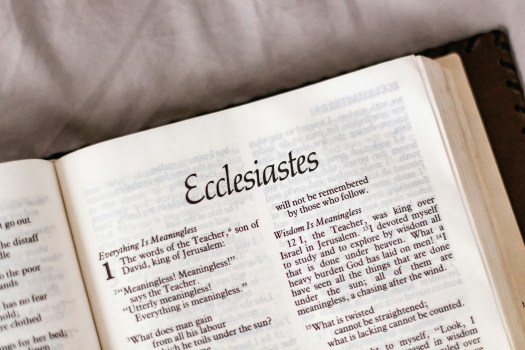

Filling a God-Shaped Hole

Ecclesiastes 2

1I said to myself, “Come now, let’s give pleasure a try. Let’s look for the ‘good things’ in life.” But I found that this, too, was meaningless. 2“It is silly to be laughing all the time,” I said. “What good does it do to seek only pleasure?” 3After much thought, I decided to cheer myself with wine. While still seeking wisdom, I clutched at foolishness. In this way, I hoped to experience the only happiness most people find during their brief life in this world.

4I also tried to find meaning by building huge homes for myself and by planting beautiful vineyards. 5I made gardens and parks, filling them with all kinds of fruit trees. 6I built reservoirs to collect the water to irrigate my many flourishing groves. 7I bought slaves, both men and women, and others were born into my household. I also owned great herds and flocks, more than any of the kings who lived in Jerusalem before me. 8I collected great sums of silver and gold, the treasure of many kings and provinces. I hired wonderful singers, both men and women, and had many beautiful concubines. I had everything a man could desire!

9So I became greater than any of the kings who ruled in Jerusalem before me. And with it all, I remained clear-eyed so that I could evaluate all these things. 10Anything I wanted, I took. I did not restrain myself from any joy. I even found great pleasure in hard work, an additional reward for all my labors. 11But as I looked at everything I had worked so hard to accomplish, it was all so meaningless. It was like chasing the wind. There was nothing really worthwhile anywhere.

12So I decided to compare wisdom and folly, and anyone else would come to the same conclusions I did. 13Wisdom is of more value than foolishness, just as light is better than darkness. 14For the wise person sees, while the fool is blind. Yet I saw that wise and foolish people share the same fate. 15Both of them die. Just as the fool will die, so will I. So of what value is all my wisdom? Then I said to myself, “This is all so meaningless!” 16For the wise person and the fool both die, and in the days to come, both will be forgotten.

17So now I hate life because everything done here under the sun is so irrational. Everything is meaningless, like chasing the wind. 18I am disgusted that I must leave the fruits of my hard work to others. 19And who can tell whether my successors will be wise or foolish? And yet they will control everything I have gained by my skill and hard work. How meaningless!

20So I turned in despair from hard work. It was not the answer to my search for satisfaction in this life. 21For though I do my work with wisdom, knowledge, and skill, I must leave everything I gain to people who haven’t worked to earn it. This is not only foolish but highly unfair. 22So what do people get for all their hard work? 23Their days of labor are filled with pain and grief; even at night they cannot rest. It is all utterly meaningless.

24So I decided there is nothing better than to enjoy food and drink and to find satisfaction in work. Then I realized that this pleasure is from the hand of God. 25For who can eat or enjoy anything apart from him? 26God gives wisdom, knowledge, and joy to those who please him. But if a sinner becomes wealthy, God takes the wealth away and gives it to those who please him. Even this, however, is meaningless, like chasing the wind. (Ecclesiastes 2:1-26, NLT)


The Daily DAVEotional

Blaise Pascal, the famous 17th century French mathematician and inventor, is often credited with saying,

​There is a God-shaped vacuum in the heart of every man which cannot be filled by any created thing, but only by God, the Creator, made known through Jesus Christ.

Interestingly, Pascal never actually said this exact quote, though he did express the sentiment when he said,

“What else does this craving, and this helplessness, proclaim but that there was once in man a true happiness, of which all that now remains is the empty print and trace? This he tries in vain to fill with everything around him, seeking in things that are not there the help he cannot find in those that are, though none can help, since this infinite abyss can be filled only with an infinite and immutable object; in other words by God himself”

As it turns out, this sentiment from Pascal, which has been shortened into the pithy quote that we all see today, was probably derived from Solomon, who explored the nature of meaning and fulfillment in this second chapter of Ecclesiastes.

So what exactly does Solomon say?

It’s important to understand the context on which Ecclesiastes 2 rests. In chapter 1, Solomon is trying to derive meaning and purpose to our existence. His initial position, based on observations and lived experience, is that life is meaningless.

It’s a sad existence indeed if there is absolutely no purpose or meaning in life. Yet that is what Solomon initially concludes.

In this chapter of Ecclesiastes, we’re subjected to a bit of Solomon’s ontological journey.

The first thing he says is that he tried to find meaning and fulfillment in pleasure, or what we call hedonism. But physical pleasure provides no lasting satisfaction. The exhilarating rush that pleasure brings quickly fades, leaving one grasping for the next opportunity to experience that physical and emotional high.

Solomon then turns his attention to the pursuit of materialism. Perhaps acquiring lots of stuff, overseeing grand construction projects or building tremendous wealth could ascribe meaning and value to life. But Solomon found that lacking as well. The allure that extreme wealth promises is never quite  achieved. John Rockefeller, who was the richest person to ever live, was once asked, “how much is enough?” His response was “just a little bit more.” He apparently did not subscribe to Solomon’s conclusion that extreme wealth does not ultimately satisfy.

Perhaps fame and taking pride in one’s work could provide the kind of satisfaction that pleasure and materialism couldn’t. But Solomon ultimately realized the utter futility of that pursuit. Fame is fleeting and whatever work we may accomplish is forgotten as quickly as we are when we die.

Solomon reasoned that hard work and wealth are ultimately meaningless because we all die. What good are those things after you die? Someone else will take possession of and oversee all that we’ve worked to produce. That hardly seems fair. You work your tail off to produce wealth and build an empire only to leave it to someone else who did nothing to earn or produce what you’ve left?

None of this makes sense on the surface. What is the point?

Solomon gives a glimpse into the ultimate purpose in verses 24-25, when he says,

24So I decided there is nothing better than to enjoy food and drink and to find satisfaction in work. Then I realized that this pleasure is from the hand of God. 25For who can eat or enjoy anything apart from him?

Is pleasure, wealth, fame and work all meaningless? Apart from God, the answer is yes. But with God, all of these things are meaningful because they are gifts from God, the ultimate gift-giver!

So we’re back to our opening line that is often attributed to Pascal. There is something inside each person that is searching and striving for meaning and purpose. Man, in his fallenness, seeks to satiate this inner desire with all kinds of things – pleasure, power, wealth and fame. But none of these things bring true satisfaction or fulfillment. That’s because God is the only one who can ultimately fulfill our basic human need for meaning and purpose. It’s part of His design.

Apart from God there is no ultimate meaning and purpose. As Christian philosopher and apologist Frank Turek says, we are just “moist robots” who appear one day and then one day we’re gone.

If that is the case, then Solomon’s initial assessment is true – life is indeed meaningless. But with God, life not only has purpose and meaning but work, pleasure and wealth all make sense.


Did you enjoy this post? I’d love to hear your thoughts! Feel free to like, leave a comment below, and share it with your friends or on social media if you found it helpful or interesting. Your support keeps the conversation going!


Reflection

What do you turn to in order to experience purpose and meaning in life?

Which of the following do you struggle with the most: the pursuit of pleasure, wealth, power or fame?

What do you think are the reasons you or people in general pursue other things to satisfy their inner needs rather than pursuing God Himself?

In what ways can you turn to God as your source of true satisfaction and fulfillment?


Photo by Sincerely Media on Unsplash

Theological Lessons from the Movie “Trading Places”

Psalm 51

1Be gracious to me, O God, according to Your lovingkindness;

According to the greatness of Your compassion blot out my transgressions.

2Wash me thoroughly from my iniquity

And cleanse me from my sin.

3For I know my transgressions,

And my sin is ever before me.

4Against You, You only, I have sinned

And done what is evil in Your sight,

So that You *[Or may be in the right]are justified when You speak

And blameless when You judge.

5Behold, I was brought forth in iniquity,

And in sin my mother conceived me.

6Behold, You desire truth in the innermost being,

And in the hidden part You will make me know wisdom.

7Purify me with hyssop, and I shall be clean;

Wash me, and I shall be whiter than snow.

8Make me to hear joy and gladness,

Let the bones which You have broken rejoice.

9Hide Your face from my sins

And blot out all my iniquities.

10Create in me a clean heart, O God,

And renew a steadfast spirit within me.

11Do not cast me away from Your presence

And do not take Your Holy Spirit from me.

12Restore to me the joy of Your salvation

And sustain me with a willing spirit.

13Then I will teach transgressors Your ways,

And sinners will be converted to You. (Psalm 51:1-13, NASB)


The Daily DAVEotional

In the 1980’s movie Trading Places, two wealthy, elderly brothers (the Duke brothers) engage in the age old debate concerning the nature of man. One brother argues that man is corrupted by nature, while the other brother believes that the corruption of man is the result of environmental factors (nurture).

With each brother equally convinced that his position is correct, they agree to an experiment to decide the matter once and for all. With a $1 bet as incentive, they embark on a plan to completely ruin the life and reputation of their sophisticated Wall Street executive assistant played by Dan Akroyd. At the same time, they exalt a crooked street bum, played by Eddie Murphy, to Akroyd’s former position. Only after seeing how each person responds can they settle the bet and the debate.

Not long after being promoted to a position well beyond his education, Murphy begins to become the sophisticated, educated person that his position requires. At the same time, Akroyd, having lost it all, begins to turn into the common criminal that Murphy once was.

The movie ends up portraying a view of man that is commonly believed in society today—that man is basically a product of the negative forces in his environment. Yet this view is in stark opposition to what the Bible teaches about the nature of man.

The Bible says that man was originally created in the image of God (see Genesis 1:26, 27). The phrase “image of God” refers to man’s ability to reveal and represent what God is like. Exactly how man reveals the image of God has been debated over the years. However, many believe that two categories that reflect God’s image in man are man’s ability to make moral decisions, and the dominion that was given to man by God.

Before Adam and Eve sinned, the “image of God” in man was perfect. Man walked with God, had dominion over the earth and every decision man made was morally representative of God’s nature. This is because man was completely dependent on God for moral direction and guidance.

However, when Adam & Eve sinned, this image became corrupted. Specifically, man was corrupted in several ways:

1. Intellectually, man’s mind became depraved.

21 For even though they knew God, they did not honor Him as God, or give thanks; but they became futile in their speculations, and their foolish heart was darkened.22 Professing to be wise, they became fools,…28 And just as they did not see fit to acknowledge God any longer, God gave them over to a depraved mind, to do those things which are not proper, (Romans 1:21,22,28, NASB)

2. Emotionally, man became perverted.

24 Therefore God gave them over in the lusts of their hearts to impurity, that their bodies might be dishonored among them…26 For this reason God gave them over to degrading passions; for their women exchanged the natural function for that which is unnatural (Romans 1:24, 26, NASB)

3. Volitionally, man’s will became enslaved to sin.

17 For the flesh sets its desire against the Spirit, and the Spirit against the flesh; for these are in opposition to one another, so that you may not do the things that you please. (Galatians 5:17, NASB)

Though none of these verses demonstrate man’s condition when he’s born, the Bible clearly communicates that man is morally depraved from birth.

In Psalm 51, David is confessing and repenting of his egregious sin of adultery with Bathsheba followed by the cover-up murder of her husband, Uriah the Hittite.

In his confession, David reveals an important truth about the nature of man when he says in verse 5:

“Behold, I was brought forth in iniquity, and in sin did my mother conceive me.”

Similarly, in Psalm 58:3, David said,

“the wicked go astray from the womb, they err from their birth, speaking lies.”

The apostle Paul agrees when he says in Ephesians 2:3,

“we are by nature children of wrath”

These verses all clearly teach that man is born with a sin nature, which produces in him a propensity toward sin.

Conversely, if one holds to the position that corruption, or sin is simply the product of one’s negative environment, how does one explain David’s reprehensible actions? He had everything he could want and certainly wasn’t in a position of need or desperation. It’s hard to argue that his environment “forced” him to do what he did. It’s more reasonable to explain his behavior as selfishness resulting from an inner compulsion towards evil.

It is obvious then, that the progressive’s idealistic Star Trek world where man’s goodness evolves over time is but a myth. The Bible clearly teaches that man was originally created in God’s image. However, that image was corrupted when Adam and Eve sinned.

Every person since Adam and Eve, with the exception of Jesus, has inherited a corrupted sin nature that exists within the person from birth. To argue otherwise is simply to deny the clear teaching of the Word of God.


Did you enjoy this post? I’d love to hear your thoughts! Feel free to like, leave a comment below, and share it with your friends or on social media if you found it helpful or interesting. Your support keeps the conversation going!


Reflection

Do you think man is basically good, and only does bad things because of the negative impact of his environment, or do you think man is innately bad, having been corrupted by his sin nature? What are the reasons for the position you hold?

For those who argue that man is only bad because of the negative effects of his environment, how do you explain the negative environment? In other words, how do you think the environment became negative in the first place?

What do you think it means that man was created in the “image of God”?

If man’s nature was perfect before sin, how exactly did their nature become corrupted? (See my blog post, “Why Did God Forbid This One Fruit?”

Why do you think this issue of nature vs. nurture is important? What are the implications of each position over the other? 


Photo: Screenshot from the movie “Trading Places”


Fact-Checking and Misinformation in the New Testament

Acts 17

10That very night the believers sent Paul and Silas to Berea. When they arrived there, they went to the synagogue. 11And the people of Berea were more open-minded than those in Thessalonica, and they listened eagerly to Paul’s message. They searched the Scriptures day after day to check up on Paul and Silas, to see if they were really teaching the truth. 12As a result, many Jews believed, as did some of the prominent Greek women and many men. (Acts 17:10-12, NLT)


The Daily DAVEotional

The advent of social media has completely changed the landscape of how information is disseminated to the masses. Prior to social media, people relied primarily on what is now known as “legacy media” – national broadcast news networks and major metropolitan newspapers.

But now with social media, anyone and everyone can be a journalist, investigative reporter, podcaster or blogger. Competing ideas and opinions abound, making it increasingly more difficult to separate fact from fiction.

With such an affluence of free-flowing information, two terms have been introduced into the mainstream cultural vernacular in recent years – misinformation and disinformation. These terms have primarily been used by politicians and pundits on both sides of the aisle to label the speech and narratives of their opponents as false. Alarmingly, our own government has cited “misinformation” as a basis for seeking to censor the speech and thus limit the reach of those whose ideas and beliefs are not aligned with the official position of the party in power.

This effort to limit speech has been evident in the last few political cycles, through an increased effort to put pressure on social media platforms to limit and even censor speech that is deemed as “misinformation”.

But who exactly determines what is misinformation?

Social media outlets have employed “fact-checkers” to determine what information is accurate and what should be labeled as “misinformation”.

A fact-checker is someone who evaluates the truthfulness of a statement and then renders a judgment. These fact-checkers are expected to be neutral but the problem, as we’ve seen, is that they’re rarely unbiased. Who then fact-checks the fact-checkers?

In this segment of Acts 17, the Bereans are commended for their ability to fact-check the information that was being promoted.

Paul was a missionary who traveled throughout Asia Minor proclaiming the message of Christ and planting churches among those who believed his message.

But just like today, there was no shortage of ideological grifters and religious charlatans traveling from village to village looking for a market to sell their ideological snake oil.

With so many traveling religious preachers, how does one determine who, if anyone, is telling the truth?

The Bereans were commended because they “fact-checked” Paul’s message by “searching the Scriptures” to determine it’s veracity.

“The Scriptures” in this case refers to the Old Testament. The Bereans listened intently at Paul’s message and “day after day” they checked the message and compared it to what they already knew was true – the Old Testament Scriptures.

Fact-checking is a good thing, as long as the facts are being checked honestly against an objective, truthful standard. As we’ve seen recently, people are often biased, meaning they are rarely objective and often will stretch the truth, or in some cases, even deny the truth in order to fit their own biases.

But God’s word is both objective and true because it is the very word of God, who is by definition, truth.

So if you really want to check your facts, be sure they are not misaligned with what the Scriptures say. If they are, you can be certain that your facts are indeed “misinformation”.


Did you enjoy this post? I’d love to hear your thoughts! Feel free to like, leave a comment below, and share it with your friends or on social media if you found it helpful or interesting. Your support keeps the conversation going!


Reflection

What are some beliefs and ideas that you may tend to hold more because of your own personal  bias than the fact that it is true?

What is the standard that you use to determine if a religious statement is true or not?

What examples have you seen in your own experience of fact-checkers who were too biased to be trusted?

How do you think it’s possible that two different people can evaluate the same “facts” and arrive at completely different conclusions?

How can you ensure that you are not being misled and falling for misinformation when it comes to some of the ideological narratives that are being promoted in our culture?


Photo by Samuel Regan-Asante on Unsplash

Oh, How Quickly We Forget!

Judges 3

1The LORD left certain nations in the land to test those Israelites who had not participated in the wars of Canaan. 2He did this to teach warfare to generations of Israelites who had no experience in battle. 3These were the nations: the Philistines (those living under the five Philistine rulers), all the Canaanites, the Sidonians, and the Hivites living in the hill country of Lebanon from Mount Baal-hermon to Lebo-hamath. 4These people were left to test the Israelites—to see whether they would obey the commands the LORD had given to their ancestors through Moses.

5So Israel lived among the Canaanites, Hittites, Amorites, Perizzites, Hivites, and Jebusites, 6and they intermarried with them. Israelite sons married their daughters, and Israelite daughters were given in marriage to their sons. And the Israelites worshiped their gods.

7The Israelites did what was evil in the LORD’s sight. They forgot about the LORD their God, and they worshiped the images of Baal and the Asherah poles. 8Then the LORD burned with anger against Israel, and he handed them over to King Cushan-rishathaim of Aram-naharaim. And the Israelites were subject to Cushan-rishathaim for eight years.

9But when Israel cried out to the LORD for help, the LORD raised up a man to rescue them. His name was Othniel, the son of Caleb’s younger brother, Kenaz. 10The Spirit of the LORD came upon him, and he became Israel’s judge. He went to war against King Cushan-rishathaim of Aram, and the LORD gave Othniel victory over him. 11So there was peace in the land for forty years. Then Othniel son of Kenaz died. (Judges 3:1-11, NLT)


The Daily DAVEotional

The book of Judges is a history of the Israelites immediately after taking possession of the land of Canaan and after the death of Joshua.

The book chronicles the struggles the leaderless Israelites experienced politically, militarily and spiritually.

The Israelites had been commanded to drive out the people of the land, but we learn in Judges 1:19 that “they were unable to drive the people from the plains, because they had iron chariots.” Though not explicitly stated, the implication is that the Israelites lacked the courage to finish the job because they feared the military superiority of the other people. They lacked the faith that God could help them defeat an enemy that appeared to out-match their military strength.

So instead of occupying this land with a clean slate, they find themselves co-existing with these other people groups who don’t share their values and who don’t worship the Lord. This is not a good start to this fledgling nation.

Here in chapter 3, we learn that the Lord allowed some of these people groups to remain in order to provide an avenue to teach warfare “to generations of Israelites who had no experience in battle.”

In other words, there was a strategic purpose that these other peoples weren’t displaced all at once. The Lord wanted the next generation to learn how to fight in battle and He also wanted to test them to see how obedient they would be to the commands that had been delivered by Moses.

Sadly, they utterly failed the test. They began to intermarry with the peoples with whom they were co-existing. Not surprisingly, they soon began to forsake the Lord by worshipping the gods of these foreign nations.

In His righteous anger, the Lord allowed the Israelites to experience divine punishment in the form of marauders and local foreign rulers becoming their overlords. In this case, they became subject to an Aramean king for 8 years.

The pattern in Judges is cyclical. The Israelites prostitute themselves by forsaking the Lord and worshipping foreign gods. God allows them to be raided and subject to others until the Israelites finally cry out to the Lord for mercy and for relief. The Lord then raises up a judge, a military leader who is empowered by God to rescue His people from their enemies. But soon after being delivered, the cycle repeats as the Israelites return again to their foreign gods, bringing retribution from a new source.

Here in chapter 3, we see the start of this pattern that repeats throughout the book. What I think is most interesting is who the first judge is that is raised up to rescue the people from the Aramean King Cushan-rishathaim.

The text says that Othniel was raised up as Israel’s first judge. Now if the name Othniel seems familiar, it’s because he was mentioned back in Joshua 15 and also again in Judges chapter 1.

Caleb offered his daughter Acsah in marriage to anyone who would attack and capture Kiriath-sepher, a village in the Judean hills that later became known as Debir. We learn that Othniel stepped up to the challenge, captured the city and won the hand of Caleb’s daughter.

Translators are not completely clear on the relationship between Othniel and Caleb. It’s not clear from the original text whether the phrase “brother of Caleb” refers to Othniel or Kenaz. Either translation is possible. Hence, Othniel was either Caleb’s younger half-brother (same mother but with a different father, Kenaz) or he was Caleb’s nephew (with Kenaz being Caleb’s younger brother). Whichever is the case, we know for certain that Othniel, though younger than Caleb, was a contemporary. In other words, they lived in generally the same era.

But here in the beginning chapters of Judges, Joshua has died and it’s likely that Caleb has died too. Othniel, however, is still around. The point is that this is less than one generation removed from the death of Joshua and the Israelites are already forsaking the Lord.

Joshua, before his passing, had urged the people in Joshua 24, to “choose for yourselves this day whom you will serve….But as for me and my household we will serve the LORD.” And now, just a few short years after his passing, the Israelites have already forsaken the Lord to chase after foreign gods.

There are a number of relevant takeaways from this story. First, we see the consequences of disobedience and a lack of faith. The Israelites lack of faith in facing an enemy that is perceived to be stronger leads to a co-existence that has long-lasting and far-reaching implications. These people, who were supposed to be displaced, became a thorn in the side of the Israelites for centuries.

Secondly, despite all their good intentions in Joshua 24, where they swore up and down that they would serve the Lord and not chase after other gods, we see that the apostasy of the Israelites comes rather quickly, during the actual lifetime of those who had been involved in the initial conquest of the land.

We don’t need to look too far to confirm that this is the nature and the pattern of people with respect to loyalty and allegiance to the Lord. During my life-time, we have seen the exponential erosion of the influence of the church on our culture.

Just as the Israelites of the Judges era were influenced by the cultures around them, so we today see that many Christians are more influenced by the gods and ideas of the culture than they are the God of the Bible and its values.

The process of “deconstructing” one’s faith has become popular today as people wrestle with the differences and disparities that exist between the biblical narrative and the secular worldview that dominates our culture. (See my post “Dealing with Doubts about God” for a deeper dive on this idea of deconstructing one’s faith.)

For some, the process of deconstruction leads to a complete abandonment of God and the faith. It seems almost commonplace these days when we hear of a prominent Christian leader who has “left the faith”.

For others, deconstruction leads to a re-imagining of God – what I call “Salad Bar Religion”, which is simply a syncretic, or progressive version of Christianity in which God is completely redefined in such a way that suits my preferences and is less offensive to the culture around us. (See my post “The Recipe for Salad Bar Religion” for a deeper explanation of this approach).

There is no doubt that cultural forces make devotion to the one true God extremely difficult. The first step to avoiding our own spiritual apostasy is to recognize that we, just like the Israelites in the time of the Judges, are not immune to these same outcomes, if we are not proactive to take steps to safeguard ourselves from those ideologies and philosophies that would seek to draw us away from the one true God.

So how do we safeguard ourselves?

That’s probably another full blog post but maintaining a strong spiritual community is a must, as well as developing a strong foundational understanding of the nature of God, which will enable us to more easily identify the many false gods being promoted by the culture.


Did you enjoy this post? I’d love to hear your thoughts! Feel free to like, leave a comment below, and share it with your friends or on social media if you found it helpful or interesting. Your support keeps the conversation going!


Reflection

What are some examples in your own life of people you have known who, at one time, seemed like strong Christians, but who now don’t believe at all, or have opted for an alternative view of God that isn’t biblical?

What do you think are some factors that can more easily lead to people abandoning their faith or redefining it in a way that is no longer faithful to God as revealed in the Bible?

What are some of the cultural forces or ideas that challenge your beliefs? How have you addressed those challenges, doubts and questions?

There were a couple of steps mentioned at the end of the blog to help safeguard ourselves from being taken captive by the ideologies of the culture. What are some other ideas you have for protecting yourself spiritually from being a spiritual casualty in your devotion to God alone?


Photo by Eric Smart: https://www.pexels.com/photo/lest-we-forget-tombstone-2233388/

Who is this Melchizedek Character?

Genesis 14

17As Abram returned from his victory over Kedorlaomer and his allies, the king of Sodom came out to meet him in the valley of Shaveh (that is, the King’s Valley). 18Then Melchizedek, the king of Salem and a priest of God Most High, brought him bread and wine. 19Melchizedek blessed Abram with this blessing:

“Blessed be Abram by God Most High,

Creator of heaven and earth.

20And blessed be God Most High,

who has helped you conquer your enemies.”Then Abram gave Melchizedek a tenth of all the goods he had recovered. (Genesis 14:17-20, NLT)

. . . . . . . . . . . . .

Hebrews 7

1This Melchizedek was king of the city of Salem and also a priest of God Most High. When Abraham was returning home after winning a great battle against many kings, Melchizedek met him and blessed him. 2Then Abraham took a tenth of all he had won in the battle and gave it to Melchizedek. His name means “king of justice.” He is also “king of peace” because Salem means “peace.” 3There is no record of his father or mother or any of his ancestors—no beginning or end to his life. He remains a priest forever, resembling the Son of God.

4Consider then how great this Melchizedek was. Even Abraham, the great patriarch of Israel, recognized how great Melchizedek was by giving him a tenth of what he had taken in battle. 5Now the priests, who are descendants of Levi, are commanded in the law of Moses to collect a tithe from all the people, even though they are their own relatives. 6But Melchizedek, who was not even related to Levi, collected a tenth from Abraham. And Melchizedek placed a blessing upon Abraham, the one who had already received the promises of God. 7And without question, the person who has the power to bless is always greater than the person who is blessed.

8In the case of Jewish priests, tithes are paid to men who will die. But Melchizedek is greater than they are, because we are told that he lives on. 9In addition, we might even say that Levi’s descendants, the ones who collect the tithe, paid a tithe to Melchizedek through their ancestor Abraham. 10For although Levi wasn’t born yet, the seed from which he came was in Abraham’s loins when Melchizedek collected the tithe from him.

11And finally, if the priesthood of Levi could have achieved God’s purposes—and it was that priesthood on which the law was based—why did God need to send a different priest from the line of Melchizedek, instead of from the line of Levi and Aaron?

12And when the priesthood is changed, the law must also be changed to permit it. 13For the one we are talking about belongs to a different tribe, whose members do not serve at the altar. 14What I mean is, our Lord came from the tribe of Judah, and Moses never mentioned Judah in connection with the priesthood.

15The change in God’s law is even more evident from the fact that a different priest, who is like Melchizedek, has now come. 16He became a priest, not by meeting the old requirement of belonging to the tribe of Levi, but by the power of a life that cannot be destroyed. 17And the psalmist pointed this out when he said of Christ,

“You are a priest forever

in the line of Melchizedek.”

18Yes, the old requirement about the priesthood was set aside because it was weak and useless. 19For the law made nothing perfect, and now a better hope has taken its place. And that is how we draw near to God.

20God took an oath that Christ would always be a priest, but he never did this for any other priest. 21Only to Jesus did he say,

“The Lord has taken an oath

and will not break his vow:

‘You are a priest forever.’”22Because of God’s oath, it is Jesus who guarantees the effectiveness of this better covenant. (Hebrews 7:1-22, NLT)


The Daily DAVEotional

One of the great themes of the book of Genesis and really the whole Bible, is the Abrahamic covenant, which is introduced in Genesis 12 and is repeated again in Genesis 15. In this covenant, God promises to bless Abraham, so that he, through his descendants, would be a blessing to the nations. This promise sets the backdrop for God’s biblical redemptive plan, which unfolds throughout the Scriptures.

In the chapters that provide the filling for this Abrahamic Covenant sandwich (Genesis 13 and 14), Moses tells the story of how Abram and Lot decide to separate, mainly because they both had grown their personal wealth so much, there was no suitable land that could accommodate both of them with all of their flocks and herds.

Now that Lot is no longer under Abram’s protection, he finds himself the innocent victim of what amounts to a local political rebellion. The end result is that Lot, along with others, is taken captive by a local ruler who did not take kindly to the uprising of his subjects.

Abram gets wind of the situation and launches a rescue operation, which is highly successful. Not only does he get Lot back, but he retrieves ALL of those who have been captured, along with all of their possessions which had been looted.

On his way back from victory, Abram encounters a local king named Melchizedek. To the unschooled reader, Melchizedek seems like just another insignificant local political leader with a name that’s hard to pronounce. There really isn’t much reason to think this guy is that important to the overall biblical narrative, until of course, you get to the book of Hebrews.

Everything we know about Melchizedek comes from just 3 verses in Genesis 14. Here is what we know:

    • Melchizedek was the king of Salem, which means “king of peace.”
    • Melchizedek was also “king of righteousness” since the name “Melchizedek” means “my king is righteousness.”
    • Melchizedek was a priest of the most High God – he apparently followed the one true God.
    • Melchizedek blessed Abram
    • Abram gives Melchizedek a tenth of all the goods he recovered. He paid a tithe to Melchizedek.

Here’s a guy who gets a mere 3 verses of attention in Genesis but then later, is a major source of discussion for 3 chapters in the book of Hebrews. What is really going on here?

If you know anything about the book of Hebrews, the theme is the idea of “Better”. The author advances a series of arguments to show how Jesus is better.

Better than what?

Better than everything!

Jesus is better than angels. Jesus is better than Moses. Jesus is a better priest because He belongs to a better priesthood. Jesus offers a better sacrifice because Jesus’ sacrifice is built on better blood.

Everything about Jesus is better. Including the fact that Jesus is the guarantor of a better covenant.

Hebrews was written to Jewish Christians who were beginning to forsake their new faith in Christ in favor of reverting back to their Jewish religious practices. The author pens his letter to demonstrate why that is not advisable. I’ve written about that in my blog post “Better Than…” as well as another post “A Better Sacrifice”.

In this section of Hebrews, the writer uses Melchizedek as an illustration to make the argument that Jesus is the author of a better covenant.

How exactly does he make his case?

The author first demonstrates that Melchizedek was greater than Abram. He does this by pointing out that Melchizedek blessed Abram and also received a tithe from Abram. He argues that the person who blesses is always greater than the person being blessed and the person who receives a tithe generally has a higher status than the person paying the tithe. Hence, Melchizedek is greater than Abram.

If Melchizedek is greater than Abram, then he’s also greater than Levi, who came from Abram. The writer points out that even though Levi, who is the basis for the Old Testament priesthood, was not yet born, his seed was within Abram when Abram paid the tithe to Melchizedek.

We know also that Melchizedek was a priest of the most high God just as Levi was. But since the Levitical priesthood had not even been implemented yet, Melchizedek’s priesthood must be of a different order. This order is different in one very obvious respect – this priesthood allowed kings to function as priests. This was not allowed in the Levitical priesthood which kept the roles of priests, who were the mediators, separate from the roles of kings, who were the rulers. (See my post, “Whatever Became of Sin?” to see an example of what happens when a king tries to perform priestly functions in the Levitical priesthood system.)

The author then gives another reason for the superiority of Melchizedek’s priesthood over Levi’s – Melchizedek’s priesthood is eternal while Levi’s was temporary.

The author reasons that alhough Melchizedek was a real person, his genealogy is not mentioned anywhere. We don’t know where he came from and there is no mention of him after these few verses in Genesis 14. It’s as if he never died.

The writer uses this as an analogy of sorts. Melchizedek appears on the scene out of nowhere and since we have no record of his death, it’s as if he lives on forever. Melchizedek, therefore, is a priest forever.

The argument then is that Jesus’ priesthood is more like Melchizedek’s priesthood than it is like Levi’s.  How?

Jesus descends from Judah, not from Levi. Therefore, Jesus is not even eligible to be a priest within the Levitical system.

Also, Jesus is a priest AND a king, just as Melchizedek was.

Finally, Jesus’ priesthood is eternal, just like Melchizedek’s appeared to be. Unlike Levitical priests, who died and had to be replaced by new priests, Jesus lives on forever and therefore is NEVER replaced.

We’ve already established that Melchizedek is greater (better) than Levi and since Jesus’ priesthood resembles Melchizedek’s not Levi’s, it logically follows that Jesus’ priesthood is better than Levi’s.

And because Jesus’ priesthood is better, the covenant which He introduces must also be better. So why would you then go back to the Old Covenant which was clearly inferior?

So there you have it. Melchizedek, who is just a blip on the screen in the Old Testament, becomes a central figure of the New Testament.

In theological terms, we say that Melchizedek is a “type” of Christ, which simply means that his existence and what we know of him figuratively resembles what we know to be true of Jesus. Hence, even though it may seem, on the surface, like Melchizedek is just a hired extra in the background of a major Hollywood movie scene, he turns out to be much more important than that. His mention is made to prefigure the coming of Jesus.

Now you know.


Did you enjoy this post? I’d love to hear your thoughts! Feel free to like, leave a comment below, and share it with your friends or on social media if you found it helpful or interesting. Your support keeps the conversation going!


Reflection

What has been your understanding of Melchizedek before reading this blog? Who did you think he was and what importance did you think he had to the overall message of Scripture?

What do you think are some of the reasons the audience of the book of Hebrews may have been forsaking their faith? What are some things that can tend to draw you away from the faith and back into your former lifestyle?

Of the characteristics of Melchizedek that resemble Jesus, which one stands out to you the most and why?

Jesus is the author of a better covenant. The old covenant was based on the Law. How would you explain to another person that the new covenant is better than the old covenant? What are some of the ways that it is better?


AI image of Abram paying a tithe to Melchizedek created by Grok

The Queen’s Gamble

Esther 8

1On that same day King Xerxes gave the estate of Haman, the enemy of the Jews, to Queen Esther. Then Mordecai was brought before the king, for Esther had told the king how they were related. 2The king took off his signet ring—which he had taken back from Haman—and gave it to Mordecai. And Esther appointed Mordecai to be in charge of Haman’s property.

3Now once more Esther came before the king, falling down at his feet and begging him with tears to stop Haman’s evil plot against the Jews. 4Again the king held out the gold scepter to Esther. So she rose and stood before him 5and said, “If Your Majesty is pleased with me and if he thinks it is right, send out a decree reversing Haman’s orders to destroy the Jews throughout all the provinces of the king. 6For how can I endure to see my people and my family slaughtered and destroyed?”

7Then King Xerxes said to Queen Esther and Mordecai the Jew, “I have given Esther the estate of Haman, and he has been hanged on the gallows because he tried to destroy the Jews. 8Now go ahead and send a message to the Jews in the king’s name, telling them whatever you want, and seal it with the king’s signet ring. But remember that whatever is written in the king’s name and sealed with his ring can never be revoked.” (Esther 8:1-8, NLT)


The Daily DAVEotional

Esther is a short book in the Old Testament that takes place during the time when the Jewish people were in exile and subjects to the Persians, who were the dominant super power on the world stage.

Esther is a young Jewish girl, who, through a series of circumstances, finds herself as the Queen to the most powerful man in the world, Xerxes I, also known as Ahasuerus.

The earlier chapters chronicle Esther’s rise to become queen, along with the plot by Haman, who, as Prime Minister, convinced the King to enact a plot to completely eradicate the Jewish people. I wrote about this in a previous blog post, “An Ancient Example of Cancel Culture”.

At great risk to herself, Esther approaches the king without an official summons and ultimately exposes Haman’s wicked plot to the king. It appears that justice has been served.

However, even though Haman’s plot has been exposed and he has been hung on the very gallows he had built to hang Mordecai, there is still the small issue that Haman’s decree ordering the elimination of the Jewish people was still in force.

One would think that the king would simply rescind his original decree but the Persian empire had an interesting law that said any decree made by the king was irrevocable. In other words, the law had to stand and he could not just reverse it. Perhaps there are good reasons for that to be the case but in this instance, it was inconvenient, to put it mildly.

So Esther finds herself in a bit of a quandary. Does she go to the king uninvited yet again?

Now at this point in the story, I think it might be easy to think that there is virtually no risk for Esther in approaching the king. After all, he was very pleased with her early on, which is why he made her queen. And she’s already gone to him uninvited and his response was very favorable. From our vantage point, there is no reason why he wouldn’t be favorable again.

But as is often the case, there’s more to the story that’s not being reported. And in this instance, there’s a religious element at play.

What we don’t see from the text, and wouldn’t know unless we did some extrabiblical research, is that the ancient Persians were highly committed to a religion known as Zoroastrianism, a monotheistic religion that still has adherents today, albeit very few.

What is not shared in the text is that king Xerxes, unlike his predecessors, kings Cyrus and Darius, was not a religious pluralist. That means he was not the kind of king who saw any value in allowing other religions and faith traditions to exist alongside Zoroastrianism within his kingdom.

While it’s true that he acted extremely favorably toward Esther in her initial meeting there was simply no reason to believe he would see it as beneficial to try to undo the previous edict.

This new information about Xerxes’ religious views places Esther’s request of the king in an entirely new light. Instead of being just a low level added encounter, Esther’s request is quite bold and risky. Esther selflessly put herself at risk in order to intervene and advocate for her people. She used her position in order to secure justice for those who could not advocate for themselves – her own people.

Esther is honored not only for her boldness and faith, but for her example of what it looks like to use your position for the well-being and benefit of others.

Reflection

What situations have you been in that are similar to Esther’s – where you had to do something that required risk on your behalf?

What are some typical reasons people might have for not stepping up like Esther did?

In what ways does the additional information regarding Xerxe’s religious views impact your understanding of Esther’s choice?

What steps can you take to increase the level of faith and boldness in your life?


Photo by Megan Watson on Unsplash

Was it Genocide or Punishment?

Deuteronomy 18

9“When you arrive in the land the LORD your God is giving you, be very careful not to imitate the detestable customs of the nations living there. 10For example, never sacrifice your son or daughter as a burnt offering. And do not let your people practice fortune-telling or sorcery, or allow them to interpret omens, or engage in witchcraft, 11or cast spells, or function as mediums or psychics, or call forth the spirits of the dead. 12Anyone who does these things is an object of horror and disgust to the LORD. It is because the other nations have done these things that the LORD your God will drive them out ahead of you. 13You must be blameless before the LORD your God. 14The people you are about to displace consult with sorcerers and fortune-tellers, but the LORD your God forbids you to do such things. (Deuteronomy 18:9-14, NLT)


The Daily DAVEotional

I heard a speaker once ask the question, “if you were put on trial for being a Christian, would there be enough evidence to convict you?”

The idea behind the question is that a lot of people who claim to be Christians don’t live like it.

I think there’s a similar question being asked within our culture about the God of the Old Testament. Is there enough evidence to prove He is God? I think the real question people are asking is, “does the God of the Old Testament measure up to my idea of God?”

For many, the answer is no, mostly because people cannot reconcile their view that God is all-loving with the commands in the Old Testament for the Israelites to wipe out the people dwelling in the land of Canaan.

I wrote about this topic recently in my post “Is the Old Testament God a Bloodthirsty, Genocidal Psychopath?” in which I argue that one of the main reasons people have difficulty with the God of the Old Testament is that they have a faulty or incomplete view of His nature. Sure God is loving. But that is not His only attribute. He’s also holy and righteous and just and infinitely good (to name just a few).

As a result, His command for the Israelites to expel the Canaanites from the land was not genocide, but divine punishment.

This passage in Deuteronomy is one of many that gives just a glimpse into the reprehensible atrocities and “detestable customs” of the Canaanites.

To say the Canaanites were wicked would be an understatement. But of course, that also depends on your definition and understanding of what is “wicked”. And that is part of the problem. Wickedness in our culture is so pervasive that we have a hard time indicting the Canaanites without indicting ourselves too.

The Canaanites not only practiced human sacrifice, with children no less, but they also engaged in sorcery, witchcraft and fortune-telling. Many of these practices have been so mainstreamed within our culture that we look at Canaanite culture as normal and innocent. Hence, we see God as the bad guy.

Sexually, the Canaanites practiced every sort of perversion you can imagine, including incest, bestiality, rape, and of course, homosexuality. But again, in a culture where anything goes sexually, our response is “what’s the big deal?”

This is the point Clay Jones makes in his well-researched article, “We Don’t Hate Sin So We Don’t Understand What Happened to the Canaanites” which can be found at his website: ClayJones.net. Jones utilizes extra-biblical texts from the ancient world to dive deeper into the Canaanites’ pagan practices. What he finds is much more disturbing than even the biblical texts portray.

Scripture is clear. God’s command to the Israelites to drive out the Canaanites from the land was not a whimsical command given to appease some genocidal proclivities. The Canaanites were wicked and their customs so depraved that justice was required. The Israelites were simply God’s tool for meting out that justice.

But make no mistake, God warned the Israelites that they too would be subject to the same just punishment as the Canaanites if they followed their customs.

This passage thus served not as a justification for God’s impending justice but a prophetic warning.

Reflection

What is. your view of God? How would you describe God’s character?

How would you define wickedness? 

In what ways do you see our current culture mirroring or following some of the ancient Canaanite practices which God says were detestable?

How do you explain God’s command for the Israelites to expel the Canaanites to those who question His character? 


Photo by KATRIN BOLOVTSOVA: https://www.pexels.com/photo/brown-wooden-gavel-on-brown-wooden-table-6077326/

Is the Old Testament God a Bloodthirsty, Genocidal Psychopath?

Psalm 106

34Israel failed to destroy the nations in the land,

as the LORD had told them to.

35Instead, they mingled among the pagans

and adopted their evil customs.

36They worshiped their idols,

and this led to their downfall.

37They even sacrificed their sons

and their daughters to the demons.

38They shed innocent blood,

the blood of their sons and daughters.

By sacrificing them to the idols of Canaan,

they polluted the land with murder.

39They defiled themselves by their evil deeds,

and their love of idols was adultery in the LORD’s sight.

40That is why the LORD’s anger burned against his people,

and he abhorred his own special possession.

41He handed them over to pagan nations,

and those who hated them ruled over them.

42Their enemies crushed them

and brought them under their cruel power.

43Again and again he delivered them,

but they continued to rebel against him,

and they were finally destroyed by their sin.

44Even so, he pitied them in their distress

and listened to their cries.

45He remembered his covenant with them

and relented because of his unfailing love.

46He even caused their captors

to treat them with kindness.

47O LORD our God, save us!

Gather us back from among the nations,

so we can thank your holy name

and rejoice and praise you.

48Blessed be the LORD, the God of Israel,

from everlasting to everlasting!

Let all the people say, “Amen!”

Praise the LORD!

(Psalm 106:34-48, NLT)


The Daily DAVEotional

Have you ever heard someone question the morality of God as He is portrayed in the Old Testament?

Perhaps you (or someone you know) have wondered if the Bible is actually describing two different gods, since God as He is depicted in the Old Testament seems so different than how He is portrayed in the New Testament in the person of Jesus.

Some might go so far as to deny the God of the Old Testament, using words like “blood-thirsty”, “genocidal” and even “psychopathic” to describe His behavior.

In a previous blog post entitled “Is the God of the Old Testament Petty“, I wrote about how some people view the Old Testament God as petty or jealous.

The bottom line is that many people simply cannot reconcile the actions of God in the Old Testament with the teachings of Jesus in the New Testament. How is it possible, the reasoning goes, that Jesus could teach about the need to love others while the God of the Old Testament routinely wipes out whole cultures and whimsically punishes people for no apparent reason? That doesn’t seem very loving. Ergo, many simply dismiss the Old Testament entirely since it paints a picture of God that is inconsistent with their view and understanding of who they think God is or should be.

The primary reason that people cannot reconcile the God of the Old Testament with the God of the New Testament (Jesus) is because they have created a caricature of each that is based on limited information and a false understanding of God’s nature.

These caricatures often set up the Old Testament God as being a bloodthirsty God of vengeance while depicting Jesus as mild-mannered and universally accepting of all peoples. It’s no wonder people are confused. Both versions and understandings of God are wrong and incomplete.

Regarding the God of the Old Testament, here are a few things people don’t often recognize:

First, God expelled the people who inhabited the land that Israel occupied because they were extremely wicked. This Psalm passage says that they even sacrificed their sons and daughters to the idols of Canaan. The land was desecrated and they defiled themselves.

Should God not bring punishment on the wicked?

The Israelites ultimately adopted the same wicked practices of the people they displaced, and despite God’s numerous warnings, their lack of repentance led to the same fate – punishment.

The second thing people don’t realize about the Old Testament is that the events portrayed extend out over a span of thousands of years. Yes, there is judgment, but it is not the constant rampage that people have depicted, as if God is out of control and in a continual fit of rage.

The Old Testament God is actually quite patient and reserved, if you think about the time frame related to the events. Over, and over and over and over again, God warns his people about impending judgment and punishment that will come as a result of their sin and wickedness. He provides many, many, many opportunities over years and years and years for them to humble themselves and repent. And yet, he doesn’t just talk a big talk. He delivers on his promised retribution.

The perception of Jesus, however, is that he doesn’t exhibit any of the out-of-control jealousy and rage that the Old Testament God does. Jesus is seemingly patient and kind, without a mean bone in his body. Jesus is often seen as someone who exhibits the pacifism of Ghandi, the esoteric teachings and pithy proverbs of Buddha and the generous giving spirit of Santa Claus, all at once.

But this caricature of Jesus is also false and incomplete.

Jesus affirmed the teachings of the Old Testament as being the authoritative words of God (see John 5:39, Matthew 5:17 and Luke 24:44-46). Additionally, Jesus quoted from the Old Testament and referenced many of the stories as if they were real. There is no indication that Jesus disputed any of the stories, writings or teachings of the Old Testament. If Jesus is so different than the God of the Old Testament, in terms of their nature and purpose, wouldn’t we expect Jesus to note that? Shouldn’t we expect that Jesus would point out the flaws in the Old Testament version of God and demonstrate where and how He is superior? He doesn’t.

In addition, the idea that Jesus is a kind, grandfatherly figure who never utters a harsh word is also false. Jesus had many harsh words, particularly for the religious elites of the day. Jesus demonstrated kindness and gentleness to those who were humble and those who were in despair, but for those who were arrogant and thought of themselves as sinless, Jesus often took a different tone – one of rebuke.

Jesus came to the earth to offer humanity the opportunity to partake in the kingdom of God, which required Him to go to the cross and secure payment for the sins of the world. It is clear that Jesus’ first advent was not as judge, but as a prophet and priest.

However, Jesus himself acknowledged and taught that He would come again, but this time, He would be coming as a conquering king, bringing judgment to the world. This is most clear in his extended discourse on the future in Matthew 24 and Matthew 25, but also in Revelation 19:11-21, which depicts Jesus on a white horse with the armies of heaven behind him as he defeats his enemies.

Jesus is in perfect alignment with God as He is portrayed in the Old Testament. He claimed to be sent from the Father and He also affirmed their unity of purpose.

Much more could be said to demonstrate this but that is beyond the scope of this limited blog post.

Suffice it to say, the idea that the God of the Old Testament is a vile, evil, rageaholic, while Jesus is Mr. Rogers on steroids is a false caricature that is based on limited information and personal preferences rather than an accurate reading and understanding of the Biblical texts.

Reflection

How would you respond to someone who says the God of the Old Testament is a different god than Jesus?

How have you reconciled in your heart and mind the differences in the Old Testament depiction of God and the New Testament portrayal of Jesus?

In what ways do you think your views and understanding of God might be deficient or incomplete? 

What steps do you think you and others can take to reconcile the supposed differences between the God of the Old Testament and the person of Jesus?


Image created by Grok-2 Ai generator on X.com