1After Jesus said this, he looked toward heaven and prayed:
“Father, the time has come. Glorify your Son, that your Son may glorify you. 2For you granted him authority over all people that he might give eternal life to all those you have given him. 3Now this is eternal life: that they may know you, the only true God, and Jesus Christ, whom you have sent. (John 17:1-3, NIV)
The Daily DAVEotional
An overwhelming number of people in the U.S. believe in an afterlife. According to a major Pew research study in 2023-24 and released in 2025, 70% of Americans believe there is, or there probably is an afterlife.
If there really is an afterlife, what does it look like and, more importantly, how do we experience it?
Christianity teaches that after people die physically, they experience either eternal life or eternal death.
But what exactly is eternal life?
I’ve asked hundreds, if not thousands of people that exact question over the course of my years in ministry and the most common answer I received is that eternal life is “living forever after you die”.
Now that’s obvious isn’t it? The word “eternal” means “forever” and “life” is the opposite of “death” so it kind of seems obvious that “eternal life” must be “living forever” because that’s exactly what the words mean.
Many people are surprised to learn, however, that Jesus actually defined eternal life and his definition doesn’t exactly line up with our traditional understanding of the term.
Most people think of eternal life as something you receive AFTER you die, like going to heaven.
But Jesus defined eternal life as something you can have NOW and then it continues on into eternity.
In John 17:3, Jesus defined eternal life as knowing God – having a relationship with Him. Hence, eternal life is beginning a relationship with Jesus now, on earth, so that when you die, you will live with Him for eternity.
This distinction might seem insignificant but it’s actually quite important.
If eternal life is just going to heaven when I die, then it’s not necessarily something I need to worry about until later in life.
But if eternal life is a relationship with God – something I can experience NOW, then waiting to receive eternal life will result in me missing out on a relationship with God.
Jesus didn’t go to the cross and die for us just so we could go to heaven after we die. Jesus died on the cross to give us LIFE….NOW!
Jesus wants us to know Him and that’s something we can begin to experience now in this life. Knowing Jesus simply means responding to the invitation of forgiveness that He offers through His death on the cross for us.
When we respond to Jesus’ invitation, Jesus comes into our lives and we become adopted sons and daughters in His family.
At that moment, our real life begins. This relationship with Jesus is permanent and never-ending.
Do you want to experience eternal life? You don’t have to wait until you die to experience it. You can experience eternal life right now, simply by entering into a relationship with Jesus, which simply requires that you put your trust in Him.
Did you enjoy this post? I’d love to hear your thoughts! Feel free to like, leave a comment below, and share it with your friends or on social media if you found it helpful or interesting. Your support keeps the conversation going!
Reflection
Before reading this short post, what was your understanding of “eternal life”? How did you define it?
Most people think of eternal life as going to heaven after you die. But Jesus defined eternal life as knowing God and having a relationship with Jesus? How does this difference impact you? In what ways does this change or impact your desire to have eternal life?
On a scale of 0-100 (0 being no desire and 100 being the highest level of desire possible), how would you rate your desire to know God? What factors caused you to choose the number that you did?
On that same scale of 0-100, what do you think is God’s desire for you to know Him?
What would keep you from putting your faith in Jesus and beginning a relationship with Him?
These are the opening words from “UnChristian”, the 2007 book by David Kinnaman, President of Barna Research Group, and Gabe Lyons, founder and president of THINQ Media. The purpose of of the book was to highlight the perceptions of the church from those who are unchurched, in order to give meaning and understanding to the decades-long decline in the influence of the church on the culture at large.
In 2011, Kinnaman published “You Lost Me”, which sought to explain why so many Young Adults who had grown up in the church were leaving the church.
For those of us who are older and have been Christians a long time, it’s been obvious that the church’s influence has been waning for years, perhaps even decades. But recently, we’ve seen that lack of influence breach the barrier of the church, as hoards of young people have been leaving the church for one reason or another.
Recently, however, there have been signs of a spiritual renewal in the U.S. and beyond.
You may recall that in February 2023, a routine chapel service at Asbury College in Kentucky turned into a 16-day outpouring of spiritual renewal that impacted nearly 50,000 people, mostly young adults. (See article here)
Many Christians pointed to that event as a possible starting point for the greater spiritual awakening that we’ve spent decades praying for.
Since then, signs indicating a spiritual renewal here in the U.S. and beyond have amplified. We hear reports of new people attending church for the first time and people returning to church after a long absence.
Since the tragic assassination of Charlie Kirk, renewed interest in church and Christianity has seemingly increased even more, in the U.S. and beyond.
You may know that Jen has been a part-time student at Talbot Seminary for the past several years, pursuing a degree in Spiritual Formation.
This semester she’s taking an online Theology course and one of the other participants is from the UK. The professor asked the UK student if the rumors he has heard about an increase in church attendance in the UK are true. The student confirmed that from what he’s seen, church attendance definitely seems to be on the rise.
Still, it’s sometimes hard to know the actual substance of what we’re hearing.
Are these reports merely anecdotal, or are they actually reflective of a larger trend of spiritual renewal?
It appears that these stories are not just isolated events but are actually mirroring a larger trend of renewal.
Earlier today, I saw a post on X.com with an image that showed that Bible sales in the U.S. have increased by over 40% in the last 3 years. Downloads of spiritual apps and Christian music are also way up.
Barna research confirms that there are signs of a spiritual awakening in the U.S. The surprising aspect of their research is that this awakening is being fueled by Young Adults!
According to a Barna report released in April 2025, there has been an increase in the number of Young Adults who claim to have made a commitment to Jesus. At the same time, many of those who say they’ve made a commitment might not identify themselves as “Christian”.
While this may seem contradictory, it actually reflects how the younger generation is attracted to the person of Jesus (at least their understanding of Him) but are often skeptical and wary of institutional religion.
A more recent report from Barna in September 2025 indicates that there has been a resurgence recently in church attendance and it has largely been led by Young Adults.
What’s surprising is that contrary to past experience, young adults are going to church more frequently than older generations.
Even more surprising is that young adult men are outpacing women in their spiritual interest.
While there are many reasons to rejoice and be hopeful, there are still challenges. Kinnaman notes that even though Young adults are attending church more frequently, they still are only attending less than 2 times per month and “churchgoing alone does not in itself create devoted disciples…there is still the challenge of shaping hearts and minds to live out their faith beyond church participation.”
This is why we are focused on Young Adults. We seek to fill in that gap – to provide coaching, mentoring and discipleship for Young Adults to help them thrive spiritually and live with purpose.
Thank you for your partnership in ministering to this vital community. Please pray for us and with us, that a spiritual renewal would continue across the U.S. and beyond and that young adults would continue to turn to Jesus as the only one who can fulfill their core needs and desires!
Most people believe in an afterlife, such as the Christian concept of heaven. But, assuming heaven exists, how does one get there?
In my thousands of conversations with people, I’ve found that people overwhelmingly believe that if they were to die, they would make it into heaven. However, when asked the question,
What is God’s criteria for deciding who makes it into heaven?
Most people I’ve conversed with don’t know.
To me, that’s a bit like studying for a final exam without having any idea what is going to be on the exam.
The Bible tells us that God’s plan from the beginning was that we would know Him and experience life in His presence. Man freely interacted with God and it was good.
Genesis 1:29-31 gives a picture of God’s initial creation:
27So God created man in his own image,
in the image of God he created him;
male and female he created them. 28God blessed them and said to them, “Be fruitful and increase in number; fill the earth and subdue it. Rule over the fish of the sea and the birds of the air and over every living creature that moves on the ground.” 29Then God said, “I give you every seed-bearing plant on the face of the whole earth and every tree that has fruit with seed in it. They will be yours for food. 30And to all the beasts of the earth and all the birds of the air and all the creatures that move on the ground—everything that has the breath of life in it—I give every green plant for food.” And it was so. 31God saw all that he had made, and it was very good.
POINT 1: GOD’S PLAN
GOD LOVES YOU AND CREATED YOU FOR A PURPOSE
God’s Love
The Bible is clear that one of God’s attributes is love.
1 John 4:8-9 says:
Whoever does not love does not know God, because God is love. This is how God showed his love among us: He sent his one and only Son into the world that we might live through him.
God demonstrated His love by sending His Son Jesus into the world to ultimately die on our behalf.
God’s Purpose
In John 10:10 (NLT), Jesus gives a glimpse into his purpose. He said:
The thief’s purpose is to steal and kill and destroy. My purpose is to give life in all its fullness.
Jesus came so that we might experience life in all its fullness – that we would begin to fulfill the purpose for which we’ve been created, which is to know Him and experience His presence in our lives.
REFLECT What do you think it means to experience life in all its fulness? What would that look like?
“Fullness of Life” Expanded
Here’s another way to think about it. When Jesus says that His purpose is to give “life” in all its fulness, He’s talking about giving eternal life.
In John 17:3 (NIV), Jesus said this:
Now this is eternal life: that they may know you, the only true God, and Jesus Christ, whom you have sent.
Jesus defines eternal life as knowing God – experiencing a relationship with Him. Therefore, when Jesus says His purpose to give life in all its fullness, what He’s saying is that He has come to offer people a relationship with Him (life) and He wants people to experience that relationship to the fullest extent possible.
REFLECT Why do you think people are not experiencing life in all its fullness? What keeps them from knowing God?
POINT 2: OUR PROBLEM
WE’VE REBELLED AGAINST GOD AND ARE THEREFORE SEPARATED FROM HIM. AS A RESULT, WE CANNOT EXPERIENCE HIS PURPOSE FOR OUR LIVES, WHICH IS TO KNOW HIM.
The Fall – the Original Rebellion
According the Bible, God’s good creation was distorted when man disobeyed God and was exiled from God’s presence. Genesis 3 tells the story of the fall of mankind (Read Genesis 3).
Adam and Eve freely interacted with God, who had given them free reign over the entire garden. They took care of it and they were given every seed-bearing plant for their food. However, there was one tree they were forbidden from eating – the fruit from the tree of the knowledge of good and evil.
Adam and Eve were deceived by the serpent (Satan) to eat this forbidden fruit. Because of their disobedience, God banished them from the garden.
Have you ever wondered why God forbade Adam and Eve from eating from that one particular tree? Was it random? Or was there a reason why that specific tree was off limits. Read this article (Why Did God Forbid this One Fruit?) to understand why this particular tree was off limits.
The rest of the Bible is the story of God’s plan to restore man’s relationship with Him and to reverse the curse that was inflicted upon creation as a result of this original sin.
The Results of Sin
It’s at this point that one might argue that we should not be punished for Adam and Eve’s rebellion. But the Bible is clear that EVERYONE has sinned against God.
Romans 3:23 says:
For all have sinned; all fall short of God’s glorious standard. (NLT) [Emphasis added]
But I’m a Good Person
In my experience, I’ve found that most people tend to think of themselves as “good”.
In our society goodness and badness are relative terms that are used in comparison to other people. I’ve found that most people consider themselves to be good because they compare themselves to others who, in their mind, have done more egregious and heinous acts. But comparing ourselves to other people is using the wrong standard of comparison.
The Bible says that only God is truly good. What this means is that God’s standard for goodness is perfect holiness and by this standard, He is the only one who is truly good.
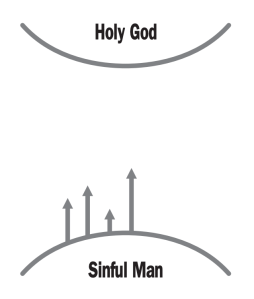
Notice the diagram to the right. God is holy and man is sinful and there’s a great chasm that separates man from God. The arrows illustrate that man continually tries to reach God through various efforts, such as religion, good works, etc. But all of these efforts ultimately fall short because God is perfectly holy, and there is no amount of good works that will enable man to achieve God’s standard of perfection.
REFLECT How does your definition of goodness compare or contrast with what the Bible says about goodness?
What is Sin?
The word “sin” is one of those churchy, religious words that many people associate with behaviors that others don’t approve of but we think is no big deal. For example, you may see nothing wrong with drinking while some “uptight, religious people” think drinking is a “sin”.
REFLECT How do you define sin? What do you think sin is?
Sin not just a list of immoral or socially unacceptable behaviors. When Romans 3:23 says that “all have sinned”, the Greek word for sin is actually an archery term.
In a competition, the archer would shoot the arrow and the goal was to hit the bullseye on the target. If the archer missed the bullseye, even if it was only by a fraction of an inch, it was considered an imperfect mark, which was called a sin.
So when the Bible says we’ve all sinned, it means that no matter how hard you’ve tried and no matter how good you think you are, you (and all people) have missed the mark of God’s standard, which is perfect holiness.
That raises the bar quite a bit doesn’t it?
Things are complicated by the fact that God is not only perfectly holy, but He’s perfectly just, and as a result, He must punish sin. He cannot just overlook it or ignore it. Sin is a violation of the very nature and character of God and His goodness, so sin must be punished.
According to Romans 6:23, the punishment, or penalty for sin is DEATH!
For the wages of sin is death, but the free gift of God is eternal life through Christ Jesus our Lord.
You might be thinking, “well we’re all going to die so what does it matter?”
Death here refers to being separated from God. So, the result of sin, or the punishment for sin is that we will experience a separation from God, FOR ETERNITY! This is literally what hell is – the complete absence of God and everything good.
POINT 3: GOD’S PROVISION
JESUS CHRIST PROVIDES THE ONLY SOLUTION TO MAN’S SIN. Through Jesus, the barriers that kept us from experiencing God’s purpose have been removed – we now have access to God and can know Him.
If everyone has sinned and God, in His justice, must punish sin, then it seems as if there is no solution to our problem. We are all seemingly doomed to punishment!
But God, in His goodness, creates a solution that only He can provide. The solution is in His son Jesus.
Christ Died for Us
Romans 5:8 says,
But God showed his great love for us by sending Christ to die for us while we were still sinners.
REFLECT If God can forgive sin, why couldn’t he just declare it to be forgiven? Why do you think Jesus had to die to pay for sin?
Why did Jesus Have to Die?
Why do you think Jesus had to die in order to pay for sin?
Jesus had to die to pay for sin because God’s justice demands that the only valid payment for sin is death.
For the wages of sin is death…Romans 6:23
Jesus died in our place, thus paying the penalty that God’s justice demanded (death) but doing it in a way that allows humankind to avoid the penalty.
The reason that Jesus could do this is because He is God. As God, He has the very righteousness that God requires for those who wish to come into His presence. Through Jesus’ death, we can be forgiven for our sins and not only avoid the penalty for sin, but experience a relationship with God!
Colossians 1:13, 14 says,
For he has rescued us from the one who rules in the kingdom of darkness, and he has brought us into the Kingdom of his dear Son. God has purchased our freedom with his blood and has forgiven all our sins.
Christ Rose from the Dead
Not only did Jesus die for us, but the Bible says that He rose from the dead.
1 Corinthians 15:3-6 states:
For what I received I passed on to you as of first importance: that Christ died for our sins according to the Scriptures, that he was buried, that he was raised on the third day according to the Scriptures, and that he appeared to Peter, and then to the Twelve. After that, he appeared to more than five hundred of the brothers at the same time,
REFLECT If Jesus had never risen from the dead, would it make any difference? What do you think is the significance of the resurrection?
Read this article, He is Risen….Why Does it Matter? to understand the significance of the resurrection to the Christian message.
Jesus is the Only Way to God
In John 14: 6, Jesus says:
“I am the way and the truth and the life. No one comes to the Father except through me.”
Notice that He doesn’t say, “I’m one of the ways, I’m one of the truths, I’m one of the lives. There are lots of ways to get to the Father, but I’m a pretty good way, so check me out, I’m cool!”
NO!
He says, “I am the way, the truth, and the life; no one comes to the Father, but through Me.”
He could say this because He is the only one who has made a valid payment for sin. Hence, only Jesus can take away our sin.
The image above demonstrates that God realized that man could not bridge the gap that separated them because of man’s sin. The distance is too wide. If you think about it, God is infinitely holy so the gap between His holiness and man’s is an INFINITE gap!
Because we could not bridge the gap ourselves, God bridged the gap for us. He sent His son Jesus, who is INFINITELY holy and righteous. Jesus’ death bridges the gap and creates a path for people to come into God’s presence and experience a relationship with Him.
POINT 4: OUR RESPONSE
We each must receive the free gift that Jesus offers – His death as payment for our sins. Only then can we experience His purpose, which is to KNOW Him.
Knowing this information doesn’t make a person a Christian. Even if you agree with everything that has been outlined so far, it doesn’t mean you are a Christian.
What makes a person a Christian is when they respond to the invitation of Jesus to accept Him and His death as a free gift that pays for your sin and provides complete forgiveness.
John 1:12 (NLT) says,
But to all who believed him and accepted him, he gave the right to become children of God.
If you want to become a Christian (a child of God), then you must believe in Jesus and accept Him.
REFLECT What do you think it means to accept Jesus?
We Receive Christ Through Faith
Ephesians 2:8, 9 (NIV) says,
For it is by grace you have been saved, through faith—and this not from yourselves, it is the gift of God— not by works, so that no one can boast.
Accepting Him simply means you accept the free gift that He offers of being saved by His death on the cross. It means that you acknowledge that His death alone can pay for sin and you put your trust in His death to provide forgiveness instead of trusting in your own good works to earn favor with God.
We Receive Christ by Personal Invitation
In Revelation 3:20, Jesus gives this invitation:
Here I am! I stand at the door and knock. If anyone hears my voice and opens the door, I will come in and eat with him, and he with me.
REFLECT What do you think the door represents in this verse? How do you think a person opens the door?
Opening the Door
The door represents your heart (your will). Jesus is inviting you to open yourself up and let Him in. The way you do that is simply by putting your trust in Jesus and His death to save you instead of trusting in your own perceived goodness to “earn” your way into heaven.
KEY QUESTIONS:
Have you ever opened the door of your life and let Jesus in to begin a relationship with Him?
If so, when was that? What were the circumstances that led you to make that decision?
If not, do you want to open the door of your life to Jesus and begin a relationship with Him?
The key to opening the door is to decide to put your trust in Jesus instead of trusting yourself. One way you can express your faith to God is simply telling Him that you want to accept His free gift and you want Jesus to come into your life. We call this prayer. Take a minute right now to express your faith and desire for Jesus to come into your life by repeating the following prayer:
Lord Jesus, I need you. I acknowledge that I am a sinner and there is no way I can earn my way into heaven. I want to trust in Jesus and His death to pay the penalty for my sins and provide forgiveness. I open the door of my life now and I invite Jesus to come in so that I might begin a relationship with Him and know Him. Amen.
Things to Remember…
God’s criteria for who makes it into heaven is not how good you are but whether you have the Son (Jesus).
And this is the testimony: God has given us eternal life, and this life is in his Son. He who has the Son has life; he who does not have the Son of God does not have life. (1 John 5:11-12, NIV)
You can KNOW you have eternal life, if you have the Son.
Jesus defined eternal life as knowing Him (John 17:3). Hence, you can have eternal life if you have the Son – if you have a relationship with Him.
You can have the Son (Jesus), simply by accepting Him and the free gift that He offers – His death on the cross as a payment for all of your sins.
Jesus gives an invitation to everyone. He is standing at the door of each person’s heart. He’s knocking. He wants to come into your life and begin a relationship.
But we have to open the door.
Opening the door is a matter of choosing to put our trust in Jesus instead of trusting in our own goodness. It means that we acknowledge that we have sinned and we cannot earn our way to God. We recognize that Jesus ALONE can pay for sin and we accept the free gift of His death as a payment for our sins.
When we make that decision to open the door to Jesus, we experience complete forgiveness of sin and Jesus enters our life, establishing a relationship with us.
Once we have the Son (Jesus), we have the life, which is defined by Jesus as knowing Him.
QUESTIONS FOR REFLECTION
1. Did you open the door an invite Jesus into your life?
2. Where is Jesus right now in relation to you?
3. After a person receives Christ, what do you think a person has to do in order to keep Jesus in their life? What do you think is required?
4. What questions do you have about the Christian faith?
WHAT NOW?
If you prayed that prayer to invite Jesus into your life, the Bible says that you are a new creation. You are now a child of God!
You can request some free resources and next steps by going to our Prayer Page, giving us your name and writing in the box, “I received Christ and would like to know how to begin growing in my new faith.”
We will respond to you with some resources and help to take some next steps.
1“Don’t be troubled. You trust God, now trust in me. 2There are many rooms in my Father’s home, and I am going to prepare a place for you. If this were not so, I would tell you plainly. 3When everything is ready, I will come and get you, so that you will always be with me where I am. 4And you know where I am going and how to get there.”
5“No, we don’t know, Lord,” Thomas said. “We haven’t any idea where you are going, so how can we know the way?”
6Jesus told him, “I am the way, the truth, and the life. No one can come to the Father except through me.”
(John 14:1-6, NLT)
The Daily DAVEotional
What is truth?
I think the best way of defining truth is “that which corresponds to reality.”
We live in a time and culture where many people are not too concerned with truth, especially as it relates to religious beliefs.
The predominant view regarding religion today is that of pluralism, the idea that there is no ONE right view or true religion. Most people think that whatever works best for you is good for you. If you think about it, this totally fits our postmodern culture.
Postmodernism is a reaction or a rejection to the philosophy of modernism, which is also known as naturalism. While naturalism emphasized logic and repeated observation and experience to arrive at truth (seen most notably in modern science and the scientific method), postmodernism emphasizes one’s own experience as the basis for truth.
Hence, for most people, there is not ONE truth, but there can be many truths, because truth is whatever your experience tells you it is.
Enter Jesus in John 14. Jesus is interacting with his disciples shortly before he is arrested and crucified. In preparing his disciples for what they will soon encounter with his death, resurrection and ascension, he tells them that he’s going to prepare a place for them. He also tells them that they know the way to get to where he’s going.
The disciples are confused. “We don’t know where you’re going….so how could we know how to get there?”
In typical fashion, the disciples are perplexed because Jesus is talking about a spiritual reality while the disciples are thinking only about the physical reality they’re currently in.
Jesus’ response to his disciples is profound and has far-reaching implications. He says:
“I am the way, the truth, and the life. No one can come to the Father except through me.”
Jesus uses three separate terms to describe himself:
I am the way – Jesus defines himself as THE way, not “a” way. In our diverse world of religious pluralism, Jesus does not describe himself as one alternative path among many. Jesus is not an option that suits some people while Buddha, Mohammad or Confucius might be more preferable for others. Jesus is not a preference. Jesus is THE option.
I am the truth – Jesus says that he is THE truth. If truth is that which corresponds to reality, then Jesus is saying that he is the ultimate reality. His life and His words accurately depict what is real. What this means is that Jesus’ words are not mere suggestions to consider. Instead, they are the basis of reality for everyone, not just those people who prefer Jesus over some other religious leader or humanistic ideology.
I am the life – Jesus also describes himself as THE LIFE. Jesus is not just a way to experience a better life as if he is a self-help guru. He is the source of all life itself. John says this about Jesus in the introductory words of his gospel:
He created everything there is. Nothing exists that he didn’t make. 4Life itself was in him, and this life gives light to everyone. (John 1:3-4, NLT)
Perhaps you have heard the analogy that getting to God is like a trek to the top of a mountain. While God is at the top, there are many routes that one might traverse in order to get to the top and reach God.
This analogy adequately illustrates what many believe today. God is whatever or however you might define him and your path to getting to him is whatever path you might choose to take.
Jesus stands in stark contrast to this way of thinking. God is not whatever or whomever you might want him to be. Making God out to be whoever you might prefer him to be is what the Bible calls idol worship and it’s an egregious sin. Israel’s engagement in idol worship is a main theme in the Old Testament and was the primary reason for their punishment and exile at the hands of foregien powers. (See my blog posts “Are You an Idol Worshiper” and “A Discourse on the Foolishness of Idols”).
Jesus says that if you want to get to God the Father, you MUST go through Him. Contrary to what our modern day religious pluralism says, Jesus IS the only way. Jesus can make that claim because He’s the only one who has made a valid payment for sin. No other religious leader or ideology even offers a solution to the problem of sin before a holy God. Jesus is the only one who does, and therefore, His claims are exclusive.
Christianity does not fit well in today’s religious pluralistic culture because it makes exclusive claims about God and salvation. Jesus himself claimed to be the ONLY way to God and this view was supported by his disciples and the New Testament writings (see my blog post “Is Christianity an Exclusive Religion?“)
We live in a pluralistic society and as a result, we’re tolerant of others and their views and beliefs. However, tolerance is not truth. Tolerance says that we respect the rights of others to hold views and beliefs that are different than ours. It doesn’t mean that we agree that their views are right. Truth is that which corresponds to reality. Jesus is truth. His words are truth. He is the only one who has paid the price for sin and therefore, He indeed is the only way to get to God.
Reflection
How would you define truth?
What is your response to those who say all religions are basically the same? How would you go about distinguishing Christianity from other religions and ideologies?
How do you respond to those who object to Christianity’s exclusive claims?
Do you think that Christianity is intolerant because it teaches that there is only ONE way to reach God? Why or why not? How do you define tolerance?
10But although the world was made through him, the world didn’t recognize him when he came. 11Even in his own land and among his own people, he was not accepted. 12But to all who believed him and accepted him, he gave the right to become children of God. 13They are reborn! This is not a physical birth resulting from human passion or plan—this rebirth comes from God. (John 1:10-13, NLT)
The Daily DAVEotional
I’ve been a Christian for a long time and ever since I can remember, I was told that becoming a Christian, or getting “saved” was simply a matter of “accepting” Jesus into your heart.
Not too long ago, I saw the above photo from one of my Facebook friends who regularly shows up in my feed. I respect Voddie Baucham as a teacher so I was curious about the context of the quote that seems to indicate that the idea of “accepting Jesus” is unbiblical.
Is it true that the New Testament nowhere mentions salvation being about “accepting Jesus”?
I think the short answer to that is NO.
John 1:12 is the most clear verse that would challenge that assertion as John states:
But to all who believed him and accepted him, he gave the right to become children of God. [emphasis added]
Now to be fair, my Scripture reference is from the New Living Translation (NLT) which is the only translation I’m aware of that uses the phrase “accepted him.” Most other translations, including the NIV, King James, NASB, ESV and others, all use the phrase “received him“. So I suppose it’s possible, if you exclude the NLT, that one could argue that the Bible doesn’t say anything about “accepting Jesus” when it comes to salvation.
In my mind, though, this could be considered theological nit-picking. It seems apparent to me that the words “accept” and “receive” are synonyms. So why make the argument that salvation has nothing to do with “accepting Jesus”?
Honestly, I could not find a link to the sermon in which Dr. Baucham made the quoted statement, so it’s hard to know exactly what he’s getting at or why he felt compelled to make the statement in the first place.
The problem sometimes with sound-bite quotes is that you don’t always get the context and so the quote can appear to be saying something entirely different than what the author was really intending to communicate.
I can say, however, that in my many years of ministry, this is not the first time I have heard someone make a statement like this. So I’ll address the statement as I’ve heard it shared from others, not necessarily from Dr. Baucham’s perspective, which, as I’ve stated, I was not able to clearly determine.
In my experience, the argument that salvation is not about just “accepting Jesus” is often made by those who are seeking to address the problem of spiritual mediocrity within the church.
An overwhelming number of people claim to be Christians and yet, as we look around at the landscape of our culture, it’s hard to imagine that there are really that many people who legitimately ARE Christians. In other words, the lifestyles of most people do not seem to indicate that most people are indeed Christians.
So what is the problem?
Some people would argue that a major problem is in our evangelistic message – that we are not calling people to repentance but instead, we’re peddling a soft message that requires little to no commitment. Note that Dr. Baucham’s quote appeals to the need to “repent and believe.”
The argument is that if we tell people that salvation is simply a matter of “accepting Jesus” into their life, we’re giving them the impression that being saved is merely a verbal transaction where, if we say the right words, and “ask Jesus into our hearts”, we can escape the punishment of hell and then go on our merry way doing whatever we were doing.
This kind of approach, the argument goes, lacks commitment and ultimately is not transformational. Instead of producing mature believers whose lives reflect Jesus, it produces worldly people who think of themselves as Christians simply because they said “the sinner’s prayer.”
The oft-suggested solution to this perceived problem is to refrain from telling people that salvation is about “accepting Jesus” and instead, communicate that it’s about a higher level of commitment that requires repentance.
As I see it, there are two problems with this solution.
The first problem is that the idea of “accepting Jesus” logically includes the idea of repentance.
Repentance literally means to turn and change direction. One cannot legitimately accept Jesus while maintaining the view that they can earn their salvation through their own good works.
Accepting Jesus is NOT just saying some prescribed prayer. It requires an attitude of humility that recognizes we fall short because of our sin and that Jesus is the ONLY one who can offer forgiveness through His shed blood on the cross.
Accepting Jesus, or receiving Christ, means that we accept the free gift of salvation that Jesus offers to all people. How do we do this? Ephesians 2:8-9 says that we do this by faith.
What that means is that I literally change direction (repentance). Instead of my former course where I trusted in my own good works to earn God’s favor, I now choose a new course, where I place my trust in Jesus alone to provide forgiveness and to save me from the penalty of my sins.
There’s a second problem with the solution of saying we should refrain from saying that salvation is about “accepting Jesus”. The second problem is that even if we were to stop talking about “accepting Jesus” and even if we were to convince everyone to use the different language of “repent and believe” in our evangelistic presentations, there is no reason to believe that the outcome would be any different than it already is.
The reason for this is because spiritual mediocrity in the church is largely a reflection of the hearts of people rather than the specific wording of the evangelistic messages that are being promoted. Mark 4 tells us that there are 4 different soils that represent the different heart attitudes of people who hear the message of the gospel. (See my blog post: Which Soil Are You?)
Sharing a message of “Repent and Believe” to a person who has a hard heart, rocky heart or thorny heart is likely to yield the same result as sharing a message of “Accept Jesus”. Regardless of the specific verbiage of your message, the outcome will be the same, because it is already determined by the heart condition of the hearer.
Please note that I’m not saying that our evangelistic message and approach doesn’t matter. Our message should be biblically correct. However, the idea that one biblical approach will produce better results than another, equally biblical approach is wishful thinking and places too much emphasis on the sower for the results.
There is no silver bullet message or approach that will guarantee the hearer will become a fruitful Christian.
In addition, since we know that spiritual mediocrity among professing believers has been a problem since the outset of the church, it stands to reason that it’s an issue of discipleship more than evangelism. The issue was addressed repeatedly in the New Testament and has been a source of controversy for 2000 years. We’re not likely to see a change in this phenomenon, though we should certainly do our best to disciple believers to maturity, just as the apostles did.
The most important thing we can do when communicating with a non-Christian is to give a clear and understandable explanation of what Jesus is offering. (See my blog post: What Does it Look Like to Follow Jesus?)
I think it’s clear that linking salvation to the idea of “accepting Jesus” is not unbiblical, as long as we help the hearer understand that accepting Jesus involves repenting of our sins and believing in Jesus as our one and only Savior.
Reflection
What has been your understanding of the idea that people must “accept Jesus” in order to be saved? What are they accepting?
What do you think are the main reasons why some Christians don’t grow? How should we change our evangelistic approach to ensure greater fruitfulness among believers?
Do you agree with the statement by the author of this blog that mediocrity among professing Christians is more a result of discipleship than evangelism? What are your reasons for agreeing or disagreeing?
How can we disciple others to greater levels of maturity and fruitfulness? What steps can be taken? What resources do you think are needed?
23For all have sinned; all fall short of God’s glorious standard.
(Romans 3:23, NLT)
The Daily DAVEotional
Back in the day there was a popular song by Linda Ronstadt with a chorus that said, “you’re no good, you’re no good, you’re no good, baby, you’re no good”! (see Ronstadt YouTube video here)
It’s doubtful that Ronstadt (or whoever actually wrote the song) had Romans 3 in mind when they penned the words, but this chorus is actually the sentiment of Paul’s message in Romans 3.
Paul has spent the first 2 chapters of Romans outlining how the pagan, the moral person and even the religious person are all sinful and therefore under God’s judgment.
In this chapter, Paul finalizes his argument that all people are no good. It’s doubtful that he could bust out the lyrics as soulfully as Ronstadt but Paul’s message is essentially, “you’re no good, you’re no good, you’re no good….baby you’re no good.”
Perhaps you disagree with this assessment. After all, a lot of people think that people are basically good. And many would argue that at least SOME people are good. So how can Paul say ALL people are NO GOOD?
It all comes down to how you define good. We (people) tend to define good in relative standards that make us look good and feel good about ourselves.
For example, if Hitler is the standard of bad, then I feel good about myself because I’m reasonably confident that I’m a better person than Hitler.
And that’s the problem. Everybody is using a different standard of goodness and each person’s standard tends to be derived in such a way that they themselves end up on the good end of the spectrum.
Is this not blatantly obvious? How many people would actually say they are no good? Very few, in my experience. Even the most hardened criminal is likely to point to someone whom they believe to be a worse person than they are as their comparison for measuring and evaluating goodness.
But God’s standard of goodness is different than ours. God doesn’t use Hitler or Stalin or any other authoritarian tyrant as the standard for what is good. God uses HIMSELF as the standard of goodness.
With God as the standard of goodness, we can see that being good requires us to be as good as God is, which is impossible. This is why Paul says in verse 23 that “all fall short of God’s glorious standard” and it explains how Paul can say that ALL are NO GOOD!
Reflection
What has been your standard for measuring goodness?
How does your definition of goodness compare or contrast with what the Bible says about goodness?
O God of vengeance, let your glorious justice be seen!
2Arise, O judge of the earth.
Sentence the proud to the penalties they deserve.
3How long, O LORD?
How long will the wicked be allowed to gloat?
4Hear their arrogance!
How these evildoers boast!
5They oppress your people, LORD,
hurting those you love.
6They kill widows and foreigners
and murder orphans.
7“The LORD isn’t looking,” they say,
“and besides, the God of Israel doesn’t care.”
8Think again, you fools!
When will you finally catch on?
9Is the one who made your ears deaf?
Is the one who formed your eyes blind?
10He punishes the nations—won’t he also punish you?
He knows everything—doesn’t he also know what you are doing?
11The LORD knows people’s thoughts,
that they are worthless!
12Happy are those whom you discipline, LORD,
and those whom you teach from your law.
13You give them relief from troubled times
until a pit is dug for the wicked.
14The LORD will not reject his people;
he will not abandon his own special possession.
15Judgment will come again for the righteous,
and those who are upright will have a reward.
16Who will protect me from the wicked?
Who will stand up for me against evildoers?
17Unless the LORD had helped me,
I would soon have died.
18I cried out, “I’m slipping!”
and your unfailing love, O LORD, supported me.
19When doubts filled my mind,
your comfort gave me renewed hope and cheer.
20Can unjust leaders claim that God is on their side—
leaders who permit injustice by their laws?
21They attack the righteous
and condemn the innocent to death.
22But the LORD is my fortress;
my God is a mighty rock where I can hide.
23God will make the sins of evil people fall back upon them.
He will destroy them for their sins.
The LORD our God will destroy them.
(Psalm 94:1-23, NLT)
The Daily DAVEotional
Psalm 94 is a cry and appeal to God for justice.
Apparently, there were evil people taking advantage of others and they appeared to be getting away with it.
Why is there no justice?
How long will we have to wait to see the wicked punished?
These are the questions the psalmist is asking.
Some things never change. We’re still asking those same questions today because there’s no doubt that evil still exists and that evil doers often seem to go unpunished.
There are two different ways of dealing with this perceived injustice:
The first way is to say God must not exist. This is the argument the atheist makes and it’s highlighted in verse 7:
7“The LORD isn’t looking,” they say,
“and besides, the God of Israel doesn’t care.”
The atheist uses the reality of evil as a primary argument against the existence of God. I wrote about this in my blog post “Does the Existence of Evil Disprove God” based on Psalm 75.
The atheist’s line of reasoning goes something like this:
If God exists, He would care about evil and He would do something about it (presumably, He would eliminate it). Since evil still exists, either God doesn’t care OR He’s unaware of it. Either way, God must not exist.
Verse 7 focuses on the premise that God doesn’t care about evil or He’s unaware of it. The conclusion is that God must not exist.
The second approach to the fact that evil exists and evil doers often go unpunished is to recognize that God will deal with justice in His timing. This is the approach the psalmist takes:
He punishes the nations—won’t he also punish you? (verse 10)
Judgment will come again for the righteous. (verse 15)
God will make the sins of evil people fall back upon them. He will destroy them for their sins. The LORD our God will destroy them. (verse 23)
The psalmist is not happy that evil doers seem to go unpunished, but He does not so quickly conclude that God must not exist.
You may be saying to yourself, “this is all well and good, but what does this have to do with refuting Buddhism.”
That’s a good question. This psalm says nothing about Buddhism, which would not even come into existence as a religious ideology for another 500 years after the writer penned this psalm.
So what’s the connection?
In December of 2023, I read a post on X.com from Nancy Pearcey (@NancyRPearcey), who had made a benign post quoting a section from the book “The Rise of Christianity“ by Rodny Stark. The quoted section was highlighting how Christianity introduced a revolutionary new ethic of love that was unique amongst religious ideologies of the time.
A person replied to the post questioning the idea that Christianity came up with anything that new or revolutionary. The poster claimed that Buddhism, and other Eastern philosophies had been preaching universal love for centuries.
This sparked an exchange regarding some of the principles of Buddhism and how it fails as a religion and philosophy to adequately explain reality.
You can trace the whole exchange here (which I highly encourage), but the exchange connects with Psalm 94 in this way:
Pearcey was explaining that Buddhism, like any religion or philosophy, has to be evaluated on its ability to adequately explain reality.
The point was made that in Buddhism, ultimate reality is not a personal being but an impersonal essence or force. Because WE are personal beings, Buddhism has no way of adequately accounting for where humans came from.
This psalm actually refutes Buddhism in verse 9, which says:
Is the one who made your ears deaf? Is the one who formed your eyes blind?
The principle is that the creator must have the same capabilities as that which is created. How could something that could not hear or see create something with ears to hear and eyes to see?
Since we are personal beings, whoever, or whatever created us must also be personal. Since Buddhism does not teach or believe in a personal creator, it cannot adequately explain our existence. In the Buddhist system, an impersonal force or essence somehow produces humanity – personal beings. This defies logic.
The psalmist has no knowledge of Buddhism, which would not exist for another 500 years. But the psalmist is aware of the skeptics’ argument that denies God. He calls the skeptic a fool (verse 8) and offers up the simple apologetic proof for God’s existence in verse 9.
This one-verse proof demonstrates that God must be personal. And since Buddhism denies a personal creator, Psalm 94:9 actually refutes Buddhism.
Reflection
When thinking about the fact that evil exists and evil doers do not always face timely justice, which of the two approaches are you most likely to take – to deny God’s existence, or realize that justice will eventually come in God’s timing? Explain your choice.
What convinces you most that God exists?
How do you explain the existence of evil to those who are skeptical about the existence of God?
What is your reaction to Psalm 94:9 and the apologetic argument that because WE are personal beings, God must also be personal because the created thing cannot be greater than that which created it? Is this argument convincing to you? Why or why not?
11And this is what God has testified: He has given us eternal life, and this life is in his Son. 12So whoever has God’s Son has life; whoever does not have his Son does not have life.
13I write this to you who believe in the Son of God, so that you may know you have eternal life. (1 John 5:11-13, NLT)
The Daily DAVEotional
When I was in college, on the last day of instruction for every class I ever took, someone would ask the professor what was going to be on the final exam.
It makes sense. Everyone wants to know what is going to be tested so they can adequately prepare for the test. Can you imagine not having any idea how the instructor was going to evaluate your knowledge and progress?
Nobody studies for a test by just guessing what will be covered on the exam and how they will be evaluated. It’s actually quite foolish.
And yet, this is exactly how many people approach life.
According to Pew Research in December 2023, over 70% of Americans believe in an afterlife, while over 60% of Americans believe in hell.
How exactly though does one determine whether they will go to heaven or hell?
In my many years of ministry, I have engaged with thousands of people regarding issues of spirituality and the afterlife. When asking people the question of whether they think they will go to heaven when they die, I found that most people think they will make it. But when asked the follow-up question of how God decides who makes it into heaven and who doesn’t, most people aren’t quite sure.
It’s interesting to me that most people aren’t sure how God decides who makes it into heaven, but they’re fairly certain that they will make it to heaven.
This is because people overwhelmingly believe that getting into heaven is a matter of being a good person and most people think of themselves as good.
But is this how God evaluates a person’s eternal destination – their goodness? And if so, what is the threshold of “good” that is needed? What kind of goodness score must one get in order to pass the test and make it into heaven? How would a person even evaluate their own level of goodness?
You would never study for a final without knowing what is going to be on the test and how your grade is going to be tabulated, but concerning one’s eternal destiny, which is a far more important outcome than your grade in a class, many people simply guess and make assumptions about how God evaluates them.
Fortunately for us, we don’t have to guess how God evaluates eligibility to enter heaven. He doesn’t make us wonder what His standards are. Here in 1 John 5, He tells us quite explicitly how He decides. In fact, we’re told that we can KNOW for certain whether we have eternal life or not.
What is the standard? It’s not what most people think. It’s not goodness, which is really just a subjective spectrum that most people have erected in such a way that no matter what bad things they have done, they think of themselves as good.
According to this passage, eternal life is based on the Son, Jesus. Those who have Jesus have eternal life. Those who do NOT have Jesus don’t have eternal life.
This standard is actually a lot easier to evaluate than some subjective idea of goodness. You either have the Son or you don’t. If you have the Son, John tells us that you can KNOW that you have eternal life. You can be 100% certain.
But if you don’t have the Son, you can be 100% certain that you don’t have eternal life.
The question for us then is how do we get the Son? Stay tuned.
Reflection
Do you believe there is an afterlife? What does the afterlife look like? What is the source of your information about the afterlife?
How do you define goodness? What makes a person “good”? How do you think God defines goodness? How good do you think a person needs to be to make it into heaven and live with God for eternity?
If you were to die tonight, how sure are you (on a scale of 0-100%) that you would make it into heaven and live with God for eternity? How would you rate your chances?
This passage says that eternal life is based on the Son, Jesus. How do you think a person can “have” the Son? What do you think is involved in getting the Son and having eternal life?
9What do people really get for all their hard work? 10I have thought about this in connection with the various kinds of work God has given people to do. 11God has made everything beautiful for its own time. He has planted eternity in the human heart, but even so, people cannot see the whole scope of God’s work from beginning to end. 12So I concluded that there is nothing better for people than to be happy and to enjoy themselves as long as they can. 13And people should eat and drink and enjoy the fruits of their labor, for these are gifts from God. (Ecclesiastes 3:9-13, NLT)
The Daily DAVEotional
In Ecclesiastes 3, Solomon contemplates the meaning and purpose of work by asking the question, “what do people really get for all their hard work?”
Solomon’s answer is interesting as he states that “people cannot see the whole scope of God’s work from beginning to end.”
Basically, people are too limited in their comprehension and their perspective to fully know and understand God and His purposes.
But in his response, Solomon uses an interesting phrase to make his point about meaning and purpose. He says that God “has planted eternity in the human heart,..”
What exactly does that mean?
I think it means that God has placed within people this innate understanding that we are eternal beings and that we have been created with purpose and meaning.
Think about it. Just the fact that Solomon is able to contemplate the purpose and meaning of work, as all humans are, is something that sets us apart from animals. We may not completely understand everything around us, like the purpose and meaning of our work, but we DO understand that there is something that sets us apart and gives us meaning and value.
Don Richardson, a famous missionary and author, takes this phrase even deeper. In his book “Eternity in their Hearts”, Richardson argues that within every people group and culture, God has placed a redemptive analogy that will enable them to understand and accept the gospel more readily.
In the book, he supports his premise with many stories of how the gospel has been communicated to various peoples and tribes.
In one story, he tells about the Sawi tribe of Indonesia. They were one of only a few tribes globally that practiced both head-hunting and cannibalism.
When they were approached by missionaries and the gospel story was communicated to them, there was a very unexpected response. The Sawi actually thought that Judas was the hero.
This was because the Sawi admired the characteristic of treachery. They would often deceive people into a friendship all the while they were only fattening their future victims.
The Sawi had an interesting tradition, however, to avoid acts of treachery from being performed on them. A Sawi chief would offer his child to another chief as a “peace child.” Acts of war and aggression would be avoided in the future because to attack that tribe might result in the death of your own son.
When the missionaries learned of this tradition, they had their redemptive analogy in hand. They then re-explained the gospel message, presenting Jesus as the ultimate Peace Child. This time, the Sawi understood and they did not look at Judas as the hero, for to betray a Peace Child was considered the ultimate offense.
With this new understanding of Jesus, it wasn’t long before the Sawi accepted Jesus as their Peace Child.
So what does it mean that God has placed eternity in the human heart? At minimum, it means that people have an inner sense that we are not finite creatures and that we have been created by someone greater than us for a greater purpose.
This inner “understanding” means that the gospel message can be explained and understood by people around the world in a way that uniquely helps them understand the person and nature of Jesus as their Creator and Savior.
Did you enjoy this post? I’d love to hear your thoughts! Feel free to like, leave a comment below, and share it with your friends or on social media if you found it helpful or interesting. Your support keeps the conversation going!
Reflection
What do you think it means that God has placed eternity in the human heart?
Author Don Richardson contends that God has placed a redemptive analogy within each people group to make the gospel more readily understandable and acceptable to them. Do you agree with Richardson’s assertion? Why or why not? How do you think this view lines up with other Biblical passages?
How would you answer Solomon’s initial question – what do people really get for all their hard work? What do you think is the purpose of work?
Solomon says that even though God has placed eternity with the human heart, “people cannot see the whole scope of God’s work from beginning to end.” What do you think he means by this statement? How would you explain its meaning to someone else?
50 years ago TODAY (June 9, 1974), I went forward in response to an altar call at the end of the Sunday morning service of Beaty Avenue Baptist Church in Whittier, California. After attending church for 6 months with my family, I responded to the pastor’s invitation for anyone to come forward if they wanted to respond to Jesus’ free gift of salvation.
As a kid, it was one of the scariest things I ever did, as I could feel all eyes staring at me as I made the trek out of the pew, into the outer aisle and toward the front of the church sanctuary. I slowly walked to the front while everyone was still singing what was commonly known as “the hymn of invitation.”.
When I arrived at the front, I was greeted by an older gentleman who escorted me into a private room in the back where he shared this little gold booklet with me called “the Four Spiritual Laws.” Little did I know that years later, I would end up sharing that same booklet with thousands of people as a missionary.
I recognized that I was a sinner and that Jesus had died on a cross to pay the penalty that I deserved for sin. I invited Jesus to come into my life, forgive me for every wrong thing I ever did or ever would do and begin the spiritual journey for which I had been created – to KNOW Him.
That evening, at the Sunday evening service (yes, old time baptist churches often had Sunday evening services, as well as mid-week Wednesday night services), I was baptized, along with my two brothers.
I remember that day because it was the same weekend as my mother’s birthday, which was yesterday. She would be 84 years old if she were still alive.
We only attended that church for about a year before moving to another church. That old Beaty Avenue Baptist church building is still there, though it is home to a different church.
Here is a photo of myself from that time frame. I have very few photos of me growing up as most of my childhood photos were destroyed in a house fire in 2000. This photo was taken about a year before the events I describe above.
Photo taken at what used to be known as East Norwalk Little League off Shoemaker in Norwalk, CA. According to current Norwalk Little League website, this field is the Zimmerman Field that is part of current Norwalk Little League.
Also included is a Google street view photo of the church that used to be known as Beaty Avenue Baptist Church.
Google Street view of church building that at one time was Beaty Ave. Baptist Church in South Whitter, CA
I don’t remember the name of the person who shared with me in that back room, though somewhere in a box at my house, I have that very booklet with a phone number written on the back.
I’m grateful for the many people who played a role in me making a decision on that day, including my parents, Sunday school teachers, the pastor of that Beaty Avenue Baptist church and the gentleman who shared the gospel message with me in that private room.
Life changed on that day in June of 1974. Real life actually began on that day!



 The Bible says that only God is truly good. What this means is that God’s standard for goodness is perfect holiness and by this standard, He is the only one who is truly good.








 The Lowedown